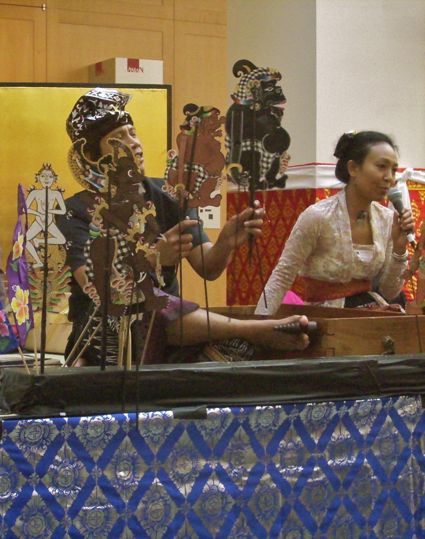
Story from the Ramayana

We went in to the Bali exhibit at the Asian Art Museum this afternoon, and saw a demonstration of Balinese puppets. The puppeteer enacted a short bit of the Ramayana, weaving in sly references to San Francisco. It was entertaining, funny, beautiful, skillfully done; and the puppeteer slipped in a serious moral message at the end. It was really a quite brilliant mix of religion, entertainment, and the lively arts.

“The day that changed the world”

With the tenth anniversary of the attacks of September 11, 2001, coming up, it made sense that the exercise for our monthly writing group at church would be on some related topic. But of course not everyone was affected by the September 11 attacks in the same way, and for some people other events had a bigger impact on their lives than did the September 11th attacks. So the writing exercise for the month was to write something about the day that changed the world — as in, the day that changed the world for you, the day that changed your world.

To start us off, I read a passage about Pearl Harbor day from Desert Exile: The Uprooting of a Japanese American Family by Yoshiko Uchida (Seattle: University of Washington, 1982, 2000):

It was one of those rare Sunday when we had no guests for dinner. My parents, sister, and I had just come home from church and were having a quiet lunch when we heard a frenzied voice on the radio break in on the program. The Japanese had attacked Pearl harbor.

“Oh no,” Mama cried out. “It can’t be true.”

“Of course not,” Papa reassured her. “And if it is, it’s only the work of a fanatic.”

We all agreed with him. Of course it could only be an aberrant act of some crazy irresponsible fool. It never for a moment occurred to any of us that this meant war. As a matter of fact I was more concerned with my approaching finals at the university [of California at Berkeley] than I was with this bizarre news and went to the library to study. When I got there, I found clusters of Nisei students anxiously discussing the shocking event. But we all agreed it was only a freak incident and turned our attention to our books. I stayed at the library until 5:00 p.m. giving no further thought to the attack on Pearl Harbor.

When I got home, the house was filled with an uneasy quiet. A strange man sat in our living room and my father was gone. The FBI had come to pick him up, as they had dozens of other Japanese men. Executives of Japanese business firms, shipping lines, and banks, men active in local Japanese associations, teachers of Japanese language schools, virtually every leader of the Japanese American community along the West Coast had been seized almost immediately.

Actually the FBI had come to our house twice, once in the absence of my parents and sister who, still not realizing the serious nature of the attack, had gone out to visit friends. Their absence, I suppose, had been cause for suspicion and the FBI or police had broken in to search our house without a warrant. On returning, my father, believing that we had been burglarized, immediately called the police. Two policemen appeared promptly with three FBI men and suggested that my father check to see if his valuables were missing. They were, of course, undisturbed, but their location was thereby revealed. Two of the FBI men requested that my father accompany them “for a short while” to be questioned, and my father went willingly. The other FBI man remained with my mother and sister to intercept all phone calls and to inform anyone who called that they were indisposed.

One policeman stationed himself at the front door and the other at the rear. When two of our white friends came to see how we were, they were not permitted to enter or speak to my mother and sister, who, for all practical purposes, were prisoners in our home.

By the time I came home, only one FBI man remained but I was alarmed at the startling turn of events during my absence. In spite of her own anxiety, Mama in her usual thoughtful way was serving tea to the FBI agent. He tried to be friendly and courteous, reassuring me that my father would return safely in due time. But I couldn’t share my mother’s gracious attitude toward him. Papa was gone, and his abrupt custody into the hands of the FBI seemed an ominous portent of worse things to come I had no inclination to have tea with one of its agents, and went abruptly to my room, slamming the door shut. [pp. 46-47]

Then each of us talked about the day that changed our worlds. I and one or two others spoke about our experiences on September 11, 2001; someone else spoke about Pearl Harbor Day; another about the Kennedy assassination; still another about a personal experience that was life-changing, even life-shattering. For each of us, it was the intersection of an exterior and catastrophic event, combined with a life-altering personal experience, that led to a “day the changed the world.” And then we spent an hour writing about our “day that changed the world.”

The varied experiences of our writing group made me curious about how other people define the “day that changed the world. So here’s a question for you, the reader of this blog: What was your “day that changed the world”? Was it 9/11, or Pearl Harbor Day, or JFK’s assassination, or MLK’s assassination — or something else? What happened on that day — both the world events, and your own personal events?

The DIY chronicles: Fortified Altoids

Once upon a time, Altoids brand peppermints were strong. That ended when the brand was bought by Wrigley. In 2006, Wrigley closed the old Altoid manufacturing plant in Wales, and began producing the candy in the United States. They first adulterated it with artificial flavor; when they removed the artificial flavor, they reduced the amount of peppermint oil until Altoids tasted bland and boring. So I stopped buying Altoids.

But I still miss the old Altoids: when you were preaching (or singing) for an extended period and needed to soothe your throat, the old Altoids had enough peppermint to do the trick. So I decided to try an experiment: I would buy some Altoids and add peppermint extract to them to try to recreate the old strong peppermint flavor.

I purchased a tin of Altoids for 2.99, and a one ounce bottle of peppermint extract (alcohol 89%, peppermint oil, and water) for 5.99. Altoids have a rough side and a smooth side, and I found the rough side absorbs peppermint extract more easily, so I laid out the Altoids rough side up on a dinner plate. I then dropped peppermint extract on them one drop at a time, starting at one side of the plate and working across to the other side, allowing each drop to soak in before starting the process again. After about seven or eight drops, each mint looked like it had absorbed about all it could hold. I turned them over, and added additional drops to those mints which still looked dry. Then I let them dry.

When I was done, Carol and I each tried one. Carol said: “Not as strong as the old Altoids.” I agreed. She crunched hers up, and then said, “But you can feel it in the back of your throat.” And she was right.

Verdict: The fortified Altoids were much better than un-fortified Altoids, but still not as good as the old ones.
Total cost: 2.99 + 1.50 (a quarter of a bottle or peppermint extract) = $4.49; plus 15 minutes. Probably not worth it.
Next steps: Try essential oil of peppermint instead of peppermint extract.

In the museum of modern art

There were hordes of people in the San Francisco Museum of Modern Art. Not only is it a holiday weekend, but the show on the art collections of Gertrude Stein and her siblings closes on Tuesday. In a couple of the galleries of the Stein family’s paintings, it got so crowded that gallery-going felt like a contact sport. I took this photo in the lobby near the elevators.

An incident unrelated to the photograph:

A young woman stood by the elevator doors checking tickets: “Tickets please. Tickets? Thank you. Tickets please.” A white man in his sixties brushed by her and went to squeeze in the elevator. “Ticket, sir?” she said, politely but firmly. He exploded at her, and I thought he was a street crazy: talking loudly and incoherently, he gesticulated at her and made it clear that he was going to go up without showing her a ticker. She took a step back, and held up her radio. “I’m going to call security, sir.” He calmed down quite a bit at that. “If I knew where my ticket was,” he spluttered, “I’d — I left it — it’s with my credit card, and I left my credit card….” His voice dropped down to a normal volume. The elevator went up without him, as he apparently explained to the woman checking tickets what he was doing. Next time I looked over, he was getting on the elevator, and she was talking into her radio. A few minutes later, a man in a plaid shirt stood next to her, and she was telling him what had happened. I heard her saying: “All I did was ask if he had his ticket.”

N.B.: The only adjustments I made on the photograph were to adjust the exposure, and to reduce pixel noise.

This is what you get when you raise your kids in a UU church

As a religious educator, when I watch kids grow up as Unitarian Universalists, I hope that when they become adults they will be thoughtful and critical of the world around them, they will value the arts, and they will have a sense of humor. Like this:

“A Song.” Written and performed by Eli Grober.

(Click through and leave your comments for Eli on YouTube.)

The choice for president in 2012

The presidential election campaign has already begun. Have you noticed? Mr. Crankypants has noticed. The Iowa straw polls — that’s where presidential hopefuls stuff scarecrows with straw and party hacks judge them on how scary they are (where “they” may refer to scarecrows, presidential hopefuls, or party hacks) — have already happened. New Hampshire is already trying to boost tourism in the state by creating a presidential-hopefuls petting zoo. And the presidential hopefuls are praying in public and raising the Christian banner, while at the same time refusing to join a church (Obama) or refusing to tithe (Rick Perry, Michele Bachman, and many others).

But as far as Mr. Crankypants is concerned, both major political parties are not worth endorsing. They are boring. Their candidates speak badly in public. Their candidates exhibit depressingly few signs of psychopathology. Therefore, just as in the last election, Mr. Crankypants will be endorsing a third party candidate: Cthulhu of the Great Old Ones Party.

The Great Old Ones Party has a refreshing party slogan: “Ph’nglui mglw’nafh Cthulhu R’lyeh wgah’nagl fhtagn,” which is translated as “In his house at R’lyeh sleeping Cthulhu waits dreaming” — dreaming of how he will devour all humanity once he gets in office. The Great Old Ones Party has a refreshing economic proposal: after vigintillions of years, great Cthulhu will be set loose on the world, ravening with delight; this will put an end to economic woes by putting an end to the economy. And finally, the Great Old Ones Party has a refreshing proposal for ending the gridlock between Congress and the White House: Cthulhu will eat everyone in the House and Senate.

Now you may say that the Great Old Ones Party seems indistinguishable from the Republican and Democratic Parties. But Cthulhu is different. Where the Republicans merely claim they will make government smaller, Cthulhu will actually eat elected representatives, as well as ever federal employee he can grab with his writhing tentacles, thus literally making government smaller. Where the Democrats merely claim that they will tame Wall Street and Big Business, Cthulhu will actually do so, by eating bankers, billionaires, and plutocrats alive. And unlike the Republicans and Democrats, there is no hypocrisy about Cthulhu: he is evil, he admits it, and he glories in it.

Mr. Crankypants is sure you’ll agree. Support Cthulhu! Vote the Great Old Ones Party ticket in the 2012 election!

Reading notes

From the essay “It’s about Faith in Our Future: Star Trek Fandom as Cultural Religion” by Michael Jindra:

Most Americans think of “religion” as a system of private, conscious, and articulated beliefs, usually expressed in churches and formal creeds, and set off from the other “spheres” of life such as work, politics, or leisure. This view of religion, however, stems from the specifically Western process of societal “differentiation,” in which institutional religion was given a specific function. After the medieval era, when religious practice was intimately connected to everyday life, the practice of Christianity became “abstracted,” or disconnected from everyday life. As a result, we now tend to regard “religion” as something connected to institutions such as churches and denominations. Alternatively, we view it as something personal and private, a psychological aid that is only peripherally connected to a person’s life.

This view of religion severely limits our understanding of it….

Religion and Popular Culture in America, ed. Bruce David Forbes and Jeffrey H. Mahan (Berkeley: University of California Press, 2000, rev. ed. 2005), p. 161.

Using a more expansive definition of religion, Jindra goes on to demonstrate how Star Trek fandom can be understood as a kind of humanist religion. He supports this in part by citing an interview with Rodenberry published in the March/April, 1991, issue of American Humanist, in which Rodenberry said he saw Star Trek as based on a humanist philosophy wherein human beings take control of their own destiny.

October2011.org?

Pallas just posted to the local minister’s email list telling us about October2011.org. At first glance, October2011.org looks like an antiwar demonstration that will take place in Washington, D.C., beginning on October 6. But unlike conventional demonstrations, they are modeling themselves after the protests of the Arab Spring. Here’s the pledge that they ask participants to sign:

I pledge that if any U.S. troops, contractors, or mercenaries remain in Afghanistan on Thursday, October 6, 2011, as that occupation goes into its 11th year, I will commit to being in Freedom Plaza in Washington, D.C., with others on that day or the days immediately following, for as long as I can, with the intention of making it our Tahrir Square, Cairo, our Madison, Wisconsin, where we will NONVIOLENTLY resist the corporate machine by occupying Freedom Plaza to demand that America’s resources be invested in human needs and environmental protection instead of war and exploitation…. [caps in original]

The focus of this demonstration will be civil disobedience. And it sounds like anyone who goes may risk arrest, based on what they say on in their FAQ:

There are important roles for those who choose not to risk arrest such as jail support, observation and other responsibilities during the occupation such as food, medical care and cleanup. That said, there are no guarantees because we cannot at this time predict the response by the DC police. Our experience in the past is that they give warnings prior to making arrests so that those who choose to do so may leave the action.

Speaking as a peacenik, I’m a little skeptical of this demonstration. Although the pledge quoted above seems to focus on an antiwar message, no Quaker or Brethren groups have yet signed on as sponsors; if this were a peace demonstration I’d expect to see at least one Quaker meeting as a sponsor. And when you read deeper in the Web site, this demonstration is not really an antiwar demonstration; peace is merely one of a list of fifteen issues. And this does not look like a broad-based coalition, but rather the usual narrow coalition of the usual leftist groups; as a leftist myself I can tell you that we are a vanishingly small segment of the U.S. population, so I’d expect a tiny turnout.

If you know more about October2011.org, I’d love to hear from you. Especially if you’re a peacenik, or have a religious perspective on this.