P. G. Wodehouse on individualism

P. G. Wodehouse, a novelist of ideas? How absurd!

And it is true that most of his dozens of novels are bits of fluff, with no more intellectual content than the brain of Bertie Wooster, one of his most famous characters. But in some of his earlier novels, Wodehouse occasionally gets philosophical — as in this passage from the 1918 novel Picadilly Jim, where Jimmy, the wealthy twenty-something protagonist, comes to the sudden and unpleasant realization that he has been pretty self-centered for much of his adult life:

“…Life had suddenly taken on a less simple aspect. Dimly, for he was not accustomed to thinking along these lines, he perceived the numbing truth that we human beings are merely as many pieces in a jig-saw puzzle, and that our every movement affects the fortunes of some other piece. Just so, faintly at first and taking shape by degrees, must the germ of a civic spirit have come to prehistoric man. We are all individualists till we wake up.” [chapter 6]

Of course, Wodehouse was writing nearly a century ago. We have progressed further in the development of civic spirit since then: the jig-saw puzzles of the wealthy and the rest of the world are no longer connected to one another. If he were alive today, Jimmy could enjoy his wealth without having ever to wake up.

Adventures in solar cooking

Yesterday in Sunday school, two groups of kids started making solar ovens. While they were working, we had solar s’mores cooking in the solar oven I made on Saturday. However, it took a long time for the solar s’mores to cook. First problem: the morning clouds didn’t begin to clear until halfway through Sunday school. Second problem: thin clouds persisted most of the morning, and even the thinnest of clouds caused the temperature to drop at least ten degrees inside the oven. We started cooking the s’mores at about 10:00, and they weren’t really done until just before noon — after most of the kids had already gone home.

The clouds finally cleared away completely, and I left the solar oven outside my office for several hours in the early afternoon. The inside temperature rose to over 200 degrees Fahrenheit (200 degrees is as high as the meat thermometer goes), with outside air temperature in the high 70s. I heated up a mug of water, to over 170 degrees, and made a nice cup of tea. While I was making tea, Fred Z., from the Green Sanctuary Committee, stopped by and suggested trying cast iron cookware in the oven — it’s dark and absorbs heat well, plus it provides a good thermal mass to even out cooking temperature.

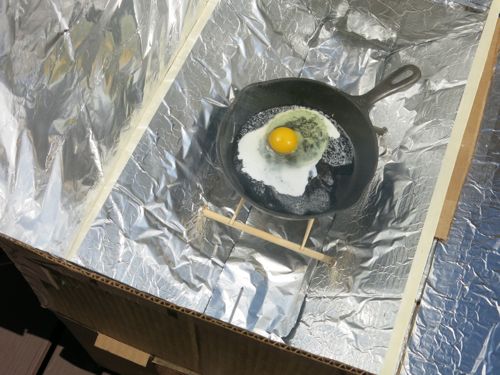
So this morning I dug out a small cast iron frying pan, and decided to try cooking a fried egg in the solar oven. The air temperature was about 65 degrees, but in spite of clear skies I couldn’t get the inside temperature over 190 degrees — which suggests I need better insulation in the oven. I cooked a fried egg, over easy:

BlogSep0814

It took about twenty minutes, and was really more of an egg baked in butter than it was a fried egg (it tasted good, though); obviously there is a lot more to be done to improve the efficiency of the oven.

Solar oven prototype

Tomorrow, the middle school ecojustice class in Sunday school is going to make solar ovens. So of course I had to make a prototype:

BlogSep0614

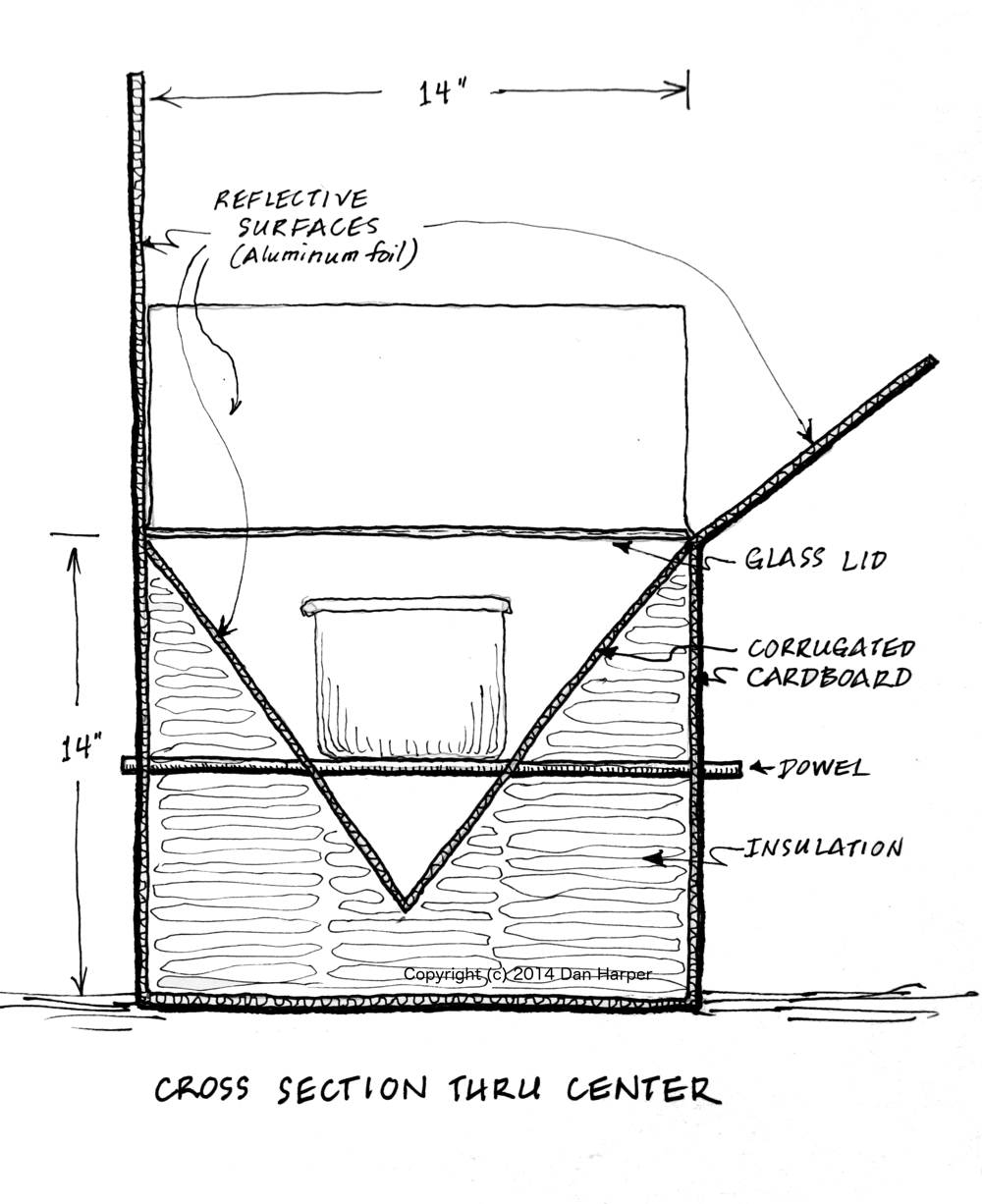
I started with a basic design made out of carboard boxes, a design that is sometimes called the “Minimum Solar Box Cooker.” But instead of just nesting one smaller box inside another box, I took the smaller box, cut out the ends, and turned it 45 degrees:

BlogSep0614a

While this reduces the amount of cooking space inside the oven, it also reduces the amount of air that has to be heated. And then, too, it’s easy to run a couple of dowels through the inner box to make a support for a cooking pot.

In preliminary tests, the oven worked reasonably well. I set the oven out at 2:45 p.m., stuck a meat thermometer in one end of the oven, and within twenty minutes, the thermometer was reading between 190 and 200 degrees F. (the thermometer only goes up to 200). At about 3:10, I put in a cup of water in a glass container. By 3:40, the water temperature was 155 degrees F., and the glass container was more like 190 degrees F. (Air temperature is 75 degrees F. this afternoon.)

Tomorrow comes the real test: we’ll set the oven out at the beginning of Sunday school and see how quickly we can make solar s’mores.

Update, one year on: This solar oven prototype proved to be only marginally effective. After using it fairly extensively, it has one big problem: when you open the lid, much of the hot air escapes; there is very little thermal mass, aside from the heated air. At the very least, I need to provide a significant thermal mass (preferably black in color, to better absorb heat). In addition, it would make sense to place the door low on one side of the oven, to minimize the loss of heated air.

A sphinx puzzle

I’ve been researching a lesson plan for an upper elementary lesson on Oedipus and the Sphinx. This research led me to a mathematical game or puzzle involving sphinxes.

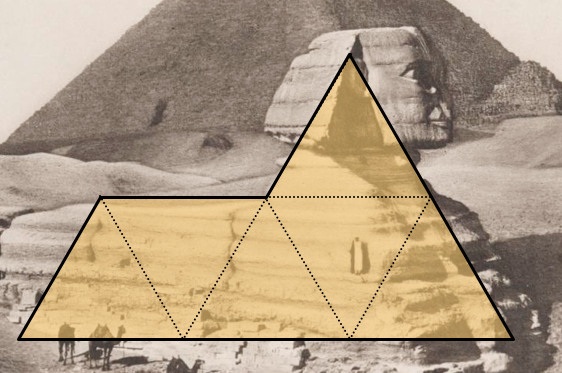
The “sphinx” of this puzzle is a five-sided figure, made up of six equilateral triangles:
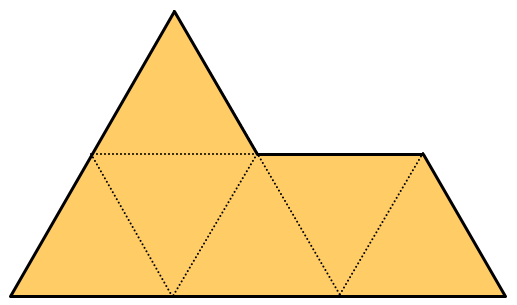
SphinxSingle

This pentagon is called a sphinx because it looks a little like the giant Egyptian Sphinx at Giza — see below. In the image below, you can see that unlike the Greek Sphinx, the Egyptian Sphinx did not have wings. However, in spite of this difference, the Greeks traced the origins of their Sphinx back to Egyptian Sphinxes.

SphinxShape

The interesting thing about the sphinx shape is that you can make larger sphinxes using smaller sphinxes (alternatively, you can dissect a larger sphinx into smaller copies of itself, though from a practical puzzle standpoint that’s difficult). Here’s how to try this out yourself. Below is a printable sheet of sphinx shapes that you can print onto heavy paper to be cut out:
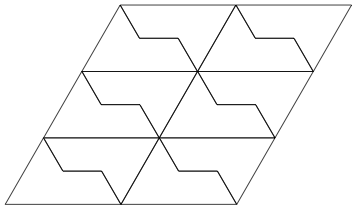
SphinxshapesPDF

Click here for a PDF of sphinx shapes for cutting out

OK, print out at least two sheets of the above PDF. Now here are several sphinx puzzles for you:

(1) Cut out 4 sphinx shapes to start, and make 1 larger sphinx shape from those 4. When you complete this puzzle, you have made a Size 2 Sphinx.

(2) Cut out a total of 16 sphinx shapes, and now make Size 4 Sphinx. (If you think about it for a moment, you should see an easy way to do this.)

(3) Making a Size 4 Sphinx was pretty easy, right? Now make a Size 3 Sphinx.


OK, those are the basic Sphinx puzzles. You’ve seen how smaller sphinxes can be made into larger sphinxes (or, conversely, how a larger sphinx may be dissected into smaller copies of itself). But this is just the beginning. If you want to keep going, here are some more challenges:

(4) We already said that making a Size 4 Sphinx is easy. But supposedly there are a total of 16 ways to make a Size 4 Sphinx. Can you find all 16 ways? (I have not yet done this.) Hmm, is there a proof to show that there are only 16 ways? (I have no idea!)

(5) Oh, and by the way, there are 4 different ways to make a Size 3 Sphinx. Can you find all 4? (I found this relatively easy.) Hmm, what about a proof showing there are only 4 ways? (Again, no idea!)

(6) It takes 4 sphinx shapes to make a Size 2 Sphinx; it takes 9 sphinx shapes to make a Size 3 Sphinx; it takes 16 sphinx shapes to make a Size 4 Sphinx. Do you care to predict how many sphinx shapes it takes to make a Size 5 Sphinx? (Easy.) Now try to make a Size 5 Sphinx. (Warning: not easy!)

(7) While you are at it, how about making a Size 6 Sphinx? And then can you make a Size 7 Sphinx?

(8) It’s easy to make a Size 8 Sphinx. That’s a lot of pieces to cut out, though — you can cheat by drawing 4 smaller sphinx shapes onto each sphinx shape. Will this technique help you make a Size 5 Sphinx? (Not really, but…) If not, what about making other shapes that can be subdivided into sphinx shapes — will that help? (For what it’s worth, one mathematician used this approach to try to prove how many different solutions there are to the Size 5 Sphinx.)

(9) There is 1 way of making a Size 2 Sphinx. There are 4 ways to make a Size 3 Sphinx; there are 16 ways of making a Size 4 Sphinx. Can you figure out how many ways there are to make a Size 5 Sphinx? (Warning: this is a problem that has challenged professional mathematicians, and to the best of my knowledge no one has proved how many solutions there are to a Size 5 Sphinx.)

There are still more puzzles and challenges to be found in the sphinx. You can find lots of them at the Mathematics Centre of Australia — click here.

The sphinx is one example of a rep-tile (self-replicating tiling), a polygon that can be dissected into smaller copies of itself. In shape, a sphinx is a pentagonal hexiamond (i.e., it has 5 sides, and it is made up by sticking 6 triangles together); further, it is an asymmetric rep-tile, since it comes in both left-handed and right-handed varieties and you need both varieties to dissect a sphinx. Note that a sphinx can be dissected into 4, or 9, or 25, or … copies of itself. According to the too-brief and not-entirely-accurate article at Wikipedia, the sphinx is the only (known?) pentagonal rep-tile.

Beyond this, I am getting in over my head. I think if the Sphinx had asked Oedipus to solve all 150+ Size 5 Sphinxes, he would have failed, she would have gobbled him up, and she would still be sitting outside Thebes terrorizing the city. Having said that, I would love to hear from you if you are a mathematician who can correct any errors I may made.

Pee on Earth Day 2014

Pee on Earth Day is an annual holiday designed to remind us that we are an integral part of the water cycle. Pee on Earth Day is celebrated on the first day of summer (June 21 for the northern hemisphere), since it is likely to be warmest then, and we don’t want to freeze any delicate bits.

I just celebrated Pee on Earth Day. It is somewhat challenging to do so in an urban setting. Let’s just say I waited until dark, and now there is a very happy plum tree.

This is what chaos looks like

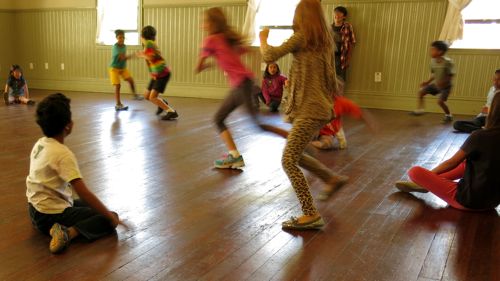
Today was the first day of Peace Camp at the San Jose UU Church. One of the things we did today was to play non-competitive games (of course). All kids who live here on the Peninsula seem to know a game they call Chaos Tag. This quickly became the favorite Peace Camp game. It’s fast, frenetic, it takes skill to play well but it can be played with pleasure by mixed age groups, from 5 to adults — a perfect game for a peace camp.

This is what Chaos Tag looks like:

BlogJun1614

I’m interested in the fact that this game is such a big part of of kids’ folklore here on the Peninsula. Every kid I’ve met from San Jose to Atherton seems to know and and love this game, and they’ll play for hours. (However, when I worked at the Berkeley UU church a decade ago, I don’t remember kids ever playing Chaos Tag; and one of the young adults on Peace Camp staff who grew up in the East Bay knew the game with slightly different rules under the name “Everybody’s It.”) I’m fascinated with the way this non-competitive game has sunk so deeply into Peninsula kids’ culture — how much they enjoy it, how hard and how long they play.

Sometimes education is a matter of finding out that the kids are already doing the right thing, and then telling them to do more of it.


(Note on the photo above: We do have media releases for the kids in Peace Camp, but nevertheless I deliberately blurred facial features in the photo above to preserve anonymity.)

Questions for discussion

Driving home from the youth service trip yesterday, we were delayed by a major accident on I-5; what should have been a six-hour trip turned into a nine-hour trip. We spent a lot of time talking, and one of the more interesting conversations was a long discussion of the Harry Potter universe.

Here are some of the questions we discussed (spoiler alert: plot twists are revealed in these questions):

(1) J.K. Rowling has said she thought of Dumbledore as being gay, but when she started publishing the books it wouldn’t do to have GLBTQ characters in books aimed at young people. We speculated that other characters might actually be GLBT or Q. Question for discussion: Which characters did you picture as gay, lesbian, bisexual, or questioning, and why?

(2) At the end of the series, we learn that Harry marries Ginny. There has been, of course, lots of online discussion about whether Harry should have married Hermione. But Harry could also have married one of the minor characters, instead of one of the central characters. Question for discussion: If Harry had to marry one of the minor characters, which one would he marry, and why?

(3) Final question for discussion: If you could be any character or creature in the Harry Potter universe, which one would you be?

D-Day

Today is the seventieth anniversary of D-Day, the invasion of Nazi-controlled Normandy by Allied forces.

My dad was a ground-based radio operator in the 437th Troop Carrier Group. An article on the U.S. Air Force Air Mobility Command Web site — “437th Airlift Wing honors its history,” written on the occasion of the last reunion of the 437th TCG in 2012 — tells a little about what the 437th did on D-Day:

“The 437th TCG, flying C-47 Skytrain transport units, played a vital role during the early morning hours of D-Day, June 6, 1944, and the remainder of World War II. During the Normandy campaign, the group towed and released glider planes, as well as carried troops, weapons, ammunition, rations and other supplies for the 82nd Airborne Division.” (More history of the 437th is available on this military history Web page.)

Radio operators like Dad provided a communication link to the C-47s flying missions, including high-frequency (HF) radio direction finding assistance. Although strict radio silence was observed at the beginning of each of the four missions flown during the D-Day actions, on the return trip, planes that were in trouble could radio in and ask for a bearing to help them return to the airbase.

Dad said the 437th TCG began flying before midnight on D-Day, dropping paratroopers at Sainte-Mère-Église. Later during the invasion, the 437th TCG also towed gliders full of troops. Something on the order of a hundred planes flew each mission on D-Day. When he wasn’t on duty as a radio operator, Dad said he stood out on the flight line, counting the planes that were in formation waiting to land, seeing how many made it back. The 437th TCG only lost a few planes; by contrast, the 434th TCG lost something like half its planes.

According to the “Friends of the WW2 437th Troop Carrier Group” Facebook page, a couple of former members of that unit are in England right now for the 70th anniversary of D-Day — you can see pictures on the Friends of 437th TCG Facebook page.

Moksha Patam

Moksha Patam is the classic board game from India (on which “Chutes and Ladders” is based). This game symbolizes the journey through life, and presents Hindu ideas of reincarnation, various virtues, etc.

Back in 2010, Sudha, a blogger living in Mumbai, wrote an excellent post on “Param Pada Sopanam,” another name for the same basic game, saying in part:

“Traditionally, Parama Pada Sopanam is played on the night of Vaikuntha Ekadashi (the 11th day after the new moon in the Tamil month of Margazhi). Many Hindus believe that the door to Vaikuntha, the abode of Lord Vishnu, will be wide open to welcome the devout and the faithful. Hindus also believe that dying on Vaikuntha Ekadashi will take them directly to the abode of Vishnu, liberating them from the cycle of rebirth. On this day, the devout stay up all night fasting and praying and playing the game helps them pass the time till dawn, when the fast is broken.”

For more cultural background on the game, read the entire post here.

I first ran across Moksha Patam in the old Holidays and Holy Days curriculum. However, that was in another UU congregation, and in my current congregation, the Holidays and Holy Days curriculum is missing Moksha Patam. So I went looking for a version online.

I found that you can play online with up to four players here. I discovered that Kreeda, a games company based in India, makes a version under the name of “Param Pada Sopanam” (scroll down). However, as of this writing, they do not ship to the U.S.

So I made my own version, which we will use in the Sunday school here in Palo Alto. The link below takes you to game rules and  PDF files of the game board. (Update Aug., 2019: revised link.)

Moksha Patam game at my curriculum Web site

Note that the squares at the heads of the snakes have the name of a Hindu demon — or the name of a person who is, in Hindu stories, bad or evil — these squares also have the name of a vice, or bad quality, in parentheses. Traditionally, landing on one of these squares would provide an opportunity to tell a little something about the demon or person — thus incorporating Hindu stories into the playing of the game.

I particularly like the fact that no skill is involved in playing this game — only random chance. Perhaps this implies that there is nothing we can do to escape the endless cycle of rebirths; it is all chance….

Updates: After reading Erp’s comment below, I checked on Wikipedia, and discovered that game boards do vary in size. Wikipedia also points out that this game (under the name “Snakes and Ladders”) appears in Salman Rushdie’s book Midnight’s Children. Here’s what Rushdie says about the game, in the chapter titled “Snakes and Ladders”:

“The moment I was old enough to play board games, I fell in love with Snakes and Ladders. O perfect balance of rewards and penalties! O seemingly random choices made by tumbling dice! Clambering up ladders, slithering down snakes, I spent some of the happiest days of my life. …

“All games have morals; and the game of Snakes and Ladders captures, as no other activity can hope to do, the eternal truth that for every ladder you hope to climb, a snake is waiting just around the corner, and for every snake a ladder will compensate. But it’s more than that; no mere carrot-and-stick affair; because implicit in the game is unchanging twoness of things, the duality of up against down, good against evil; the solid rationality of ladders balances the occult sinuosities of the serpent; in the opposition of staircase and cobra we can see, metaphorically, all conceivable oppositions, Alpha against Omega, father against mother; here is the war of Mary and Musa, and the polarities of knees and nose … [ellipsis in original] but I found very early in my life, that the game lacked one crucial dimension, that of ambiguity — because as events are about to show, it is also possible to slither down a ladder and climb to triumph of the venom of a snake …” — Midnight’s Children (New York: Random House, 2006), p. 160.

Developing online curriculum

Over the past few years, I’ve slowly been developing UU religious education curriculum that are meant to be published online. This past week, I finally put together a new Web site to publish them: Yet Another UU Curriculum Site.

At present, three curriculum are published on this site: “Beginnings,” an 8-session course for upper elementary grades; “Coming of Age,” a 9 month, 17 session, program for gr. 8-9; and “Greek Myths,” an 8-week course for upper elementary grades that’s still in development. In addition, I’ve included a selection of games that are appropriate for Sunday school classes and youth groups.

Why publish curriculum online?

First and foremost, I wanted to have the complete curriculum available in a format so that a teacher can access it with their smartphone or tablet.

This is good for teachers because all lesson plans and associated resources are easily accessible, and teachers don’t have to worry about leaving their curriculum book or binder at home. Long term, I will convert at least some of the curricula to epub format, and/or to printed books available as print-on-demand copies, so teachers can use whatever format they prefer.

View: Smartphone

Above: The site as it would be seen on a smartphone.

This is also good for parents, because parents can ask which lesson their child did on a given Sunday, and then look up that lesson online. Then they will can go over the material with their child if they want to. Some of the curricula I’m developing have a story associated with each lesson, and long term I’m planning to create storybooks in both epub and affordable print-on-demand print editions.

View: Laptop

Above: The site as it would be seen on a laptop or home computer.

Second, I wanted to have curricula online side-by-side with supporting resources. Thus, one of the first resources I’ve put up on this site are lots of games. That way, if a lesson plan fails, a teacher will have immediate access to back-up activities. Long term, I’m working on an online how-to-teach resource, with tips and techniques for adapting printed lesson plans for your own needs.

Finally, I want to see where this leads me, and I suspect I’ll start thinking differently about curriculum development. With cheap, easily accessible online publishing, it won’t just be teachers who are accessing curricula — parents and even kids will be able to do so as well. I’m going to start allowing people to add comments (which I will carefully curate), and that will enrich the curriculum. Finally, I’m contemplating adding some sort of assessment section to some of the curriculum, by developing fun ways for learners to show what they’ve learned.

This is very much a project that’s in development. I would value your thoughts and comments. To view “Yet Another UU Curriculum Site,” click here.