Caroling

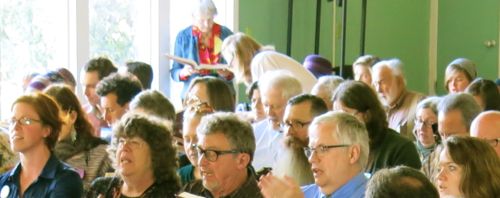
Jenni suggested the Ferry Building in San Francisco, so that’s where Ray, Tara, and I met her a little after three this afternoon. Both our tenors were ill, but we figured no one would notice that both Ray and I were singing bass. We started out just inside the main entrance, but between the traffic along Embarcadero and the crowds in the building, it was too noisy. So we went down to the south entrance, and set up there. “What should we start with?” “Deck the Hall, page 11.” Jenni counted us in, and we began to sing.

Once we got in the groove of singing, I could relax a little and look at the people who were listening to us. Everyone was smiling. Except two small children, who stood listenly raptly, their mouths slightly open. We decided to take a break, and the woman who was with the two children thanked us. “My kids are just enthralled,” she said. “Oh, then we’ll sing something else for you,” said Jenni. The kids wanted to hear “Frosty the Snowman,” but we didn’t have the music for it, so we settled on “Jingle Bells.”

Later we sang at the north end of the Ferry Building, and people had the same reactions: the adults all smiled, and the children just stood and listened. We all hear a lot of Christmas music in December — the endless Christmas carols played as background music in stores, the songs you hear on the radio — but it’s much better when you hear live music, even when it’s performed by people who are not professional musicians. Live music is not neatly packaged by corporate bean counters; it is not controlled by the touch of your finger on a touch screen; it is not performed in some acoustically perfect recording studio somewhere. Unlike recorded music, it is imperfect and alive and a little bit wild.

We sang until we got tired. We sang several of the carols several times over, but they never got boring, because people were smiling, and one little girl started dancing. Finally we had to stop singing. We were all smiling, too.

How I read

Mr. Elphinston talked of a new book that was much admired, and asked Dr. Johnson if he had read it. JOHNSON. ‘I have looked into it.’ ‘What, (said Elphinston,) have you not read it through? Johnson, offended at being so pressed, and so obliged to own his cursory mode of reading, answered tartly, ‘No, Sir, do you read books through?’

James Boswell, Life of Johnson, April 19, 1773 (in my 1924 Oxford University Press edition, vol. 1, p. 493)

REA: Last day of the 2014 conference

BlogNov1214a

(em>Above: Yes, there were arts and crafts at the Religious Education Association 2014 conference. In keeping with the more interactive approach at the 2014 conference, there were several opportunities for conferees to participate in interactive projects around the topic of unmaking violence. Here, conferees decorate a “peace pole.”

BlogNo1214d

Above: REA president-elect Mai-an Tranh, professor at Eden Theological Seminary, speaking at the final plenary session: wrapping up this year’s conference, and tying this year’s conference topic to next year’s topic. Tranh used Henry A Giroux’s “disimagination machine” as a central theme in her talk.

BlogNov1214c

Above: In the final plenary, Evelyn L. Parker of Perkins School of Theology led conferees in an interactive theatre exercise. She invited ten conferees to imagine with their bodies what the “disimagination machine” might look and feel like. Then she invited the rest of us “spec-actors” to disassemble the machine. In the photo above, a conferee is gently removing a piece of the machine.

BlogNov1214b

Above: The close of the conference, just before the business meeting.

REA: Religious literacy, bullying, and RE teaching

In the second breakout session of the Religious Education Association 2014 conference, I attended a combined colloquium. Wing Yu Alice Chan, a doctoral student at McGill University, presented work in progress under the title of “Can Religious Literacy Deter Religious Bullying?” Andrea Haith of Canterbury Christ Church University presented her work in progress under the title of “An Exploration of Religious Education Teachers’ Understandings of Religiously Inspired Violence and the Worldviews of Children in the Classroom.”

Chan presented a definition of religious literacy based on a definition by Diane Moore (2007), the ability to discuss and analyze the intersections o religion with society.

She next defined religious bullying as bullying on the basis of religious difference, including physical and psychological bullying, online bullying, etc. In a review of literature on religious bullying, she found research that indicates that religious bullying gets transmitted across generations. Furthermore, she found research that the aftereffects of religious bullying can lead to religious extremism.

At the moment, her research is focusing on two North American religious literacy programs in public schools: Quebec’s “Ethics and Religious Culture” program, and the “World Geography and World Religions” programs in modesto, California. These are the only two mandatory courses in religious literacy that she found in North America. In her research so far what is most prominent is the role of dialogue.

Her research methodology is outlined in her online prospectus here.

Andrea Haith is a teacher of religious education in the United Kingdom (U.K.). She began by saying that teaching religious education is extremely challenging, as the young people taking the courses “don’t see the point.” It is also challenging because “any discussion of Islam does evoke stereotypes.”

Haith said that the U.K. has complex legislation that implements religious education in the public schools. The challenge then is how to discuss religiously inspired violence within this framework. Her research focuses on the teaching of religiously inspired violence as it relates to religious education teaching more generally.

Her hypothesis is that religious education has become “sanitized,” in part because examination-focused learning outcomes may serve to distort the subject matter of religious education. Her research questions include:

— What is the nature of RE teacher’s understandings of religiously inspired violence?
— How are these understandings translated into teaching practice in the classrooms?
— Is there a relationship between teachers concepts of religiously inspired violence and their pedagogy?

Haith’s research project is outlined online here.

At the end of the two presentations, a questioner pointed out that a key issue is how we train teachers. Haith and Chan both agreed.

Another questioner pointed out that it is problematic to consider religious literacy out of any other context, and that religious literacy must be placed in a values-based context. Haith and Chan seemed less interested in this idea.

I asked a somewhat inarticulate question about the importance of students recognizing their own religious identity. Interestingly, in a later colloquium, I learned about the “worldview framework approach” in Mualla Selçuk and John Valk’s presentation “Journeying into Islam” (more on their research here); Selçuk and Valk’s worldview framework explicitly names religious identity as important.

I would say that I found both Haith and Chan’s research to be of great interest and importance. Chan’s research into the relationship between religious literacy and religious bullying could be especially valuable.

REA: Experiential and multimedia

The Religious Education Association 2014 conference was more of an experiential, multimedia experience this year — as befits religious educators, who often have a progressive pedagogy. Here’s some evidence that this conference is not just the same old lectures-with-Powerpoints:

Taiko Legacy Chicago at opening Plenary

Above: Taiko Legacy Chicago, live performance at the opening plenary session, accompanying a slide presentation

BlogNov0814a

Above: Andrea Bieler’s professionally produced video, which included tours of sit-specific art works

BlogNov0814b

Above: Participatory opening ritual about (un)making and (re)membering violence

BlogNov0814d

Above: Photo from Precious Blood Reconciliation Ministries, one of three field trips to sites and organizations in Chicago where people are actively working to unmake violence. In the photo above, the center of one of Precious Blood Reconciliation Ministry’s “truth circles”; the four key values of the truth circles are printed on the four cards: confidentiality, listening, respect, and truth.

And while photos were not allowed during her performance, I have to mention “Unveiled,” a one woman play about five Muslim women, written and performed by Rohina Malik.

I should also mention the superb plenary talk by Willie James Jennings. He eschewed the usual Powerpoint slides, and simply spoke to us. He didn’t need slides: his voice, his delivery, what he had to say was gripping on its own, without any need for multimedia. His talk was a reminder that the spoken word can be performed as a lively art, one just as engaging as a one-person play.

REA: “Cross-cultural Analysis” and “Sabbath as Post-Christian Ed”

On Friday afternoon at the Religious Education Association 2014 conference, I attended a colloquium with two presenters: Courtney Goto ofBoston University presented “Troubling Cross-Cultural Analysis in Healing the Effects of Racism,” and Jonathan LeMaster-Smith, doctoral student at Garrett-Evangelical Theological Seminary, presented on “Sabbath as Post-Christian Education: The (De)valuing of Rural Working-Class Persons as Liberation from Socio-Economic Disposability.”

Goto told us that she was presenting work in progress, and what she was going to present differed from the outline on the conference meeting Web site. She is working on two case studies, comparing the way two different cultural communities use aesthetic practices to form people theologically, aesthetically, and culturally.

Her first case study is of Lithuanian rituals on All Saints Day, during which families place candles and decorations at the grave sites of deceased family members. Her second case study is of an All Saints Day ritual at the Sacramento Japanese United Methodist Church.

Since Lithuanians and Japanese Americans are people on the margins, Goto’s research will use the concept of “social death” to explore these two case studies. Social death happens when a group of people is treated as nonpersons by the dominant culture. Examples of victims of social death include Jews during the Holocaust, native Americans in the U.S., etc. Both Japanese Americans and Lithuanians were victims of social death before and during the Second World War. Both communities use All Saints Day to hold rituals which serve as a response to trauma.

Of particular interest to me were the slides that Goto showed of an All Saints Day art installation in the Sacramento Japanese United Methodist Church. 26 yukata (a type of traditional Japanese clothing) were hung from from the ceiling of the sanctuary; another yukata clothed the usually plaint cross at the front of the church. The symbolism — how this art installation represents the way Japanese Americans were treated during the years of internment — was explained during services, in orders of services, etc. I felt this was a powerful example of all-ages religious education in a congregation.

Jonathan LeMaster-Smith spoke about another marginalized group, rural white working class persons. He is in the process of investigating ways to do religious education around the Sabbath in a post-Christian rural working class context. “One possible pedagogical practice is the observance of Sabbath,” LeMaster-Smith said — but not Sabbath in the traditional sense of a day of rest on Sunday (or Saturday).

Rather, LeMaster-Smith wants to ways the concept of Sabbath could be incorporated into popular culture rituals such as, for example, a Hallowe’en bonfire. (One of the participants later pointed out the obvious parallels between the Lithuanian popular culture ritual on All Saints Day described by Goto.) LeMaster-Smith said he saw potential in finding Sabbath-type observances in existing holiday celebrations.

A draft of Lemaster-Smith’s paper is online here. I saw a great deal of potential in this idea of translating the old observance of Sabbath into current post-Christian celebrations. Indeed, I believe some churches and faith communities are already on this path, e.g., many non-Hispanic congregations are incorporating Dias de los Muertos into Sunday services. LeMaster-Smith is simply asking faith communities to take this kind of thing outside the walls of the church building, out into the community. It seems to me that powerful things could happen at the intersection of pop culture and post-Christian religion.

REA: “My God, what have we done?”

Leah Gunning Francis opened the first plenary session of the Religious Education Association 2014 conference. She introduced the plenary speakers, and informed us that unfortunately Gabriel Moran was not able to be present. Francis lives in St. Louis, Missouri, and given that the theme of this year’s conference is “Religion and Education in the (Un)Making of Violence,” she showed some of her photographs of the protests in Ferguson, Missouri — to the great interest of the conferees.

The first “speaker” was Andrea Bieler, Professor of Practical Theology at the Kirchliche Hochschule in Wuppertal/Bethel, Germany. Bieler did not appear in person; her presentation was a video, in which she spoke, and showed various works of art and other material.

Bieler’s video began with a statement by Theodor Adorno: “The principal demand upon all education is that Auschwitz does not happen again.” Bieler extended this to other instances of systematic violence, including systemic racism in the United States, the state terrorism and “disappearances” in Argentina and Chile, apartheid in South Africa, etc.

In the video, Bieler laid out a nuanced argument, beginning with theories of memory and winding up with a discussion of remembering violence through aesthetic art. I was most interested in her analyses of several site-specific art works in Berlin, particularly the Chapel of Reconciliation, built near the site of the Berlin Wall.

Continue reading “REA: “My God, what have we done?””

REA: Teaching and learning in online spaces

In the afternoon pre-conference session of the Religious Education Association 2014 conference, Eileen Daily of Boston Univeristy and Daniella Zsupan-Jerome of Loyla University presented a workshop titled “Teaching and Learning in Online Spaces: An Experiential Engagement with Digital Creativity.”

While online media are new, Daily reminded us that religions have always used mediated forms of communication. “What did Paul do? He wrote letters!” she said. “Email is just another form of letter,” she added. “These are just new names for things we’ve been doing for a long time. There’s a difference of form, but there’s not necessarily a difference of message.”

Daily told us that when she teaches religious education online, she emphasizes nonlinearity. Whereas face-to-face learning environments lend themselves to a linear path through a subject, online environments lend themselves to a nonlinear approach. However, you still have to pay careful attention to course structure; there is a “Skinnerian side of education,” so there’s always a sense in which you have to “keep students in the rat maze” to produce behavioral outcomes. And Daily reminded us that the goal of any religious education is to “integrate religion into people’s messy lives.”

Daily and Zsupan-Jerome then led us in “a mini non-linear learning event that will appear on a curated platform at the end of the session.” As a subject for this experience in non-linear online learning, Daily and Zsupan-Jerome had us investigate the Salt Creek watershed; Salt Creek runs immediately behind the conference hotel. They split us into six groups, each group charged with investigating the environmental challenges facing Salt Creek through different approaches. Thus one group conducted Skype interviews with people who knew about Salt Creek; one group investigated sacred texts on the subject of the environment; another group researched specific environmental challenges facing Salt Creek today; etc.

Continue reading “REA: Teaching and learning in online spaces”