William R. Jones writing retreat

Hassahan Batts writes: “Practitioners Research and Scholarship Institute (www.prasi.org) is having another writing retreat where we are bringing together students of Dr. Jones in Allentown, Pennsylvania. If interested please email justequality@yahoo.com .”

No date given, so if you’re interested I’d suggest writing to the above email address right away.

A what?

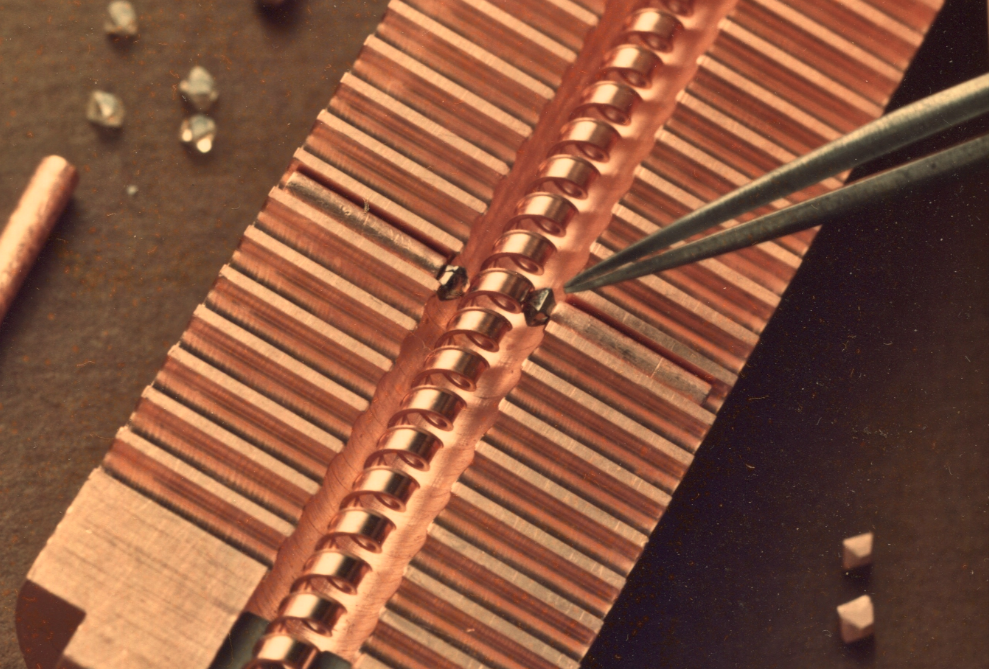
When we were kids, we often heard my father talk about the diamond supported helix. We had no idea what a diamond supported helix was, except that it was something that went into a traveling wave tube, which is a type of microwave power tube. Of course we also had no idea what a traveling wave tube was, or what a microwave power tube was.

Since then, I learned that Dad did some of the pioneering research in diamond supported helices, and I’ve had enough coursework in physics to understand that this is something to do with electron optics. But I never knew what a diamond supported helix looked like. Today, my younger sister and I were looking through Dad’s files, and we actually found a photograph of a diamond supported helix. It was nothing like I imagined it. But it is actually quite a beautiful piece of technology:

Detail of a diamond supported helix

Look at all that copper, presumably to suck heat out. Guess I have to bring that photo along when we go visit Dad tomorrow; he’ll get a kick out of seeing it.

Personal computer, c. 1983

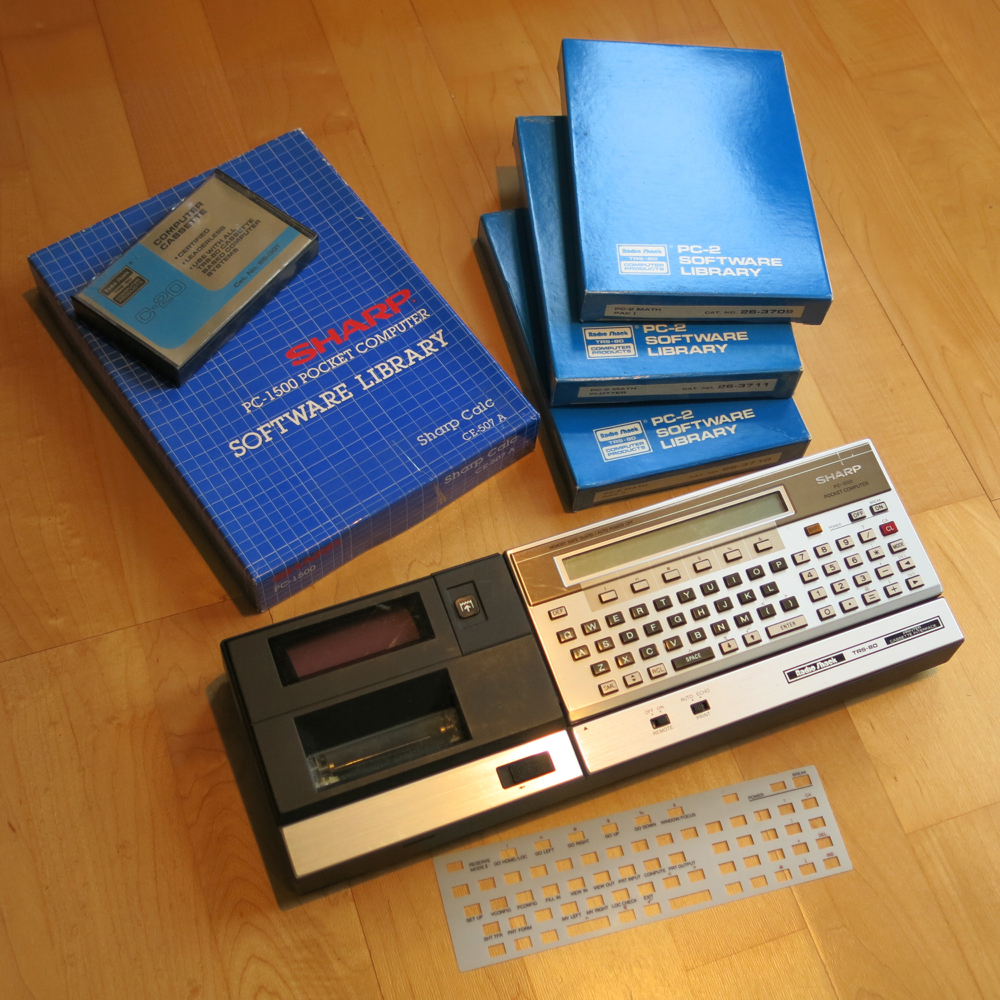
My sister and I are doing some organizing in our father’s condo. Dad’s a retired electrical engineer who saved almost everything, and he has several decades worth of electrical gear. Including this:

Sharp PC-1500 Pocket Computer

It’s a Sharp PC-1500 Pocket Computer, which apparently ran the same operating system as the famous Radio Shack TRS-80 computer. What you’re seeing above is the computer nested in its docking station, which has a little printer built into it. For memory, you hitched up a cassette player, and at top left there’s a special computer memory cassette. There are several boxes of software — not sure how that worked — plus a keyboard overlay (on the ground in front of the computer) which goes with one of the software packages.

Abby remembers this computer well, because Dad had a biorhythms program that fascinated her.

Religion in the public square

In the United States, all too often the phrase “religion in the public square” means someone accosting you and telling you that you should join their religion; so the meaning of the phrase becomes, “our religion is right and yours is wrong.” Or that same phrase can be used pejoratively to imply that all religious practice shouldb e kept out of public view; so the meaning of the phrase becomes, “all religion is wrong.” Either way, someone is imposing their own views on the rest of a democratic society.

But if ours is a truly multicultural democracy, we should allow space in the public square for a variety of worldviews, without letting any one worldview dominance over the others. This becomes a delicate balancing act. Literal or metaphorical shouting matches between religious worldviews don’t promote tolerance; mind you, sometimes you have to get into shouting matches to preserve the openness of the public square, as when we have to fight to limit Christmas displays on public property, but no one imagines that these shouting matches increase tolerance. So given that public religious expression is a delicate balancing act, what does it look like when you have an appropriate expression of a religious worldview in the public square?

Sukkah at the JLISF, Columbus and Lombard, San Francisco

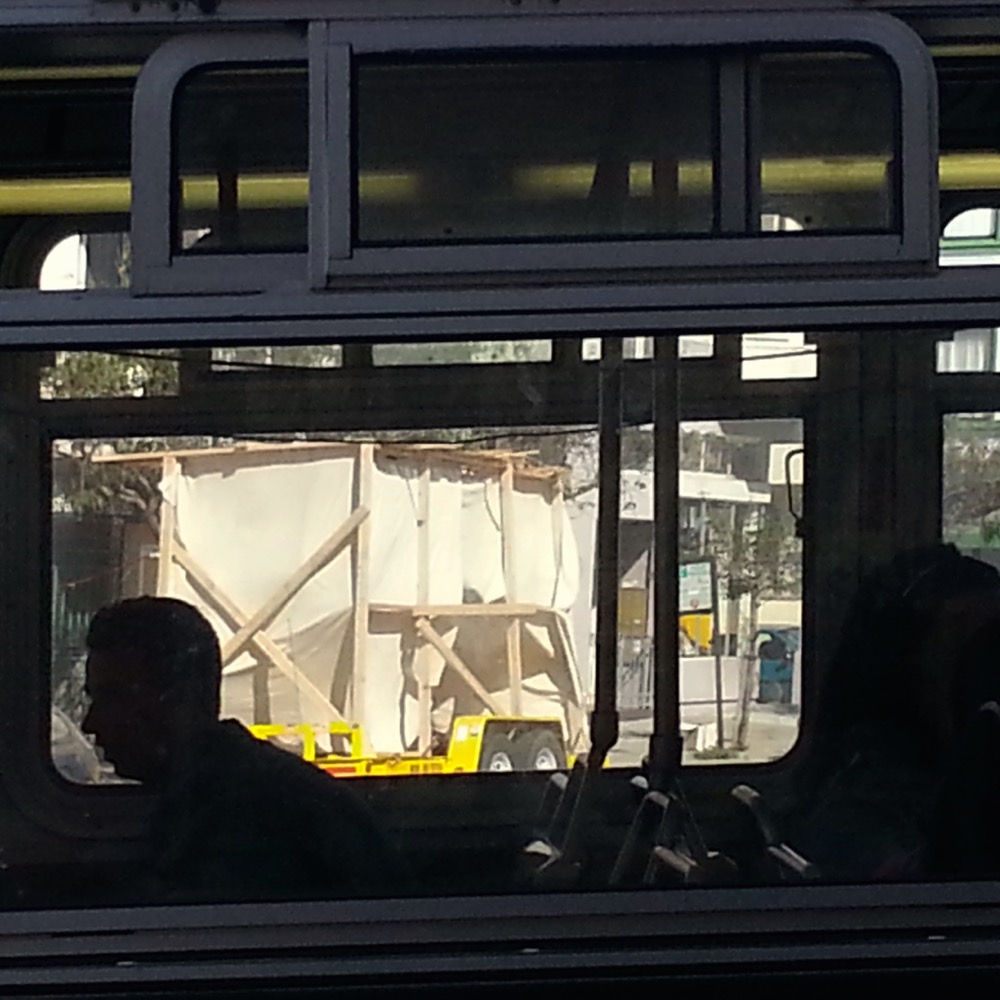
Today I saw such an expression of a religious worldview in the public square, and it looked like a rented flatbed trailer with a sukkah built on top of it. The trailer was parked in front of the Jewish Learning Institute of San Francisco (JLISF), on Lombard Ave. right off busy Columbus Ave in the North Beach neighborhood. Carol and I walked by just as some people from JLISF were cleaning up from lunch. They were polite and friendly, and ready to explain that they were celebrating Sukkot, and what a sukkah was, and so on.

This is a good display of religion in the public square: present, but not intrusive; with friendly people who are ready to explain, but not berate.

Sukkah through a bus window

(Posted the next day, and backdated.)

Go to a bookstore

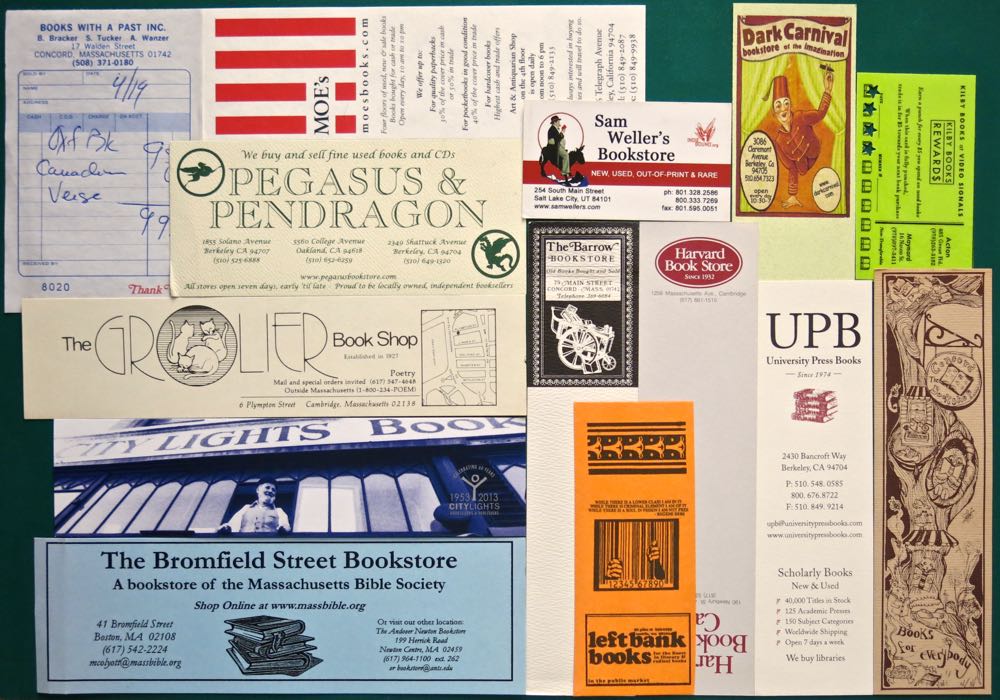
It’s the last day of Banned Books Week 2015. Local bookstores are often on the front lines of fighting local book bans. (And while I rely on the big behemoth booksellers, face-to-face bookstores can be centers of cultural resistance in a way that chain bookstores and online booksellers will never be.) With that in mind, I dug up some bookmarks from some of my favorite local bookstores:

Bookmarks

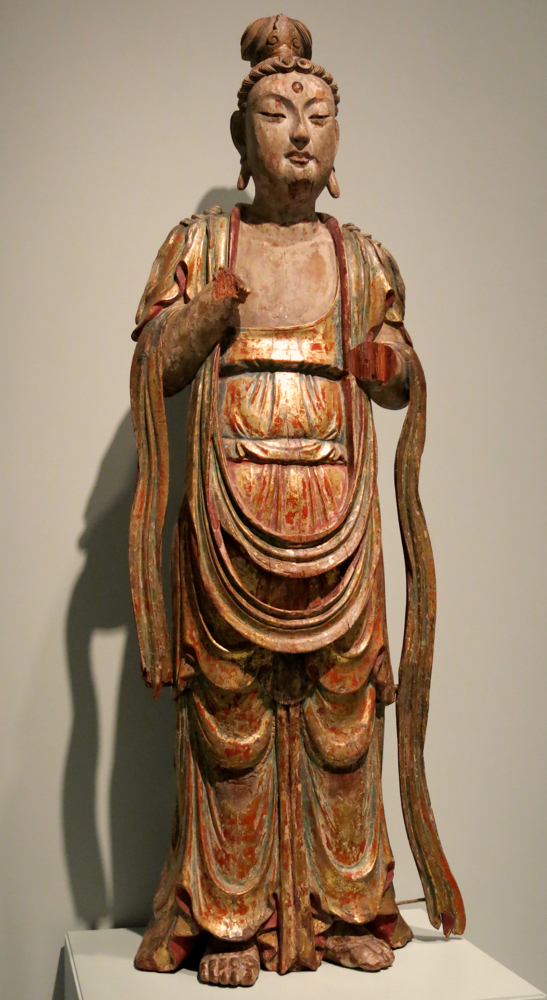
Kuan yin

Kuan yin (in Pinyin, Guanyin) is a deity with multiple identities, including multiple gender identities. According to the Lotus Sutra, the Buddha said, “If living beings in this land must be saved by means of someone in the body of a Buddha, Guanshiyin Bodhisattva will manifest in the body of a Buddha and speak Dharma for them.” And if someone needs to be saved by this boddhisattva, Guanshiyin, who is also known as Guanyin or Avalokiteshvara, will manifest him/herself in whatever form works best:

“If they must be saved by someone in the body of the wife of an Elder, a layman, a minister of state, or a Brahman, he [sic] will manifest in a wife’s body and speak Dharma for them. If they must be saved by someone in the body of a pure youth or pure maiden, he will manifest in the body of a pure youth or pure maiden and speak Dharma for them. If they must be saved by someone in the body of a heavenly dragon, yaksha, gandharva, asura, garuda, kinnara, mahoraga, human or non-human, and so forth, he will manifest in such a body and speak Dharma for them.” [trans. from City of Ten Thousand Buddhas Web site

Guanyin2

Above: “The Boddhisattva Avalokiteshvara (Chinese: Guanyin), 1300-1400 CE,” Asian Art Museum, catalog no. B61S37+

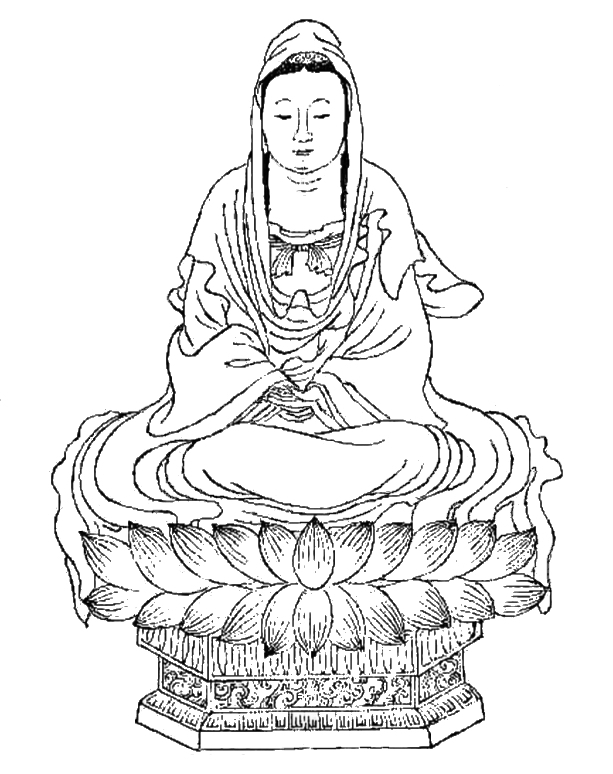
Guanyin also became a Daoist deity, a female immortal; one can chant a spell to the Daoist Guanyin “whereby one will accomplish unimaginable virtues, and give evidence to the penetration of the absolute.” (Guanyin mizhou tu)

Guanyin

Above: A Daoist Guanyin, adapted from Henrik Sorenson’s article “Looting the Pantheon.”

“The increasing Daoist appropriation and transformation of the Avalokiteshvara cult and the associated teachings which took place during the later imperial period, is also reflected in the mid-Qing work, the Guanyin xin jing bijue (‘Secret Explanation on the Heart Scripture of Avalokiteshvara’). This text, which to all appearances and purposes appears to be a Buddhist commentary on the Prajnaparamitahrdaya sutra, one of the most important and popular Buddhist scriptures in China, on closer examination turns out to be a Daoist commentary on the Buddhist sutra. In addition to its full-scale doctrinal modification, it casts Avalokiteshvara in the role as a female immortal (nuxian) from the Zhou dynasty (1122–255 BCE). … the level of appropriation [of Buddhist deities by Daoism] could, and often did, go well beyond superficial borrowing, ending with something akin to full-scale integration.”

— Henrik H. Sørensen, “Looting the Pantheon: On the Daoist Appropriation of Buddhist Divinities and Saints,” The electronic Journal of East and Central Asian Religions, vol. 1 (Edinburgh: Asian Studies at the University of Edinburgh, 2013), p. 62.

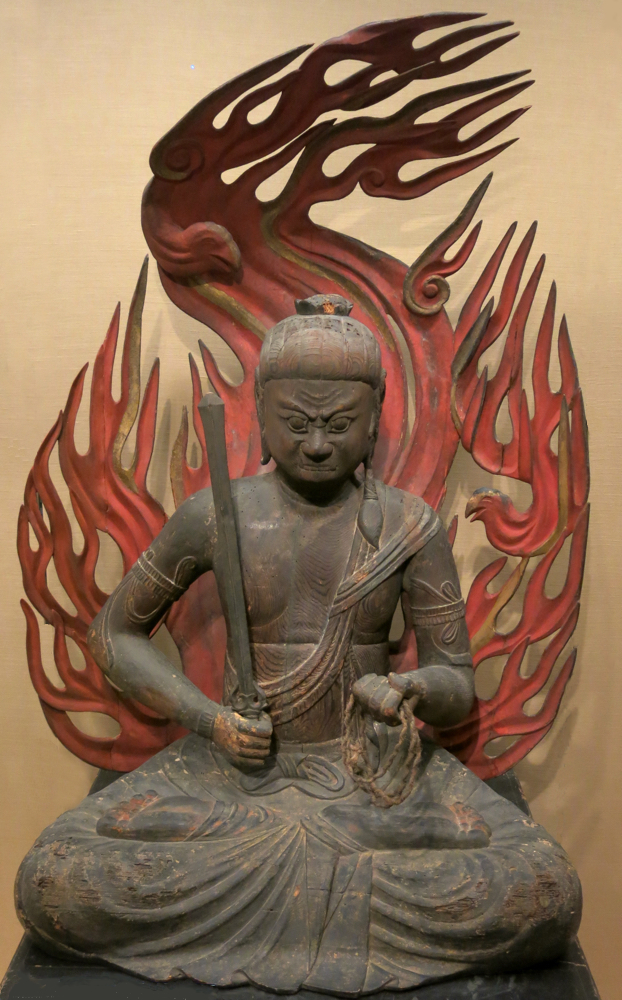
Fudo Myoo

FudoMyoo

Fudo Myoo is a Japanese Buddhist deity, one of the Five Great Kings, or Godai Myoo.

The Godai Myoo “are considered to have great magical powers to fight against heresy, passion, ignorance, illusion, and other spiritual obstacles. The most popular Myoo in Japan is Fudo, whose name means literally ‘The Immovable One.’ He is an incarnation of Dainichi Nyorai, who is an idealization of the truth of the universe, from whom all other Buddhas and boddhisatvas are born. Fudo is thought to fight against all evil to protect Buddhist law.” — Selected Works: The Asian Art Museum of San Francisco (San Francisco: Asian Art Museum, c1994), p. 179.

This image is a digitally manipulated photograph of a sculpture in the Asian Art Museum labeled “The Buddhist deity Achala Vidyaraja (Japanese: Fudo Myoo),” dated to 1100-1185, catalog no. B605146+.

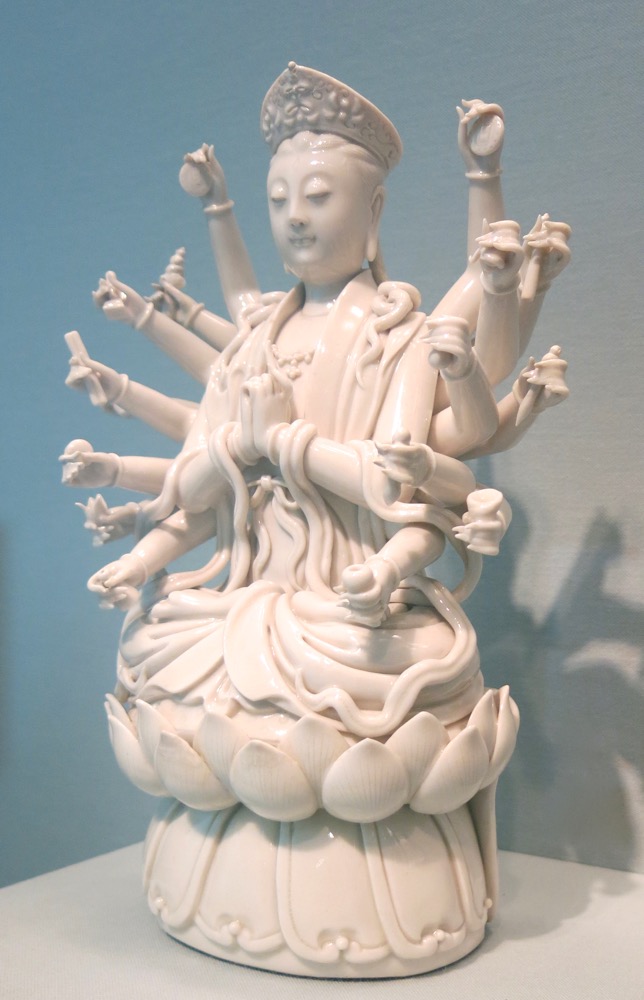
Doumu

Doumu

Above: porcelain image of the Taoist deity Toumu [Doumu], made in Fujian province in the 18th century, now in the Asian Art Museum, San Francisco (catalog no. B60P1362).

“The Dipper Mother [Doumu] is a star deity and a Daoist adoption of the Tantric deity Marici, a personification of light and dawn. As a savior and healer, she is invoked through visualizations that unite the adept with cosmic light and ‘oneness with cosmic principles’ (75-76). As the cosmic mother of the nine star-gods of the dipper, she is a nurturer and instructress, but the Dipper Mother also maintains her own salvific powers and authority.”

From a book review by Sara Elaine Neswald of McGill University on the Daoist Studies Web site (2 Dec. 2004), of the book Women in Daoism by Catherine Despeux and Livia Kohn (Cambridge, Mass.: Three Pines Press, 2003).

———

Update: August 12, 2019: Entry on Doumu in E. T. C. Werner, Myths and Legends of China (London: George G. Harrap & Co., 1922), pp. 144-145:

Goddess of the North Star

Tou Mu, the Bushel Mother, or Goddess of the North Star, worshipped by both Buddhists and Taoists, is the Indian Maritchi, and was made a stellar divinity by the Taoists. She is said to have been the mother of the nine Jen Huang or Human Sovereigns of fabulous antiquity, who succeeded the lines of Celestial and Terrestrial Sovereigns. She occupies in the Taoist religion the same relative position as Kuan Yin, who may be said to be the heart of Buddhism. Having attained to a profound knowledge of celestial mysteries, she shone with heavenly light, could cross the seas, and pass from the sun to the moon. She also had a kind heart for the sufferings of humanity. The King of Chou Yu, in the north, married her on hearing of her many virtues. They had nine sons. Yuan-shih T’ien-tsun came to earth to invite her, her husband, and nine sons to enjoy the delights of Heaven. He placed her in the palace Tou Shu, the Pivot of the Pole, because all the other stars revolve round it, and gave her the title of Queen of the Doctrine of Primitive Heaven. Her nine sons have their palaces in the neighbouring stars.

Tou Mu wears the Buddhist crown, is seated on a lotus throne, has three eyes, eighteen arms, and holds various precious objects in her numerous hands, such as a bow, spear, sword, flag, dragon’s head, pagoda, five chariots, sun’s disk, moon’s disk, etc. She has control of the books of life and death, and all who wish to prolong their days worship at her shrine. Her devotees abstain from animal food on the third and twenty-seventh day of every month.

Of her sons, two are the Northern and Southern Bushels; the latter, dressed in red, rules birth; the former, in white, rules death. “A young Esau once found them on the South Mountain, under a tree, playing chess, and by an offer of venison his lease of life was extended from nineteen to ninety-nine years.”

Let’s talk UU SEO

Behind the scenes, several Unitarian Universalist bloggers have been discussing how to increase traffic to blog posts that the blogger thinks are useful or important. One UU blogger observed that if you write a post that is some combination of controversial, critical, or ranting, you are more likely to get a lot of hits on that post. But how do you drive traffic to more thoughtful posts that you think are worthy of a wider readership, but which aren’t the kind of traffic you think they deserve? The advice given by several bloggers was to write headlines and titles that are carefully designed to drive appropriate traffic to the blog post.

This is a sound approach to driving traffic to your blog, and I have no intention of following it.

Over the years, I’ve tried this approach a few times, and I’ve written a few blog posts on controversial topics that, judged by my low standards, got a fair amount of traffic. I discovered three things: First, writing controversial blog posts that attract lots of traffic forces me to think about the world in ways that I do not enjoy: you have to start looking for controversies everywhere. Second, once you start getting more than half a dozen comments on controversial blog posts you are going to have to spend time moderating whackos and fending off trolls, activities I find dull and unpleasant. Third, controversial blog posts tend to attract readers who either have an axe to grind or who aren’t interested in nuance, people with whom I have little in common.

So I came up with a different strategy for writing blog posts.

I tend to write carefully-written, well-documented posts designed to have a long shelf life. Such posts might provide information not easily available elsewhere on the Web, e.g., the posts I have done on Black theologian William R. Jones. Or such posts might provide authoritative information on an area where I have some level of expertise, e.g., the post I did on implementing #FergusonSyllabus in Sunday school. Or such posts might provide useful summaries on an obscure topic (note that since Unitarian Universalism is a tiny sect, most UU topics are obscure), e.g., the posts I have done on the theological influence Mary Rotch had on Ralph Waldo Emerson. In SEO (search engine optimization) terms, this is a variant of “long tail search”; my SEO goal is to have lots of authoritative posts with just a few highly specific links going into them.

To put it another way, trying to compete for traffic with Huff Post (or for that matter with Doug Muder and Vicki Weinstein) is a mug’s game, a strategy with a low chance of success. At least, it’s a mug’s game for someone like me, because I’m not that kind of writer.

I’ve spent some time thinking about the kind of writing I am best able to do. My partner, a former freelance writer, talks about being an “information hunter-gatherer,” and I can do some of that. My older sister, a professor of writing and an author, talks about the book by Robert Coles, Doing Documentary Work, and I can do some of what Coles describes. Then too I’m a minister, and every once in a while I’m able to do some writing on spiritual topics.

Once we’ve gone this far, the rest is obvious. Finding out what kind of writer you are means figuring out who your readers are, and what they are interested in reading. Finding out who you are as a writer means learning how to write well for your readers. Depending on who you are as a writer, this could mean learning how to write clickbait headlines, and keyword-rich blog posts. Or if you’re a different kind of writer, this could mean something different. In my case, it means trying to write well-crafted short essays on topics about which I have knowledge. And in your case, it might be something else altogether.

I don’t believe there is one best way to write a blog. I believe what you want to do is know who you are as a writer, know who your readers are, write well-crafted blog posts aimed at your readers, and then find the SEO strategy that best allows you to reach your readers.


Easy face painting

Some of our high school youth youth advisors went to Kids Carnival today, the fun event organized by the University AME Zion Church as a way for people of different races and ethnicities to get to know each other a little better while having a good time. Our youth group offered to do a face painting booth. We lucked out in that Elaine, a high school senior from the Palo Alto Vineyard Church, joined us — she is a fine artist who has her own business doing face painting for kids’ birthday parties. We let her do all the hard designs (Ice Bear, a Death Eaters logo, etc.), and we used our own easy designs.

Our designs turned out to be easy enough that children can do them (we let some of the children who came to our booth use our paints to paint designs on each other) — yet they’re satisfying and look pretty good when you’re done. I’m posting them here in case you want to use them next time you do face painting in your congregation. Except where noted, our designs are meant to go on cheeks or backs of hands. We had copies of the designs where children could look at them and choose the one they wanted. One last suggestion: it is worth spending extra money for good face paints; we bought the cheap ones, but when Elaine let us try hers, we saw that they were far better.

Face Painting 1

Face Painting 2

Face Painting 3