Pete Seeger: a brief appreciation

When my older sister and I were young, our parents used to play this one record that I liked to try to sing along to: “Pete Seeger at Carnegie Hall.” I loved all the songs on that album: “Little Boxes,” and “We Shall Overcome,” and “Guantanamera,” and “Keep Your Eyes on the Prize.” I can still remember Pete Seeger’s spoken introduction to “If You Miss Me at the Back of the Bus,” when he talks about the violent measures taken against civil rights protesters. I can remember trying to memorize the words to “Little Boxes,” and in the process learning how to be critical of the assumptions undergirding middle class suburban culture, which probably helped lay the intellectual groundwork for my studies of critical theory and Marxism about ten years later, when I was in college. I had already learned from my parents how to be critical of what I was taught in school, but listening to “What Did You Learn in School Today?” made that seem fun and mischievous and delightful, and a few years later when I started working with children the memory of that song gave me a standard by to judge my own efforts as an educator.

Pete Seeger’s greatest strength was his ability to sing for children and young people. He was a teacher as much as, or more than, a musician. When he sang, he taught about big concepts like justice and human rights and racism and social inequality — he taught all these big concepts in a way that a six year old could understand them. His infectious songs and style of singing ensured that the children and young people who heard him sing would remember the lessons he taught for a long, long time. Continue reading “Pete Seeger: a brief appreciation”

Update

I managed to get bronchitis and laryngitis at the same time (I always think it’s amusing when preachers, who make their living by talking, get laryngitis). This slowed me down: I haven’t had much energy for a week, and my brains feel like Swiss cheese.

But I did have enough energy to finally update The Folk Choir Song Book, which was first published in 2009 (when I was coming off two years of directing a folk choir at a UU church). I’ve corrected many typographical errors, removed one song that turned out to be covered by copyright, and added some fun stuff that didn’t make it into the first edition.

Update, 2023: this book is no longer available.

What we do at committee meetings

One of the things we do in committee meetings in our congregation is we wind up talking about other subcultures of which we are a part. Beth, for example, is part of the autoharp subculture. And, said Beth, one of the things they sometimes do at autoharp conventions is they have an autoharp toss. What’s that? we asked. That’s when you take an old autoharp that’s beyond repair, and see how far you can toss it. So we interrupted committee business to watch a Youtube video of autoharp tossing….

Autoharp Toss

When I showed this video to Carol, my partner, she thought it was silly. She’s obviously not a sports fan.

Twelfth day

It’s the twelfth day of Christmas. What to do on the twelfth day of Christmas? You could read Shakespeare’s “Twelfth Night.” Or some family traditions hold that this is the day to take down your Christmas tree.

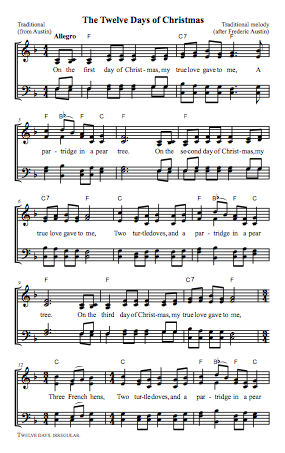
Or, if you have a certain kind of obsessive personality, you could sing every verse of “The Twelve Days of Christmas.” And, in case you want to engage in this last effort, I’m posting a PDF of sheet music with guitar chords and a SATB/piano accompaniment.

twelvedays

N.B.: The first five verses are written out completely. Then the last page shows all twelve verses, and you’ll have to figure out on your own where to start each new verse.

16 SATB Xmas carols and songs

I’ve added a new Web page with 16 Christmas carols and songs, in basic SATB arrangements (one is STB) — including carols not in the current Unitarian Universalist (UU) hymnals (like “Jingle Bells”), carols with words from older UU hymnals (like “Joy to the World”), etc. You can find the page here.

(Yes, I know Christmas is over for the year. I’ve been meaning to put these online for a couple of years, I never seem to have time to do it before Christmas, so I’m going to put them up now.)

Caroling

Michele, my voice teacher and friend, sent out an invitation to some caroling in her neighborhood. Even though she lives way over in north Berkeley, I decided to go — I didn’t know anyone who was going to go caroling near where we live, and I wasn’t up to organizing caroling on my own.

Close to twenty people gathered in Michele’s living room yesterday evening. We introduced ourselves, and ran through two carols where we thought we might sing some harmony — “Silent Night” and “Deck the Hall.” Fortunately there was another bass there who helped me through “Deck the Hall,” and I was able to help him once or twice in “Silent Night” — it’s always easier to sing your part when there’s someone else singing with you.

We headed out into Michele’s neighborhood. Michele said we would only sing at houses where we could see Christmas decorations. There were half a dozen children with us, and they ran ahead to scope out likely houses. We’d gather on the sidewalk in front of the house, Michele would quietly tell us which carol — “‘Frosty the Snowman,’ page 3 of the packet!” — the kids would ring the doorbell, and as soon as someone showed up, we’d sing.

Some people listened to us while standing indoors; in one case because there were dogs that desperately wanted to get out; in other cases maybe because it’s a little weird to have a score of people standing in front of your house singing. Other people came out and listened. Reactions ranged from politely tolerant to very enthusiastic. One woman, who had a foreign accent (maybe Middle Eastern?), was really very touched by the singing; we sang her another song.

After an hour, we were getting cold, and some of the younger kids were getting a little bit tired. So we all said “Good night!” and “Merry Christmas!” and dispersed into the night; the younger kids probably heading for bed. As for me, I had some errands to run in downtown Berkeley; but I found myself humming Christmas carols all the way home.

Jingle Coins

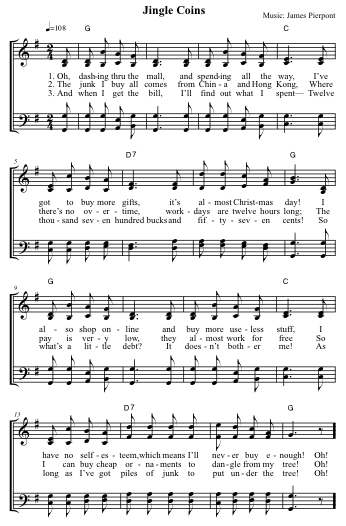
Another parody Christmas carol — an anti-consumerism parody this time. I got the words from some singing friends, and typeset it with a SATB arrangement which is based on James Pierpont’s original paino/vocal score for “Jingle Bells” (click on the image below for a full-size PDF):

Jingle Coins thumbnail

We sang it in our junior high Sunday school class this past Sunday, and the kids loved it. We also sang it during social hour on Sunday with the adults, again people seemed to like it.

Good King Wenceslas

Here’s another song for Christmas time:— Quite a few people in our congregation like the song “Good King Wenceslas” because it’s a social justice song: King Wenceslas and his page bring food, drink, and fuel to a poor family on the Feast of St. Stephen, December 26 (the second day of Christmas). While they’re trudging through the snow to the poor family’s dwelling, the king’s page weakness and thinks he can go no longer, but Wenceslas provides warmth to keep him going; and this is my favorite part of the story because it seems to me to be a kind of parable about social justice leadership.

Philip, a long-time member of our congregation, pointed out to us that you can produce a nice effect if the high voices (i.e., most of the women and the children) sing the page’s words, and the low voices (i.e., those who sing in the tenor and bass range) sing the king’s words. So that’s how we sing it in our congregation.

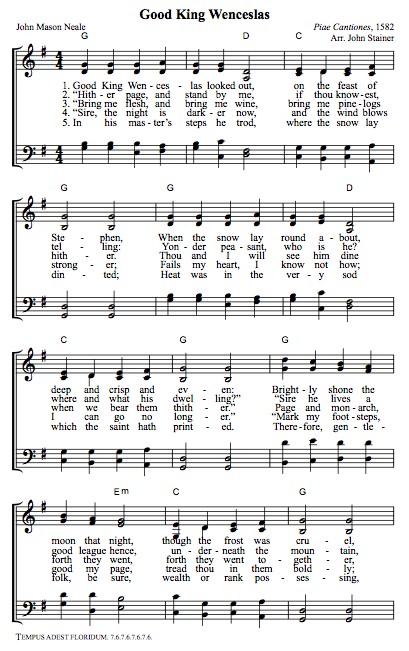
Click on the image below for PDF sheet music of the traditional (copyright-free) four-part arrangement by John Stainer, with guitar chords, and sized correctly to fit into the typical order of service:

GoodKingWenceslas

“We Wish You…”

Every year in our congregation, Paul, one of our resident musicians, teaches the children in grades preK – 3 a couple of Christmas songs. On the day of our No-Rehearsal Christmas Pageant, Paul has the children sing these songs at the beginning of the early service.

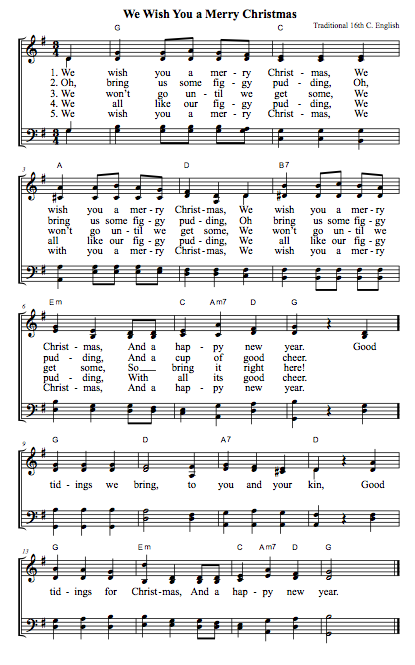
One of the songs Paul usually has the children sing is “We Wish You a Merry Christmas.” Actually, it’s a great song for anyone to sing. I found an old four-part arrangement, simplified it, added guitar chords — and here it is, in a PDF version that’s copyright-free and sized right to go into the typical order of service:

We Wish