My father’s brother died last night; one of my cousins called me today to let me know. This was not unexpected: my uncle had been in hospice care for a couple of months. He went into skilled nursing a week ago. On Thursday, he was insisting he had to get back to his apartment, so he could use his computer and printer. He was entirely coherent, albeit frustrated, and said, “I have things I have to do.” I am not clear what things he had to do; he was a chemist by profession, an expert on raising fish by way of avocation, and had many other interests besides. In any case, he wasn’t strong enough to return to his apartment, and so those things will remain undone.
My cousin asked me if I knew anyone else who should be notified, but I couldn’t think of anyone. We talked it over, but both of us were sure the last of our fathers’ cousins had died a couple of years ago. “That means you’re the oldest male in the family now,” I said to my cousin, but he had already figured that out.
Speaking for myself, I don’t have any interest in taking on the responsibilities of the oldest generation. I have too many things to do. I fully intend to shirk any oldest generation duties that come my way. That’s pretty much the way my uncle and my father carried on after their parents had died, and I see no reason to do anything differently.
For some time, I’ve been thinking about making a lightweight portable stove that burns biomass instead of fossil fuels. Search the Web, and you’ll turn up lots of plans for such stoves — tin can rocket stoves, Canadian candle stoves, etc. But most of the plans I looked at seemed overly complicated and not particularly elegant. Then I stumbled on a video titled “How To Make a Wood Gasifier Stove”: it showed how to make a stove that was simple, even elegant. So tonight I made one.
The basic principle for the “wood gasifier stove” is the same as for a rocket stove: the solid biomass fuel (wood) burns at the bottom of the stove, with another combustion area higher up where rising gases are enabled to burn further. This is supposed to extract more heat from the fuel, and additionally the more complete combustion should result in less crud going into the air and into your lungs. However, where the rocket stove has been tested for greater efficiency by scientists, I know of no such studies for this design; we’ll just take it on faith that this design is probably more efficient than an open fire.
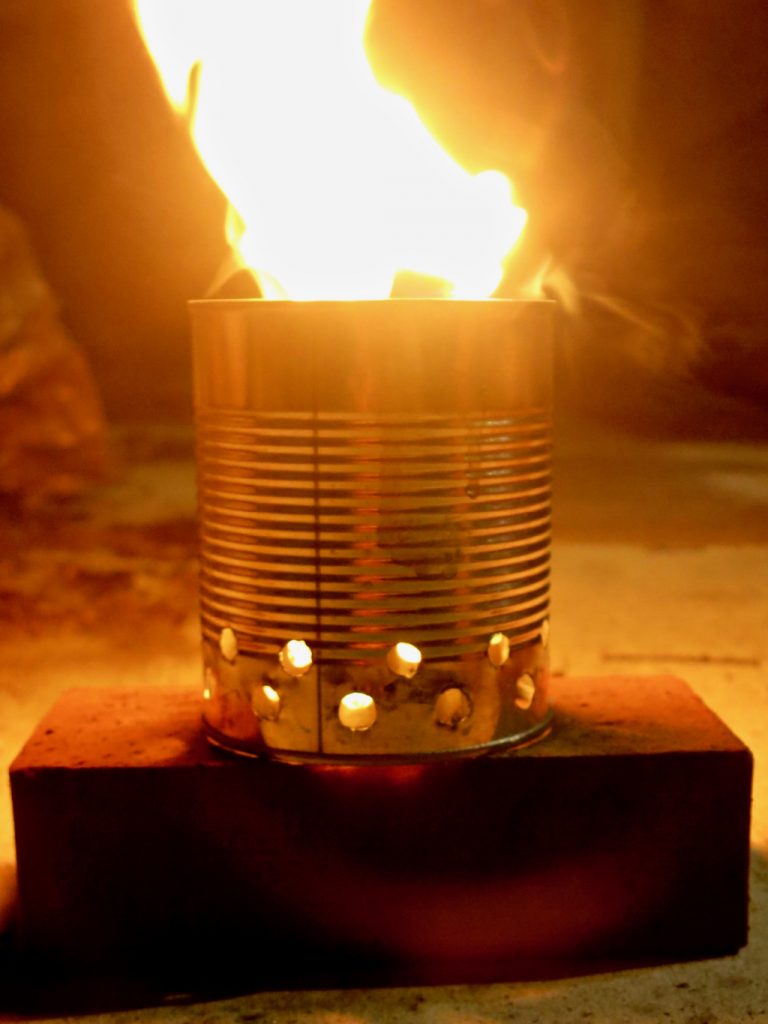
The biomass-burning stove with a fire in it
The stove requires two “tin” cans, one larger than the other: I got a 15 oz. can of pears, and a 29 oz. can of peaches. The smaller can, nested inside the larger can, is where you build the fire. Ventilation holes at the bottom of the larger, outer, can line up with ventilation holes at the bottom of the smaller, inner, can. The smaller can also has a row of ventilation holes near the top; this is where additional air is injected so to make rising gases can burn. If you look carefully at this photo of the stove I made, you can see the upper ventilation holes, with jets of flame coming out where the injected air is igniting rising gases.
Upper ventilation holes in the lit stove
I completed the basic stove in about an hour (including the time it took to eat the pears). The stove is reasonably practical, particularly for car campers or ordinary backpackers (i.e., not those crazy ultralight backpackers). And the stove is environmentally responsible: it’s made with recyclable materials, and it burns biomass instead of fossil fuels like white gas, butane, or propane. Plus, since it’s homemade, it doesn’t feed consumer consumption; and consumerism is a major contributing cause to the pending global environmental disaster.
I still have to make a potholder, to keep the cooking pot a couple of inches above the flames, where the greatest heat should be — but I have to wait until I eat another can of pears. Once I get the potholder made, I’ll post a photo showing something cooking on the stove (and I’ll add a sketch showing how to make one).
Drew asked about a “family tree” for the Unitarian Universalism, and as it happens I had drawn one back in 2003, so I revised it and sent it to him. It might be of interest to others:
Simplified family tree of the Unitarian Universalism
This family tree is based on a revisionist interpretation of Unitarian Universalist history, and therefore some explanation is in order.
First, this family tree shows Transylvanian Unitarianism as quite separate from North American Unitarianism. This is based on my reading of Earl Morse Wilbur’s history of European Unitarianism; Wilbur dearly wanted to connect Transylvanian and North American Unitarians, but the few connections he documents may be summed up as: maybe a few English-speaking Unitarians read a few books about Transylvanian Unitarianism. When you look at the two Unitarian groups today, some of the differences are more pronounced than the vague theological similarities: the Transylvanians have bishops, their religion seems more narrowly ethnic, etc. Thus, I depict the two groups as quite separate.
I understand North American Unitarianism and Universalism as being reactions against aspects of Calvinism. Thus I show both groups as having roots in Calvinism.
North American Unitarians came in large part from the New England Standing Order churches; there wasn’t enough room to show the small but important influence of Joseph Priestley and a few other early Unitarians who brought their Unitarianism from England, rather than getting it from Boston. Thus I show the major event in the beginning of North American Unitarianism to be the split between the conservatives — people like Jonathan Edwards — and the liberals — people like Charles Chauncy, a split which took place after the Great Awakening. However, the first openly Unitarian congregation in North America was King’s Chapel; originally affiliated with the Church of England, it became Unitarian in 1785, long before any of the Standing Order churches openly declared themselves to be Unitarian.
The beginnings of North American Universalism are a little more tangled. John Murray and George DeBenneville brought their Universalist beliefs from England when they came to live in the coastal cities of the New World; that history is well known. But there’s another history, well documented by scholar Stephen Marini and others, of how Universalism also arose in central New England, often in formerly Baptist churches. Thus I show Universalism as having some roots in Baptist traditions; this is perhaps most evident in the institutional structures (or lack thereof) of early Universalism. Then too, it is important to mention John Murray’s marriage to Judith Sargent; she came from a prominent and wealthy New England family, and both her family connections and her own intelligence contributed a great deal to John’s eventual success as a Universalist standard-bearer.
By about 1825, both Unitarians and Universalists were well established in North America. But the boundaries of both denominations remained somewhat porous. In the early nineteenth century, Unitarians sometimes cooperated with the Christian Connexion denomination (not show in the family tree). In the late nineteenth century, a small group of ministers split from the Unitarians to form the Free Religious Association, and in a few cases they brought their congregations with them; some of those congregations reportedly never rejoined the Unitarian denomination (though I’ve never been able to document that myself). Then around 1900, some Icelandic Lutheran churches in the prairie provinces of Canada switched to the Unitarian denomination; at least one other formerly Lutheran church, Nora Church in Hanska, Minnesota, also joined the Unitarians.
However, Unitarian boundaries were not completely porous. When William Jackson, an African American Baptist minister, tried to join the American Unitarian Association in 1860, bringing his congregation with him, he was carefully kept out.
In Universalism, the porous boundaries become most evident in the late nineteenth century, a time when many Universalists became enamored with spiritualism. Then spiritualism became an organized religion, and some Universalists, such as minister John Murray Spear, left Universalism to become Spiritualists. But again, the boundaries of Universalism were not completely porous. A splinter group of Primitive Baptists (Baptists who, among other things, refuse to have musical instruments in church, relying instead on a capella singing) adopted Universalist beliefs, probably after having read books by Hosea Ballou, the great Universalist theologian. But there has been very little interest in exploring the commonalities between Primitive Baptist Universalists (PBU) and Universalists, or for that matter Unitarian Universalists (the PBU-UU connection between may seem more robust theologically than the connection between Transylvanian and North American Unitarians; but the class difference is far greater).
As for the racial boundaries of Universalism, they were slightly more porous than those of the Unitarians. The Universalists accepted Joseph Jordan, an African American and former Baptist minister, into fellowship and ordained him in 1889. However, the racial boundaries were not all that porous: there remained little denominational support for African American Universalists outside of a couple of congregations in Virginia, and individual Universalist congregations in the South remained explicitly segregationist up into the mid-1960s.
The late nineteenth century saw a growing number of connections between Unitarians and Universalists ; this is symbolized on the family tree by Eliza Tupper Wilkes; she was ordained a Universalist minister, but worked for both groups at different times, and founded both Universalist and Unitarian congregations. There were also strong connections between both the Unitarians and the Universalists with the Congregationalists. During the early twentieth century, there were Universalist congregations that merged into Congregationalist congregations, and both Universalist and Unitarian congregations that federated with Congregationalist congregations. Some of the federated congregations still exist; they are one congregation in real life, but on paper they also exist as two separate congregations, and when you join a federated congregation you decide if you’re joining as, e.g., a Congregationalist or a Unitarian.
In 1961, the Unitarians and the Universalists consolidated (the legal term is “consolidated,” not “merged”). This now seems inevitable to us here in North America, but groups like the Khasi Hills Unitarians in India, or the Universalist churches in the Philippines, had no corresponding group to merge with.
Finally, it is worth remembering that several features of contemporary North American Unitarian Universalism which today seem diagnostic in helping to identify who’s a Unitarian Universalist are actually recent innovations. The “seven principles,” the widespread use of the flaming chalice in worship services, the water communion service — all these grew out of the feminist revolution of the 1980s, a revolution led by people like Natalie Gulbrandsen. Feminist theology has helped drive us further away from groups like the Primitive Baptist Universalists, while driving us closer to the United Church of Christ (UCC), a very liberal Christian group that is the inheritor of the old conservative New England churches from which the Unitarians split in the early nineteenth century. The UCC and the UUA today are close religious relatives, sociologically, politically, and demographically. The UCC and the UUA cooperated to produce the innovative “Our Whole Lives” comprehensive sexuality education program; politically, UCC churches are often to the left of UU churches; demographically both groups a dominated by white college-educated professionals. The only big difference today is that more UCC members believe in God than do Unitarian Universalists; though that too may be changing, as a friend of mine who’s a UCC minister says that most of the children and teens in her church are professed atheists.
Another in a series of stories for liberal religious kids, this one from the Mahabharata. Adapted from The Indian Story Book: Containing Tales from the Ramayana, the Mahabharata, and Other Early Sources, by Richard Wilson (London: Macmillan & Co., 1914).
One day, near the end of their long exile in the forest, King Yudhisthira and his four brothers were searching for a mysterious deer which had stolen the wooden blocks which a Brahmin needed so he could light the sacred fire. The king and his brothers wandered deeper and deeper into the forest trying to find the deer. They grew more and more thirsty, but they were unable to find water. At last they all sat down, exhausted, beneath a tall tree.
“If we do not find water soon, we shall surely die,” said Yudhisthira He turned to his brother Nakula. “Brother,” he said, “climb the tree for us and see if you can spot water nearby.”
Nakula quickly climbed the tree, and in a few moments called down, “I see trees which only grow near running water, and there I hear the sound of cranes, birds which love the water.”
“Take your quiver,” said Yudhisthira. “Go fill it with water, and bring it back to quench our thirst.”
Nakula set out, and quickly found a small stream which widened into a pool of clear water with a crane standing on the far side.
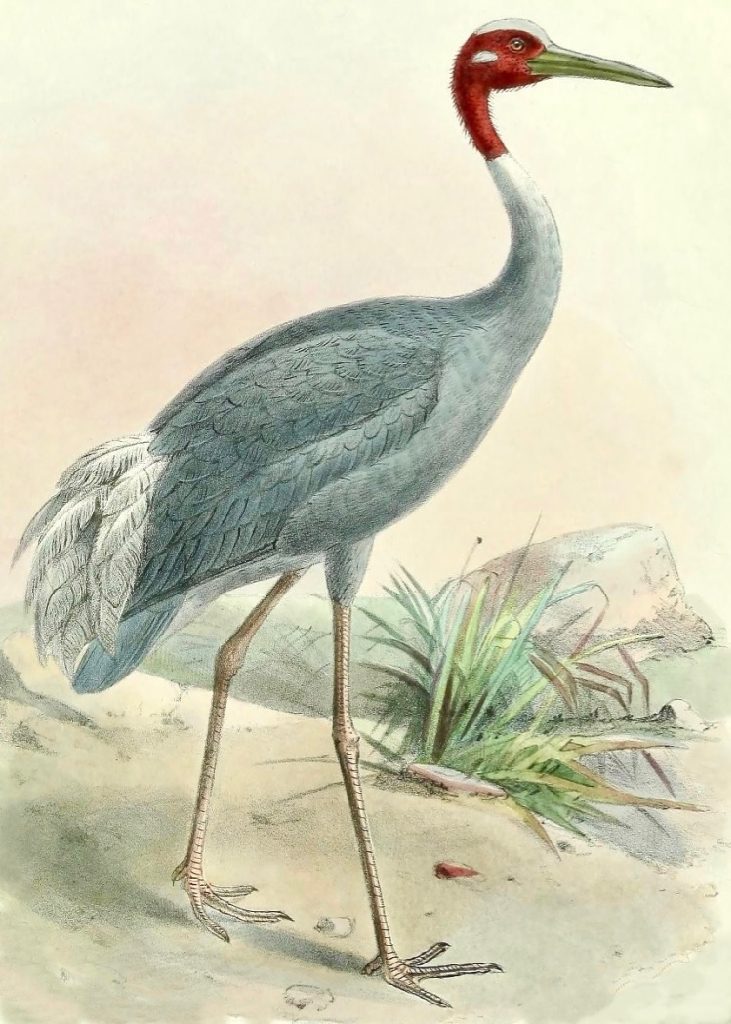
A Sarus Crane (Antigone antigone). Public domain image.
Nakula knelt down at the edge of the pool to drink. Suddenly a stern Voice spoke: “Do not drink, O Prince, until you have answered my questions.”
Nakula was so thirsty he ignored the Voice, and drank eagerly from the cool water. In a few moments he lay dead at the edge of the pool.
The other four brothers waited patiently Nakula’s return. At last Yudhisthira said, “Where can our brother be? Go, Sahadeva, find your brother, and return with a quiver full of water.”
Sahadeva walked off through the forest. Soon he found Nakula lying dead at the edge of the pool. But he was so thirsty that he did not stop, but knelt down at the pool to drink.
The stern Voice spoke: “Do not drink, O Prince, until you have answered my questions.”
But Sahadeva had already drunk from the water, and lay dead at the edge of the pool.
Once again the remaining brothers waited patiently. At last Yudhisthira spoke to his brother Arjuna, the mighty archer. “Go, Arjuna,” he said, “find our brothers, and return to us with a quiver full of water.”
Arjuna slung his bow over his shoulder, and with his sword at his side walked to the pool. When he saw his brothers lying dead among the reeds, he fitted an arrow to his bow while his keen eyes pierced the darkness of the forest searching for the enemy who had killed them. Seeing neither human nor wild beast, at last he knelt down at the edge of the pool to drink.
The stern Voice spoke: “Do not drink, O Prince, until you have answered my questions.”
Prince Arjuna looked about him. “Come out,” he cried, “and fight with me.” He shot arrows in all directions, but the Voice only laughed at him, and repeated its command.
But Arjuna ignored the Voice, knelt and drank, and soon lay dead at the edge of the pool.
Yudhisthira waited patiently, but when Arjuna did not return, the king turned to Bhima. “Go,” he said, “find our brothers, and return with them and a quiver full of water.”
Bhima silently rose, walked to the pool, and found his brothers lying dead. “What evil demon has killed my brothers,” he thought to himself, looking around. But he was so thirsty he knelt to drink.
Again the stern Voice spoke: “Do not drink, O Prince, until you have answered my questions.”
Bhima had not heard the Voice, and so he lay dead next to his brothers.
Yudhisthira waited for a time, then went himself to find water.
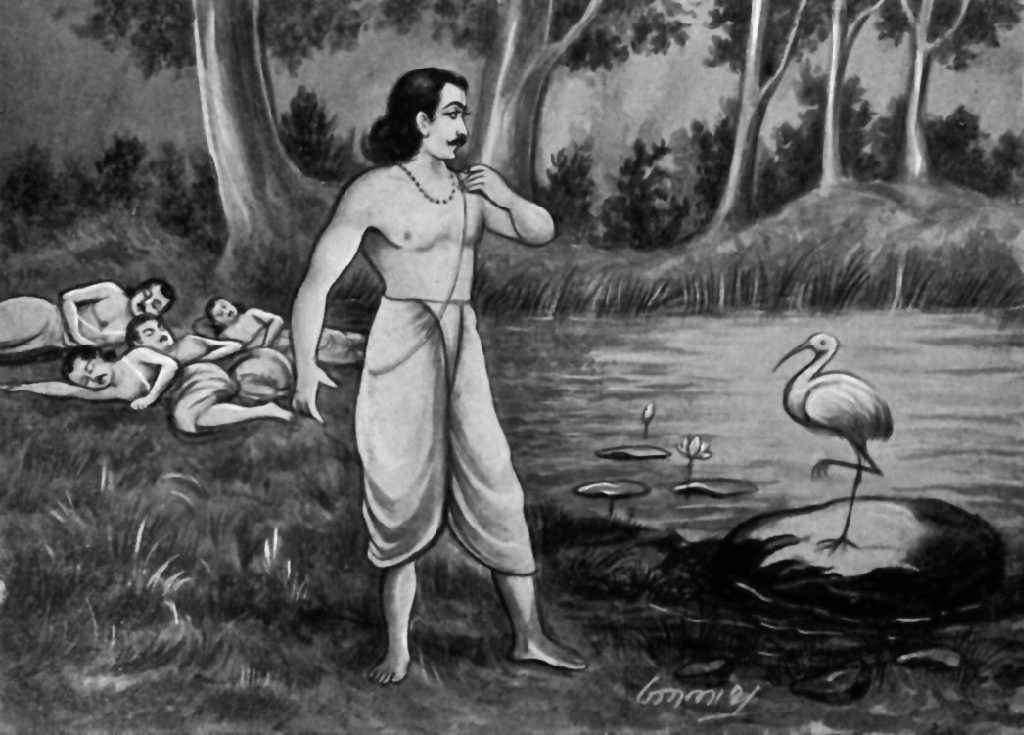
When he came to the pool, he stood for a moment looking at it. He saw clear water shining in the sunlight, lotus flowers floating in the water, and a crane stalking along the edge of the pool. And there were his four brothers lying dead at the edge of the pool.
Even though he was terribly weak and thirsty, he stopped and spoke aloud the name of each of his brothers, and told of the great deeds each had done. He spoke out loud his sorrow for the death of each one.
“This must be the work of some evil spirit,” he thought to himself. “Their bodies show no wounds, nor is there any sign of human footprints. The water is clear and fresh, and I can see no signs that they have been poisoned. But I am so thirsty, I will kneel down to drink.”
Yudhisthira and the crane (public domain image)
As King Yudhisthira knelt down, the Voice took the shape of a Baka, or crane, a gray bird with long legs and a red head. The Baka spoke to him in a stern voice, saying:
“Do not drink, O King, until you have answered my questions.”
“Who are you?” said Yudhisthira boldly. “Tell me what you want.”
“I am not a bird,” said the Baka, “but a Yaksha!” And Yudhisthira saw the vague outlines of a huge being above crane, towering above the lofty trees, glowing like an evening cloud.
“It seems I must obey, and not drink before I answer your questions,” said the king. “Ask me what you will, and I will use what wisdom I have to answer you.”
So the questioning began:
The Yaksha said: “Who makes the Sun rise? Who moves the Sun around the sky? Who makes the Sun set? What is the true nature of the Sun?”
The King replied: “The god Brahma makes the sun rise. The gods and goddesses move the Sun around the sky. The Dharma sets the Sun. Truth is the true nature of the Sun.”
The Yaksha asked: “What is heavier than the earth? What is higher than the heavens? What is faster than the wind? What is there more of than there are blades of grass?”
The King replied: “The love of parents is both heavier than earth and higher than the heavens. A person’s thoughts are faster than the wind. There are more sorrows than there are blades of grass.”
The Yaksha asked: “What is it, that when you cast is aside, makes you lovable? What is it, that when you cast it aside, makes you happy? What is it, that when you cast it aside, makes you wealthy?”
The King replied: “When you cast aside pride, you become lovable. When you cast aside greed, you become happy. When you cast aside desire, you become wealthy.”
The Yaksha asked: “What is the most difficult enemy to conquer? What disease lasts as long as life itself? What sort of person is most noble? What sort of person is most wicked?”
The King replied: “Anger is the most difficult enemy to conquer. Greed is the disease that can last as long as life. The person who desires the well-being of all creatures is most noble. The person who has no mercy is most wicked.”
The questions went on and on, but Yudhisthira was able to answer them all, wisely and well.
At last the Yaksah stopped asking questions, and revealed its true nature: the Yaksha was none other than Yama-Dharma, the god of death, and the father of Yudhisthira.
Yama-Dharma said, “It was I who took on the shape of a deer and stole the wooden blocks so the Brahmin could not light the sacred fire.
“Now you may drink of this fair water, Yudhisthira! And you may choose which of your four brothers shall be returned to life.”
“Let Nakula live,” said Yudhisthira.
“Why not Bhima or Arjuna or Sahadeva?” said Yama-Dharma.
“My brother Nakula is the son of Madri,” said the King, “while Arjuna, Bhima, Sahadeva and I are the sons of Kunthi. If Nakula returns to life, then both my mothers, both Madri and Kunthi, will have a living child. Therefore, let Nakula live.”
Then Yama-Dharma spoke kindly as he faded away. “Truly you are called ‘The Just,” he said. “Noblest of kings and wisest of all persons, for your wisdom and your love and your sense of justice, I shall return all of your brothers to life.”
More riddles — Here are two dozen more of the riddles that Yama-Dharma asked of Yudhisthira:
1. How may a person become secure? — A person becomes secure through courage. 2. How may a person become wise? — A person gains wisdom by living with people who are wise 3. What is best for the Brahmans (those who pursue learning as their life’s work)? — Studying the Vedas, the holy books, is best for the Brahmans. 4. What is best for the Kshathriyas (those who are the warriors and defenders)? Weapons are best for the Kshathriyas. 5. What is best for farmers? — Rain is best for farmers. 6. Who does not close their eyes when sleeping? — Fish do not close their eyes when sleeping. 7. What does not move even after birth? — Eggs do not move even after birth. 8. What does not have a heart? — A stone does not have a heart. 9. What grow as it goes? — A river grows as it goes to the sea. 10. Who is the guest who is welcome to all? — Fire is the guest who is welcome to all. 11. Who travels alone? — The Sun travels alone. 12. Who is born again and again? — The Moon is born again and again. 13. What container can contain everything? — The Earth can contain everything. 14. Out of all things, what is best? — Out of all things, knowledge gained from wise people is best. 15. Out of all blessings, what is best? — Out of all blessings, good health is best. 16. Out of all pleasures, what is best? — Out of all pleasures, being contented is best. 17. Out of all just actions, which is best? — Out of all just actions, non-violence is best. 18. What must a person control in order to never be sad? — A person must control their mind in order to never be sad. 19. What will a person never be sad to leave behind? — A person will never be sad to leave behind anger. 20. What should a person leave behind to become rich? — A person should leave behind desire in order to become rich. 21. What should a person leave behind to be have a happy life? — A person should leave behind selfishness to have a happy life. 22. By what is the world covered? — The world is covered by ignorance. 23. Why doesn’t the world shine brightly? — Bad behavior keeps the world from shining brightly. 24. What is surprising? — It is surprising that we think of ourselves as stable and permanent, when every day we see beings dying.
Illustrations are from the following public domain sources (accessed through the Internet Archive): Sarus Crane, H. E. Dresser, “A History of the Birds of Europe,” London: 1871-1881. Yudhistira and the crane, Mahabharata, Gorakhpur, India: Geeta Press, n.d.
Today, the owner of the goats came to pick them up. He and his helper backed the goat trailer up to where the goats were penned in. While the humans were dismantling the electric fence, they let the goats munch on a few last weeds. The herd dog stayed in the goat trailer, waiting until he might be needed.
Goats getting ready to go home. Photo courtesy Carol Steinfeld.
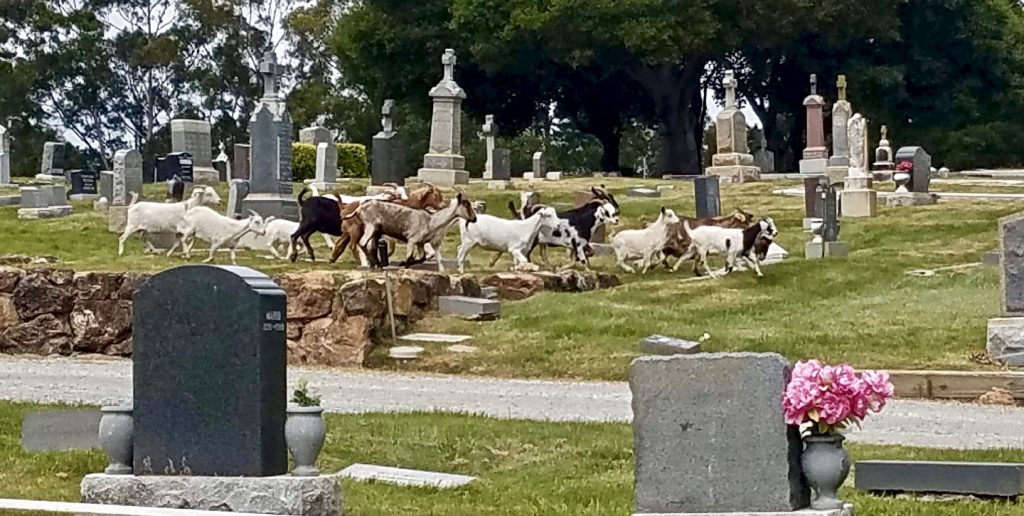
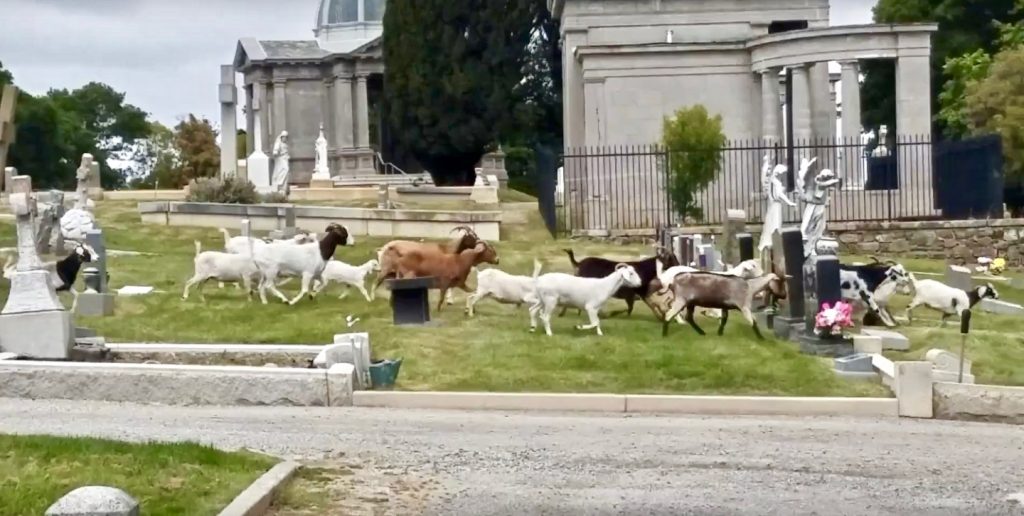
But the goats, being goats, wanted more to eat. The electricity had been turned off in the fence, and the goats found a small opening they could sneak out of. Carol looked up from her laptop and suddenly saw a couple of goats in the small cemetery parking lot. We went out to see what we could do, but the goats paid no attention to us. Then more goats came out. Pretty soon, all the goats were out. Carol called the cemetery superintendent so the superintendent could call the goatherds on their cell phones. By now, the goats were moving in a bunch across the cemetery, cropping grass as they went.
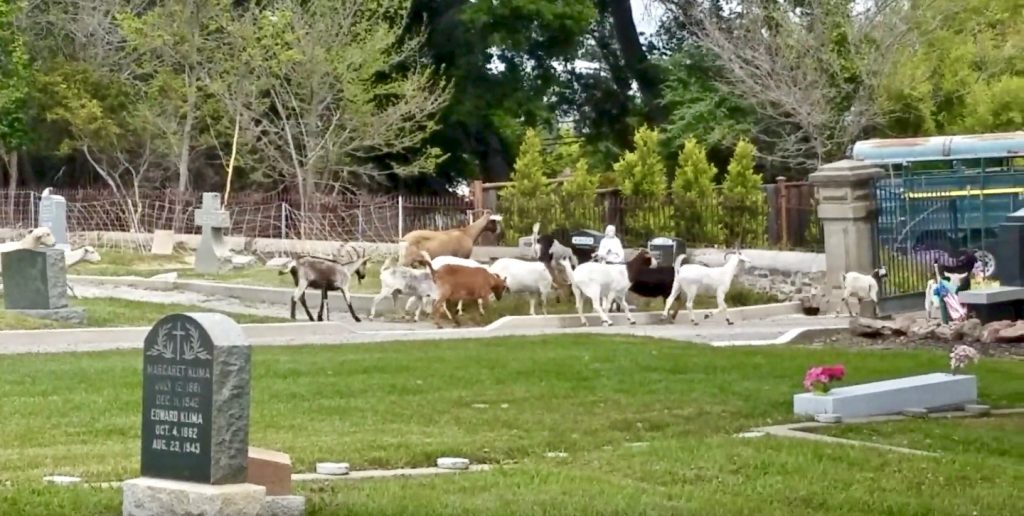
Soon one of their humans showed up, and he got the herd dog. Between the two of them, the human and the dog got the goats moving back towards the trailer. The goats would try to break away — all that lovely grass, just waiting for them! — but the dog would run quick as lightning and head them off, with his human partner cutting off any chance of retreat. At last the goats broke into a trot and ran towards the trailer.
Goats in retreat. Photo courtesy Carol Steinfeld.Goats breaking into a trot. Photo courtesy Carol Steinfeld.Goats heading back to the trailer. Photo courtesy Carol Steinfeld.
Carol watched the action from inside the cemetery, while I and one of the cemetery gardeners stood in the parking lot, both to try to keep the goats from escaping into the streets of San Mateo, and to make sure any visitors who drove in didn’t run over a goat. We weren’t really needed, though; the herd dog and his human quickly had the goats under control.
Soon enough, all the goats were back in a fenced-in area, ready to be loaded in their trailer. Carol and I went back inside, and opened up our laptops. It didn’t last long, but the goats’ breakout provided a dramatic finale to their stay at the cemetery.
Yesterday would have been Pete Seeger’s one hundredth birthday, had he not died in 2014. In preparation for a Pete Seeger sing-along at church tomorrow, I’ve been reading through the songs in his books “The Bells of Rhymney” and “Where Have All the Flowers Gone, listening to some of his recordings, and reflecting on his legacy.
He is often remembered as a songwriter, but as a song writer he was at his best when he collaborated with others. “The Hammer Song,” one of his most notable songs, was co-written with Lee Hays, who recalled that the song was written “in the course of a long executive committee meeting of People’s Songs” during which “Pete and I passed manuscript notes back and forth until I finally nodded at him and agreed that we had the thing down” (quoted in Doris Willens, Lonesome Traveler: The Life of Lee Hays [New York: W. W. Norton, 1988], p. 88) — then several years later, the melody of “The Hammer Song” was modified to its most recognizable version when it was recorded by Peter, Paul, and Mary. “Where Have All the Flowers Gone,” while it was written solely by Seeger, has lyrics which are derived from a Cossack folk song. “The Bells of Rhymney” gets lyrics from a poem by Idris Davies. “Turn, Turn, Turn” takes its lyrics from the Biblical book of Ecclesiastes.
Of the songs which Seeger wrote entirely by himself, both words and music, the best is “Waist Deep in the Big Muddy”; though written about the Vietnam War, the song holds up today (especially if you leave out the sixth verse in which Seeger claims he’s “not going to point any moral,” then does so with a heavy hand). Most of the rest of Seeger’s songs are either forgettable, like “Maple Syrup Time,” a folk music pastorale with sentiments as sickly sweet as the title suggests — or hard to sing, like “Precious Friend” with its awkward rhythm and high notes reachable only by tenors and sopranos.
Seeger was better as an interpreter and transmitter of traditional songs, as well as songs written in a folk style. He was not impressed by the tradition of Western classical music, and instead dedicated himself to the folk tradition, the tradition of “people’s songs.” As he recalled in his memoir Where Have All the Flowers Gone: A Singalong Memoir:
“My violinist mother once said, ‘The three Bs are Bach, Beethoven, and Brahms.’ I retorted, ‘For me, they are ballads, blues, and breakdowns.'” (p. 205)
He loved the folk tradition, and had an encyclopedic knowledge of traditional and traditional-sounding songs — mostly from the Anglo-American and African-American folk song traditions, but he also knew a lot of songs from other traditions. There are many instances where he helped transmit an obscure song into wide popularity. “Wimoweh” is a perfect example of this. In 1948, Alan Lomax gave Seeger a hit record from South Africa titled “Mbube,” written by a Zulu sheepherder named Solomon Linda. Seeger transcribed the music from the recording, misunderstanding the Zulu word “mbube” as “Hey yup boy,” taught it to a newly-formed quartet called The Weavers, and their recording of it hit no 6 on the Hit Parade. Then in 1958, another group, The Tokens, adapted the song further, calling it “The Lion Sleeps Tonight.”
Seeger particularly liked folk songs, or folk-like songs, with a political message. The one solo recording of his that made it onto the charts was his version of his friend Malvina Reynolds’ song “Little Boxes,” a song that protested the conformity of suburbia. Reynolds included the song in her collection of children’s songs, and for me “Little Boxes” is at its best as a silly sing-along kids’ song. Seeger’s interpretation of the song has a harsher bite to it. I suspect Tom Lehrer had Seeger’s interpretation of the song in mind when Lehrer called “Little Boxes” “the most sanctimonious song ever written” (quoted in Christopher Hitchens, “Suburbs of Our Discontent,” The Atlantic, December, 2008). Seeger was an angry man: angry as the way the Hudson River had been polluted and exploited, angry at the way workers and union members were exploited, angry at the way Congressman Joe McCarthy used red-baiting to silence leftists, angry at the maltreatment of African Americans, angry at all kinds of injustice. He sang songs that helped channel his anger into changing the world for the better. Seeger identified with the poor and down-trodden; yet at the same time he never managed to lose his upper-class accent, though he tried to obscure it by pronouncing “-ing” as “-in,” and frequently dropping the first-person singular pronoun.
That combination of affected upper-class accent and an identification with the working class still grates on me, and sometimes makes me want to call Seeger sanctimonious. He was a little too sure of his ethical stands, and a little too quick to condemn others. A perfect example of this is when he quit the Weavers. Lee Hays recalled:
“It came out in the guise of going ahead to do something pure and noble, which had the effect of making the rest of us feel guilty as hell for going on, as if we were doing something wrong…. He just walked out on us, and it was a terrible blow.” (quoted in Doris Willens, Lonesome Traveler: The Life of Lee Hays [New York: W. W. Norton, 1988], p. 182)
Hays went on to acknowledge Seeger’s “fantastic accumulation of songs”; when Hays first met him, Seeger knew more than 300 songs, ready to sing and play. Seeger’s political activism, coupled with his extremely high moral standards, are an important part of his legacy, but his true genius lies in his passion for song.
And crucial to Seeger’s genius was his dedication to getting groups of people to sing. Seeger was moderately good performer (though he abused his voice and don’t imitate his vocal style unless you want to ruin your voice), but his talent was small compared to someone like Leadbelly or Woody Guthrie — but he was a genius as a songleader. Seeger didn’t just sing his songs and get off stage; he wanted you to sing along with him, so the song became a part of you. Listen to his concert recordings, and you will hear how he got people to sing freely and unselfconcisously. I heard him sing at several political rallies and demonstrations during the 1980s, and he was brilliant at energizing the crowd by getting us singing; this was a distinct contrast with other singers who treated those political rallies as performances.
But Seeger’s dedication to getting people to sing for themselves is best exemplified, not in his live performances — which were performances after all — but in his tireless dedication to giving people the tools to sing and play for themselves. His modest 1948 booklet “How To Play the Five-String Banjo” popularized that instrument to an entire generation. He was the guiding genius behind “Sing Out” magazine, a magazine which each month contained a few songs that you could learn to sing and play yourself. And it was his encouragement that got the popular sing-along songbook Rise Up Singing published and popularized.
So I remember Pete Seeger, not as a songwriter or performer, but as someone who urged us all to sing. For that gift, I can forgive him his sanctimoniousness, and I can forgive him all the sublimo-slipshod songs he wrote. He was a genius at getting us to sing. And singing, for Seeger, was a way for us to make the world a better place; to energize us so we could do the work that needs to be done; to nurture and grow a community founded on harmony and love.
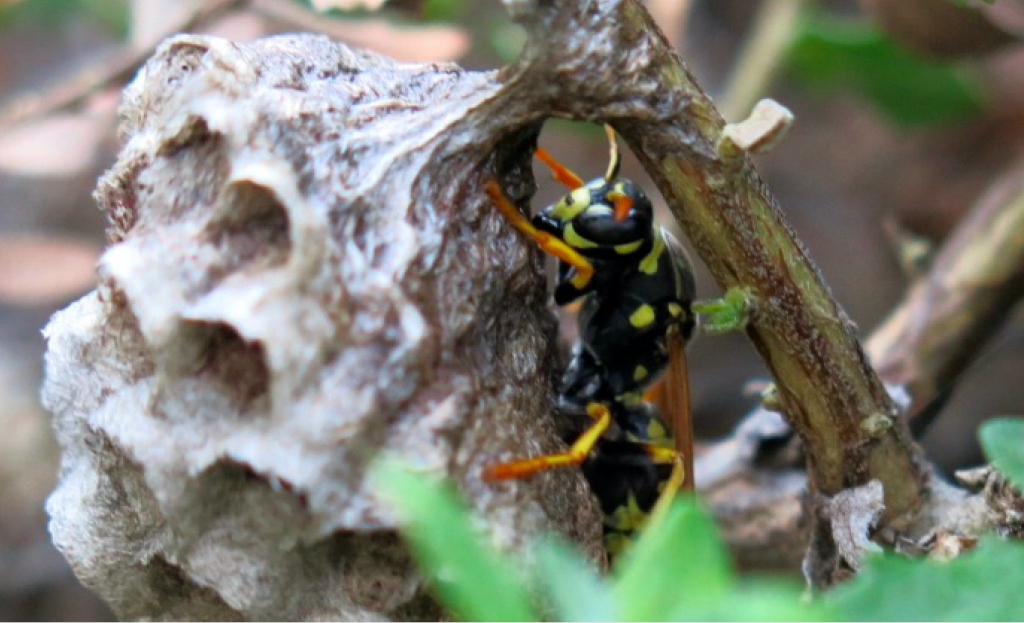
This evening, I went out to look at the paper wasp nest that is well-hidden in the native plants garden at the church. I’ve learned that in the hour before sunset, the founder wasp rests herself on the nest, between the nest and its supporting twig, just below the petiole. And that’s exactly where she was when I got out there.
My camera is a good tool for getting a close look at her without getting too close; I have a healthy respect of wasps and have no desire to provoke her into stinging me. Looking at the photos I took of her, it looks like she has added some cells to the nest. The light began fading rapidly while I was taking photos, and it wasn’t long before the camera would no longer focus on the nest; as a result, I didn’t get any photos looking into the ends of the cells, so I’m not sure whether the cells contain any eggs or larvae.
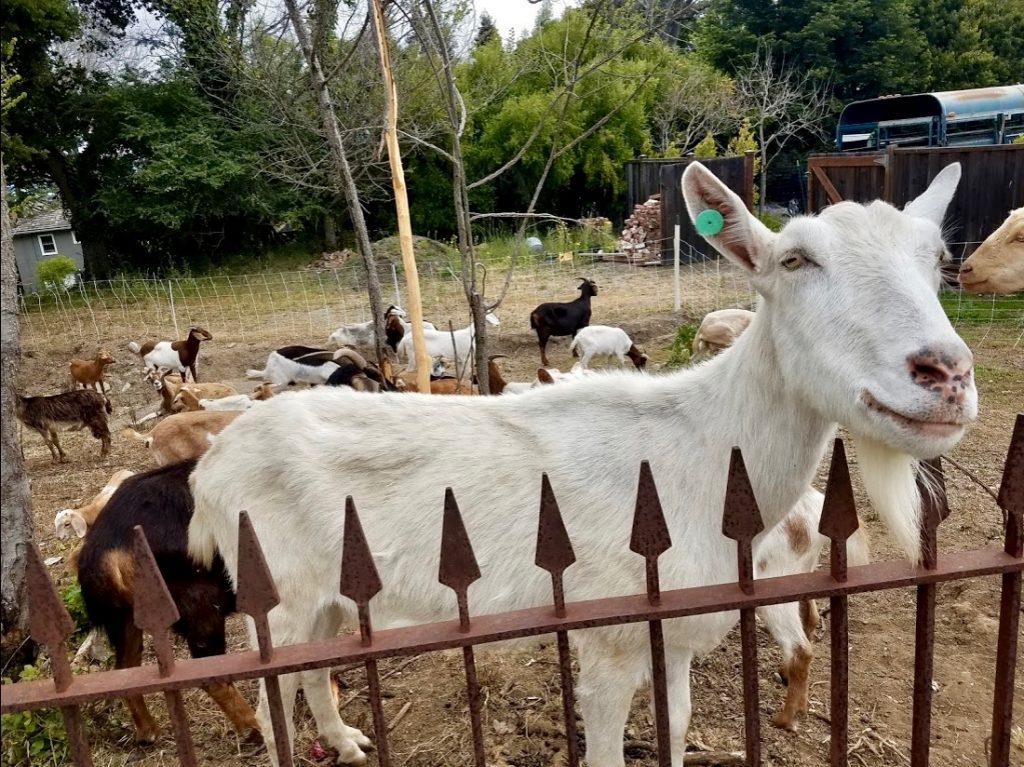
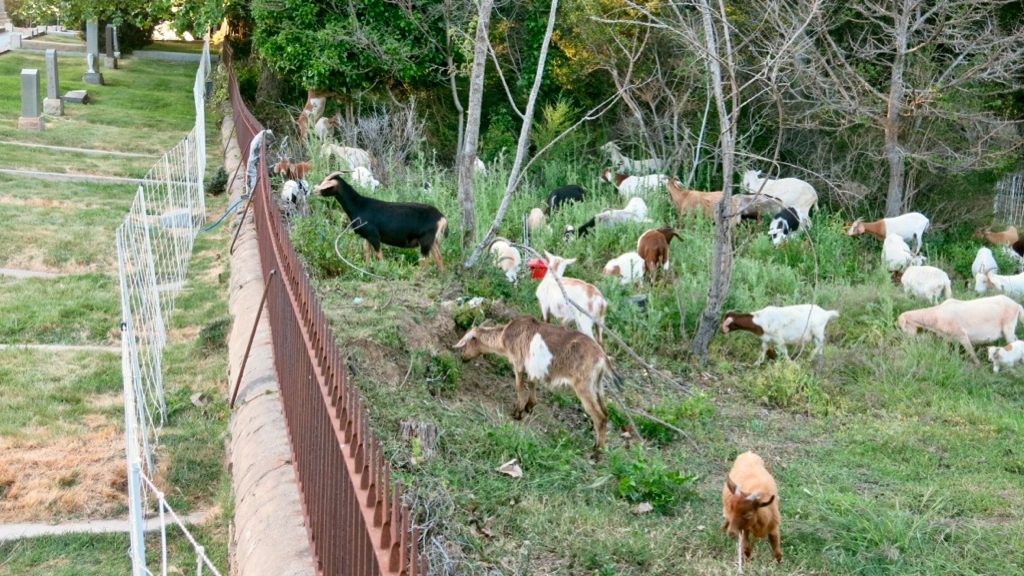
St. John’s Cemetery, where we live, owns a strip of land between the actual cemetery and an adjacent residential neighborhood. This strip of land, while attractive, has gotten overgrown with undesirable plants like Russian thistle and poison oak. As an environmentally friendly way to control these undesirable plants, Kathy, the cemetery director, brought in Green Goat Landscapers.
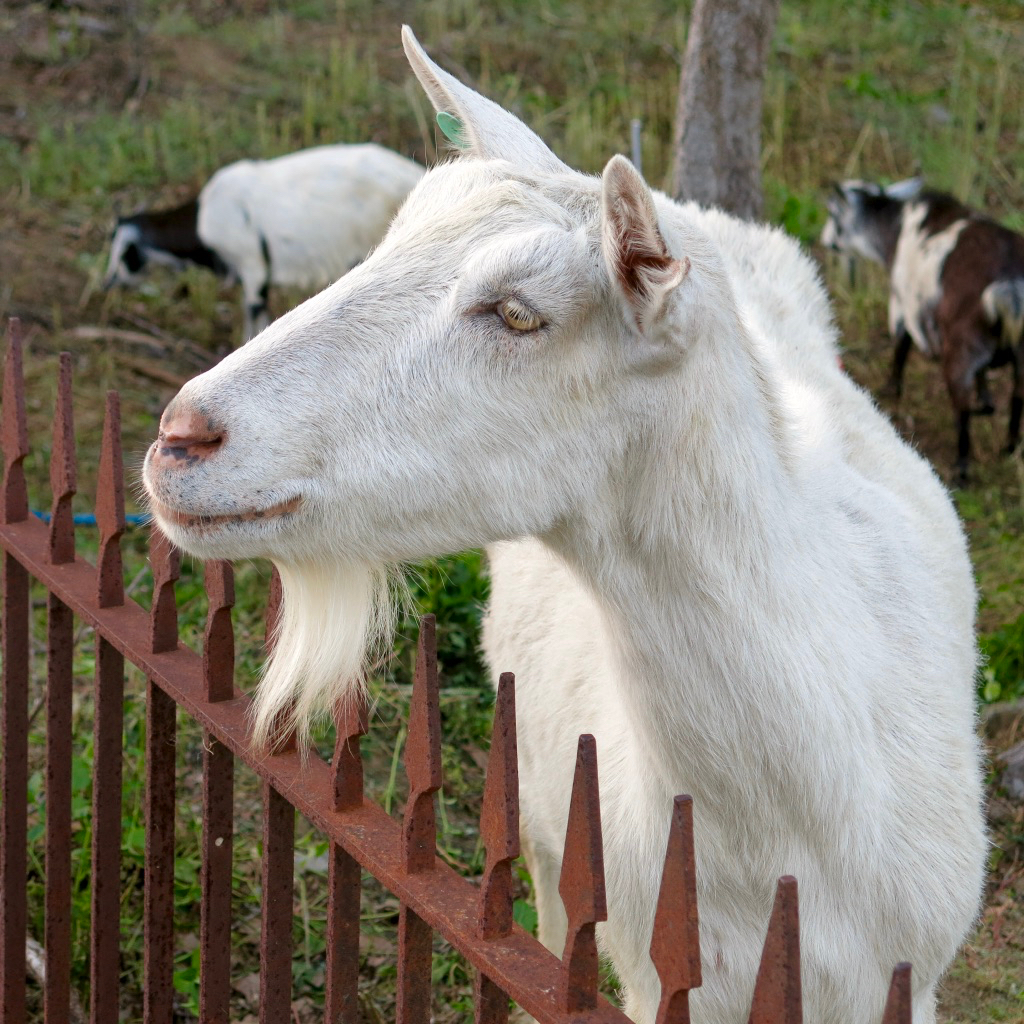
The goats arrived this afternoon, and I went out to look at them this evening. They are safely installed behind a temporary electric fence — the fence not only keeps the goats in, it also keeps any roaming mountains lions out (and yes, mountain lions have been seen in the cemetery).
I found it very satisfying to stand and watch the goats. Perhaps I had distant ancestors from Eurasia who herded animals, and I still have some ancestral memory of that. More likely, it’s just that herd animals and humans spent a lot of time with each other, and while we humans domesticated goats, the goats for their part also domesticated us.
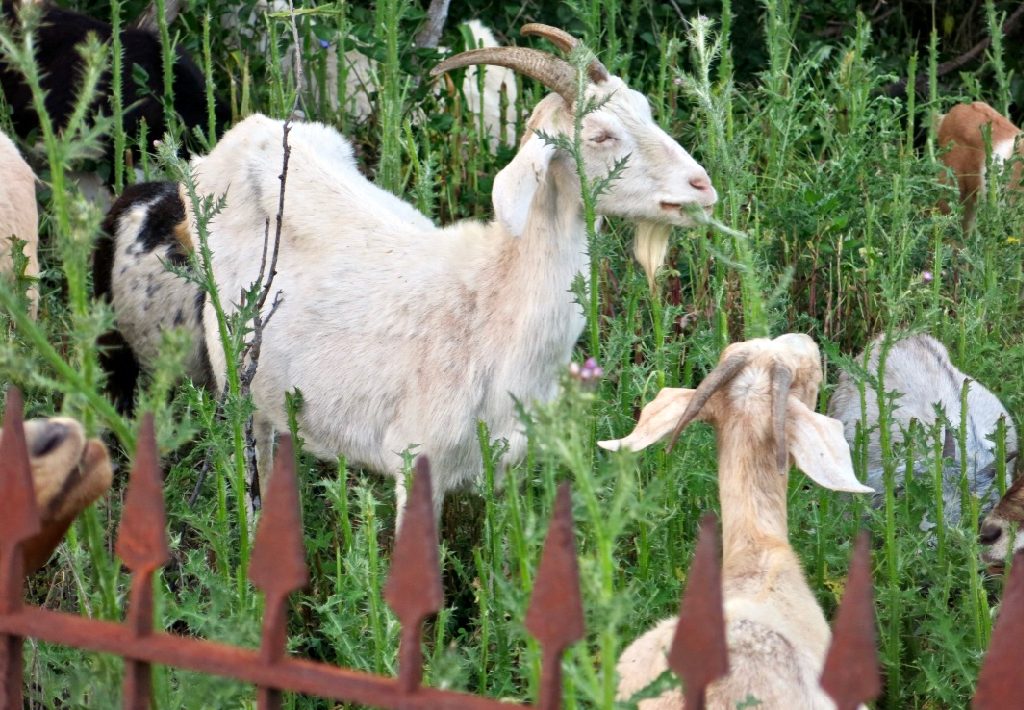
Eventually computers will domesticate us in different ways, but at the moment we humans are still closer to goats than to computers. I stood watching the goats eat the thistles. They didn’t seem to mind the prickles on the thistles; their facial expressions showed no signs of pain; only contentment.
I stood watching the goats for quite a while, and had a brief fantasy about being a goatherd. But goatherding is even less remunerative than being a children and youth minister, so I went indoors to check email.
Veronika sent a photo of hymn number 736 in Anglican Hymns Old and New, Revised and Enlarged (Great Britain: Kevin Mayhew, 2008). The hymn is titled “The Wolrd Is Full of Smelly Feet.” Of course I thought it was a faked photo, but a little bit of Web searching reveals that it is, in fact, a real hymn with text by by Michael Forster, and music by Christopher Tambling.
I suppose if one is in a Christian church with a liturgical heritage, and one is looking for a contemporary praise-song-type hymn to sing during footwashing, one might consider having the congregation sing this; although it’s hard to imagine.
But then my Web searching revealed that this hymn is included in a collection for junior choirs, and that boggled my mind. If the junior choir I was in sang this song — which we wouldn’t have, since it was a Unitarian Universalist church — but if we had been told to sing that song, my buddy Barry and I would have been laughing so hard we probably would have been unable to sing. Maybe some of the serious older girls would have sung it, but I can’t even imagine them getting through the lyrics with a straight face.
I am sometimes annoyed by some of the hymns in the Unitarian Universalist hymnals. It is good to know that we, at least, do no have a hymn to smelly feet.
For educational purposes, and in the spirit of Maundy Thursday, I’ll include the chorus and two of the verses here. I think you’ll especially enjoy the unexpected rhyme between “toes” and “nose.”
Chorus: The world is full of smelly feet, Weary from the dusty street. The world is full of smelly feet, We’ll wash them for each other.
Jesus said to his disciples, ‘Wash those weary toes! ‘Do it in a cheerful fashion, ‘Never hold your nose!
We’re his [Jesus’] friends, we recognise him In the folk we meet; Smart or scruffy, we’ll still love him, Wash his smelly feet!