We live in times when it is worth looking at the way old white guys in power cloak themselves with words. They also surround themselves with expensive ties, expensive watches, expensive haircuts — but their words are the primary tools they use in wielding power.
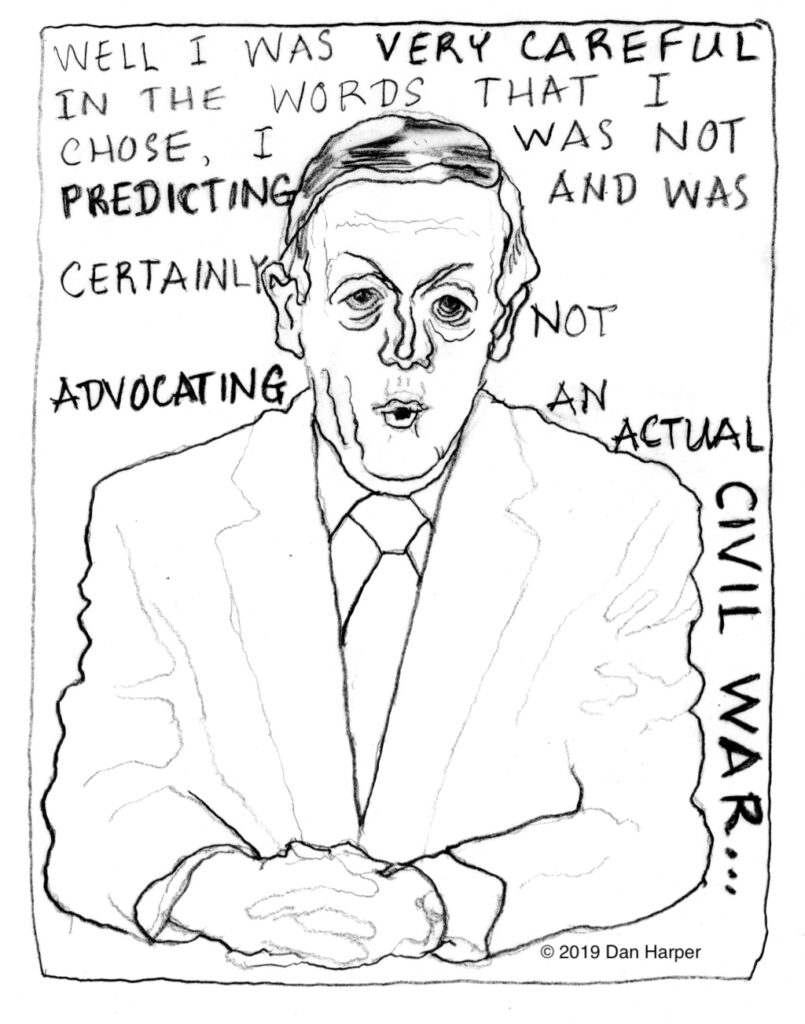
Rev. Robert Jeffress, evangelical Christian and senior pastor of First Baptist Church, a megachurch in Dallas, Texas, told Fox News in a televised interview: “If the Democrats are successful in removing the President from office (which they will never be), it will cause a Civil War like fracture in this Nation from which our Country will never heal.” Donald Trump quoted Jeffress in a series of Twitter posts, which Jeffress then retweeted. What did Jefress mean by talking about a civil war? When interviewed by CBN News, he said, “Well I was very careful in the words that I chose, I was not predicting and I was certainly not advocating an actual civil war.” And, he went on, if anyone thought he was in fact advocating for a civil war, they must be “too stupid to understand what we [he and Trump] are saying.”
When you are an old white guy, it’s so easy to surround yourself with the sound of your own words, so you don’t have to hear anything beyond your own words.
In a short news analysis piece, BBC reporter Anthony Zurcher says: “The recently announced formal impeachment inquiry has become all-consuming for Mr Trump — and is turning the man who likes to fashion himself as a ‘counter-puncher’ into a whirling frenzy of fists.”
Kindness has been neglected as a societal virtue in recent years. A popular catch-phrase tells us to practice random acts of kindness. While there’s nothing wrong with indulging in random acts of kindness, it’s also easy because it doesn’t require you to be kind all the time; you can just be kind when you feel like it. It is much more difficult to attempt to be kind most of the time.
Religions tell us to practice compassion, and to love our neighbors as we love ourselves. But compassion and love have their roots in the ordinary care and respect we should show for others. We begin by caring for and respecting those closest to us: our households, our families, our children and parents. This includes care for our physical selves: parents provide food for their children to eat; members of households share in day-to-day tasks. Kindness begins with such physical needs, but it extends to a sense of respect for each other as humans. A sense of respect requires us to attempt to understand others: what are they thinking and feeling? — or if not to understand, then at least to appreciate.
Care and respect should be mutual: when care and respect are given, but not in turn received, it becomes difficult to keep on caring and respecting. Random kindness in intimate relationships does not suffice; kindness should permeate households, families, and the relations between parents and children. Indeed, kindness should originate within one’s self; if you regulate yourself with kindness, then you are more likely to be kind in your household. When those in your household are kind to each other, you will more likely be kind to others; your entire household will practice consistent acts of kindness.
Some people assume that kindness means things like cutting out paper hearts and giving them to people; or, when you’re stopped at a tollbooth, paying the toll of the vehicle behind you in line. But these acts, while well-intentioned, are not particularly kind. Kindness strengthens the web of interdependence that exists between us all, and that requires consistency in thought and word and deed. Thoughts and words do matter. I wish that all supporters of the Democratic and Republican parties would understand this. When supporters of the Democratic party refer to supporters of the Republicans as “Repugs” on their social media accounts, that is not consistent with kindness, and no number of random acts of kindness can really make up for it. When Republicans make similar comments about Democrats, once again, they are being unkind.
Unkindness weakens the bonds between us, the bonds which make us human. Unkindness makes us less than human. The Non-conformist minister Isaac Watts, who late in supposedly owned a pew in a Unitarian chapel, wrote in a poem for children:
Let dogs delight to bark and bite, For God hath made them so; Let bears and lions growl and fight, For ’tis their nature too.
To bark and bite and growl and fight makes us less than human. While I feel Isaac Watts maligns dogs, bears, and lions — they too can show care and respect to their offspring, and sometimes to larger groups — it is true that their social relationships do not extend as far as those of humans. Bears are fairly solitary, lions less so, and dogs are pack animals, and none of these species is as social as humankind. In a globalized world, you or I can connect with thousands, even millions of other people. In our widespread human connections, we can bark and bite and growl and fight, or we can be kind. Growling and fighting break human connections and lead to dissolution of society.
Confucius taught: “Recompense injury with justice, and kindness with kindess.” Kindness begets more kindness, crowding out injury, and helping justice to grow and flourish. Kindness, consistently cultivated — first for ourselves, then for our families and households, then more and more widely, eventually for all humankind — strengthens human bonds, and makes it possible for compassion and love to take root as well, and to shoot upwards towards the sun, and to flower, and to set fruit that will nourish us and allow each of us to thrive and grow ourselves.
I continue to make progress in recovering from the pulmonary embolism of a year and a half ago, but I still get tired easily. And I’m finally learning that sometimes when you’re tired, you should rest a little bit rather than trying to maintain the fiction that you’re perfectly all right. So I’m resting.
If you’re looking for something to read, there are some new and thoughtful comments on this recent post.
A recent article from Religion News Service highlights the challenges for progressive Christian parents: these parents are looking for children’s books “that represent diversity — including race and gendered language used to describe God. And they want resources that stress social justice.”
This is a very similar problem to that facing Unitarian Universalist parents (and UU religious educators): how to find children’s books about religion that aren’t riddled with conservative religious thinking. Maybe you want to improve a UU child’s religious literacy by introducing them to stories from the Hebrew Bible and Christian scriptures — oops, too bad, nearly all the children’s books of Bible stories are heteronormative, binary gendered, patriarchal, with pronounced Euro-centric and white biases. It’s like queer theology, feminist and womanist theology, black liberation theology, etc., never existed.
The Religion News Service article reports on one interesting book that’s due out soon, “Holy Troublemakers and Unconventional Saints.” This book for middle grades was funded through Kickstarter, and will have stories about Maryam Molkara, Bayard Rustin, and Rabbi Regina Jonas, among other stories of “women, LGBTQ people, people of color, indigenous people, and others often written out of religious narratives.” Sounds pretty awesome; I’m looking forward to seeing it when it’s published.
“What does religion look like to you? Taste like? Smell like?” So asks Pauline Lee, associate professor at Saint Louis University (SLU) — as she and Pauline Lindsey, an assistant professor at SLU, create a digital database of lived religion in St. Louis, Missouri. A press release from SLU dated Nov., 2018, says in part:
“Our hope is to tackle preconceived notions about this thing we call ‘religion’,”Lindsey said. “What does the study of religion look like when we shift public attention from shared beliefs (be they theological, moral, or civic) to shared spaces? And more than that, what does religion do in these spaces?”
A recent article from Religion News Service (RNS) reports on the progress of the project, called Lived Religion in the Digital Age. According to the article, “Lived Religion is a method of studying religion that focuses on religious practices and beliefs in everyday life — not only those that take place in a church or during a religious celebration.”
The RNS article reports how the researchers are documenting what’s going on a Centenary United Methodist Church, which continues to house a church, but also houses a bakery staffed by ex-felons and run by a Buddhist priest. After noting that Centenary Church is LGBTQ-friendly, the article quotes Lindsey as saying, “then you have these stories of Buddhism and social justice all happening in the same place and in conversation with each other, and it’s hard to think about this using the categories that we typically use to study religion.”
This approach to religion has implications for how we teach religious literacy to Unitarian Universalist children and teens. It is tempting to teach children about religion based on the old categories we Unitarian Universalists have inherited from our Protestant past, which emphasize belief and hard boundaries between religions. However, in an increasingly multi-cultural world, those old categories are becoming less and less useful for understanding how people are doing religion today. In addition, we Unitarian Universalists are also likely to believe that, while religions may be different on the surface, they all have the same goal. Yet as the world becomes increasingly multi-cultural, it becomes increasingly difficult to maintain the fiction that religions as diverse as Cao Daism, Scientology, Santeria, fundamentalist Christianity, and Therevada Buddhism are pretty much like Unitarian Universalism.
These days, when I teach or write curriculum for Unitarian Universalist kids, I try to point out both the similarities and the differences between religions. For example, I’ve been developing (and am currently co-teaching) a curriculum with the working title “Neighboring Faith Communities” which invites middle schoolers to explore the emotional, social, and material dimensions of nearby faith communities. Exploring the social dimension of other faith communities can help reveal differences such as treatment of men and women and non-binary genders, differences of treatment of races (yes, we do explore just how white Unitarian Universalism is), attitudes towards various sexual orientations, etc. And another aspect of the social dimension of religion, how a faith community tries to affect the world outside it, can reveal commonalities such as a shared desire to assist people who are poor, homeless, or hungry. I have come to feel that in order to teach about other religions, the teacher must cultivate in students both an understanding of the profound strangeness of other religious traditions (Confucian priests put out bowls of celery in certain rituals), and the commonalities between religious traditions (Sikh gurdwaras provide free meals to all comers, mainline Protestant Christians are committed to helping the poor, etc.).
At the same time, the growth of digital resources allow us teachers to present students with more than written statements and religious texts. As a teacher, I can always use more resources that present lived religion digitally, because those digital resources allow students to see in new ways how people are actually living their religions. Unfortunately, there’s very little about lived religion yet posted on the Lived Religion in a Digital Age Web site — let’s hope they begin posting their video documentation, and crowd-sourced photos of religion, soon.
I have been following, at a distance, the controversy about the publication and distribution of The Gadfly Papers, a book of essays critical of the UUA’s antiracism approach, written and self-published by Todd Eklof, the minister at the Spokane, Wash., Unitarian Universalist church. Eklof distributed the books at General Assembly (GA), the annual meeting of the Unitarian Universalist Association (UUA); GA was held in Spokane this year.
As someone who didn’t go to GA, and as someone who doesn’t trust social media for reliable information, it wasn’t easy to figure out what went on. So far, UUWorld.org, usually an excellent source of information about GA, has not reported on what happened; instead, in their media round-up column, they pointed to an article from the local newspaper.
That local newspaper, the Spokesman-Review of Spokane, Wash., published an article on June 25 titled “Unitarian Universalist minister in Spokane stirs controversy for calling church too politically correct.” The article gives a basic outline of the story. Unfortunately, while they interviewed Eklof, they didn’t interview anyone opposing him, relying instead on public statements issued on social media platforms. (The simple, non-conspiracy-theory, explanation is that the reporter was under deadline pressure, interviewed the local guy, and relied on public statements to fill out the opposing side.)
What about the book itself? Well, I refuse to buy a copy: Eklof self-published the book on Amazon, and I won’t buy books from Amazon because they reduce the already meager incomes of working authors. I haven’t talked to anyone who has actually read the entire book. And most of the online reviews of the book that I have found simply state that it represents a white supremacist point of view, but don’t offer critiques of the actual arguments of the book.
However, Scott Wells did read the entire book, and posted a two-part review of the book on his blog: part one and part two. Scott reports: “It might surprise non-readers that he [Eklof] has ideas for dismantling racism, and to continue to work on not being racist. … You might think them hogwash (or wonderful) but they’re there. ” However, says Scott,”some terms Eklof uses, such as political correctness and safetyism, are used by other authors to dismiss or belittle critics,” meaning that Eklof’s sugestions for anti-racism probably aren’t going to be heard. The book also offers at least one solution that I can only characterize as bizarre: in one essay, Eklof proposes splitting the UUA back into separate Unitarian and Universalist denominations, which Scott sums up as “Swiftian fancy, or simply romantic misreading” of Unitarian and Universalist history. Scott does not seem to care much for the book; if I were to pick one statement from his review to sum up the book, it would be this: “This is a work of controversy.”
After Scott’s dismissive review, I concluded I won’t spend my limited free time reading this “work of controversy.” And if I haven’t read the book, I don’t feel qualified to comment on it. But I do feel qualified to comment on the controversy surrounding the book, from my perspective as a religious educator.
Progressive religious educators like me spend a lot of time thinking about how to move people to a place of greater understanding; how to get people to change their perspective; and how to get people to act in more humane ways. While a confrontational approach utilizing a “work of controversy” might work in a few educational situations, if the goal is to move people towards greater understanding and more humane action, then there are many situations where a confrontational approach will not be effective. One such situation is when you, as the educator, are talking about racism and anti-racism and the U.S. today, and your auditors include people who have been rubbed raw by racism; in that situation, a confrontational approach is less likely to lead to greater understanding or more humane action, and more likely merely to piss people off. Thus, speaking as an educator, passing out a “work of controversy” on the subject of racism seems to me to be a waste of everyone’s time.
So where do we go from here? As a religious educator, I’d say it’s fairly obvious we in the U.S. all need to deepen our understanding of how racism has affected us, and continues to affect us. And I believe we would all like to figure out a more humane way to act with one another. The Gadfly Papers has proved yet again that controversy is not a particularly useful anti-racism strategy here in the U.S. — but that doesn’t mean we should give up.
Still speaking from an educator’s perspective, I would suggest that race is such a difficult topic here in the U.S. that we are going to need a wide range of strategies to address it; no one strategy is going to work for everyone and in every situation. But how do we judge what is a good strategy? I would propose a pragmatic criterion: if an educational strategy reduces systemic racism in a measurable way, then it is a good educational strategy. For example, for a religious educator working within a majority-white local congregation, if an anti-racist educational strategy leads to an increased proportion of non-white people in the congregation without a decline in absolute numbers of white people (beyond the usual losses to death or moving away), that strategy has succeeded quite well indeed.
Speaking from my own experiences in several local congregations, I believe that educational strategies based on behaviorist models (where we modify external behaviors) are generally more successful than therapeutic models (where we attempt to influence the way people feel). Similarly, educational strategies based on progressivist models (where we work together to confront or reduce racism in the wider world) generally work better than models based on logic or rhetoric (where we try to get people to think differently about racism). While I am not good at creating educational strategies at the denominational level, I suspect the same will hold true there; in which case, books about racism, or blog posts about racism, or social media chatter about racism, are not going to be particularly effective, except where they show us how to change behaviors and increase external action.
Lorraine forwarded an article from a local newspaper about the Silicon Valley Youth Climate Strike, which is organizing a march on Friday, September 20. Lorraine and I are co-directors of Ecojustice Camp, an annual week-long ecology camp run from the UU Church of Palo Alto, and Lorraine noticed that Peri Platenberg, one of the co-organizers of the march, is a junior counselor at Ecojustice Camp. Peri is also a member of the UU Fellowship of Sunnyvale. Here’s one of my favorite quotes from the article:
“One of our main goals is to make sure that we combat environmental racism,” Plantenberg said. “It’s traditionally a very whitewashed movement. We make it a priority to take a look at who is around us and make sure that we are including different ethnicities and different types of people.”
Religion News Service (RNS) published an interview today with Rev. Lenny Duncan, a black minister in the 94% white Evangelical Lutheran Church in America (ECLA). Duncan has written a new book, “Dear Church: A Love Letter from a Black Preacher to the Whitest Denomination in the U.S.” According to RNS, Duncan’s book counters the notion that churches are dying, and challenges the ECLA to overcome white supremacy within the denomination.
The interview goes on to talk about other topics. And since the Unitarian Universalist Association is something like 95% white, I was very interested to hear what Duncan had to say about his own overwhelmingly white denomination. Here are a few key quotes from the interview:
In speaking of the necessity of reparations to person of African descent, Duncan says such reparations must go beyond money: “It is time for all straight white males in the Evangelical Lutheran Church in America to remove their names from ballots for bishop. It’s the same thing when we come to some of the positions that we see in our churchwide organization — to just self-select their way out.” The equivalent for the UUA, of course, is that all us straight white men should stop applying for senior staff positions in the UUA, e.g., Regional Leads — and of course we should not run for elected positions like UUA Moderator and President.
Duncan also believes in the value of shutting up: “As someone who shows up as a cis male, if I’m quiet long enough typically a female or femme in the room will say the same thing I was gonna say much more succinctly and probably more intelligently than I would.”
How can you motivate white people to actually do things like leave their names off ballots? Duncan suggests that “…the American white Protestant church is obsessed with legacy. If you want your church to survive, if you want your denomination to be relevant in the 21st century, if you actually want a viable Lutheran legacy in the American context, then you’ll take these suggestions….” Same goes for white folks in the UUA: if we want the UUA to survive even another couple of decades, then we had better start dismantling white supremacy now.
Duncan also believes that, just because your pews aren’t filled up on Sunday morning doesn’t mean that your local church is dying: “I think we need to rethink church and we need to rethink the way that we count membership. I might have, like, 40, 50 people in my church on a Sunday. But there’s 200 people who are engaged in our community in various ways.” This point ties in with what we know of Millennials (who are a white-minority generation): they want to do church the way they want to do church, and if you tell them that the only way to do church is to show up on Sunday morning they’re going to ignore you.
The interview is short and worth reading in its entirety. Read it here.
Nathan Johnson was an African American who is best known for welcoming Frederick Douglass into his house on Douglass’s first night of freedom in New Bedford, Mass. In the late 1830s, Johnson was a member of the Universalist church in New Bedford, then served by the staunchly abolitionist minister John Murray Spear.
A few years ago, I wrote a brief biography of Nathan Johnson. Since then, online searching of federal and state census records has gotten much easier, and I easily tracked Johnson in Massachusetts through three U.S. Censuses. Of greater interest, I believe I have found him in the 1852 California census.
First, here are the U.S. Census records from Johnson’s time in New Bedford (note that links will require you to sign in to FamilySearch.org to view the photos of the census records):
1830 U.S. Census [see image 71 of 102]: Nathan Johnson listed as head of household; only white persons are enumerated in the census, and no one is enumerated in Nathan Johnson’s household, leading to the conclusion that he is black. Most probably our Nathan Johnson; I could find no other Nathan Johnson listed living in New Bedford.
1840 U.S. Census [see image 43 of 204]: Nathan Johnson, head of household; in the household were on black male between 10 and 24 years old, one black male between 33 and 55 [probably Johnson himself], 3 black females between 10 and 24, 1 black female between 24 and 33, 2 black females between 33 and 55, and one black female over 55. This corresponds well enough with what we know of Johnson’s household. Most probably our Nathan Johnson; I could find no other Nathan Johnson listed living in New Bedford.
1850 U.S. Census [see image 111 of 388]: Although I believe that Nathan was in California by 1850, his wife, Mary “Polly” Johnson may have expected him to return soon, and so reported him to the census taker. The household is listed as follows: Nathan Johnston [sic], 54 year old male, black, occupation “Waiter,” owning real estate valued at $15,500, born in Penna.; Mary J. Johnston, 60 year old female, black, born in Mass.; Charlotte A. Page, 10 year old female, black, born in Mass.; Clarissa Brown, 14 year old female, black, born in Ohio; Emily Brown, 75 year old female, black, born in Penna.; George Page, 17 year old male, black, occupation laborer, born in Mass. Probably our Nathan Johnson; I could find no other Nathan Johnson listed living in New Bedford.
Next, the 1852 California census:
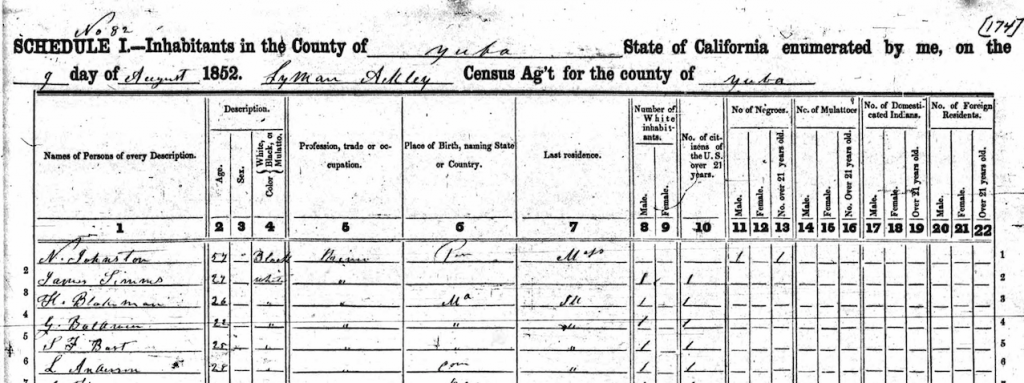
An N. Johnson is listed as living in Yuba, Calif, age 57, born in Penna. In consulting other records, I had tentatively placed Nathan Johnson in Yuba City, so this could possibly be our Nathan Johnson. (No image of the census records available.) This was the only record I could find that matched our Nathan Johnson in California.Update on 8/29: Lisa deGruyter, who commented below, sent me the image of the 1852 California census, and reveals that this N. Johnson was white, probably age 36 (the handwriting is hard to read), born in Germany, and last lived in Louisiana — clearly not our Nathan Johnson.
Further update on 8/30: Lisa deGruyter has found our Nathan Johnson in the 1852 California census. He is listed as N. Johnston, age 54, black, occupation Miner, born Penna., last residence Mass., currently living in Yuba County.
Screenshot of the 1852 California Census; Nathan Johnson is on the first line.
And I was unable to find any further U.S. Census records of Nathan Johnson living in Massachusetts or California.Update on 8/29: Lisa deGruyter found a Nathan Johnson listed in the 1855 Massachusetts census as living in New Bedford, with occupation given as “Cal.” (in quotation marks), which, as Lisa points out, could mean that Nathan was working in California; listed as a black male, age 55, with Mary Johnson living with him; his birthplace Penna. This is almost assuredly our Nathan Johnson, and reveals that Polly still thought of his removal to California as in some sense temporary.
The most interesting bit of information is the 1852 California Census, which seems to confirm Johnson’s presence in Yuba. The most interesting piece of information is finding Nathan Johnson listed in the 1852 California Census as a miner in Yuba County. But where he was in California from 1852 to 1873 remains a mystery. Lisa deGruyter found a little more information in a National Park Service Research Report “California Pioneers of African Descent,” available here — now available on the Wayback Machine.
Nathan Johnson returned to Massachusetts after his wife’s death, in 1873. His gravestone in Oak Grove Cemetery in New Bedford states that he died Oct. 11, 1880, “aged 85 years,” with the legend “Freedom for all Mankind.” The death records for the City of New Bedford list his birthplace as Virginia, and it is possible that prior to the Civil War he gave a free state as his birthplace because he had emancipated himself from slavery.
Update: More information came in an email from Lisa DeGruyter (1 Sept. 2019). She writes:
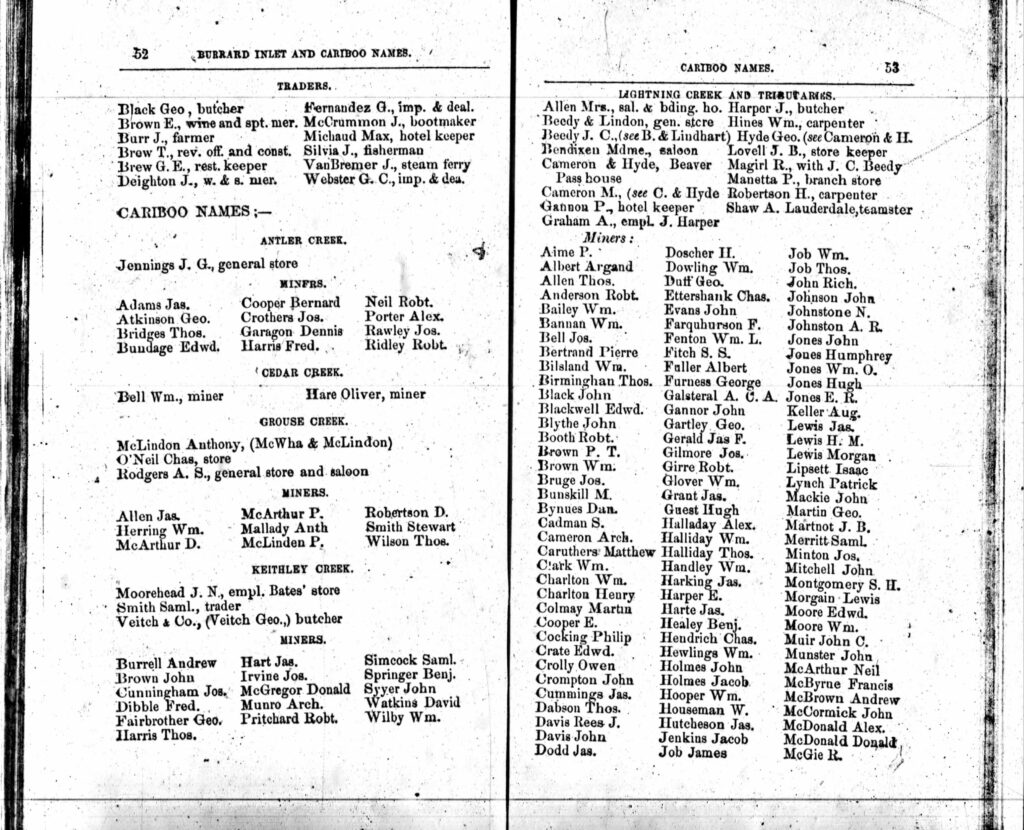
“If [Nathan] was in California, he should have showed up in a record after the 1852 Census. But there doesn’t seem to be a record of him anywhere in the country — no Nathan Johnson anywhere, and indeed no Nathan in California, that looks like him. … Aha. From the 2000 article [by Kathryn Grover], ‘Johnson remained in the West until the early 1870s. He lived for a time in Oregon, and former Whaling Museum curator Philip F. Purrington found his name among settlers in 1869 in Caribou, British Columbia, where gold had been discovered.’… Attached is a BC Directory for 1871 with N. Johnstone listed as a miner at Lightning Creek in the Cariboo.”
Buchanan, Thomas P. ( -1873) He was the son-in-law of Nathan Johnson’s wife Mary (Polly). He ran a public bath house in New Bedford from 1836 to 1849. In 1849 he left for California on the Mayflower of New Bedford. He may have returned to New Bedford with Nathan Johnson in 1873. His death was recorded in New Bedford in 1873. Grover, Kathryn, “Fugitives in Alaska,” pp. 22-23.
Johnson, Nathan …It is likely that he was deeply in debt with mortgages at the time he left for California. When he returned to New Bedford in 1873 he may have been joined by his wife’s son-in-law Thomas P. Buchanan. Grover, Kathryn, “Fugitive Slaves in Alaska,” pp. 22-23.
I see in my records that Lisa also found some interesting material on Polly. I’m going to include this material here in case anyone wants to pursue further research. Back in 2019, Lisa wrote:
“I became more fascinated by Polly…. On looking at her daughter Rhoda’s death record, I saw her father’s name and researched him a bit. I suspect that Polly wasn’t married to him — he sounds rather like some men in my research who were upstanding rich guys who fathered a bunch of children by women other than their wives. I also think Polly’s father was Wampanoag. Some records and other info:
Also, Kathryn Grover and Carl Cruz wrote an article about Nathan Johnson for the New Bedford Standard Times back in 2000. Since then, that newspaper got purchased by the Gannett corporation, and is currently being driven into the ground — old articles seem to be disappearing from their online repository, probably to save a few cents in data storage. The link to that old article was <https://www.southcoasttoday.com/article/20000206/News/302069998> [link no longer works], and fortunately it was archived on the Wayback Machine; full access is blocked on the Wayback Machine although there are ways to see most of the text.
The disappearance of both the National Park Service and the New Bedford Standard Times material shows the fragility of data on the web. While the web does make some kinds of research easier, web-based information is far more ephemeral than print material.