Environmental destruction and COVID-19

The BBC reports that scientists are expecting more pandemics like COVID-19. Why?

“Many scientists agree that our behaviour — particularly deforestation and our encroachment on diverse wildlife habitats — is helping diseases to spread from animals into humans more frequently. According to Prof Kate Jones from University College London, evidence ‘broadly suggests that human-transformed ecosystems with lower biodiversity, such as agricultural or plantation landscapes, are often associated with increased human risk of many infections’.” 

In other words, COVID-19 is a result of environmental destruction and mismanagement. And those of us in the wealthier countries are especially culpable:

“The current crisis, Prof Eric Fevre [from the University of Liverpool and the International Livestock Research Institute in Nairobi, Kenya] said, provides a lesson for many of us about the consequence of our own impact on the natural world. ‘All of the things we use and take for granted — the food we eat, the materials in our smart phones; the more we consume, the more someone will make money by extracting them and moving them around the world. So it’s incumbent on all of us to think about the resources we consume and the impact it has’.”

A word to my fellow white guys

On Saturday, Clarissa-Jan Lim, a journalist with BuzzFeed News, reported on the violent protests against police violence and George Floyd’s murder:

“In a video that has been shared online widely, [Tay] Anderson [a Denver school board director and activist], who is black, is seen confronting a white man with a cloth covering on his face after the man spray-paints ‘ACAB’ — ‘all cops are bastards’ — on public property. Anderson said he was doing a news interview when he saw the man vandalizing, so he turned around and tried to stop him.

“‘I said, “We asked allies to step back so that we can make sure that you’re following what we’re asking you to do,”’ he recalled. ‘And he was like, ‘I’m not your ally, you guys want to protect the status quo….”’”

Well, actually — that white guy is doing his best to reproduce the status quo.

We white men are brought up to believe that we always know best, that we always have to be in charge. Just like that white guy that Tay Anderson confronted in Denver. I get very skeptical when I hear about white men talking about joining or helping organize protests against racism. Us white guys need to — to paraphrase Tay Anderson — step back and follow the lead of people who are not white guys. If we can’t do that, for all we may talk about being allies we’re actually just protecting the status quo.

How does this protect the status quo, you ask? Let’s go back to Tay Anderson:

“Anderson … said he knows that others ‘are going to blame black people for the violence and destruction, whether or not they started it. When we aren’t asking people to destroy things in our name and people do it anyway, we know that this is something that’s going to blow back on us,’ he said. ‘I’m pissed that this is going to blow back on us, because we don’t deserve this. We didn’t ask for this.’”

You see how this works, right?

White guys go to a non-violent protest march organized by black people. The white guys can’t stand not being the center of attention, so they start getting violent. This displaces the center of authority from the black organizers of the protest march to the white guys. Suddenly, it’s no longer a non-violent protest march organized by black people, it’s a violent protest organized by white guys. And as usual, if anything goes wrong, black people get blamed. The status quo of American racism is preserved yet again.

Here’s a word of advice to my fellow white guys:

If you really want to change the status quo, then when you go to one of the protests, make sure for once in your life that you’re not in charge of anything. In fact, if you go to a white allies protest, let white people of other genders run it. When you’re at a protest, don’t draw attention to yourself. Don’t do anything to cause others to photograph you. Don’t be a rugged individualist or a lone ranger. Don’t even go bragging all over social media about what a social justice warrior you are because you, a white guy, were brave enough to attend a protest. In short, for once in your life, you’re not going to be the center of attention. I’m a white guy myself, so I know how hard that will be; but that’s what we need to do.

Because if us white guys could actually stop trying to be in charge all the time, that would go a long way towards changing the status quo.

All over again

I’ve been re-reading one of the great American autobiographies, James Weldon Johnson’s “Along This Way.” Johnson was a renaissance man: poet, novelist, school teacher, writer of hit songs with his brother Rosamond, diplomat who served as American consul in Nicaragua during a revolution, and executive secretary of the NAACP.

In this last capacity, Johnson investigated a number of lynchings, and in his autobiography he describes an investigation into a lynching in 1917:

“I rushed to Memphis to to make an investigation of the burning alive of Ell Persons, a Negro [sic], charged with being an ‘axe murder.’ I was in Memphis ten days; I talked with the sheriff, with newspaper men, with a few white citizens, and many colored [sic] ones; I read through the Memphis papers covering the period; and nowhere could I find any evidence that Ell Persons was guilty of the crimes that had been committed. And, yet, without a trial, he was burned alive on the charge. I wrote out my findings, and they were published in a pamphlet that was widely circulated….”

More than a hundred years later, we’ve been hearing about the murders of George Floyd and Ahmaud Aubrey. Reading Johnson’s autobigraphy has prompted me to ask myself: What, if anything, has changed? The biggest change might well be the wide availability of videography, and the ability to disseminate videos almost immediately: instead of just reading a pamphlet some weeks after a lynching, we sometimes see a video of a lynching almost in real time. Another change: according to Johnson, some 5,000 people turned out to watch Ell Persons being burned alive; today, while the people doing the lynching still aren’t trying to hide their actions, at least some bystanders might call them out on it.

But in many ways it feels as though not much has changed. A hundred years later, black men are still being murdered without cause. Too many murderers of black men still get away with it. And, as my cousin Saba has pointed out, we still mostly don’t hear about the violence perpetrated on black women.

I suppose now I should offer some of the usual platitudes that white people offer, using key words like “justice” and “white supremacy” and “reconciliation” and so forth. But I think instead I’ll quote James Weldon Johnson’s key insight as he researched the Ell Persons case, as he discovered both the physical sufferings of the black victim, and the “moral degradation” of the white community:

“The truth flashed over me that in large measure the race question involves the saving of black America’s body and white America’s soul.”

Ecojustice Avenger Theme Song

It’s been interesting watching to see what online religious education resources people actually use. How-to craft videos? Single digits for number of views. Read-aloud programs? Low double digits, if I’m lucky. It’s not a great return for my invested time.

But what about “Story for All Ages” videos that are included in the Sunday service? We typically get over a hundred log-ins to our Zoom worship services, probably representing 1.5 humans on average, and posting on other social media (Facebook Live, Youtube) might add 10-30 views to the total. Plus a lot of informal positive feedback. These videos are definitely a better return for the time I invest, and as a result that’s what I’ve been concentrating on recently.

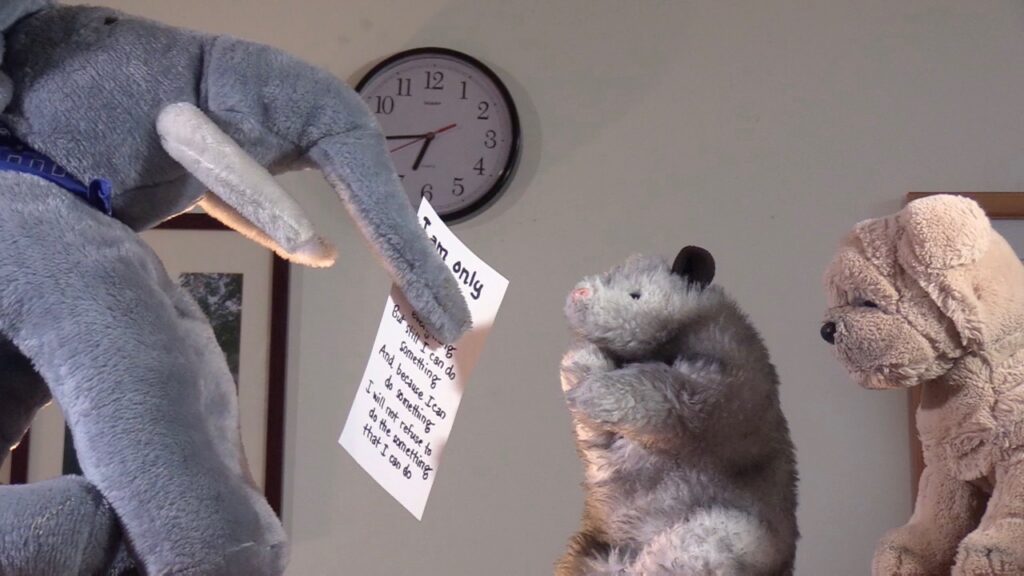
Since the “Story for All Ages” gets the largest audience, I thought maybe I’d try a tie-in video. The current “Story for All Ages” video series is about the conflict between Ecojustice Avenger and a dastardly villain named Trashman. The Ecojustice Avenger videos have a 12 second jingle, and after two episodes some kids had memorized all the lyrics to the jingle. That inspired me to expand that 12 second jingle to a full 1:41 music video, with videography inspired by Nam June Paik:

Will this reach kids? Maybe…probably not. But doing religious education in the age of COVID-19 requires constant experimentation until we discover what we can do that will reach kids.

Great virtual meetings

Harvard Business Review (HBR) has a couple of articles on virtual meetings. Back on March 5, they published an article by Bob Frisch and Cary Greene titled “What It Takes To Run a Great Virtual Meeting.” If you’re experienced at running online meetings, most of this will seem like good common sense, but you should read it anyway. Some of HBR’s suggestions should be obvious, like “test the technology ahead of time.” Others may be less obvious, but are still critically important, like “make sure faces are visible.” HBR suggests having a facilitator for meetings, someone who can take the pulse of the group; and one of their more innovative ideas is that the facilitator can use a parallel phone-based survey tool like “Phone Everywhere” to get that feedback.

An earlier article, published in 2015, by Keith Ferrazi was titled “How To Run a Great Virtual Meeting.” This covers much of the same ground, though with different emphases. Ferrazi spent a couple of years researching virtual meetings, and his article summarizes his research findings. One of my favorite points from this article: ban multitasking, because it doesn’t work and it slows down the team. I’ve been guilty of multitasking at virtual meetings, and it’s true: when I start checking email, I lose track of what’s going on in the meeting. That’s one reasons why Ferrazi says to leave video on: so you can see when someone is trying to multitask. (This, by the way, is a big drawback of Google Meet: depending on how you set up the meeting, you can only see 4 people at a time.)

An article by John Wimberly of Congregational Consulting Group got me started reading up on the topic. Wimberley titles his article “Will There Ever Be A Non-Virtual Meeting Again?” Wimberley says that once the COVID crisis ends, many urban congregations will keep doing virtual meetings because of the time it saves commuting to and from meetings. Actually, it’s not just urban congregations: congregations in suburban areas also have traffic problems; plus virtual meeting can include those who can’t travel at night (elders and people with young children); and for those of us in regional congregations, drawing from a big geographical area, virtual meetings allow our more far-flung members to participate. Before COVID-19 hit, our Palo Alto congregation was already doing hybrid meetings — some people in person, some people online — and I expect after COVID-19, there will be more committee and Board members who opt for the virtual option.

The bottom line: since virtual meetings are here to stay, we should learn how to run great virtual meetings.

Welcome to Chaos Manor

Beginning back in the 1980s, science fiction writer Jerry Pournelle wrote a column for BYTE magazine called “Computing at Chaos Manor” which consisted mostly of entertaining accounts of his struggles with computers and other IT software and hardware. Later on his blog “Chaos Manor,” arguably the first blog ever, Pournelle continued to write about his IT struggles, though unfortunately it looks like those old posts disappeared when Pournelle moved his blog to the WordPress platform in 2011. That’s too bad, because it would be fun to read those posts today, and se whether we’ve made any progress in home computing.

This past week, I’ve felt like I entered the land of Chaos Manor.

My troubles began when my HP Laserjet 1320 started malfunctioning: it would only print a page or two of a multi-page document, then shut down. At first I suspected that perhaps I’d missed an update for the printer driver, only to learn that HP no longer issues updates for that printer; I have to rely on Apple’s drivers. I’m told that writing printer drivers is not that hard — if you’re a software engineer, which I’m not. Instead, I looked online and bought a smaller, more energy efficient monochrome laser printer for under a hundred dollars. I had grown to like the old printer, as one grows attached to well-designed and reliable tools. Plus there is still plenty of toner in the cartridge (a corollary of Murphy’s Law says that a printer will die not long after you’ve purchased a new toner cartridge), and it can still print one page at a time. So it will go to my office as a last-ditch emergency back-up printer.

Then I made the mistake of learning how to use JamKazam, a service that allows you to make music online with other people, in almost real time. The problem with making music with other people online can be summed up in one word: latency. From a musician’s point of view, latency is the lag time between musicians, measured in milliseconds. 10 milliseconds of latency is approximately equivalent to standing 11 feet from your fellow musician; for a rule of thumb, think of 1 additional millisecond of latency as being 1 additional foot away from a fellow musician. Most musicians won’t even hear a latency of 10 milliseconds; 20 milliseconds becomes noticeable and may require extra concentration; and a latency of, say, more than 35 milliseconds makes it difficult to play in synch. If you want to know more about latency, you can read these posts on JamKazam’s support forum.

Jam Kazam provides a way of minimizing the latency, but it is not a plug-and-play-music solution. As I found out very quickly. When I tried to use the JamKazam service, their desktop client gave me several error messages. After a certain amount of swearing and head-scratching, the problem proved to be in my 11 year old wifi router. I attempted a firmware update, and the router stopped working. I had a moment of panic — Carol and I both rely on our internet connection, and we’d be in deep trouble if the router went down — but when I shut the power off and rebooted the router, it started working again. Sort of. Clearly, it was time to buy a new router.

The new router arrived today, and setting it up was mercifully easy. I started up the JamKazam desktop client on my MacBook Air, and everything worked well. However, the Jam Kazam client reported that at time I was using 20% of my processor power — and that was with just me, and no other musicians. So I started up the JamKazam desktop client on my Mac Mini, which has a much faster processor, plugged in my Blue brand Snowball USB microphone — and JamKazam returned an error message. The Snowball microphone samples at 44.1 KHz, and although JamKazam claims to allow you to change the sampling rate of your microphone, it soon became clear that unless I used a USB mic with a sampling rate of 48 KHz, the audio quality would be poor. In addition, the JamKazam desktop client revealed that the internal latency of the Mac Mini was quite high; it turns out this is a known issue with Macs: the Mac sound card introduces significant latency, which can be overcome by purchasing an external audio interface for, oh, two or three hundred dollars, or more.

I had just spent $180 on a blazing fast new wifi router; that expense I can justify. I cannot justify spending several hundred dollars on an audio interface and a new microphone. I went back to the MacBook Air. Using the internal microphone, the basic latency was under 10 milliseconds — more than sufficient for me to try using JamKazam with other musicians to see if I even like the experience.

One final addition to my home office has nothing to do with information technology, though it is the biggest improvement so far. I purchased a small apartment-sized rowing machine for under a hundred dollars. I can’t type while I’m rowing, but I can sit on the rowing machine and watch webinars or even read long pieces on Web sites. And whenever I need a five minute break, there it is, ready for me. If you’re ever on a videoconference call with me, and I turn off my video, you’ll know why — I’m rowing.

Speaking of which, I’ve been sitting at my computer too long. It’s time to row.

Thank you, UUA

The Unitarian Universalist Association (UUA) posted a notice today recommending that Unitarian Universalist congregations should consider NOT opening in-person meetings before May, 2021. You can read the recommendations here.

I’m glad the UUA has issued these recommendations. I had already come to most of the conclusions outlined in their recommendations. I’ve been trying to figure out how to gently break it to lay leaders and congregants who are already feeling weary of being stuck at home, already getting tired of Zoom meetings, that we really won’t be able to meet in person until there’s an effective vaccine and/or an almost universally effective treatment with incredibly robust contact tracing in place. Which means most likely no in-person meetings for at least another year — maybe longer in some areas.

The only thing I’d quibble about in the UUA recommendations is this statement: “It is the UUA’s strong recommendation that congregations plan for ongoing virtual gathering and operations through May 2021.” I would have added the phrase “at least” before “through May, 2021.” I don’t think there’s any guarantee that we will be able to resume in-person meetings by the end of May 2021; human beings are really good at false hope, and I wouldn’t want to encourage that human tendency.

That minor quibble aside, the recommendations are quite well done, especially in how they recognize that different congregations in different locales will face different sets of problems.

Best of all, now I don’t have to go through the trouble of summarizing all the research I’ve been doing. All I have to do is point to the UUA recommendations, and say, “This generally agrees with the research I’ve been doing.”

And then we can all say together, “OK, let’s plan for a year of online programming. How can we unleash our creativity, serve the needs of our members and friends, and make Unitarian Universalism in Silicon Valley serve the goodness of humanity?”