A jolly holly Xmas

Yet Another Unitarian Universalist
A postmodern heretic's spiritual journey.

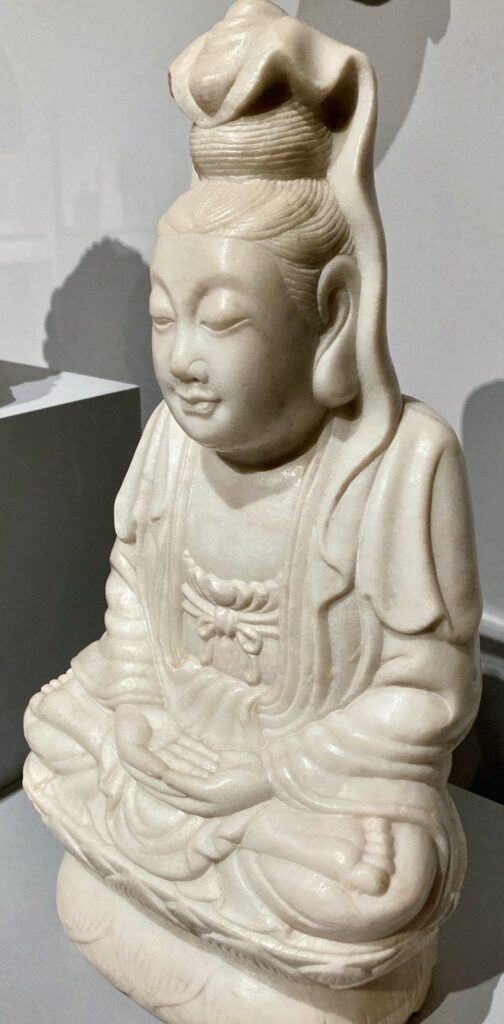
Avalokiteshvara is a Buddhist deity with multiple identities, some of which I outlined in an earlier post. In Vietnam, this deity appears as Quan Am.

This sculpture, carved in Vietnam in the nineteenth century, portrays Quan Am attired in a white robe. So it is that here Avalokiteshvara manifests both as Vietnamese, and as the White Robed Bodhisatva of Compassion — showing how one deity’s manifestations can be shaped both by theological concerns, and by regional or national identity.
In its Dec. 6-12 edition, The Economist has an article has an article in which it proposes its “word of the year.” The article has no byline, and cites no sources — typical for The Economist, and one of the reasons I do not fully trust it — but this particular article is mostly humorous so I guess I don’t need a byline. The anonymous author begins the article by naming words-of-the-year that were runners-up:
“Finance is a good place to look for words of the year because trends move fast, and its denizens like neologisms. TACO is this year’s favorite. Coined by Robert Armstrong, a journalists at the Financial Times, it stands for ‘Trump Always Chickens Out’ and points to the many tariff fights Donald Trump has picked and then backed down from….”
For the record, The Economist’s winning word of the year is “slop,” as in “AI slop.”
From an interview in Esquire with Scott Galloway, who is clinical professor of marketing at the Stern School of Business, New York University:
“When I was younger, I considered myself a scientist, and I was disparaging about religion and people who practiced it. What I’ve generally found is that people getting together once a week to be in the agency of something bigger than themselves and wish their neighbors good tidings is a good thing.”
(Thank you, Carol, for finding this.)
The San Francisco Standard recently published an article by Zara Stone titled “How Gifted Is Your 3-year-old? IQ tests for preschoolers become the norm in Silicon Valley: Psychologists have seen a surge in Bay Area parents seeking a leg-up for admissions to elite schools.” Now remember — it’s elite preschools for which they’re seeking a leg up. That’s 3 years olds.
The long title of the article pretty much tells the whole sick story, but some of the quotes are revealing. The author interviews Tsunami Turner, who works as an educational psychologist at a company in San Jose that provides “child-centered therapy” as well as IQ testing services:
“‘Some parents come in with an IQ number in mind. They are really wanting to have their child hit a specific number,’ she said. Their kids are often very accomplished, taking dace, soccer, art, and music — and know they ‘have to get a certain number.’ They show up ‘highly anxious,’ she said. If scores come in lower than expected, Turner gets pushback and requests for retests.
“‘There’s a lot of societal pressure. The family is incredibly busy and wants their kid in a school that challenges their intellect and supports their development,’ she said. It can spiral quickly. ‘The goal is that a child will get into a good primary school, and that will lead them to getting into a good college, which will lead them to getting a good job and doing really well in the world.'”
In my 13 years working as a minister of religious education in Silicon Valley, I saw some of this — not so much among the families in the UU congregation there, because if you’re trying to fast-track your kids in this way, you don’t waste time on things like moral and spiritual education — but I did see it happening. It really is true, some well-to-do Silicon Valley parents start trying to build their child’s resume starting when the child is 2 years old. I feel this phenomenon is bad for children, and tends to result in accomplished but stunted and less-than-fully-human adults.
Sikhs are strongly monotheistic. The first words in the Guru Granth Sahib, their collection of holy writings, say “Ek Onkar,” or “God is one.” Furthermore, God is transcendent and has not been incarnated in some physical form. Guru Nanak, the founder of the Sikh religion, wrote a statement of belief that can be translated as follows (reference: Pluralism Project):
There is one God whose name is True. God is the Creator. God is without fear. God is without enmity. God is of eternal form. God is unborn, uncreated, beyond incarnation. God is self-existent and self-sufficient. God is attained by the grace of the Enlightener.
Thus within the Sikh worldview, it would be wrong to say that there is more than one deity. The Sikh religion does recognize a series of ten holy persons, the gurus, of whom Guru Nanak was the first. These human beings are not considered deities by Sikhs — even though from the perspective of other worldviews they may seem to take on some of the qualities of lesser deities — but rather they may thought of as humans who had a special connection to God and who are tehrefore worthy of veneration.
Guru Nanak lived in the Punjab region of South Asia, a place where Hindus and Muslims both claimed their religion was true. Guru Nanak said that God transcends such divisions, and famously proclaimed that there is no Hindu, there is no Muslim.
The story is told that Guru Nanak once visited Mecca, the most holy city for Muslims. Sayad Muhammad Latif, in a history of the Punjab, tells what happened there:
“He (Guru Nanak) travelled over the whole of India, visited Persia, Kabul and other parts of Asia, and it is said even Mecca. A story is related by both Hindus and Muhamadans [sic] in connection with Nanak’s visit to Mecca. It is said that while at Mecca, Nanak was found sleeping with his feet to the Kaba, before which the Muhamadans prostrate themselves when performing their devotions. The Kazi Rukan-ud-din, who observed this angrily remarked: ‘Infidel, how dare you dishonour God’s house by turning your feet towards it.’ ‘Turn them if you can,’ replied Nanak, ‘in a direction where the house of God is not.'” (quoted in Kazhan Singh, History and Philosophy of the Sikh Religion: Part I: History, Lahore: Newal Kishore Press, 1914, p. 99)
This story gives a sense of the Sikh conception of God — transcendent, omnipresent.
A lovely painting on paper from West Bengal, painted in the mid-eighteenth century and currently in the Asian Art Museum in San Francisco, depicts Guru Nanak sleeping with his feet towards the Kaba:

In another version of the story, a Muslim cleric kicks Guru Nanak for sleeping with his feet pointed towards the Kaba, then grabs hold of the guru’s legs and tries to turn his feet away, but “lo and behold the miracle the whole of Mecca seemed to be turning.” (Vaaran: Bhai Gurdas, Pauri 32, At Mecca)
According to tradition, the Nicene Creed turns 1,700 years old tomorrow.
I was born into a Unitarian family, and as old-school New England Unitarians, we didn’t think much about the Nicene Creed. I mean that literally, and not in a snide sense: obviously the Nicene Creed was never recited in our Unitarian church, but beyond that no one even talked about it; it just wasn’t something we ever thought about.
If we ever thought of the Nicene Creed, we thought about it in negative terms, much the same way Professor Francis Christie of Meadville Theological School wrote about it in 1910:
“The symbol of Nicaea inaugurated a mania for fixed and irreformable definitions, a consequent scholasticism, a cessation of thought, a weakening of the moral force of the church, a period of superstitious ritualism.” (Francis A. Christie, “The Significance of the Nicene Creed,” The American Journal of Theology, vol. 14 no. 2, April, 1910, p. 271.)
Today, I’d be less doctrinaire about the Nicene Creed. Even though the Nicene Creed’s trinitarian theology has never made much sense to me personally, I have friends for whom it remains a profoundly moving statement of theology (including some good Universalist friends). Part of being staunchly non-creedal is remaining open to the possibility of truth in creeds you don’t feel much emotional sympathy with. Yet Transcendentalist that I am, I continue to feel that Thoreau got it right when he wrote:
“…in dealing with truth we are immortal, and need fear no change nor accident. The oldest Egyptian or Hindoo philosopher raised a corner of the veil from the statue of the divinity; and still the trembling robe remains raised, and I gaze upon as fresh a glory as he did, since it was I in him that was then so bold, and it is he in me that now reviews the vision. No dust has settled on that robe; no time has elapsed since that divinity was revealed.…”
To use Theodore Parker’s terms, when it comes to religiou, there is that which is transient, and that which is permanent. Using these terms, Thoreau is talking about that which is permanent: “no time has elapsed since that divinity was revealed.” A creed, on the other hand, is a fallible human invention, and while it is useful for a time, it is nonetheless transient. The Nicene Creed has been useful to many Christians for 1,700 years, which is a very long time indeed; but it only points toward the divine, it is not itself divine. — At least, so sayeth my Unitarian forebears, with whom I entirely agree.
With those caveats, happy birthday to the Nicene Creed.
I use AI tools for certain tasks. But there are other tasks I would never use them for. Bloomberg News has an article on how AI-generated recipes are taking over both the web and social media. And it’s not going well, neither for the food bloggers, nor for the people trying to use AI-generated recipes. They interview Eb Gargano, who writes the Easy Peasy Foodie blog:
“Instead of sending home cooks to her decade-old, well-tested recipes, Google increasingly inserts AI-generated summaries stitched together from bits of her work and others’ that often get the basics wrong. An AI-assembled version of Gargano’s Christmas cake, for instance, would have people cooking a 6-inch cake for 3 to 4 hours at 320°F (160°C). ‘You’d end up with charcoal!’ she said. Meanwhile, traffic to her turkey recipe is already down 40% year over year….
“All of this, food bloggers say, erodes the simple promise of a recipe: that someone has actually cooked it before you have. To Gargano, this is the core issue. ‘No matter how clever the AI is,’ she said in a recent interview, ‘it can never actually test a recipe in a real kitchen and see how it works.’”
As a follow up to a previous post on tumbaderos — a tumbandero is the washtub bass that’s played in the Caribbean and Central America — tumbandero player Axel D. Rodríguez sent links to some fabulous videos. If you’re interested in tumbanderos or washtub bass, you’ll be fascinated by these videos, both to hear the varied playing styles, and to see helpful visual cues for making your own instrument.
Thank you Axel! (Find Axel and his band on Spotify — and on Youtube.)
Tingo Talango — Cuba 1 — A must-watch video showing a musician building a Cuban version of the earth bow, called a “tingo tualango” or a “tumbandero.” The earth bow was the African instrument from which the washtub bass and the tumbandero are derived. Skip ahead to 2:50 to watch the building of the instrument, and then watch it being played both by plucking the single string, and playing rhythm on the soundboard. The musician frets the string rather than adjusting the tension on the bow.
Tingo Talango — Cuba 2 — A short video with someone playing the tingo talango.
Tumbandera or Kaolin — Cuba 3 — Another traditional Cuban earth bow. These musicians adjust the string tension by moving the bow, and get different notes. In the short demonstration of playing, it seems the instrument sometimes requires two musicians — one to play, and the other to adjust tension to keep the instrument on pitch.

Quijongo Caribeño — Costa Rica — The visuals show some adults showing kids of about middle school age how to build an earth bow-derived instrument out of a wood box, a string, and a neck. (The audio isn’t coordinated with the visuals.)

Marengwen — Haiti — An earth bow-type instrument, but the string tension is fixed, and pitch is altered by fretting. In addition, rather than plucking the string, the musicians strike the string with a stick. A must-watch video.

Tumbandero or Bajo De Palangana — Puerto Rico 1 — A band with a tumbandero made from a plastic five gallon bucket.
Tumbandero or Bajo De Palangana — Puerto Rico 2 — Tumbandero made from a plastic five gallon bucket. One musician playing along to a recording, with a good view of his playing technique.
Tumbandero or Bajo De Palangana — Puerto Rico 3 — The tumbandero player picks up his instrument at 0:15. This instrument appears to be metal and plastic.
Tumbandero or Bajo De Palangana — Pureto Rico 4 — Tumbandero made with a plastic five gallon bucket. Once again, the tumbandero functions more like tuned percussion than a bass. You can hear the tumbandero from 0:00 to 2:45; and from 6:15 to the end.

Tumbandero or Bajo De Palangana — Puerto Rico 5 — A Smithsonian Folkways recording. Great audio, no visuals.
Tumbandero or Bajo De Palangana — Puerto Rico 6 — A tumbandero made out of a metal washtub. The tumbandero player explains his instrument as follows:
“Wherever the African diaspora is, you are going to find some sort of instrument similar to this one. In the case of [the musical genre] la plena, it’s an instrument that is complementary to the traditional panderetas [frame drums] and guiro [hollow gourd played with wire brush]. And it sounds close to a bass [in range]. But the pitch isn’t perfect, so it’s basically another percussive instrument.”

Axel also sent some photos he found online — since I don’t know the source of them, and whether they’re copyrighted, I decided not to include them in this post. But if you do an image search for “tumbandero” you should turn up some interesting images.
A final note: I really want to make the Costa Rican instrument. I like the sound of the wood, I like the looks of it, and it would be fun to make. But we don’t have room for such a large musical instrument in our tiny apartment.
The whole disgusting Epstein saga is really a story about how rich old white guys think they can do whatever they want. Jeffrey Epstein, as you recall, was the billionaire pedophile who died by suicide rather than go on trial for sex trafficking girls. And he had lots of rich old white guys as friends. People like Donny Trump, who up until a couple of days ago resisted releasing the Epstein files with all his political might — even though he had promised to release those files during his campaign. People like Larry Summers, who had a nasty email exchange with Epstein in which Larry asserted that women have lower IQ than men. People like No-longer-prince Andrew, who was photographed with his arm around a 17 year old girl that Epstein was trafficking. People like Peter Thiel, who was glad to have Epstein’s investments — an amount that now totals $170 million, none of which will go to Epstein’s victims — and who apparently got tax advice from Epstein.
In their relationships with Epstein, none of these rich old white guys demonstrated what I’d call a strong sense of morality. And now, they are all doing whatever they can to avoid any consequences for making friends with a billionaire pedophile. Donny Trump claims he was mad at Epstein and ended the friendship before anything bad happened. Andy Winsor denies everything, even as his brother the King of England strips him of all his titles. Larry Summers offers a hollow apology that he’s sorry for what he did — while enjoying his $40 million net worth in a very comfortable retirement. Petey Thiel offers no apology whatsoever for accepting Epstein’s money, because (I guess) his business is a realm where morality need not intrude.
As an old white guy myself, I feel it’s incumbent on people like me to call out other old white guys when they behave badly. Not that it will do any good with these guys; their actions show they don’t care about morality. Nevertheless, their lack of accountability makes me want to try (in my ineffectual way) to puncture their aura of smugness. So here goes nothing:

And please see my earlier post about how the rich old white guys get too much attention.