“‘On February 29, 2024, counsel for the SBC Executive Committee was informed that the US Attorney’s Office for the Southern District of New York has concluded its investigation into the EC with no further action to be taken,’ Jonathan Howe, Executive Committee interim president and CEO, told Religion News Service in a text….”
“‘The lead investigator from the DOJ concerning this investigation was as surprised as we were by these reports. She answered both Megan [lively, another abuse survivor] and I immediately when we called (separately) and said the investigation is very much open and active,’ Thigpen told Religion News Service in a text….”
The DOJ is unable to comment publicly about ongoing investigations, so they refused to comment to Religion News Service. The fact that they can’t comment is in itself revealing. And on March 7, Baptist Press reported that SBC legal counsel has confirmed that the investigation is ongoing.
Obviously, this is a bone-headed move on the part of SBC leadership. But the rest of us can learn from this. The main takeaway — learn from Yogi Berra that it isn’t over till it’s over. So don’t do any victory laps until it’s actually, really and truly, finally over.
A letter from Dr. Samuel Johnson, to his friend Dr. Lawrence whose wife had just died:
“The loss, dear Sir, which you have lately suffered, I felt many years ago, and know therefore how much has been taken from you, and how little help can be had from consolation. He that outlives a wife whom he has long loved, sees himself disjoined from the only mind that has the same hopes, and fears, and interest; from the only companion with whom he has shared much good or evil; and with whom he could set his mind at liberty, to retrace the past or anticipate the future. The continuity of being is lacerated; the settled course of sentimant and action is stopped; and life stands suspended suspended and motionless, till it is driven by external causes into a new channel. But the time of suspense is dreadful.”
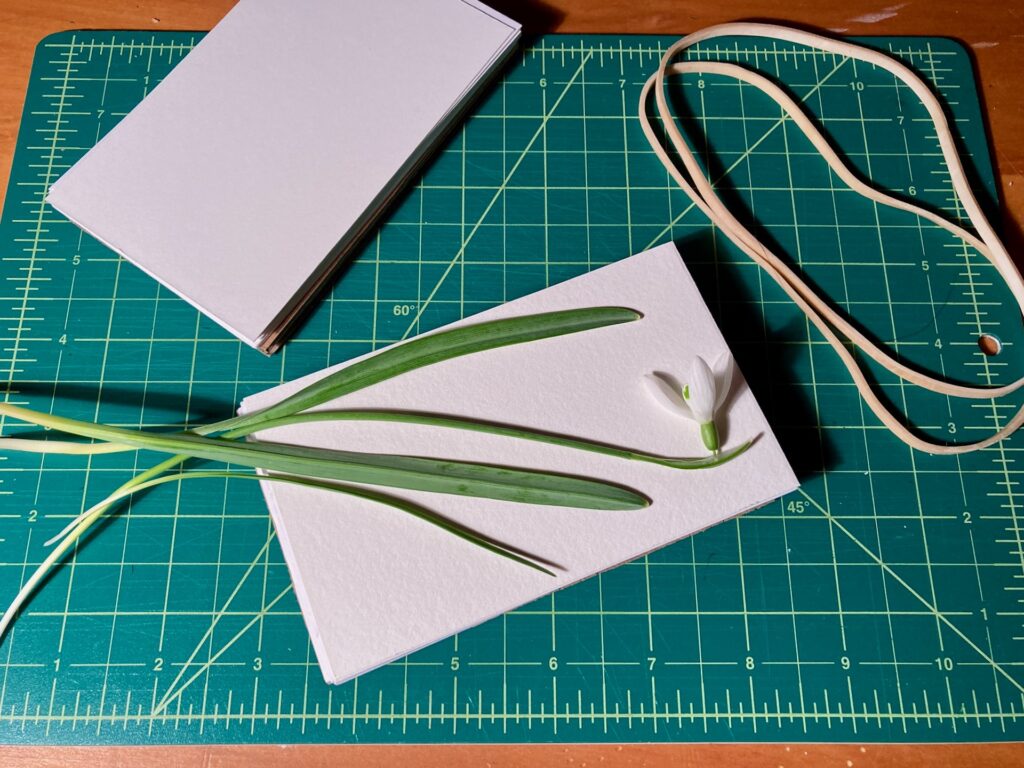
(1) This pocket plant press is made from a stack of 3 x 5 index cards, salvaged corrugated cardboard, cheap watercolor paper, and rubber bands. Cut two pieces of corrugated cardboard to 3 x 5 inches. Cut two pieces of cheap watercolor paper to the same size. Find a flower, and blot it dry with paper towels.
(2) Place one piece of corrugated cardboard down. Stack half the file cards on top of it. Place a piece of watercolor paper on top of that. Arrange the flower on this stack. Then make another stack of corrugated cardboard, file cards, and watercolor paper.
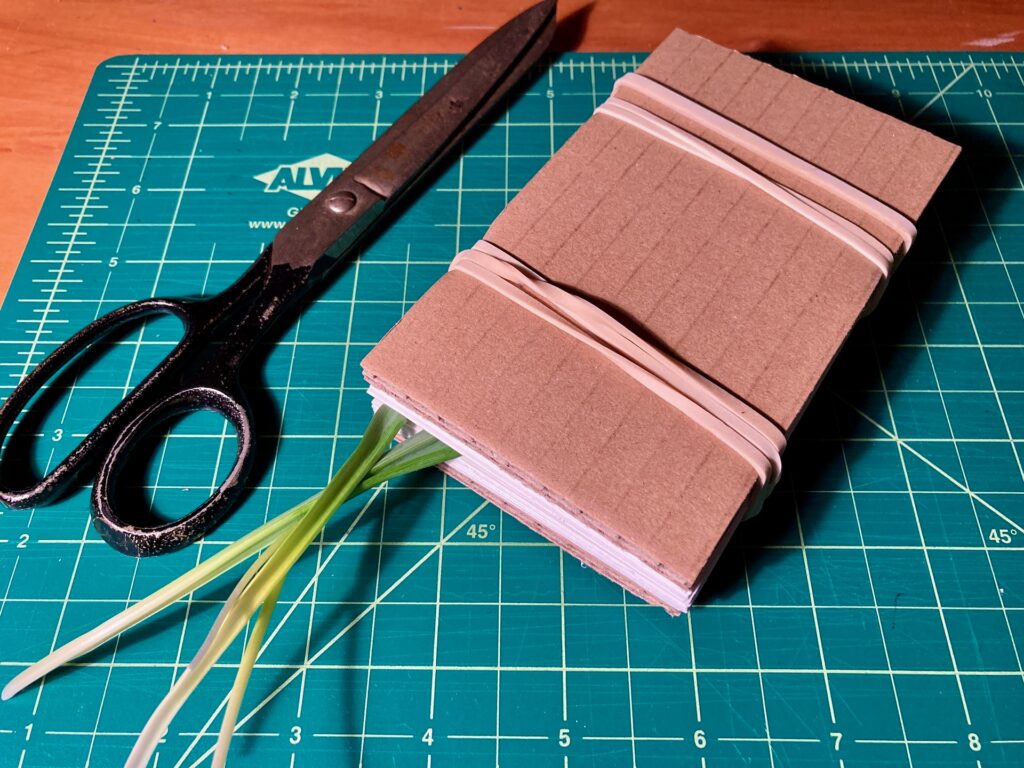
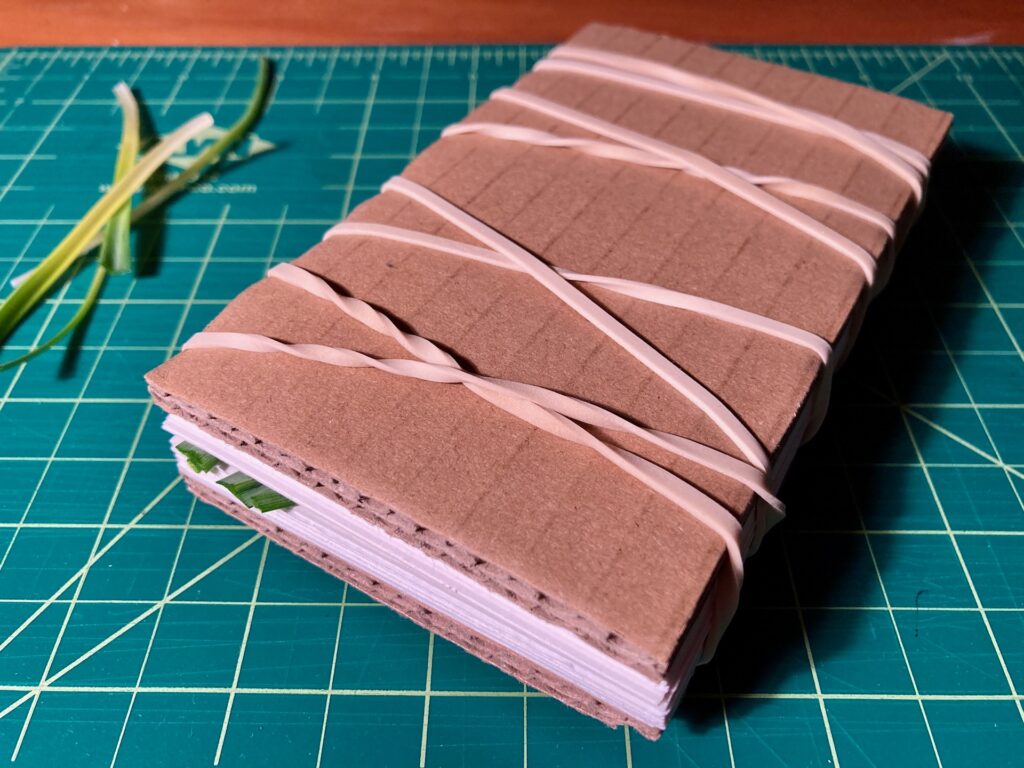
(3) Assemble the stack with the corrugated cardboard on the outside. Wrap the assembly with the rubber bands. If the stem of the flower is sticking out, you can trim it off with scissors.
Now let it dry for at least a week. Longer if the weather is humid, or the flower is especially moist. If you want the flower really flat, stack some heavy books on top of the plant press.
The watercolor paper takes the place of blotter paper in a real plant press. In some cases, the pressed flower may leave a colored image on the watercolor paper, so with some experimentation you should be able to use this technique to make pressed flower monoprints.
The stack of file cards makes the plant press stiffer, and helps spread the pressure of the rubber bands out evenly. You can also press several flowers in this plant press by using alternating layers of file cards, watercolor paper, and flowers.
(This is a follow up to this post. And for the finished product, see this post.)
I’m in the process of developing curriculum for a couple of different eco-spirituality programs I’ll be co-leading this summer. One of the people I’ll be working with, Jessica, a former environmental educator who’s now the DRE at the Northhampton UU congregation, floated the idea of pressing plants.
Now, plant pressing is usually done to prepare specimens for an herbarium. But Jessica found a lesson plan in the Project Wild Aquatic curriculum book which uses a plant press for a process art project. You assemble a collage of aquatic plants (or really, any kind of plant) between sheets of porous paper, and press in a plant press. As the plant is pressed, the paper absorbs some of the colors of the plant. Wait a week till it’s dry, and you have a cool collage.
This activity kind of resembles flower pounding (see lesson plan #24 on this webpage). It also introduces participants to the use of a plant press — a standard botanical tool/process — which is a nice addition.
Still working on refining this activity for use with kids in a summer camp setting. We’ll see where this leads. In the mean time, a couple of resources: Plant presses for the classroom | Herbarium Supply Co.
Update, later the same day:
Here are my instructions for a cheapo plant press, cobbled together from several online sites:
You’ll need fifty 3×5 file cards, two pieces of corrugated carboard cut to 3×5 inches, and two strong rubber bands. Place a flower in the middle of the stack of file cards. Put the rubber bands around everything (see the drawing). Let dry for a week or more. When dry, glue the dried flower to the index card using white glue.
Snowdrops are starting to bloom outside our front door, so in a couple of days I’ll be able to give this a try in the real world.
Juanita Nelson (1923-2015) was a war tax resister, a participant in the Civil Rights Struggle, and a back-to-the-lander. I just found a great oral history interview with her on the website for Massachusetts Department of Higher Education website.
One of the reasons I’m interested in Juanita Nelson is that she had no particular religious leanings one way or another; as she put it, she was not “religiously oriented.” And she was this way long before it was cool to be a None (i.e., to have no particular religious affiliation). Yet much of her life was spent seeking out and building intentional community, and spent in pursuing the highest moral and ethical values — and in that sense, she was what I’d call religious. She was also “religion-adjacent,” in part because she spent the last half of her life homesteading on land provided by a Quaker retreat center, and in part because so many war tax resisters are members of the historic peace churches.
Another reason I’m interested in her is that she’s a fascinating person in her own right. Someone should write a full-length biography of her — I’d buy it!
Another story for liberal religious kids — well, maybe. I find this to be a challenging story. Buddha walks out on his wife and baby? I’ve known families where one parent walked out, ostensibly to “find themselves,” not unlike what the the Buddha did. But we should tell such a story to kids? Maybe like fairy tales, which put into words some of the things children fear most, this is in fact the kind of story we should share with kids. Another argument for telling this story to liberal religious kids: Sophia Fahs included her version of this story in her book From Long Ago and Many Lands, aimed at middle elementary grades, and Fahs had plenty of insight into the developmental capacity of children to understand difficult stories. Unfortunately, Fahs only included three of the four sights, so I wouldn’t use her version. That’s why I came up with my own version.
For this story I didn’t go back to one original sources, because this story is told and retold so often in the Buddhist tradition. I did the best I could to synthesize what I knew of the story. Consider this a provisional retelling of this tale. Leave any corrections in the comments.
Once upon a time, a prince named Gotama lived in a royal palace in the land of Kapilavastu, which was on the border between the countries we now call India and Nepal. Gotama’s family was very wealthy. As he grew up, the prince had everything money could buy. He had servants to take care of every need. He had the finest food. He had all the toys he could wish for.
The story is told that while Gotama was still young, a sage came to visit his parents, the King and the Queen. This sage was very wise. He looked at the young boy and said, “This child will grow up to be either a great king, or a great spiritual leader.”
Now his father wanted Gotama to become king after the father died. Therefore, the King decided that the young prince must never see anything that might raise spiritual questions in him. The King instructed everyone in the palace that Prince Gotama must never be allowed to go outside the palace grounds by himself, lest he fall into conversation with a wandering spiritual person. The King also ruled that Prince Toama must not see anyone who was ill, or disabled in any way, nor anyone who was old. The King also ruled that if someone died, the prince should hear nothing of it. Thus the King hoped to keep the prince from asking any spiritual questions.
To keep Gotama happy, the King and Queen gave him everything he could want, so that he would want to stay inside the palace grounds. And when he was old enough, they found the kindest and most beautiful young woman in all the kingdom to marry the Prince. Both the prince and his new wife were vary happy, and they became even more happy when they had their first child together. The King and Queen hoped that the prince had forgotten his wish to leave the palace on his own.
One day, when he was twenty-nine years old, Gotama went out of the palace to go hunting, accompanied by his servant Channa. As they were riding along on their two horses, they came upon a man lying beside a rock, groaning in pain.
“What is wrong with this man?” asked Gotama.
“He is ill,” said Channa.
“But why is he in such pain?” said Gotama.
“It is the way of life,” said Chana. “It is just what happens when people are ill.” And they rode on.
When he was back at the palace, he tried to ask the wise men there about illness, but they would not answer his questions.
Gotama and Channa went out hunting again. As they rode along, they passed a woman whose hair was white and whose skin was wrinkled, and who used a cane to walk.
“What is wrong with this woman?” asked Gotama.
“She is old,” said Channa.
“But what do you mean by ‘old’?” said Gotama.
“It is the way of life,” said Channa. “It happens to anyone who lives a long time.”
Back at the palace, Gotama tried to ask the wise men there about being old, but they would not answer his questions.
Gotama and Channa went out hunting again. As they rode along, they came across man lying as if asleep. But Gotama could not wake him.
“What is wrong with this man?” asked Gotama.
“He is dead,” said Channa. “This is the way of life, people must one day die.”
Gotama and Channa went out hunting a fourth time and saw a wandering holy person. Gotama asked Channa who he was.
“He is a wandering holy person,” said Channa. “He wanders around the world begging for his food, and seeking spiritual enlightenment.”
This was something Prince Gotama had never heard of before. That night, Gotama could not sleep. He remembered both the suffering he had seen, and the holy man seeking enlightenment. Gotama realized that he himself would one day face illness, old age, and death.
“I must leave the palace where I’m always protected,” he thought to himself. “I must find answers to my questions.”
He got up, and told Channa to saddle his horse. The he looked in at the bedroom where his wife and their child lay sleeping. If he left the palace, he worried that his his wife and son would not be safe. He didn’t want to make them go with him.
He stood looking at them, wondering what to do. Should he stay? Or should he go?
As it happens, we know what Prince Gotama did. He left his wife and child behind, went out into the wide world, and after many hardships he became the Buddha, the Enlightened One, one of the greatest spiritual leaders the world has ever known. Knowing that, what would you do? Would you stay and become a great king, or leave and become a great spiritual leader? Would you give up the chance of being enlightened to stay with your family?
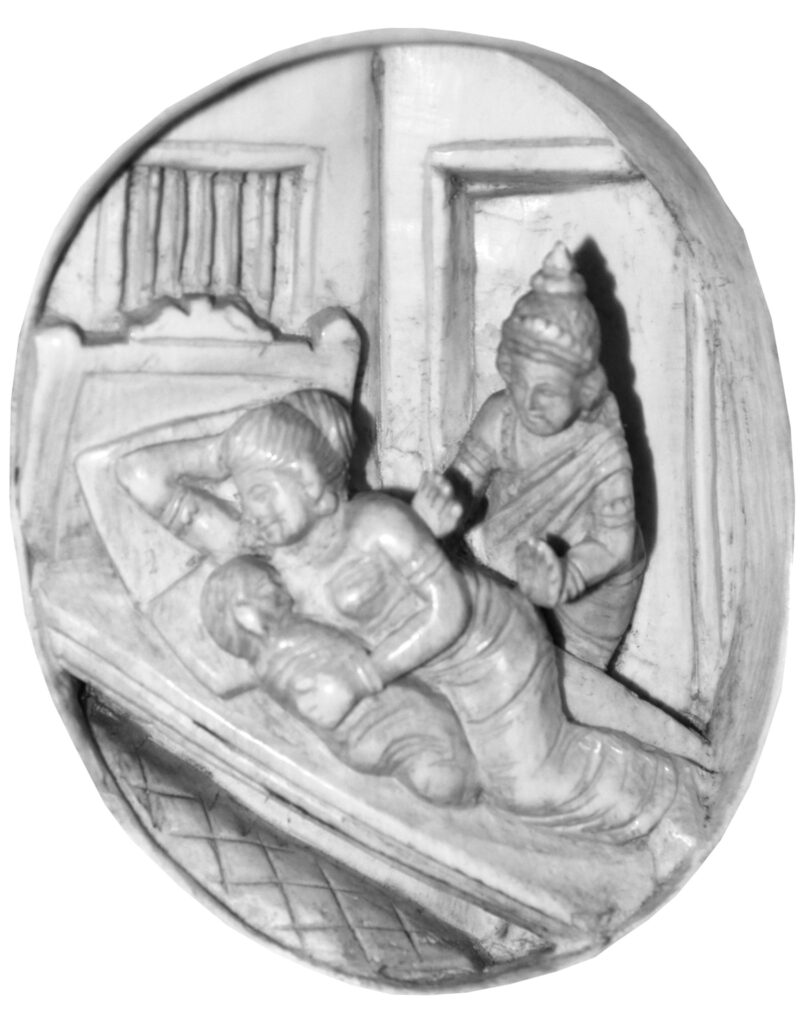
Siddhartha Gotama taking leave of his wife and baby. (CC-BY-SA 3.0 Nomu420; modified by me.)
Cory Doctorow lays down an obvious marketing rule for 2024:
“If there was ever a moment when the obvious, catastrophic, imminent risk of trusting Big Tech intermediaries to sit between you and your customers or audience, it was now. This is not the moment to be ‘social first.’ This is the moment for POSSE (Post Own Site, Share Everywhere), a strategy that sees social media as a strategy for bringing readers to channels that you control….” (Here’s Cory’s blog post — just be aware the title of the post is Not Safe For Work.)
This applies to congregations, too. If you’re relying on Facebook as your central marketing strategy, that’s probably not a wise thing to do. Sure, it’s fine to use a Facebook account for marketing, but Cory’s point is that you really want to use that Facebook account to drive people to your own website. Which you control. So it cannot be censored, or walled off, or otherwise controlled by Big Tech.
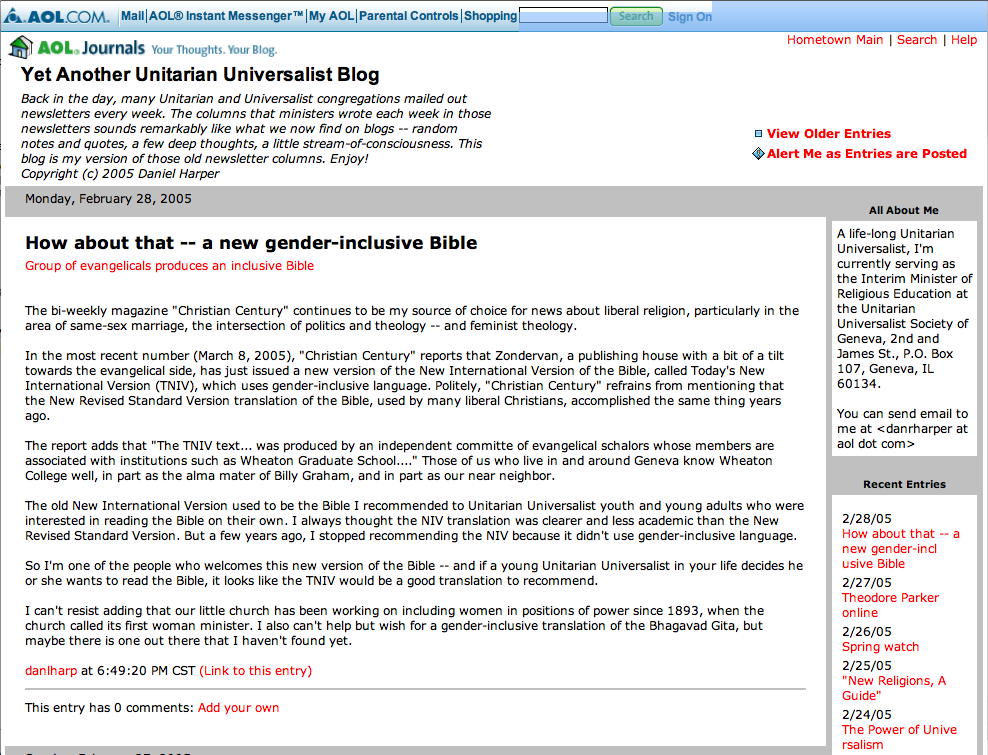
On February 22, 2005, I sat in my office at the Unitarian Universalist Society of Geneva (Illinois), and wrote my very first blog post, “Requiring the seven principles.” There were already forty or so other UU blogs out there. So I was a latecomer to Unitarian Universalist (UU) blogging. This was enormously freeing for me. The other UU blogs could do the heavy lifting of representing Unitarian Universalism to the world. I could just sit back and write whatever I wanted to write.
That was then. There have been huge changes in intervening nineteen years.
The peak of UU blogging was probably around 2007. (My blog peaked at about 3,600 unique visitors a month in May, 2007.) Then came a long slow decline, as people turned to commercial social media sites like Facebook and Twitter. By 2020, most Unitarian Universalists had migrated to commercial social media.
Today, UU blogging in the United States appears moribund. I believe that I’m now the only U.S. UU blogger still posting at least once a week. It’s hard to be sure because unfortunately UUpdater, a site that used to track UU blogs online, has ceased operations. Blogger Scott Wells — one of the last of the regular UU bloggers, and a smarter and better blogger than I’ll ever be — has dropped to an irregular schedule. Patrick Murfin is still blogging daily, but most of his posts are on history, not UUism. Outside the U.S., the United Kingdom still has a few Unitarian bloggers who post regularly. I follow Still I Am One, where there are links to a couple of other still-current blogs.
Given that UU blogging is moribund, why should I continue with this blog? I guess because blogging turns out to be a good medium for some of the things that most interest me. I’ll give a couple of examples, so you can see what I mean. I’m interested in the history of local congregations—but local history holds little interest to serious scholars of UU history (and rightly so), so really the only publishing outlet for local history research is on the web. I’m interested in the ongoing saga of misconduct by clergy and lay leaders within Unitarian Universalism—but this is a topic that is mostly avoided elsewhere (we UUs are willing to take on racism and anti-LGBTQ+ bias in our midst, but not so willing to take on misconduct by our leaders), so again the only publishing outlet for reporting on misconduct is on the web.
In addition, there are a few other topics which interest me where web publishing is the best option for my writing. Mind you, I won’t promise another nineteen years of blogging, but I do plan to stick around. And I’m grateful to all of you who continue to read this blog.
See you here at least a couple of times week — as long as the creek don’t rise, and the good Lord’s willing, and there ain’t no meltdown.
Screenshot of this blog as it appeared back on the old AOL blogging platform (from the Wayback Machine)
According to a Religion News Service article, the Episcopal Church has beefed up its procedures for reporting clergy misconduct:
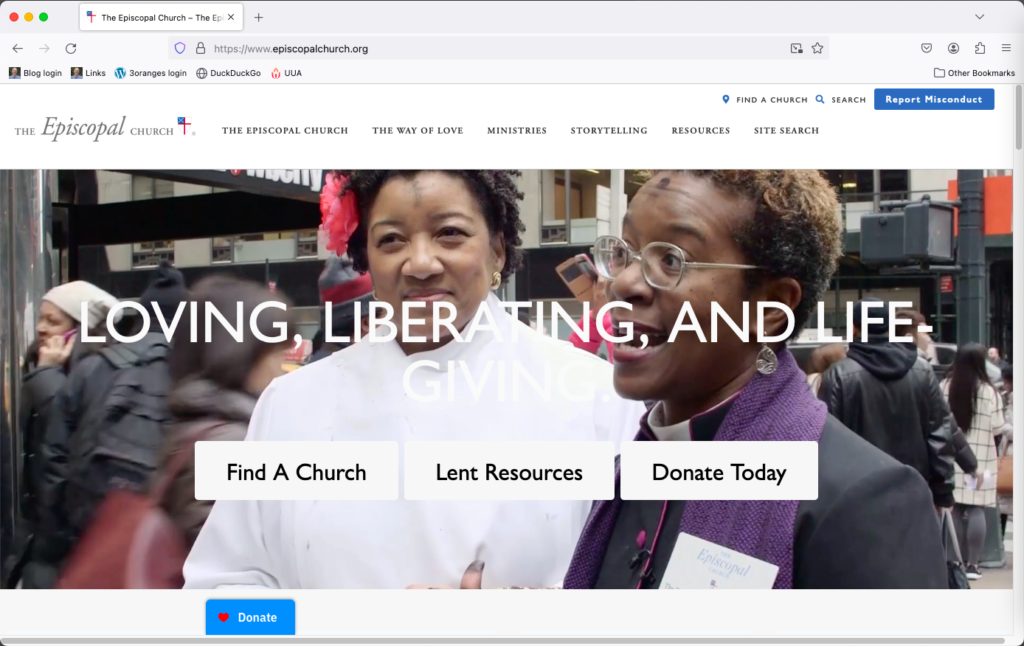
“A blue ‘Report Misconduct’ button now appears in the top right corner of the Episcopal Church’s homepage. The button leads to an informational page on Title IV with a step-by-step breakdown of Title IV processes involving bishops and a link to report bishops.”
Good for the Episcopal Church for making it easier to report misconduct. Here’s a screenshot showing the blue misconduct button:
Mind you, it’s not perfect. When you view the website on your phone (and half of all web use is now from phones), the blue misconduct button disappears into a menu.
But it’s a heck of a lot better than the UUA website, where it’s quite difficult to figure out how to report misconduct.
I’ve been working on other writing projects this week and haven’t had time to post on this blog. There’s a post in the works, though, to celebrate the nineteenth birthday of this blog….