It kept snowing all day today. The town’s plows haven’t been able to keep up, so the town has extended the on-street parking ban through Wednesday at 8 a.m.
Because it’s been so windy, it’s hard to say how much snow we got here in Cohasset. The National Weather Service reports that a trained spotter measured 13.5 inches of snow in Rockland, just south of here, at 5:13 this morning. We’ve had another 2 to 4 inches since then, and it’s still snowing. I’d guess the total snowfall will be at least 18 inches here in Cohasset.
I took a break from work in the middle of the day, and went snowshoeing in Great Brewster Woods, a 25 acre tract of conservation land close to our house. It felt like I was out in the middle of nowhere — a pretty amazing feeling for crowded suburbia. I didn’t see another soul, and the falling snow deadened all the sounds except for a Great Horned Owl hooting mournfully in a tree overhead.
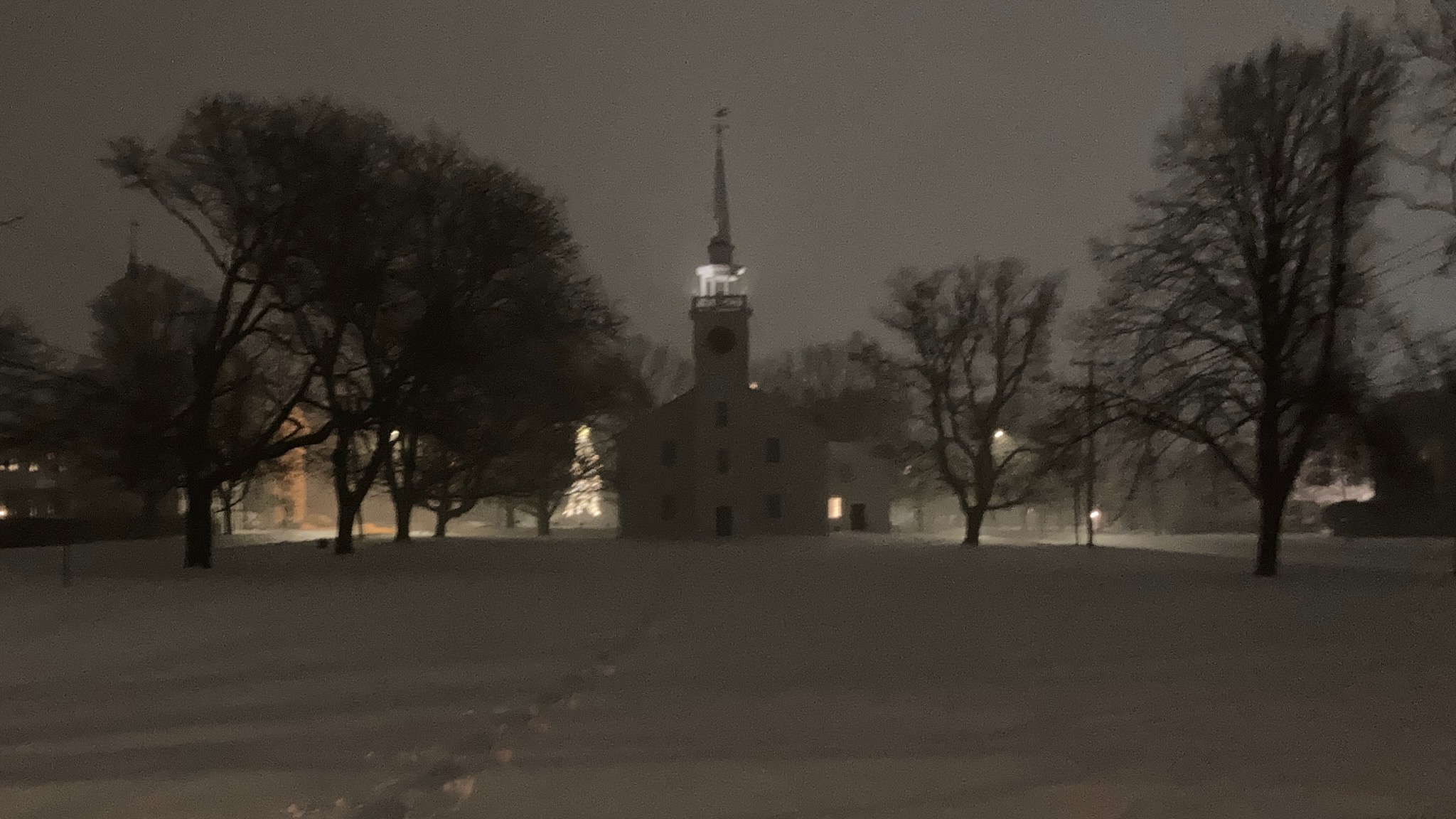
Snow is coming down, maybe an inch an hour. The wind is drifting the snow around our building, and I couldn’t really tell how much snow we have gotten so far. So I put on my snowshoes, walked over to Cohasset Common, and saw there was at least eight inches of snow in the middle of the common.
The Common was quite beautiful. A few kids were sliding down the hill that St. Stephen’s church is on, and the occasional snow plow rumbled past. Aside from that, no one else was out. Lights were on in nearly all the houses around the common, making it look cheerful in spite of the gusty winds.
Cohasset Common in a night time snowstorm. The First Parish meetinghouse is in the center, with my snowshoe tracks leading towards it.
This morning, Nativity Assumption of the Virgin Mary, the Greek Orthodox church in Cohasset informally known as Panagia church, held a memorial prayer service for Ana Ljubicic Walshe. If you live in eastern Massachusetts, you’ll remember that Ana Walshe is the Cohasset woman who disappeared on January 1, 2023. Last month, her husband, Brian Walshe, was found guilty of first degree murder; he also pleaded guilty to misleading the police and improperly disposing of a body. When sentencing Brian Walshe to life imprisonment without the possibility of parole, the judge called his acts “barbaric and incomprehensible.” With the sentencing, a truly grisly murder case had finally come to an end.
Yet even with Brian Walshe’s sentencing, Ana Ljubcic Walshe’s family still didn’t have complete closure. There is an oddity in Massachusetts state law that a death certificate cannot be issued when there is no body. Brian Walshe pleaded guilty to disposing of her body in various dumpsters around eastern Massachusetts, and none of her remains was ever found. That means no death certificate can be issued.
Ana’s mother is Serbian Orthodox. In that faith, a full funeral can’t take place without a death certificate (that is, without a body). Various Massachusetts officials are now trying to get the law changed so that in certain circumstances, a death certificate can be issued when there is no body. In the mean time, the Serbian Orthodox bishop based in Cambridge arranged to come down to the Greek Orthodox church in Cohasset to celebrate a memorial prayer service for Ana Walshe. A memorial service, in the Orthodox tradition, doesn’t require a body. The memorial service was livestreamed so that Ana’s mother in Belgrade, and her sister in Canada, could participate from a distance.
Panagia church opened the service to the entire Cohasset community; they know how this murder has impacted everyone in the community. They also issued a special invitation to the other congregations in Cohasset, so of course I had to attend. I would have gone anyway, because domestic violence prevention is one of the issues that I care most about. I’m also grateful that the Cohasset community has not tried to forget, or to cover up, this horrendous incident of domestic violence — something that happens all too frequently.
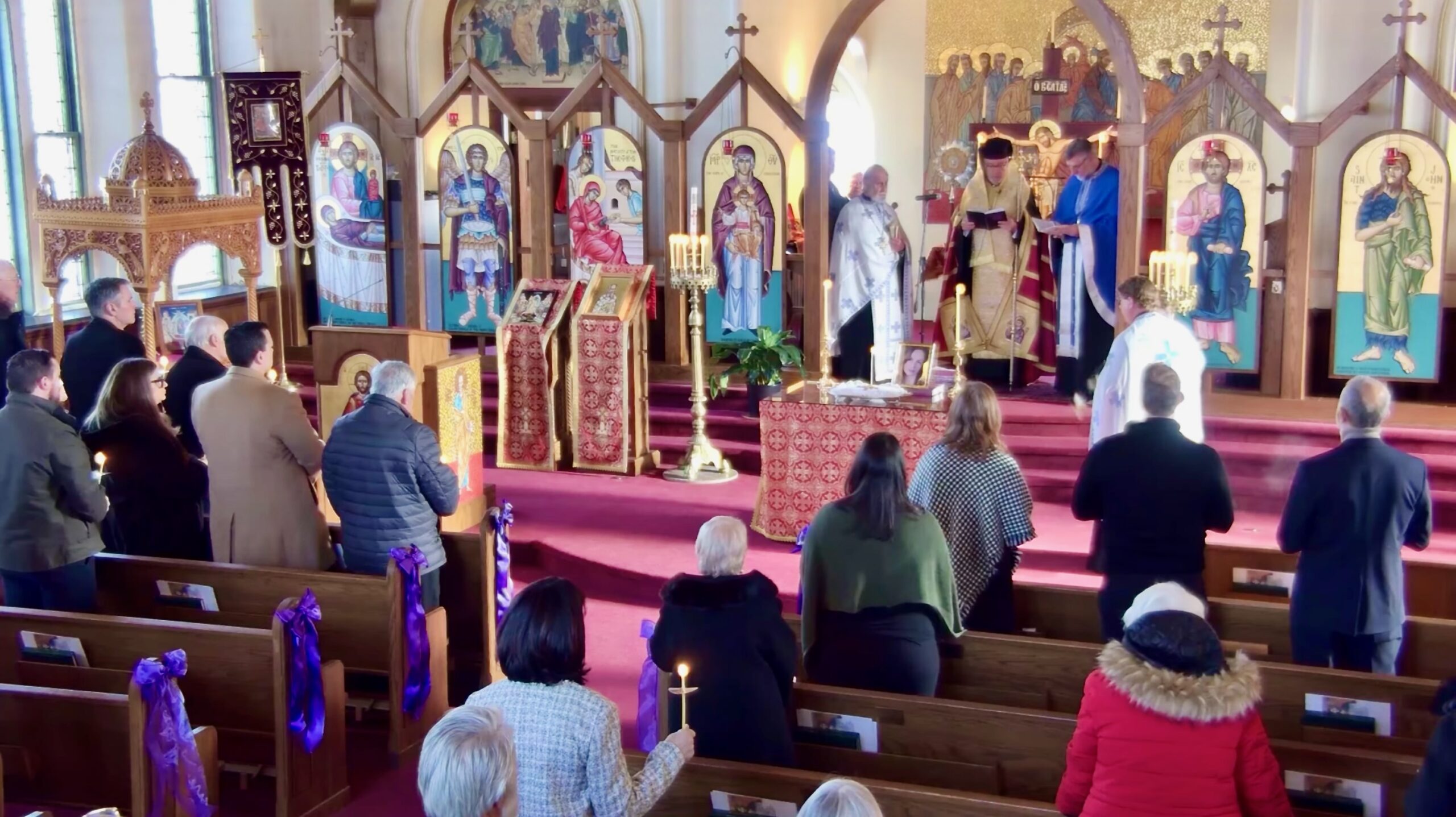
The interior of the Greek Orthodox church is beautiful, filled with icons. Even though I’m part of an iconoclastic religious tradition, personally I love icons, and I found it peaceful and calming to look at them before the service began. The service was led by the local Greek Orthodox bishop (who used to be the pastor of Panagia church, the Serbian Orthodox bishop, the current pastor of Panagia, and his immediate predecessor. It was a beautiful service, filled with (as they put it) the hope of eternal life.
We can only Ana’s family got at least some measure of comfort from this service.
Screen grab from the livestream of the memorial service for Ana Ljubicic Walshe, at Panagia church in Cohasset
If you live south of Boston, I want to invite you to a workshop I’ll be giving on Sat., Jan. 31:
Woody Plants in Winter: An Intro to iNaturalist
Saturday, Jan. 31, 10-12 noon. Led by Dan Harper, sponsored by the Cohasset Conservation Trust.
Come explore the winter woods using iNaturalist, a nonprofit online platform that helps you learn about nature while connecting you with other nature lovers. We’ll start indoors with an introduction to iNaturalist. Then we’ll head outdoors, to identify trees and shrubs in Great Brewster Woods and Dean’s Meadow, a 25-acre tract of woodland next to Cohasset Common.
10 a.m., Introduction to iNaturalist, Carriage House Nursery School, 23 N. Main St. Cohasset. Learn the power of the iNaturalist platform, which offers computer vision identification suggestions that are checked by human experts who volunteer their time. If possible, install the iNaturalist app on your smartphone in advance.
11 a.m., Woody Plants in Winter, start at Carriage House Nursery School, 23 N. Main St. Cohasset. After an introduction to identifying woody plants in winter, we’ll go out and find some plants to identify. We’ll use the classic field guide Woody Plants in Winter by Earl L. Core and Nelle P. Ammons, as well as other field guides. If you have a 10x hand lens, or a macro lens for your phone, please bring it along.
All ages are welcome, but persons under age 18 must be accompanied by an adult. Please note that iNaturalist users under the age of 12 must obtain parental permission to use the platform here.
Weather cancellation: Major winter storm cancels. Otherwise, dress for the weather. If it’s super cold or wet, we’ll spend minimal time outdoors, and bring samples indoors to identify in comfort.
As a professional educator for 25 years, Dan Harper developed curriculum for a weekly ecojustice class (gr. 6-8), a week-long ecology day camp (gr. 2-8), and week-long half-day workshops for children and adults. He currently is co-director of Ecojustice Camp South Shore.
The Cohasset Conservation Trust is a volunteer, non-profit organization whose mission is the protection of areas of ecological importance, such as marshes, woodlands, and seashores; the promotion of public interest in conservation and smart development; and the preservation of properties of unique historic interest or unusual beauty.
(Eventually, this will turn out to be about progressive spirituality — bear with me….)
Scott Adams, the creator of the “Dilbert” cartoon (and the Dilbert merchandise empire) has died of prostate cancer, at age 68. Cancer deaths are often unpleasant, and Adams’s last months sound like they were especially painful and debilitating, not something you would wish on anyone.
Adams left behind a very mixed legacy. His “Dilbert” comic strip was syndicated from 1989 until 2023. For the first few years, the strip often offered a fresh and funny take on what it’s like to be a lower-level white collar worker in corporate America. But Adams’s career went downhill from there.
Although, who am I to judge? I guess I can call myself a cartoonist, insofar as I drew a regular strip for the weekly newspaper of the undergraduate college I attended. My drawings were good enough, but my weakness was writing the strips. I depended on my friend Mike (who’s now a rabbi) to write the strips, and after he graduated I never drew another weekly strip. I manage to write acceptable nonfiction prose, but when it came to writing comic strips, I was a failure.
By contrast, Scott Adams was a wildly successful cartoonist, even though he drew badly. His characters show no particular expression, and he had little understanding of how to represent three dimensional space. But his writing was good, or it was in the first few years of the strip, because in writing for the strip he managed to capture some of the more frustrating aspects of corporate bureaucracy. He came out with a strip that appealed to the white collar cubical worker at a time when there were lots of white collar cubical workers. His success as a cartoonist was probably due more to lucky timing than anything else.
Yet after half a dozen years, in the late 1990s, “Dilbert” was getting repetitive. By the 2000s, none of the characters was likable; or maybe Adams no longer liked any of his characters. And by the 2010s, the strip was just plain boring, as well as mean-spirited. I think what happened was simple. In 1995, Adams quit his white collar cubical job in order to work full-time as a cartoonist; once he stopped working in a cubical, he stopped being funny.
Furthermore, by the 2000s, Adams was becoming an unlikeable person. My take on it is that he let his success go to his head, deluding himself into thinking he was pretty hot stuff even though he couldn’t draw and he wasn’t much of a writer. He became pompous and self-righteous. You can read a brief summary of his online sockpuppetry, trolling, and bad behavior here. His bad behavior kept getting worse, culminating in 2023 when he said in his podcast:
“If nearly half of all Blacks are not okay with white people—according to this poll, not according to me, according to this poll—that’s a hate group. And I don’t want to have anything to do with them. And I would say, based on the current way things are going, the best advice I would give to white people is to get the hell away from Black people. Just get the –– away. Wherever you have to go, just get away. Because there’s no fixing this. This can’t be fixed.” [Expletive deleted by me.]
(Full disclosure: I admit I didn’t listen to the podcast myself; I depended on this transcription.)
In fact, as early as 2000, Adams had turned into one of the least likable characters in his strip. He founded Scott Adams Foods to manufacture a frozen burrito that he called “the blue jeans of food.” What a stupid phrase. It’s a phrase that is classic corporate gobbledy-gook; it is exactly the sort of meaningless utterance made by the Pointy-Haired Boss of the early “Dilbert” cartoons. Adams had become the Pointy-Haired Boss.
I told you that eventually we’d get around to religion. In the last few weeks of his life, when he was in hospice, Adams apparently became a Christian. According to TMZ, in a final episode of his podcast his ex-wife read a letter from him which stated “he’s converting to Christianity because of the ‘risk-reward’ calculation.” (For an in-depth discussion of this philosophical stance, see Pascal’s Wager on the Stanford Encyclopedia of Philosophy; there is little evidence that Adams understood any of the philosophical complexities.) Calling his conversion to Christianity a “‘risk-reward’ calculation” sounds like more corporate gobbledy-gook. Again, it’s the sort of thing the Pointy-Haired Boss would say, which is kind of sad.
Crucially, he did not say what form of Christianity he converted to. Did he become a Roman Catholic? a Latter Day Saint? Russian Orthodox? an evangelical Protestant? “Dilbert” had grown so mean-spirited in its last couple of decades that it’s hard for me to imagine what form of Christianity finally attracted him. Or maybe he just didn’t know all that much about Christianity, and just called himself a Christian without knowing quite what he meant. However, from my religious point of view, he didn’t have to worry about the afterlife. If he had become almost any form of progressive Christian, he would have understood God as love and forgiveness, and he wouldn’t have had to worry so much about formal conversion. Instead, he seems to have understood God as a sort of deified Pointy-Haired Boss, and Christianity as a corporate bureaucracy. Which is too bad.
But despite all your flaws, thank you Scott Adams, for a half dozen years of a good comic strip. Not a great comic strip — you weren’t a Herriman, or a Mauldin, or a Johnston. And maybe you should have done what Bill Watterson did, refusing to sell related merchandise, then quitting while you were still fresh. Nevertheless, your half dozen good years remain a legacy that surpasses what most people manage to do. So thank you for the good stuff, and we’ll try to forget about the rest of it.
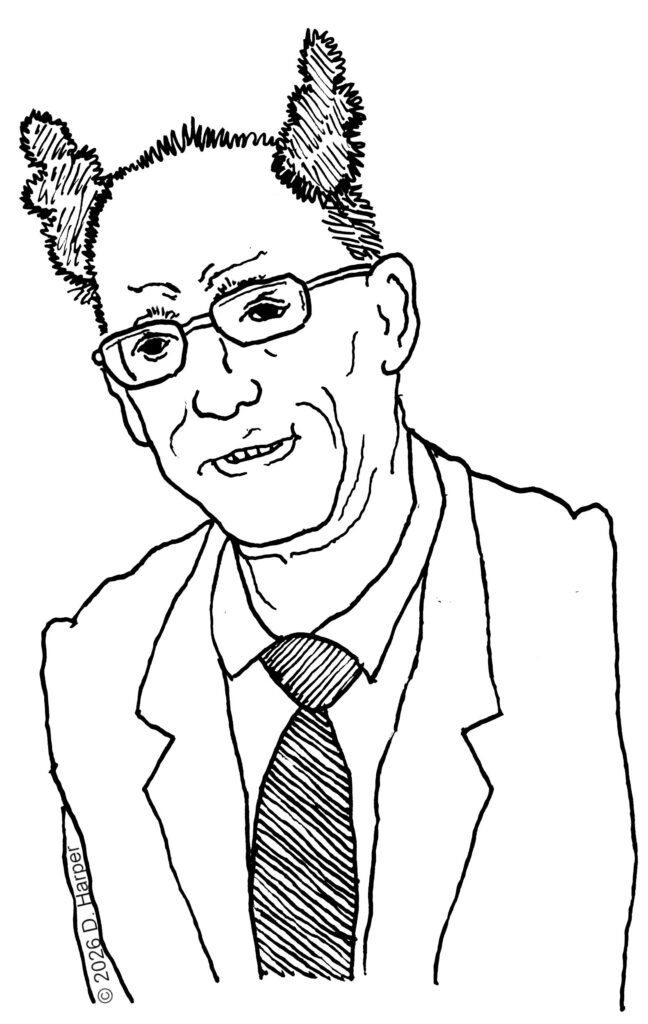
From one cartoonist to another: Adams as the Pointy Haired Boss. Maybe the Pointy-Haired Boss was more likable than we all thought….
While researching Neo-Dadist sculptor Soroku Toyoshima this afternoon, I ran across a quote by his son that feels like it’s meant for the coming year:
“Create dialogue, because in the end, you’re not going to change people’s minds by telling them they’re dumb.” — Tak Toyoshima
This comes from a 2021 interview titled “Teach-In on Race: Tak Toyoshima on Using Art to Heal the World,” on the Emerson College website. Tak is probably best known as the creator of the “Secret Asian Man” cartoon. And while he’s not exactly a Unitarian Universalist, Tak is UU-adjacent, with a spouse who’s active in a local UU congregation.
A/ The decline of organized religion has halted (for now)
In 2025, the big news in progressive religion was that religion is not quite as dead as the social scientists want us to believe. A Pew Research Center study released in December was titled “Religion holds steady in America.” At the same time, the study also found that “people in every birth cohort — from the youngest to the oldest — have grown less religious as they have aged.”
However, as usual, religiosity is measured with phenomena that are very much Christian-centric. One of the metrics that Pew looks at is how “prayerful” people are. By that metric, I’m completely non-religious, since I don’t pray. Another metric used by Pew is whether people “identify with a religion.” That means that Pew is measuring religiosity as a function of affiliating with an organized religious group. But we already know that the twenty-first century is a time when people are disaffiliating from all organizations. I would also say that lots of people I know are religious/spiritual without belonging to an organized religious group — I think of the people I know who do yoga or qi-gong, or who create their own spiritual rituals for groups of friends, or who consult Tarot cards, etc.
You also have to consider how organized religion gets defined. If you’re a practitioner of Orisa devotion (such as Santeria) and regularly visit a botanica, you’re not going to be counted as participating in organized religion. If you’re a yoga teacher, spending many hours leading classes and attending ongoing training, you’re not going to be counted as participating in organized religion. The unacknowledged influence of Protestant Christianity on American social scientists is still there. The more something looks like a Protestant Christian church, the more likely it is to be defined as a religion. The more something looks like Protestant Christian spiritual practice (e.g., prayer, regular attendance at religious services, belief in God, etc.), the more likely it is to be defined as a religious practice.
B/ Protest politics remains important for White Christian and post-Christian religious progressives
In a year-end article on Religion News Service, veteran religion reporters Jack Jenkins and Bob Smietana wrote about the Americas religious figures whom they expect to be most news-worthy in 2026. They chose a mix of religious conservatives, moderates, and liberals/progressives — and a range of races, ethnicities, and religious affiliations. The only person they chose who is best known for protest politics is Rev. David Black, a progressive White minister in a majority-White denomination, Presbyterian Church (USA).
Contrast that with the person Jenkins and Smietana picked to represent Black Protestantism, Rev. Frederick D. Hayes, who is running for Congress in his Dallas congressional district. Instead of protest politics, Hayes is using his religious platform to try to add another progressive voice in Congress.
Or consider Brad Lander, a Jew who is running for Congress in New York City. Lander offers a nuanced, liberal Zionist take on Israel — he calls himself a “steadfast supporter of Israel,” while also calling the Israeli campaign in Gaza a “genocide.” But instead of setting up a protest like a tent city, Lander hopes to take his nuanced view of Israel to Congress.
Or contrast that with Mehdi Hasan, a Muslim journalist whose show was canceled by MSNBC. Hasan went out and founded his own media outlet using Substack, and now has 50,00 paid subscribers (and 450,000 total subscribers). Instead of protest politics, Hasan is contributing directly to public discourse.
Speaking personally, most of the Unitarian Universalists I know (i.e., people who are mostly White, mostly progressive, mostly post-Christian) seem to place highest value on protest politics. If you want to get maximum kudos in Unitarian Universalist circles, tell people that you’re going to go to a protest rally. But if you say that you’re running for the local school board, or helping to run the local food pantry, or doing progressive journalism, it doesn’t seem to impress other religious progressives as an expression of your progressive religious values.
White religious progressives seem to place the most value on protest, and on what they call “resistance.” I just wish they placed more value on constructive ways to change the world.
C/ What religious progressives don’t seem to pay much attention to
The religious progressives I know don’t seem to pay much attention to several trends that I would have thought interesting to all religious progressives.