
Sikhs are strongly monotheistic. The first words in the Guru Granth Sahib, their collection of holy writings, say “Ek Onkar,” or “God is one.” Furthermore, God is transcendent and has not been incarnated in some physical form. Guru Nanak, the founder of the Sikh religion, wrote a statement of belief that can be translated as follows (reference: Pluralism Project):
There is one God whose name is True. God is the Creator. God is without fear. God is without enmity. God is of eternal form. God is unborn, uncreated, beyond incarnation. God is self-existent and self-sufficient. God is attained by the grace of the Enlightener.
Thus within the Sikh worldview, it would be wrong to say that there is more than one deity. The Sikh religion does recognize a series of ten holy persons, the gurus, of whom Guru Nanak was the first. These human beings are not considered deities by Sikhs — even though from the perspective of other worldviews they may seem to take on some of the qualities of lesser deities — but rather they may thought of as humans who had a special connection to God and who are tehrefore worthy of veneration.
Guru Nanak lived in the Punjab region of South Asia, a place where Hindus and Muslims both claimed their religion was true. Guru Nanak said that God transcends such divisions, and famously proclaimed that there is no Hindu, there is no Muslim.
The story is told that Guru Nanak once visited Mecca, the most holy city for Muslims. Sayad Muhammad Latif, in a history of the Punjab, tells what happened there:
“He (Guru Nanak) travelled over the whole of India, visited Persia, Kabul and other parts of Asia, and it is said even Mecca. A story is related by both Hindus and Muhamadans [sic] in connection with Nanak’s visit to Mecca. It is said that while at Mecca, Nanak was found sleeping with his feet to the Kaba, before which the Muhamadans prostrate themselves when performing their devotions. The Kazi Rukan-ud-din, who observed this angrily remarked: ‘Infidel, how dare you dishonour God’s house by turning your feet towards it.’ ‘Turn them if you can,’ replied Nanak, ‘in a direction where the house of God is not.'” (quoted in Kazhan Singh, History and Philosophy of the Sikh Religion: Part I: History, Lahore: Newal Kishore Press, 1914, p. 99)
This story gives a sense of the Sikh conception of God — transcendent, omnipresent.
A lovely painting on paper from West Bengal, painted in the mid-eighteenth century and currently in the Asian Art Museum in San Francisco, depicts Guru Nanak sleeping with his feet towards the Kaba:
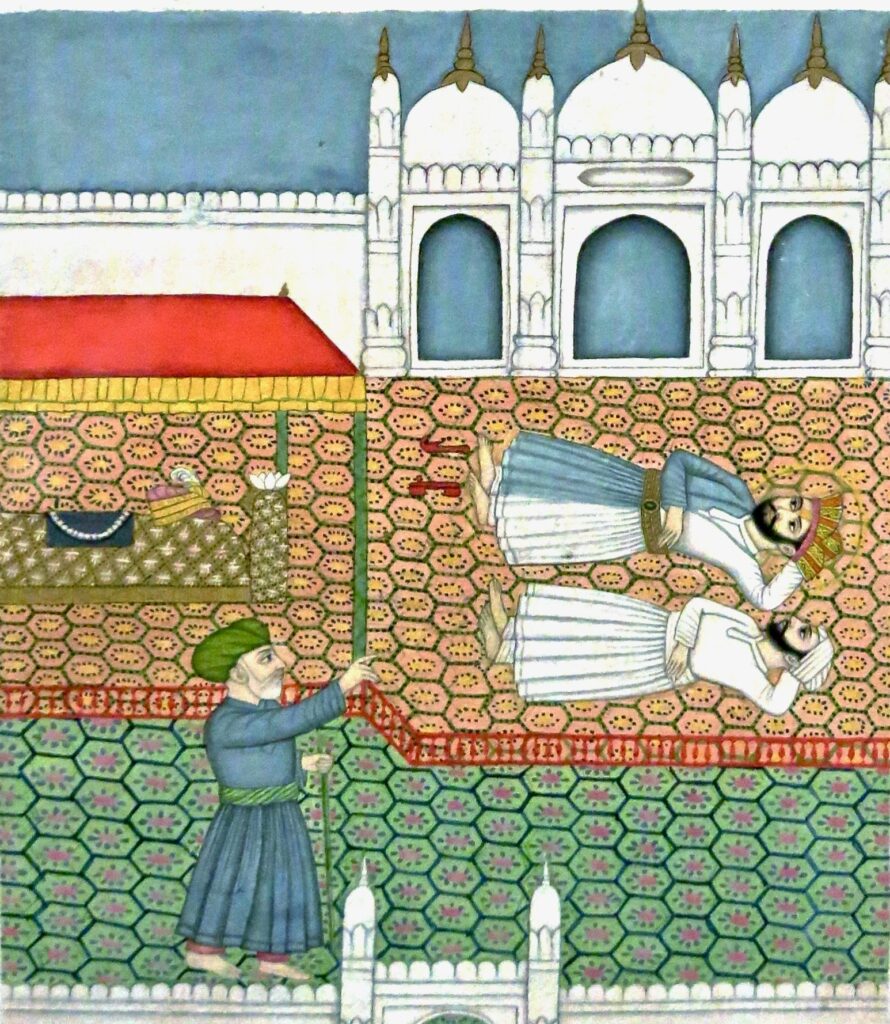
In another version of the story, a Muslim cleric kicks Guru Nanak for sleeping with his feet pointed towards the Kaba, then grabs hold of the guru’s legs and tries to turn his feet away, but “lo and behold the miracle the whole of Mecca seemed to be turning.” (Vaaran: Bhai Gurdas, Pauri 32, At Mecca)