Tumbandero videos and gallery

As a follow up to a previous post on tumbaderos — a tumbandero is the washtub bass that’s played in the Caribbean and Central America — tumbandero player Axel D. Rodríguez sent links to some fabulous videos. If you’re interested in tumbanderos or washtub bass, you’ll be fascinated by these videos, both to hear the varied playing styles, and to see helpful visual cues for making your own instrument.

Thank you Axel! (Find Axel and his band on Spotify — and on Youtube.)


Tingo Talango — Cuba 1 — A must-watch video showing a musician building a Cuban version of the earth bow, called a “tingo tualango” or a “tumbandero.” The earth bow was the African instrument from which the washtub bass and the tumbandero are derived. Skip ahead to 2:50 to watch the building of the instrument, and then watch it being played both by plucking the single string, and playing rhythm on the soundboard. The musician frets the string rather than adjusting the tension on the bow.

Tingo Talango — Cuba 2 — A short video with someone playing the tingo talango.

Tumbandera or Kaolin — Cuba 3 — Another traditional Cuban earth bow. These musicians adjust the string tension by moving the bow, and get different notes. In the short demonstration of playing, it seems the instrument sometimes requires two musicians — one to play, and the other to adjust tension to keep the instrument on pitch.
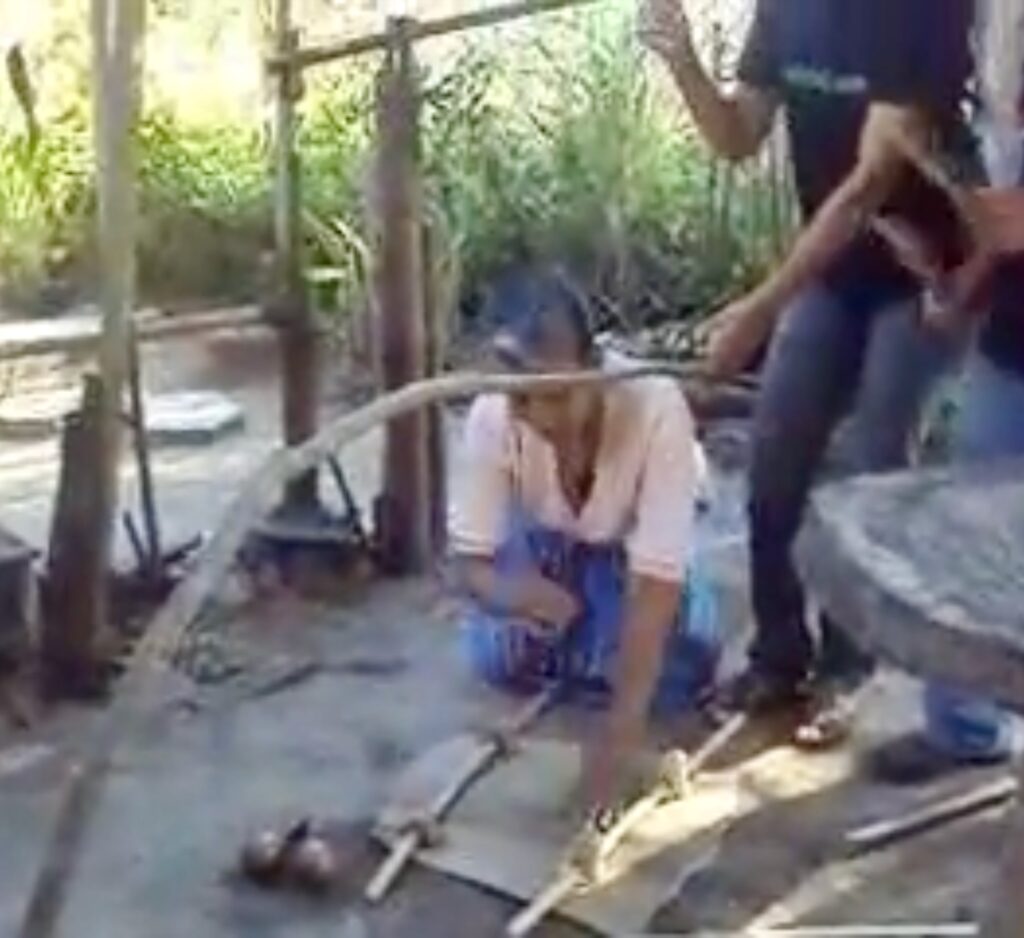
Screen grab from the 3rd Cuba video. You can clearly see the bow which provides tension for the string.

Quijongo Caribeño — Costa Rica — The visuals show some adults showing kids of about middle school age how to build an earth bow-derived instrument out of a wood box, a string, and a neck. (The audio isn’t coordinated with the visuals.)
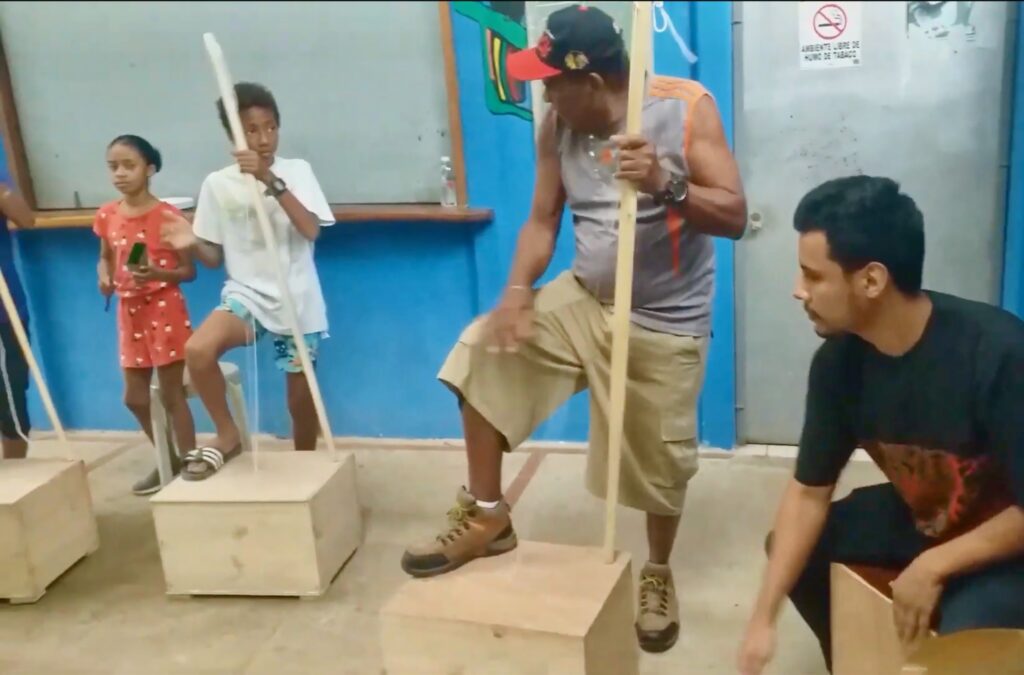
Screen grab from the Costa Rica video. The kids are learning how to play the instruments they just made.

Marengwen — Haiti — An earth bow-type instrument, but the string tension is fixed, and pitch is altered by fretting. In addition, rather than plucking the string, the musicians strike the string with a stick. A must-watch video.
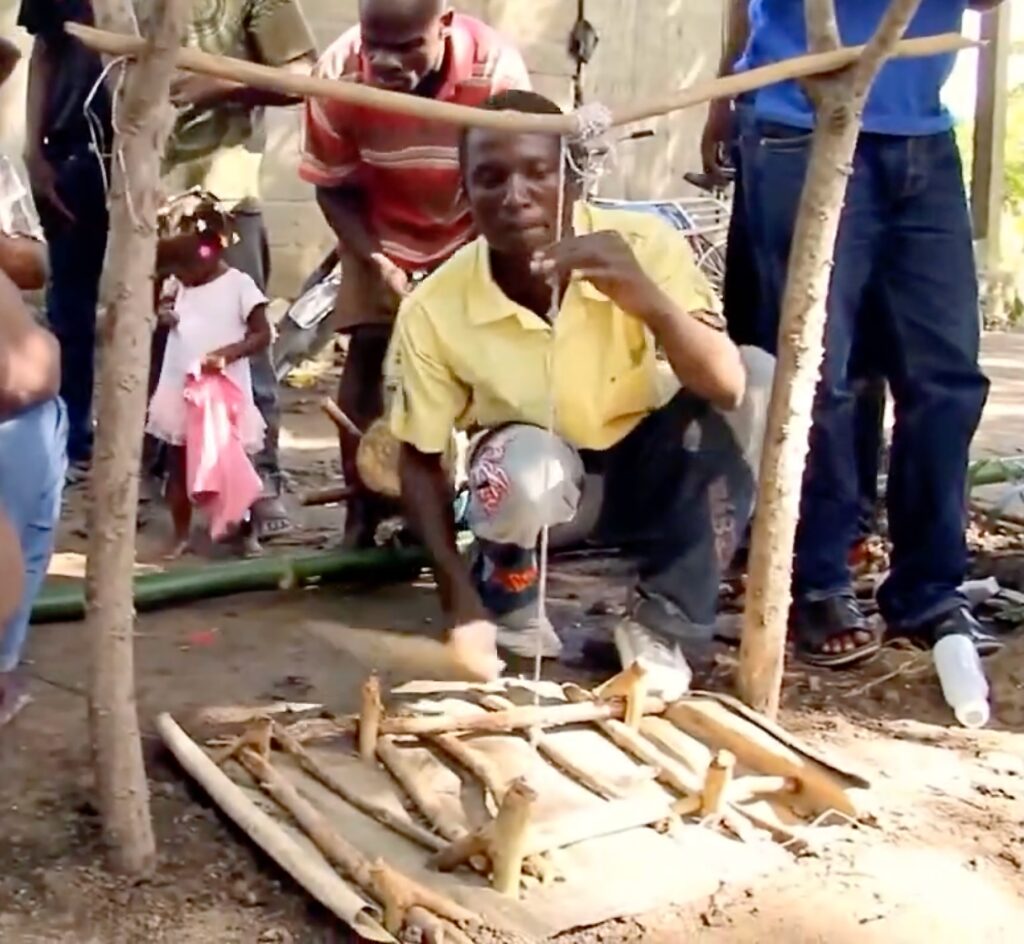
Screen grab from the Haiti video. The stick used to hit the string is blurred in this image.

Tumbandero or Bajo De Palangana — Puerto Rico 1 — A band with a tumbandero made from a plastic five gallon bucket.

Tumbandero or Bajo De Palangana — Puerto Rico 2 — Tumbandero made from a plastic five gallon bucket. One musician playing along to a recording, with a good view of his playing technique.

Tumbandero or Bajo De Palangana — Puerto Rico 3 — The tumbandero player picks up his instrument at 0:15. This instrument appears to be metal and plastic.

Tumbandero or Bajo De Palangana — Pureto Rico 4 — Tumbandero made with a plastic five gallon bucket. Once again, the tumbandero functions more like tuned percussion than a bass. You can hear the tumbandero from 0:00 to 2:45; and from 6:15 to the end. 
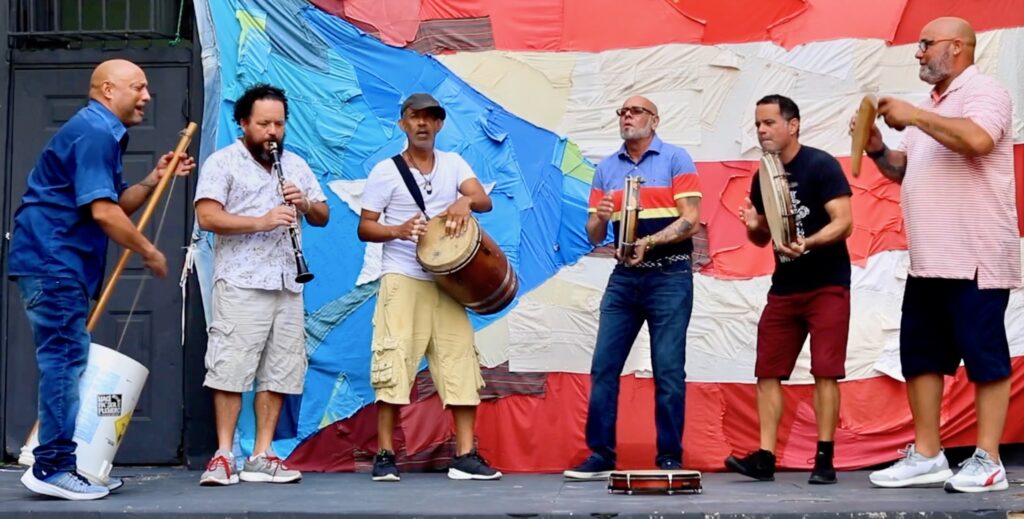
Screen grab from the 4th Puerto Rico video. The tumbandero (at far left) is made out of a 5 gallon plastic bucket.

Tumbandero or Bajo De Palangana — Puerto Rico 5 — A Smithsonian Folkways recording. Great audio, no visuals.

Tumbandero or Bajo De Palangana — Puerto Rico 6 — A tumbandero made out of a metal washtub. The tumbandero player explains his instrument as follows: 

Screen grab from the 6th Puerto Rico video. This tumbandero, made from a metal washtub, looks like a classic American washtub bass.

Axel also sent some photos he found online — since I don’t know the source of them, and whether they’re copyrighted, I decided not to include them in this post. But if you do an image search for “tumbandero” you should turn up some interesting images.

A final note: I really want to make the Costa Rican instrument. I like the sound of the wood, I like the looks of it, and it would be fun to make. But we don’t have room for such a large musical instrument in our tiny apartment.
Tumbandero

A comment by Axel D. Rodríguez, a musician and cultural researcher from Puerto Rico (his band on SpotifyYoutube), recently appeared on one of my old posts about the washtub bass. He gives some interesting information about the washtub bass that I wanted to highlight:

Rodríguez also writes that he has played the tumbandero himself on stage for several years. I found very little about the tumbandero on the web, but I did find one video on Youtube where it’s featured. There’s also a video on Facebook showing people making a tumbandero out of a five gallon bucket.

Since the washtub bass derives from the earthbow, an African instrument, it should be no surprise to find related instruments throughout the African diaspora. Nevertheless, I was fascinated to learn about the tumbandero.

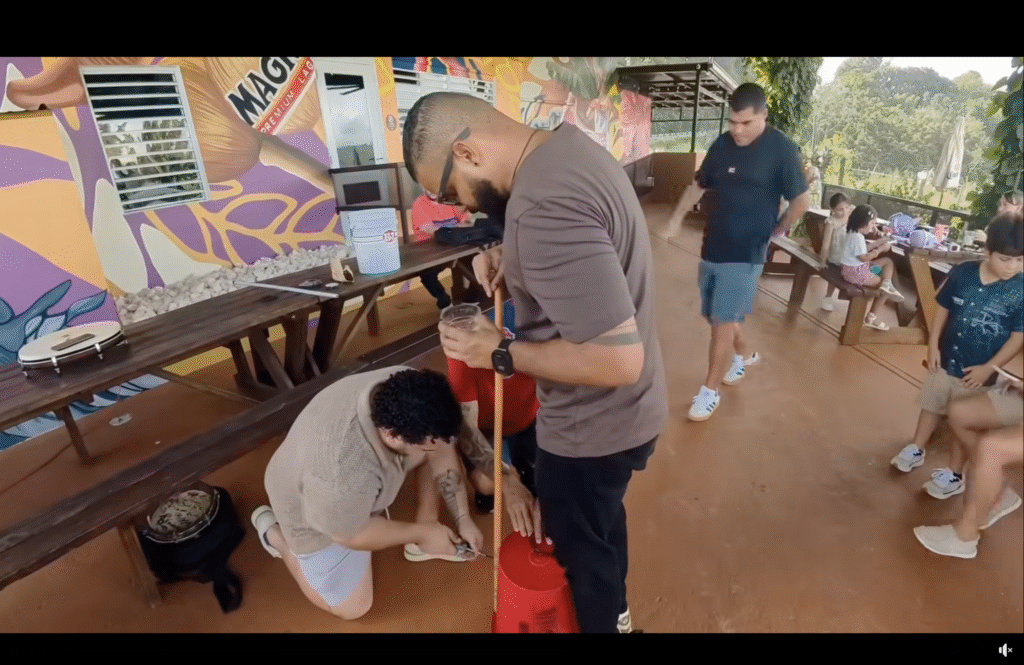
Two people making a tumbandero from a five gallon bucket.
Screen grab from the Facebook video. They’re attaching the neck to the bucket.

See this follow up post with tons of tumbandero videos.

Hammer dyeing with sumac leaves

I was reading the chapter on mordants in the book Craft of the Dyer: Colour from Plants and Lichens (by Karen leigh Casselman, 2nd ed., Dover Publications, 1993), when I came across this: “Some dye plants are used in the pot as mordants. This is true with alder and with sumac leaves.” (p. 40). (In case you’re not familiar with the term, a mordant is a substance used to help fix dyes in the cloth; a mordant helps make the dye color more light-fast, and helps the color stand up to washing better.)

This summer, I got interested in hammer dyeing (also known as “plant pounding”). This process transfers plant colors to cloth by hammering the plant against the cloth (details on the process are in this blog post). One problem with hammer dyeing is that the colors are not always lightfast, and may not stand up well to washing. But if sumac leaves can act as both mordant and dye-stuff, I wondered if they might produce a more permanent color if used for hammer-dyeing.

So I hammer-dyed a t-shirt using sumac leaves. And yes, they did indeed stand up to washing. As for lightfastness, only time will tell.

To see photos and a description of the whole process, scroll down.

Continue reading “Hammer dyeing with sumac leaves”

Hammer dyeing for nature journals

“Hammer dyeing” is a technique where you transfer the shape and color of leaves and flowers to cloth or paper by hammering. The process is fairly simple: you place plant material on cloth or heavy paper; cover with cloth, heavy paper, or plastic wrap; then hammer the plant material to release its juices which stain the cloth or paper. This article covers hammer dyeing projects that are intended for inclusion in nature journals.

The technique goes under several different names: “flower pounding,” “hammer printing,” “hammer staining,” “leaf hammering,” “tataki-zome,” “hapa-zome,” “Cherokee leaf pounding,” etc.; but I prefer to call it “hammer dyeing.”

Origins of hammer dyeing

I found no well-documented source giving the origins of hammer dyeing. I suspect the technique arose independently in several cultures.

Some online sources call this technique tataki-zome or hapa-zome, and claim it’s an “ancient Japanese art form,” but without citing any sources. A search on Google Books turns up many references to tataki-zome from 2000 on, but I could find only one reference prior to that date: Rita Buchanan, in Dyes from Nature (Brooklyn Botanical Garden Record, Plants and Gardens, vol. 46 no. 3, autumn 1990), p. 79, says that students learning how to dye in Japan practice tataki-zome: “Using their own plants, they learn dyeing techniques such as batik, itajime — a sort of variegated effect made with wood chips, and tataki-zome, a way of mashing plants on the cloth.” More research is needed to determine if tataki-zome is actually a traditional Japanese art form.

Alabama quilter Bettye Kimbrell (1936-2016), named a National Heritage Fellow by the National Endowment for the Arts, used a hammer dyeing technique she called “Cherokee leaf pounding.” It’s not clear this technique was actually used by the Cherokee people, so it’s best to consider this an American folk art with uncertain historical roots. Kimbrell used this technique in her quilts: “Cherokee leaf pounding is a technique where a fresh green leaf is taped to the backside of muslin fabric with masking tape. Using a hammer, gently pounding the leaf allows the chlorophyll to stain the fabric. After transferring each leaf to the fabric, the stain is set with a vinegar and water solution. The fabric is then dried and entirely hand quilted.” (Kristin G. Congdon and Kara Kelley Hallmark, American Folk Art: A Regional Reference, vol. 1 [Bloomsbury Publishing, 2012], p. 226.) More about her process here.

Screenshot from a video about hammer dyeing.
Screenshot from a PBS video on Bettye Kimbrell, showing her hammer dyeing a quilt. Click on the image to watch the video on the PBS website.

Books and references on hammer dyeing

For a comprehensive reference book on this technique, see Laura C. Martin, The Art and Craft of Pounding Flowers (Mt. Kisco, NY: QVC Publishing, 2001; Rodale Press, 2003). Martin covers which types of flowers, and which types of leaves, produce the best results; mordanting fabrics so the image is perhaps more light-fast; setting the image with a hot iron; etc. Unfortunately the book is now out of print. Used copies can be found on Thriftbooks (please do not buy from evil Amazon). The Internet Archive has a copy online that can be borrowed. The first 32 pages of the book are available on Google Books.

I’ve found references to two other books about the process: (1) Ann Frischkorn and Amy Sandrin, Flower Pounding: Quilt Projects for All Ages (Concord, Calif.: C & T Publishing, 2001); and (2) Linda Rudkin, Flower Pounding (London, U.K.: A & C Black Publishers, 2011). I haven’t seen either book, so can’t comment on them.

PBS has a video with Bettye Kimbrell demonstrating her leaf pounding technique. Sadly, the video does not show her technique for setting the image in vinegar (see below).

My curriculum website has instructions for doing flower pounding with children, using inexpensive watercolor paper. Scroll down to “V/Printmaking,” then go to project “D/Pounding flowers.” The technique I describe has been extensively field tested with children from grade 1-8, and produces reliable results. However, this technique is more focused on process than product (“process art”), and is not suitable for use in a nature journal curriculum.

Cloth with hammer-dyed impression of a fern on it.
Hammer-dyed fern on bleached cotton muslin, 36 inches wide. No mordant or scouring, but the image was set using a steam iron. The darker places are plant material deliberately left on the finished image. Image copyright (c) 2025 Dan Harper.

Hammer dyeing process

Earlier this month, during a week-long family conference at a Unitarian Universalist summer camp, I was leading an ecology workshop that centered around participants recording thoughts, feelings, and observations about the nature in journals (i.e., nature journaling). My co-leader, Rebecca, who is a middle school teacher, contributed to the development of this activity (thanks, Rebecca!). During this workshop, we field-tested a procedure for hammer dyeing. The process, outline below, is easy to set up, and is designed to help participants become more aware of the details of leaves and flowers.

Tools needed

  • Hammer, at least 1 for every 2 participants (see discussion of hammer types below)
  • Disposable foam ear plugs
  • Table with a hard flat surface

Materials

  • Thin cotton muslin cloth, 36 or 45 inches wide
  • Leaves, flowers

A rule of thumb for collecting leaves and flowers: Collect just 1 out of 20 similar leaves/flowers.

A note about fabric: I used to go to Joann Fabric to buy cloth for class projects, but they went out of business this year. Michael’s purchased Joann Fabric intellectual property, and one of the local Michael’s stores does carry 45″ cotton muslin in stock. My preferred online source for fabric is Dharma Trading Post, but as of this writing their popular 45 inch cotton muslin is out of stock.

Continue reading “Hammer dyeing for nature journals”

Adventures in cyanotype

(Written on July 3, finally getting around to posting on July 12.)

I’m running an ecology workshop at a small conference at Ferry Beach Park Association in Saco, Maine. One of the activities I did to get participants to see the world in new ways was making cyanotype prints of plants. I was inspired in part by Anna Atkins, who created the first-ever book of photographs with cyanotypes of seaweed.

Thea and Mandy were leading an art workshop at the same time, and they got interested in cyanotypes. So after our morning workshops were over, we did some experimenting. In the evenings, after it got dark, we coated several different kinds of paper with cyanotype emulsion. During the day, we experimented with different compositions using natural object to make photograms. We even took a field trip to the Portland Museum of Art, where there’s a special exhibit of Jo Sandman’s large photograms on platinum-palladium paper.

We didn’t wind up with much in the way of finished art works. But we learned a great deal. As Thea kept reminding us, often the process is more important than the product.

Turning twenty

(I wrote this a few days ago, then forgot to post it. Here it is now….)

On February 22, 2005 —twenty years ago last Saturday — I wrote my first blog post. If you want a summary of this blog’s boring history, try here, here, and here. But I don’t want to look at the past, I want to think about the ongoing role of independent blogs like this one.

Twenty years ago, most blogs were a mix of day-to-day trivia, snarky commentary, and a few more serious long-form posts. All three of these have now migrated to other platforms.

The day-to-day trivia gets posted to social media outlets like Facecrook, TikFok, YouCrude, Instacrap, etc. Much of it consists of images, graphical memes, and videos. There’s no longer much interest in text-based day-to-day trivia.

Snarky commentary has also moved to social media outlets. Again, there’s been a movement away from text-based snark to videos, graphical memes, and images. Snark has also declined in intelligence, creativity, and kindness; I wouldn’t even call it snark any more, I’d call it Rage Porn.

Long-form text-based posts have moved to outlets that cater to that format, such as Substack and Medium. This move is generally a good thing; writers can focus on writing, and they can stop worrying about the technical challenges of publishing online.

In short, most of what appeared on independent blogs twenty years ago has now moved to other platforms. There’s a good reason for these moves: it has become increasingly challenging to stay current with web technology.

Take, for example, WordPress, the blogging platform I use. I started out in 2005 using WordPress 1.5, when it was simple and uncomplicated blogging software. Today, WordPress has morphed into a major CMS capable of running today’s most complex websites. I no longer have the time to stay current with its capabilities. That’s one of the reasons I still use a nine-year-old theme: I don’t have the time to make the move to a new theme. Sure, I could hire a WordPress consultant to do it for me; but that gets away from the DIY ethos that I found so appealing about blogging back in 2005.

Whatever platform you choose, web security has become increasingly difficult, as the evil hackers get bolder and more skilled. I’m lucky I have a good web host who helps me keep current with security issues. But it’s getting harder and harder for me to stay current with web security. I can thoroughly understand why writers would want to move to a platform like Substack or Medium.

Beyond the challenge of staying current with technology, I don’t think there’s much of an audience for independent text-based blogs any more. Most of my early readership long ago migrated to social media platforms. Once you’re hooked in to a social media platform, there’s not much reason to go visit an independent website. Potential new audiences tend to prefer audio or visual podcasts; they don’t want to read text, they want to watch or listen to content.

The only reason to write an independent text-based blog like this one is because you like to write. That describes me. I enjoy the process of writing, and I write all the time. As long as I’m writing something, I might as well publish it. And even though publishing a blog has gotten more difficult in the past twenty years, it’s still far easier than the printed fanzines I used to publish in the 1980s and 1990s.

So what if the audience for independently hosted blogs is tiny? I’m still having fun, which has always been the point of this blog. I hope you’re still having fun, too — and thank you for continuing to read.

Cyanotype…notes to myself

I wrote this post while I was experimenting with cyanotype as a way to get people to look more closely at plants. I updated it several times, with the final revision on 21 August 2025.

(Updates: 30 May; 12 July 2025; 17 July; 20 July 2025. Final revision, 21 August 2025.)


Cyanotype books

Many of the books on cyanotype available online are self-published. The following two books come from reputable publishers.

Cyanotype: The Blueprint in Contemporary Practice by Christina Anderson (Focal Press, 2019), covers everything you need to know about cyanotypes — setting up a “dim room”; how to coat your own cyanotype paper; recipes for classic cyanotype, new cyanotype, and other formulas; how to tone prints; and more. Anderson tested over 100 different papers to see which worked best for cyanotype, and there’s a whole chapter on paper. The last chapter of the book showcases artwork by contemporary cyanotype artists. This is a must-have book.

Cyanotype Toning: Using Botanicals To Tone Blueprints Naturally by Annette Golaz (Routledge, 2021) is an excellent introduction to toning cyanotypes using plant materials. Aimed at the proficient cyanotype artist, Golaz shows how to achieve a wide range of colors that take you far beyond the typical blue cyanotype.


Cyanotype supplies

Chemistry

Jacquard Products sells cyanotype sets — two plastic bottles with cyanotype chemicals that you fill with water, then mix the resulting solutions 1 to 1 when you’re ready to coat your paper. (I bought mine at an independent art supply store, and it was super easy to use.) I also bought a Jacquard kit which included chemicals, brush, glass plate for contact printing, and some Hahnemuhle Platinum paper — it’s probably overpriced, but I found the kit helped me get started.

Bostick and Sullivan is the major supplier of alternative photographic processes. I have not ordered from them, but they have everything you need for cyanotypes. Other sources for cyanotype chemistry include Photographer’s Formulary, The Cyanotype Store, and Fotospeed.

Paper

Finding paper that’s good for cyanotype can be a challenge, since not only must the paper stand up well to repeated wetting, but the pH of the paper is also important. See Christina Andersons’ book for comprehensive information on papers.

One of the inexpensive papers Anderson recommends is Canson XL Watercolor paper. This is currently my go-to paper, and I can recommend it. Widely available at places like Michael’s and Dick Blick.

Both Anderson and Golaz say Hahnemuhle Sumi-e is an excellent lightweight paper to use in cyanotype. I got mine at the Art Mart in Portland, Maine, which stocks it. Or, Bostick and Sullivan sell Hahnemuhle Sumi-e online. It requires gentle handling, but produces beautiful results.

At a week-long summer art workshop, three of us loved Fabriano Medievalis paper. It’s slightly cream-colored, which sets off the Prussian blue of the cyanotype nicely. However, it does not stand up well to toning, or long wash baths.

I’ve also used Yasutomo “Sketch,” which produces similar results to Hahnemuhle Sumi-e, but is much less expensive. However, it’s very fragile in water and tears easily during the developing process — you can forget about bleaching and toning this paper. If you’re on a budget and very patient, maybe give it a try.

Cyanotype in the classroom

Lawrence Hall of Science sells “Sunprint Kits” with 12 pieces of 4 inch square cyanotype paper and a clear acrylic overlay sheet. Cost buying direct from them is US$5.99 per kit (do not buy from Amazon where the price is higher). This cyanotype paper develops quickly and requires little water to develop — perfect for classroom use. They also sell refill packs of 12 sheets of cyanotype paper for US$3.99, as well as 8-1/2 by 11 inch cyanotype paper. The kits and refills are ideal for class use — inexpensive enough to allow people to experiment.

My younger sister the children’s librarian uses 5×7 inch “Nature Print” cyanotype paper from Dick Blick. It’s just as good, but I’ll stick with the Lawrence Hall of Science paper, because my purchase helps support their science education mission.


Cyanotype websites

Many of the cyanotype websites appear to be “AI”-generated slime. Others are too basic (“Expose the cyanotype paper, put it water, look at the result!”). But I found the following websites to be worth a look.

Cyanotypes with plants

Cyanotype by Angela Chalmers, a PDF, gives instructions on making cyanotype photograms using plants. Great ideas, and the author’s photograms are gorgeous.

“How To Make Cyanotypes of Flowers” on the Nature TTL website includes very useful instructions on a specific form of wet cyanotype process.

A digitized version of Anna Atkins’s book of botanical cyanotypes is online at London’s Natural History Museum website. A scholarly article with an analysis of Atkins’s book from the point of view literary analysis can be found here.

Atlas Obscura has samples of a 12 year old’s botanical cyanotypes here. Educators might find this inspiring.

Cyanotype techniques

Toning can alter the bright blue color of cyanotypes. Jacquard has a guide to toning cyanotypes to produce various colors.

The “Koraks Tinkers” blog has a post pointing out the difference between collimated vs. diffuse light when exposing cyanotypes. Direct sunlight provides collimated light, while an overcast day provides diffuse light. This difference is less important when making contact prints from a negative, but will produce quite different results with 3-D objects. Cloudy skies = diffuse light, and blurred edges. Clear skies = collimated light, and sharp edges.

UV light boxes

A UV light box allows you to expose cyanotypes indoors, or at night. I finally decided not to build a UV light box (no room for one in our tiny apartment), but here’s some info I collected while researching them.

Photographer Steph Coffman has a page on her website detailing how she made a UV light box — inexpensive and effective. A photography teacher from CCSF shows how to make an even cheaper UV light box — unfortunately, the UV light source she used is no longer available; her video is still worth watching, just to see how she does it. The Alternative Photography website has instructions for making inexpensive UV boxes. Finally, the “Koraks Tinkers” blog shows how to build your own custom UV light box with an LED array — but you have to be comfortable using soldering irons and test equipment.

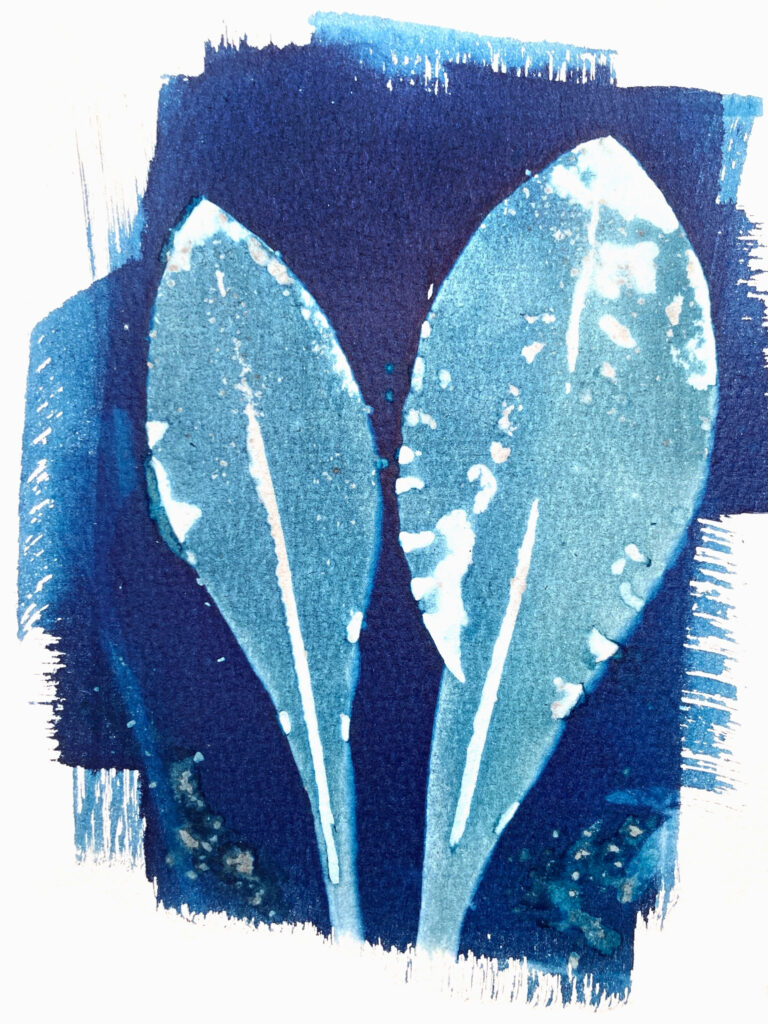
Photogram of two leaves.
Cyanotype of two mullein leaves. The leaves were dampened before placing on the paper, so this is a partially wet cyanotype process — this yields the greenish hues seen above — and a longer exposure would have revealed more details of the veins in the leaf.

Even more copyright free hymns

I found four more copyright-free hymns that I’d been meaning to upload: “Yielding and Simple,” a Shaker song; “Trouble in Mind,” the blues and jazz standard; “Hold On,” also known at “Keep Your Hands on the Plow”; and “Rise Up O Flame,” which I once thought might be protected by copyright but am now convinced in public domain.

You can find them on this webpage. Descriptions below the jump.

That webpage is static HTML, by the way, which I code by hand in the text editor Atom. Thank goodness this is the last of the hymns I have which are ready to post. Writing static HTML takes up too much time, time that I’d rather spend creating content (e.g., writing actual posts for this blog). This bout of hand-coding proved to be especially time-consuming because Filezilla, free open-source software which I use to upload the HTML to the server, suddenly stopped talking to the server. I spent half a day troubleshooting, until I finally gave up and purchased Transmit, another FTP application. However, static HTML is more resistant to attacks by malicious hackers, and requires less energy consumption to render — so I suppose writing static HTML is worth it in the long run.

Continue reading “Even more copyright free hymns”

It came from a plant press

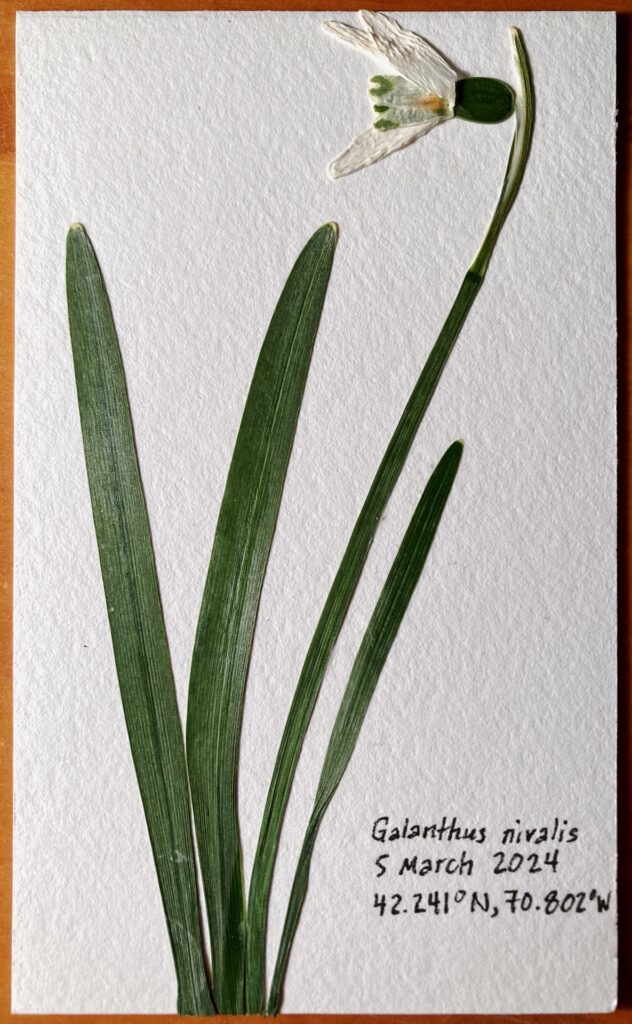
Back in early March, I wrote about how to make a cheap pocket plant press, showing a Common Snowdrop (Galanthus Nivalis) in the press. I finally got around to mounting the prseed plant, and here’s what the finished product looks like:

A pressed and dried flower mounted on cardstock.

I used polyvinyl acetate (PVA) glue (Elmer’s Glue) to mount the pressed-and-dried plant onto a piece of cardstock. PVA glue dries fairly clear, is reasonably non-acidic and flexible, will fill small gaps, and is cheap, making it a good choice for gluing dried plants to a base.

If you’re mounting a plant for an herbarium, you’d include the whole plant, roots and all. But I’m doing this for fun, so I didn’t include the roots. I mounted the plant with a bit of the stem extending off the cardstock. Then when the glue dried, I used a sharp knife to trim the stems at the edge of the card. Notice how I glued the petals down so that the inner parts of the flower are visible.

The end result is attractive, and even though it’s scientifically useless, I’m happy to have it for my own reference. I’m thinking of making a somewhat larger cheap pocket plant press — maybe 4 x 6 inches (10 x 15cm) — for slightly larger flowers.

As always, don’t collect plants unless you have permission to do so. These days, written permission is typically required for collecting on most federal lands (including national parks, Forest Service land, and often even BLM land), on many state lands, on nearly all wildlife sanctuaries, etc. — don’t collect unless you’re sure you’re allowed to do so. If it’s in your back yard or you know the landowner personally, you should be fine. PLUS, never collect rare or endangered plants, and never collect more than about 5% of a given species in a given location. The only exception would be invasive plants — e.g., here in Massachusetts, go ahead and collect all the Purple Loosestrife, Yellow Iris, Rosa Multiflora, etc., that you want.

Cheap pocket plant press

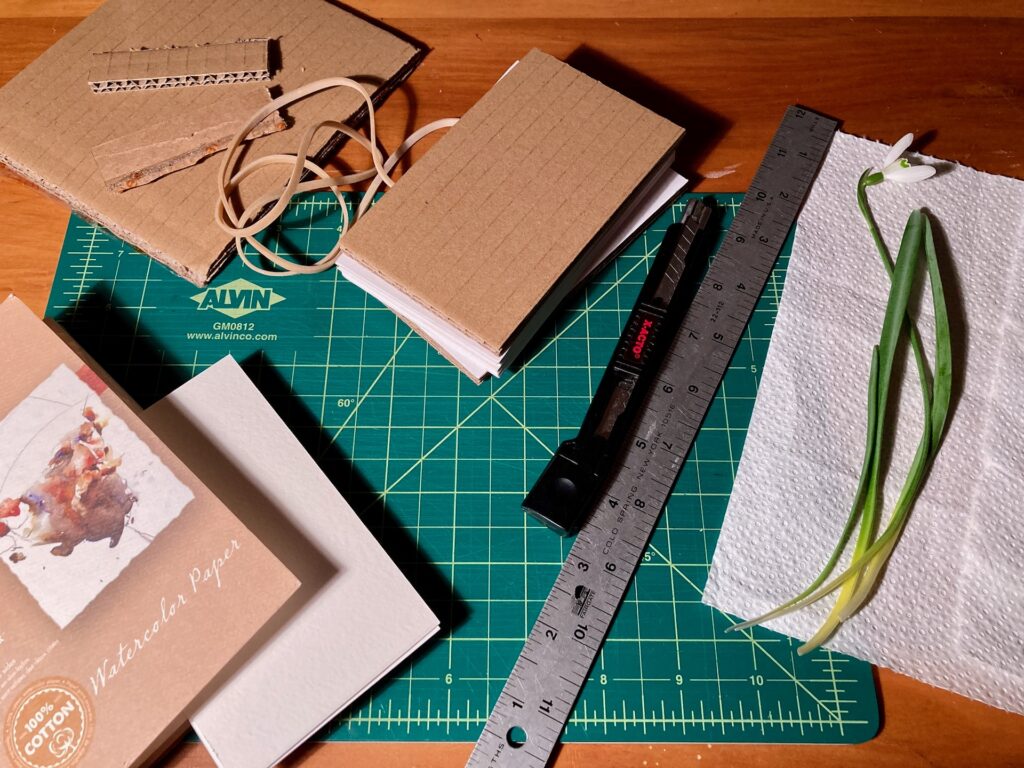
Photo of the materials listed, laid out on a work table.

(1) This pocket plant press is made from a stack of 3 x 5 index cards, salvaged corrugated cardboard, cheap watercolor paper, and rubber bands. Cut two pieces of corrugated cardboard to 3 x 5 inches. Cut two pieces of cheap watercolor paper to the same size. Find a flower, and blot it dry with paper towels.

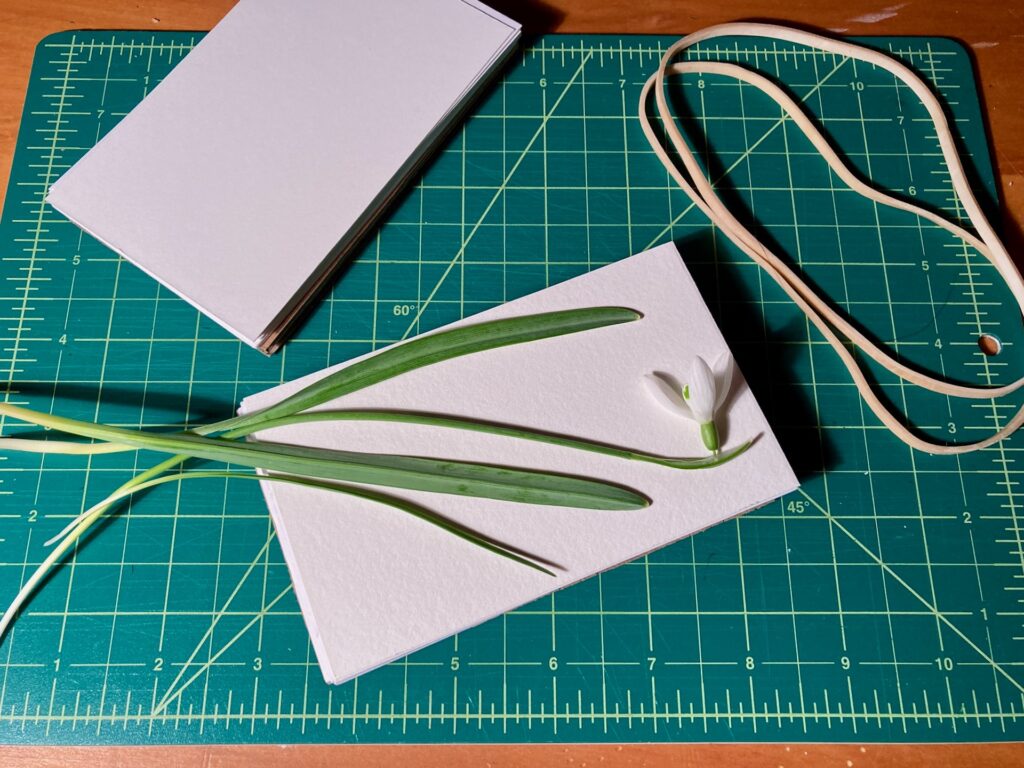
A flower arranged on the open plant press

(2) Place one piece of corrugated cardboard down. Stack half the file cards on top of it. Place a piece of watercolor paper on top of that. Arrange the flower on this stack. Then make another stack of corrugated cardboard, file cards, and watercolor paper.

The completed stack, the flower is in the middle with its stem sticking out.

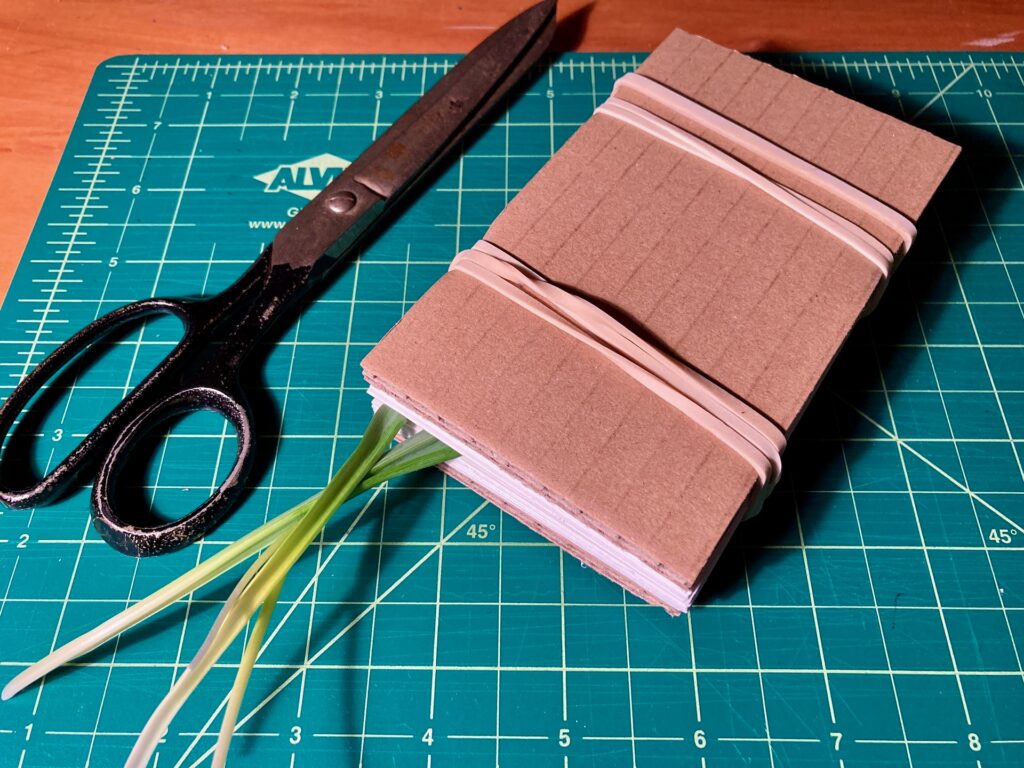
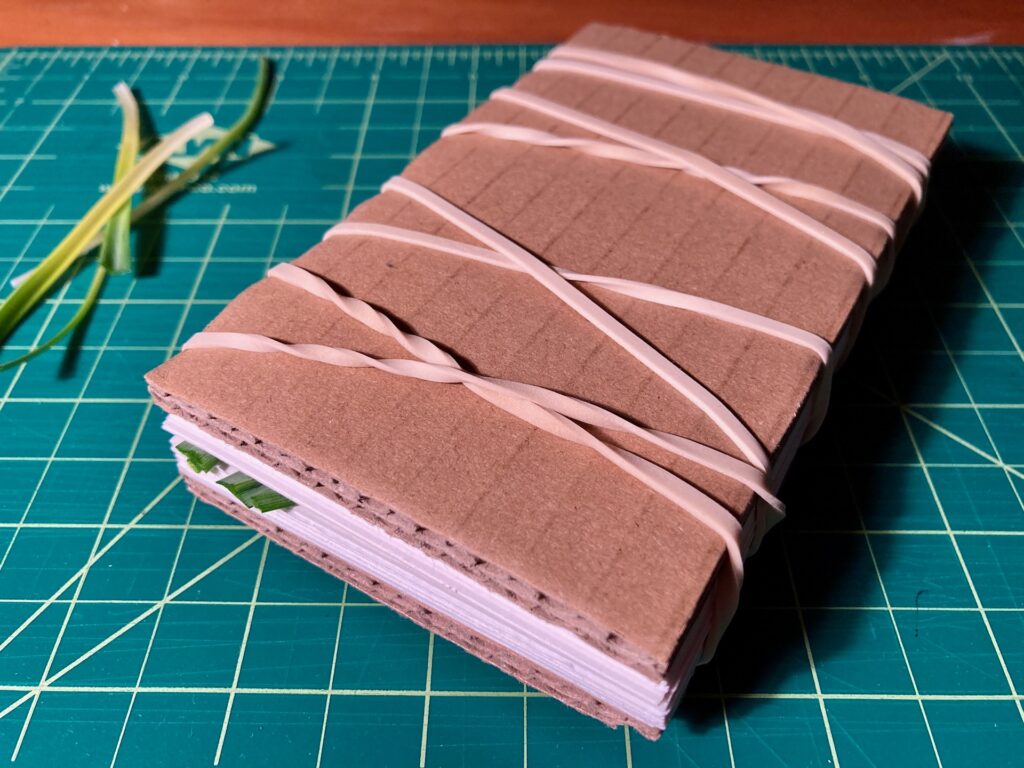
(3) Assemble the stack with the corrugated cardboard on the outside. Wrap the assembly with the rubber bands. If the stem of the flower is sticking out, you can trim it off with scissors.

Side view of the assembled stack, showing the layers.

Now let it dry for at least a week. Longer if the weather is humid, or the flower is especially moist. If you want the flower really flat, stack some heavy books on top of the plant press.

The watercolor paper takes the place of blotter paper in a real plant press. In some cases, the pressed flower may leave a colored image on the watercolor paper, so with some experimentation you should be able to use this technique to make pressed flower monoprints.

The stack of file cards makes the plant press stiffer, and helps spread the pressure of the rubber bands out evenly. You can also press several flowers in this plant press by using alternating layers of file cards, watercolor paper, and flowers.

(This is a follow up to this post. And for the finished product, see this post.)