Fudo Myoo

FudoMyoo

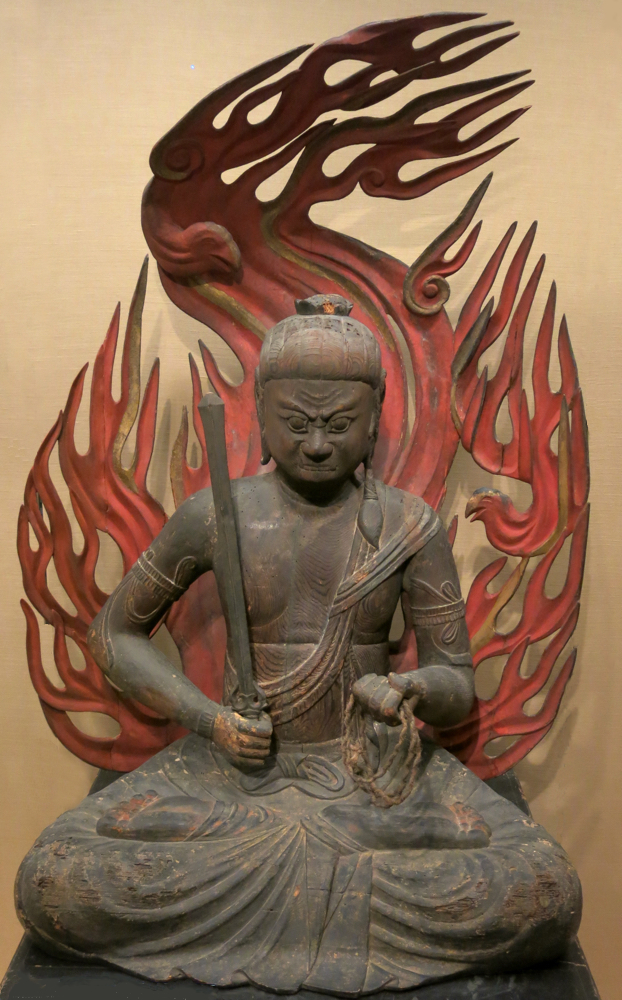
Fudo Myoo is a Japanese Buddhist deity, one of the Five Great Kings, or Godai Myoo.

The Godai Myoo “are considered to have great magical powers to fight against heresy, passion, ignorance, illusion, and other spiritual obstacles. The most popular Myoo in Japan is Fudo, whose name means literally ‘The Immovable One.’ He is an incarnation of Dainichi Nyorai, who is an idealization of the truth of the universe, from whom all other Buddhas and boddhisatvas are born. Fudo is thought to fight against all evil to protect Buddhist law.” — Selected Works: The Asian Art Museum of San Francisco (San Francisco: Asian Art Museum, c1994), p. 179.

This image is a digitally manipulated photograph of a sculpture in the Asian Art Museum labeled “The Buddhist deity Achala Vidyaraja (Japanese: Fudo Myoo),” dated to 1100-1185, catalog no. B605146+.

Doumu

Doumu

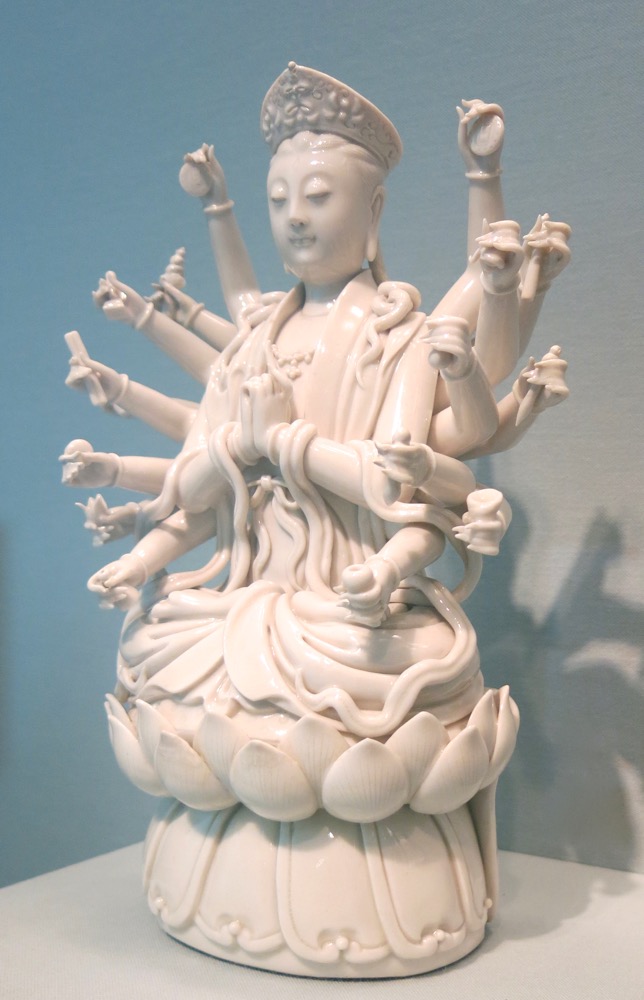
Above: porcelain image of the Taoist deity Toumu [Doumu], made in Fujian province in the 18th century, now in the Asian Art Museum, San Francisco (catalog no. B60P1362).

“The Dipper Mother [Doumu] is a star deity and a Daoist adoption of the Tantric deity Marici, a personification of light and dawn. As a savior and healer, she is invoked through visualizations that unite the adept with cosmic light and ‘oneness with cosmic principles’ (75-76). As the cosmic mother of the nine star-gods of the dipper, she is a nurturer and instructress, but the Dipper Mother also maintains her own salvific powers and authority.”

From a book review by Sara Elaine Neswald of McGill University on the Daoist Studies Web site (2 Dec. 2004), of the book Women in Daoism by Catherine Despeux and Livia Kohn (Cambridge, Mass.: Three Pines Press, 2003).

———

Update: August 12, 2019: Entry on Doumu in E. T. C. Werner, Myths and Legends of China (London: George G. Harrap & Co., 1922), pp. 144-145:

Goddess of the North Star

Tou Mu, the Bushel Mother, or Goddess of the North Star, worshipped by both Buddhists and Taoists, is the Indian Maritchi, and was made a stellar divinity by the Taoists. She is said to have been the mother of the nine Jen Huang or Human Sovereigns of fabulous antiquity, who succeeded the lines of Celestial and Terrestrial Sovereigns. She occupies in the Taoist religion the same relative position as Kuan Yin, who may be said to be the heart of Buddhism. Having attained to a profound knowledge of celestial mysteries, she shone with heavenly light, could cross the seas, and pass from the sun to the moon. She also had a kind heart for the sufferings of humanity. The King of Chou Yu, in the north, married her on hearing of her many virtues. They had nine sons. Yuan-shih T’ien-tsun came to earth to invite her, her husband, and nine sons to enjoy the delights of Heaven. He placed her in the palace Tou Shu, the Pivot of the Pole, because all the other stars revolve round it, and gave her the title of Queen of the Doctrine of Primitive Heaven. Her nine sons have their palaces in the neighbouring stars.

Tou Mu wears the Buddhist crown, is seated on a lotus throne, has three eyes, eighteen arms, and holds various precious objects in her numerous hands, such as a bow, spear, sword, flag, dragon’s head, pagoda, five chariots, sun’s disk, moon’s disk, etc. She has control of the books of life and death, and all who wish to prolong their days worship at her shrine. Her devotees abstain from animal food on the third and twenty-seventh day of every month.

Of her sons, two are the Northern and Southern Bushels; the latter, dressed in red, rules birth; the former, in white, rules death. “A young Esau once found them on the South Mountain, under a tree, playing chess, and by an offer of venison his lease of life was extended from nineteen to ninety-nine years.”

Xenophanes on the appearance of the divine

Xenophanes, a Greek thinker (fl. 540 BCE), is quoted by later writers as having said the following about the divine:

If cattle or lions had hands, so as to paint with their hands and produce works of art as humans do, they would paint their gods and give them bodies in form like their own — horses like horses, cattle like cattle. [Diels-Kranz fr. 15.]

Mortal [humans] suppose that the gods are born as they themselves are, and that they wear human clothing and have human voice and body. [Diels-Kranz fr. 14.]

— trans. Arthur Fairbanks [and altered slightly by me], The First Philosophers of Greece: An Edition and Translation… (London: Kegan Paul, Trench, and Trubner Co., 1898), p. 67.

Ceremonial deity, Phillippines

Ceremonial Deity, Philippines

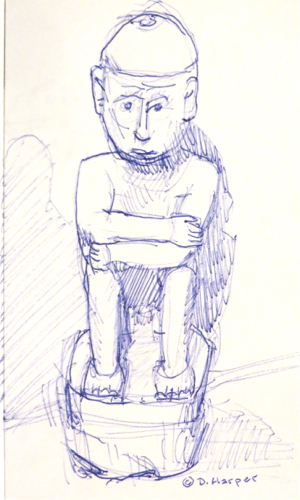
Above: Sketch of a “ceremonial deity,” Philippines, c. 1930. Wood and shell. Asian Museum of Art.

One of delights of going to the Asian Art Museum in San Francisco is seeing the diversity of depictions of deities. Today I particularly noticed the unnamed deities — like this sculpture of an unnamed ceremonial deity, made in the Philippines around 1930. Why do we not know the name of this deity? Is it because it is a minor deity, and thus not widely identifiable (though perhaps readily identifiable by a devotee)? Did it never have a name that could be spoken by humans? Or was this a deity like the Roman Lares familiares, the household gods, who don’t seem to have had names, or whose power was so geographically restricted that their names perhaps were known only to the household they protected?

I think that the end of Christendom is allowing us to see such minor deities more clearly. In the worldview of Christendom, only the major deities — the wildly transcendent deities, Jehovah’s direct competition — were worthy of serious attention. Now maybe we can pay a little more attention to the many minor deities who inhabit the metaphorical space between those distant transcendent deities and mortal creatures.