Astarte

I went to the Museum of Fine Arts in Boston yesterday (in part so I could take advantage of their air conditioning on a steamy, stormy day). Major art museums in the West tend to be strange places, because they are typically full of deities from many different cultures. We in the West may have eradicated deities from our homes, and it looks like we’re in the process of slowly eradicating our public places of worship — but we like to salvage a handful of deities from all the cultures we’ve colonized, purify them of their religiosity by calling them “art,” and putting them in glass cases. Such is the trajectory the colonization of religion.

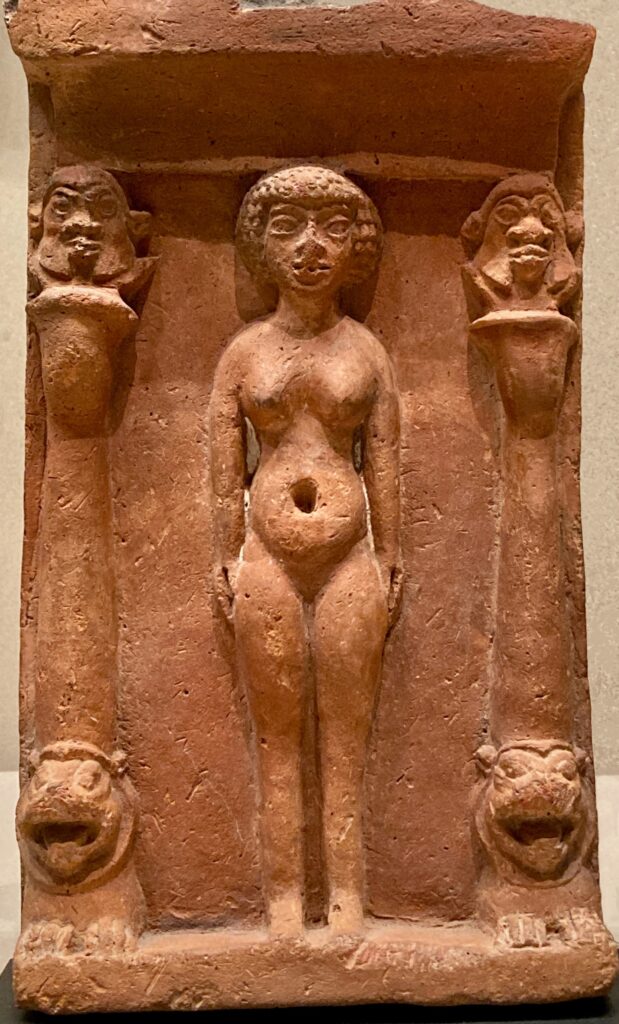
A small household shrine made of terracotta caught my eye. From Phoenicia in the seventh or sixth century before the Common Era, the shrine contains the goddess Astarte. Astarte was a goddess from Canaan. Some sources say that she was merged with, or took over from, the earlier Canaanite goddess Anat, a fierce goddess of fertility and war. Other sources say Astarte traces her origins back to the Mesopotamian goddess Ishtar. Still other sources relate her to Esther, or to Aphrodite. There was plenty of cultural borrowing in the Ancient Near East.

King Solomon is taken to task in the Hebrew Bible because he worshiped Astarte, among other deities: “Solomon followed Astarte the goddess of the Sidonians… So Solomon did what was evil in the sight of the Lord, and did not completely follow the Lord, as his father David had done” [1 Kings 11:5-6]. One of Jeremiah’s jeremiads was against Astarte. The Shalvi/ Hyman Encyclopedia of Jewish Women has a brief article on Astarte that’s worth reading, and that concludes by saying: “Although our sources do not provide enough information to identify definitively which Israelites were particularly attracted to the worship of Astarte or the reasons for their attraction, it is possible that some devotees were compelled by the presence of a female divine figure in an otherwise male-dominated religious environment.” You can learn a great deal more about Astarte in the Bible in the essay “Astarte in the Bible” by Stephanie Anthonioz, in David T. Sugimoto, ed., Transformation of a Goddess: Ishtar — Astarte — Aphrodite (Academic Press Fribourg, 2014).

But the Phoenicians apparently had no compunctions about worshiping Astarte. This small sculpture shows her nude, as if she were Ishtar. She is given an Egyptian headdress, and the columns on either side of her are topped with depictions of the Egyptian god Bes. She is, if you will, a multicultural goddess. This is not entirely surprising, given who the Phoenicians were. They were merchants and sailors, and they traded throughout the Mediterranean Sea and beyond, perhaps sailing even as far as Britain. No wonder, then, that they worshiped multicultural deities.

A small terra cotta relief sculpture of a woman standing between two columns.
Household shrine from Phoenicia, with the goddess Astarte
(Boston Museum of Fine Arts, 1990.605)

Depictions of Pangu

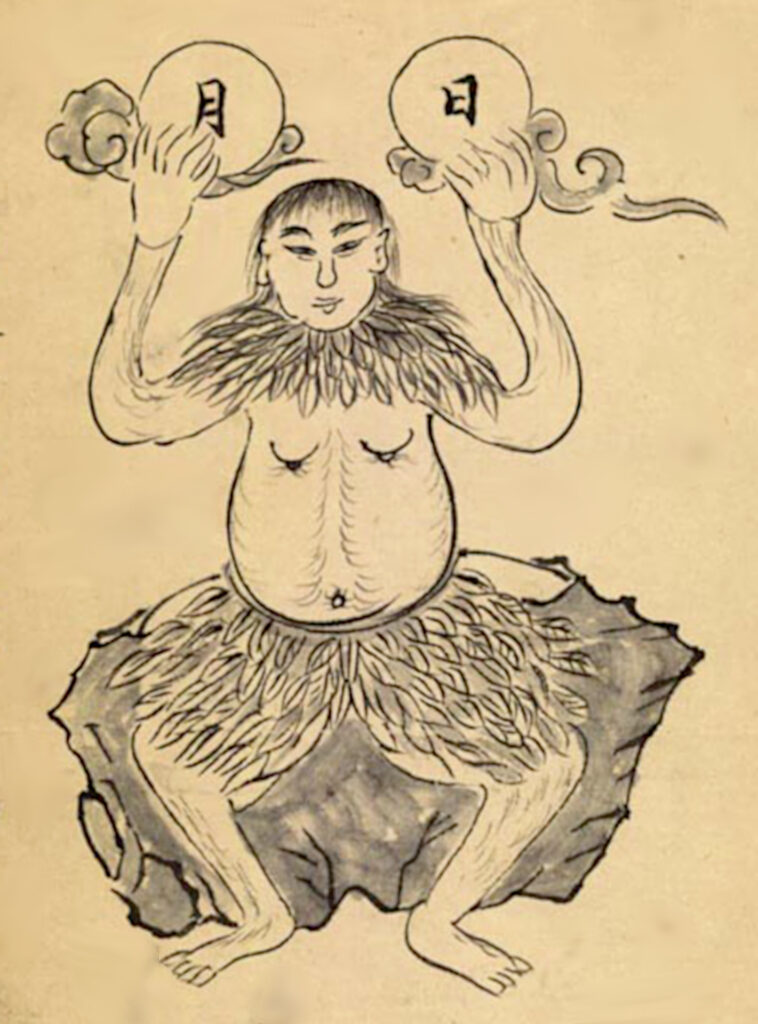
I’ve been searching online for depictions of Pangu, a creator deity in Chinese folk religion. So far, I’ve found lots of video game and anime and cartoon depictions of Pangu, which appear to be more or less commercial, and generally from an outsider perspective. But I’ve found few depictions done by religio-cultural insiders. This is probably in part because I’m searching for Pangu using English, and Anglophones don’t appear to be very interested in deities from Chinese folk religion.

But I have found a few interesting depictions of Pangu. Like this sketch in a Chinese manuscript dated c. 1900, currently in the collection of the Library of Congress:

Tian-gong Yuan. “Pangu Kaitian Pidi” (Pangu Creating the World) from Tui Bei Quan Tu, 1820, copied by Wu-Yi Chao Xie, circa 1900. Manuscript. Chinese Rare Book Collection, Asian Division, Library of Congress (33.1) www.loc.gov/exhibits/world/images/images/s33.1.jpg

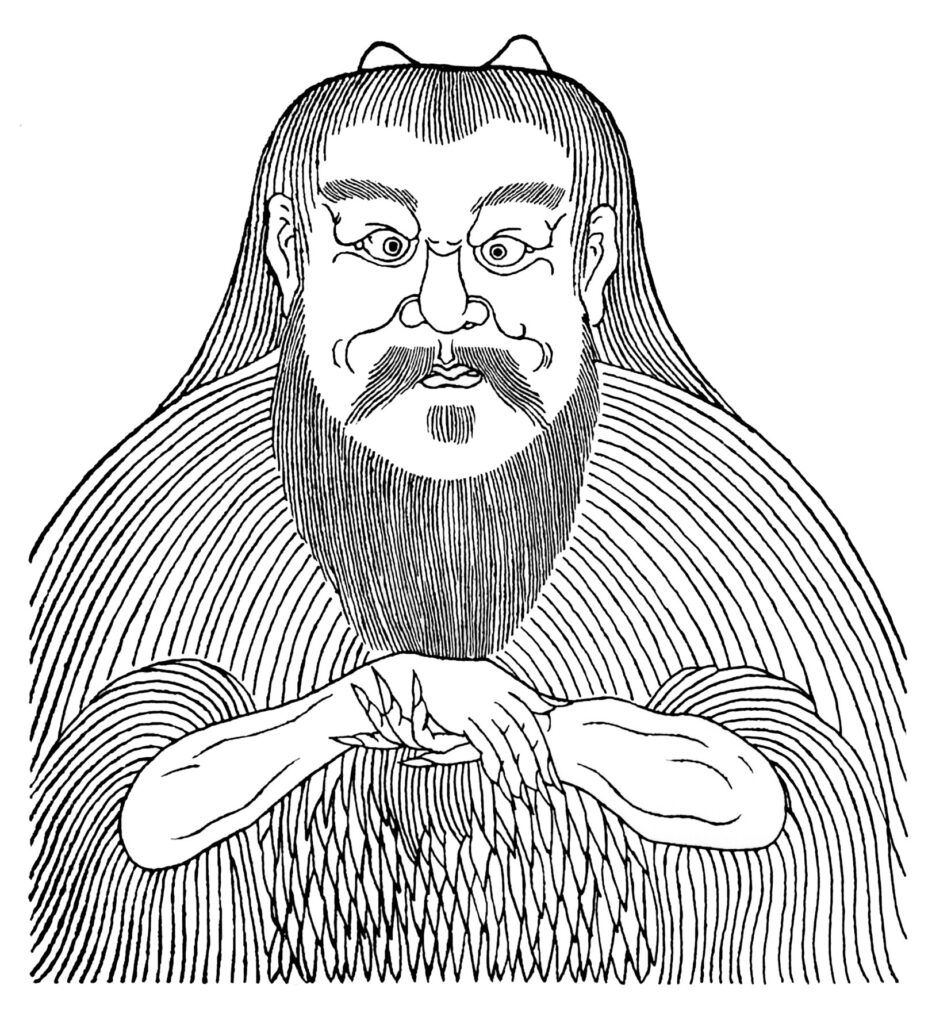
Then there’s this depiction of Pangu. Note the horns on his head.

Pangu. Digitally enhanced image from the Sancia Tuhui (1607), as reprinted in Li Ung Bin, Outlines of Chinese History (Shanghai, 1914).

(I had to do a lot of digital repair to the image above; the scan that’s widely available online was apparently made from a poorly done print. I tried to remain as true to the original as I could, but this is really a recreation rather than a direct copy of the original.)

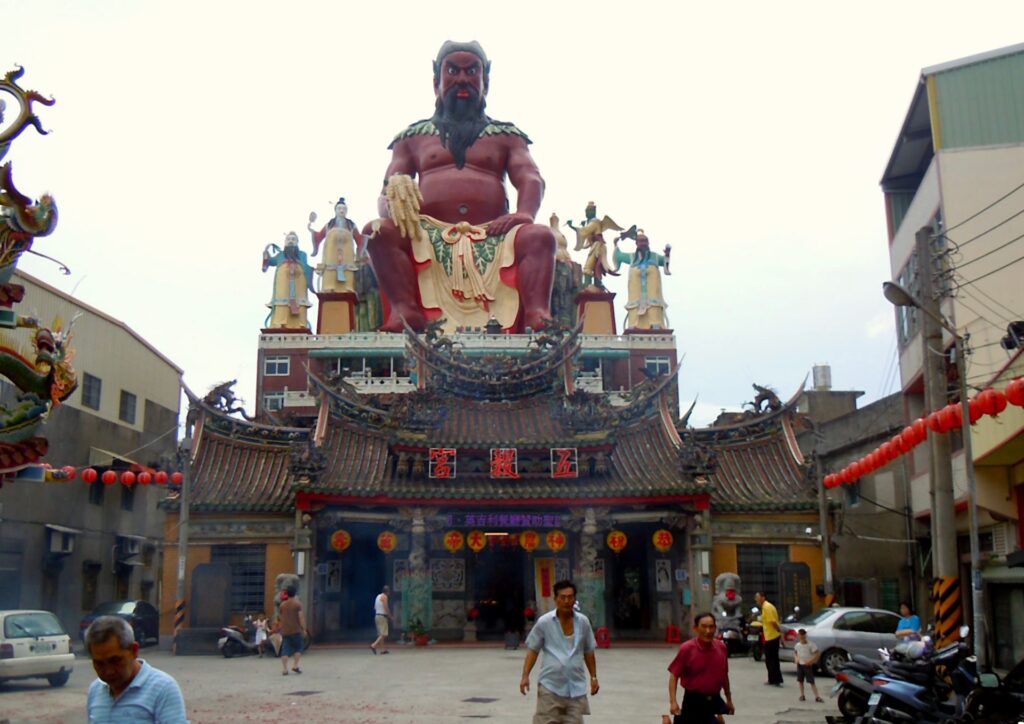
Finally, here’s my favorite depiction of Pangu. Like the previous depiction, he has horns on his head, a beard, and a sort of shoulder cape made of leaves (?).

Temple dedicated to Pangu in Zhunan, Miaoli, China. Digitally enhanced public domain image from Wikimedia Commons.

There’s another depiction of Pangu, plus a retelling of a creation story featuring him, over at my curriculum site.

I still have not idea of what Pangu worship looks like, or what it involves. Chinese folk religion is one of those religions where Westerners have a real blind spot. Which makes it hard to find out much of anything about Pangu.

“Whitened Buddhism” and the opiate of the masses

Carolyn Chen, a UC Berkeley sociologist who studies religion, spent the last few years studying religion in Silicon Valley. She’s especially interested in the way work has become a religion for the tech workers of Silicon Valley — and in the way tech companies use religion to keep their workers in line.

Not surprisingly, given the stark realities of Silicon Valley, Chen finds that White supremacy is alive and well in this toxic mix of work, religion, and corporate control. In her book Work Pray Code, Chen writes about how tech companies co-opt Buddhism in service of making workers compliant and more productive:

“Most White Westerners don’t realize that the Buddhism they know is a particular brand of Buddhism that has been repeatedly altered and adapted to appeal to them…. This brand of ‘nonreligious’ Buddhism, however, has racial implications. It associated Asian Buddhism’s ‘rituals, robes, and chanting’ with ‘the complications of religious tradition.’ It dismisses the religious reality of most Buddhists who are Asian and is therefore a form of White supremacy….”

For this last insight, Chen cites Race and Religion in American Buddhism: White Supremacy and Immigrant Adaptation by Joseph Cheah (Oxford Univ. Press, 2011); looks like I’ll have to add that book to my reading list. Chen then goes on to detail the ways in which Whitened Buddhism ignore the religious realities of Asians:

“For the vast majority of Buddhists who reside in Asia, Buddhism is a devotional faith that involves the veneration of deities and beliefs in the supernatural. For example, in Chinese, the phrase that describes practicing Buddhism, ‘bai Buddha,’ translates to ‘worship Buddha.’ Most lay Buddhists in Asia orient their devotional practices — offerings of incense and fruit, ritual chanting, praying, bowing, donating money to temples and monasteries — to the attainment of merit or a favorable rebirth….”

Of course, for Silicon Valley tech companies enamored of Buddhism, what Buddhism is really all about is things like meditation. And meditation is supposedly a value-neutral “technology,” not a religious practice. Whitened Buddhism focuses on things, like meditation, that can increase worker productivity and worker compliance. Whereas non-White Buddhism is deliberately ignored:

“Whitened Buddhism tends to protray the ‘religious’ Buddhism of Asians and Asian Americans as burdened by unnecessary accoutrements — ‘complications,’ ‘culture,’ ‘folklore,’ ethnicity,’ baggage’ — that distract from the essence of the Buddha’s teachings. For example, Mandy Stephens, whose company runs a meditation app for corporate clients, explains that they distill medication to ‘the fundamentals,’ ‘the part that isn’t religious or spiritual.’ Her company gets to ‘the fundamentals’ by getting rid of teachers who are ‘zany gurus’ [i.e., non-White] and replacing them with ‘strait-laced [White] trainers’ in [Western] business casual clothes. The chanting at the local Asian temple is ‘folklore,’ says former tech executive Pierre Beaumont, irrelevant to ‘what’s good for me in meditation.’ Mandy and Pierre dismiss the very elements of Buddhism that tens of millions of Asians hold most dear.” [my comments in brackets]

Because if you’re White, it’s apparently OK to co-opt whatever you want out of other religious traditions, and use it for whatever you feel like. And then you can say it’s not even really religion: “This Whitened Buddhism becomes a ‘universal philosophy’ and ‘science.’ It become ‘White’ — floating above context, invisible, and normal….” [Chen, excerpts from pp. 165-167]

I find the entire Silicone Vally Religion of Work to be repellent. But I find this especially repellent: co-opting a non-White religious tradition, perverting it from its original purpose to stop the endless cycle of rebirth, and instead using broken bits of it to control workers.

Indeed, as Chen notes elsewhere in her book, when tech companies offer things like meditation and mindfulness training to help tech workers deal with the overwhelming demands of Silicon Valley overwork, these companies are merely offering “therapeutic interventions, Band-Aids lovingly applied to deep and gaping wounds. Their programs might not be too distant from the ‘opiate of the masses’ that [Karl] Marx wrote about.” [Chen, p. 85]

Deity?

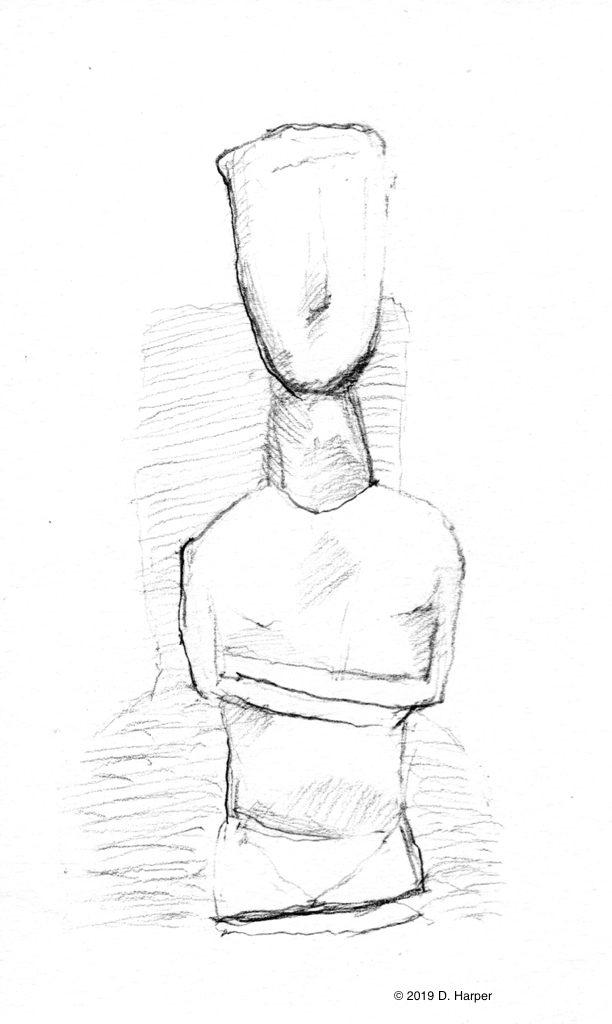
The DeYoung Museum in San Francisco has a number of Cycladic figures made thousands of years ago in what is now Greece. I was attracted to one of these figures, labeled as “Cycladic Figure, Early Cycladic II, Spedos variety,” dating to perhaps 2500 BCE, so I made a quick sketch of it:

This is a typical Cycladic figure of a woman with her arms crossed; it is made of white marble, though originally it would have been “painted with mineral-based pigments—azurite for blue and iron ores, or cinnabar for red.” There are those who assert that this type of figure represents a deity, perhaps the Great Goddess who may have been the chief deity of the ancient Greek world.

But of course there’s really no way to know what this figure represents. Is it a deity, or just a human figure? Or maybe something in between? Perhaps we would tend to call it a deity because the shape is so satisfying to look at; when we like looking at a piece of art it is tempting to think of that art as representing something beyond the mundane.

Deities of non-binary gender

As I develop some new middle-elementary curriculum materials, I’ve been looking at myths and religious narratives for deities who do not have a binary, male-or-female, gender.

The most familiar example of a non-binary gender deity — but an example we mostly ignore — is in one of the two stories of the creation of humankind in the book of Genesis. The more familiar Genesis story of the creation of humankind comes from the second chapter of Genesis, where God creates a male human, then puts the male human to sleep, takes a rib, and makes a woman. However, as feminists began pointing out back in the 1970s, there’s another story about how humans were created in the first chapter of Genesis:

“So God created humankind in his image, in the image of God he created them; male and female he created them.” (Genesis 1:27, NRSV)

Commenting on this passage, Susan Niditch, professor of religion at Amherst College, says:

“For feminist readers of scriptures, no more interesting and telegraphic comment exists on the nature of God. The male aspect and the female aspect implicitly are part of the first human and a reflection of the creator.” (Women’s Bible Commentary, ed. Carol A. Newsom and Sharon H. Ringe, Westminster/John Know Press, 1992, p. 13)

While agreeing with Niditch, I would add that this passage implies to me that the God of Genesis 1 cannot be reduced to a single binary gender.

The Navajo deity Turquoise Boy is of non-binary gender in a different way. In the Dine Bahane, the Navajo creation myth, when the humans get to the Third World, the men decide to live apart from the women, and cross a river in order to separate themselves. But the men take Turquoise Boy with them, because he is able to do the women’s work of grinding corn, etc., which the men ordinarily wouldn’t be able to do. (See: Aileen O’Bryan, The Dîné: Origin Myths of the Navaho Indians, Bulletin 163, the Bureau of American Ethnology, Smithsonian Institution, 1956.) White Shell Girl is also a non-binary gender deity; the narrative refers to her as being intersex, or in the O”Bryan translation, a hermaphrodite.

Turning to Chinese myths and religious narratives, Lan Caihe (Lan Ts’ai-ho), one of the Eight Immortals of Taoism, is ambiguously gendered. According to folklorist E. T. C. Werner:

“Lan Ts’ai-ho is variously stated to have been a woman and an hermaphrodite…. According to the Hsiu hsiang Pa Hsien tung yu chi, … though he was a man, he could not understand how to be a man (which is perhaps the reason why he has been supposed to be a woman).”(Myths and Legends of China, E. T. C. Werner, London: George Harrap & Co., 1922, p. 293)

There are many other deities with ambiguous or non-binary gender, including perhaps most famously the ancient Greek deity Hermaphroditus. What I find particularly interesting is that non-binary gender plays out in many different ways in these various myths and religious narratives. I want to say that there is a spectrum of gender choices, but I think saying that imposes my early twenty-first century Western cultural framework on other cultures. Better to say that gender has been interpreted in many ways in different religious traditions.

Ch’ang-O, the Moon Goddess

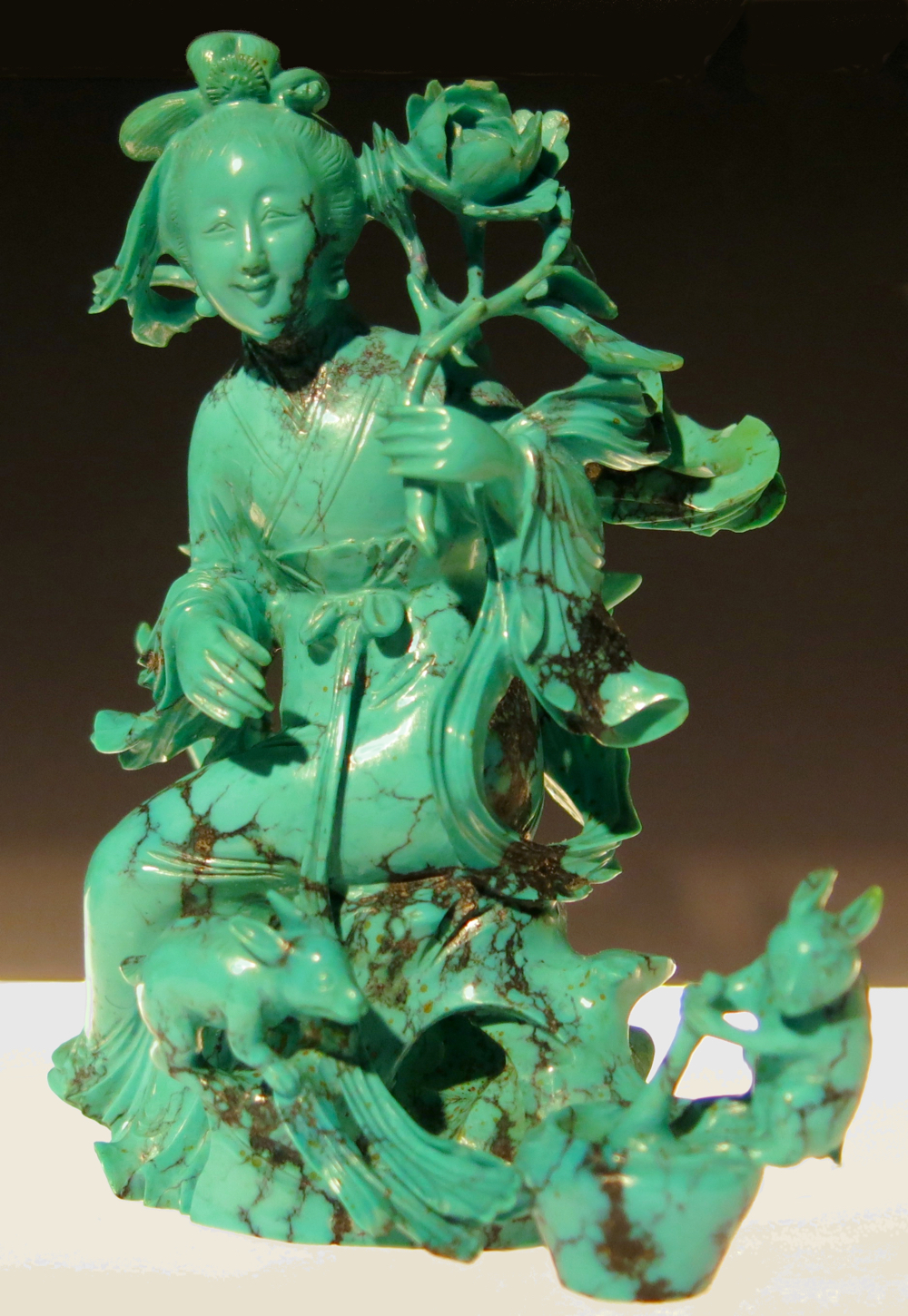
Our Coming of Age class took a field trip to the Asian Art Museum to see images of divinities. There we saw a beautiful jade sculpture of Ch’ang-O (Pinyin: Chang-e), the Moon Goddess. It’s just a few inches tall, but highly detailed: Ch’ang-O is smiling beatifically, and she is accompanied by her rabbits, one of whom is grinding something in a mortar and pestle:

Ch’ang-O is still honored in Chinese popular culture, at the Mid-Autumn Festival which takes place on the fifteenth day of the eighth Lunar month. More than one version of Ch’ang-O’s story is told, but the general outlines of the various versions are similar:

Ch’ang-O is an immortal being; she and Houyi are sweethearts. One day, ten suns appear in the sky, the sons of the Jade Emperor of Heaven, and these ten sons cause much damage; Houyi takes up his bow and arrow and shoots down nine of the ten in order to save the earth. Ch’ang-O loses her immortality by offending the Jade Emperor in some way. Houyi obtains a concoction that will make one person immortal (in some versions the pill could be split between Houyi and Ch’ang-O, making them both very long-lived, but not immortal), and this concoction is formed into a pill. Ch’ang-O takes the entire pill herself, either mistakenly or on purpose, upon which she not only becomes immortal, but she begins floating upwards towards heaven. At last she lodges permanently on the moon.

The Rabbit in the Moon

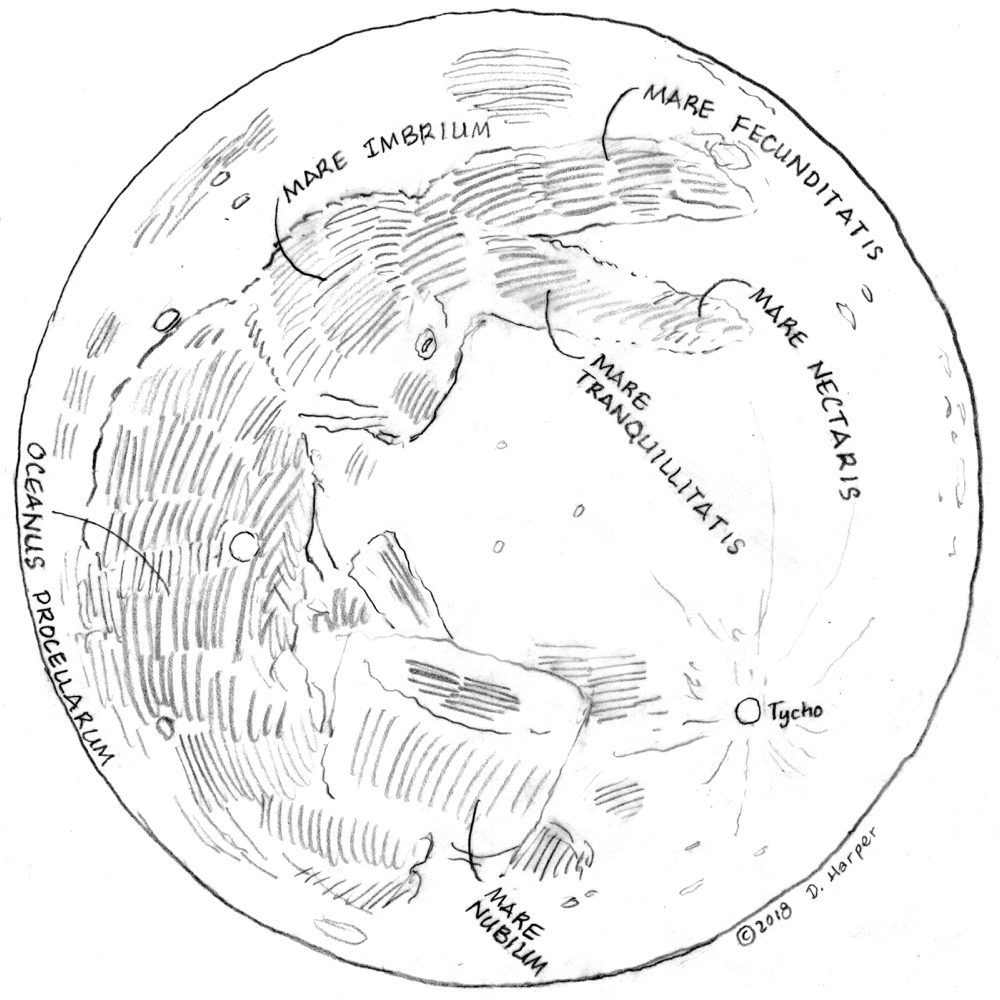
The reason there must be rabbits in the Moon is simple. In the West, we look at the moon and see the Man in the Moon, but in East Asia it is common to look up and see the Rabbit in the Moon; the Rabbit has a mortar and pestle in which it grinds herbal medicine, rice cakes, or mochi (depending on who tells the story). The body of the rabbit corresponds to roughly lunar landscape features as follows: left ear — Mare Fecunditatis; right ear — Mare Nectaris and Mare Tranquilitatis; base of ears — Mare Serenitatis; head — Mare Imbrium; body — Oceanus Procellarum. The mortar which the Rabbit uses for grinding is centered on the Mare Cognitum. For Westerners, here’s a sketch of the Moon Rabbit:

To help you find the Moon Rabbit next time you look at the moon, remember that the crater Tycho is just to the right of the Rabbit’s mortar.

How divine is Ch’ang-O?

Something we ask Coming of Age participants to consider when they look at images of deities is where they would place that deity on the following rough scale:

1. Ordinary human
2. Extraordinary human (prophet, sage)
3. Semi-divine (more than human, not quite a god or goddess)
4. Human who became divine
5. God or goddess with a non-human form
6. God or goddess that acts like a human
7. God or goddess that is far above humans
8. God or goddess so divine that humans cannot know it

In the stories about her, Ch’ang-O started out as — perhaps — semi-divine (more than human, not quite a goddess); then became completely human; then became immortal once more; and finally wound up as the Moon Goddess. Most Westerners, influenced by the strongly Western tradition of ancient Greek philosophy, tend to think of a deity as unchangeable, the “Unmoved Mover”; but far more human cultures have deities that can change in response to events. Thus Ch’and-O serves as a perfect counter-example for Westerners (both theists and atheists) who dogmatically assert that God is perfect and does not change.

Ch’ang-O in popular culture

The story of Ch’ang-O doesn’t leak out much beyond the boundaries of the Chinese American community (or other East Asian communities). But once in a while, the story of Ch’ang-O makes it into Western popular culture. The most notable example of this was just before the first humans set foot on the moon.

Here’s the Air-to-Ground Voice Transcription of the Apollo 11 Lunar mission, from July 20, 1969, not long before the Lunar Module landed on the moon:

03 23 16 18 CC [Capsule Communicator, i.e., Mission Control]:
…The “Black Bugle” just arrived with some morning news briefs if you’re ready.

03 23 16 28 CDR [Commander, i.e., Neil Armstrong]:
Go ahead.

[some material omitted]

03 23 17 28 CC:
Roger. Among the large headlines concerning Apollo this morning, there’s one asking that you watch for a lovely girl with a big rabbit. An ancient legend says a beautiful Chinese girl called Chang-o has been living there for 4000 years. It seems she was banished to the Moon because she stole the pill of immortality from her husband. You might also look for her companion, a large Chinese rabbit, who is easy to spot since he is always standing on his hind feet in the shade of a cinnamon tree. The name of the rabbit is not reported.

03 23 18 15 LMP [Lunar Module Pilot, i.e., Edwin E. Aldrin, Jr.; this was latter corrected to Michael Collins]:
Okay. We’ll keep a close eye out for the bunny girl.

(National Aeronautics and Space Administration, “Apollo 11 Technical Air-to-Ground Voice Transcription,” Tape 61/3 page 270 [Houston, Texas: Manned Spacecraft Center, July, 1969], pp. 178-179.)

— And don’t let the conspiracy theorists fool you: the Apollo astronauts saw no sign of Ch’ang-O, nor of any rabbits, nor of a cinnamon tree (actually a cassia tree in the myth).

Updated 3/7/18 with revised drawing and Apollo 11 transcript.

Guteel

In a Tlingit myth, Guteel was a being who lived on human blood. He was larger than humans, and semi-divine, so in English translations of the myth he is referred to as a “giant” or a “monster.” I found a few different versions of the myth — as you’d expect with an oral tradition — but the central plot remains much the same: Guteel is killing too many humans, so the humans figure out a way to kill him. As they destroy him, he prophesies that they will never kill him completely. The humans burn his body, but the ashes turn into mosquitoes which suck blood from humans, thus rendering Guteel’s prophecy true.

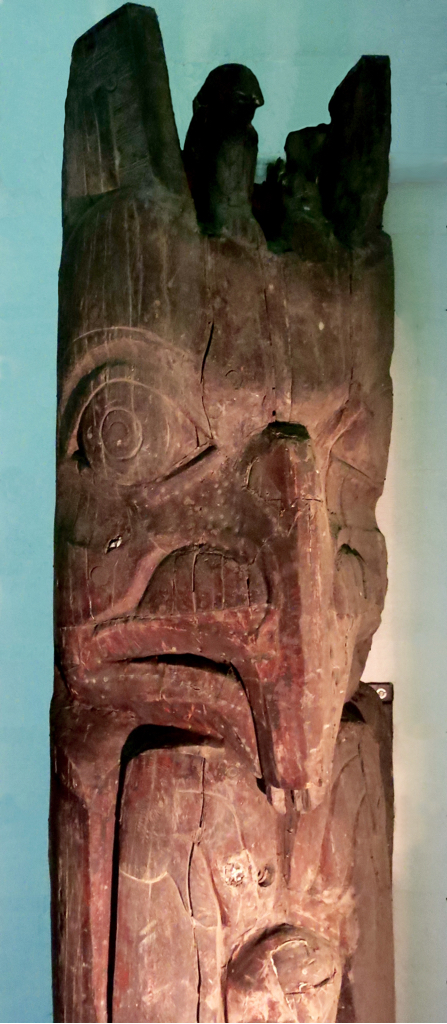
At Sitka National Historical Park, there is a Mosquito Legend Pole carved before 1900, which once belonged to Hattie Wallace of the Kaigani Haida village of Sukkwan. Even though it was in a Haida village, the pole shows the Tlingit Mosquito Legend. The traditional Watchman figure is missing from the top of this pole; so now Guteel sits at the top, a giant with a beak that looks like a mosquito proboscis.

We probably would not include monsters or giants like Guteel in the category of deities. Yet a being like Guteel is in some sense a lesser deity: he is immortal, he is powerful, he is part of the order of existence. Not all deities are benevolent.

More information:

Info about the replica Mosquito Legend Pole at Sitka National Historical Park

Versions of the Tlingit Mosquito Legend: a brief versionversion with photos of old totem poles

Tlingit myths and Texts

A minor deity

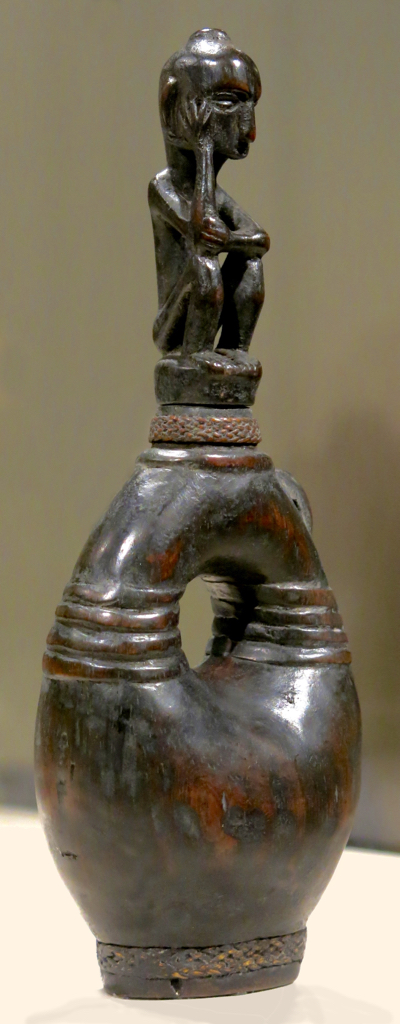
Here’s a small figure, probably a deity, from the Ifugao people of the Philippines. This figure sits on top of a small container used for holding agriculatural lime (a misture consisting primarily of calcium carbonate), one of the constituents used in preparing a mild stimulant from betel leaf (Piper betle) and the nut of the areca palm (Areca catechu).

This figure, made sometime in the first half of the twentieth century, is probably an ancestor deity, or a guardian deity — akin, perhaps, to the household gods of Rome, minor deities which have retained a place in the collective memory of the Western tradition.

In the West, we tend to assume that a deity by definition is unitary (or unitary-but-triune), and transcendent. We forget that for much of human history, there were a multiplicity of deities that lived quite close at hand; and we forget that a significant percentage of humans today still live in a world where many deities live close at hand. And perhaps these close-at-hand deities have never really left our collective consciousness; today we keep our glowing smartphones always with us, just as the ancient Romans kept the statues of their Lares or household gods close at hand so that they might consult them constantly, to ensure good fortune.

An Asian Mary

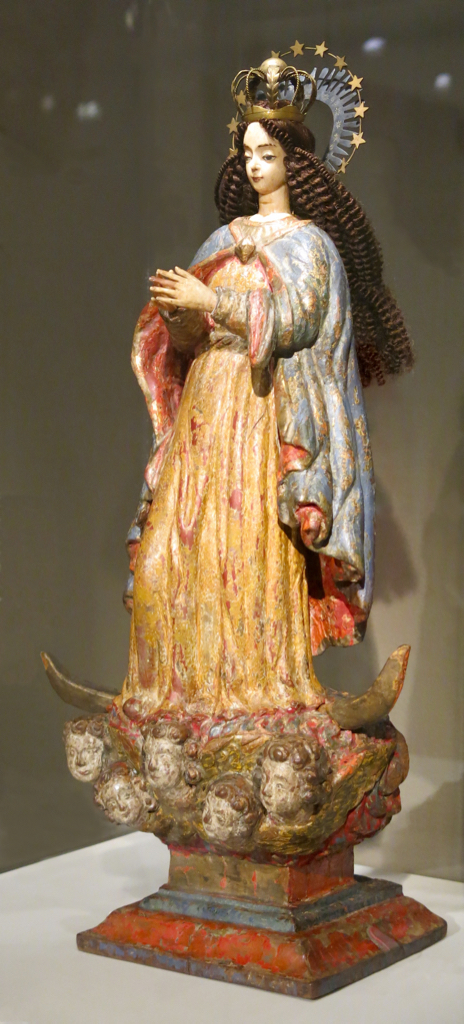
On a recent visit to the Asian Art Museum, I saw a beautiful mixed media sculpture of the Virgin Mary. The body of the sculpture was made of wood, the head and hands of ivory, a crown of stars of metal, and the hair of actual human hair.

When Westerners think of Asian religious art, they tend to think of Buddhas and Ganeshas and Guan Yins, forgetting that Christianity has had a presence in Asia for more than 1900 years. So of course there are Asian Christs and Asian Marys.

This Virgin Mary was made in the Philippines, to whence Christianity was brought by European Christians about five hundred years ago. The sculpture cannot be precisely dated, but was made sometime between 1650 and 1800.

Anyone familiar with European Christian art from the Middle Ages and the Renaissance will recognize the iconography of Mary standing on a crescent moon. But some of the details feel Asian. Mary’s facial features do not look stereotypically European, and according to the wall label next to the sculpture, “Early Spanish reports describe artists of Chinese descent as well as Filipino artists carving these images in the Philippines.” The treatment of the draped fabric feels non-European to me, especially Mary’s blue robe, which takes on a life of its own in a way that European Renaissance sculptures, based on classical models, never do; it feels more like the flowing, moving fabric found on some Chinese sculptures, or even on some Medieval European sculptures. I particularly like the use of human hair, a material that anchors Mary in the human realm, and keeps her from drifting into a realm of inaccessible transcendence.

In short, here is a deity that incorporates European iconography with Asian forms and sculptural traditions; she is a globalized deity who also links the human to the transcendent realms.

Agni

Agni, the ancient Vedic deity of fire, has always appealed to me. But until today, I’d only met Agni through poetry, like this hymn to Agni, the fifth hymn of the third book of the Rig Veda, as translated by Ralph Griffith:

Agni who shines against the Dawns is wakened;
the holy Singer who precedes the sages:
With far-spread luster, kindled by the pious,
the Priest has thrown both gates of darkness open.
Agni has waxed mighty by songs of praise,
to be adored with hymns of those who praise him.
Loving the varied shows of holy Order
at the first flush of dawn, he shines as envoy.
Midst mortal’s homes, Agni has been established,
fulfilling with the Law; Friend, germ of waters.
Loved and adored, the height he has ascended;
the Singer, object of our invocations.

Thus I was pleased to finally see a visual depiction of Agni at the Asian Art Museum this afternoon. He was part of a painting from the Ramayana, protecting Sita during her trial by fire, as imagined by a Balinese artist c. 1850-1900. Since this was a traveling exhibit, photography was not permitted, so I drew a quick sketch of Agni — leaving out Sita, Rama, the army of monkeys, the tongues of fire, and everything else in this detailed painting:

Agni, pencil on paper, 3-1/2x5 in.