The fourth installment of the Back in Time series:
A postmodern heretic's spiritual journey.

The fourth installment of the Back in Time series:
According to the Associated Press: “Louisiana authorities arrested pastor [Tony Spell] on an assault charge on Tuesday after he admitted that he drove his church bus toward a man who has been protesting his decision to continue holding mass gatherings at church in defiance of public health orders during the coronavirus pandemic.”
By contrast, after learning that the governor of Georgia planned to reopen churches and other businesses, despite contrary advice from public health professionals, “Bishop Reginald T. Jackson, the presiding prelate in Georgia for the African Methodist Episcopal Church, instructed the state’s roughly 520 AME congregations not to gather,” according to Religion News Service.
And by way of further contrast: Angelus Temple, a megachurch in Los Angeles, has now served 350,000 free meals during the pandemic, according to Religion News Service. The pastor, Matthew Barnett, said a few people disagreed with the decision to stop holding services in mid-March and concentrate instead of feeding people in need, but such criticism is “not productive in bringing about healing and possibilities of what we can do during this time.”
The difference between Tony Spell on the one hand, and Reginald T. Jackson and Matthew Barnett on the other, is that Jackson and Barnett have a more mature understanding of Christianity. They understand that their actions go far beyond the churches they supervise; their actions have ethical and moral implications that transcend their own self-interest.
What I’m taking away from this: I’m going to do my best to NOT be like Tony Spell, selfish and immature when it comes to quarantine restrictions. Instead, I’m going to do my best to model my behavior after Jackson and Barnett — looking to the greater good, acting with kindness and compassion.
We’re all sitting at home under quarantine, with time on our hands. Not surprisingly, many of us thought, Now would be a great time to bake bread. I used to bake bread regularly, back when I lived in a group house with other twenty-somethings. We’d trade recipes and tips, and I got to be pretty good at the overnight sponge method of baking bread.
Clearly, lots of other people had the same thoughts about baking bread, and maybe even the same fond memories of how they used to bake bread. Not surprisingly, then, our local supermarket ran out of yeast three weeks ago, and I haven’t been able to purchase any yeast there since.
So I decided to make sourdough. I found a method online: mix a few tablespoons of flour and water, cover with something porous, then add another tablespoon of flour each morning and evening until you have a nice foaming mess of sourdough starter. It sort of worked; the flour mix bubbled a little bit, but it didn’t foam. Then I dragged out my old copy of Joy of Cooking; Marion Rombauer suggests adding a bit of sugar along with the flour, and that made the difference. Within a couple of days, I had a pint Mason jar filled with foamy sourdough starter. Then I followed the recipe for sourdough bread in Joy of Cooking, which includes eggs and some oil, and turned out two smallish but attractive loaves.
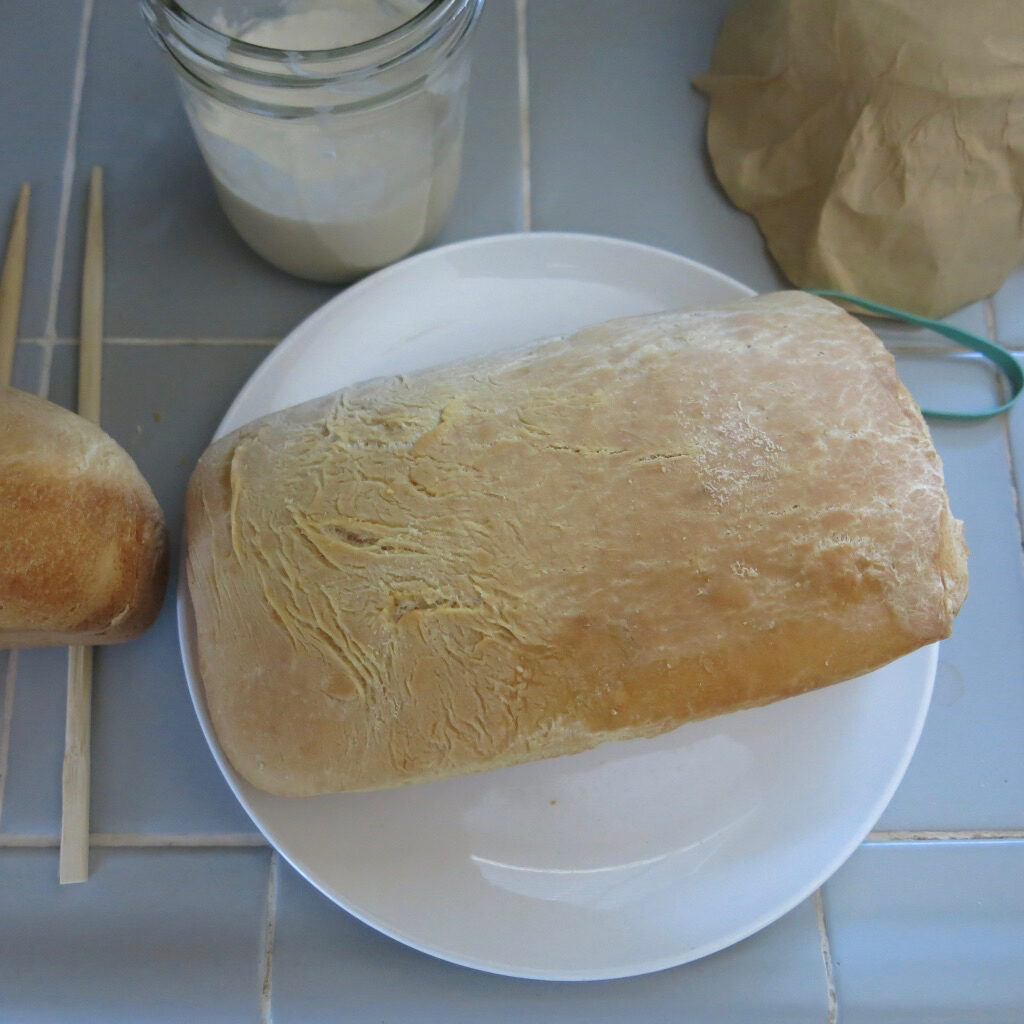
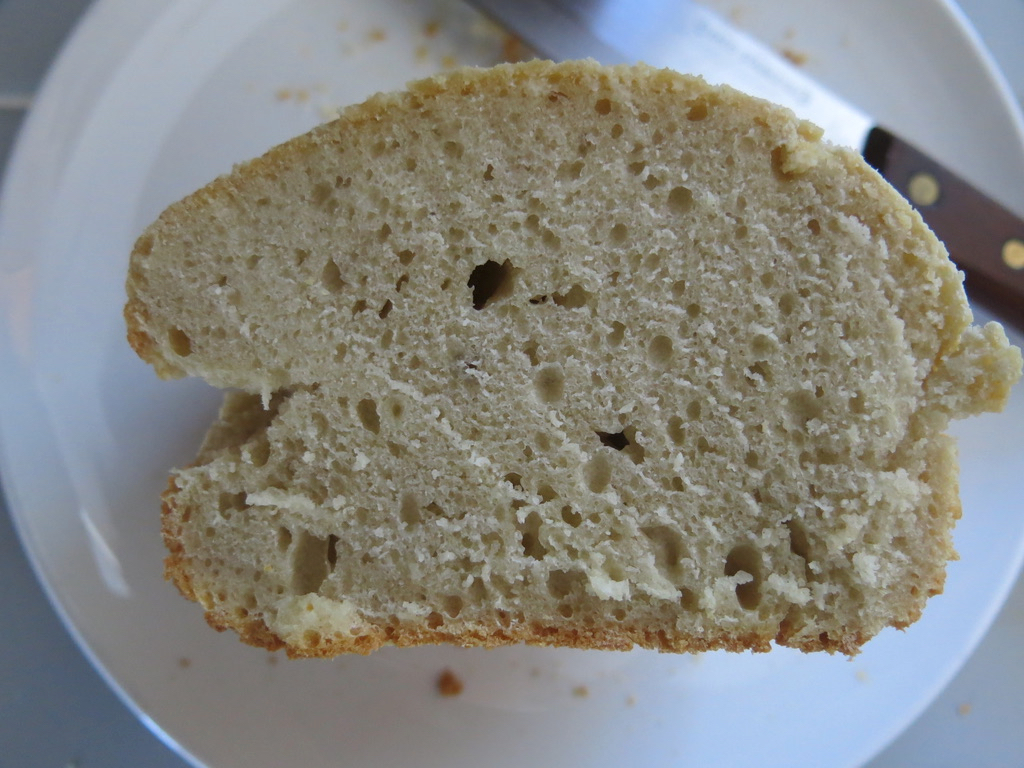
The loaves are moist, and have a nice crumb. The taste is quite good — there’s a faint tang of sourness, but it’s not in the least harsh. But the loaves weren’t perfect, and I think I should have kneaded them a little longer, and let them rise in the bread pans a little longer.
But then, baking bread is all about perfecting your timing. And in quarantine, I’ll have plenty of time to work on my timing.
Update, April 30: The next batch of sourdough bread came out much better!
The third installment of the Back in Time series:

I spent much of this week producing and aggregating online content suitable for UU kids. I’ve been trying to keep up with my sister, Abby, who’s been recording read-aloud videos at a breakneck pace — some of her videos have their own dedicated playlists at the UUCPA CYRE Youtube channel: Alice’s Adventures in Wonderland, and The Wonderful Wizard of Oz. I’ve been posting Beth’s Aesop’s Fables on another playlist. Yet another playlist has Amy reading aloud The Secret Garden.
And I had enough time left over to make another video in the “Things To Make” series, as well as adding another episode to the ongoing “Back in Time — to the Year 29!” saga.
It’s not easy to figure out how to make good online religious education content in the era of COVID. First and foremost, parents tell me that they don’t want another lesson plan; they’re sick of helping their kids do online school lessons, they don’t need another burden. So that means the videos I post have to require minimal supervision from an adult. Second, religious education is always optional, which means it has to be fun or engaging or no one will watch it.
These two constraints mean I have to interpret “religious education” pretty broadly. How is listening to “Alice’s Adventures in Wonderland” religious education? Well, Unitarian Universalist religious education has always included the broad goal of supporting literacy; we want children to grow up thinking for themselves, and literacy promotes that in a number of ways. So while “Alice” doesn’t have any religious content per se, it’s a book that encourages literacy because it makes kids want to read.
And how is a series on “Things To Make” religious education? Well, the things I’m showing kids how to make promote independent play; they give kids a sense of agency; they cultivate creativity instead of consumption; and they have kids engage in hands-on embodied activities as a partial antidote to the disembodied lives many of us are now forced to lead online. This is rooted in good feminist theology: promoting embodied activities, promoting agency instead of passivity.
The “Back in Time” video saga could be considered religious education by almost any definition. (Yes, it would be considered rank heresy by many, but it’s still education on a blatantly religious topic.) The Aesop’s Fables series could certainly be considered moral education. But I think both showing kids how to make things, and reading aloud to kids, help us achieve some of the larger educational goals of Unitarian Universalist religious education.
Update, July 24: I’ve now added posts with links to the “Back in Time” series of videos on Youtube, as well as to subsequent video “Stories for All Ages.” The posts are backdated to the release date of the video, and include the full script for each video. You can see the entire series of posts here.
The second installment in the “Back in Time” series:
As of April 2, the San Mateo County Board of Health recommends that everyone wear a mask when they’re in public places.
I’ve been doubtful about the efficacy of masks, since my understanding is that wearing a mask won’t do much to protect you from being infected by others. But I’ve come to understand that masks might protect others from being infected by you, if you happen to have COVID-19 but are still asymptomatic.
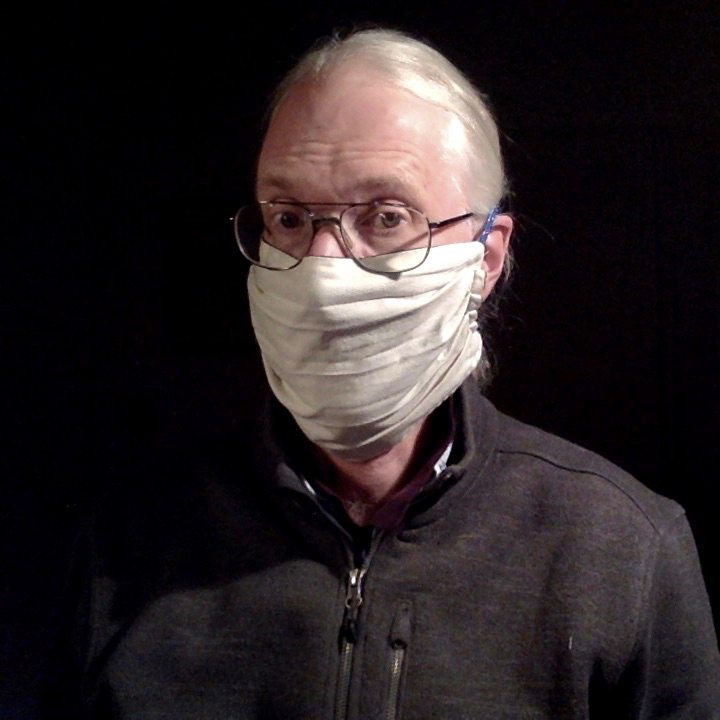
So today I decided to be a good citizen and sew a couple of masks, one for Carol and one for me. I am very slow at sewing, partly because I don’t know how to use a sewing machine, and partly because I don’t know what I’m doing. But I found a good online video showing how to make one of the 2-layer pleated masks that are supposed to be the most effective handmade masks. I didn’t have the elastic bands called for in the video, but I had some 1/4 inch polyester cord to use for the ties. Carol has a big bolt of unbleached cotton muslin, and I sacrificed an old t-shirt. Sewing the pleats by hand was kind of a pain at first, but I quickly figured it out.
After two or three hours, I had a mask for Carol and a mask for me. We went to the grocery store, and three quarters of the people there were also wearing masks. Mask wearing peer pressure has begun.
As soon as we got home, I washed both masks in hot water, as you’re supposed to do.
Next step: make another mask for Carol using a high fashion fabric for the outer layer….
If you’re one of those using Zoom to carry out online programs and ministries for our congregations, you’ll want to update to the latest version of the Zoom app (a.k.a. the Zoom client). The latest version is 4.6.10, and I got notification about it an hour ago.
This update has one absolutely critical security feature that you must have: you can prevent participants from changing their screen name. The previous version gave participants the ability to change their screen name to anything, including something obscene, and the host couldn’t do anything except boot that person off the call.
There are other security enhancements, too. Update now.
My younger sister the children’s librarian has inspired me. Her library is closed, or course, so she’s creating online content by uploading an average of a new video every day to the Harvard (Mass.) Public Library Children’s Room Youtube channel. So far, she’s got a simple craft project, story time that parents can do with young children, and she’s reading aloud the entire Alice’s Adventures in Wonderland.
I like several things about Abby’s videos. First, they’re a great supplement to Zoom calls — some of us are getting Zoom burnout, and it’s nice to be able to watch a video when YOU want to watch it. Second, they’re Goldilocks videos — not too long, not too short, but just the right length. Third, they don’t put a big burden on parents — the crafts project can be done by kids on their own without parental supervision, kids can watch the installments of Alice on their own, and the story time for young children has them doing what they’re going to be doing anyway which is sitting in a parental lap.
So I repurposed this Youtube channel, where I already had some religious education videos. I added a video we used in last Sunday’s service. I created a couple of playlists, one for crafts (Abby’s craft video is included there), and another for story time (Abby’s Alice stories are going there, because Alice in Wonderland is a sacred text). I’ve got a children’s librarian from our congregation half convinced to do a story time, I’m planning a story time (I think I’ll read aloud from an old edition of the Jataka Tales), there will be more crafts projects.
Blog readers, if you know of some videos that you think would be appropriate to share on this Youtube channel, please send me the links. I can’t promise to put everything up, but I’d really like to see your suggestions — send them to danharper then the little “at” sign then uucpa then a dot then org.
The first installment of the “Back in Time” series….