The opposite of a bullying boss

Over the past week, I’ve been writing a series of posts about bullies in the workplace —although I prefer the terminology of Robert I. Sutton, professor of business at Stanford University, who calls them “assholes,” not “bullies.” Now I’d like to consider the opposite of assholes. And what, you ask, is the opposite of an asshole? — it’s a boss who’s nice but incompetent.

Back in 2012, Sutton wrote a blog post titled “Are incompetent and nice bosses even worse than the incompetent assholes?” This post is based on a chapter from his book Good Boss Bad Boss, in which he describes in some detail what a good boss looks like. Sutton says that “one of the most personally troubling lessons I’ve learned (or at least am on the verge of believing)” is this:

Sutton then includes an excerpt from his book Good Boss Bad Boss which gives a vivid portrait of a nice-but-incompetent boss:

So does this apply to Unitarian Universalist clergy? You bet it does. If you’ve been around Unitarian Universalism long enough, you’ll be able to think of clergy who were kind, gentle souls whom everyone loved — and who drove their congregation into the ground because of their incompetence. I started working as a Director of Religious Education (DRE) in 1994, and I remember hearing from other DREs about ministers who were good and nice people, but who were horrible to work for because they lacked necessary skills, had no thirst for excellence, communicated poorly, lacked the courage to confront poor employees, didn’t develop the network of partners the congregation needed, etc. — just like the senior executive that Sutton writes about.

But remember that the ultimate boss of a Unitarian Universalist congregation is the board. And in my experience, boards of congregations can also be nice-but-incompetent. Back in the 1990s, I remember one board that was so nice that they refused to terminate a destructive employee, even though that one employee was causing massive turnover in every other staff position. I’ve also seen boards that were poor communicators, that neglected to develop a network of partners, etc.

Whether it’s a nice-but-incompetent board, or a nice-but-incompetent minister, it can be very unpleasant to work under them — ask any DRE who has worked under a nice-but-incompetent boss. Sure, they’re really nice people. But they will not protect you from another staff person who’s destructive. They will not communicate effectively with you. They do not have the skills they need to lead effectively. They will not develop networks that bring in resources that will help you do your job. And because they’re so nice, they will never get fired. Finally, to point out the obvious, whether you’re paid staff and to volunteer staff, it’s equally painful to work under a nice-but-incompetent boss (it might even be worse for volunteer staff, because you’re not even getting a salary).

Sutton concludes his blog post with some advice:

Close-up of a delete key on a computer keyboard.
“…if rehabilitation has failed…the time has come to hit the delete button….”

Part of a series of posts on clergy and bullying — Sigh. Not Again.What ministerial bullying looks likeWhat ministers didn’t learn in theological schoolWhen clergy get bulliedThe opposite of a bullying boss

When clergy get bullied

Recently, I wrote about what it looks like when clergy act as bullies. But clergy can also be the targets of bullying. What does that look like?

In a recent article on a United Church of Canada website, Christopher White describes what it looks like when clergy get bullied:

As it happens, I’ve been bullied by congregants a couple of times. The first time it happened, I lucked out — the bully (who was also bullying other staff and lay leaders) left the congregation soon thereafter. And by the time it happened to me again, I knew exactly what was going on, so it had less impact on me. It was still extremely unpleasant.

Perhaps the most important part of the article is the brief section on why bullying seems to be on the increase:

Note that the article is about congregations in Canada. I’d say that the United States is even more angry than Canada right now, which I guess means our congregations can expect more bullying and bullies than usual.

Mind you, I still don’t care for the term “bully.” I still prefer the term “asshole,” as defined by business professor Robert Sutton in his book The No Asshole Rule. Using Sutton’s term helps me remember that assholes have a negative impact on organizational performance. That is, it’s not just about one bully making the life of one target absolutely miserable — it’s about how an asshole not only makes life miserable for their targets, but they can also drag down the entire organization.

Whatever term you use, it’s definitely worth reading the article: “More United Church clergy are feeling targeted by congregational bullies.”


Part of a series of posts on clergy and bullying — Sigh. Not Again.What ministerial bullying looks likeWhat ministers didn’t learn in theological schoolWhen clergy get bulliedThe opposite of a bullying boss

What ministers didn’t learn in theological school

The Religious Workforce Project has released a report titled “What Clergy Leaders Wish They Had Been Trained To Do: And Why It Matters.”

I think it’s a pretty good report. And I think anyone involved in congregational leadership will find it worth reading.

A key finding detailed in the report is that there are five key skill sets where clergy leaders felt they did not receive adequate training. Those five key skill sets:

  1. Administration and management
  2. Technology skills
  3. Soft skills for leadership, a broad category which includes:
    • inspire others to achieve shared goals
    • set a clear vision and communicate it effectively
    • create a culture of accountability and excellence
    • solve problems
    • coach or mentor others
    • manage conflict well
    • delegate tasks
    • have high emotional intelligence, incl. self-awareness and self-care
  4. Counseling and pastoral care
  5. Facilities management

I encourage you to read the report, which includes many direct quotes from interviews with working clergy about what they wished they had been taught in theological school. One of my favorite quotes in the report starts off like this:

But the real point here — for both clergy and for lay leaders — is pretty simple: clergy do, in fact, need to know these skills. In the Unitarian Universalist tradition, lay leaders of congregation supervise ministers, so lay leaders should be prepared to evaluate whether clergy have these skills or not. When clergy do not have these skills, lay leaders should work with clergy to prioritize which of these skills are most important in their congregation, and then figure out how to get clergy appropriate training for any needed skills. And lay leaders have to realize that learning these skills takes time, which means they have to reduce the clergy workload so that there’s time for the required training.

Furthermore, since lay leaders are pretty notorious for being inconsistent supervisors, clergy have to take it on themselves to hold themselves accountable for learning the high-priority skills. Ideally, clergy will find someone (e.g., a consultant or coach) who will work with them over an extended period as they learn a needed skill.

Another thought [added 15 April 2025]: I’ve been thinking about ministerial bullying recently, and I suspect at least some bullying happens because clergy lack soft skills (esp. inspiring others, coaching and mentoring, managing conflict, delegating tasks well, and having emotional intelligence), and because they lack administration and management skills. I suspect that if you don’t have soft skills, and you don’t know how to manage, it’s much easier to become a bully — because you don’t know any other way to get things done.

One more thing: when lay leaders are in the process of hiring a new minister, they should look over these five key skill sets, and determine which ones their new hire absolutely must have. During the hiring process, both lay leaders and clergy should make a point of discussing these five key skill sets together. Better that everyone has clear expectations right up front.


Part of a series of posts on clergy and bullying — Sigh. Not Again.What ministerial bullying looks likeWhat ministers didn’t learn in theological schoolWhen clergy get bulliedThe opposite of a bullying boss

What ministerial bullying looks like

Last month, there was a dust-up at Winchester Cathedral in England. Not surprisingly, as a cathedral of the Church of England they have an unbelievable music program. The long-time music director and organist was Andrew Lumsden, led the Winchester Cathedral Choir to a Grammy award in 2024 for their soundtrack to a Star Wars video game. Lumsden suddenly resigned last summer with no explanation. At about the same time, half the adult choristers — so-called “lay clerks” — quit. In addition, the boy choristers were also well below the usual number. Upon receiving numerous complaints, including a negative social media campaign, the bishop commissioned an outside review. Very Rev. Catherine Ogle, Dean of the cathedral — the senior management position in the Cathedral organization — announced she would retire in May, 2025, but after the outside review was completed she announced an immediate departure and left in early March.

So why all these departures?

According to Living Church magazine — an international periodical of the Anglo-Catholic wing of the worldwide Anglican communion — the problem was bullying by the Precentor of the Cathedral, Rev. Canon Andy Trenier. Back on July 3, 2024, Living Church reported:

Living Church quotes from other news sources that point to management practices that sound questionable to me, including possible mismanagement of funds:

The idea of start-up choral groups sounds good, but if those start-up groups sued funds earmarked for the main music program, to me that doesn’t sound so good. I’d pay more attention, however, to the decline in the number of choristers. Reportedly, that decline was the result of the alleged bullying. Living Church went on to report what the bullying looked like:

“Ali Kefford of The Mail on Sunday wrote about Trenier: ‘He is said to have berated the Director of Music Dr Andrew Lumsden in front of the boy choristers, and told singers they could leave if they didn’t agree with his approach. Those targeted by his volcanic temper are said to have been left trembling.’ Kefford added: ‘Canon Trenier’s relationship with the eight adult male lay clerks is said to have irretrievably broken down amid allegations that he has been coercive, manipulative, and belittling. They are four short of their usual tally of 12 because, his critics say, working at Winchester is now seen as a poison chalice.'”

These days, the term for people who behave in the way Trenier is alleged to have behaved is “bully.” I often use a different term. Back in 2007 Robert I. Sutton, professor of business at Stanford University, called this kind of manager an “asshole.” In his book The No Asshole Rule, Sutton details how abusive supervisors — bullies, if you will — often prove to be a detriment to the overall performance of an organization. Thus, it’s not just that assholes are a pain to work with, they actually damage the organization.

Best of all, Sutton has a fairly precise definition for what constitutes an asshole. “Bully” often proves to be a vaguely defined term, but Sutton turns “asshole” into a precisely defined term so you can clearly identify who’s an asshole, and who isn’t. According to Sutton, there are two main tests for determining who is an asshole:

From the few reports that I’ve read on the situation at Winchester Cathedral, it does sound like Andy Trenier might pass both tests. If it’s true that he has a “volcanic temper” that leaves underlings “trembling,” then he appears to pass the first test. And according to reports, he yelled at people he supervises, i.e., people who have less power than he, which would mean he passes the second test.

For our purposes, though, we don’t need to try to judge the facts of the Winchester cathedral case. The allegations, whether true or not, give a pretty good feel for what ministerial bullying looks like — it’s “coercive, manipulative, and belittling”; it can leave the target “trembling”; it may include a my-way-or-the-highway demand; and people do in fact leave the organization rather than have to deal with the ministerial bully.

If you’re in a situation where you think you’re seeing ministerial bullying, you might want to check out Robert Sutton’s books on assholes: The No Asshole Rule and The Asshole Survival Guide: How To Deal with People Who Treat You Like Dirt. Or, if you’re a minister or supervisor, you might want to read Sutton’s book Good Boss, Bad Boss: How To Be the Best…and Learn from the Worst.


Part of a series of posts on clergy and bullying — Sigh. Not Again.What ministerial bullying looks likeWhat ministers didn’t learn in theological schoolWhen clergy get bulliedThe opposite of a bullying boss

Sigh. Not again.

I got one of those emails today, informing me that a Unitarian Universalist minister has been removed from fellowship. It read:

A quick web search (including what appears to be his Facebook page) shows John L. Saxon as a professor of public law and government at UNC-CH, retiring from there in 2010. He graduated from Meadville/Lombard Theological School in 2009, serving as hospital chaplain for Alamance Regional Medical Center, beginning c. 2010. He was assistant at the Unitarian Universalist Fellowship of Raleigh, N.C., beginning in 2010, then later lead minister; he left the latter position in 2017. From 2017 to 2020 he was Executive Director of the Unitarian Universalist Social Justice Ministry for North Carolina, and then apparently from 2020 to 2022 he was president of the organization (online sources are not clear). One brief bio of him says he retired in 2022, so it’s not at all clear where he allegedly engaged in the actions that led the Ministerial Fellowship Committee to remove him from fellowship.

As usual when I publish these announcements, I’m making no judgements on the truth of the allegations. I’m publishing these because up until a few years ago the UUA did not maintain a public list of this sort of thing; and since then it has become increasingly difficult to find out where the accused ministers have worked.

I will make one general comment, though, which is that removing a minister from fellowship for bullying now appears to be more common than removing a minister from fellowship for sexual misconduct. Does this mean I believe UU ministers are no longer engaging in sexual misconduct? No, I suspect it’s simply more difficult for victims of sexual misconduct to come forward. [Plus as I outline in a later post in this series, there are societal factors leading to more bullying.]


First in a series of posts on clergy and bullying — Sigh. Not Again.What ministerial bullying looks likeWhat ministers didn’t learn in theological schoolWhen clergy get bulliedThe opposite of a bullying boss

Noted with minimal comment

This is the conclusion of Bertrand Russell’s chapter on the influence of the philosopher John Locke, from his History of Western Philosophy:

John Locke inspired some of the most important parts of the U.S. Constitution; I think it would be fair to say that one of the unwritten foundations of the U.S. Constitution is enlightened self-interest. We are now in an age when enlightened self-interest is deprecated in favor of naked self-interest. The big philosophical question now is whether the Constitution can survive when the prop of enlightened self-interest is removed.

Jump Billy

In November, British singer-songwriter Angeline Morrison released a new song titled “Jump Billy.” I got interested in the song because it tells the story of someone born in America who left during the American Revolution. If you dive into local history, you’re constantly running up against stories of the Tories who left America during the Revolution. But you rarely hear the rest of the story — where they went, and how they fared.

Here’s a link to Morrison’s studio recording of “Jump Billy” — which she has made freely available on an educational webpage about the life of William Waters.

So why did Morrison write this song? She has long loved the traditional music of the British Isles. As the daughter of a Black Jamaican woman and a White man from the Outer Hebrides, she began to search for traditional songs about Black people like her. By some estimates, circa 1800 there were 20,000 Black people living in London alone — but where were the songs about them?

Morrison did record one traditional English song, “The Brown Girl,” which she imagined might actually be a song about a woman with brown skin (as opposed to a mere poetic description). Then, in the tradition of generations of folk musicians, she decided to write her own songs in the idiom of traditional music, featuring non-White Britishers. In 2022, after having written a number of new songs, she released an album of those songs.

(A side note: if Morrison were working in the U.S. today, she would be accused of violating the recent presidential executive order titled “Restoring Truth and Sanity to American History.” Don’t get me started on how that executive order tells lies about history.)

She is still mining this vein of material, and in her latest song is about the Black sailor William “Billy” Waters. I don’t know if Morrison saw the new book by Mary L. Shannon, Billy Waters is Dancing: Or, How a Black Sailor Found Fame in Regency Britain (Yale University Press, 2024) or if she did her own research (or both). In any case, Morrison’s song tells the same basic story that’s told in the book, which goes something like this:

William Waters was born in New York City (probably) around 1775. His family (probably) left New York when the British troops evacuated in 1783; little Billy would have been about eight years old. In 1811, he signed on as an able seaman in the British Royal Navy. Since he signed on as an able seaman, not an ordinary seaman, he (probably) had had previous experience as a sailor. Little else is known about his early life.

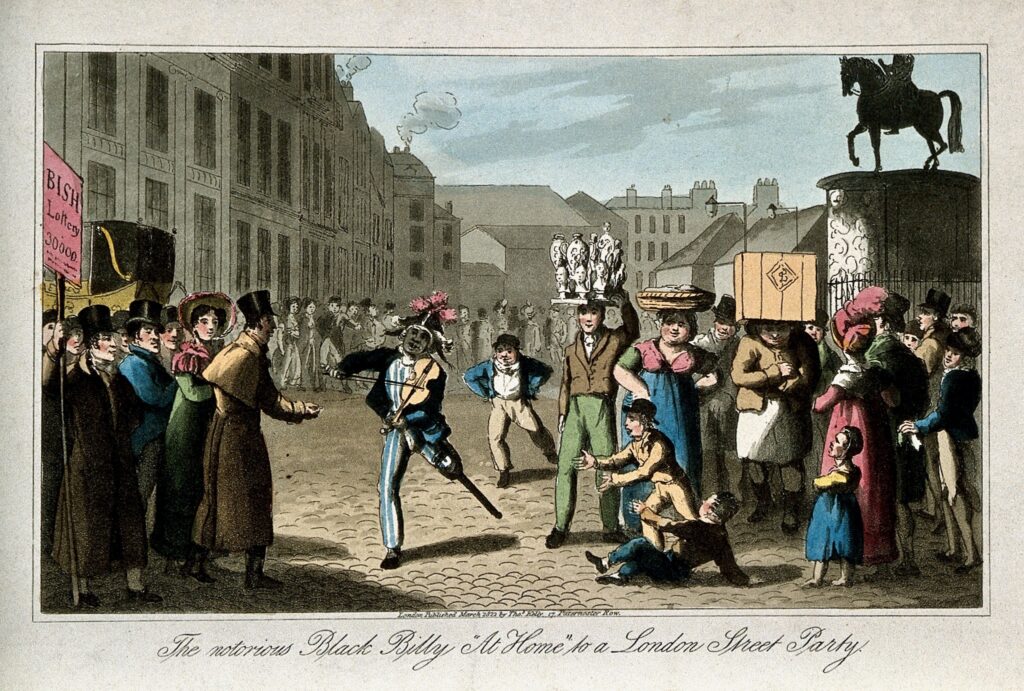
In 1812, the captain’s log reports that Waters fell from the from the main spar, broke both legs, and had to have one leg amputated. Waters was invalided out of the Navy with an inadequate pension, as was all too typical at the time. To earn enough money to live on, he turned to busking. He gained fame as a frequent performer outside London’s fashionable Adelphi Theatre. As many buskers did at the time, he adopted a distinctive dress: for Waters, this included his naval coat and a tricorn hat decorated with showy feathers. In his act, he not only sang and played fiddle, but he also danced with great dexterity; this last was considered remarkable due to his wooden leg.

Drawing of a street scene showing a man with a wooden leg dancing and playing fiddle.
Billy Waters, a one legged busker, in a crowded London street. Coloured aquatint, 1822.
Image courtesy: Wellcome Trust Creative Commons Attribution only licence CC BY 4.0 .

Waters married and had two children. In spite of his fame, he and his family lived in St. Giles rookery, notorious as one of the worst slums in London. He died in 1823, aged approx. 60. At the time of his death, he was living in the St. Giles workhouse, an institution for indigent people. Presumably, by that time he was no longer able to earn his living busking. So much for his fame —sic transit gloria mundi.

As an able seaman, Waters would have had as good a life as could be expected for a working class man — and he could live in freedom, whereas slavery persisted in New York until well after his death. After he had his leg amputated, the Royal Navy didn’t treat him especially well. Yet in spite of his disability, he was able to earn enough money to allow him to provide for a family.

— And this is just one story telling how the American Revolution played out in the lives of ordinary people. We hear over and over again stories of how the Revolution affected prominent people like John Adams and Benjamin Franklin. I like to hear those old stories about those wealthy and prominent people who remained in America. But I also want to hear how the Revolution affected ordinary people, including the ones who left America. It’s hearing all those stories that makes history come alive for me.

(N.B.: Morrison’s song is so new, I couldn’t find lyrics to it anywhere online. I’ll post my own transcription of the lyrics after the jump.)

Continue reading “Jump Billy”

Majority of potential deportees are Christian

The National Association of Evangelicals (NAE), the U.S. Conference of Catholic Bishops (USCCB), World Relief, and the Center for the Study of Global Christianity have released a report about the impact of the Trump administration’s proposed deportations on American Christian communities. I found the report, titled “One Part of the Body: The Potential Impact of Deportations on American Christian Families” available online on the USCCB website (link to the PDF).

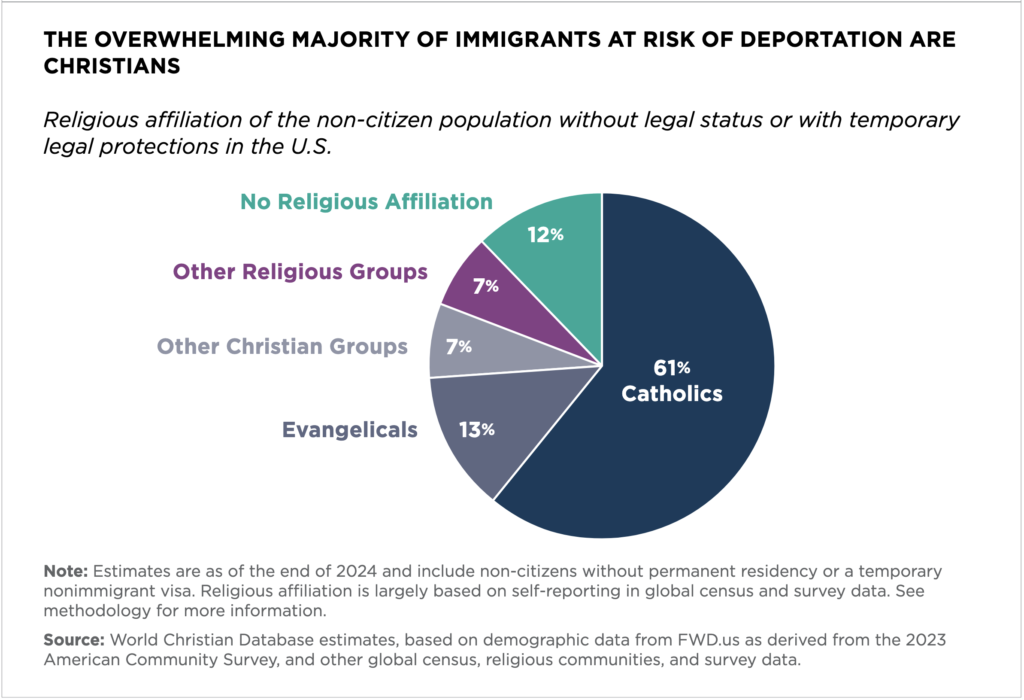
According to their report, the majority of people subject to deportation are Christian. You can go to the actual report to read their methodology, but to give you a quickie summary, here’s a screen shot of a relevant pie chart taken from the report:

Graphic titled "The Overwhelming Majority of Immigrants at Risk of Deportation Are Christians."
Screenshot of part of page 15 from the online report by NAE, USCCB, et al.

An article about this report by Religion News Service (RNS) points out that U.S. vice-president J.D. Vance is Catholic. According to RNS, Vance does not agree with previous statements by Catholic bishops that deportations pose any problems. But the real question is how many American Christians will see this as a problem. RNS interviewed Anthea Butler, a professor of religious studies and an astute commentator on American religion. Butler thinks this report could serve to alert Catholic leaders to a major problem facing them, saying, “For Catholic parishes, for Catholic ministries, this is a disaster.” According to the report, 18% of U.S. Catholics are at risk of deportation, implying that perhaps one in five U.S. Catholics are either at risk of being deported, or at risk of of having a family member being deported.

Looking at the religious affiliations of people seeking asylum in the United States, the report concludes that more than three quarters of asylum seekers are are Christians. Of those Christians, 58% are Catholics.

Graphic titled "People Seeking Asylum."
Screenshot of part of page 17 from the online report by NAE, USCCB, et al.

Will reports like this sway the current administration? I doubt it. More importantly, will reports like this sway the majority of the electorate who elected the Trump administration? Well, reports like this are designed by members of the professional-managerial class to affect others in the professional-managerial class — so perhaps this report will influence some Trump voters who are both Christians and who belong to the managerial-professional class.

But honestly — I don’t see reports like this having an effect on voters who don’t belong to the professional-managerial class. Instead, if you really want to influence a broad range of people, you tell stories. So maybe this report will have some impact if it convinces story-tellers to tell about Catholics and Evangelicals, people leading good and moral lives, who got deported.

Making history (up)

The current presidential administration has been making history.

I don’t mean making history the way that phrase is typically used. I mean the Trump administration has been making history up, by erasing facts that don’t meet the administration’s standards for political correctness. The erasures have taken place in several formats, including on federal websites, in federal training materials, etc. The American Historical Assoc. and the Organization of American Historians have issued a “Statement Condemning Federal Censorship of American History”; I’ll include the full statement below.

A few of the changes have been stopped by public protests, such as removing the Tuskegee Airmen from Air Force training videos. The Air Force removed the Tuskegee Airmen from the videos because they intepreted Trump’s executive orders against DEI as applying to any mention of the history of a Black combat unit. Given the wording of the executive order, I feel the Air Force made a reasonable interpretation of the order, i.e., the fault lies not with the Air Force but with the executive order.

Other changes to American history remain in place. For example, as of right now the home page of the Stonewall National Monument doesn’t contain the word “transgender,” and the the acronym “LGBTQ” has been replaced by the acronym “LGB.” (The Internet Archive Wayback Machine shows that the acronym “LGBT” was used prior to the Trump administration executive orders; see e.g. this archived webpage from 2022.) Since trans people were integral to the Stonewall riots, the simple removal of the “T” from “LGBTQ” does in fact represent a major rewriting of history by the federal government. The Trump administration may not like transgender people, but like them or not, they were most definitely a part of the history of the Stonewall riots.

I see several things going on here. First, while the Trump administration and their allies denounce “cancel culture,” this looks like cancel culture to me. Second, while the Trump administration and allies denounce censorship, this looks like censorship to me. And finally, as I said at the beginning of this post, this is political correctness — which the Trump administration and their allies have also denounced.

No surprises here. The Trumpites are not the first politicians to spin stories that have little relationship to facts, but which help to bolster their agendas. But it seems like a good idea to document the amazingly vast extent to which the Trump administration is just — making stuff up.

(Thanks to…)

Continue reading “Making history (up)”

Practical politics

In his History of Western Philosophy, Bertrand Russell provides historical context that helps us understand why philosophers tackled certain problems at different times in history. In much of the Middle Ages, there was no philosophy. So Russell describes the battles between various polities, and the struggles between the Roman Catholic Church and secular authorities, which helped set the stage for the blossoming of scholastic philosophy in the thirteenth century.

In 1154, Hadrian IV became Pope. Hadrian soon became embroiled in a struggle with Frederick Barbarossa, who had become king of Germany in 1152, and wanted the Pope to crown him Holy Roman Emperor. According to Russell, however, Hadrian IV and Barbarossa were able to find common cause when the city of Rome sought to become an independent city. A poulist faction in Rome wanted an elected body of lawmakers, and they wanted the right to choose their own emperor. The Romans brought in one Arnold of Brescia, a man known for his saintliness. Russell doesn’t make it entirely clear what Rome hoped to get from Arnold, but I suppose they wanted moral credibility.

Unfortunately for Rome, Arnold was a heretic. Russell describes his “very grave” heresy thus: “he maintained that ‘clerks who have estates, bishops who hold fiefs, monks who possess property, cannot be saved’” [i.e., cannot be saved from damnation in the Christian scheme of the afterlife]. Arnold maintained that clerics should abjure material things and devote themselves solely to spiritual matters. However, Arnold’s biggest heresy was that he was supported Roman independence. This enraged Barbarossa. Hadrian IV became equally enraged when there was a riot in Rome in which a Roman Catholic cardinal was killed.

This happened during Holy Week, the week leading up to Easter which was the most holy week of the year for the residents of Rome. Hadrian banned the Romans from joining in the Easter rites, unless they got rid of Arnold. The Romans submitted to Hadrian, and expelled Arnold from Rome. Arnold went into hiding, was discovered by Barbarossa’s soldiers, executed, his body burned, and the ashes disposed of in a river. Literally nothing of Arnold remained around which resistance could be organized.

Once Arnold of Brescia was disposed of, Hadrian and Barbarossa could resume their political battle without further distraction. Russell comments:

This is a useful lesson for our own time. Since at least the time of Newt Gingrich, it feels like the honest people have slowly been forced out of politics by the “practical politicians” who seem mostly interested in their personal grabs for power.