Recap of NAACP webinar for Labor Action Week

[Note: I wrote up my notes from this meeting, pasted them into WordPress, then forgot to hit “Publish.” Sigh. So this post is dated September 5th, even though it actually went live a couple of weeks later.]

While watching the NAACP webinar on “Labor action Week”, I transcribed a few of the speakers’ comments that especially caught my attention. Here are my rough notes, lightly edited:

Donna Mitchell, who is with Laborers’ International Union of North America (LiUNA, a building trades union), said that their union is asking each local to build alliances in their communities, including of course alliances with local NAACP chapters. LiUNA leadership knows that many of their members voted for Trump, so they are now reaching out to their membership to become “reacquainted.” They are also asking their members to “vote with their paychecks.” As an example of what she means by that, Mitchell pointed out that the Trump administration shut down the Revolution Wind project off Rhode Island, which has thrown hundreds of LiUNA workers out of work. “Overnight, those jobs are gone,” Mitchell said. She added that the demise of Revolution Wind will “drive up energy prices,” thus hitting LiUNA members once again in the pocketbook.

While Mitchell was speaking, I noticed this comment in the chat:

Rev. Dr. Regena Thomas, who is a ministerial associate at Grant Chapel AME church and also Co-Director of Human, Civil, and Women’s Rights for the American Federation of Teachers, said, “If I’m completely honest, I’m mad as hell. But I’m also fearful.” She is especially fearful because of the attacks on Black women by the Trump administration. She sees the labor movement as taking the lead right now, adding:

In response to Thomas, this comment appeared in chat:

Actually, some of the most inspiring material came from the chat. Here is a small sampling of comments from NAACP members from across the U.S.:

You can watch the recording of this webinar on Youtube.
And you can take action by signing the petition to protect Black workers.
And you’ll find more opportunities for action here.

A final note of apology: I was typing as fast as I could, and my transcriptions are probably not entirely accurate; if you spot errors, please leave a comment with a corrected version.

NAACP Labor Action Week

As we work towards getting out the current political situation, most of the so-called progressive left seems to be in disarray, with little more to offer than “We don’t like Trump.” Which, to be honest, is not very helpful.

Fortunately, the NAACP has been promoting a positive vision for what needs to be done. This week, the week after labor Day, is “Labor Action Week,” a week to promote the interests and needs of working people — with the slogan, “Fierce Advocates for Working People.” Tonight, the NAACP offers a webinar on all this. Here’s the description:

“This Labor Action Week, we unite under the banner The Urgency of Now to confront the challenges facing working people — and to act. Join us as we shine a light on the fights, the victories, and the voices that keep our movement strong. Together, we will honor the dignity of work, demand policies that protect and empower workers, and inspire a new generation to carry the torch forward.”

It’s not too late to register for the webinar — I just did. Go to this page, then click through to the registration form. And if you can’t make it, I’ll report on the webinar tomorrow

On the brighter side…

This summer, a couple of people whom I knew and liked and respected have died; one of them was quite a bit younger than I. The news of their deaths really brought me down. On top of that, there’s the national and international news, which has also been bringing me down. Plus today I started feeling under the weather — I hate being sick in the summertime.

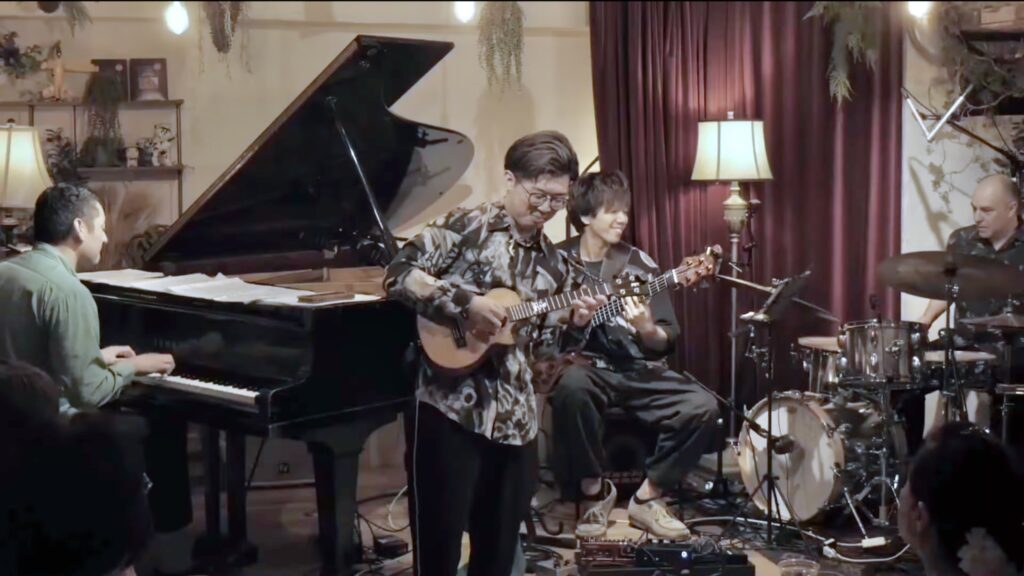
I needed something to pick me up. So I looked for music by Rio Saito, a young ukulele virtuoso who has been playing some hot jazz. And I found a Youtube video of the Rio and Dani Brazilian Jazz Trio, recorded last November, playing “Aquelas Coisas Todas” by Brazilian jazz great Toninho Horta. I recognize Rio Saito as the ukulele player and band leader, but since I don’t read Japanese I can’t tell you the names of the pianist, bassist, and drummer. All I can tell you is that they are all fabulous musicians who put across eleven minutes of bright, uptempo, very accomplished jazz that made me smile.

One of the reasons I love jazz is because of the international connections. This performance is a perfect example — a Japanese ukulelist playing a Brazilian composition that comes from the American tradition of jazz. In a world filled with hot wars and trade wars and cultural wars, it’s good to remember that we can build connections across our differences.

Rio Saito playing ukulele, with a pianist, bassist, and drummer behind him on a small stage.
Screenshot from the video. Click on the image above to view the video on Youtube.

And if you want more, here’s Abe Lagrimas Jr. and Rio playing Antonio Carlos Jobim together.

Quaker Checkers revisited

Back in 2012, I posted a game board and rules for playing “Quaker Checkers.” Photocopies of that game had been passed around for years between Unitarian Universalist Sunday schools. I decided to create a clean copy, and put it online where maybe more people could access it. And if you read the comments on that 2012 post, you’ll see that Quaker Checkers has been played with great success in Unitarian Universalists Sunday schools (and maybe in one or two Quaker First Day Schools as well).

This week, I received email from Sally Q Campbell, who invented the game. Sally said she’s currently talking with a friend of hers about developing an online version of Quaker Checkers. Actually, I would have loved to have an online version during the pandemic when Sunday school had to meet online.

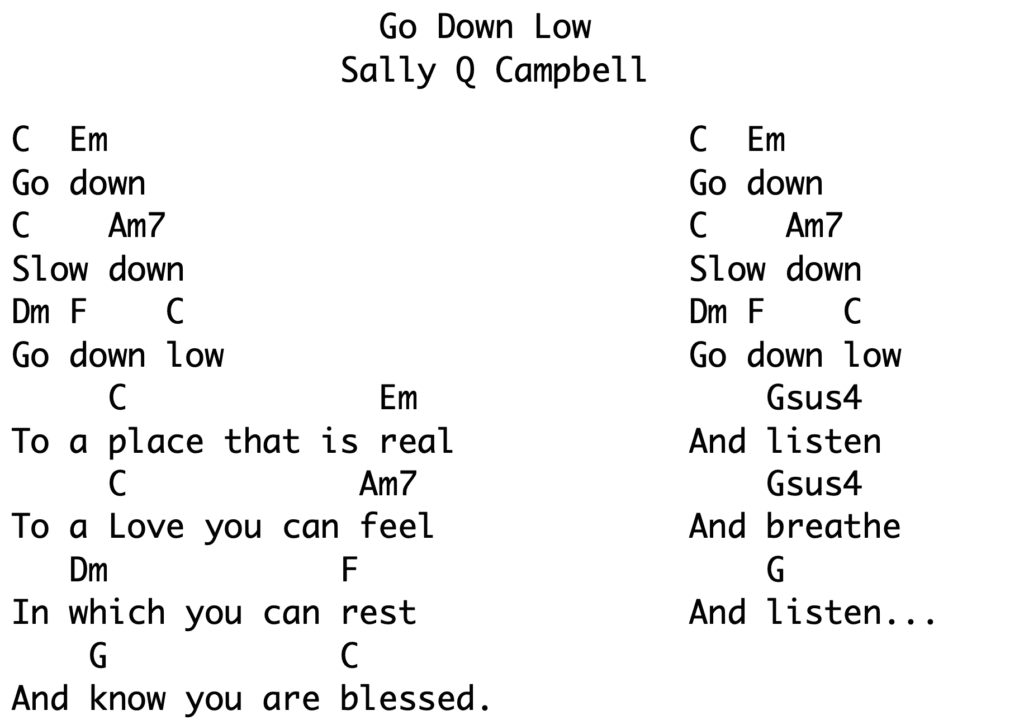
It appears that Sally is one of those endlessly creative people. She is also a songwriter, with a number of songs about peace and spirituality to her credit. On her her Youtube channel, she writes: “I’m a Quaker Singer/songwriter. Many of my songs are given to me in the silence if I will S l o w D o w n.” In fact, I especially like her song “Go Down Low,” which is all about slowing down and centering down. She hadn’t come up with chords for it, so I did. Here’s the standard warning for online chord/lyrics sheets: this is my interpretation of someone else’s song, posted here for educational purposes only; the songwriter Sally Campbell retains the copyright.

Graphic with lyrics and chords

(N.B.: she sings “Go Down Low” in B flat.)

All the above is by way of digression. My real point in writing this blog post is to correct something Sally pointed out in her email. She said: “You did make one error when you tidied it up. My board does not have dark and light squares, it’s just a grid. Makes it more of a challenge.”

She’s absolutely right. To make amends, here’s a corrected version of the game board:

Graphic of the game board for Quaker Checkers.
Click on the image above for a printable PDF of the game.

The color of late summer plants

We’re past Lughnasa now, and the days are noticeably shorter. At this time of year, I always look for a few plants with spectacular colors.

Delicately formed flowers.
Lobelia cardinalis

The Cardinal Flower grows in wet ground — in swamps, or along streams, rivers and ponds. I don’t often find a cardinal flower blooming where I can get close enough to see the details of the flowers, but this one was growing in a wet place along one of the paths around Aaron River Reservoir. The vivid red color, and the dramatic structure of the flower, makes it especially memorable.

Butterfly on a flower head.
Danaus plexippus on Asclepias tuberosa

Butterfly Milkweed grows in open fields and meadows. The bright orange is pretty enough by itself, but when an orange and black Monarch Butterfly lands on it, it’s truly spectacular.

Thin orange stems twining around a green plant.
Cuscuta gronovii

At this time of year along one of the inlets of Cohasset Harbor, I always see marsh plants covered in strange-looking orange filaments. Common Dodder is a parasitic plant that has no chlorophyll; it gets all its nutrients by sucking the sap out of a host plant. Parasites always creep me out a little — though I suppose letting your food source live is better than killing it, the way we humans kill carrots and potatoes, or cows and chickens. Nevertheless, the showy orange stems of Common Dodder twined in among green leaves is quite a beautiful sight.

What needs to be said

In a podcast on Religion News service, Rabbi Jay Michelson says that leaders among religious progressives have been avoiding talking about what we can only presume at this point is a government cover-up about the Epstein sex trafficking ring.

I’m not sure if I qualify as a religious progressive leader, but I haven’t been talking about Epstein, or about Ghislaine Maxwell, or about Donnie Trump’s possible connection to their pedophile ring, because I don’t like giving a lot of air time to human traffickers who got money and power trips out of exploiting girls. It always seems to be that the sexist assholes in this world take over all the conversations.

So let’s talk about Haley Robson, who was molested by Epstein when she was 16 years old. When she was 15, she had been raped, and her rapist was still stalking her and humiliating her; as a result she was probably extra vulnerable to Epstein’s emotional manipulation. So Epstein molested her, but stopped short of intercourse, telling her that she should go recruit other girls for him. An article in Psychology Today covers this part of Robson’s story — it’s a very ugly story.

In an interview with BBC News posted just a couple of hours ago, Robson talks about why we should not talk so much about Epstein and his accomplice, Ghislaine Maxwell. Instead of talking about them, Robson says:

The whole Epstein saga reminds me far too much of the sexual misconduct cases I’ve seen in smaller organizations (like organized religion, and sports teams, and schools, etc.). A person in a position of authority uses their power to sexually exploit vulnerable people — then when they get found out, everyone focuses attention on the person in the position of authority, neglecting or ignoring or forgetting the vulnerable people who got exploited.

So I respect Rabbi Michelson’s opinion that religious progressives should not cede the conversation about the Epstein cover-up to the religious right. But I feel that Robson has the right idea — I don’t want to sensationalize or glorify either Epstein, or his proven and alleged accomplices. If we do decide to talk about this case, let’s make sure our conversation is focused on the people who got molested and manipulated, and how we might get justice for them.

Hammer dyeing with sumac leaves

I was reading the chapter on mordants in the book Craft of the Dyer: Colour from Plants and Lichens (by Karen leigh Casselman, 2nd ed., Dover Publications, 1993), when I came across this: “Some dye plants are used in the pot as mordants. This is true with alder and with sumac leaves.” (p. 40). (In case you’re not familiar with the term, a mordant is a substance used to help fix dyes in the cloth; a mordant helps make the dye color more light-fast, and helps the color stand up to washing better.)

This summer, I got interested in hammer dyeing (also known as “plant pounding”). This process transfers plant colors to cloth by hammering the plant against the cloth (details on the process are in this blog post). One problem with hammer dyeing is that the colors are not always lightfast, and may not stand up well to washing. But if sumac leaves can act as both mordant and dye-stuff, I wondered if they might produce a more permanent color if used for hammer-dyeing.

So I hammer-dyed a t-shirt using sumac leaves. And yes, they did indeed stand up to washing. As for lightfastness, only time will tell.

To see photos and a description of the whole process, scroll down.

Continue reading “Hammer dyeing with sumac leaves”

Christian Socialism in 1935

I’ve been reading Capitalism and Its Critics by John Cassidy. According to Cassidy, Karl Polanyi criticized capitalism as being essentially undemocratic. After watching the rise of fascism in Europe, in 1935 Polyani wrote:” The mutual incompatibility of Democracy and Capitalism is almost generally accepted today as the background of the social crisis of our time.” Why? Because “only an authoritative State can deal with the contradictions inherent in Capitalism.” (Quoted by Cassidy, p. 283, originally from Polyani’s “The Essence of Fascism.”)

There was a religious side to this. Polyani was a Christian Socialist. Today, Christian Socialism is a concept that would probably cause the heads of many U.S. Christians to explode. (It would also probably cause the heads of Bernie Sanders and the Democratic Socialists of America to explode, but I digress.) Yet Christian Socialism used to be a widely-known option that boasted adherents ranging from Dorothy Day (a Catholic) to Adin Ballou (a Universalist turned Unitarian).

From Polyani’s viewpoint as a Christian Socialist, the rise of fascism not only threatened socialism, it also threatened Christianity. In that same 1935 essay, Polyani wrote: “Victorious Fascism is not only the downfall of the Socialist Movement; it is the end of Christianity in all but its most debased forms.” As a theological point, I think this is true — when people allow a central political authority to make moral choices for them, you’re going to see an attenuation of their individual moral capacity, which will similarly attenuate their religious capabilities.

Another

Email piled up while I was on vacation. I missed the fact that the Ministerial Fellowship Committee sent out another notice back on July 16:

As I’ve said before, I do wonder who the independent investigator was. Does the UUA have enough money to pay for an outside law firm or consulting firm to carry out these reviews? If not, who is the independent investigator? In any case, Kaaren Anderson has her own website, where you can her employment history.

AI and UU sermons

Should Unitarian Universalists use so-called AI (Large Language Models, or LLM) to write sermons?

Since Unitarian Universalists don’t have a dogma to which we must adhere, there will be many answers to this question. Here are my answers:

I/ Adverse environmental impact of LLMs

Answer: No. The environmental cost of LLMs is too great.

First, we all know about the huge carbon footprint of LLMs. And the more complex the answer required from the LLM, the more carbon that is emitted. Deborah Prichner, in a June 19, 2025, Science News article on the Frontiers website, sums up the impact by quoting someone who researched energy use of LLMs:

“‘The environmental impact of questioning trained LLMs is strongly determined by their reasoning approach, with explicit reasoning processes significantly driving up energy consumption and carbon emissions,’ said … Maximilian Dauner, a researcher at Hochschule München University of Applied Sciences…. ‘We found that reasoning-enabled models produced up to 50 times more CO2 emissions than concise response models.’”

Thus, not only do LLMs have a big carbon footprint, but handling something as complex as a sermon could result in a carbon impact 50 times greater than the lowest LLM carbon footprint.

Second, the data centers running LLMs use a tremendous amount of fresh water. In their paper “Making AI Less ‘Thirsty’: Uncovering and Addressing the Secret Water Footprint of AI Models,” Pengfei Li (UC Riverside), Dr. Jianyi Yang (U Houston), Dr. Mohammad Atiqul Islam (U Texas Arlington), and Dr. Shaolei Ren (UC Riverside) state:

“The growing carbon footprint of artificial intelligence (AI) has been undergoing public scrutiny. Nonetheless, the equally important water (withdrawal and consumption) footprint of AI has largely remained under the radar. For example, training the GPT-3 language model in Microsoft’s state-of-the-art U.S. data centers can directly evaporate 700,000 liters of clean freshwater, but such information has been kept a secret. More critically, the global AI demand is projected to account for 4.2 – 6.6 billion cubic meters of water withdrawal in 2027, which is more than the total annual water withdrawal of … half of the United Kingdom.”

Third, on 1 May 2025, IEEE Spectrum reported that “AI data centers” cause serious air pollution. The article, titled “We Need to Talk About AI’s Impact on Public Health: Data-center pollution is linked to asthma, heart attacks, and more,” raises several concerns. The authors write:

“The power plants and backup generators needed to keep data centers working generate harmful air pollutants, such as fine particulate matter and nitrogen oxides (NOx). These pollutants take an immediate toll on human health, triggering asthma symptoms, heart attacks, and even cognitive decline.”

In sum: Because my religious commitments call on me to aim for a lower ecological impact, the environmental impact of LLMs alone is enough to stop me from using them to write sermons.

II/ Sermons as human conversations

Answer: No. I feel that sermons should be the result of human interaction.

You see, for me, a sermon should arise from the spiritual and religious conversations that people are having in a specific congregation or community. As a minister, I try to listen hard to what people in the congregation are saying. Some of what I do in a sermon is to reflect back to the congregation what I’m hearing people talk about. At present, a LLM cannot access the conversations that are going on in my congregation — a LLM can’t know that P— made this profound observation about their experience of aging, that A— asked this deep question about the reality of the death of a family member, that C— made a breakthrough in finding a life direction, that J— took this remarkable photograph of a coastal wetland. Some or all of those things affect the direction of a sermon.

Mind you, this is not true for all religions. Deena Prichep, in a 21 July 2025 article on Religion News Service titled “Are AI sermons ethical? Clergy consider where to draw the line,” states that “The goal of a sermon is to tell a story that can break open the hearts of people to a holy message.” In other words, according to Prichep, for some religions the role of the preacher is to cause other people to accept their holy message. Prichep quotes Christian pastor Naomi Sease Carriker as saying: “Why not, why can’t, and why wouldn’t the Holy Spirit work through AI?” I can see how this would be consistent with certain strains of Christianity — and with certain strains of Unitarian Universalism, for that matter, where the important thing is some abstract message that somehow transcends human affairs.

But that’s not my religion. My religion centers on the community I’m a part of. Yes, there is a transcendent truth that we can access — but as a clergyperson, I don’t have some special access to that transcendent truth. Instead, truth is something that we, as a community of inquirers, gradually approach together. Any single individual is fallible, and won’t be able to see the whole truth — that’s why it’s important to understand this as a community conversation.

As a clergyperson, one thing I can do is to add other voices to the conversation, voices that we don’t have in our little local community. So in a sermon that’s trying to help us move towards truth, I might bring in William R. Jones, Imaoka Shinichiro, or Margaret Fuller (to name just a few Unitarian Universalist voices). Or I might quote from one of the sacred scriptures — i.e., from one of the sources of wisdom traditions — from around the world. Now it is true that maybe a LLM could save me a little time in coming up with some other voices; but given the huge environmental costs, it seems silly to save a small amount of time by using a LLM.

III/ Biases built into LLMs

Answer: No, because of hidden biases.

LLMs are algorithms trained on digitized data which has been input into them. For a LLM, the digitized data is mostly in the form of text. But we know that certain kinds of authors are going to be under-represented in that digitized data: women, non-Whites, working class people, LGBTQ people, etc. The resulting biases can be subtle, but are nonetheless real.

As a Universalist, I am convinced that all persons are equally worthy. I have plenty of biases of my own, biases that can keep me from seeing that all persons are equally worthy of love — but at least if my sermons are affected by my own biases, my community can successfully challenge me about my biases. If I use a LLM model to write a sermon, a model that’s riddled with biases that I’m not really aware of, that makes it harder for my community to help me rid my sermons of my biases.


IV/ Final answer: No

Would I use a LLM to write a sermon?

No. It goes against too many things I stand for.

Should you use a LLM to write your sermons?

I ‘m not going to answer that question for you. Nor should you ask a LLM model to answer that question for you. We all have to learn how to be ourselves, and to live our own lives. Once we start asking others — whether we’re asking LLMs or other authority figures — to answer big questions for us, then we’re well on the road to authoritarianism.

Come to think of it, that’s where we are right now — on the road to authoritarianism. And that’s a road I choose not to follow, thank you very much.