UUCPA Social Justice Timeline

For the 75th anniversary of the Unitarian Universalist Church of Palo Alto

1949 — Our congregation protests “the assumption that war is inevitable and an A-bomb justified…. We urge positive program negotiations to avoid war.”

1950 — Congregation gives sizable contributions to help Spanish refugees who had been living in France since 1938
1950 — Congregation sponsors and settles a Displaced Persons family from Latvia

1952 — Congregation refuses to sign California’s “Loyalty Oath,” and has to pay state tax even though it’s a nonprofit
1952 — Congregation collects 155 pounds of clothing for Spanish refugee children

1953 — Our congregation, the San Jose Unitarian church, and the Los Gatos Unitarian Fellowship form a dental loan fund to aid children of migrant workers

1956 — Congregation assists a displaced persons family from East Germany

1958-66 — With a group of 5 Bay Area Unitarian churches, our congregation helps found Stevenson House, Palo Alto’s first nonprofit housing for low-income seniors

1958 — Over 200 members sign a pledge of open housing, agreeing to welcome all persons to their neighborhood regardless of race, creed, or national origin

1959 — Congregation supports a Displaced Persons family from East Germany

1960 — Congregation assists a displaced persons family, plus four children from Indonesia
1960 — Congregation approves a resolution calling for the dissolution of the House Un-American Activities Commission

1962 — The Women’s Alliance sends six cartons of clothing to Spanish refugees in Toulouse, France
1962 — The Sunday school packs food baskets for prisoner’s families at Christmas

1964 — Rev. Dan Lion participates in the Mississippi Summer Project (a.k.a. Freedom Summer), and is supported by our congregation
1964 — Congregation votes overwhelmingly to oppose the Becker Amendment, Resolution 693, that would allow prayer in public schools
1964 — Congregation votes to oppose California Proposition 14, which would allow open racial discrimination when selling or renting housing

1965 — Congregation supports Rev. Dan Lion’s trip to Selma, Ala.
1965 — Sunday school students give $90 [$800 in 2020 dollars] to sponsor a foster child in Greece

1966 — Activism against the Vietnam War
1966 — Congregation sells 2.2 acres to Stevenson House elderly housing community at $30,000 below market rates [$240,000 in 202 dollars], then gives Stevenson House a $5,000 donation [$405,000 in 2020 dollars]

1967 — The congregation’s newsletter carries a series of letters over several months from congregation members both opposing and supporting the Vietnam War
1967 — Senior minister Rev. Dan Lion and Assistant Minister Rev. Mike Young provide counseling to conscientious objectors

1968 — Congregation votes to not build a new church building, and instead votes to spend the money raised on “human rights” programs

1969 — Rev. Dan Lion and other Unitarians participate in anti-war march in downtown Palo Alto

1970 — Congregation forms a nonprofit corporation to start an alternative high school, called “Lothlorien High School”

1971 — Congregation establishes Ellen Thacher Children’s Center, a day care center named after the recently deceased Ellen Thacher; 1/4 of the children receive scholarships

1972 — Congregation grants the use of the church as sanctuary for those “acting according to the dictates of their conscience in opposition to civil or military actions” [i.e., for conscientious objectors]

1975 — The Social Concerns Committee supports the United Farm Workers boycott of Gallo
1975 — After its sixth year, Lothlorien High School ceases operations

1977 — Gail Hamaker and other women from our congregation are active in getting the Unitarian Universalist Association General Assembly to adopt the groundbreaking Women and Religion resolution

1981 — The World Concerns Committee presented non-partisan lectures on various topics of social concern

1982 — Congregation votes in December to join South Bay Sanctuary Covenant to provide protection and advocacy for Central American refugees

1984 — The Sanctuary Committee raises $100 a month to support South Bay Sanctuary Covenant [$250 in 2020 dollars]
1984 — The Stevenson House Committee helps raise funds to renovate Stevenson House, arranges activities to “enliven the environment” of residents

1987 — Congregation votes to join the Mid-Peninsula Peace Center
1987 — Congregation votes to make our congregation a Nuclear Weapons Free Zone
1987 — Congregation votes to join the Urban Ministry of Palo Alto, to address homelessness

1988 — Congregation is a founding member of Hotel de Zink, a short-term homeless shelter

1989 — 1st annual Undie Sunday collection of donations of new underwear for unhoused people

1992 — Congregation gives over 3% of its annual budget to the Unitarian Universalist Service Committee

1994 — Congregations begins Welcoming Congregation process, to become more welcoming to LGBTQIA+ people

1997 — Congregation joins with other churches to form Peninsula Interfaith Action; began work on education and housing

1999 — UUA recognizes UUCPA as a Welcoming Congregation,welcoming to LGBTQIA+ people

2002 — Congregation adopts Statement of Conscience opposing the Iraq war
2002 — Marriage equality activism against the Knight Initiative (Prop 22)

2003 — Congregation raises more than $50,000 for construction of the Opportunity Center to provide services to unhoused people
2003 — Founding member of Multifaith Voices for Peace & Justice

2005 — Antiwar activism against second Iraq war

2007 — Green Sanctuary Committee is formed

2008 — Task force on ridding the world of nuclear weapons is formed
2008 — Welcoming Congregation Committee organizes congregation to attempt to defeat Prop 8, a ballot measure to ban same-sex marriage

2009 — Congregation receives Green Sanctuary Congregation certification from the Unitarian Universalist Association for good congregational environmental practices

2010 — 1st annual sale of fair trade chocolate for Halloween
2010 — Fair Elections task force is formed

2011 — Congregation works on the California DISCLOSE Act with California Clean Money Campaign
2011 — Solar panels installed on the roof of the Main Hall, providing about half of UUCPA’s energy needs

2012 — Congregation endorses SB 52, the California Clean Money Act, to require financial disclosure of campaign contributions; holds CA DISCLOSE Act rally at the church
2012 — Our Whole Lives comprehensive sexuality education classes are open to the wider community

2013 — Immigration Task Force is formed; adult class is offered on “Immigration as A Moral Issue”
2013 — Music Director Bruce Olstad launches Bodhi Tree North concert series to raise money for charitable causes

2014 — Installation of native plant garden in front of the church is completed

2015 — “Drone quilts” are displayed in the Main Hall, sponsored by Multifaith Voices for Peace & Justice
2015 — Ecojustice Camp day camp is launched to teach kids about environmental justice

2015 — Congregation gives authority to the Green Sanctuary Committee to advocate on behalf of UUCPA for environmental issues

2016 — Rev. Amy Zucker Morgenstern leads first Beloved Conversations anti-racism class

2017 — Congregation endorses SB 31, California Religious Freedom Act
2017 — Congregation co-sponsors Unity Rally to counter rally by Anti-Sharia proponents
2017 — More solar panels added to Main Hall roof, which now satisfy all the congregation’s electrical needs

2018 — Congregation approves fast-track process for endorsements on behalf of the congregation, and for approvals to carry a UUCPA banner in public rallies and vigils
2018 — Parking lot solar panels, erected by a solar energy company leasing from the congregation, begin operation
2018 — Congregation becomes a host of the year-old Heart & Home Collaborative women’s homeless shelter
2018 —Native plant garden in front of the church is expanded

2019 — Signed a Statement of Support for people arrested and charged for leaving food and water in the desert for immigrants
2019 — Congregation organizes phone banks for Reclaim our Vote, reaching out to voters of color
2019 — Rev. Amy Zucker Morgenstern begins “White Folks Dismantling White Supremacy” anti-racism class
2019 — In cooperation with Grassroots Ecology, congregation becomes a rain barrel demonstration site, with over 500 gallon capacity 

2020 — Congregation participates in the Unitarian Universalist Association’s UU the Vote campaign
2020 — Members of the congregation write thousands of postcards and made hundreds of phone calls to encourage people of color in southern states to register and vote in the 2020 election
2020 — Due to COVID lockdown, Heart & Home Collaborative homeless shelter remains at UUCPA for 3 months, 24/7
2020 — Board approves carbon-neutral policy
2020 — “White Folks Dismantling White Supremacy” class expanded to twice monthly

2021 — Congregation endorses the California Ballot DISCLOSE Act
2021 — Congregation receives final approval and launches UUCPA Safe Parking Program, hosting four passenger vehicles in our parking lot, in conjunction with Move Mountain View
2021 — Board approves plastics reduction policy
2021 — First all-electric heat pump HVAC system is installed in church office
2021 — Congregation begins work on proposed 8th Principle on addressing racism and other oppressions
2021 — Core group takes online Beloved Conversations class from Meadville Lombard Theological School
2021 — Congregation renews their commitment to being a Welcoming Congregation
2021 — Congregation adds Showing Up for Racial Justice at Sacred Heart as a monthly Justice Partner

Update, 11/18/21: Errors corrected, new items added
Timeline of the Unitarian Universalist Church of Palo Alto

The seventy-fifth anniversary of the organization of the Unitarian Universalist Church of Palo Alto is in 2022. So I’ve been working on the history of the congregation, starting with a basic timeline.

Sources for this timeline: Rae Bell’s timeline for the 60th anniversary of the congregation; Annual Reports from 2009-2020; documents in the UUCPA archives; personal reminiscences; denominational sources.

See the corrected version here, which includes vintage photos.

Continue reading “Timeline of the Unitarian Universalist Church of Palo Alto”

Timeline of Palo Alto Unitarians, 1891-1950

A timeline that give institutional chronology of the Unity Society and the Unitarian Church of Palo Alto — and also introduces you to some of the interesting Unitarians who lived in Palo Alto from 1891 to 1950. The links mostly go to Wikipedia or other online encyclopedia pages, or to local history websites.

1891-1894 — A few Unitarians move to Palo Alto, including Emma Rendtorff

Unity Society of Palo Alto, 1895-1897

March, 1895 — Rev. Eliza Tupper Wilkes, a Universalist, is hired by Pacific Women’s Unitarian Conference to do “missionary work”
May 1-5, 1895 — Palo Alto Unitarians Luna and Minnie Hoskins attend Pacific Unitarian Conference in San Jose
May 5, 1895 — Eliza Wilkes preaches at Memorial Church, Stanford University; first woman to preach at Stanford
Autumn, 1895 — Eliza Wilkes leads Unitarian services in Palo Alto
Jan. 12, 1896 — Unity Society of Palo Alto formally organized, Executive Committee includes both men and women; members include Anna Probst Zschokke, John and Isabel Butler, and George Blakesley, Palo Alto’s first dentist
March, 1897 — Unity Society has supply preachers
Spring, 1897 — Unity Society ceases activity

Continue reading “Timeline of Palo Alto Unitarians, 1891-1950”

Devil’s Slide Trail

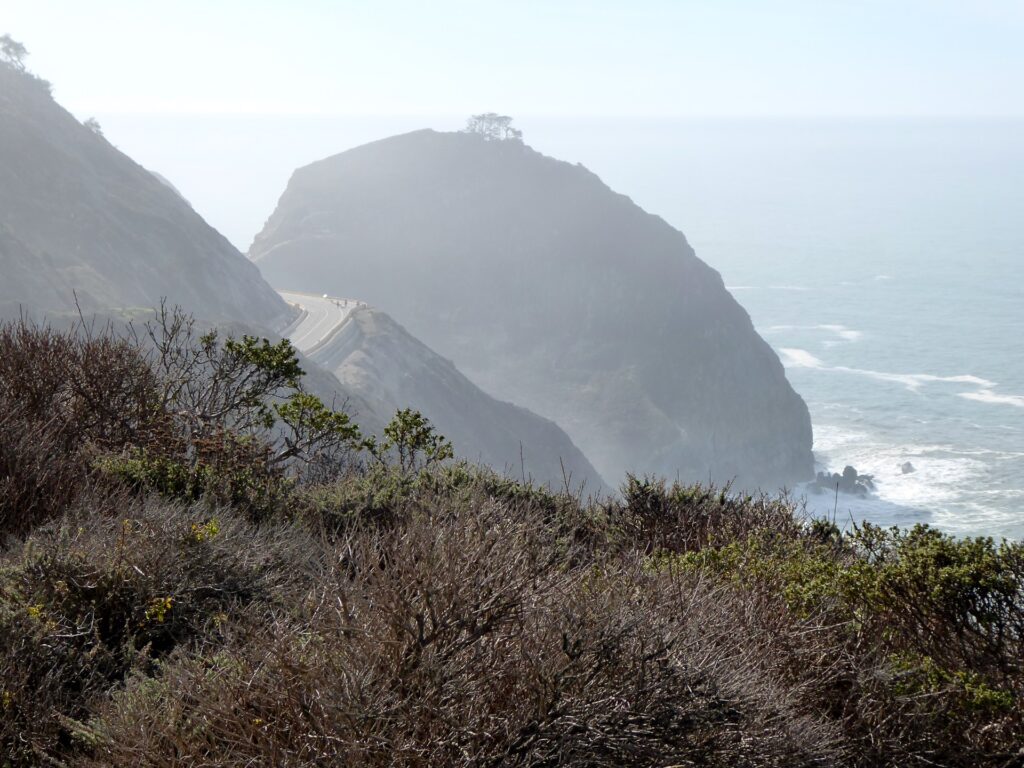
On Friday, we walked the Devil’s Slide Trail. This used to be part of Highway 1. It runs through a geologically unstable area, and every year or so a landslide would cut off the road. Since this is the main route to San Francisco from the coastside of San Mateo County, these landslides led to major traffic problems. Finally in 2012, the state completed a tunnel to bypass this a mile and a half stretch of Highway 1, and the county took over the former highway and turned it into a recreational trail. We’ve been meaning to walk this trail ever since, but it wasn’t until last Friday that we did. It was even better than we anticipated, with dramatic scenery like this:

Sure, you could see this scenery when it was a highway and you were driving past, but mostly when you were driving this stretch of road you had to watch the road. Even if you were in the passenger’s seat, at fifty miles an hour you didn’t have time to see the Common Murres clustered on Egg Rock:

Common Murres clustered on top of a large rock formation, with the ocean behind it

Transparency, part three

The Ministerial Fellowship Committee (MFC) of the Unitarian Universalist Association (UUA) is making a big step towards transparency. According to an email I just received, the MFC will publish a list of all ministers who have been removed from fellowship:

“In the past, the UUA relied on the UU World Magazine’s Milestones section as the most transparent way to list ministers removed from Fellowship. The UU World is only published twice a year at this time, and it is impractical to search the archives of the magazine for this information. Therefore, the UUA will soon publish a compiled list on its website.”

This email was signed by the two co-chairs of the MFC, Rev. Jackie Clement and Rev. Dr. Rebekah Savage. Given how understaffed the UUA is these days, no doubt it will take a little time for the list to actually make it up on the UUA website. Nevertheless, this decision is a big step towards transparency.

The email, by the way, goes on to give a primer in congregational polity: “only congregations have the right to ordain ministers, and thus the MFC does not have the power to remove ordination, or even to force a minister to resign from a position if a congregation does not vote removal or termination.” In other words, if someone’s congregation wants to keep a minister who has been removed from fellowship by the MFC, they have every right to do so — but now it’ll be harder to hide the fact that their minister has violated the ethical standards of the UUA.

Unitarians in Palo Alto, 1915-1920

Part Four of a history I’m writing, telling the story of Unitarians in Palo Alto from the founding of the town in 1891 up to the dissolution of the old Unitarian Church of Palo Alto in 1934. If you want the footnotes, you’ll have to wait until the print version of this history comes out in the spring of 2022.

Part OnePart TwoPart Three

Years of Turmoil, 1915-1920

The American Unitarian Association sent William Short, Jr., to be the next minister of the Palo Alto church. Short, the son of an Episcopalian priest who had died when he was just 17 years old, entered the Episcopal Theological school, in Cambridge, Mass., in 1912. He became interested in Unitarianism, and two days before he graduated from the Episcopal Divinity School, he applied for fellowship as a Unitarian minister. Louis Cornish and others at the American Unitarian Association advised him to serve as assistant minister under some more experienced Unitarian minister, but Short insisted he was ready for his own parish. Cornish later remembered that Short had “the ready gift of awakening friendship in other men.” After serving as the summer minister in the Unitarian church in Walpole, Mass., Cornish assigned Short to the Palo Alto church. Short arrived in Palo Alto in November, 1915.

At first, it seemed like a good match between congregation and minister. True, the Sunday school enrollment dropped from 90 students in 1915 down to 54 the next year, but under Emma Rendtorff’s leadership enrollment rebounded to 63 students in 1917. Church membership was low in 1916, with just 40 members, and that probably represents a significant decline. But for a small church, it was quite active:

“[In winter, 1916-1917] the church hall [i.e., the Social Hall] has given hospitality…to Mr. John Spurgo, the noted Socialist speaker; to the American Union against Militarism, which is earnestly fighting the cause of democracy; and to Mme. Aino Malmberg, a refugee from the persecutions of Old Russia.… Two physical training clubs for women and girls have their home in the hall, as well as a club to encourage the finer type of social dancing. The church passed a resolution of approval of the visit of Mr. Short to Sacramento in March [1917] in the interests of the Physical Training bills.”

It appears that much of this activity sprang from Short’s theory of religion:

“[I]f religion is to awaken and triumph over the soullessness of life it must be based on unquestionable sincerity and bear a stirring message for the oppressed and the outcasts of society; it must be the potent factor in the reconstruction of the social order.…”

But none of this activity really had much to do with Unitarianism. The church was proud that the “pamphlet-rack in the vestibule must constantly be refilled,” but the congregation was the smallest it had ever been since the completion of the church building in 1907.

By early 1917, William Short decided he didn’t want to continue working as a minister any more. On March 15, 1917, after just a year and a half serving the Palo Alto church, he wrote to Louis Cornish, “I have failed [as a minister in Palo Alto], and my intention is to try to understand life better before I try to preach again in some other place.” Short’s resignation was not even mentioned in the minutes of the Board of Trustees.

Short was a strong pacifist: his next job was with the People’s Council of San Francisco, an anti-war group, and he wound up being arrested for draft evasion in 1918 after military authorities decided he was not exempt from the draft under the exemption for ministers. As a pacifist, Short inspired some of the pacifists in the Palo Alto church, including Guido Marx, who attempted to bail him out of jail when he was arrested for draft evasion. But Short also annoyed the pro-war contingent in the congregation, and the simmering conflict between the two groups split the church and contributed to the decline in membership and participation during the war years. When Alfred S. Niles came to the church in 1927, more than a decade after Short had left, he was told that “the minister at the time of World War I had been a pacifist and conscientious objector, and this had caused a split in the church from which it never recovered.” By all accounts, Short’s ministry ended in failure.

The Palo Alto church was at such low ebb after Short’s departure that a denominational field representative “recommended the merging of the San Jose and Palo Alto churches” in April, 1917. Denominational officials agreed, and “proposed the federation of the churches for reasons of economy in January, 1918.” However, the San Jose Unitarians were not interested in merging, and they began to raise funds and increase their membership; by early 1920, the San Jose Unitarians paid off all their debt to the denomination. The denomination was stuck with the Palo Alto church, and had to figure out what to do with it.

Continue reading “Unitarians in Palo Alto, 1915-1920”

What doesn’t kill you….

Sometimes when I’m talking to someone who has just been through a major life disaster, they will say, “Well, ‘what doesn’t kill you makes you stronger,’ right?” They find it comforting to think that life will turn out all right in the end.

When I’m doing pastoral counseling, my job is mostly to listen, and maybe to help people find at least a little hope in their lives. If the phrase “What doesn’t kill you makes you stronger”gives them hope, then of course I agree with them.

But I can’t help thinking about all the people who have suffered through one of life’s disasters, and come out of the other end weaker, rather than stronger. And I think to myself: “What doesn’t kill you, doesn’t kill you.” That can still be an expression of hope, just maybe a little more true to more people’s actual experiences.

So I was pleased to read about Kate Bowler’s new book, No Cure for Being Human (and Other Truths I Needed To Hear). Bowler’s earlier book, Everything Happens for a Reason (and Other Lies I’ve Loved) gently showed up the mistakes of the Prosperity Gospel, that strange vaguely Christian theology which interprets any misfortune as some kind of personal failing that has invoked God’s disfavor.

Bowler’s new book continues in the same vein. Religion News Service says the book “is a broadside against a culture obsessed with the power of positive thinking.” Bowler is a professor at Duke University who has written academic studies of the Prosperity Gospel. And she survived stage 4 colon cancer while in her thirties, and “her health is fragile and will likely remain so.” So she is someone who can see just how damaging the prosperity gospel can be. And she’s out to provide a popular, friendly, optimistic alternative.

And boy, do we need an alternative to the Prosperity Gospel. Because it’s not just Christians who believe in the Prosperity Gospel. I have atheist friends who think this is the best of all possible worlds, that you can improve your life by making more money and “taking care of yourself,” that if anything goes wrong in your life it’s your own fault. I have Buddhist friends who believe that you wouldn’t suffer if you’d just meditate more, so if you feel bad it’s your own fault. And I have Pagan friends who are convinced that it’s negative thinking that causes life’s problems, meaning if you have any problems, it’s your own fault.

But of course it isn’t your fault. When bad things happen to you, more often than not it just means that bad things have happened to you. (Of course, if you do something foolish like storming the Capitol building and you find yourself in jail, then yes it actually is your fault.) I’m glad there are people like Kate Bowler who are willing to point out that the Prosperity Gospel in any form — Christian, atheist, Buddhist, Pagan — is wrong. There’s a better way: learn to live with life as it is, and instead of manufacturing fake hope, find real hope instead.

Website update

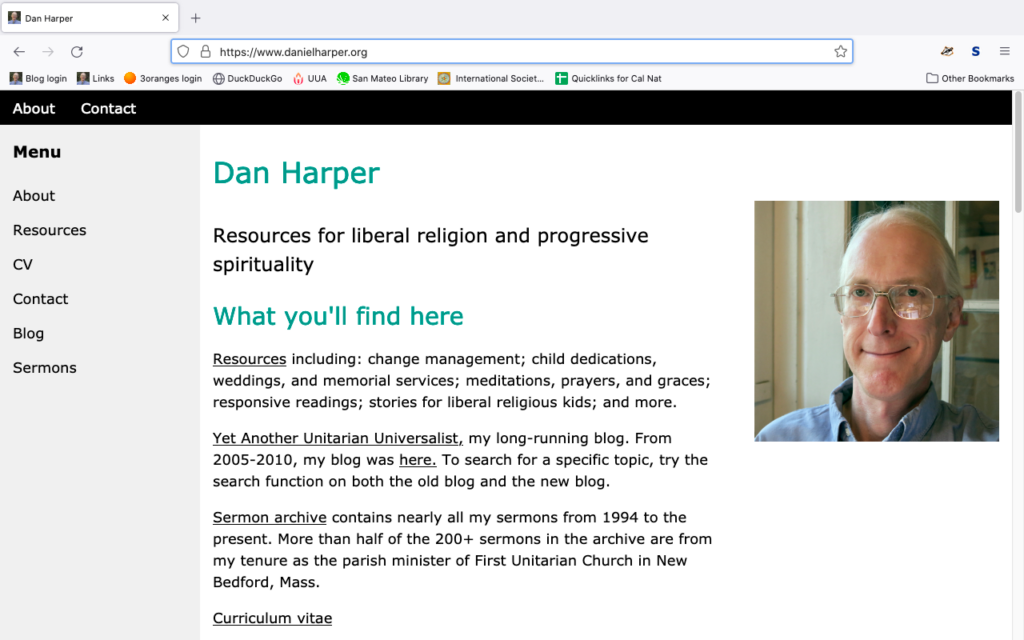
The last time I did a major update of my main website was around 2009. It was looking pretty old and creaky. So I did a complete redesign, and it’s now responsive and html5 compliant.

On the content side, I added some significant new content, including an essay on change management in congregations. I did delete some old outdated content, but I think no one will miss it (if there’s something you do miss, let me know, and I can put it back up).

Thank you Abby, for giving me the impetus to learn about responsive websites (and happy birthday, too!).

Check it out — https://www.danielharper.org/ — and if you see any problems or if you have any comments, please leave them here.

Step by Step

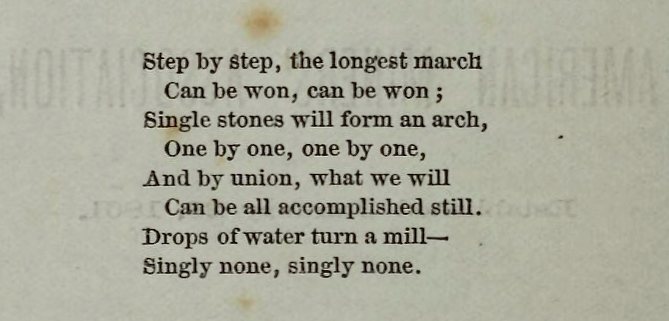
I got curious about the song “Step by Step,” a song that Waldemar Hille and Pete Seeger put together — it’s hymn number 157 in the Unitarian Universalist hymnal. Hille found a poem in the “Constitution and Laws for the Government and Guidance of the American Miners’ Association” (1864), and he and Seeger made a song out of it. But Seeger said they changed some of the words, so I got curious about the original wording. I found a digitized copy of the poem online, and it reads like this:

Step by step, the longest march
Can be won, can be won,
Single stones will form an arch
One by one, one by one,
And by union, what we will
Can be all accomplished still.
Drops of water turn a mill—
Singly none, singly none.

I decided I liked the original words better than Hille and Seeger’s rewrite — the original second stanza feels more positive to me. Then I realized I’ve always disliked Hille and Seeger’s tune; it sounds like a dirge, better suited to a funeral than to a union marching song.

Worst of all, Hille and Seeger slapped a copyright on their song. Maybe while they were alive they would have given permission to use it freely, but they’re both dead now. Besides, who wants to have to write for permission to sing the song?

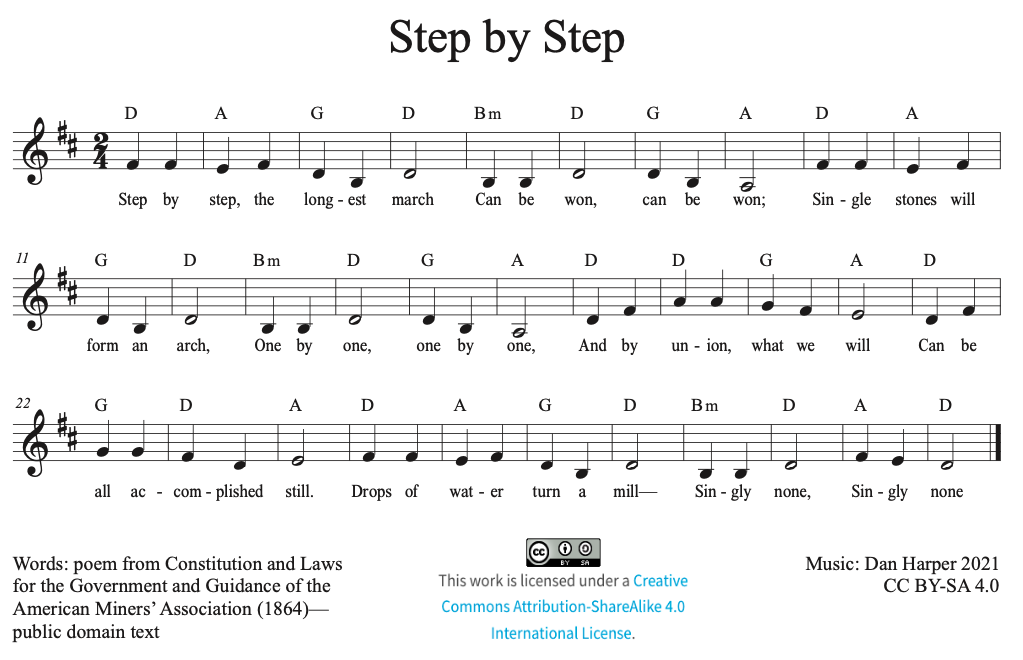
So here’s my version of this grand old union song. It has the original public domain words, paired with a tune licensed under the Creative Commons Attribution-ShareAlike 4.0 International License:

Click on the image above for a PDF.

Solving the Silicon Valley housing crisis four people at a time

The title of a recent San Francisco Chronicle article says it all:

He wanted to let homeless neighbors sleep in cars outside his church. It launched a two-year battle.

The “he” in the title is my new UU hero, Chris Kan. Chris grew up in San Francisco, and after a stint teaching at UC Santa Cruz, moved to Silicon Valley to do cancer research. He also joined the Unitarian Universalist Church of Palo Alto (UUCPA), where he got involved in an effort to allow car dwellers to park safely in the church parking lot. I’m proud to say that UUCPA is my congregation, too, and I’m proud that many of us supported Chris in this two year battle — showing up at City Council meetings, working behind the scenes with community stakeholders, coordinating with Move Mountain View, a local nonprofit, to provide support services, arranging to have a Porta-Potty on site, making sure we could provide free wifi to car dwellers, and on and on — but Chris was the one who provided clear and steady leadership through this agonizing two-year process.

Sadly, we all knew that UUCPA’s permit application would take forever to get through the city of Palo Alto. The city is notorious for its torturous permitting process. And during the application process we suspected we’d hear comments like, “We don’t want those people living near us.” Those are the things you have to expect when you propose any solution to Silicon Valley’s housing crisis: the city government will take forever to approve the project, and some city residents will talk about “those people.”

Admittedly, we were a little surprised when Stevenson House, the subsidized elderly housing project next door to our church, filed a last minute appeal to block our permit this summer. But it all turned out all right in the end. You can read about the appeal in this news article — the reporter quotes Grace Mah, president of the Stevenson House Board, as saying the Board wanted background checks. True, some safe parking programs do require background checks, but our local county opposes background checks because they raise another barrier to housing. Fortunately, the Stevenson House Board quickly changed its mind, and the next time they met they voted to drop the appeal. (That installment of the story is reported here.) I’m a big supporter of Stevenson House’s mission, and I appreciate the fact that their board, after doing their due diligence, ultimately supported our safe parking program. We’re grateful to have a good neighbor like Stevenson House, a group that’s also committed to solving the Silicon Valley housing crisis.

The big problem is how badly local city governments are handling any proposed solution to the Silicon Valley housing crisis. As Chris Kan told the Chronicle reporter: “They basically treated [the safe parking program] the same way you would if I was building a condo building…. [but] it’s literally a parking lot with a trash can.” I suppose you could do some incisive social analysis of why local city governments throw up barriers to any solution to the Silicon Valley housing crisis. However, I’ve given up on incisive social analysis, preferring to pour my energy into supporting people like Chris Kan, who are actually out there solving the problem. As I said, Chris is my new UU hero.

Update: NBC Bay Area covers this story here. Here’s an excerpt from their story — I particularly like Amber Stine’s comment at the end:

“A board member at the senior living facility next door [i.e., Grace Mah of Stevenson House] asked for a review…. She eventually dropped the request after Kan and other church members explained the program…. ‘The pushback is fine. Some of it is necessary. It creates conversation. I think it’s the outcome that matters more than anything,’ said Amber Stime, executive director of Move Mountain View.”