
More on electric cars

Rabbi Yonatan Neril, founder of the Interfaith Center for Sustainable Development and co-author of the Eco-Bible, adds another reason why electric cars won’t solve the ecological crisis:

“The ecological crisis is a spiritual crisis. It’s not just about nature and bees and the birds and the trees and the toads. It’s also about human beings and how we live as spiritual beings in a physical reality. And so, you know, with all due respect to Elon Musk and everyone buying a Tesla, we’re not going to curb climate change with Teslas alone — when the operating system of billions of people is consumer-driven.”

As Rabbi Neril points out, we’re not going to stop climate change by buying something new. In fact, buying an electric car is really just part of consumerism, the ideological myth that buying something new can solve our problems. Consumerism is the problem, not the solution. Rabbi Neril continues:

“The only force in the world that changes this operating system of consumerism is religion and spirituality. The root issues we’re talking about are greed, short-term thinking, egoism, seeking pleasure in the physical. The spiritual solutions to those are humility, long-term thinking, caring for other people and creatures. The only institutions in the world that can deliver that are religious institutions.”

Electric cars are not the solution to the world’s problems

Science fiction author and Scottish nationalist Charles Stross opines:

“I’m going to suggest that American automobile culture is fundamentally toxic and aggressively hegemonizing and evangelical towards other cultures, and needs to be heavily regulated and rolled back.”

Not to belabor the point, but while electric cars may help us address climate change, they still emit toxic substances (tires spewing microplastics into the environment, for example), and they also enable habitat destruction. Even when it comes to climate change, their carbon footprint is not zero.

(Why mention that Stross is a Scottish nationalist? Because that means he apparently hasn’t bought into the American mythos.)

Mandatory pronouns

Joshua Pederson, professor at Boston University, makes a good point in today’s Boston Globe. Several years ago, Pederson began all his classes by having students introduce themselves by saying their names and pronouns. But, Pederson says, at the end of that first class:

“As my students began filing out of the classroom, one lagged behind, visibly distraught. They asked if they could talk to me about the way I ran introductions. They identified as non-binary and used they’them pronouns, but they felt exposed and vulnerable when I told them to share that. I din’t make them feel included; I made them feel unsafe.”

Now, Pederson gives his own pronouns, and invites but does not require students to share their pronouns. I think he’s on to something. In part, he’s addressing the power imbalance between teacher and student. And also, as he notes, “mandating that students share pronouns can force those who are unsure of their gender identity to pick one, even if they don’t feel ready.”

Those of us who spend time in religious organizations might think about following Perderson’s lead. In congregations, ministers, Sunday school teachers, committee chairs, youth leaders, etc. can share their own pronouns, but there’s no need to make it mandatory for everyone to share their pronouns. In other gatherings, denominational staff, volunteer denominational leaders, workshop leaders, etc. can do the same thing — share their own pronouns, but not make it mandatory for everyone to share pronouns.

In the past, I’ve asked various Unitarian Universalist groups to share pronouns. I won’t be doing that any more. I might share my own pronouns, but I’m not going to ask anyone else to share theirs. Invite, maybe; ask, nope.

Don’t call it the “Axial Age,” please

If you’ve ever referred to the “Axial Age,” Jack Tsonis, lecturer at the Graduate REsearch School, Western Sydney Univ., suggests you might want to stop. “Axial Age” is a term coined by Karl Jaspers to describe a time about two and a half millennia ago when several key religio-philosophic texts emerged: the Dao de Jing, the Bhagavad Gita, the writings of Plato, the Lun Yu (Analects), the books of Jeremiah and Isaiah in the Hebrew Bible, etc. The “Axial Age” is typically represented as a time when religion and philosophy emerged, as it were, into the light from the darkness of “primitive” thinking. This would imply that, for example, Christianity is somehow better or more advanced than Lakota religion and spirituality. Tsonis says:

“We need a full-scale acknowledgement of just how problematic this whole ‘Axial Age’ story is. So my big thing, I suppose, is that we’ve got to just stop using this term. The ‘Axial Age’ should not have credibility. It’s like ‘world religions.’ You shouldn’t use the term ‘world religions’ if you’re analytically responsible and politically responsible…. I don’t even care how we describe the first millennium B.C.E., I’m not going to use the term world religions, I’m not going to use the term Axial Age, because they’re bankrupt [and] founded in racial ideologies [Editor: and colonial ideologies]. But if you keep using them, even if you’re not aware of this stuff, you feed that discourse. We just need to starve those terms of oxygen.” Link to the Religious Studies Podcast where he makes this comment

Another way of putting this: Using the term “Axial Age” (or the term “world religions”) promulgates a theological position that sets up a hierarchy where indigenous religious traditions are ranked lower. It’s not what you’d call respectful.

Three books on Transcendentalism

Three recent books provide new insights into the nineteenth century Transcendentalist movement.

The Transcendentalists and Their World by Robert A. Gross (New York: Farrar, Strauss and Giroux, 2021).

Robert Gross is perhaps best known for his brilliant use of social history techniques in his 1976 book, The Minutemen and Their World. Social history was a mid-twentieth century intellectual movement that, rather than focusing on elite powerful figures, focused on the mass of people in a given historical era. In The Minutemen and Their World Gross and his research assistants pored through historical documents like voting records, deeds, tax rolls, and the like. Using both quantitative techniques, like statistical analysis, and qualitative techniques, he was able to tell a much richer story about the Minutemen of Concord, Massachusetts, and why they decided to take up arms against His Majesty’s troops.

After completing that book, Gross extended his research into nineteenth century Concord. He wanted to figure out why such a small town became the home of both Ralph Waldo Emerson and Henry David Thoreau, two major Transcendentalist figures. He also wanted to find out more about the social and cultural milieu of Emerson and Thoreau, as a way to better understand their intellectual accomplishments.

Continue reading “Three books on Transcendentalism”

Going to have to work for peace

Peace is not the absence of war,
it is the absence of the rumors of war and the panic for war and the preparations for war.

Peace is not the absence of war,
it is the absence of the threats of war and the rumors of war and the preparations for war.

There’ll be no freedom without peace.

— Gil Scott-Heron, “Work for Peace” (2001)

Gen Z activism

BBC News has an article today on how Gen Z is an activist generation. The article has the usual platitudes, like Gen Z activists are different because they’re digital natives — um, we’ve heard the same thing about the Millennials. And Gen Z activists are different because they feel like there’s not much hope for the future — um, when I was a teenaged peace activist in the late 1970s, there was a high level of hopelessness among my peers around the high probability of a nuclear holocaust, and the certainty of environmental disaster. So yes, there are differences between Gen Z and previous generations, but I think journalists are playing up the differences more than reality indicates.

One thing I think the BBC piece gets absolutely right is that Gen Z is energizing older generations. I feel energized by Gen Z activism. And not internationally famous Gen Zers like Greta Thunberg, but rather the Gen Zers I’ve met face to face. Like the teens I got to know in California who organized Silicon Valley Youth Climate Action. Like the college music major I met this summer who’s using their music to promote activism. On the other hand, I’m not so thrilled with, for example, Gen Z anti-abortion activists. Yet I have to admit that those Gen Z anti-abortion activists also energize me, by making me more committed to regaining legal access to abortion.

Meetinghouse

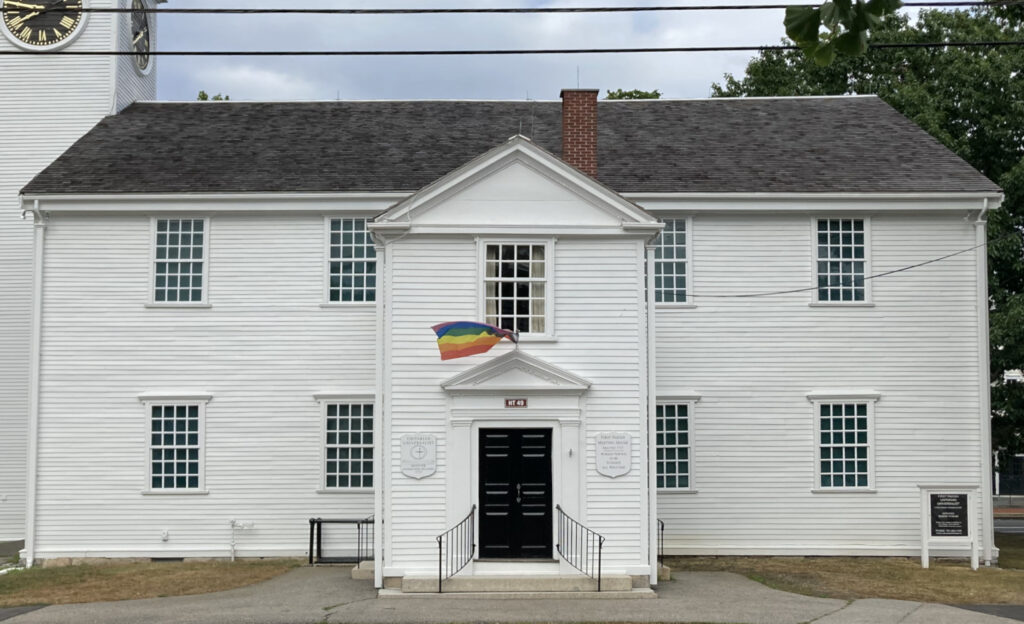
Early New England meetinghouses, used for both public worship and for town meetings, differ from later church buildings in a couple of ways.

First, meetinghouses lack the axial orientation of churches. A church is rectangular, and you enter through the main door in one of the short walls. The congregation is aligned along an axis facing the pulpit. Meetinghouses are either square, or the main entrance is on the short wall; typically there would be entrances on three walls. Instead of an axial orientation, a meetinghouse has (to my mind) more of a communal orientation. You can see the lack of an axial orientation in the photo below, which shows the interior of the meetinghouse of First Parish in Cohasset, my new congregation.

Interior of the meetinghouse, First Parish in Cohasset

Second, meetinghouses were typically not built with a bell tower. If a bell tower was added to a meetinghouse, it would often be placed to the left or right of the pulpit, not opposite the pulpit. A church, by contrast, typically has the bell tower over the main entrance, opposite the pulpit. The placement of the bell tower in a church has the effect of reinforcing the axial orientation. The meetinghouse of First Parish in Cohasset has the bell tower off to one side, which to my eye tends to diminish any sense of an axial orientation in the building.

Front of the building with the main entrance, First Parish in Cohasset

A final difference: meetinghouses typically have less ornamentation than a church. A meetinghouse tends to place the emphasis, not on the building, but on the people in the building.

I’ll be interested to see whether the form of the building makes any difference in the way people interact. Ask me about this in six months or so….

Heat and humidity

The National Weather Service calls this “oppressive” heat and humidity. When I got up at 6:00 a.m., the temperature inside the house was 81 degrees Fahrenheit, and it was maybe two degrees cooler outside.

I went for a walk while it was still relatively cool. A light breeze was coming in off the water, just strong enough to blow the deer flies away. Down on the town beach, you could see maybe a few hundred yards out into Buzzard’s Bay — it wasn’t exactly fog, the air was just murky with moisture. There was no horizon: the gray water shaded into the gray murk which got slightly brighter as it shaded into the gray sky.

Double Crested Cormorants rest on rocks in Buzzard’s Bay

I walked slowly, stopping to look at the periwinkles slowly making their way along the sand, and at green seaweed (Ulva intestinalis?) waving in the water. Though I walked slowly, within a quarter of an hour I was drenched in sweat.

This heat humidity has been going on for weeks now, with only an occasional break. This is not the summer weather we had in New England twenty years ago. It feels more like summers in Philadelphia when I lived there in the 1980s. Or maybe even summers in the Deep South.

Scientists tell us that you can’t tell if climate change is happening based on one weather pattern of a few weeks. So OK, I’m willing to trust the scientists on this one. Nevertheless, this doesn’t feel like the New England weather I remember from the past. Maybe I’m just another old guy waxing nostalgic for lost youth. (Or maybe I’m just an old guy who can’t take the heat any more.) Then I read about the extreme heat in Europe this summer, and what I’m experiencing fits into a larger pattern. Climate change is happening.

Lughnasa

The pagan holiday of Lughnasa traces its roots back to old festivals that celebrated the first fruits of the harvest. In northern Europe, early August was the time when agriculturalists would begin to know what kind of grain crop they’d harvest this year. And they’d begin to have fresh grains again, instead of having to rely on what was left from the previous year’s harvest.

When I’ve lived in New England, as I am once again, Lughnasa becomes a bitter-sweet celebration. More and more fresh vegetables make their appearance at farm stands and farmer’s markets. Raspberries are at their peak, and it won’t be long until we start getting the first summer apples.

Yet at the same time, this is the time of year when you first begin to sense that the days are growing shorter. Some birds begin to drop out of the morning chorus; when I went out for a walk early this morning, I didn’t hear any more Willow Flycatchers. In a drought year like this year, you even begin to see red leaves in early August; we took a long walk on Sunday and here and there were Poison Ivy vines with brilliant red leaves.

It’s both the peak of summer, and the beginning of the turn towards winter.