Hammer dyeing for nature journals

“Hammer dyeing” is a technique where you transfer the shape and color of leaves and flowers to cloth or paper by hammering. The process is fairly simple: you place plant material on cloth or heavy paper; cover with cloth, heavy paper, or plastic wrap; then hammer the plant material to release its juices which stain the cloth or paper. This article covers hammer dyeing projects that are intended for inclusion in nature journals.

The technique goes under several different names: “flower pounding,” “hammer printing,” “hammer staining,” “leaf hammering,” “tataki-zome,” “hapa-zome,” “Cherokee leaf pounding,” etc.; but I prefer to call it “hammer dyeing.”

Origins of hammer dyeing

I found no well-documented source giving the origins of hammer dyeing. I suspect the technique arose independently in several cultures.

Some online sources call this technique tataki-zome or hapa-zome, and claim it’s an “ancient Japanese art form,” but without citing any sources. A search on Google Books turns up many references to tataki-zome from 2000 on, but I could find only one reference prior to that date: Rita Buchanan, in Dyes from Nature (Brooklyn Botanical Garden Record, Plants and Gardens, vol. 46 no. 3, autumn 1990), p. 79, says that students learning how to dye in Japan practice tataki-zome: “Using their own plants, they learn dyeing techniques such as batik, itajime — a sort of variegated effect made with wood chips, and tataki-zome, a way of mashing plants on the cloth.” More research is needed to determine if tataki-zome is actually a traditional Japanese art form.

Alabama quilter Bettye Kimbrell (1936-2016), named a National Heritage Fellow by the National Endowment for the Arts, used a hammer dyeing technique she called “Cherokee leaf pounding.” It’s not clear this technique was actually used by the Cherokee people, so it’s best to consider this an American folk art with uncertain historical roots. Kimbrell used this technique in her quilts: “Cherokee leaf pounding is a technique where a fresh green leaf is taped to the backside of muslin fabric with masking tape. Using a hammer, gently pounding the leaf allows the chlorophyll to stain the fabric. After transferring each leaf to the fabric, the stain is set with a vinegar and water solution. The fabric is then dried and entirely hand quilted.” (Kristin G. Congdon and Kara Kelley Hallmark, American Folk Art: A Regional Reference, vol. 1 [Bloomsbury Publishing, 2012], p. 226.) More about her process here.

Screenshot from a video about hammer dyeing.
Screenshot from a PBS video on Bettye Kimbrell, showing her hammer dyeing a quilt. Click on the image to watch the video on the PBS website.

Books and references on hammer dyeing

For a comprehensive reference book on this technique, see Laura C. Martin, The Art and Craft of Pounding Flowers (Mt. Kisco, NY: QVC Publishing, 2001; Rodale Press, 2003). Martin covers which types of flowers, and which types of leaves, produce the best results; mordanting fabrics so the image is perhaps more light-fast; setting the image with a hot iron; etc. Unfortunately the book is now out of print. Used copies can be found on Thriftbooks (please do not buy from evil Amazon). The Internet Archive has a copy online that can be borrowed. The first 32 pages of the book are available on Google Books.

I’ve found references to two other books about the process: (1) Ann Frischkorn and Amy Sandrin, Flower Pounding: Quilt Projects for All Ages (Concord, Calif.: C & T Publishing, 2001); and (2) Linda Rudkin, Flower Pounding (London, U.K.: A & C Black Publishers, 2011). I haven’t seen either book, so can’t comment on them.

PBS has a video with Bettye Kimbrell demonstrating her leaf pounding technique. Sadly, the video does not show her technique for setting the image in vinegar (see below).

My curriculum website has instructions for doing flower pounding with children, using inexpensive watercolor paper. Scroll down to “V/Printmaking,” then go to project “D/Pounding flowers.” The technique I describe has been extensively field tested with children from grade 1-8, and produces reliable results. However, this technique is more focused on process than product (“process art”), and is not suitable for use in a nature journal curriculum.

Cloth with hammer-dyed impression of a fern on it.
Hammer-dyed fern on bleached cotton muslin, 36 inches wide. No mordant or scouring, but the image was set using a steam iron. The darker places are plant material deliberately left on the finished image. Image copyright (c) 2025 Dan Harper.

Hammer dyeing process

Earlier this month, during a week-long family conference at a Unitarian Universalist summer camp, I was leading an ecology workshop that centered around participants recording thoughts, feelings, and observations about the nature in journals (i.e., nature journaling). My co-leader, Rebecca, who is a middle school teacher, contributed to the development of this activity (thanks, Rebecca!). During this workshop, we field-tested a procedure for hammer dyeing. The process, outline below, is easy to set up, and is designed to help participants become more aware of the details of leaves and flowers.

Tools needed

  • Hammer, at least 1 for every 2 participants (see discussion of hammer types below)
  • Disposable foam ear plugs
  • Table with a hard flat surface

Materials

  • Thin cotton muslin cloth, 36 or 45 inches wide
  • Leaves, flowers

A rule of thumb for collecting leaves and flowers: Collect just 1 out of 20 similar leaves/flowers.

A note about fabric: I used to go to Joann Fabric to buy cloth for class projects, but they went out of business this year. Michael’s purchased Joann Fabric intellectual property, and one of the local Michael’s stores does carry 45″ cotton muslin in stock. My preferred online source for fabric is Dharma Trading Post, but as of this writing their popular 45 inch cotton muslin is out of stock.

Continue reading “Hammer dyeing for nature journals”
MFC/RECC action

The Ministerial Fellowship Committee (MFC) and the Religious Education Credentialing Committee (RECC) of the Unitarian Universalist Association (UUA) sent an email dated July 9. It reads:

He was most recently the combined minister and director of religious education at the UU congregation in Honolulu. As always, by posting this I’m making no judgement about the facts of this particular situation. I post these on my blog simply because not everyone gets these emails. In addition, the page on the UUA website where these decisions are listed now appears to be hidden from public view and available only by application to the UUA; presumably this is part of the UUA’s decision to hide names and identifying information from bad actors. While making it more difficult to see this page is probably the right thing to do (in our current tumultuous socio-political moment), it also makes it easier to overlook this important repository of MFC judgements.

There is one thing in this email that I’d like to know more about. The email references a “thorough, independent investigation.” It makes sense to have an independent investigation, but I’d like to know who made this investigation. Identifying the investigating body would increase transparency, and consequently increase trust in the overall process.

On another topic — I don’t remember getting an email from the Religious Education Credentialing Committee before. I didn’t know that they could terminate religious education credentials. It makes sense that they can do so; I just didn’t know about it.

Update 15 July 2025: Added a sentence that got left out by mistake in the editing process.

Adventures in cyanotype

(Written on July 3, finally getting around to posting on July 12.)

I’m running an ecology workshop at a small conference at Ferry Beach Park Association in Saco, Maine. One of the activities I did to get participants to see the world in new ways was making cyanotype prints of plants. I was inspired in part by Anna Atkins, who created the first-ever book of photographs with cyanotypes of seaweed.

Thea and Mandy were leading an art workshop at the same time, and they got interested in cyanotypes. So after our morning workshops were over, we did some experimenting. In the evenings, after it got dark, we coated several different kinds of paper with cyanotype emulsion. During the day, we experimented with different compositions using natural object to make photograms. We even took a field trip to the Portland Museum of Art, where there’s a special exhibit of Jo Sandman’s large photograms on platinum-palladium paper.

We didn’t wind up with much in the way of finished art works. But we learned a great deal. As Thea kept reminding us, often the process is more important than the product.

Secularism stalls? Not so fast…

In the June 14 issue, The Economist reports that the decline of organized religion has seen a mild reversal since COVID. In 2023-2024, according to this report, three different surveys show a decline of “Nones,” those who report no religious affiliation, by four percentage points.

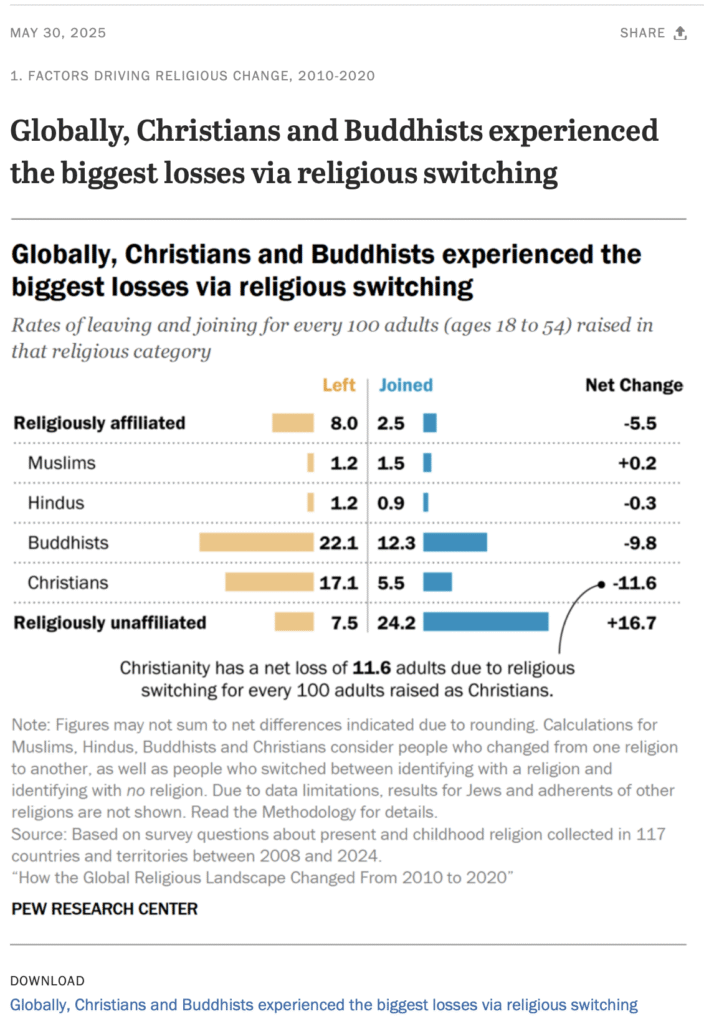
Unfortunately, The Economist neglects to tell us which three surveys report this decline (sadly typical of their reporting). A survey by Pew Research is probably one of them. On January 24, 2024, Pew Research published an online report titled “Religious ‘Nones’ in America,” in which they document a drop in the number of Nones from 2022 to 2023. However, in an analysis published the same day, Pew Research felt that it was “too early to tell” whether drop was significant. In another article published this year, on June 9, Pew Research detailed global religious decline from 2010 to 2020. One of the things they looked at was which religions suffered the greatest losses via “religious switching,” i.e., people switching to another religion or switching to no religion at all. Based on global surveys conducted from 2008 to 2014, Pew found that the biggest religious losers were Christianity (-11.6%) and Buddhism (-9.8%); the biggest gainer was no religious affiliation (+16.7%).

Screenshot of an infographic
Screenshot of web page with the infographic by Pew Research showing global percentage losses over five major religions, plus gains by the religiously unaffiliated. Click on the image above to go to the original.

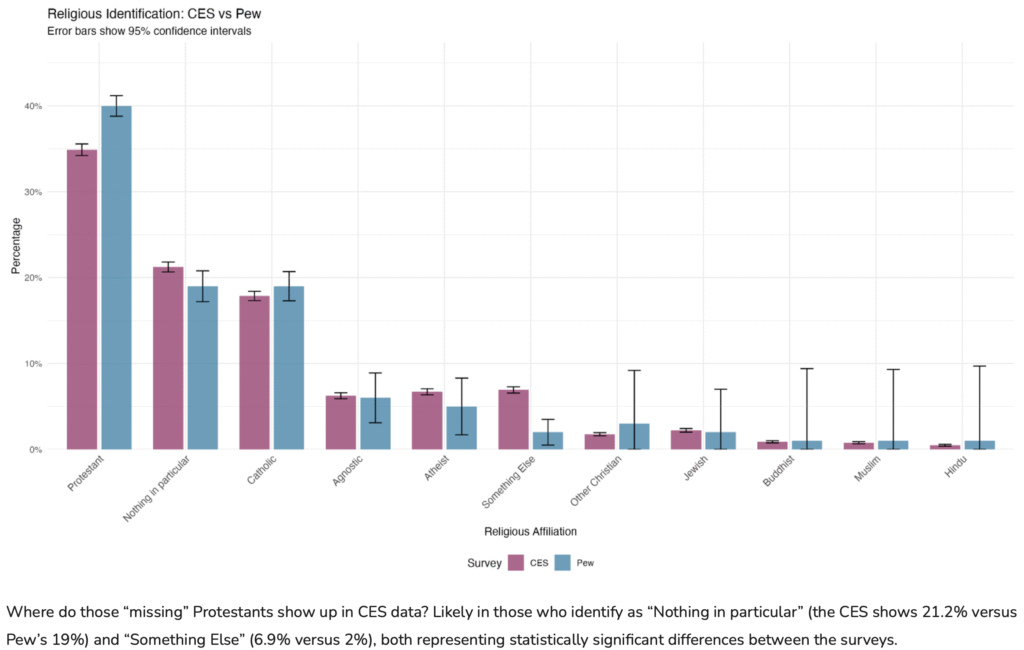
The Cooperative Election Survey (CES), housed at Harvard University, also asks questions about religion, and serves as another good source for data on religious affiliation. The CES tracks the Pew Research surveys within a few percentage points. But there are some curious differences. CES finds 5.1% fewer Protestants than Pew does. There’s also a significant gap in those reporting as “Something else” — which is probably what many Unitarian Universalists would report themselves as.

Screenshot of inforgraphic
Screenshot of web page with infographic showing differences between CES and Pew. Click on the image above to go to the original.

Also of note — in my view, both CES and Pew define “religion” in such a way that Christianity serves as the paradigm, which may not capture the religion of, say, Unitarian Universalists who strongly identify with their religion yet don’t believe in God, don’t pray, and don’t feel the need to attend regular worship services. If you don’t assume that religion centers around Christian-style belief in God and attendance at church, then social atomization and disaffiliation (as reported, e.g., by Robert Putnam in his book Bowling Alone) might be the stronger factors driving so-called secularization.

The Economist does report one possible explanation for the slight increase in religious affiliation from 2022 to 2023:

Time will tell if we’re actually seeing a slight decline in “Nones,” or if this is just a temporary blip. As a Unitarian Universalist, I’m also less worried about secularization — after all, by many definitions we’re already secular — and far more worried about social atomization and disaffiliation. We don’t have to convince people to believe in God. We only have to convince people that being part of a values-based community is a good thing.

Bhairava

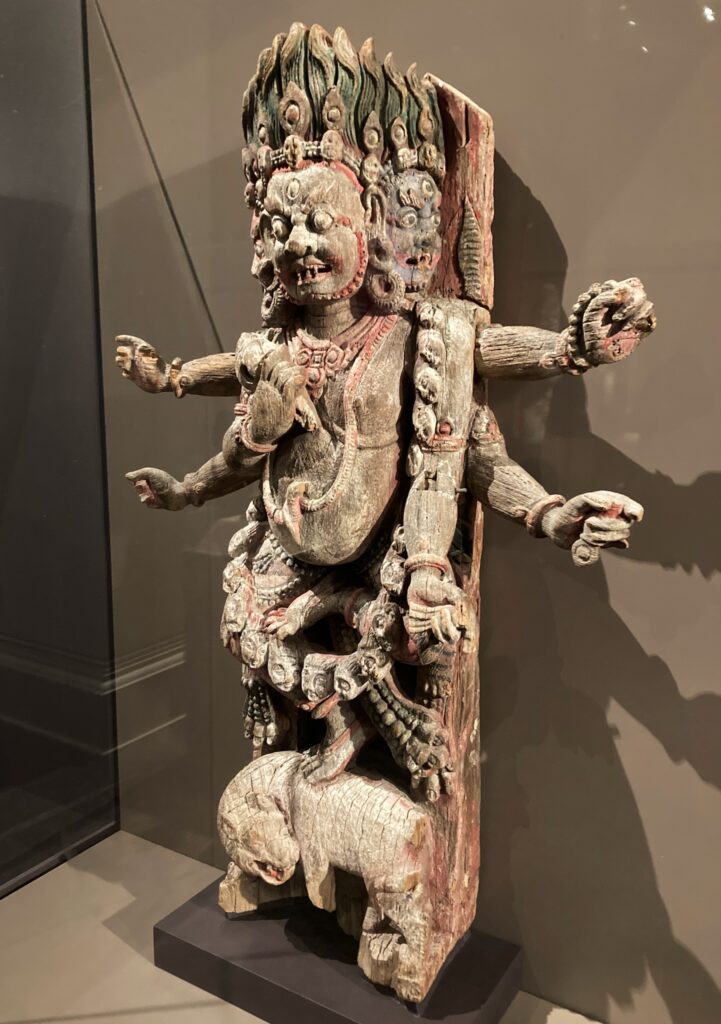
This representation of the deity Bhairava, now in the Walters Art Museum in Baltimore, was once part of a building in Nepal’s Kathmandu Valley. The deity was an integral part of a wooden support that supported an overhanging eave.

A deity carved in wood, with four arms and three heads.
The museum label reads: “Strut with Bhairava, Nepal (Kathmandu Valley), ca. 1700, Wood with traces of pigment…. Gift of John and Berthe Ford, 2021, acc. no. 25.271”

Bhairava is actually one of the forms that the Hindu deity Shiva takes on. H. Krishna Sastri, who was Asst. Archeological Superintendent for Epigraphy (Southern Circle) in the early twentieth century, describes Bhairava in his book South-Indian Images of Gods and Goddesses (Madras Government Press, 1916), p. 151:

I don’t know to what extent Bhairava takes on another form in Nepal, but the Bhairava in the Walters Art Museum does in fact have round eyes, protruding teeth, and wide nostrils. He wears a garland of either skulls or heads, and something that could be a snake is draped around his neck. At one time, his six hands held various items, but those are all lost now — perhaps they included a trident, a sword, and/or other destructive weapons. He is either naked or close to it, and he is riding on the back of an animal that could be a dog. In short, this Bhairava from the Kathmandu Valley seems to be very similar to the South-Indian Bhairava described by H. K. Sastri in 1916.

The Daya Foundation, a Nepalese nonprofit organization, published a blog post last August titled “Bhairav in Nepal.” In that post, they offered this interpretation of Bhairava’s origins:

In this blog post, the Daya Foundation describe some of the ongoing worship of Bhairava. Among other things, Bhairava is connected with the Nepalese monarchy, “as a guardian of both the spiritual and the civic welfare of Kathmandu.”

GA wrap-up: from Global UUism to administration

On Friday morning, I went to “Global Worship: Celebrating Our Diverse Faith,” led by (among others) Rev. Zsolt Elekes of the Transylvanian Unitarians; Juban Lamar, a member of the Jowai church of the Khasi Hills Unitarians; Vyda Ng, executive Director of the Canadian Unitarian Council; and Liz Slade, chief officer of the General Assembly of Unitarian and Free Christian Churches (United Kingdom). As I understand it, a couple of other primary worship leaders did not receive visas and were unable to attend General Assembly.

I found this worship service to be very moving. Zsolt Elekes talked about how the Transylvanian Unitarians went through some hard times, particularly under the repressive Ceausescu regime; yet they found strength through their international partnerships. All the speakers used the image of a bridge held up by many pillars — the bridge representing worldwide liberal religion, and the pillars representing the various Unitarian, Universalist, Unitarian Universalist, and Free Christian groups that are spread throughout the world.

What holds all these groups together? What, for example, do the distinctly theistic Khasi Hills Unitarians have in common with some of the fundamentalist humanist Unitarian Universalists in the United States? One of the speakers said, half-humorously, that we’re all heretics — but that remark was only half humorous, because in all seriousness our willingness to be heretics is a unifying factor. We also share the symbol of the flaming chalice, which is used by our co-religionists around the world. Zsolt Elekes also pointed out that the Flower Celebration, developed by Norbert and Maja Capek in the Prague Unitarian Church just over a hundred years ago, is something else we hold in common — a religious celebration that symbolizes how we perceive human unity in our diversity.

Continue reading “GA wrap-up: from Global UUism to administration”

Don’t forget Pee on Earth Day tomorrow

One of my favorite holidays of the year is Pee on Earth Day. This delightful holiday is celebrated on the longest day of the year — June 21 in the northern hemisphere, and December 21 in the southern hemisphere.

Why should you pee on earth? If you live in a part of the world where there are no diseases spread through urine (which means most of my readers), peeing on earth is a way to get rid of your urine in a sanitary and ecological manner. Your urine contains valuable nutrients that plants can use, and as long as you don’t eat too much salt, your urine (diluted, or in small amounts) is good for plants. Peeing on earth is a way to remind yourself that you are a part of the great cycle of nature. As Carol puts it, “Don’t throw it away, grow it away!”

Why on the longest day? Because it’s unlikely there will be snow on the ground, and it’s likely the weather will be more conducive to peeing outdoors.

We’ll be on the train from Baltimore back home to Cohasset for much of Pee on Earth Day. I’ll wait to pee on earth until we get home.

Pee-on-earth bumper sticker. Image (c) Carol Steinfeld, used by permission.

Why Are You You?

I’ve got convention brain. What did I do after yesterday’s business meeting? What programming did I attend? With whom did I talk? It’s a bit of a blur.

But I do know that last night I went to a screening of the documentary “Why Are You You?” a new documentary about the now-defunct youth program Young Religious Unitarian Universalists, or YRUU. I was fairly heavily involved in YRUU as an adult advisor from 1995 through about 2003, serving as an advisor in local youth groups, as well as at district and continental “cons” or conventions. As a result, I got to meet youth leaders and youth advisors across the continent, from Alaska to Maine.

The filmmakers interviewed a number of former YRUU youth leaders, and I recognized several of them. I enjoyed hearing their memories of YRUU conferences and programs; I especially enjoyed hearing about how YRUU changed their lives. Given all those hours I spent supporting youth leaders and UU youth institutions, it’s nice to know that those hours weren’t wasted. But the ending of the movie is a little depressing. The Unitarian Universalist Association (UUA) ended funding for YRUU in (I think) 2007. There was no replacement for YRUU — YRUU was a semi-independent organization with youth leadership, not just another department of the UUA.

Not that YRUU was perfect. The documentary touches on some of its problems. What’s missing are the voices of all those teens for whom district and national YRUU programs held no interest, or those for whom YRUU did not feel safe — I knew quite a few of those teens, some of whom were devoted members of a local youth group. What’s also missing is mention of the adult advisors with poor boundaries — I saw a few too many of those; part of the reason I pulled away from district and national youth events was that I felt YRUU didn’t train adults adequately, nor hold them fully accountable.

Yet these were all solvable problems. The solution was not to get rid of the national youth organization; the solution was to reform that organization. For the past twenty years, I’ve had the sense that Unitarian Universalism broadly construed, especially at the national level, just really doesn’t like children and teens. Children and teens are messy, they take up a lot of time and energy, and if you don’t like them that much, it’s easier to shut them out rather than support them and their families. I feel that the death of YRUU is part of this larger trend.


P.S.: If the issues raised by this film are of interest, you might also be interested in childist theology, a new approach to Biblical interpretation that places children at the center of Biblical interpretation. So… What would it mean to place children and teens at the center of a Unitarian Universalist theology?

South Arabian goddess

The Walters Museum in Baltimore has a small selection of South Arabian art. I’m completely unfamiliar with South Arabian art, and before I went to the Walters Museum yesterday I knew nothing about its long history. According to the Smithsonian National Museum of Asian Art:

“For over a thousand years, from around 800 B.C.E. to 600 C.E., the kingdoms of Qataban, Saba (biblical Sheba), and Himyar grew fabulously wealthy from their control over the caravan routes of the southern Arabian peninsula and, in particular, from the international trade in frankincense and myrrh. Excavations at the capitals of these ancient kingdoms have yielded spectacular examples of architecture, distinctive stone funerary sculpture, elaborate inscriptions on stone, bronze, and wood, and sophisticated metalwork.”

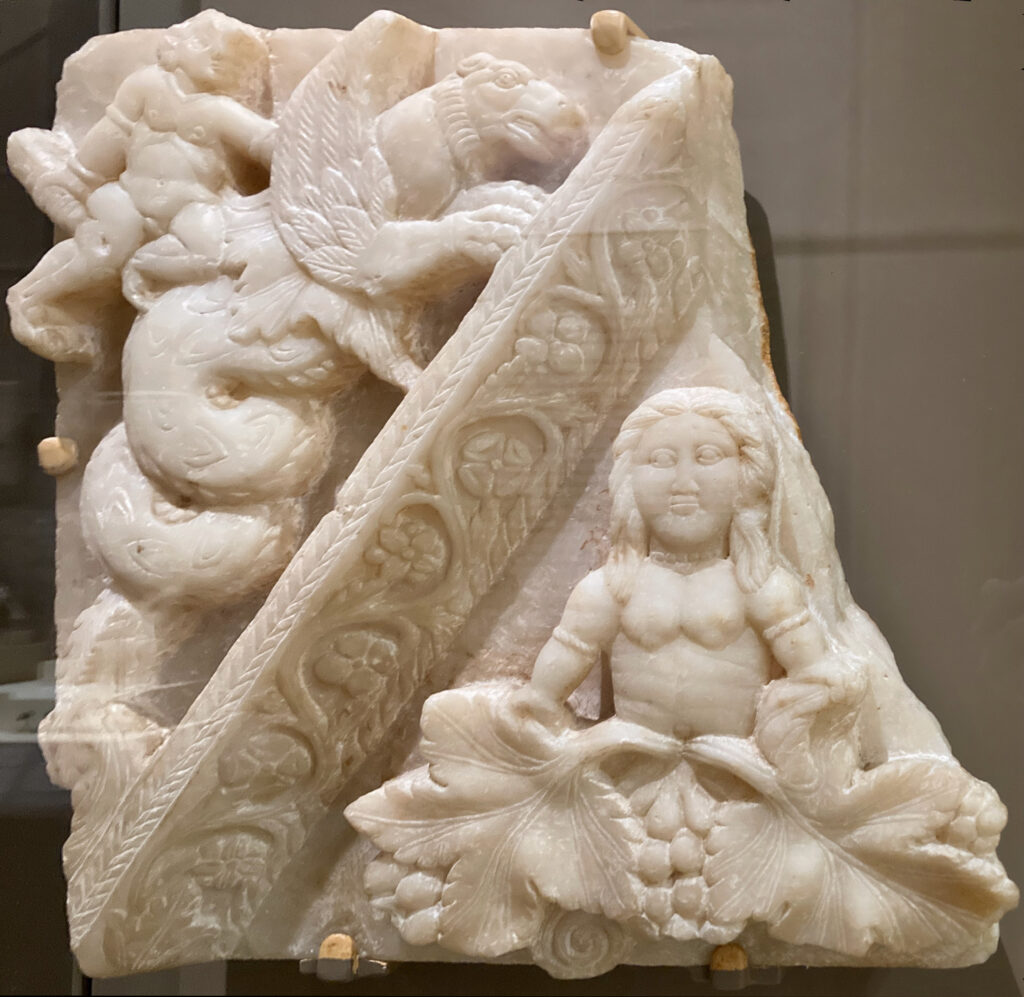
One of my favorite pieces of South Arabian art on the view at the Walters Museum is an unnamed goddess, who appears in a fragment of a pediment. She sits next to a child deity. Due to the lighting, I found it difficult to take a photograph due to the reflections on the glass case which houses this goddess; I had to do a fair amount of digital manipulation to make her look more or less the way she looks in the museum.

Sculpture carved in stone.

Here’s what the museum label says about this sculpture:

I wonder if she was really a fertility goddess, or a goddess of wine. I don’t think we’ll ever know.