Can’t watch

Now that the Red Sox are in the World Series, I can’t follow them.

No, no, you don’t understand. I first began following the Sox in 1967, during the Year of the Impossible Dream. They lost the Series. I followed them through the 1975 Series. They lost. In 1986, I watched the Series with my then-housemates. The Sox lost again. I followed them through the 2003 AL playoffs. They lost.

In 2004, when they made it into the Series again, I didn’t watch any of the World Series games on TV, nor did I read any coverage in the sports pages. They won. I followed them in 2005. They lost in the first round of the playoffs. I didn’t follow them in 2007, and they won the Series.

I’ve learned my lesson. If I want the Sox to win, I can’t follow them. So don’t talk to me about the Series, OK? I don’t want to know.

Autumnal battle

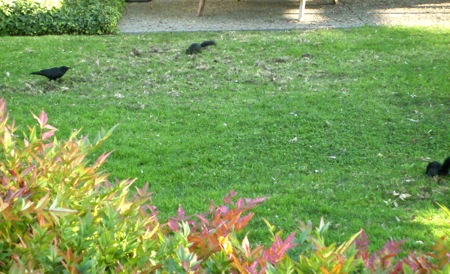
The window of my office looks out on a patch of lawn about thirty by fifty feet. In the middle of the lawn there’s a live oak tree. This oak tree appears to have produced a bumper crop of acorns this year. This afternoon, I counted at least six Eastern Gray Squirrels (Sciurus carolinensis) on the grass, the surrounding sidewalks, or in the tree; three of them were the black color morph of S. carolinensis.

The squirrels have been digging furiously in the lawn, and in a few places have completely dug up all the grass, leaving a network of small holes about two inches across and one inch deep. Every so often, one squirrel will get too close to another one, which can lead to vocal squabbling and one squirrel chasing another. I also saw at least three American Crows (Corvus brachyrhynchos), who would land on the grass periodically and peck at the ground where the squirrels had been digging. Sometimes a squirrel would run at a crow; and the crow, even though it was somewhat larger than the squirrel, would flap its wings a couple of times and fly out of the way.

Amy and I were watching the squirrels a couple of days ago. “If they would only get organized,” said Amy, “they could run all us humans out of here and take over.” Of course she was exaggerating, but they are aggressive. They have come right into my office while I’ve been sitting at my desk with the door open, looking for food. It’s worth noting that since Eastern Gray Squirrels have been introduced to the Bay area, the native Western Gray Squirrel (Sciurus griseus) has essentially be extirpated from the region.

I went over to look at the damage the squirrels had done to the lawn. There is nothing in the holes they have dug. The ground is littered with the outer husks of acorns; some of the husks look green and new, some look brown and old. There are plenty of new acorns on the ground. I’m not sure why they are digging so furiously this year; this is not something they have done in past years. Maybe there’s a good reason behind it, or maybe they’re just — well, maybe they’re nuts.

BlogOct1713

Each in his own tongue

William Herbert Carruth was a poet, a professor of literature and writing at Stanford where he taught John Steinbeck (more about Steinbeck in a moment), and a member of the old Palo Alto Unitarian Church. One of his signature poems strikes me as quite characteristic of early twentieth century west coast Unitarianism:

Each in His Own Tongue

A fire-mist and a planet,
   A crystal and a cell,
A jelly-fish and a saurian,
   And caves where the cave-men dwell;
Then a sense of law and beauty
   And a face turned from the clod,—
Some call it Evolution,
   And others call it God. Continue reading “Each in his own tongue”

Persimmon

The first time I visited California was in October, 1987. Everything about California was mind-blowing to a young guy like me who had, although I had been to Europe, had never been further west than Washington, D.C. It was my first experience of the Pacific Rim: the landscape of the Rim of Fire, the cultural encounter between east Asia and North America, the climate; even the sight of the sun setting in the Pacific Ocean was mind-blowing, for though I could have seen that sight from western Europe, watching the sun set into the endless Pacific was a very different experience than watching the sun set into the gray North Atlantic.

I stayed for a few days with my cousin Nancy in Oakland. She was the ideal host. She drove me up to Grizzly Peaks where I looked down with amazement on the city of Berkeley a thousand feet below me, and the bridges in San Francisco Bay beyond the city; I could not have imagined then that sixteen years later, that road would be part of my daily commute to work. She took me out to Cliff House to watch the sun set in the Pacific; she took me into Chinatown and Japantown; and she introduced me to locally-grown persimmons (Diospyros kaki).

Nancy had a few persimmons ripening in her kitchen. She found one that was ripe, cut it open, and showed me how you use a spoon to eat it. The combination of the jelly-like texture, the flavor, and the bright orange color were unlike any food I had ever eaten before. After I got back to Massachusetts, I found persimmons in the supermarket, but they never tasted as good as the ones I had eaten in California; they just weren’t worth buying.

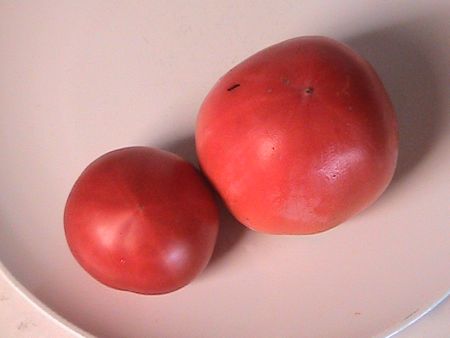
Now here I am, living in California, and when I saw a sign in the local supermarket for “Locally Grown Persimmons” of course I bought some. I put them on the kitchen counter next to some late tomatoes that I had just picked in our garden. Nancy tells me that the Chinese word for tomato is xihongshi, meaning “western red persimmon,” and the two fruits do look remarkably alike from a certain angle (the tomato is the smaller one on the left):

BlogOct1013b

The problem with eating persimmons is that if you eat them before they are fully ripe, the high level of tannins will make your mouth feel furry on the inside. You can also get so-called fuyu persimmons, funny stubby little things that contain less tannin in them so you can eat them when they’re not quite ripe. If you’re impatient, as Carol is, perhaps it’s best to eat fuyu persimmons. I’m impatient, and I rarely wait quite long enough before I eat a persimmon; but I’ve come to appreciate the light astringency of a not-entirely ripe persimmon, and to enjoy the faint furry feeling that lingers in your mouth after you’ve eaten one.

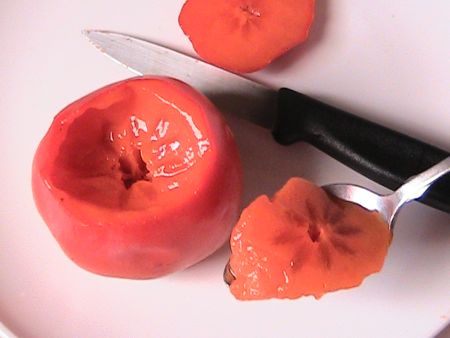
The three persimmons I bought have been sitting on the kitchen counter for two whole days now, tempting me. I kept feeling them gently: were they soft all the way down to the stem? Did they feel as though they would collapse in my hand if I picked them up? Finally I decided that one of them was ripe enough to eat. I cut off the end, and scooped out some of the fruit:

BlogOct1013a

Oh, it was good! — I couldn’t believe that I had actually waited long enough for my first persimmon of the season to ripen fully! I ate the whole thing in about five seconds. And then, sure enough, I started to feel that faint furry sensation on the inside of my mouth. It was a very faint sensation, and not unpleasant, but it was enough to remind me that once again I had been too impatient.

Bitter melon

One sunday morning, Dora came up to me with something in her hand. “You said you like bitter food, right?” she said.

“I love bitter things,” I said.

“Then you should try this,” she said, holding out a small, wrinkled green vegetable. “It’s called bitter melon.”

She told me how to prepare it: slice it open, scoop the seeds and pulp out, slice it up and stir-fry it, maybe mixing it with some other vegetables and perhaps some kind of meat, like sausages. Dora comes from a Chinese family, but bitter melon is not just Chinese; when Hong, who is Vietnamese, saw the bitter melon, her eyes lit up, and it turns out she loves it, too — sauteed with garlic, in her case. Both of them agreed that not everyone likes bitter melon.

You’d think a New England Yankee like me, raised on mild and restrained flavors, would not care for bitter melon. But I love it. It’s not an extreme taste; I think of it as being mildly bitter, maybe about as bitter as strong turnips. I haven’t been able to find it in any supermarkets, but fortunately there is one farmer at the San Mateo farmer’s market who carries both the white and green varieties.

Bitter melon

Towed away

Yesterday Ned and Judy, who belong to a congregation I used to serve, were in town visiting relatives. I was supposed to meet them for lunch at the church down in Palo Alto. Bay Area traffic being what it is, I allowed an extra ten minutes beyond the usual twenty-five minutes driving time. But when I walked down from our apartment, I saw that someone had parked their car at the end of our driveway. I couldn’t get out.

I called the police. They wanted to know what kind of car it was, and I told them it was an older model Toyota Camry, dark green, and gave them the license plate number. I didn’t bother telling them about the statue of the Virgin Mary on the dashboard. They said they’d send someone right out.

I called the church, and Debra said she’d leave a note on my office door saying that I would be down as soon as I could get there. Then I stood there waiting, and hoping that whoever owned the car would come along right then, and I’d tell them that they really shouldn’t park in someone’s driveway, and they’d look embarrassed and drive away — that would be the fastest solution to my problem.

After about fifteen minutes, one of the city’s little three-wheeled traffic enforcement vehicles rolled around the corner. The traffic officer, a pleasant, soft-spoken young man, shook his head when he saw where the car had parked. He radioed for a tow truck. Continue reading “Towed away”

Labor Day picnic

Carol and I went to a Labor Day picnic in Alameda today. But this wasn’t your typical backyard barbeque. I’ve started singing with the Bay Area Labor Heritage Rockin’ Solidarity Chorus again, and the Chorus got invited to sing at a Labor Day celebration sponsored by the Alameda County Coalition of Unions.

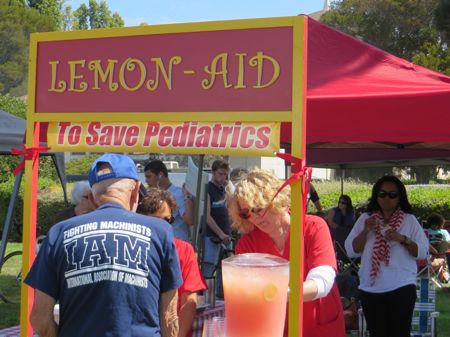
Carol and I got to Alameda Point Park a little early, so we had time to wander around. Several of the unions had booths set up, and Carol got to talking with a nurse who was at the booth that said: “Lemon-Aid To Save Pediatrics.” The nurses union is trying to convince Kaiser Permanente not to shut down a pediatrics inpatient unit. The nurse told us that Kaiser is building a new hospital — a good thing, since the old Hayward hospital does not meet current state requirements for earthquakes — but the new facility will not include a pediatrics inpatient unit. We talked about the craziness of the health care industry these days, and we all agreed that Kaiser is one of the best health care providers out there — yet the health care market can cause event hem to make bad decisions.

BlogSep0213

The nurse had to go serve lemonade to someone else, so we walked around some more. I saw all kinds of people from all kinds of unions: teachers, nurses, cops, firefighters, electrical workers — I saw a sign for IFPTE Local 20 Engineers and Scientists of California, lots of t-shirts that said AFL-CIO, someone was wearing a button that said International Association of Machinists and Aerospace Workers. This being the Bay Area, no one racial or ethnic group predominated. I saw parents with babies and little children; Carol pointed out one big man with a little boy on his lap; the man had a colorful Rosie the Riveter tattoo on his right bicep. Bigger kids without any parents nearby were running around playing together. Some firefighters from Alameda drove a big ladder truck around the periphery of the picnic area, and waved out the windows at the kids.

At some point, it hit me that we were all representatives of the eroding middle class. The people around me were people who managed to make it through the Great Recession still holding on to their decent middle class jobs with benefits. I’m one of those people. Even though Unitarian Universalist ministers aren’t unionized — all we have is a professional organization that is pretty toothless — ministers fit right in with cops and nurses and teachers and electricians. All of us in the middle class are facing the same problems: we feel lucky to have jobs, we’ve lost ground in terms of real wages over the past couple of decades, there are fewer full-time job openings than there were ten years ago. But we’re holding on. The middle class keeps shrinking, but we’re still in it. For the moment.

The director of the Labor Chorus showed up, and she found us a place at the opposite end of the picnic area from the rock band that was playing. We warmed up for a few minutes, then the rock band quit and it was time for us to get up on stage. Carol said that when we went on stage, it took awhile for people to realize that we weren’t going to be singing rock ‘n’ roll. It took a few minutes, she said, but then you could see people realizing that we were singing labor songs. Up on stage, I noticed that when we sang phrases like “We’re talking about dignity,” or “All we need is unions,” or “Don’t you cross that picket line,” I could hear some cheering. When we got to the final three songs, “Roll the Union On,” “We Shall Not Be Moved,” and “Solidarity Forever,” Carol said people started singing along — as you can see in this thirty second video clip of the final chorus of “Solidarity Forever”:

After our half hour set was over, we in the chorus all hung around for a while at the picnic, and ate hot dogs and veggies burgers cooked by guys wearing AFL-CIO t-shirts. It was a good way to celebrate Labor Day.

Oil change

The young guy at the oil change shop said with surprise, “How’d you go four thousand miles in less than a month?”

“We drove across the country,” I said.

He looked interested. “How long did it take?”

“Seven days to get across,” I said. “You should do it. It’s an amazing drive.”

He asked me whether I wanted synthetic or conventional oil, and then asked me a few more questions. He wanted to know if we had to bring our passports, and I said no, all you need is your driver’s license. He was fascinated, but seemed a little overwhelmed at the idea of driving all the way across the country. I told him, “You’d love it. Do it before you get old.” He laughed.

Then he and the rest of the crew got to work. Ten minutes later, he came over and handed me the keys. “Remember,” I said, “seven days across and seven days back. That’s your two week vacation. You gotta do it some day.”

He smiled as he turned away. Maybe I’d gotten him thinking about it.

From Elko, Nevada, back home

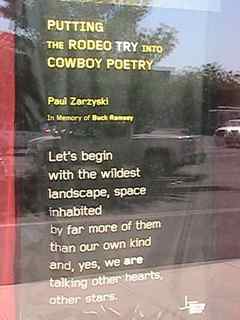
The air in Elko this morning was clean and dry and cool, and it made me feel like a million dollars. We walked a couple of blocks to McAddoo’s in downtown Elko for breakfast, and then headed over to the Western Folklife Center, the home of the Cowboy Poetry Gathering in late January, and currently housing an exhibit on Basque sheepherders that we thought sounded like it was worth seeing. But the Center is closed on Sundays, so we read the cowboy poem that was displayed on six banners hung in six large windows near the entrance. The section of the poem on the first banner read:
BlogJul2113a
PUTTING THE RODEO TRY INTO COWBOY POETRY
Paul Zarzyski

Let’s begin
with the wildest
landscape, space
inhabited
by far more of them
than of our own kind
and, yes, we are
talking other hearts,
other stars…


It was a pretty good poem, and I took photos of each window so I could remember it.

We drove across north Nevada, a land of forbidding desert and mountains interspersed with small green valleys that look so inviting that you want to settle down and live there. We could have lived in Elko, if there were jobs for us; my cousin Susan and her husband ran a computer business in Winnemucca for many years, and I can understand why they wanted to live in a small city in northern Nevada: open and friendly people, bracing desert air, incredible natural beauty that overwhelms even the tawdriest casino. We stopped in Battle Mountain for lunch. It is not as attractive a city as Elko, but it was still a pleasant place to spend an hour or two.

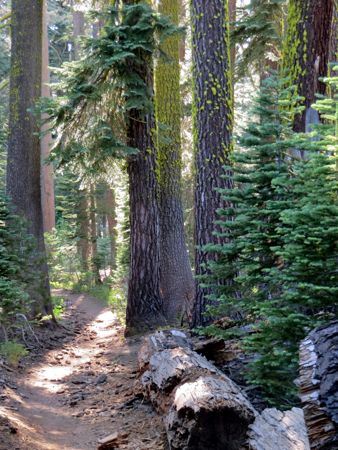
As we made our way down into Reno, the traffic got heavier, and the fact that I would have to return to ordinary life tomorrow at last began to emerge in my consciousness. Then we climbed up out into the Sierra Nevadas, and stopped at the Donner Summit rest area. We needed to stretch our legs, so we walked along some of the trails that connect to the rest area.
BlogJul2113g

One of the trails that connects to the rest area is the Pacific Crest Trail. We met three or four people through-hiking the trail from Mexico to Canada; Carol offered to take photos of Sheepdog, and later of Trivia — these are their trail names, for through-hikers on long distance trails in the United States tend to use trail names rather than their regular names — and then email the photos to them. We chatted a bit with both these hikers, and Sheepdog said that there had been very little water for the last fifteen miles of the trail, and that it had been a very hot day, and that she would have loved a cold can of soda. Unfortunately, we had none to offer her.

We ate dinner at the rest area, enjoying the delightful air that you get in an alpine environment at an altitude of about six thousand feet above sea level. At last it was time to begin the drive back down out of the mountains, down to sea level and the Bay Area. Down, down, down we drove, and when we got to Loomis (population 6,430, elevation 399), I realized that this was probably the lowest altitude we had been at since we left Massachusetts. Down we drove, dodging the crazed drivers going at maniacal speeds — I imagined they were stressed-out people trying to get home after a relaxing weekend in the mountains — and I thought about when we drove under the Appalachian Trail where it crossed Interstate 90 in the Berkshires just a few days ago, and I thought about my friends who hiked the Appalachian Trail, and I wondered where Sheepdog and Trivia would spend the night tonight; and now I sit here at home wondering why we take long trips, pilgrimages, that have no real destination, trips that are taken only for the sake of leaving home and then returning once again.