The Saturday Bag

Mom got tired of her two children leaving their toys and belongings all over the house, and so she came up with the idea of the Saturday Bag. Mom explained how the Saturday Bag was going to work: If Jean or I left something around the house, she would pick it up and put it in a brown paper bag high up on the top shelf of the closet in the kitchen, where we could not reach it. On Saturday morning, she would bring down the Saturday Bag from its high shelf, open it up, and Jean and I could get back anything of ours that was in it.

Jean and I asked questions about how this was going to work. Would we really have to wait until Saturday morning to retrieve our belongings? Yes, said Mom calmly, we would. But what if we forgot, and left something in the kitchen? Mom said, then it will go into the Saturday Bag. And we won’t be able to get it until the next Saturday? That’s right, said Mom. What if we leave something out that’s too big to go inside the Saturday Bag? Then, said Mom, it will just go up on the top shelf next to the Saturday Bag.

This Saturday Bag idea worried me. I pretty much knew that sometime during the week I would forget and leave a favorite toy where it didn’t belong, and Mom would put it in the Saturday Bag. And of course I did leave things out, and they promptly went into the Saturday Bag. I have a vague memory of saying, Mom, I can’t find something-or-other — and Mom telling me that it was in the Saturday Bag. I have a distinct memory of looking up at the high closet shelf where the Saturday Bag was, knowing that some of my things were up there, in the Saturday Bag, where I couldn’t get them back until Saturday.

I was only about five years old, and so it seemed like it took forever for Saturday to arrive. It was a bright sunny morning. After breakfast, Mom reached up and took down the Saturday Bag. At last I had my toys back! But I knew, I just knew that it would all happen again in the coming week: once again I would forget and leave something out, and Mom would pick it up, and put it in the Saturday Bag.

I don’t think Mom kept the Saturday Bag idea going on for very long. Or maybe it went on for years, but I don’t remember it after the first few months because I got good at putting my toys and belongings away. Kindergarteners can be trained to put things away, and my mother had been a kindergarten teacher for a decade before she got married; if anyone could train a five year old boy and a seven year old girl, it was my mother.
What I did on my vacation, pt. 2

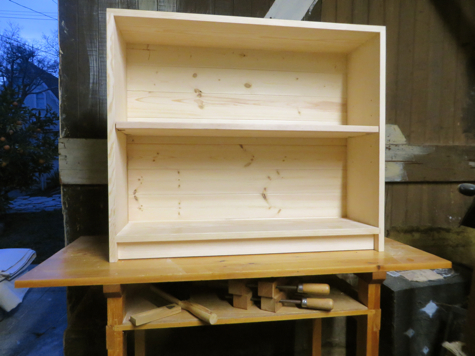
Ms. M and Mr. O, old friends of ours, are adopting two girls. I’m supposed to make two shelf units for them by this weekend. So far, one is completed and ready for finishing. Here’s the completed unit (the fish-eye lens makes it look out of square, but it’s not):

DIY shelves

I’m supposed to have both shelf units completed by this weekend. I don’t think I’m going to make the deadline. The sad truth is that it’s been something like eighteen or nineteen years since I worked for the cabinetmaker, and I’ve gotten out of shape — I can’t put in an eight hour day in the shop any more.

(The details: 28 x 33 inches, 9-1/4 inches deep. Adjustable middle shelf. Solid pine construction throughout.)

California drought

Good photos of the ongoing Clifornia drought, and summary of long-range forecast possibilities, in a January 25 post at the California Weather Blog.

Here in San Mateo County, our drought level is classified as “extreme,” second highest of the five possible drought levels. The hills of the Coastal Range should be bright green right now, but instead they are dull gray-brown; needless to say, the fire danger is high. We haven’t had any significant rain in over a month, so the air is filled with fine particulate matter. And with a declared state-wide drought emergency, we’re all expecting mandatory water restrictions in the next few months.

On the plus side, we’ve had abnormally sunny and warm weather, with temperatures often in the seventies. while we need bad weather, at least we can enjoy the good weather while we’ve got it.

The green flash

We all knew my mother’s illness had gotten to the point where she had only a couple more years to live. So I decided to go on a ten day hiking trip.

I really wanted to take an entire month and hike the Long Trail in Vermont. I had left one job in June and was about to start another job in August, which meant I had a month to spare. But what if my mother should get suddenly worse while I was on the trail? This was before cell phones, and you couldn’t count on a pager receiving a message in the Green Mountains of Vermont. Finally Carol told me what I already knew: I could not take a whole month to go hiking. I settled on ten days hiking the Long Trail in the Green Mountains of Vermont.

Carol drove me up U.S. 4 to where it intersected the Long Trail, and I started hiking south. It had taken a good three hours for Carol to drive me from our group house to the trailhead, so I only got a half day’s hiking in. I stopped about an hour before sunset to spend the night at Pico Camp, a bunkhouse near Pico Peak. One more hiker showed up to spend the night, a fellow a few years younger than I; he was headed north, through-hiking the Appalachian Trail.

The other hiker suggested we climb up the lookout tower on Pico Peak to watch the sunset. We hiked the steep little half mile trail to the summit of the mountain, and climbed up the old fire tower.

Aviators talk about unlimited visibility. That’s what we had. We could see the Taconic Range in New York straight ahead, the White Mountains in New Hampshire fading into dusk behind us, and the broad ridge of the Green Mountains heading south towards Massachusetts on one side of us, and north towards Quebec on the other side. We didn’t say much, but just looked and looked, amazed at the view.

The sun began to set behind the distant mountains of New York. We watched it touch the horizon and slowly disappear. Just as it disappeared, there was a flash of green light.

“Did you see that?” we said to each other. We had just seen the legendary green flash. It’s a rare sight at sea, and rarer still on land. Just by chance, the two of us had happened to wind up at Pico Camp on a day with unlimited visibility; we just happened to have time to climb the old fire tower right at sunset. We looked at each other, and back at the waning light from the sun.

“I’ve been hiking since February, and this is the best view I’ve gotten, and you get it on your first night out,” said the other fellow, without rancor.

We stayed up in the fire tower another fifteen minutes. But it was getting cold and dark and late, and we both had a long day of hiking ahead of us the next day. We climbed down the rickety steps of the tower, hiked down the spur trail to Pico Camp, and went to bed. The other hiker headed north to Mt. Katahdin in Maine, and I headed south to Mt. Greylock in Massachusetts. Of course I never saw that other hiker again; I’m told that the rickety old fire tower is gone from Pico Peak; and I’ve never seen the green flash again.

Sunny and seventy

I’m getting ready for the Christmas Eve candlelight services at the Unitarian Universalist Church of Palo Alto. It’s over seventy degrees and sunny, and while the sun was hitting my office window it got warm enough that I had to have the door open to cool off. At this point, some of you who live in places where it is now cold and dark and maybe snowy might be saying to yourselves, “Warm and sunny? That doesn’t feel like Christmas Eve!”

Ten years ago, I spent a year working part-time as the religious educator for Church of the Larger Fellowship, an online congregation that serves religious liberals around the world, including in the tropics and in the Southern Hemisphere. On my first week on the job, the senior minister and the administrator both warned me to remember that given our congregation it was a mistake to draw parallels between Easter and springtime, and between Christmas and the winter solstice. If I did so, I was further warned, I would be sure to get complaints from our members in places like Australia and New Zealand and equatorial Africa. That’s how I learned to be able to separate Christmas from the seasons.

Now that I’m in the Bay Area, however, I’m living in a so-called Mediterranean climate, a climate that is similar to the climate of Bethlehem and Nazareth (though we are farther north so we have much longer nights at this time of year). Our seasons correspond reasonably well with the seasons of ancient Judea. We’ve had a very dry year, so this year at Christmas because it’s sunny and warm we’re praying for the winter rains to hit — like the people of the Ancient Near East, we’re less concerned with snow and crackling fires and short nights, and we’re far more concerned with where our water is going to come from.

So this year here’s what I’m humming to myself:

   I’m dreaming of a wet Christmas,
   Just like the ones in El Nino years,
   When the treetops glisten
   And children listen
   To hear raindrops falling near….

Caroling

Michele, my voice teacher and friend, sent out an invitation to some caroling in her neighborhood. Even though she lives way over in north Berkeley, I decided to go — I didn’t know anyone who was going to go caroling near where we live, and I wasn’t up to organizing caroling on my own.

Close to twenty people gathered in Michele’s living room yesterday evening. We introduced ourselves, and ran through two carols where we thought we might sing some harmony — “Silent Night” and “Deck the Hall.” Fortunately there was another bass there who helped me through “Deck the Hall,” and I was able to help him once or twice in “Silent Night” — it’s always easier to sing your part when there’s someone else singing with you.

We headed out into Michele’s neighborhood. Michele said we would only sing at houses where we could see Christmas decorations. There were half a dozen children with us, and they ran ahead to scope out likely houses. We’d gather on the sidewalk in front of the house, Michele would quietly tell us which carol — “‘Frosty the Snowman,’ page 3 of the packet!” — the kids would ring the doorbell, and as soon as someone showed up, we’d sing.

Some people listened to us while standing indoors; in one case because there were dogs that desperately wanted to get out; in other cases maybe because it’s a little weird to have a score of people standing in front of your house singing. Other people came out and listened. Reactions ranged from politely tolerant to very enthusiastic. One woman, who had a foreign accent (maybe Middle Eastern?), was really very touched by the singing; we sang her another song.

After an hour, we were getting cold, and some of the younger kids were getting a little bit tired. So we all said “Good night!” and “Merry Christmas!” and dispersed into the night; the younger kids probably heading for bed. As for me, I had some errands to run in downtown Berkeley; but I found myself humming Christmas carols all the way home.

Pushkes and the UUSC

Amy, the senior minister at our church, had to tell me what a pushke is. “Pushke” is a Yiddish word for a little box that you keep in your house into which you can place money that is to be donated to charity. I didn’t grow up Jewish, and we just called them money boxes; but I think pushke is a much better word.

Up until this year, the Unitarian Universalist Service Committee used to send out little boxes to support their Guest at Your Table program. Every year on the Sunday before Thanksgiving, families would come to Sunday services, pick up their Guest at Your Table box — their Guest at Your Table pushke, if you will — and bring it home to put on their kitchen table. Then during the weeks between Thanksgiving and Christmas or New Year’s Day, kids were supposed to put a little money in the box each day. Towards the end of December, families would count up the money they had deposited in the box and the grown-ups would add something to round it up to the nearest ten or twenty dollar mark. On the Sunday before Christmas, all the families would bring their pushkes full of money to be collected at the service, and the congregation would send it all to the UUSC.

This year, the UUSC decided it wasn’t going to send out Guest at Your Table boxes any more. I can understand why they made this decision. Each of those boxes must cost the UUSC a dollar or so; better to spend money on helping people, rather than on Guest at Your Table boxes.

However, I found an interesting informational paper written by Jennifer Noparstak, a graduate student of social work at the University of Michigan. She writes that in the Jewish tradition, pushkes help teach young people about giving and philanthropy. Pushkes teach the importance of anonymous donations: “Anonymous donation maintains a dignified relationship between those who are giving and those who are receiving aid.” Pushkes teach the importance of community in giving: “[The pushke] is also important because it signifies a community effort to aid people who need it and may not be able to ask for it directly. The pushke serves as a means for each member of a household to contribute, both children and adults alike, fostering the importance of giving among all age groups.” And, perhaps most importantly, pushkes cultivate the habit of charitable giving: ” It is considered more credible to develop a habit of giving regularly rather than giving large sums infrequently.”

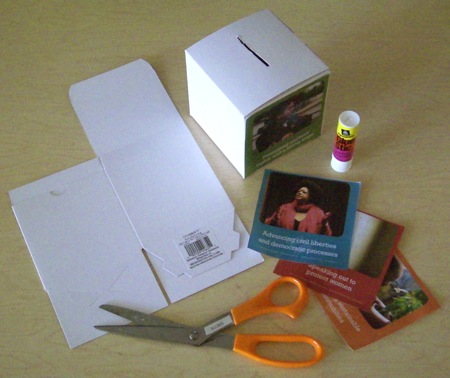
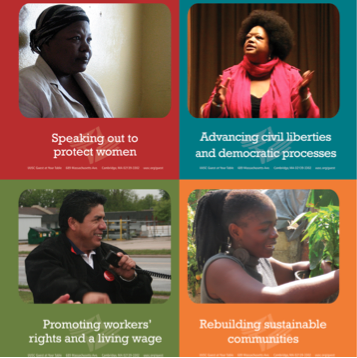
Here in our congregation, we decided that even though the UUSC isn’t going to make Guest at Your Table boxes any more, it was important for us to provide Guest at Your Table pushkes for our families. Our Guest at Your Table Coordinator, Beth Nord, found plain white gift boxes that are the same size as the old Guest at Your Table boxes (look for 4x4x4″ gift boxes, sometimes sold as gift boxes for coffee mugs; Beth bought ours at Michaels, an arts-and-crafts chain store). We printed out images from the UUSC, sized so they would fit onto the sides of the pushkes — like this:

Pushke

You cut out the four pictures, take one of the plain white gift boxes, glue one picture to each of the four sides, cut a slot in the top for money, and there you have it — your very own Guest at Your Table pushke. Here’s one in the process of being made:

BlogNov2413

This morning during the service, Amy explained where the Guest at Your Table money goes to, while I showed how to make a pushke. After each service, kids came with great enthusiasm to pick up boxes and pictures to take home so they could make their own pushkes. This is the most enthusiasm I’ve ever seen for the Guest at Your Table program!

So the UUSC gets to save money, our kids are more enthusiastic about the Guest at Your Table program, and we continue to provide pushkes to help teach kids about giving anonymously, giving communally, and getting in the habit of giving a little bit every day to charity.

Snow and dialect

On the last morning of my trip back east, it started snowing. I hadn’t seen snow falling for more than four years, not since we moved to the San Francisco Bay area. I got that familiar, mesmerized, contemplative feeling that you get when you watch snow falling; and almost immediately the worry kicked in: will this affect driving? will my flight be delayed? are my shoes waterproofed? Fortunately the snow stopped after about ten minutes, leaving no accumulation: I got the pleasure of seeing it without all the discomfort that goes along with snow.

While I was in the Boston area, it was interesting to again speak in what the linguists call Eastern New England dialect — popularly known as a “Boston accent,” though really there are several Boston accents which are a subset of Eastern New England dialect, and actually my accent is west of Boston, with a does of New Bedford from my time living there. Whatever my accent, or the accent of the natives I talked with, I found it’s much easier for me to communicate when speaking Eastern New England dialect, and I realized I always feel there’s always something missing when I have to speak American Standard English, that bastard dialect of television and movies that lacks subtlety and emotional nuance.

REA 2013 conference: Project Interfaith & RavelUnravel

During this afternoon’s breakout sessions, I went to a workshop led by Beth Katz, founder and executive director of Project Interfaith, a nonprofit organization dedicated to the growth of understanding and respect between people of different religious traditions.

In the workshop, Beth Katz introduced us to RavelUnravel, Project Interfaith’s online video project. This project has people of many different faiths responding to three basic questions: (1) What is your religious or spiritual identity? (2) What is a stereotype that impacts you based on your religious or spiritual identity? (3) How welcoming do you find our community [i.e., the place in which you live] to be? There are close to a thousand videos on their Web site, and Katz showed us this video as an example:

Project Interfaith has developed curriculum guides to go with the online videos, and during the workshop Katz asked us to review sections of the curriculum guide for college students.

It’s an impressive and well-designed curriculum, and some of the other workshop participants who work in academia were able to give some intelligent feedback. The most I was able to say was that I don’t think the curriculum would work particularly well in my setting, that is, in a local congregation. Nevertheless, I am excited by Project Interfaith’s online video resources, and am thinking these videos could be a resource for our congregation’s “Neighboring Faiths” curriculum.

Death, and violence in the skies

Like me, Howard, the sexton at church, keeps a pair of inexpensive binoculars at work. We trade stories of the birds we see at the church.

This morning, Howard said, he was walking out towards the dumpsters when he saw what looked like a pair of falcons flying over the parking lot. One of the birds was carrying something big in its bill, and the other bird was diving at the first bird. There were also some crows flying around, and attacking the raptors every now and then.

Howard saw the first raptor drop something as it flew over the parking lot; none of the other birds seemed to notice. Howard took me over to where it landed, right next to someone’s minivan: a long naked tail, with bits of skin and tendon still attached to the root end. The fur was grayish-white; it could have been a rat, or a small opossum. After the first bird had dropped the tail, Howard said that it and its followers flew off somewhere else.

(What kind of raptor was it? Howard couldn’t get his binoculars in time to be sure. But at about this time in past years, I have seen Cooper’s Hawks hunting over and around the church grounds; and Cooper’s Hawks are known for being skillful fliers.)