“There is no solution to the gun problem, and little more to write, because Americans are addicted to firearms…. Americans love guns, and appear willing to pay the price in blood.”
Stephen King is a master of the horror genre. Of all his output, this is probably the most horror-infused thing he’s written.
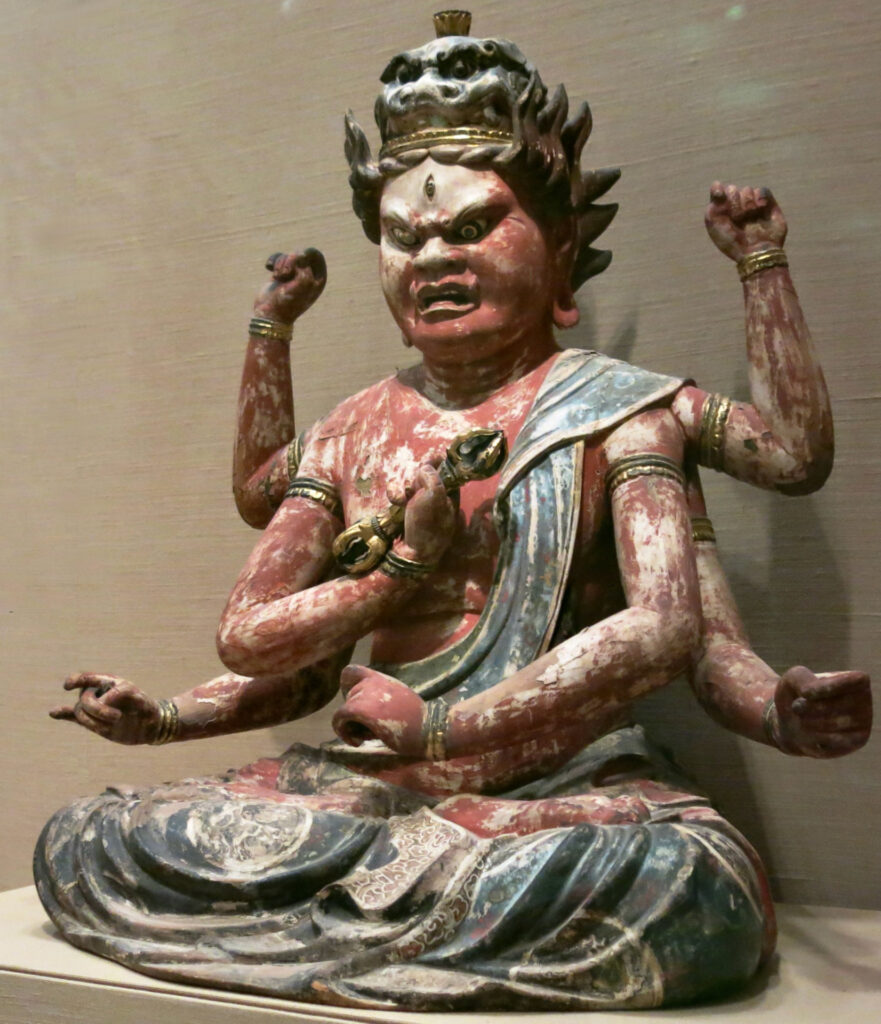
The Asian Museum of Art in San Francisco has a polychromed wood sculpture of Aizen Myo-o, the Japanese name for the esoteric Buddhist deity of love and passion. His original Sanskirt name is Ragaraja. I have very little understanding of esoteric Buddhism, so rather than get some details wrong, here’s a 1916 description of Aizen myo-o’s attributes and iconography from a Japanese English-language publication:
The Esoteric Buddhist king of passion (Japanese: Aizen Myoo [sic]), 1600-1700. Japan. Edo period (1615-1868). Gilding and colors on wood. Asian Museum of Art, San Francisco: The Avery Brundage Collection, B6059+
Aizen Myo-o, by Noritake Tsuda (expert in the Tokyo Imperial Museum), The Japan Magazine: A Representative Monthly of Things Japanese (Japan Magazine Co., Tokyo), vol 7, no 7, November 1916, pp. 401-402:
“Another familiar Buddhist deity is Aizen Myo-o, though he is not so widely popular as Fudo [Myo-o], treated in our last number of the Japan Magazine. Aizen Myo-o is the Indian god known in Sanskrit as Raga-vidyaraja. Raga usually means color, especially red, which symbolizes love or affection. Vidya means finding, and Raja a king; and sometimes the Sanskrit name used for this deity is Namu-vajra-raga-vidyaraja, or again simply Ragaraja.
“Aizen Myo-o is said to be a partial incarnation of Kongo-satta, in Sanscrit Vajrasattva, who took an oath to expel from mankind all wicked passions and to hasten the coming of all men to Buddha, giving them happiness and good fortune.
“This god is represented commonly in red with three terrible eyes, six arms, the figure seated on a lotus pedestal with lion headdress. Some ideas associated with the iconography of Aizen Myo-o may be inferred from one of the old masterpieces of painting representing him. The most beautiful and interesting of these is in the Hobodai-in temple in Kyoto. The painting is now a national treasure, and at present is on view at the Imperial Museum, Tokyo. A minute examination of the piece shows that the body and features have been painted in red. In the sutra referring to this deity, his heart and body are said to shine as the sun; and it is probable that the red color was selected to represent this, as well as to suggest reality. The gaping, terrible eyes sparkle marvelously in the red face, one of the eyes being placed lengthwise between the usual two. The three eyes are to give the beholder an impression of terror and awe as well as to suggest that this god has the oversight of three different aspects of the world. The eyes are blue with golden eyebrows. The mouth is open and has a grotesque grin with teeth gleaming, a common characteristic of Aizen to represent truth indestructible; the Logos, which, in Buddhism, is symbolized by the first letter of the alphabet.
“The hair on the head of Aizen stands erect in bizzare fashion, and a cap, in shape like a lion, is placed on the head with a fine-pointed kongo-sho stuck in it. The erect hair is intended to symbolize the subjugation of all evil agents. In his first left hand Aizen holds a bell; and in his first right hand another kongo-sho, both of which are symbols of mercy, bringing the peace of Vajrasattva to men. In the second left hand he holds a bow and in the second right hand an arrow, to dispel the four demons and the three other obstacles of man, shooting especially the pessimistic passions. The third left hand is extended in a grasping attitude with nothing in it, and in the corresponding right hand a lotus bud is just opening, the gesture suggesting that the bud is to be thrown at something. This symbolizes the driving out of all worldly trouble by lotus-like purity. The red lotus on which the god is seated, typifies the stability of his will. In front of the pedestal stands a treasure jar, around which are scattered treasure symbols, which suggest the bounty of the deity to all in need.
“It is noticeable that red is the prevailing color in the icons of this deity; and this is always so, because in esoteric Buddhism red always stands for love and the faculties that make for affection and compassion. The painting just described comes down from the 12th century and may be taken to represent Aizen Myo-o in his most orthodox form.
“Several other forms, however, are found among the representations of him, as, for example, some with four heads or two heads and four hands, but such divergences from the conventional form are rare.
“The Aizen Myo-o is the god of the upper classes chiefly, especially since the Fujiwara period, as he is believed to have the power of staying calamities, or gaining happiness, for those who serve him. On occasions of worship an altar of red is erected and a red image of Aizen is placed thereon; and the officiating priests are also robed in red.
“There now remains in Japan some 21 representations of Aizen Myo-o which are listed as state treasures. In addition to the painting above mentioned there is a very beautiful one on silk in the Gokokuin in Tokyo, as well as a very fine gilt statuette of him in the Imperial Museum, Tokyo, which is dated February, 1297 A.D.”
So wrote Noritake Tsuda in 1916. More recently, as can be seen in the Wikipedia entry for Aizen myo-o, there have been Western attempts to recast Aizen myo-o as a deity of same-sex male love and passion. It’s an interesting possibility, but I don’t know enough to judge if this is merely Western wishful thinking, or a considered appraisal of the historical record.
It appears that Aizen myo-o spread beyond Buddhist circle into Shinto rites. In their book Shinto in History: Ways of the Kami (Routledge, 2018), John Breen and Mark Teeuwen document how Aizen myo-o was part of a kanjo or Shinto initiation rite:
“The kirikami [i.e., written notes] of this [Shinto] initiation further reveal that the syllable un, that is at the heart of the ritual, represents not only the mind of enlightenment, but is also the seed syllable (shuji) of Aizen Myoo or King Raga. This figure (which is also bright red) represents human lust and desire, and personifies the insight that one’s innate desires are no other than inherent enlightenment itself…. The practice revealed in Ise kanjo thus teaches the practitioner that the kami [i.e., Shinto deity or power] dwells in his own heart/mind. The initiate is taught to visualize the kami as the syllable un, representing both the mind of enlightenment and his innate desire, in the guise of Aizen Myoo. The insight to be gained from this is that enlightenment and desire are identical…. The kirikami go on to teach that the kami of the Inner and Outer Shrine of Ise appear in our world as a golden and a white snake…. both the kami of Ise and [of] Aizen Myoo are snakes….” [pp. 103-104]
The case of Aizen Myo-o shows yet again that it’s unwise to assume that a deity belongs exclusively to one tradition and has only certain specified attributes. That’s an assumption Westerners, especially Protestants (and their offspring, the crusading atheists), like to make, but it’s often incorrect. Deities tend to have regional variations, just as Ragaraj became Aizen myo-o when he left India fro Japan.. Deities may move between traditions, just as Aizen Myo-o moves between the porous boundaries of Japanese Buddhisms and Shinto. And deities may have more than one manifestation, just as Aizen myo-o can be both a humanoid with six arms and three eyes, and, at an esoteric level, a snake.
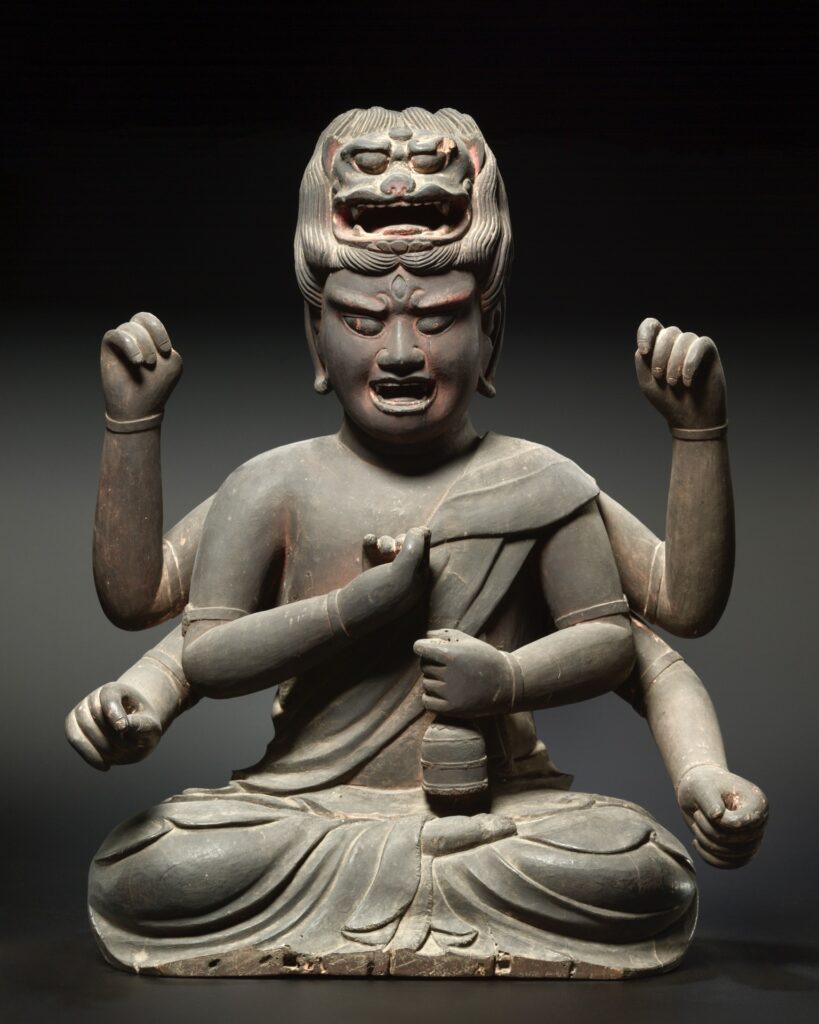
You can find quite a few photographs of Aizen Myo-o sculptures and paintings online. The Cleveland Museum of Art has posted the following photograph with a CC0 license, which allows me to repost it here:
Aizen My??, early 1300s. Japan, Kamakura period (1185-1333). Wood with black lacquer and red pigments; overall: 75 x 59 x 35 cm (29 1/2 x 23 1/4 x 13 3/4 in.). The Cleveland Museum of Art, Bequest of Elizabeth M. Skala 1987.185
A note on orthography: Usually there are macrons over both “o”s in the Romanization of this deity’s Japanese name: Aizen My?-?. And there are supposed to be macrons over the first and third “a”s in the Sanskrit name: R?gar?ja. However, diacritical marks don’t always translate well in all web browsers, so I’ve left them off.
Back in 2004, Brian Donahue, an environmental historian, noted:
“Beginning in the seventeenth century England was able to rationalize the production of its own countryside partly by genuine improvements, partly be replacing scarce firewood with boundless coal, and partly by drawing on its new colonies and on trade with the wider world, whether cattle from Ireland and Scotland, sugar from the West Indies, tobacco from the Chesapeake, or cod from the Grand Banks exchanged for Madeira wine. All this marked the birth of twin forces that have since transformed the relationship between people and their environment all around the world and that have remained closely related. The first was the increased substitution, via the market, of imported resources for local resources. The second was the unlocking of fossil energy, which has provided the power to both fetch and manipulate all other resources on the modern industrial, global scale and which has also had enormous environmental consequences.” — Brian Donohue, The Great Meadow: Farmers and the Land in Colonial Concord [Mass., U.S.] (Yale Univ., 2004), p. 72.
The first of Donahue’s twin forces has resulted in the spread of invasive species; the second has resulted in global climate change. Yet as Donahue points out, these twin forces were in part human responses to seventeenth century ecological challenges. Human population in England increased during the seventeenth century, so that humans had to either figure out how to produce more food or face famines. Humans began burning coal in England because there wasn’t enough firewood to keep them warm during the Little Ice Age, and part of the reason there wasn’t enough firewood was because woodlands had been cleared to create more arable land to grow food crops.
England had faced similar problems a few centuries earlier. Donahue says that during the High Middle Ages in England:
“…it appears that a population in the neighborhood of two million (and surely well under three million) in 1086 more than doubled to something like six million by 1300…. The ecological expression of population growth was the steady expansion of the arable fields to produce more grain, at the expense of other important elements in the interlocking agrarian economy. This imbalance resulted in scarcity and degradation….” (p. 65)
In 1346, the bubonic plague put an end to England’s population growth — which temporarily solved the problems of food production and firewood scarcity.
All this is worth remembering when we’re trying to figure out the origins of the current environmental crises: it all comes back to human overpopulation.
A short excerpt from The Power Worshippers: Inside the Dangerous Rise of Religious Nationalism by Katherine Stewart. In this excerpt, the author and Rev. Chris Liles, a Bible-believing Southern Baptist preacher, have just attended a meeting of the Family Research Council, a Christian nationalist group. Neither one of them felt comfortable at the meeting. As they leave, Pastor Chris begins speaking to Katherine Stewart:
“‘It’s ten degrees hotter than normal, and these people don’t believe in climate science,’ he grumbles. Then his words start tumbling out like a waterfall.
“‘Do we not owe people more than simply reducing “pro-life” to one issue?’ he says. ‘I mean, no one wants babies to die. No one is “pro-abortion.” That is a false dichotomy. Do we not owe people more than to force them into one box or another? As much as abortion is a pro-life issue, so is affordable health care, access to contraceptives, and real, comprehensive sex education. Minimum wage. Fighting poverty. These should all be part of the “pro-life” conversation.’
“Chris falls into silence for a few minutes, then speaks again.
“‘And shouldn’t we show compassion to people regardless of how they identify? They, too, are made in God’s image. We find in Scripture the imperative to love our neighbors and care for the least of these. That is by far one of the clearest messages we receive.’
“I feel bad for Chris [says Katherine Stewart]; he seems dismayed by the event precisely because the Bible is his greatest source of comfort and moral direction…..
“Stopping at a red light, Chris picks up his Bible and turns to the Old Testament book of Amos. ‘Here, for instance, in chapter five, the prophet says, “You, Israel, you were supposed to take care of the poor and you’re not doing it,”’ Chris says. ‘“You’re using power and wealth to tilt the system in your favor.” For society to be just, it was necessary for everyone to be seen as equal.’ He falls silent for a few moments. ‘Sometimes,’ he adds, ‘it’s almost like people are reading a different Bible. That’s the trick with Scripture. You can make the Bible say just about anything you want it to.’”…
Carol and I got the latest COVID booster on Monday evening.
By mid morning on Tuesday, I had a headache. Carol texted me saying, “So tired.” After my last meeting ended at 2:30, I went home. We spent the day on the couch, went to bed at 8:30, and slept twelve hours. This morning we’re both back to normal.
COVID is here permanently. Which means we now have to plan for a booster sick day at least once a year.
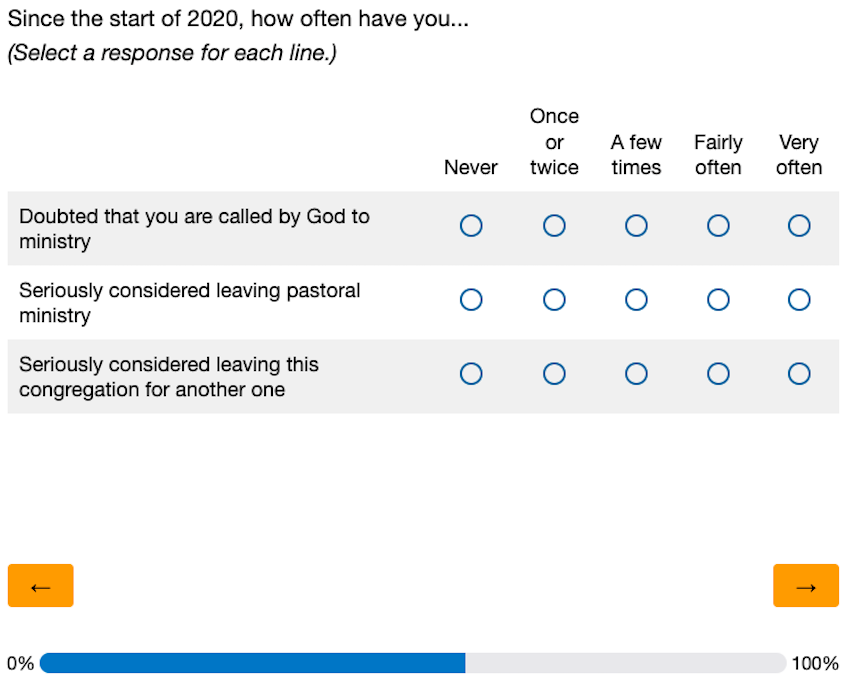
I received a long email today from a research group called “Exploring the Pandemic Impact on Congregations.” The email began:
“Dear Pastor, Greetings! This past spring, you or your church completed a survey for the national study entitled Exploring the Pandemic Impact on Congregations. At that time you were willing to be contacted for follow-up questions. In that survey, we found that 51% of clergy had thought about leaving the pastoral ministry. This was a considerable increase from our earlier survey. Because of this finding, we wanted to better understand the challenges clergy were facing. Religious leaders have suffered especially hard due to the pandemic and the many other challenges in our changing society. This short survey specifically addresses clergy health and well-being….”
So I took their survey. First they asked a lot of questions about the congregation (e.g., our average annual attendance went from 68 in 2018 to 48 in 2022). Then they asked questions about me: Am I employed full-time or part-time? How’s my financial well-being? Do I doubt that I am called by God to ministry? (Left that one blank, that’s not my theology.) Am I part of a clergy support group, do I see a shrink or spiritual director, do I still pray as much as I did before the pandemic? (Yes, and yes, and I pray as much now as before the pandemic which is not at all.)
The survey ended with two open-ended questions: What’s the biggest challenge in my ministry right now? and: What do I find most satisfying in my ministry? I was able to say that my biggest challenge, and also the most fun part of my job, is coming up with creative ways to respond to the rapidly changing world around us while maintaining the integrity and traditions of a 275 year old congregation. Then I was able to say that pretty much everything is satisfying, because I love my job.
Yep, I love my job. I was surprised at how positive I felt. I know that quite a few Unitarian Universalist ministers have left pastoral ministry, and that many others are unhappy with the way pastoral ministry has changed. Not me. I feel excited and energized.
Huh. Maybe there’s something wrong with me.
Questions from the survey. Have I ever doubted that I was called by God to ministry? I left that one blank. Have I ever seriously considered leaving pastoral ministry? Not since 2020. Have I seriously considered leaving this congregation for another one? This was kind of difficult to answer, since I just started serving this congregation in 2022, and I left my previous congregation for reasons unrelated to COVID — so I answered “never.”
Back in 2020, in the depths of the pandemic, I began assembling a collection of copyright-free hymns. (Remember when we were all figuring out navigate copyright laws with online worship services?) I uploaded PDFs of the hymns to Google Drive, and made the folder publicly accessible. It was clumsy, and probably very few people actually used those hymns.
I finally moved all those hymns off Google drive and onto one of my own websites. You can find them here — with a much-improved navigation system.
I got interested in the Buddhist Churches of America (BCA) after reading Jeff Wilson’s book Dixie Dharma: Inside a Buddhist Temple in the American South. Ekoji Temple, the one Wilson writes about in this book, was founded by Rev. Takashi Kenryu Tsuji in the 1980s. Tsuji had retired as a bishop of BCA, and Ekoji Temple was one of his retirement projects. In his book, Jeff Wilson quotes Tsuji extensively, and I found I resonated with what Tsuji had to say. As in this passage from Tsuji’s book The Heart of the Buddha-Dharma: Following the Jodo-Shinshu Path:
“Shinran Shonin and the teachers before him explained that the Pure Land was situated in the western corners of the universe, zillions of miles away. It was pictured as a very beautiful place, free of suffering, where everyone is happy. Philosophically speaking, however, the Pure Land does not refer to a specific location out there somewhere. Rather, the Pure Land is symbolic; it symbolizes the transcendence of relativity, of all limited qualities, of the finiteness of human life. In this transcendence, there is Compassion-Wisdom, an active moving, spiritual force. The Pure Land ideal is the culmination of the teaching of Wisdom and Compassion.”
First of all, Tsuji makes Pure Land Buddhism sound a little like Universalism. The old Universalists, coming out of the Christian tradition, said that everyone gets to go to heaven. Similarly, Pure Land Buddhists said that everyone can can enter Buddha’s Pure land, that is, everyone can achieve Buddhahood. We Unitarian Universalists translated the old Universalist ideas into modern terms, and that’s what Tsuji does for Pure Land Buddhism in this passage: “The Pure Land ideal is the culmination of the teaching of Wisdom and Compassion.”
What I like is that both groups have not only translated their religious traditions into Modernity, both groups say that all persons are radically equal. Maybe this is because I know I’m not good enough to be one of those Christians who gets into heaven, and I lack the self-discipline to become one of those Buddhists who reaches Enlightenment. Whatever the reason, I prefer the radically egalitarian religious groups.
Religion New Service interviews Laura E. Anderson, a psychologist who has written a new book, When Religion Hurts You: Healing from Religious Trauma and the Impact of High-Control Religion. In the interview Anderson makes the obvious point that the cure for religious trauma might not be renouncing all religion:
“[Religion News Service:] Why might it be important for therapists working with religious trauma not to be anti-religion?
“[Laura Anderson:] Anti-religious messages can quickly become prescriptive and fundamentalist. To say all religion is terrible and you just have to get rid of it, or the idea that God is dumb and only for mentally weak people, is incredibly shaming and discouraging. It’s also not necessarily helpful for the healing process. My job as a therapist is not to get you to a belief that I might hold. It is to help you heal and to lean in more to who you are authentically. I think that includes religion or spiritual practices. Now I always say I’m not anti-religion, but I am anti-harm and power and control, and anti-abuse. So if you can find a religion or faith or spiritual practice that isn’t including those things, I think that’s wonderful.”
I call this an “obvious point,” though it might not be obvious to everyone. But think of this analogy: if someone is sexually assaulted, psychotherapists don’t tell them to never have sex again. Instead, the therapeutic goal is healing so that the person who survived sexual assault can go on to have healthy relationships, including health sexual relationships.
The entire interview with Anderson is worth reading, not just for her thoughts about religious trauma, but also for her insights into trauma and healing from trauma.
It’s been a busy couple of days for me. Another one of my websites started misbehaving. The problem turned out to be that the site had been compromised by some bad actor, presumably for nefarious purposes. While I was working on that problem, my younger sister told me that this site was down. Now I had two sites down at once. Yikes.
My internet service provider quickly brought this site back up. He described the problem:
“…When a group of processes, in this case the PHP Interpreter php-fpm, experiences high memory pressure, it kills the entire group. The cause of the pressure is too many criminals attacking too many sites simultaneously. They’re stupid, running scripts which very rapidly request php pages with vulnerabilities, hoping to find one. When too many of them are doing this at the same time, we get this problem…. It’s irritating to me that literally more resources have to be devoted to fending off criminals than providing the actual service….”
As for my other website, I’m converting it from a dynamic site run on WordPress to static HTML. It’s kind of funny. I started out building websites by writing HTML in a text editor. That was too time-consuming, so I switched to using WordPress as a CMS. And now for this one small website, I’m switching back writing HTML in a text editor because it takes less time than dealing with all the security needed to keep WordPress from being compromised.