“…the transformation from self-centredness to Reality-centredness [following a transcendent experience from e.g. psychedelic drugs] is a fundamentally ethical one: to be far enough along it is to be a saint, one who has had ‘a transcendence of the ego point of view and its replacement by devotion to or centred concentration upon some manifestation of the Real, response to which produces compassion/love towards other human beings or towards all life’ (Interpretation of Religion 301). But I think we need to be very careful about that sort of claim. The point came up in my interview with Osheen Dayal of MAPS Canada, where I pointed to the example of tycoon Elon Musk.
“It is publicly documented that Musk has used psilocybin, LSD and more, and given his known involvement in psychedelic spaces like Burning Man, he’s probably done far more than the documents let on. He has almost certainly had multiple psychedelic experiences of self-transcendence in the face of a larger reality. And yet Musk is about as far as one could imagine from ‘compassion/love towards other human beings or towards all life.’ Rather, he is practically a caricature of a self-absorbed egoist, so confident in his own rightness that he used his brief time in government to destroy thousands of military veterans’ lifelong careers and end the lifelines of thousands of desperately poor people around the world in the name of saving a tiny fraction of money and sometimes nothing at all.
“Musk is to today’s generations what Charles Manson was to the baby boomers: a sobering reminder that psychedelic experiences can leave you a terrible person….”
Back in 2017, sociologists Brad Christerson and Richard Flory published a book titled “The Rise of Network Christianity: How Independent Leaders Are Changing the Religious Landscape.” In one of their central arguments, they said:
“We argue that macrolevel social changes since the 1970s, including globalization and the digital revolution, have given competitive advantages to religious groups organized by networks rather than traditionally organized congregations and denominations.”
For Flory and Christerson, Independent Network Charismatic (INC) Christianity is the paradigm for this type of religious organization. INC Christianity is associated with a specific set of beliefs, including spiritual healing, confrontations with “demonic forces,” and social transformation on the far right side of the culture wars.
But why couldn’t other religious groups, with different sets of beliefs, organize themselves through networks? And I suspect that there are such religious groups, including those with sets of beliefs, and with political commitments, with which I’m somewhat more comfortable.
I suspect that it would be possible to identify what we might call Independent Network Westernized Buddhism. From what I’ve seen of Westernized Buddhist practitioners, there does appear to be a loose network that shares some of the attributes of INC Christianity, including “experimentation with controversial supernatural practices, innovative finance and marketing, and a highly participatory, unorthodox, experiential faith that is attractive in today’s pluralistic, unstable religious marketplace.” I’m sure many Westernized Buddhists would argue that they do not engage with “supernatural practices,” but the evolving science around meditation and mindfulness appear to downgrade some of the more extreme claims of that practice — a practice which, to my skeptical mind, is just as supernatural as prayer.
Another decentralized network that might qualify is Progressive Christianity. In a comment on a post I made earlier this week, Gabriele Simion drew my attention to this network, which features progressive Christian luminaries like Diana Butler Bass (thank you, Gabriele!). Progressive Christianity is not exactly a denomination — they don’t appear to ordain or credential clergy, they have minimal staff, they don’t plant new congregations, etc. — so maybe they’re a “network” in the sense that Christerson and Flory use the term?
I’ve begun to think that the Unitarian Universalist association might want to take on more attributes of networked religion. Funding for denominational work continues to plummet, congregations continue to fade away — the denomination is shrinking before our eyes. In spite of the shrinking of the denomination and the congregations, there are lots of individual Unitarian Universalists in the world who still want to connect with other Unitarian Universalists. My own tiny little congregation here in Cohasset has (we think) three regular viewers of our livestream who live far from Cohasset, have never been a part of the in-person congregation, yet who have been watching our livestreamed services most weeks, and donate money as well.
Yet I suspect that most Unitarian Universalist leaders would not be very receptive to the idea of moving away from the traditional organizational structures of denomination and congregation. Back in 2004, evangelical Christian Brian McLaren pointed out that “[religious] conservatives tend to be rigid theologically and promiscuous pragmatically and [religious] liberals tend to be rigid methodologically and a lot more free theologically.”
Well, that’s still going on — the religious conservatives are being “promiscuous pragmatically” and they are dramatically out-competing the religious liberals. There is one group among Unitarian Universalists that might have a hope of competing with the INC Christians: the Church of the Larger Fellowship (CLF). They deliver their religious services primarily online, and have the potential for adopting the best organizational practices of network Christianity. However, they are pretty well locked into the traditional denominational financial structure of the UUA, which hampers their ability to innovate financially.
I suspect a great many religious progressives have mostly given up on religion, and just assume that secularization will do away with religion entirely. But the secularization hypothesis is just that — a hypothesis — and in any case, right now the INC Christians have become extremely adept at winning elections and pushing their agenda of social transformation. I wish religious progressives could find it in themselves to be as innovative as the INC Christians.
I went for a walk at Black Rock Beach late this afternoon. A large quantity of seaweed had been left behind by the ebbing tide, mostly Sugar Kelp (Saccharina latissima), but also some wrack (Fucus spp.), some Sea Lettuce (Ulva lattuca), and a few other odds and ends.
There were also hundreds of small (2-3 cm long), almost transparent jelly-like objects washed up above the line of seaweed. At first glance I thought they were Sea Gooseberries (Pleurobrachia pileus), a species of comb jellies. But when I put my photos on iNaturalist, user ja-fields corrected me — they were salps.
What is a salp, you ask? It’s an organism in Family Salpidae. The Salpidae are in Subphylum Tunicata, which is a part of Phylum Chordata — animals with spinal cords. Human beings are also in Phylum Chordata, so this odd little animal is more closely related to us than are crabs, sea urchins, or starfish.
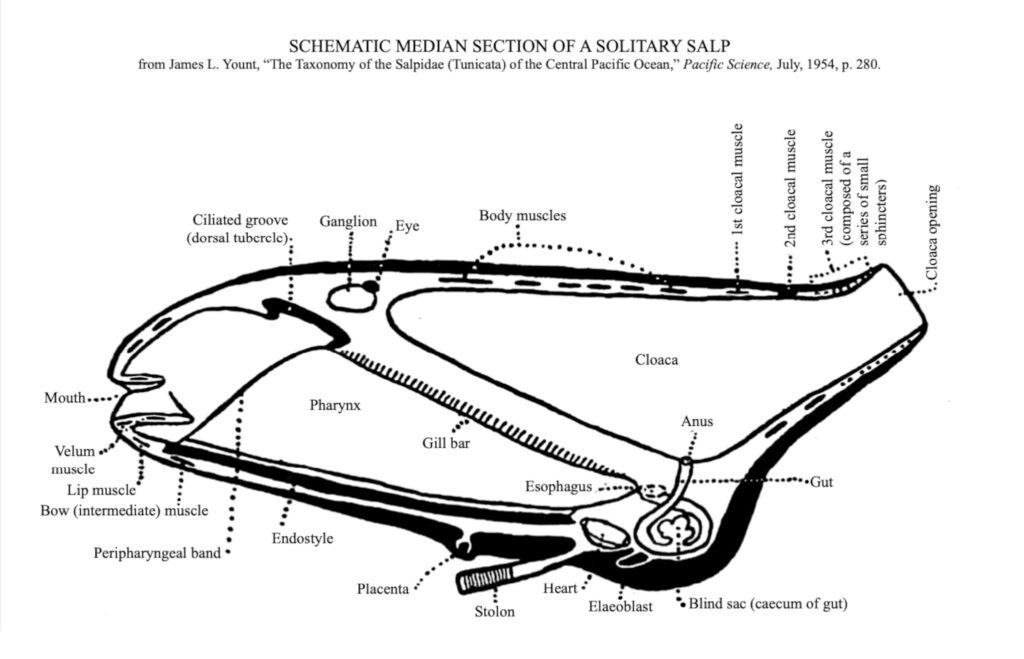
This made me curious — how does one identify Salpidae, if not to species level, then at least to genus? James L. Yount, “The Taxonomy of the Salpidae (Tunicata) of the Central Pacific Ocean,” Pacific Science, July, 1954, has a “Key to world species and reproductive forms of Salpidae,” pp. 280 ff. Identification requires looking at the internal structures, and Yount provides a “Schematic median section of a solitary salp (after Ihle, 1935).” I digitally enhanced his sketch, and identified the body parts in easy-to-read type:
After Yount (1954).Click the image above for a PDF version.
At some point, perhaps I’ll type up Yount’s key. In the mean time, you can find it yourself here.
Back in 2010, Scott Wells came up with a list of congregations that claimed an affiliation with both Unitarian Universalism and some other religious tradition. 15 years later, we’ve seen many small congregations close, so I decided to revisit Scott’s list and see how many of the congregations in his post were still in existence.
Below is my list, grouped together by U.S. state, and in alphabetical order within each state grouping. Except where noted, I’ve given religious affiliations as garnered from congregational websites.
Update, 13 Oct. 2025: Thanks to commenter Gabriele Simion, added several congregations; cleaned up some typos, and fixed names of denominations / religious groups. Update, 23 Oct.: Added Free Congregation of Sauk City, thanks to Gabriele again.
The list
The list has all multi-religious congregations I was able to find that are formally affiliated with the UUA. I determined formal affiliation based on the congregation’s appearance in the UUA’s online directory. (N.B.: I haven’t included affiliations with the new North American Unitarian Association, because they don’t publicize a list of their member congregations.) If you know of multi-religious congregations formally affiliated with the UUA that I’ve missed, please mention them in the comments.
First Universalist Church of Hardwick Preservation Trust (part of the Tri-Parish Community Church, which meets at First Universalist July-Dec.; affiliations from UCC denominational website, and UUA directory) — Hardwick, Mass. — UCC, UUA
First Church of Templeton (website is gone, I’ve linked to their active Facebook page; UCC affiliation from other online sources) — Templeton, MA — UCC, UUA
United Church of Winchester (website is gone, I’ve linked to their active Facebook page; UCC, UMC affiliations from other online sources)— Winchester, NH — UCC, UMC, UUA
There are other congregations that may have had a Unitarian or Universalist affiliation in the past, but no longer do. Trying to research such congregations seems incredibly difficult, so I haven’t included them. But here are three examples from Scott’s 2010 blog post:
The Community Church of Pepperell, in Pepperell, MA, is formally affiliated solely with the UCC. On their website they say that they formed as a merger between the Unitarian church and the Congregationalist church in Pepperell.
First Church in Belfast, Maine, was formerly affiliated with the Unitarians and the Congregationalists, but is now solely affiliated with the UCC. (The history section of their website states that “Congregationalists believed in the complete autonomy of the local church; Unitarians did not”; this is incorrect, as both Congregationalists and Unitarians share the same polity).
The Federated Church of Hyannis is an “independent” (i.e., nondenominational) congregation that claims both Universalist and Congregationalist roots. It would be interesting to learn more specifics of their history; there were other Universalist churches which left the Universalist General Convention and affiliated with the Congregationalists in the first half of the twentieth century.
If you know of other multi-religious congregations with a Unitarian or Universalist history, please mention them in the comments. If possible, provide a link to their website or social media presence.
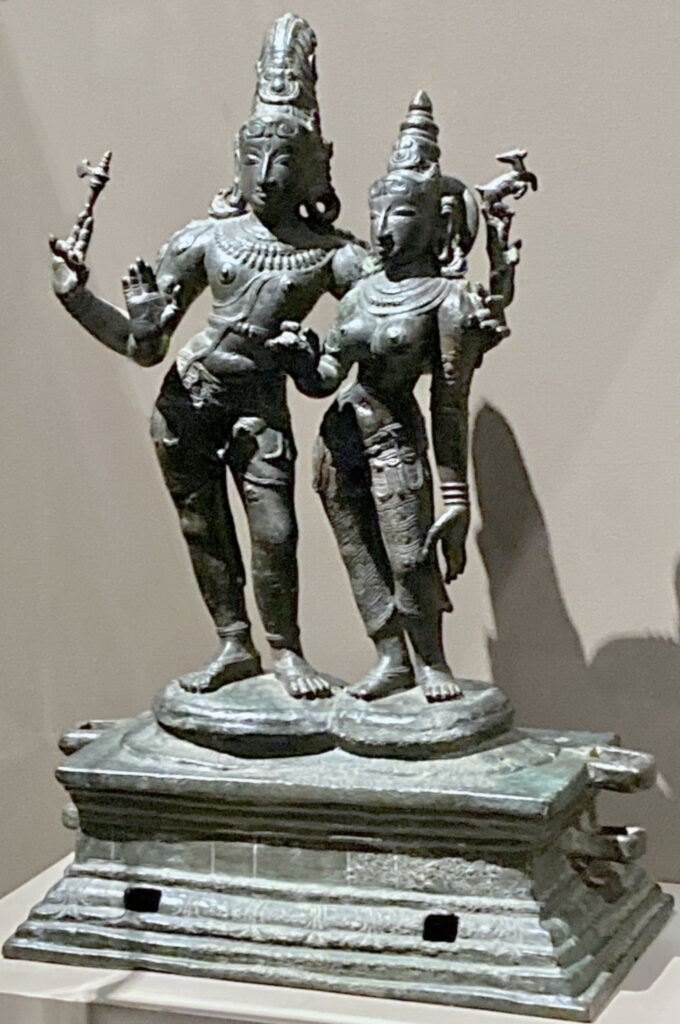
In the Walters Art Museum in Baltimore, there’s a lovely small sculpture of the god Shiva with his wife Uma. It was made in the 13th century CE out of “copper alloy” in Tamil Nadu, the southernmost state in India.
Shiva and Uma, Walker Art Museum, acc. no. 54.3023. Uma is on the right.
But wait a minute…isn’t Shiva married to Parvati? Who is Uma?
For a partial answer to the question of Uma’s identity, I looked at the Kena-Upanishad, which can be found of the Talavakara-Upanishad. I used Max Mueller’s translation in The Upanishads Part I, Sacred Books of the East series, volume I (Oxford, U.K.: Clarendon Press, 1897), pp. 46 ff. The third and fourth khandas of this upanishad tell how Brahman, the ultimate reality or highest deity, is more powerful than anything else in the universe, more powerful even than various other gods and goddesses. Mueller’s translation of the third khanda (verses 1-12), and the first verse of the fourth khanda, reads as follows:
“Brahman obtained the victory for the Devas. The Devas became elated by the victory of Brahman, and they thought, this victory is ours only, this greatness is ours only.
“Brahman perceived this and appeared to them. But they did not know it, and said: ‘What yaksha [sprite, demon] is this?’
“They said to Agni [fire]: ‘O Gatavedas, find out what yaksha this is.’ ‘Yes,’ he said.
“He ran toward it, and Brahman said to him: ‘Who are you?’ He replied: ‘I am Agni, I am Gatavedas.’
“Brahman said: ‘What power is in you?’ Agni replied: ‘I could burn all whatever there is on earth.’
“Brahman put a straw before him, saying: ‘Burn this.’ Agni went towards it with all his might, but he could not burn it. Then he returned thence and said: ‘I could not find out what yaksha this is.’
“Then they said to Vayu [air]: ‘O Vayu, find out what sprite this is.’ ‘Yes,’ he said.
“He ran toward it, and Brahman said to him: ‘Who are you?’ Vayu replied: ‘I am Vayu, I am Matarisvan.’
“Brahman said: ‘What power is in you?’ Vayu replied: ‘I could take up all whatever there is on earth.’
“Brahman put a straw before him, saying: ‘Take it up.’ Vayu went towards it with all his might, but he could not take it up. Then he returned thence and said: ‘I could not find out what yaksha this is.’
“Then they said to Indra: ‘O Maghavan, find out what yaksha this is.’ He went towards it, but it disappeared from before him.
“Then in the same space [ether] he came towards a woman, highly adorned: it was Uma, the daughter of Himavat [the Himalayas, or snowy mountains]. He said to her: ‘Who is that yaksha?’
“She replied: ‘It is Brahman. It is through the victory of Brahman that you have thus become great.’…”
In a footnote, Mueller provides some information about Uma:
“Uma may here be taken as the wife of Siva, daughter of Himavat, better known by her earlier name, Parvati, the daughter of the mountains. Originally she was, not the daughter of the mountains or of the Himalaya, but the daughter of the cloud, just as Rudra was originally, not the lord of the mountains, girisa, but the lord of the clouds. We are, however, moving here in a secondary period of Indian thought, in which we see … the manifested powers, and particularly the knowledge and wisdom of the gods, represented by their wives. Uma means originally flax, from va, to weave, and the same word may have been an old name of wife, she who weaves (cf. duhitri, spinster, and possibly wife itself, if O. H. G. wib is connected with O. H. G. weban). It is used almost synonymously with ambika, Taitt. Ar. p. 839. If we wished to take liberties, we might translate uma haimavati by an old woman coming from the Himavat mountains; but I decline all responsibility for such an interpretation.”
David R Kinsley, in his book Hindu Goddesses: Visions of the Divine Feminine in the Hindu Religious Traditions (Berkeley: Univ. of Calif. Press, 1986), p. 36, has a somewhat different take on who Uma in this upanishad might be:
“The Kena-upanisad contains a goddess named Uma Haimavati (3:12). This is one of the most common names of the late Sati-Parvati, but this reference does not associate the goddess with Siva, nor does it associate her with mountains, except by name (haimavati meaning ‘she who belongs to Himavat,’ who is the Himalaya Mountains personified as a god). Her primary role in this text is that of a mediator who reveals the knowledge of the brahman to the gods. She appears in the text suddenly, and as suddenly disappears. It is little more than conjecture to identify her with the later goddess Sati-Parvati, although quite naturally later writers do make the identification when describing the exploits of Sati or Parvati. To devotees of the goddess, this early Upanishadic reference provides proof of her venerable history….”
How can we make sense of all this? On Hindu Blog, which gives contemporary popular accounts of Hinduism, writer Abhilash Rajendran cites the Encyclopedia of Hinduism, vol XI (India Heritage Research Foundation and Rupa Publications, 2012) p. 22, and says Uma “has thousands of names depending on which way a devotee want to perceive her.” Rajendran goes on to say that some of the key aspects of Uma’s symbolism include feminine energy, “motherly love and nurturing,” balance, harmony, and “asceticism and devotion.” She can also appear as a “fierce warrior goddess”; and in fact, Kali is one of her manifestations.
Other sources may depict Uma slightly differently, but the gist of her is always the same: the great power of the feminine. Don’t mess with Uma.
From a story by Fiona Murphy titled “How ‘RaptureTok’ amplified an extreme corner of faith” (Religion New Service, 26 Sept. 2025). The story documents how minority religious views are often mocked and belittled on TikTok….
“Heidi Campbell, director of the Network for New Media, Religion and Digital Culture Studies at Texas A&M University in College Station, said that since 2016, online discourse has shifted toward what she calls a ‘performance of meanness.’
“‘The screen has allowed us to broadcast so much more diversity, which can be a positive thing,’ Campbell said. ‘But instead of bringing us closer together, which a lot of internet prophets and cyber philosophers kind of said in the 1990s, it’s actually brought more division.’”
Back in 2022, I mentioned in a year-end blog post that Rev. Kathryn J. Rohde had been removed from fellowship by the Ministerial Fellowship Committee (MFC) of the Unitarian Universalist Association (UUA). Now it turns out there’s a (publicly available) sequel.
The following year, 2023, Rohde sued the UUA for removing her from fellowship, and further for ending the retirement stipend she received from the “Unitarian Service Pension Society” (an organization I didn’t even know existed). You can read the basic court documents here, but I read about the case in a blog post by Daniel Dalton on the website of Dalton-Tomich, a law firm specializing in “religious properties” (a legal speciality I didn’t even know existed).
According to the court filings, and Daniel Dalton’s blog post, Rohde got in trouble because of a social media post made in 2020:
“In 2020, Rohde posted in a private Facebook group with about 1,200 members. Three individuals found her posts offensive and reported them to the UUA. The UUA allegedly initiated a disciplinary process against Rohde, despite her being retired. Rohde claims the process was politically motivated, driven by a ‘woke’ faction within the UUA. She was stripped of her ministerial credentials and retirement stipend, with no clear violation of UUA policies cited.”
[Parenthetical note: “private Facebook group” is an oxymoron; social media is never private.]
[Another parenthetical note: Both the court filing and the Daniel Dalton blog post state that Rohde alleged she was the victim of sexual harassment early in her ministerial career — an allegation I would expect to be true, based on what older women ministers told me about the way they were treated by male ministers and denominational officials in the late twentieth century.]
Daniel Dalton goes on to reveal what the court decided; or rather, didn’t decide:
“In a ruling on July 11, 2025, Judge Mary Kay Costello issued a mixed ruling on the defendants’ motion to dismiss based on the ministerial exception to the First Amendment. Rev. Rohde’s claims of defamation, invasion of privacy (false light); tortious interference with contract, and breach of contract (specifically regarding her removal from fellowship and alleged procedural failures) were dismissed without prejudice. However, her claims of breach of contract, related to her retirement benefits, breach of contract against the Unitarian Service Pension Society and promissory estoppel were allowed to continue. The court also granted Rohde the opportunity to file an amended complaint by July 25, 2025, consistent with the court’s decision.”
I have not been able to find out whether Rohde filed an amended complaint. I did find out that the usual vocal critics of the UUA — the Fifth Principle Project, the North American Unitarian Council, etc. — have been trumpeting Rohde’s case as another example of how “wokeness” has overtaken the UUA. Rupert Murdoch’s New York Post also picked up the story, using it to castigate so-called cancel culture.
Daniel Dalton, however, draws different conclusions from this case. First, he points out that most of Rohde’s claims were dismissed, not necessarily on their merit (or lack of merit), but rather on the legal notion of “ministerial exception.” As I interpret this, the dismissal, then, does not necessarily represent a judicial judgement (for or against) on Rohde’s claims.
Second, he notes that the Rohde case “prompts questions” in the area of “governance and accountability” regarding disciplinary procedures. Such question could lead to “greater transparency in internal investigations.” While Dalton seems to direct this comment at the UUA, I would imagine that local congregations should also pay attention to this — disciplinary procedures should always be clear and transparent.
Among other conclusions, Dalton points out that this case highlights the need to balance freedom of expression over against “community values.” Dalton suggests: “UU congregants and leaders may need to find ways to balance inclusivity with respecting diverse viewpoints.”
Dalton also highlights “ideological splits within the denomination,” and he then speculates if this might prompt “wider discussions on political polarization, identity politics, and theological diversity” within Unitarian Universalism. I think we Unitarian Universalists try to ignore the divisions among us, but Dalton shows us just how visible those divisions are to outsiders.
So that’s the inconclusive sequel to the 2022 removal of Kate Rohde from ministerial fellowship. Yet even though this sequel is inconclusive, there’s one conclusion I’d like to draw. Expanding on what Daniel Dalton says, I think it would be good to have additional clarification on Unitarian Universalist disciplinary policies for ministers (at both the denominational and local levels), as well as “greater transparency in internal investigations” (again, at both the denominational and local levels). The problem is that I don’t know how to make that happen. Our individualism means we find it hard to work together. 25 years of budget cuts have left the UUA understaffed in some key areas. Wider American society has grown polarized, and people are tender and raw. All these factors are going to make it extremely hard to come together to talk openly about a difficult topic like how we discipline clergy.
12 Oct. 2025: Minor edit made that didn’t change basic content (added brackets and intro phrase to the second parenthetical note).
I climbed up to the bell level of the tower of the Cohasset Meetinghouse, because someone wanted to know if our bell was cast by Paul Revere (it was not). While I was up there, I took a panoramic photo. Not much of a view, to be honest — the tower isn’t all that tall, and it doesn’t have the dramatic view the you get from First Parish in Lexington (from which you can see the skyscrapers of Boston), or from First Unitarian in New Bedford (from which you can see New Bedford Harbor). But it’s still a charming view.
Click on the image above for a higher resolution version.
It’s a crazy world out there, and sometimes you just need to forget about the human world and get in touch with the beauty and subliminty of the non-human world. And on a walk today, I saw more than a dozen species of wildflowers in bloom….
Chelone glabra, White TurtleheadLobelia cardinalis, Cardinal FlowerImpatiens capensis, Common JewelweedCuscuta gronovii, Common DodderEutrochium dubium, Coastal Plain Joe-Pye WedMikania scandens, Climbing Hempvine
[Note: I wrote up my notes from this meeting, pasted them into WordPress, then forgot to hit “Publish.” Sigh. So this post is dated September 5th, even though it actually went live a couple of weeks later.]
While watching the NAACP webinar on “Labor action Week”, I transcribed a few of the speakers’ comments that especially caught my attention. Here are my rough notes, lightly edited:
“It is by design to make us feel powerless,” said Julie Collier of the AFL-CIO. “They are trying to make us feel powerless, so that we act powerless…. That is not where we are, we are going to be fighting back.” “We’re going to organize, because that is what we do best.”
Donna Mitchell, who is with Laborers’ International Union of North America (LiUNA, a building trades union), said that their union is asking each local to build alliances in their communities, including of course alliances with local NAACP chapters. LiUNA leadership knows that many of their members voted for Trump, so they are now reaching out to their membership to become “reacquainted.” They are also asking their members to “vote with their paychecks.” As an example of what she means by that, Mitchell pointed out that the Trump administration shut down the Revolution Wind project off Rhode Island, which has thrown hundreds of LiUNA workers out of work. “Overnight, those jobs are gone,” Mitchell said. She added that the demise of Revolution Wind will “drive up energy prices,” thus hitting LiUNA members once again in the pocketbook.
While Mitchell was speaking, I noticed this comment in the chat:
“Have we ever had another president in the White House that raised unemployment and inflation at the same time?”
Rev. Dr. Regena Thomas, who is a ministerial associate at Grant Chapel AME church and also Co-Director of Human, Civil, and Women’s Rights for the American Federation of Teachers, said, “If I’m completely honest, I’m mad as hell. But I’m also fearful.” She is especially fearful because of the attacks on Black women by the Trump administration. She sees the labor movement as taking the lead right now, adding:
“I’m mad, and scared, but also energized and fired up.”
“If it’s good enough for them to want to take it, it’s good enough for us to fight to keep it,” Thomas went on. “Everyone has a lane [i.e., everyone has a role to play] … and we need boots on the ground [i.e., each of us has to get to work].”
In response to Thomas, this comment appeared in chat:
“No silos! We can do this together!!”
Actually, some of the most inspiring material came from the chat. Here is a small sampling of comments from NAACP members from across the U.S.:
“We must remember Galatians 6:9, ‘And let us not be weary in well doing: for in due season we shall reap, if we faint not.’ Keep standing in solidarity.”
“The working class needs to fight back, we outnumber the oppressors.”
“[Work] collectively. Stop the divide and conquer. What they do to one, they will do to another.”
“Partnerships and collaborations are necessary.”
“Racism and bigotry are integral to capitalist exploitation.” [Mostly I forgot to note who made the comments, but this last one came from Rev. Chester Banks, president of the Bayonne Branch of the NAACP.]
A final note of apology: I was typing as fast as I could, and my transcriptions are probably not entirely accurate; if you spot errors, please leave a comment with a corrected version.