Prime number days and consecutive odds days

Today’s date is made up entirely of prime numbers: 7, 5, and 2011. I’m sure you already noticed that, because you’re already aware that 2011 is a prime number, and so you’re watching for the fifty-two dates this year made up entirely of prime numbers. Which means that you have also noticed that there are three prime number Sundays this month, which is the greatest number of prime number Sundays you can have in any month.

However, you may not have thought about the fact that Saturday’s date is made up of consecutive odd numbers (if, that is, you define the number of the present year to be 11, as it is often written, rather than 2011). Ron Gordon of Redwood City has thought about it, and has received national press in his efforts to promote what he calls Odd Day. I’d have to say that a more precise name would be Consecutive Odds Days, but I recognize that “Odd Day” is a catchier name.

Using Gordon’s definition, there are six Odd Days per century. For purists who believe that a number is a number, dammit, and you can’t just arbitrarily chop off the digits to the left of the tens place, there were only six true Odd Days ever using our present system of numbering years, and those happened even before our present system was in place. While this notion might disturb you, it is probably more satisfying to the pure mathematician, for the pure mathematician prefers things that don’t actually exist.

Robert Gould Shaw, liberal religious patriot

For Independence Day, here’s the story of Robert Gould Shaw to inspire you. Excerpted and slightly modified from a sermon I delivered yesterday at the Palo Alto church.

Robert Gould Shaw was born in Boston in 1837 to a wealthy Unitarian family. His parents were Francis George Shaw and Sarah Sturgis; they had inherited money from Francis’s father, and Francis was involved in business and philanthropy. When Robert was five, the family moved to West Roxbury, near the famous Brook Farm community; and when Robert was in his teens, they moved to Staten Island, where the family helped found the Staten Island Unitarian church. The Shaws were abolitionists, and they may have been active in the Underground Railroad, helping escaping slaves to flee to the northern states.

Given the wealth and influence of the Shaw family, Robert surely could have avoided military service during the Civil War. But he chose to enlist. On April 19, 1861, Shaw joined the private Seventh New York Volunteer Militia. That short-lived unit disbanded after a month or so, and he joined the Second Massachusetts Volunteers (Infantry), and was commissioned as Second Lieutenant on May 28, 1861. He became First Lieutenant on July 8, 1861, and Captain on August 10, 1862. While with the Second Massachusetts, he took part in several battles, including the battle at Antietam. In late 1862, he was offered the chance to command a regiment made up entirely of free African Americans from the north. He became Colonel of Fifty-fourth Massachusetts Volunteer Infantry on April 17, 1863.

A small volume titled Memoirs of the War of ’61, published in 1920 by George H. Ellis (who was the printer for Unitarian tracts and books), tells the story of Shaw’s military service through excerpts from his lettersBelow are the excerpts relating to the 54th Regiment, which show his courage, and his growing realization that the men under his command were indeed his equals; for even though he was an abolitionist, like most white people of his day, he began by thinking African Americans his inferiors:

[Upon accepting command of the 54th Regiment, February 5th, 1862. Shaw wrote:] “There is great prejudice against it — at any rate I shan’t be frightened out of it by unpopularity.” March 25: “The intelligence of the men is a great surprise to me.” March 30: “The mustering officer who was here to-day is a Virginian, and he always thought it was a great joke to make soldiers of ‘n——s’ [African Americans], but he tells me now that he has never mustered in so fine a set of men, though about 20,000 have passed through his hands since September. The skeptics need only to come out here to be converted.” Morris Island, July 18: “We are in General Strong’s brigade. We came up here last night in a very heavy rain. Fort Wagner is being heavily bombarded. We are not far from it. We hear nothing but praise for the Fifty-fourth on all hands.”

Shaw was offered the post of greatest danger and greatest honor in the assault on Fort Wagner, and accepted immediately. Here is a contemporary account of what happened, written from South Carolina on July 22 by an unidentified person attached to General Strong:

The troops looked worn and weary; had been without tents during the pelting rains of the two previous nights. When they came within six hundred yards of Fort Wagner they formed in line of battle, the Colonel heading the first and the Major the second battalion. With the Sixth Connecticut and Ninth Maine and others they remained half an hour. Then the order for ‘charge’ was given. The regiment marched at quick, then at double-quick time. When about one hundred yards from the Fort the rebel musketry opened with such terrible fire that for an instant the first battalion hesitated; but only for an instant, for Colonel Shaw, springing to the front and waving his sword, shouted, ‘Forward, Fifty-fourth!’ and with another cheer and shout they rushed through the ditch and gained the parapet on the right. Colonel Shaw was one of the first to scale the walls. He stood erect to urge forward his men, and while shouting for them to press on was shot dead and fell into the fort.

Thinking to humiliate Shaw and his family, the Confederate Army, shocked that a white man would serve with African Americans, buried Shaw in a common grave with his soldiers. But his parents were pleased by this, and wrote:

We can imagine no holier place than that in which he lies, among his brave and devoted followers, nor wish for him better company — what a body-guard he has!

The story of Robert Gould Shaw is a classic story of patriotism. He gave his life in service of his country; more to the point, he gave his life while serving the highest ideals of his country, the ideals of freedom and equality for all persons. And in this case, the ideals of his country, and the ideals of his Unitarian faith, were clearly aligned. It is a classic story of patriotism, yet even so, Shaw’s patriotism questioned a dominant notion of his day: that African Americans could not serve with distinction in the military. So you see, this is a story of how a religious liberal pushed the boundaries of patriotism.

Notes:

Quote from Shaw’s parents from Seeking the One Great Remedy: Francis George Shaw and Nineteenth-century Reform, by Lorien Foote (2003: Ohio University Press). Other quotes by and information about Robert Gould Shaw from Memoirs of the War of ’61 (1920: George Ellis); the online biography of Shaw at the UU Historical Society Web site; and other online and printed sources.
Barstow to home

I awakened sometime in the middle of the night, and had a hard time getting back to sleep: too much caffeine too late in the day. So I listened to the freight cars in the railroad yard behind the hotel. As the cars were moved around the yard, their wheels gave off flute-like, almost musical, tones. First a tone held for three long beats, the basic tone of which was maybe as high as the C above middle C; then it would change in pitch, shifting suddenly to a higher note or notes. I began listening to the change in pitch, using standard solmization syllables to determine the rise in pitch. Do, re, mi, no not quite mi; a slightly flatted third, like the blue notes in jazz or blues. Do, re, mi, fa, sol, la, ti; that’s a major seventh. The notes began to blur into each other, there were chords, I was fast asleep.

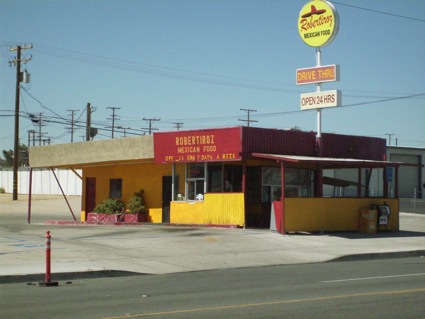
The next morning, we took a long walk along the Historic Route 66 in Barstow. The sun was incredibly bright, the air clear and very dry, and because it was so dry we didn’t feel uncomfortable walking through the desert heat. We went down a short side street where there was a big sign that read “Barstow Classification Yard,” and another sign that read “BNSF Barstow CA.” Carol stood around waiting while I took some photographs of the rail yard beyond. We walked past that, taking photographs of the motel and restaurant and other signs next to or on buildings along the highway: “Palm Court American-Chinese Food”; “Yahweh Flooring”; “Entrance /Low Rates / Office,” with an arrow pointing, and a Hindu “Om” symbol; “Route 66 Motel / Vacancy / Free WiFi — Round Beds — HBO — Remodeled Rooms — Best Prices”; “Robertiroz Mexican Food / Open 24 Hours 7 Days a Week.”

On one side of the highway, side streets led to neat modest homes; on the other side of the highway, beyond the Barstow Classification Yard, we could sometimes see the desert. If this strip of highway, with its big bright signs and bright gaudy roadside architecture, was anywhere else, it would have looked gaudy. But the highway was competing with the intense desert sun, and the glare, and the hot dry air, and it was no competition at all for the sun and glare and dry air won handily.

Driving west, we climbed up towards the Tehachapi Pass, through the high desert with Joshua trees here and there on either side. Erle Stanley Gardner, in one of his detective books, writes about driving through the desert at night and seeing “the weird Joshua trees on either side”; they do look weird, they look vaguely humanoid, but to me they have a friendly and very satisfying look to them.

Once in Tehachapi, the humidity set in. Visibility dropped, distant hills looked blue, the most distant ones disappeared in the haze, and I kept wanting to polish my glasses so I could see again. We began feeling the heat more. All during the long drive through the Central Valley, the air was blue with humidity, and the heat felt uncomfortable, even in the air-conditioned car. Finally we wound through the Coastal Ranges, and arrived at home near the shores of San Francisco Bay, where at last the air felt cool and comfortable.

from July 2, posted July 3

California Aqueduct

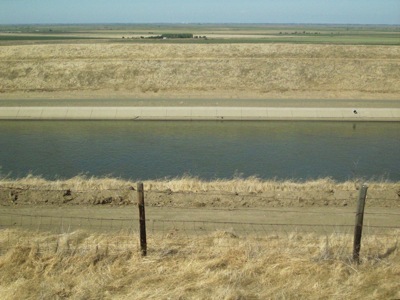
Heading north from Barstow to our apartment, driving along Interstate 5, just before where we were to turn off to take state road 152 through the Pacheco Pass, we saw a little sign reading “Vista Point.” We turned off into a narrow, dreary parking area, and looked down into the California Aqueduct. There’s an explanatory sign that tells you why the California Aqueduct is important. I admit I didn’t read it; I was too interested to look at the water flowing through the uncovered aqueduct, and the parched grass on either side, and the green irrigated agricultural fields of the Central Valley in the distance. It was a hot summer day, and as I stood there looking at the aqueduct, I wondered how much of that water is lost to evaporation on its long journey to southern California.

Navajo Nation to Barstow

We were almost the only whites in the Dine’ Restaurant this morning; and we were the only whites at the Window Rock post office; and the only whites at the Navajo Nation Museum, which doubles as a cultural center and meeting space. Of course we went to the bookstore in the Navajo Nation Museum, where, among other things, I bought I Swallow Turquoise for Courage, a book of poetry by the Navajo poet Hershman R. John. In the poem “Strong Male Rain,” John writes about his childhood fear of thunderstorms, and how he discovered that his friend “Darcy, a Jewish girl from Phoenix,” was also scared of thunder:

I told her about the Male Rain and what not to do during a storm.
She told me about Ean and his tale of the Kugelblitz.
I guess Jews and Navajos aren’t all that different.
We were both afraid of thunderstorms.
We have other past storms we were afraid of too.
She had the Holocaust
And I had America.

We drove up to the tribal park in Window Rock, and looked at the memorial to the Navajo Code Talkers of the Second World War. We also looked at the memorial that had a long list of Navajo who had died while serving in the U.S. military. Continue reading “Navajo Nation to Barstow”

From Texas to Navajo Nation

We left Amarillo and drove across the flat plains to the west. Everything looked frighteningly dry: the grass wasn’t even brown from lack of water, it was bleached almost white.

At lunch time, we got off the interstate and followed Historic Route 66, as it is called in New Mexico, through Santa Rosa. We pulled in to a restaurant called “Route 66.” A man got out of a truck marked “City of Santa Rosa” and walked in in front of us. I figured it was a good sign that a city worker was going to eat there. Inside, the restaurant was well kept, with lacy curtains in the windows, Route 66 memorabilia on the walls, and pretty red and white artificial flowers in vases on the tables. It seemed like just about everyone eating in the restaurant knew each other; one older man stopped at nearly every table to greet people on the way to his table at the back of the restaurant.

A distinguished looking man with salt-and-pepper hair, wearing a sport shirt and new and neatly pressed blue jeans, stood at the cash register. He asked us with a soft Spanish accent how our meal was. We got to chatting about the weather. “It’s the driest year ever since they’ve been keeping records,” he said in his soft voice. When he learned we were from California, he asked, “How is it there?” “We’ve had a wet year,” I said. “And cold,” said Carol, “our tomatoes just aren’t growing.” He shook his head at this news: wet and cold! Continue reading “From Texas to Navajo Nation”

Heading west

We got a late start this morning, and didn’t leave Van Buren, Arkansas, until nearly noon. After we had been driving a bit, we turned off at a sign that said “Oklahoma Welcome Center,” and turned into the poshest rest stop I think we’ve ever seen. It was staffed by three volunteers. One politely asked me if she could help me with something, and I said, “No thank you, I’m just waiting while she checks email,” pointing to Carol, who was sitting an a very comfortable armchair enjoying the very fast Internet service. “In that case,” she said in her Oklahoma drawl, “I’ll just kill flies,” and, picking up a flyswatter, proceeded to do just that. “Do you keep score?” I said. “No,” she said, “and I’m not doing a very good job, either,” as she missed a fly for the third time.

As we drove through eastern Oklahoma, I noticed that the land looked much greener and much less dry than it had when we drove east a couple of weeks ago. Clearly they had had rain since then.

At exit 200 for Seminole, Oklahoma, we turned off to see if Robertson’s Ham Sandwiches was open. We had seen their distinctive red-and-white billboards heading east, but we had arrived after they closed. They were open. There wasn’t much on the menu but ham sandwiches, so we each had a double ham sandwich for less than five dollars. We sat at one of the wood tables to eat our sandwiches. It was about the best ham I’d ever eaten in a ham sandwich.

We turned off the interstate at El Reno, Oklahoma. Continue reading “Heading west”

Still in the South

Our goal for our driving vacation this year was to see the South. We saw some southern cities — Birmingham, Memphis, Nashville, Charlotte — and we saw a little bit of the country — Natural Bridge and San Mountain in Alabama. Now here we are in Van Buren, Arkansas, and tomorrow we drive in Oklahoma.

I feel that we’re still in the south here. The air is warm and damp, and the trees and plants are all very green. When you walk across some grass or under trees, you can smell the earth and the vegetation. Distant hills are blue. The people say “y’all,” and it’s easy to find a place that serves turnip greens or green beans cooked up with bacon, or some fried okra.

By tomorrow night, we’ll be in Amarillo, Texas. The air will be dry, there won’t be those rich smells at night, the trees won’t be nearly so green. People will still say “y’all,” but it won’t be quite the same. We’ll be headed back towards home, towards the far West.

The last of my general assembly reporting

A few last posts by me on the uuworld.org GA blog:

Scholars of color assess UU history, report on brief talks by Rev. Mark Morrison-Reed, Rev. Monica Cummings, and Rev. Patricia Jimenez.
Music and cultural change in UUism, interviews with UU musicians Nick Page and Jeannie Gagne.
Commission on Appraisal continues study of ministry and authority, covering the Commission on Appraisal’s report to GA, and brief interview with Megan Dowdell of the Commission.
Moderator’s report: All of us working together, covering Gini Courter’s report to GA.

As before, comment here, or comment on the posts themselves.

(Earlier links to my reporting are here, and here.)