Carol had to do some business last night after I went to bed, so I got up before her and went to the truck stop restaurant next to our motel to buy a protein-filled and fat-filled breakfast of bacon and eggs. While I ate, I read The Des Moines Register. The 90 point headline proclaimed: “A BANNER DAY FOR GAY RIGHTS”. Three quarters of the front page was devoted to articles on Monday’s Supreme Court rulings. Four of the inside pages, and half the editorial page, were devoted to gay marriage. The Des Moines Register made sure to point out the important role Iowa has played in the recognition of equal marriage rights:
“In 2009, Iowa became the third state to legalize same-sex marriage, when the Iowa Supreme Court ruled that a state ban on same-sex marriage violated equal rights embedded in the state constitution.
“The Iowa case, Varnum v. Brien, helped pave the way for Wednesday’s Supreme Court decisions, said Randall Wilson, legal director of the American Civil Liberties Union of Iowa.
“It was only after (Varnum) that we saw that opinion was starting to change around much of the country,” Wilson said. “And it’s the Iowa tradition of being on the forefront of civil rights.”
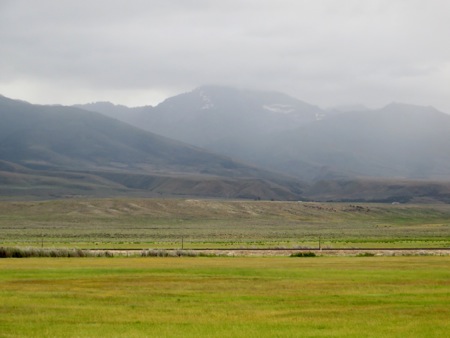
It was so green in Iowa! I couldn’t get over how green the gently rolling hills looked as we drove through the Iowa landscape. The trees were astonishingly green; the grass by the side of the road, although it showed just a little bit of summer gold, was green; the corn, not quite knee-high, filled the cultivated fields with deep green; the soybeans were green; everything looked green except for the occasional white farm house, silver silo, gray-brown weatherbeaten and collapsing barn, and the white cement roadway stretching in front of us. The great drought of the past few years is over; and the open water standing in the bare, low corners of the fields showed that an excess of rain, while making everything green, has given the farmers the opposite problem: wet and flooded fields.
We decided to stop in Iowa City to buy lunch at the coop. We didn’t know where the coop was, nor if there even was one any more; when we made this trip in the opposite direction ten years ago, we thought that there would be a coop in a college town, and we navigated to it by instinct; but now Carol just consulted her phone, which gave the address and phone number of the coop. We decided to call the coop for directions, and a nice young man asked if we were coming from the east or the west, and then told Carol to take exit 249. Exit 249 was a good five miles east of the main Iowa City exit, but we took it anyway, thinking that a polite young man who worked at the coop would have local knowledge that we should take advantage of. The directions he gave us had us drive in on Rochester Avenue and turn left on Jefferson, but we discovered that Jefferson paralleled Rochester. We gave up on the directions. By instinct, we found the Unitarian Universalist church, and parked beside it. New Pioneer Food Coop was just behind the church parking lot; this was not unexpected, since fifty years ago there were many Unitarian Universalists were involved in helping to start food coops.
We stocked up on lunch food at the coop, and then drove to the next Iowa rest stop, where we ate at a shaded picnic table, while watching clouds building up to the north. The clouds kept building as we drove through Illinois and then entered Chicagoland, the vast sprawling mix of suburbia, industry, and occasional fields of corn and soybeans that extends nearly halfway across Illinois from Chicago itself. It was nearly rush hour. Traffic started getting heavy, and the drivers started getting more aggressive and ruder. We thought of pulling off the highway and eating dinner somewhere. We took the exit to Minooka, Illinois. There was nothing in Minooka; nothing, that is, except for sprawling housing developments with big stone gates inscribed with the name of the housing development. One development was called Indian Ridge; the name was a blatant lie, for the Indians had all been killed off in the Blackhawk War of the 1830s, and this particular housing development stood on a particularly flat stretch of ground.
We gave up finding food in Minooka, and braved Chicagoland rush hour. Chicagoland was so soul-suckingly dreary that we drove clear through to Chesterton, Indiana, where we stopped to have dinner at a Round the Clock restaurant, where our waitress called us “sweetie,” and where we had free wifi and apple pie.
By now it was dark, and we drove through intermittent rain and darkness until at last we reached Auburn, Indiana. We had hoped my sister could drive up an meet us here for breakfast, but she came down with Clostridium difficile, one of those very unpleasant illnesses which makes you want to stay close to home, and which makes your friends and relatives choose not to visit you just in case you forget the sterilization protocols. We decided to wave to her from here: Hi, Jean!