Stow, Massachusetts, to Fredonia, New York

We left the house of Carol’s dad and his wife at about half past nine this morning, and started driving west. We drove down Interstate 495 to 290 to 90, through the hills of central Massachusetts. I lived most of my life in relatively flat eastern Massachusetts, where small hills rarely rise more than a couple of hundred feet above the general level of the land, where the rivers may take several miles to drop a few feet, where eskers rise up out of swamps. Stow is a few miles to the west of where I grew up, on the edge of the central Massachusetts hills. This part of Massachusetts was settled in the mid-eighteenth century, reached a peak in population half a century later, and in some areas is still less populous than it was in the nineteenth century. The soil is relatively poor and as soon as the rich land west of the Hudson River opened up, people began to leave central Massachusetts. When I did some supply preaching in north central Massachusetts a decade ago, it was hard to find a full-time job, and the great hope of economic salvation was that the commuter rail would extend out far enough that people could commute to the great economic engine that is Boston; the commuter rail never got extended, and I have little doubt that the Great Recession made things worse, not better.

Nevertheless, the tree-covered rolling hills, dotted with crooked roads and clapboard houses, are beautiful; a subtle beauty equal to the dramatic beauty of the California coast. On a hot summer day like today, I think the central Massachusetts hills are more beautiful: the moist air makes distant hills look blue, giving a delightful sense of distance; and the wet spring has made all the vegetation incredibly green.

We climbed up through the Berkshires, reaching an elevation of 1,724 feet; we will not reach that elevation again until we get to Hamilton County, Nebraska. Hamilton County, with a total area of 547 square miles, has a total population of fewer than 10,000 people; Berkshire County, with an area of 947 square miles, has a total year-round population of over 130,000, and a summer population higher than that.

As we drive through New York state, I read aloud to Carol from the newspaper coverage of the aftermath of the acquittal of George Zimmerman in the killing of Trayvon Martin. Neither of us was surprised that Zimmerman was acquitted. Carol wondered how the prosecutors allowed a jury to be seated that had no black people; I wondered how Florida could be so stupid as to have a law on the books that basically legalizes murder. I read aloud a quote in the newspaper story that captured something else I was thinking: if Zimmerman had been black and Martin had been white, odds are pretty good that the outcome of the trial could have been different.

After a boring, uneventful drive, we arrived in Fredonia, New York, at about half past six. It was still hot and humid, but we immediately went for a walk so we could stretch our legs. A block or two from our hotel, we came to small cemetery. A plaque facing the street read:

“The Pioneer Cemetery, Town of Pomfret. This site was given by Hezekiah Barker for a cemetery and the first burial here was in 1807. There are 15 known Revolutionary soldiers and many other earlier settlers of Pomfret resting here in this pioneer cemetery. This marker placed by the Pomfret Town Board — 1977. Elizabeth L. Crocker — Town Historian.”

I would not be surprised if at least some of the people buried in this cemetery were originally form the central hills of Massachusetts. I could not find any of the older grave stones that were still legible, though there were a number of old slate stones that were broken or shattered by frost and moisture. Most of the stones that were legible were less interesting mid- to late nineteenth century stones. But I did find one attractive stone, obviously hand-lettered, lying flat on the ground where it had fallen long ago:

BlogJul1513

The inscription, as near as I could make it out, reads: “In memory / Lucyett Smith / Who Died July 16th, 1846 / Age 19 years 3 Months & 1 day.”
Wedding

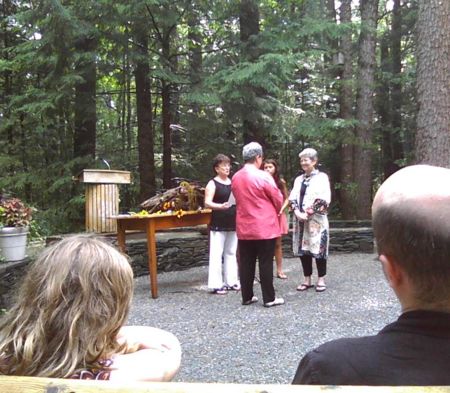
Saco, Maine — I’m at Religious Education Week at Ferry Beach, the Universalist conference center in Maine, taking a class in religious education. One of the people in my class had a big church wedding down in Texas several months ago, which wasn’t a legal wedding because she and her wife are both women. With the recent Supreme Court decision against the federal Defense of Marriage Act (DoMA), their advisors told them that they should have another wedding in a state which sanctions same-sex marriage; Maine, of course, is one of those states. So right after class was over, we all walked over from where we were meeting to the chapel in the grove, and there, under the pine trees still dripping with rain from a passing shower, they were legally married in a brief but meaningful ceremony.

BlogJul1113

Our teacher and one of our classmates were the witnesses who signed the wedding documents. They fed us cake and champagne after the ceremony.

It is worth stating the obvious: one effect of the recent Supreme Court decision is (and will be) marriages like this one; even if a same-sex couple can’t be legally married in the state in which they reside, by getting legally married in a state which recognizes same-sex weddings, they can still access some federal marriage benefits. (And I’m thinking that if I’m asked, I would perform such brief ceremonies for out-of-state same-sex couples at no charge.)

Independence Day, Acton, Mass.

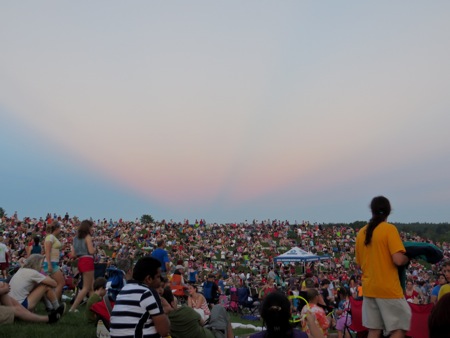
Independence Day in Acton, Massachusetts: It was blazing hot and the sky was a perfect New England blue with a few clouds. We went to Nara Park. The chair of the Board of Selectmen read a proclamation. Someone read the Gettysburg Address, then a color guard in Civil War uniforms fired their rifles. I ate a pulled pork sandwich I got from the Lions, Abby had fried chicken from a food truck, Jim ate a hotdog, Carol ate some of my potato chips. A Beatles cover band played. We left before the fireworks so we could sit in Abby and Jim’s living room and watch “Little Britain.” We went to bed late.

BlogJul0413

Above: Independence Day sunset, Acton, Mass.

Albany, New York, to Alice’s Restaurant in Stockbridge, Massachusetts

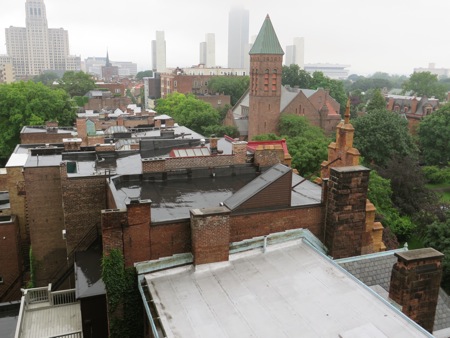
The view out our eighth story window when we got up in the morning showed wet roofs on buildings you don’t see in the Bay Area: chimneys and ornamental brickwork from the first half of the nineteenth century mixed in with newer brick buildings and one or two older wood frame houses.

BlogJul0113a

Carol remarked that the neighborhood we’re in looks like some of the older parts of Washington, D.C. While she was in a thrift store looking for a raincoat, I walked around Lark Street and Willet Street admiring the brickwork, ornamental ironwork, and bay windows on the townhouses (they were too grand to call rowhouses), and the old stone Methodist church around the corner from our hotel.

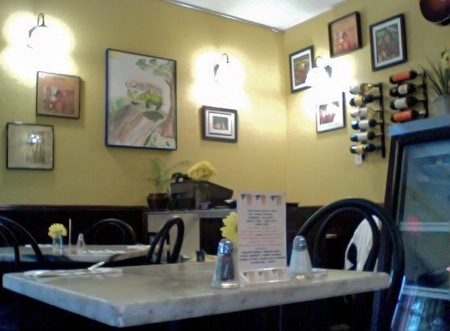
A short uneventful drive brought us to Stockbridge, Massachusetts. We stopped for lunch at small restaurant down a short alley, that held just eight marble-topped tables. The sign our front said, “Teresa’s Restaurant, formerly Alice’s Restaurant.” On the walls were a framed album cover of Arlo Guthrie’s “Alice’s Restaurant,” a small steel string guitar singed by Arlo Guthrie, a painting of a 1960s-vintage VW bus, several framed articles from various publications featuring Arlo Guthrie and Alice’s Restaurant, along with a framed photo, dated 1997, showing Alice, Arlo, and Teresa.

BlogJul0113b

We are less interested in being in the restaurant made famous by Arlo Guthrie’s anti-war song than in finding a place that has good inexpensive lunches — I had a pretty good turkey burger, and excellent sweet potato fries — and, more importantly, in finding a place with free wifi. We’re not sure if we’ll have wifi the next few days. Carol’s dad and his wife were the winning bidders on a Berkshires summer house at a fundraising auction at their Unitarian Universalist church, and we’ll be staying there with them, and my dad and his best friend — but we don’t know if there will be wifi, so we have to get our Internet fix now. In the mean time, I’ve had the refrain of Arlo Guthrie’s famous song running through my head: “You can get anything you want / At Alice’s restaurant.”

Macedonia, Ohio, to Albany, New York

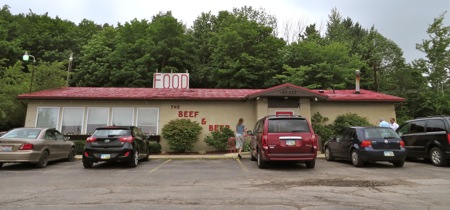
We stopped for an early lunch just inside the Ohio border at a truck stop. But the truck stop only had one of those miserable fast food joints, which cannot even be dignified with the title of restaurant. But we looked across the road from the truck stop, and there perched on the top of a little hill was a sign proclaiming in big red letters FOOD. Another, smaller, sign, read: The Beef and Beer Popular Sandwiches and Famous Beers. The decision was made easily, by consensus, and almost instantaneously: we went to The Beef and Beer. The food was a little greasy, but good. The waitress gave me some sauce to go with my sweet potato waffle fries, saying, “There’s you sauce, it’s nummy.” It was indeed nummy: some kind of cinnamon sugar sauce, but not too sweet, a perfect match for the sweet potato fries.

BlogJun3013

Soon we were on the New York Thruway, which is not a particularly pleasant road to drive. The goal of the New York Thruway is to get as many vehicles as possible to their destinations without letting them off the highway, and while charging them substantial tolls. We stopped at one of the service areas near Rochester. It wasn’t too terrible. It had the usual crummy fast food, but it also had a player piano that played constantly. This rest area was crowded, presumably with people coming back from or heading off to summer destinations for the week of July 4. It wasn’t too bad a service area, but I was glad to get back in our car and start driving.

There is a point on the New York Thruway where the road has to pass through a gap in the hills between the Adirondack and Catskill mountains. Here the Mohawk River, enlarged to carry the traffic of the Erie Canal, the railroad that used to be the New York Central, the interstate highway, and a smaller state highway all come close together to pass through the tree-clad hills that rise dramatically and steeply up on either side. It’s a dramatic stretch of road, and I’d been looking forward to seeing it again, but as we got closer it started raining, and by the time we got there the rain was heavy enough that traffic had slowed down to 55 miles an hour; the heavy rain obscured the view, and I had keep my eyes on the road in any case.

We arrived in Albany at a quarter to nine. After we checked into our small downtown hotel, we went for a walk down Lark Street. A sign proclaimed something to the effect of “Welcome to Lark Street, a village in the city”; I can’t remember the exact wording. We saw lots of young hipsters walking the streets and sitting outside small bars and restaurants, all of them dressed much alike, urban chic clothing carefully chosen so as not to look too carefully chosen. A flashing electronic traffic sign parked by the side of the road informed motorists and motorcyclists that a city ordinance prohibited excessively loud music coming from vehicles. About five seconds after I saw this sign, a car passed by vibrating and pulsing with excessively loud music. I had wondered how they could enforce such a city ordinance.

We didn’t walk around much. My nerves were jangled with too much driving. I bought a copy of the Sunday edition of the New York Times, and I now propose to read it until the excessively gray prose quiets my nerves and puts me to sleep; this will take about five minutes; or ten minutes, if I start by reading the book review section.

Macedonia, Ohio, to Hudson, Ohio

The only driving we did today was from our motel to to our aunt and uncle’s place in Hudson.

Once we got to Hudson, my uncle took us on a driving tour of Cuyahoga National Park: the old Ohio and Erie canal and towpath; the Cuyahoga Valley Scenic Railroad, originally the Cuyahoga Valley Line, which uses vintage diesel locomotives and passenger cars; the spectacular Brandywine Falls; and, of most interest to all of us, the heron rookery. The Great Blue Herons were still on their nests, big, ungainly, awkward-looking birds perched on huge next built of sticks high up in trees. I counted nine nests in one tree, and there were at least four trees with nests in them.

At one point, my uncle and aunt and I were sitting in the car waiting for Carol, and listening to a talk given by a professor from Case Western Reserve University. She has been doing research on Internet access and broadband usage among residents of different socioeconomic classes, races, and ethnic groups in the Cleveland area. We all know that Americans have unequal access to broadband Internet service, but this professor’s research shows more precisely who has what kind of Internet access. For example, her research shows that people whose only Internet access is through a smartphone tend to be disproportionately African American or Latino. I’m going to have to track down who this woman is, and read more about her research.

In the late afternoon, Carol and I visited a small independent bookstore in Hudson called The Learned Owl Book Shop. While I was buying a new road atlas for our trip, I got into a conversation with the woman who was staffing the store that day. She said the store was doing quite well, and has a loyal following. We both said how much we hate Amazon, a soul-less corporate entity that cares only about profit, and about crushing all competitors. I told her about a post on Melville House blog (Melville House is a small independent publisher who recently released The Science Delusion: Asking the Big Questions in Culture of Easy Answers, of interest to religious liberals) that is titled “There are exactly zero defensible reasons for authors to link to Amazon.” She was amused. Carol and I spent an hour at The Learned Owl; amazingly, this is the first visit to a book store we have made on this trip.

We joined my aunt and uncle, and my cousin and her husband, for a pleasant dinner. We talked a little about education and autism, which my cousin’s work deals with, and a little about multiple sclerosis research, which relates to her husband’s work; but mostly we talked about family.

And when Carol and I got back to the motel, we watched the episode about Cleveland cuisine from Anthony Bourdain’s TV series “No Reservations.” Head cheese, chili, sausage, and postmodern midwestern cuisine — we decided we have to come back to the Cleveland area soon.

Auburn, Indiana, to Macedonia, Ohio

Because we were going to have a short drive today, less than four hours, we did a few errands in Auburn before we started driving: Carol went to the Salvation Army store to look for a hat, and I went to get the oil changed in the car. The workers in the oil change place were perhaps the nicest, friendliest, most courteous workers you could imagine. They finished the oil change so quickly it surprised me, and I drove over to wait for Carol. While I waited for her in the parking lot, enjoying the cool, dry air that followed the cold front, I heard a child’s voice ask, “Can we get pizza, ma?” and a man’s voice replied without emotion, “Shut up.” I watched the family walk past our car to another parking place: a man, a woman, and three children between the ages of five and eight, none of them saying a word or looking at each other. I decided not to make generalizations about the people of Auburn, Indiana, based either on the nicest workers imaginable, or on the father who told his child to shut up. People are about the same everywhere: some are very nice, some are the opposite, and most of us are a mixture of both.

We stopped at a rest area outside Toledo to eat lunch. I bought the Toledo Blade, which bragged on its masthead that it is one of American’s great newspapers. But the Toledo Blade left no impression on me whatsoever.

As we ate, dark clouds moved in and a wind whipped up. Soon after we got back on the road, it began raining so hard that traffic slowed down to thirty miles an hour, and once there was enough water on the roadway to engage the antilock braking system (ABS); our old car had not had ABS, so it was a new experience for me to feel the brakes pulsing while I kept a steady pressure on the brake pedal. At about this time, the odometer clicked over to 100,000 miles; I had meant to watch for this singular event, but the visibility was so poor, and the driving required so much attention, I missed when it happened. I hope this car lasts another 100,000 miles; we like it, and it has delivered up to forty miles per gallon for us.

We arrived in Macedonia, Ohio — a few minutes before another thunderstorm passed through — checked in to our motel, and went to have dinner with my aunt and uncle and cousin, at the retirement community my aunt and uncle live in. The day was relatively uneventful, but the evening was filled with family conversation.