Web of relationships

Today I was at Pescadero Marsh to look at live birds, but the dead things proved more interesting. It was just after low tide, and I saw two empty crab shells (prob. Red Crabs, Cancer productus), looking as though they had been eaten by gulls; interesting, but a pretty common sight, and it’s more interesting to actually see a gull eating a crab. Then I found the empty shells of two small crustaceans, organisms I’d never seen before. Here’s one of them:

BlogMar1215a

I have no idea what species this is, though I suspect it’s a fairly common organism.

Later, I walked along the dike near Butano Creek, and came across a dead mole (the notebook next to the mole is marked in inches):

BlogMar1215b

Given the size of those front feet and the short tail, I’d say it was a Broad-footed Mole (Scapanus latimanus). This is the third dead mole I’ve found in six months.

What interests me when i see dead things in the field is trying to figure out how they died, and how they are tied in to the ecosystem. The Red Crabs were easy to figure out — probably eaten by gulls. But why did that little crustacean die? it didn’t look as though another organism had tried to eat it, so was it simply left high and dry at low tide? As for the Broad-footed Mole, there was a definite hole in the other side of the animal, which could have been made by a bird’s bill; I saw Red-tailed Hawks and Northern Harriers hunting in the marsh; perhaps a raptor killed the mole, then got scared away before it could eat.

These are just possible scenarios; I’ll never know what really happened; but what I do know is that somehow these dead creatures reveal something about the web of relationships between organisms.

Pescadero Marsh

Pescadero Marsh

I went for a walk in Pescadero Marsh for the first time today. It’s a pretty remarkable place. It encompasses a variety of habitats, including pickleweed salt marsh, freshwater marsh, riparian corridor, sandy beach, old sand dunes, etc. Birdlife ranged from birds typical of beaches, like Sanderlings and Black Turnstones; to birds typical of freshwater marshes, like Marsh Wrens and Common Yellowthroats.

There were signs of other resident animals as well. Along the edge of Pescadero Creek, you pass by what look like big piles of sticks, but they’re actually houses built by Dusky-footed Wood Rats (Neotoma fuscipes). In the photo below, the tape measure at lower left is extended to 12 inches (300 cm); so this particular wood rat house is about four feet high (1.3 m).

house of Neotoma fuscipes

From a little further down the same trail, you can see a Great Blue Heron rookery. Their nests look like big piles of sticks, piles that may be three or more feet from bottom to top, that somehow got stuck high up in the branches of dead trees. I counted at least eight herons sitting on nests — four foot high birds roosting on three foot high piles of sticks thirty or forty feet above the ground.

immature Phalacrocorax auritus

On a secluded part of the beach on the other side of Highway 1, an immature Double-crested Cormorant (Phalacrocorax auritus) was too stupid, or too dazed, to move away when I walked past it. It stood quite still while I took its photo (above). The other birds and animals I saw were far less trusting than this cormorant: as soon as humans came into view, they flew or scuttled away out of danger. Except for the fifty or so Elephant Seals I saw lying on the rocks out beyond the beach: they did not seem to pay any attention to the humans walking on the beach; but then, they were well out of reach of any meddling humans, protected by a couple hundred feet of surf and slippery rocks.

The story of Kisa Gotami, and women in early Buddhism

Generations of Unitarian Universalist children have learned the story of Kisa Gotami since it was first included in Sophia Fahs’s classic Sunday school text, From Long Ago and Many Lands. That book was published in 1948, and I included the story in an updated version of From Long Ago that we still use in Sunday school today.

But I’ve become increasingly uncomfortable with this story for its depiction of the state and status of women. Kisa Gotami’s story shows that the Buddha accepted that women were able to follow his path to liberation. At the end of the story, the Buddha ordained Kisa Gotami as a nun, and she “quickly attained arhantship,” and Buddha praised her accomplishments. (1)

But this does not mean that Buddha and the early Buddhists considered women to be the equals of men. Early Buddhism was part of a patriarchal society. Buddha did acknolwedge that women were able to follow the path to liberation (as Kisa Gotami does), but early Buddhist women also were required “to submit to the standards of male control.” (2)

And early Buddhist writings tend promote the following negative stereotypes of women:
“1. A woman is stupid; a beautiful woman has no brains.
2. A girl should be a devoted daughter, and agree to the arrangements made for her by her parents and inlaws.
3. A woman in only concerned with her body, her clothes, and her jewelry.
4. A woman is sensual and seductive, and should therefore be under male control.
5. Children and relatives are a central concern in a woman’s life. Female reproduction i painful and having children binds womend to the world of matter.
6. Women who are old are ugly and useless. A woman’s body is an example of impernance and decay.” (3)

The story of Kisa Gotami plays into these stereotypes, as does the poem attributed to her that is found in the Therigatha, a collection of early Buddhist poems supposedly written by women. Kisa Gotami’s poem in the Therigatha includes the following:

“Being a woman is suffering,
that has been shown by the Buddha,
the tamer of those to be tamed.

“Sharing a husband with another wife is suffering for some,
while for others, having a baby just once is more than enough suffering.

“Some women cut their throats,
others take poison,
some die in pregnancy,
and then both mother and child experience miseries.” (4)

This poem stereotypes women by saying that the suffering a woman feels is due to her reproductive biology and her social status — whereas, for example, her suffering is not due to her intellect. So we can admire the Buddha for going beyond some of the stereotypes about women that held sway in his time and in his land, when he acknowledged that women could follow his path of liberation. Yet we must also recognize that early Buddhism was run by men, and that the early buddhists (including the Buddha himself) were not able to let go of their negative stereotypes of women.

So I think I’m going to have to rewrite that lesson plan on Kisa Gotami to include some more pointed feminist critique of the story….

Notes:

(1) Rita M. Gross, Buddhism after Patriarchy: A Feminist History, Analysis, and Reconstruction of Buddhism (Albany, N.Y.: SUNY Press, 1993), p. 53.

(2) Ria Kloppenberg, “Female Stereotypes in Early Buddhism: The Women of the Therigatha,” in Female Stereotypes in Religious Traditions, ed. Ria Kloppenberg and Wouter J. Hanegraff, (Leiden, Netherlands, and New York: E. J. Brill, 1995), pp. 152.

(3) Kloppenberg, pp. 153-154.

(4) Therigatha: Poems of the First Buddhist Women, trans. Charles Hallisey (Cambridge, Mass.: Harvard University Press, 2015), pp. 111 ff.

Yolo Bypass Wildlife Refuge

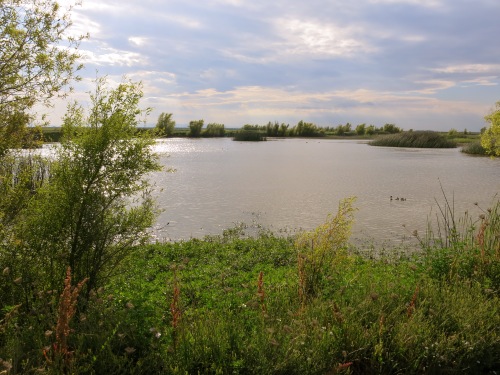
This afternoon, I spent about three hours at the Yolo Bypass Wildlife Refuge, some 25 saure miles of managed habitat for waterfowl just east of Davis, Calif.

Yolo Bypass Refuge

Above: Yolo Bypass Refuge, near parking lot B.

A huge portion of California’s Central valley — about four million acres — was once wetlands. These vast wetlands once provided a winter home to uncounted waterfowl, and resting places for migrating birds. Today there are only 395,000 acres of Central Valley wetlands. (David Carle, Introduction to California Water [University of California Pres, 2004], pp. 37-40).

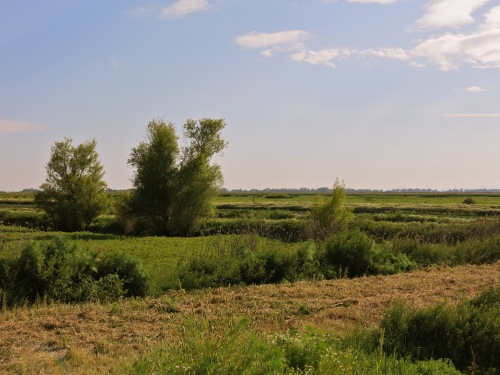
BlogFeb2715b

Above: Looking west across the wetlands, with the Coastal Ranges visible in the distance.

Even though Yolo Bypass Refuge is heavily managed by humans, and even though Interstate 80 and the skyscrapers of Sacramento are visible from everywhere in the refuge, being there gave me something of a sense of what the pristine Central Valley wetlands must once have been like: birds everywhere, birds in the tens of thousands: ducks, curlews, egrets, heron, owls, blackbirds, sparrows, ibises, coots, falcons, doves, harriers; all those birds supported by the amazing fecundity of the wetlands.

BlogFeb2715c

Above: Sunset near parking lot A.

In three hours of desultory birding (and I’m not a very good birder), I saw forty different species of birds. And I only had time to visit one small corner of the refuge. The vast expanse of wetlands, the diversity of the fauna, the beauty of the land — simply amazing.

“Good Morning, Blues”

When the New York Times Book Review asked which literary figure was overdue for a biography, Ayana Mathis argued for Albert Murray. She was persuasive enough that I decided I had better read some Murray, and that led me to the book he co-wrote with Count Basie, Good Morning, Blues: The Autobiography of Count Basie: a book for which Basie supplied the reminiscences, and Murray wrote the text.

Good Morning, Blues reminds me of Anthony Trollope’s Autobiography: both books are, above all, a record of how one artist worked; Trollope was a writer and Basie was a bandleader, which makes for some significant differences, but both are really books about work. Just as Trollope’s autobiography is filled with details of how he came to write his various books, Basie’s autobiography is filled with details of the various bands and combos he put together. The most interesting part of both books comes early on, when the artist serves his apprenticeship; the least interesting part is the ending, but then, autobiographies can never come to a interesting ending because the ending of a life story that we really want to know about is how the person died.

Because Basie’s book is about his work, he avoids dishing dirt, fanning the flames of feuds, or talking much about his personal life. “I don’t want to get into all that,” Murray frequently has him say, and in fact I can just about hear Count Basie saying exactly those words. Basie passes lightly over his first experience of the South’s Jim Crow laws (though he says from his point of view, there wasn’t much in Jim Crow that he hadn’t already experienced in the North). He spends less than two pages on his wife’s death, and perhaps a paragraph on his daughter’s birth. He spends a couple more pages on his own heart attack, but then his heart attack meant he had to take time off from work.Aside from that, he talks about his work — though as Murray has him say: “But truthfully, playing music has never really been work.” Again, you can just about hear Basie saying exactly those words; Murray gets his voice just right, and makes it feel as though it’s Basie’s words you’re reading, even though you know that this book has been carefully writer by a master of American prose style.

I like his music, but I was never a big fan of Basie’s, and sometimes the book devolves into a jazz fanboy’s dream with a little too much minutiae about who played tenor at one specific recording session, and who “cut out” just before which gig at the Famous Door in New York City, and who filled in for them, and so on. But I tolerated all that, and even read it with interest because obviously Basie himself cared a great deal; as a bandleader, who played with him, who was in the band, which personalities were involved in making music at a certain point of time, is of critical importance.

When I finished reading, I had all sorts of unanswered questions about Basie’s life. What about all those hard feelings that are hinted at, then dismissed with, “I don’t want to get into all that”? What about the hints of tough times in his family life? What about the racial discrimination that — to use his phrase — “sepia performers” had to put up with? In the last few pages of the book, Murray has Basie address this last question:

“If I haven’t spent a lot of time complaining about all of these things, it’s not that I don’t want anybody to get the impression that all of that was not also a part of it. It was. So what? Life is a bitch, and if it’s not one damn thing, it’s going to be something else.”

For Basie, what was most important was his work. That’s what he wanted to tell about. And that’s what Albert Murray perfectly captures, making Basie’s words echo the jazz he played, so even the prose style is just what you’d want to hear from a bandleader who cared most about the work. So rather than bothering with trying to read up on Basie’s life, I went online and listened to a whole bunch of his music, from the 1930s right up to the 1980s. Nothing else I could read was going to be as good as Albert Murray’s book, anyway.

Count Basie at the piano in 1964

Above: Still from “Jazz Casual” television program, KQED, 1964 — looking over the shoulder of jazz guitar great Freddie Green, towards Basie at the piano. Clicking on the photo takes you to the half hour show on Youtube, which features Basie’s rhythm section in 1964: Basie on piano, Green on guitar, Sonny Payne on drums, and Norman Keenan on bass.

Tenth anniversary

On February 22, 2005 — ten years ago today — I published the first post on my blog. If you want, you can read the first post here. I’ve posted a summary of how the blog started elsewhere, so no need to rehearse that history now.

Ten years is a long time in the world of social media. When I started this blog in 2005, blogs were about ten years old, and their popularity was still rising as we migrated away from the command-line interface of the old social networks like Usenet to the amazing world of the Web. In 2005, MySpace was arguably the coolest social network, LiveJournal had just been purchased by Six Apart, and Facebook was limited to students in Ivy League colleges. How things have changed.

We are in a vastly different social media landscape today. A great deal of social media now happens away from the Web, in the social universe of texting and phone apps. Web-based social media has become dominated by for-profit companies which are really in the advertising business, not in the social media business. Blogging itself has become dominated by for-profit publishing companies like the Huffington Post. A great many amateur bloggers have discovered that it’s much easier to put your thoughts out on Facebook or Twitter or Pinterest.

Yet in spite of all the changes in the social media landscape in the last ten years, there still appears to be a place for blogs written by amateurs. Blogging continues to be a fairly interesting publishing platform, one that attracts some fairly interesting writers. With that in mind, what better way to celebrate the tenth anniversary of this blog than by pointing you to some blogs that I continue to read:

Charlie’s Diary, written by SF writer Charles Stross, along with guest bloggers and a host of literate commenters, brings back the glory days of blogging — heck, this blog takes me back to the glory days of Usenet, when intelligence, snark, wit, and seriously geeky knowledge ruled social media. Still more fun than Facebook or Twitter.

• I’ve been reading Hoarded Ordinaries off and on for over a decade. Sometimes the subject matter is trivial (this happens to every periodical; even Dr. Samuel Johnson wrote some real crap for The Rambler); sometimes the writing sounds a little too much like the creative nonfiction I used to hear in writing workshops. But Hoarded Ordinaries remains a fine example of the best of amateur blogging, and I keep going back every few months to check in.

• Scott Wells is still writing about religion at Boy in the Bands, and after more than a decade of reading him I still find it worthwhile to listen to what he has to say. This is one of the few religion blogs that I read regularly. I’ll admit my bias: Scott’s one of the few Universalists on the Web, and sometimes I read his blog just to get my fix of Universalism.

• Another religion blog that I read regularly is Roy King’s Mediterranean Wisdom. Roy’s training as a psychiatrist (and former professor of psychiatry at Stanford) and his training as a minister informs his writing about religion, which makes for some interesting reading. Since Roy is also a Universalist, I’m probably biased in his favor, but I can still recommend his blog.

A final note: It’s thanks to readers like you that amateur blogs remain viable. Thank you for supporting these independent voices!

Malcolm

Malcolm X was shot to death on February 21, 1965 — fifty years ago.

Of the two most prominent figures of the Civil Rights Era, I feel more religiously aligned with Malcolm X than with Dr. Martin Luther King, Jr. I find Dr. King to be a forbidding figure. Dr. King’s writing, his preaching, and his speaking were all extraordinary. Dr. King not only stayed true to his principle of non-violence in the face of actions that would make just about anyone else retaliate in anger, but he also managed to lead his many thousands of followers to maintain their commitment to nonviolence as well. Dr. King intimidates the hell out of me, and makes me realize my own utter inadequacy as both a minister and a human being.

Of course, Malcolm X is a forbidding figure as well. His father was murdered by whites, and his mother then went into an insane asylum, leaving Malcolm X effectively an orphan. Malcolm was imprisoned, yet in prison he had a religious awakening, got himself straightened out, and educated himself. He wound up becoming one of America’s most compelling religious leaders. Malcolm X intimidates the hell out of me, too: I have no doubt I would crumple under that kind adversity, and he too makes me realize my own utter inadequacy as both a minister and a human being.

I’m a pacifist, but I still feel more aligned with Malcolm X than with Dr. King. I think it’s because I better understand Malcolm X’s way of writing. He was a master of the plain style. In his book The Ballot or the Bullet, he wrote: “Three hundred and ten years we worked in this country without a dime in return — I mean without a dime in return. You let the white man walk around here talking about how rich this country is, but you never stop to think how it got rich so quick. It got rich because you made it rich.” This is stating a simple fact as clearly as possible. Perhaps it lacks some of the literary finesse of, say, “Letter form Birmingham Jail”; what it lacks in finesse it gains in clarity.

Reading Malcolm X is a bracing experience for me. Recently, I’ve been questioning this notion of “white privilege” that we white liberals have been playing around with for twenty-five years or so. In The Ballot or the Bullet, Malcom X writes: “Whenever you’re going after something that belongs to you, anyone who’s depriving you of the right to have it is a criminal. Understand that. Whenever you are going after something that is yours, you are within your legal rights to lay claim to it. And anyone who puts forth any effort to deprive you of that which is yours, is breaking the law, is a criminal.” This simple, clear statement puts the lie to the concept of “white privilege”; what we’re actually talking about is theft, a criminal act, a crime; it’s not white privilege, it’s white theft.

One of Malcolm X’s clearest statements comes from his Autobiography. Yes, the Autobiography of Malcolm X was written in collaboration with Alex Haley. But Haley based the book on extensive interviews and conversations, and I have enough trust in Haley’s skill as a writer to trust him to accurately record Malcolm X’s words in key passages. And when I read the following passage, I can hear the clarity of language and thought that belong Malcolm X, not Alex Haley:

“Since I learned the truth in Mecca, my dearest friends have come to include all kinds — some Christians, Jews, Buddhists, Hindus, agnostics, and even atheists! I have friends who are called capitalists, Socialists, and Communists! Some of my friends are moderates, conservatives, extremists — some are even Uncle Toms! My friends today are black, brown, red, yellow, and white!”

An essential religious insight into theological anthropology; a plainly spoken insight that needs to be heard clearly by people throughout America.

Malcolm X was murdered at age 39: a sorry waste of a brilliant mind.

Amphibian

This afternoon I was walking in Purissima Creek Redwoods Open Space Preserve, through Douglas Fir woodlands, along a ridge that was about 1,400 feet aboe sea level. I happened to look down at my feet, and there was a — well, no, it wasn’t a lizard, it was some kind of salamander.

Sometimes it pays to walk slowly and deliberately. I got down on my knees to look more closely.

BlogFeb1815

I haven’t seen seen a salamander since I moved to California more than five years ago, so I stopped to watch it for a while. I placed a quarter on the ground, to give a sense of scale in the photos I was taking. The salamander obligingly stepped right on the quarter:

BlogFeb1815b

It was fun to watch it walk — it had that rolling, deliberate salamander gait, so very different from the quicker-than-the-eye sprinting done by lizards. Eventually, it walked off the trail and disappeared into the leaf litter.

When I got home, I looked on the California Herps online identification guide. I’m pretty sure it was a Rough-skinned Newt (Taricha granulosa). Another possibility would be the Red-bellied Newt (Taricha rivularis) — but the eye of my newt showed some whitish yellow, while T. Rivularis has uniformly dark eyes.

Invertebrate pitfall trap

When we humans think about the interdependent web of life, we tend to think about the relationships between ourselves and familiar organisms like mammals and trees. These are organisms that are either larger than us or relatively close to us in size, or they are taxonomically close to us. But if you conduct a survey of biodiversity in a given tract of land, the majority of non-microscopic species you find will be invertebrates, e.g., insects, spiders, crustaceans, etc. For a more realistic theological understanding of the web of life, I think it’s necessary to develop a more realistic understanding of biodiversity. It is easy and fun to feel a connection through the web of life to relatively cute organisms like rabbits, and to relatively majestic organisms like redwoods. Understanding our connections with organisms that are not particularly cute or majestic expands our idea of the interdependent web of life.

A few years ago, I participated in a blogger’s bioblitz; a bioblitz is a study that provides a “snapshot of biodiversity.” One of the tools used in a bioblitz is an insect pitfall trap; this kind of trap provides a sampling of insects and other invertebrates. I decided to place an insect pitfall trap in our front yard, so I could see some of the invertebrates that live in our urban setting.

Some online research revealed that pitfall traps made of glass are most effective (Oecologia 9. VI. 1975, Volume 19, Issue 4, pp 345-357), but the easiest way to make a pitfall trap is with nested plastic drinking cups. You dig a hole deep enough to bury the two nested cups, and pack dirt around them so that the rim of the upper cup is exactly at ground level. Then you can remove the upper cup, dump out all the dirt that fell into it when you were burying it, and then replace it. I used two nested 10-ounce clear plastic drink cups:

BlogFeb1615a

To use pitfall traps ethically, you should check them at least once a day, and either release the captured organisms or collect them responsibly. If you’re expecting rain or hot sun, you should place some sort of cover over the trap, raised up an inch or two. The cover will keep rain and sun out, but still allow invertebrates to crawl into the trap. If you’re no longer going to use the trap, pull it out of the ground.

Here’s what I found in my pitfall trap this afternoon:

BlogFeb1615b

The large organism appears to be in the genus Stenopelmatus; from looking at online identification guides, I’d guess this organism is probably a Dark Jerusalem Cricket (Stenopelmatus fuscus [Haldeman, 1852]). Where does it fit into the web of life? According to the Nevada at Reno Department of Extension: “Because it is nocturnal and comes out of the ground at night to roam around, owls, including the endangered spotted owl, feed on it. Probably other nighttime predators such as coyotes, foxes, and badgers eat it as well.” As for their food sources, the Orange County (Calif.) Vector Control District (OCVCD) says the primary food sources of Jerusalem Crickets are “plant roots and tubers; however, “they also feed on other insects, even their own kind.” The OCVCD also states that Jerusalem Crickets do not pose a health threat to humans.

The other organisms in the trap — you can see something like a centipede under the Jerusalem Cricket’s left antenna — were too small for me to have any hope of identifying. Besides, if I’m going to accurately identify insects and similar invertebrates, I’d need to ask an entomologist equipped with powerful binocular microscope.

More about insect pitfall traps.

Ferguson, six months on

Six months ago today, Michael Brown was shot and killed by a police officer in Ferguson, Missouri. I did not then, and do not now, find this shooting to be astonishing. Brown’s killing was preceded by other, similar, well-publicized events. Most notably, in 2009, Oscar Grant, another young black man, was shot and killed by a police officer. And in 2012, Trayvon Martin was shot and killed by by a neighborhood watch coordinator. And on August 5, 2014, John Crawford III was shot and killed by police officers in a Walmart store. In the bare fact of Brown’s killing, there wasn’t much to astonish.

This kind of violence has been going on for a long time. W.E.B. DuBois, in his book Black Reconstruction in America, 1860-1880, wrote about the “widespread violence in the South, the murder and mobs,” that occurred during Reconstruction:

“Probably in no country in the civilized world did human life become so cheap. This condition prevails among both white and black and characterizes the South even to our day. A spirit of lawlessness became widespread. White people became a law unto themselves, and black men, so far as their aggressions were confined to their own people, need not fear the intervention of white police. Practically all men went armed and the South reached the extraordinary distinction of being the only modern civilized country where human beings were publicly burned alive.” [p. 700]

The violence described by W.E.B. DuBois no longer exists in quite that form, but it counts as its direct lineal descendant the violence that killed Oscar Grant, Michael Brown, and many others. While such violence might surprise us, it has lost its power to astonish.

But there were things about Brown’s killing that did astonish me. The initial response of police and elected officials to the protests which followed Browns’ killing was astonishingly tone-deaf — it was almost as if police and elected officials were trying to say things that would inflame tensions. The grand jury investigation was similarly tone-deaf — I sometimes felt was as if the district attorney’s office did everything they could to erode my trust.

Further, I was astonished how many non-black people actually paid attention to Michael Brown’s killing. Whether they reviled him for stealing cigarillos, or lauded him for being a hero, it seemed to me that more non-black people noticed Brown’s death than noticed the death of, say, Oscar Grant or John Crawford. White people in particular seemed to pay close attention. What drew the attention of so many of us white people? Was it the militarized police response to the protests in Ferguson that drew white people’s attention? — with some whites fearing that such militarized tactics could well be used on them, and other whites feeling safer because the police had so much military gear with which to quash protests? I don’t know. I only wish more white people could express a more nuanced view of Michael Brown, making him out to be neither a one-dimensional saint, nor a one-dimensional sinner, but rather a complex human being living in a difficult and complex world.

And I admit I was sometimes astonished by the way some whites responded to Brown’s killing. I remember seeing a video of one of the Ferguson protests where someone who appeared to be white harangued a black police officer, telling the officer that he should get rid of his uniform and join the protesters. This seemed to be another response lacking awareness of the nuances and complexity of the issue at hand.

But it is not easy for us white people to talk about race so openly. White people rarely talk about race with other white people. I can tell you this from experience:— if you’re a white person and you want to end a conversation with another white person, bring up the topic of race: as often as not, the other white person will find an excuse to end the conversation; sometimes they just walk away from you, which can feel a little strange.

If the Ferguson protests do prompt conversations about race among us white people, I will consider that a positive result. Here is W.E.B. DuBois again, from the same book, a few pragraphs after the quotation given above: “The theory of race was supplemented by a carefully planned and slowly evolved method, which drove such a wedge between the white and black workers that there probably are not today in the world two groups of workers with practically identical interests who hate and fear each other so deeply and persistently and who are kept so far apart that neither sees anything of common interest.” If the Ferguson protests provoke a wide conversation about the importance of black lives, that would be an even better result.

Those wedges DuBois talks about are driven between other racial groups in the United States as well. Somehow we have to extract those wedges that have been driven between all the races in the United States.