Nesting colonies

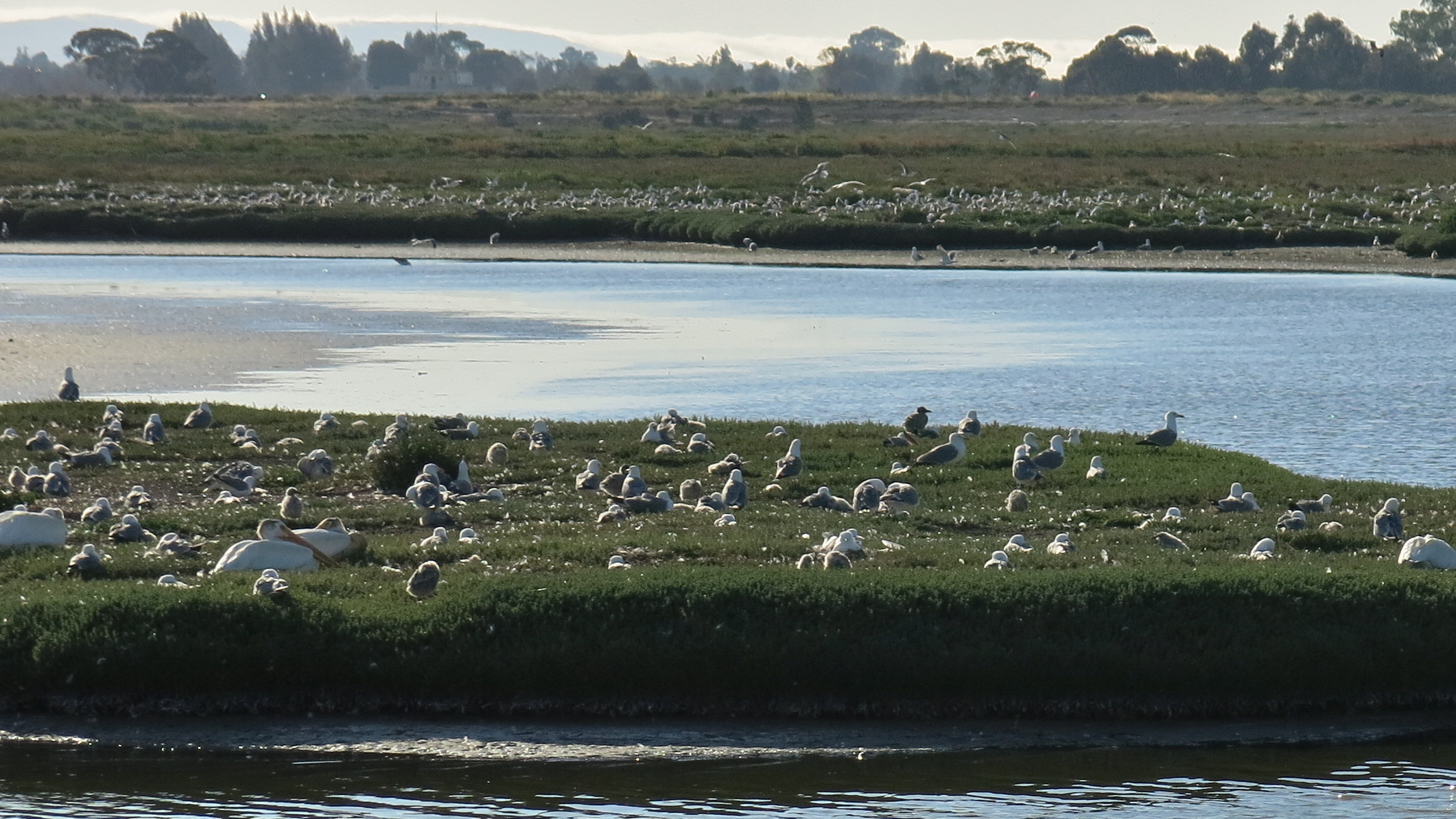
It’s nesting season, and this afternoon I managed to take some time out of a busy day to visit two nesting colonies. The first one I visited was the California Gull nesting colony at Baylands Nature Preseve in Palo Alto.

IMG_2858

The gull chicks still have their downy feathers, but they are looking pretty big, about three quarters the size of the adults. A few White Pelicans sat along one edge of the colony, seemingly ignoring the gull chicks stumbling around near them.

From there, I drove over to Mountain View where there is an egret nesting colony along a street lined with corporate offices. The only nests I saw had Snowy Egrets on them; but I also saw Great Egrets and a Black-crowned Night-heron, along with the usual suburban passerines. The nests look like Great Blue Heron nests, untidy piles of twigs jammed into tree crotches; and just as with heron nesting colonies, it’s strange to look up thirty feet in the air, and see birds that you’re used to seeing stalking through swamp water.

The sounds coming from the nesting colony were varied and interesting. It turns out egrets make a wider variety of sounds than do Great Blue Herons, everything from raucous cries like you’d imagine a dinosaur would make, to low burbling noises not unlike you might hear at a gull nesting colony.

Definitely a pleasant break in an otherwise too-busy day!

Obscure Unitarians: the Rendtorff / Meyer family

Karl and Emma E. Rendtorff were two of the key leaders of the old Unitarian Church of Palo Alto (1905-1934). Emma’s mother and sister happened to be living in Palo Alto 1905-1908, and also got involved with the church. With baby Gertrude, there were thus three generations of Meyers/Rendtorffs involved with the founding of the church.

Palo Alto was a small town, with a population of 4,486 in 1910; 5,900 in 1920 (Sawyers, History of Santa Clara County, California, 1922). The town really wasn’t big enough to support a Unitarian church, and I suspect the church never got bigger than what Arlin Routhage calls “family-size” — that is, a small church that acts more like a family, with matriarchs and patriarchs. I further suspect that Karl and Emma E. Rendtorff were two of the matriarchs/patriarchs. Their extended family is of interest for this reason alone.

But their extended family is also of interest because of the characteristics they share with so many other members of the church. Karl and Emma both spoke German, and both were associated with Stanford; as was true of many members of the church. Karl was trained as a librarian, and there were at least half a dozen other librarians who were part of the congregation; he was a pacifist, and there were many other pacifists in the congregation. Emma was a woman with a college degree in an era when that was uncommon, and she was an experienced teacher; many other women in the congregation also had college degrees, and some were experienced and dedicated teachers (like her sister and daughter).

Without further introduction, here are brief biographies of the Rendtorff / Meyer family, three generations of five fascinating people who were part of the Unitarian Church of Palo Alto: Continue reading “Obscure Unitarians: the Rendtorff / Meyer family”

Obscure Unitarians: Melville B. Anderson

Melville Best Anderson was born in Kalamazoo, Michigan, in 1851. He studied at Cornell University in 1870-72, where he was a classmate of David Starr Jordan, who became president of Stanford University.

Melville Anderson received his A.M. from Butler University in 1877, and taught there for the next three years; he was then professor at Knox College, 1881-1886; Purdue University, 1886-1887; University of Iowa, 1887-1891; and finally, professor of English at Stanford University, from 1891 until his retirement. He was a charter member of both the Unity Society and the Unitarian Church of Palo Alto. He married Charlena Van Vleck April 27, 1877; she received her A.B. at Lawrence University in 1874. They had four children: Balfour (1878-1895); Malcolm Playfair (b. 1879, A.B. Stanford ’04); Gertrude (1883-1892); Robert (1884-1949, A.B. Stanford ’06).

Anderson was a distinguished scholar best known for his translation La Divina Commedia: The Divine Comedy of Dante Alighieri, a Line-for-Line Translation in the Rime-form of the Original (Yonkers-on-Hudson, N.Y., World Book Co., 1921). He became friends with Ewald Flügel in 1891, while staying in Leipzig. Flugel joined the faculty of Stanford partly through the good offices of Anderson; and Flugel was another one of the early members of the Unitarian Church of Palo Alto. Unfortunately their differing viewpoints on the First World War put a damper on their friendship; Flügel was a pacifist, while as early as 1916, Anderson advocated for the entry of the United States into the First World War in a long self-published poem; one stanza will suffice to give a sense of the dreary whole:

Since men first gathered into clans
    Was peril never yet so sharp;
    Loud would I smite the chorded harp:
    Awake! awake! Americans…

The Stanford Daily, vol. 49, no. 48, Nov. 2, 1916, p. 3, said: “The poem, which is a denunciation of the apparent apathy of Americans in regard to the issues of the great war, was dedicated to David Starr Jordan, and written during Anderson’s stay in Florence, Italy, where he has been translating in triple rhyme ‘The Divine Comedy’ of Dante.”

Anderson died on June 22, 1933.

Obscure Unitarians: John Merton Aldrich

Update, 14 Nov. 2025: See my new, expanded biography of John Merton Aldrich.

John Merton Aldrich was born Jan. 28, 1866, in Olmsted County, Minnesota, and went to school in Rochester (where there is a Unitarian church founded in 1866). He graduated from South Dakota State University in 1888, and received his M.S. there. In 1893, John founded the Department of Zoology at the University of Idaho. He married Ellen Roe of Brookings, South Dakota, and they lived in Moscow, Idaho.

After four years of marriage, his wife and infant son died, and he lost himself in his researches on insects of the order Diptera, or true flies. On June 28, 1905, he married Della Smith of Moscow, Idaho. He then took a year of sabbatical leave, went to Stanford University to study, and received his Ph.D. in May, 1906. While at Sanford, he was active in the formation of the Unitarian Church of Palo Alto.

One of the pre-eminent entomologists of his day, he became Associate Curator and Custodian of Diptera at the Smithsonian Institute, Washington, D.C., and became a member and trustee of All Souls Unitarian Church in Washington. He died May 7, 1934, just before setting out on a collecting trip to the West Coast.

Yolo Bypass Wildlife Area

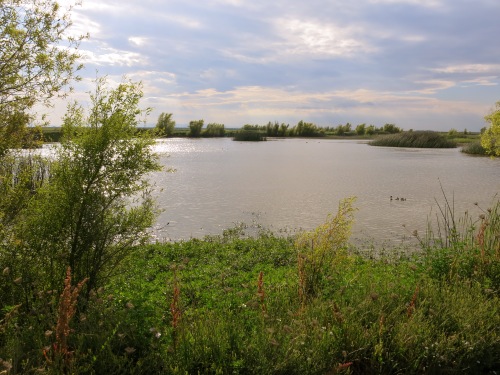
As promised to E, photos of Yolo Bypass Wildlife Area, from my birding trip there yesterday.

BlogMay2315a

This wildlife area is huge. It covers about 25 square miles along the Sacramento River, and when you’re in the middle of it, you’re more than a mile from the east and west boundaries, and maybe five miles from the north and south boundaries.

BlogMay2315b

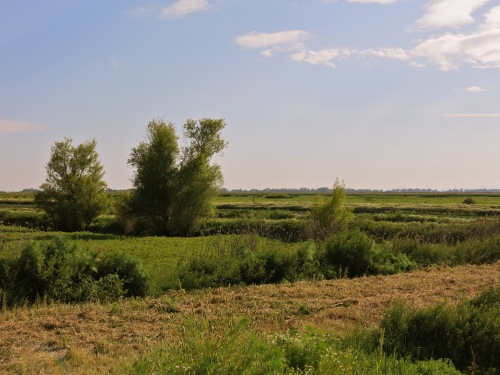
About a third of the land is still farmed, and you can see some of the fields on the right of this photo. While I was there, they were prepping several fields for rice cultivation. Rice farming is getting a bad name in California right now because of the drought, but migrating birds love rice fields. Diverting water away from rice fields to big cities is going to reduce the number of places migrating waterfowl have to rest during their travels.

BlogMay2315c

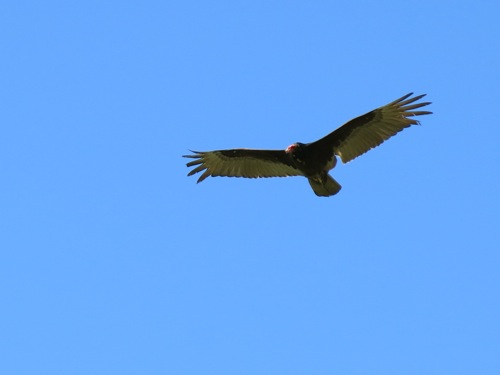
This Turkey Vulture flew quite close overhead. Notice the worn primaries — P5 on the left, and P3 on the right — as well as the missing left tertials.

Poems as theology

I have a tough time reading academic theology, and prefer to get my theological fix from poetry. I’m promiscuous in my theological tastes when it comes to poetry — how can I resist the cranky Buddhism of Gary Snyder? or the strange pacifistic Roman Catholicism of Denise Levertov? or the Black humanism of James Weldon Johnson?

Of course, sometimes it’s good to be parochial, and engage with one’s co-religionists. When I started listing some of the poems by Unitarian Universalist poets which have most influenced my theology, I realized that I prefer poets who are mystics and Transcendentalists. Since mystics and Transcendentalists are theologically suspect, I further realized that I shouldn’t be wasting my time getting theology from poetry rather than from works of academic theology.

Yet I’ll bet there are other people out there who get their theology in poetry. If you’re one of them, which poems have most influenced your theological thinking? If you happen to be a Unitarian Universalist, which poems by Unitarian Universalists are your theological mainstays?

And in the interests of full disclosure, below I’ll list some of the poems by UU poets that influenced me. Continue reading “Poems as theology”

Palo Alto Unitarians and the 1906 earthquake

Palo Alto Unitarians were getting ready to build their first church building when the great earthquake of April 18, 1906, struck.

1. A first-hand account by a Unitarian

Gertrude and I were rudely awakened by the shaking of the house and the accompanying rumble, roar, and crash. “What is it?” said she. “It’s an earthquake — and it’s a bad one,” I replied. “What shall we do?” “Stay right here. This little house will last as long as anything.” I knew the sturdy construction of our bungalow … but in my heart I felt that nothing could survive such a vicious shaking—that this was the end for us. It was like a terrier shaking a rat.

— Guido Marx, husband of Gertrude V. D. Marx, a charter member of the Unitarian Church of Palo Alto; quoted in Sandstone and Tile, vol. 30, no. 1, Winter, 2006 (Stanford, Calif.: Stanford Historical Society, 2006), p. 3.

———

2. Unitarians join the relief effort

Palo Alto.— The hall in which services have been held was wrecked by the earthquake, and there has been but one regular meeting of the church since that event. The men and women of the church have been most active in relief work. All the churches and societies united for relief work, with headquarters at the Congregational church. We undertook an employment agency for men and women, and this was one of the valuable helps in the restoration to normal living. Of a sum of money sent to Mrs. Stone [wife of Rev. George Stone, AUA Field Secretary] by the women of our Alliance in Detroit, $25.00 came to us. Never was such a sum stretched to cover many wants,— clothes for babies and uniforms for nurses. These nurses had been burned out and lost everything except the clothes they wore. They had volunteered to form a new hospital for the care of children with contagious diseases. When discovered they had worn their clothing a week among these contagious cases, and their only supply of water had to be carried entirely by hand. It was hard to decide whether the Women’s Alliance which made the uniforms, or the nurses who received them, were the happier.

Many of our church members are connected with the University, and as soon as work closed there they left town. Those of the Alliance who are still in Palo Alto met on the 12th of June and each woman pledged herself for a contribution of articles for the fall sale.

Our hearts are full of gratitude for the bright future. To know that our church building is assured and that Mr. Snow has accepted the call of the parish is a constant inspiration. The great opportunities of a university town lie before us. We shall try not to be unworthy of them.

The Pacific Unitarian, San Francisco, vol. 14, no. 8, June, 1906, p. 260.

———

3. Architectural plans destroyed Continue reading “Palo Alto Unitarians and the 1906 earthquake”

How to fail sex ed

One of the wonderful people who teaches comprehensive sexuality education in our church sent along a link to a post on Imgur headed: “Two years ago today, my then 14 year old sister got suspended for submitting these answers for her sex-ed class. I’m so proud of her.” Then there’s a photo of a worksheet titled “Objections to Condoms.” Kids were supposed to come up with possible responses to various excuses for not using condoms.

So, for example, one of the excuses for not using a condom was: “Condoms are gross; they’re messy; I hate them.” To which this creative girl replied: “So are babies.”

Condoms are messy -- So are babies

Mind you, a couple of the replies are just plain unconvincing, e.g. — Excuse: “I’d be embarrassed to use one”; reply: “Look at all the fucks I give.” Yeah, whatever.

But some of the replies, while very snarky, just might actually work in the real world, e.g. — excuse: “I don’t have a condom with me”; reply: “I don’t have my vagina with me.” This is not a good response to put on a worksheet that a public school teacher has to read; but a snarky early adolescent girl who needs to use a little humor to get through to a boy might find that reply useful.

This brings up an interesting point of educational philosophy. A core element of my educational philosophy is to start where the learner is. Some early adolescents learning about sex and sexuality may be most comfortable using snark and f-bombs to talk about sex. Of course we want to move them to a more reasoned form of discourse, a way of speaking that will allow them to talk about sex with potential partners openly, humanely, and with emotional intelligence. But we may have to listen to their f-bombs for a while before we get them there.