Chart of Christian churches

Another handout I developed for our “Neighboring Faith Communities” course for middle schoolers, a timeline of Christian churches and their derivatives:

Christian Church timeline thumbnail

Christian church timeline (PDF)

This is a revision of an earlier version of this timeline, which I originally posted here.

One purpose of this chart is to introduce middle schoolers to the incredible diversity of Christian churches, especially churches that are not well know in the West (i.e., Oriental Orthodox Churches, African Independent Churches), and groups that are often passed over or ignored by religious liberals (i.e., Restorationist groups including Mormons, Pentecostals).

Another purpose of the chart is to show how Unitarian Universalists do in fact derive from Christian churches — and further to show how very few in number we Unitarian Universalists are compared to the various Christian churches.

Chart edited. See comments.

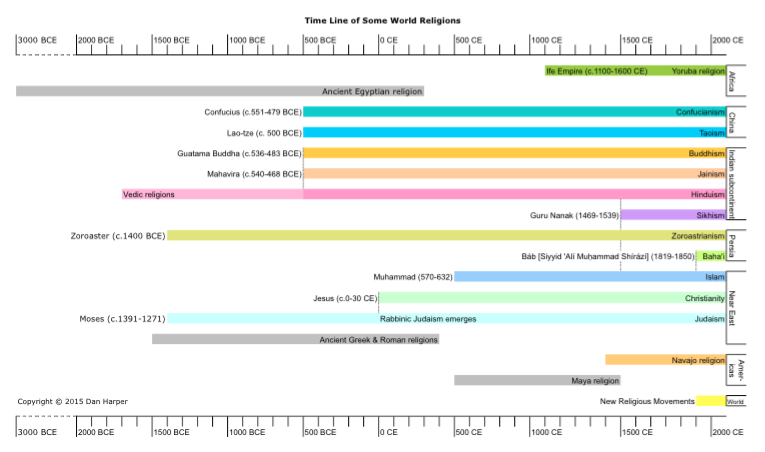
Chart of world religions

Here’s a handout I developed for our “Neighboring Faith Communities” course for middle schoolers, a timeline of some world religions:

World religions chart thumbnail

Timeline of some world religions (PDF)

This timeline shows the eight major world religions, as listed in Stephen Prothero’s book God Is Not One: Islam, Christianity, Confucianism, Hinduism, Buddhism, Yoruba religion, Judaism, Daoism.

In addition, the timeline shows some other religions of interest. Two religions from the Americas are shown, Mayan religion and Navajo religion. Two ancient religions that influenced the Western tradition are shown, viz., ancient Greek and Roman religions and ancient Egyptian religion. Several smaller religions that may be of interest to Unitarian Universalists are also shown: Jainism, Sikhism, Zoroastrianism, and Baha’i.

I’m still revising this timeline, and I invite your comments!

Peach Blossom Spring

“Peach Blossom Spring,” or “Peach Blossom Fountain,” is a well-known Chinese story by T’ao Yuan-ming, whose literary name was T’ao the Hermit (or recluse). I put part of this story on an earlier blog post here, and am finally posting the whole story, in this translation Herbert Giles, Gems of Chinese Literature, pp. 107-108:

Somewhere around the year 390, when the north of China had been conquered by the Mongol invaders from central Asia, and refugees from the invasion filled the south, there lived a fisherman in the village of Wu-ling. These were the years when the emperors of the Ch’in dynasty sat on the throne of China. The Ch’in emperors were powerful, and while some people said they did what had to be done in the face of barbarian invasions, there were others who said that government officials were too often vain and greedy, and did not have the interests of the ordinary people at heart.

To get back to the fisherman of Wu-ling:

One day, this fisherman was out on the river, and he decided to follow the river upstream. When he came to a place where the river branched, he took the right or left branch without paying attention to where he was going.

Suddenly he rounded a bend in the river and came upon a grove of peach-trees in full bloom. These peach trees grew close along the banks of the river for as far as he could see, until the next bend in the river, with not a tree of any other kind in sight. The fisherman was filled with surprise at beauty of the scene and the delightful perfume of the flowers. He continued upstream, wondering how far along the river these trees grew.

At last he came to the end of the peach trees. By now, this branch of the river was scarcely bigger than a stream, and here also the river ended, at the foot of a hill. But in the side of this hill there was a cave. A faint light was coming from the cave, so the fisherman tied up his boat to a tree, and crept in through the narrow entrance of the cave.


So he made fast his boat, and crept in through a narrow entrance, which shortly ushered him into a new world of level country, of fine houses, of rich fields, of fine pools, and of luxuriance of mulberry and bamboo. Highways of traffic ran north and south; sounds of crowing cocks and barking dogs were heard around; the dress of the people who passed along or were at work in the fields was of a strange cut; while young and old alike appeared to be contented and happy.

One of the inhabitants, catching sight of the fisherman, was greatly astonished; but, after learning whence he came, insisted on carrying him home, and killed a chicken and placed some wine before him. Before long, all the people of the place had turned out to see the visitor, and they informed him that their ancestors had sought refuge here, with their wives and families, from the troublous times of the House of Ch’in, adding that they had thus become finally cut off from the rest of the human race. They then enquired about the politics of the day, ignorant of the establishment of the Han dynasty, and of course of the later dynasties which had succeeded it. And when the fishermen told them the story, they grieved over the vicissitudes of human affairs.

Each in turn invited the fisherman to his home and entertained him hospitably, until at length the latter prepared to take his leave. “It will not be worth while to talk about what you have seen to the outside world,” said the people of the place to the fisherman, as he bade them farewell and returned to his boat, making mental notes of his route as he proceeded on his homeward voyage.

When he reached home, he at once went and reported what he had seen to the Governor of the district, and the Governor sent off men with him to seek, by the aid of the fisherman’s notes, to discover this unknown region. But he was never able to find it again. Subsequently, another desperate attempt was made by a famous adventurer to pierce the mystery; but he also failed, and died soon afterwards of chagrin, from which time forth no further attempts were made.

Giles claims the story is really about how childhood innocence can never be recovered, and I suppose that’s a valid interpretation, but I don’t find it a compelling interpretation. The story could also be read as being related to Hesiod’s Age of Gold (Works and Days, ll. 109–201), that time when humankind was in an ideal state; or a story related to the ancient Hebrew story of a Garden of Eden; but both Hesiod and the ancient Hebrew story make it clear that the early age of innocence ended at some point, while in the country of the Peach Blossom Spring that age continues. I prefer to interpret this story as a utopian vision, and thus as a critical commentary on contemporary political realities. Or the story could mean all of these things, or none of them, and really we will never know for the way to the land beyond the Peach Blossom Spring has been lost.


Journal on childhood and religion

Noted recently on the Religious Education Association blog: an online journal devoted to childhood and religion.

The Journal of Childhood and Religion is a peer-reviewed journal providing “an interdisciplinary forum for scholars representing a wide range of research fields, interests, and perspectives that relate to children and religion.” The journal was started in 2010, and there are about four articles per year.

I’m glad to find a journal focused on children and religion; so many religious education scholars and researchers these days focus either on older persons, or on abstract issues.

Test your religious knowledge

Think you know a lot about religion? Well, the Pew Research Center has developed a “U.S. Religious Knowledge Quiz” where you can find out. The fifteen questions on the quiz test your knowledge of the Bible and of world religions. The online quiz is here.

After you take the online quiz (and find out how much you really do know), you’ll want to go on to read about the survey from which this quiz was extracted, the “U.S. Religious Knowledge Survey.” Pew Research Center did a telephone survey in which they asked 32 religious knowledge questions of a random sample of U.S. residents. The average number of correct responses was 16 out of 32. Jews, atheists/agnostics, and Mormons scored best on this longer quiz. Scoring below average were white mainline Protestants, black Protestants, Hispanic Catholics, and “nothing in particular.”

There were so few Unitarian Universalists included in the sample that they are not included in the statistical analysis. How well would we perform? Sometime I’d like to administer either the shorter quiz, or the longer set of survey questions, to young people who have gone through a UU religious education program. How well have we done at teaching our children basic religious literacy? Since religious literacy is not the goal of most UU religious education programs, my guess is that our kids would only do well if their day school taught them this information. And how about us professional religious educators, how would we do on this quiz? I scored 100% on the quiz, but I’ve been working in UU congregations for two decades, during which time I earned my M.Div. degree — back in 1994, when I started working as a religious educator, my guess is that I would have scored between 50-75%. Finally, how about our ministers?

Do we care? — that is, should religious literacy be a goal of Unitarian Universalist religious education (and should it be a goal for our ministers and religious educators)? I’d argue that in order to be good U.S. and world citizens, we do need a basic level of religious literacy, and that Unitarian Universalists have always aimed to produce good citizens; yet there are very good reasons to disagree with making religious literacy an educational goal.

What do you think?

Rethinking a classic story

“The Picture on the Kitchen Wall,” a story from the classic Sophia Fahs book From Long Ago and Many Lands, has some serious problems: it’s arguably not very Chinese, it contains a number of hidden biases, etc. This story is, in fact, a good example of why we should question everything that Sophia Fahs wrote — even though she remains the most brilliant Unitarian Universalist religious educator we’ve ever seen, she was not by any means perfect.

“The Picture on the Kitchen Wall” purports to tell the back story of the Kitchen God, the minor deity in Chinese popular religion whose image is mounted somewhere near the kitchen stove. Each year, according to most accounts, the Kitchen God leaves the kitchen and reports to a higher deity (sometimes identified in English-language accounts as the Jade Emperor) about the good and bad deeds of the family in whose house he lives. In Fahs’s retelling of the Kitchen God’s story, he was originally a historical figure, a person named Chang Kung.

In tracing Chang Kung, I find him mentioned in a book of maxims attributed to Emperor K’ang-hsi [Kangxi], who ruled China from 1661-1722, an early emperor of the Ch’ing [Qing] dynasty. These maxims appeared in English translation in 1817 as The Sacred Edict, Containing Sixteen Maxims of Emperor Kang-He, Amplified by his Son, the Emperor Yoong-Ching, trans. Rev. William Milne (London: Black, Kingsbury, Parbury, and Allen, 1817), pp. 51-52:

“Formerly, nine generations of Chang-kung-e inhabited the same house; and a Mr. Chin of Keang Chow had seventy persons who all ate together. Those who belong to one family, and are of one surname, should think of their ancestors; rather exceed, than be deficient in respect; rather surpass, than be wanting in kindness. When there is prosperity, rejoice mutually, by an interchange of social affections; when adversity, sympathize mutually, by affording reciprocal aids. In building a family temple to sacrifice to ancestors; in erecting a domestic academy for instructing youth; in purchasing a charity field for the supply of indigent brethren; and in correcting the family calendar, to interweave the names of the more distant relatives — let the same mutual aid be afforded.”

Chang Kung continued to be mentioned by later English-speaking writers as the nineteenth century progressed. A typical example, with an unpleasantly racist conclusion, may be found in Arthur H. Smith D.D., Village Life in China: A Study in Sociology (New York: Fleming H. Revell Co., Publishers of Evangelical Literature, 1899), p. 27:

Continue reading “Rethinking a classic story”

Secure video chat

Deborah, another UU minister, told me about VSee, a video chat service with 256-bit encryption. VSee is designed as a “telehealth” app, for use by doctors and other medical professionals; the company claims that it is the first such application that complies with HIPAA.

Clergypersons working in congregations do not have to comply with HIPAA, and certainly HIPAA would not be the right set of standards for congregational work. But maybe we should be thinking more about how to protect the privacy of congregants. Email is far from secure, yet I find myself doing pastoral car via email. I don’t know that VSee is an appropriate product for me to use (I’ll have to experiment with it), but maybe it’s time to research options like this.

Racial diversity and religious groups

How racially diverse are various religious groups in the United States? The Pew Research Center recently investigated this question, and ranked various religious groups based on a racial diversity index they developed.

Out of 29 religious groups they looked at, the most racially diverse group was Seventh day Adventists, with a diversity index of 9.1. A higher number indicates greater diversity. Seventh Day Adventists are 37% white, 32% black, 15% Latino/a, 8% Asian, and 8% other. The study included only five racial categories, where the fifth category is “other.” Muslims and Jehovah’s Witnesses come close, with diversity indices of 8.7 and 8.6, respectively.

And where do Unitarian Universalists come in? No, not dead last; don’t be so cynical. With a diversity index of 2.7, Unitarian Universalists come in at 21st place. By way of reference, the racial diversity of all United States adults is 6.6. (Note that this study does not consider the racial diversity of individual congregations, but only of nationwide religious groups; individual congregations may be more or less diverse than the nationwide group.)

Given how white Unitarian Universalism is, I have a couple of thoughts about where we might put our efforts to change that. With congregational polity, no one can tell any congregation what to do; but we can offer incentives to help motivate congregations. So when the denomination and other funding bodies consider funding new congregations, first priority should go to ministers and leaders of color who intend to start non-white congregations; and ongoing funding should be tied to maintaining either a non-white majority and/or a high diversity index. And when existing congregations seek financial assistance of any kind, they can be asked to verify their racial mix, and priority should be given to more racially diverse congregations. In short, don’t belabor ’em with guilt, motivate ’em with money.

Today’s lesson plan on Ferguson

Here’s today’s lesson plan, as taught in the summer Sunday school program at the Unitarian Universalist Church of Palo Alto (UUCPA), Calif. We had about a dozen children in gr. K-8. The lesson plan was written to engage the older children (gr. 5-8), in the expectation that the younger kids would do their best to follow the lead of the older kids; this worked quite well, so even though the conversation was over the heads of the kindergarteners, they followed along as best they could, and at least understood that we were talking about something very important.

One unexpected benefit of this lesson plan: While most of the children knew what “Ferguson” was, they were pretty hazy on the details of the events of August 9, 2014. Going over the story three different times helped reinforce details of that day in their memory.

Lesson plan
Credits
Goals and objectives
Theological background
Notes and resources
Thoughts for teachers
Why isn’t —— in this lesson plan?

Continue reading “Today’s lesson plan on Ferguson”