
Obscure Unitarians: Mabel and Louise Mead

Mabel Mead lived in Palo Alto for less than a year, but her life story is interesting enough to recount in some detail. A schoolteacher for many years, she was born Dec. 30, 1870, in Ledger, New York to Louise and Alexander Mead (Greeley Daily Tribune, May 12, 1961).

She received her B.S. from Cornell in 1898 (Fifteenth Annual Register, 1905-06, Stanford University); her sister Mildred was at Cornell at the same time she was (Cornell Era, April 21, 1900, class notes, p. 257). By 1900, at the age of 29, she was a schoolteacher, living with her parents in Greeley, Colo. (1900 U.S. Census).

A short digression to tell something of her mother, Louise Mead:

Louise was born Mar., 1851, in New York. She married Alexander Mead c. 1870 in New York state. In 1880, Louise and Alexander were living in Greeley, Colo., where Alexander was an agricultural implements dealer. By 1900, Louise and Alexander were running a rooming house in Greeley, with seven children: Mabel (b. Dec., 1870, N.Y.); Edgar (b. Sept., 1872, N.Y.); Ella (Jul., 1874, N.Y.); Mildred (b. Jul., 1875, N.Y.); Worthen (b. Sept., 1880, Colo.); Alexandra (b. July, 1884, Colo.); and Wilhemina (b. Sept., 1889, Colo.) (U.S. Census, 1880, 1900; in the 1900 Census her name is misspelled Luiese). The family Moved to Greeley sometime between 1875 and 1880. Alexander Mead was a Trustee for the city of Greeley for the year 1883. A Unitarian church had formed in Greeley, Colorado, in 1880; perhaps the Meads were members. (David Boyd, A History: Greeley and the Union Colony of Colorado, Greeley Tribune Press, 1890).

The Cornell Alumni News, vol. 7, Dec. 21, 1904 (Ithaca, N.Y.: Cornell University), ran the following notice: ” ’98 B.S. The marriage of Miss Mabel Mead to R. J. Wright was celebrated at Greeley, Col., this fall. Mrs. Wright is now connected with the social settlement work in the Italian District of Denver. She has charge of the North Side neighborhood house, the centre of settlement work in the northern part of the city.” But I found no other mention of R. J. Wright, and Mabel had resumed the name Mead by 1905. Perhaps this mysterious event precipitated her removal to Stanford for a year of study?

In any case, by autumn, 1905 she was a student at Stanford, living with her mother Louise at 742 and later 750 Bryant St. (Directory of Palo Alto, Mayfield, Stanford University, Jan., 1906; Cornell Alumni News, vol. 3, no. 25, March 28, 1906). She studied Romanic Languages (Fifteenth Annual Register, 1905-06, Stanford University); however, her name does not appear in later alumni directories.

She lived in Palo Alto for less than twelve months. While living in Palo Alto, she and her mother Louise were two of the early members of the Women’s Alliance of the newly formed Unitarian church (Women’s Alliance records).

By fall, 1906, she was teaching German, Spanish, and “physical culture” at a high school in Orange, Calif. (Cornell Alumni News, Oct. 3, 1906). She married Tracy C. Marsh before 1917; they had one son, Alexander Mead Marsh who was born c. 1913 (1920 U.S. Census). After her husband died in Nevada, she moved to Sutler, Calif., where she taught school until her retirement sometime before 1935; then she moved back to Greeley, where she was “prominent in civic and club work” (Greeley Daily Tribune, May 12, 1961). Back in Greeley, she lived with Edgar, Ella, and her son (1940 U.S. Census). In 1961, at age 90, she moved to Aberdeen, Md., to live with her son (Greeley Daily Tribune, May 12, 1961). She died in Annadale, Va., Feb. 2, 1975 (Cornell Alumni News, May, 1975, p. 80).

Further research might uncover additional information about Mabel Mead Marsh. It would, for instance, be interesting to search the membership records of the Greeley Unitarian church to see if the Mead family had been members there. It might also be possible to track down records of the Denver settlement house where she worked. However, it seems unlikely that we’ll ever find out what happened with R. J. Wright, and why she decided to attend Stanford at the age of 36.
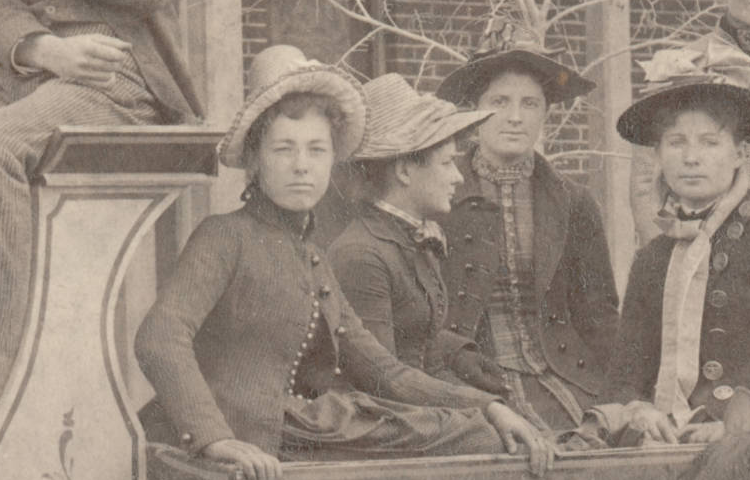
Mabel Mead Marsh

Above: Detail from a photograph in the collection of the Denver Public Library (call. no. Z-7616) showing Mabel Mead Marsh in a horse-drawn coach in Greeley, Colo., between 1890 and 1900; Mabel is at the back, right of center.

Why I won’t be wearing a safety pin

Another social media maelstrom, this time over the wearing of safety pins: Straight white people are wearing safety pins as a symbol that they are allies to people of color, BGLQQT people, Hispanic people, other marginalized or oppressed groups. Some people like the idea, some hate it.

I don’t have a strong opinion about whether anyone should wear a safety pin or not, but I know I won’t be wearing one, and here’s why:

A significant part of my career as a minister has been cleaning up after clergy sexual misconduct. This has turned out to be a complicated business: there are more than a few misconducting ministers who have a lot of power in Unitarian Universalism, and these ministers have a lot of friends. They have gotten very good at shutting down victims of ministerial misconduct, and shutting down those of us who stand by those victims.

Often these misconducting ministers, and their friends, talk about how they want to end ministerial misconduct. Then they’ll say that we have to do it the right way — we can’t rush, we can’t do any damage to those talented ministers who committed misconduct. In the end, this means they will resist any change in the status quo with all the force at their disposal, all the while talking as if they want real change.

Thus I have learned to pay little attention to what people say. Instead, I watch for those who stand up to sexual misconduct even when it is inconvenient, those who do something even when they think no one is looking.

As a corollary, I also assume that no one should trust me. Just because I’ve done a little bit of work on clergy misconduct, I do not expect victims of clergy misconduct, or anyone else fighting this battle, to claim me as an ally. It’s too easy to tell stories about yourself and make yourself into a hero; therefore anything I say about myself can be discounted. If you see me doing the work, then you can count me as an ally — but only for just as long as I’m doing the work.

As an example of what I mean, I had a conversation with a powerful UU minister this past summer. This person said that they were staunch advocates of cleaning up clergy sexual misconduct. Yet it quickly became clear that they knew little or nothing about how one actually cleans up after clergy misconduct; and it quickly became clear that they were allied with some ministers who have actively resisted change, that they had been mentored by older ministers who have been documented as having committed misconduct. This minister said they were a staunch ally to those of us working to end clergy misconduct; I believe they honestly thought they were helping end clergy misconduct; but their words and their deeds were not aligned.

That’s why I won’t be wearing a safety pin. I don’t want to be one of those well-meaning white people who have convinced themselves they’re anti-racists when they’re not. I don’t want to be one of those well-meaning straight people who think they’re fighting homophobia, but they’re not. I’m not looking to set up false expectations for myself; I already know I fall short, and I’m sure I fall short by a much greater distance than I’d like to think.

I’m not going to judge you if you wear a safety pin; we’re all doing the best we can, and me trying to judge you is just another way of falling short myself. But for my part, I’d rather be judged on what I do; that’s a course of action that won’t be particularly comfortable, but I suspect the lack of comfort will do me good.

Revolution

Carol just sent me my horoscope, which quotes Rebecca Solnit on the necessity of revolution:

“I still think the revolution is to make the world safe for poetry, meandering, for the frail and vulnerable, the rare and obscure, the impractical and local and small, and I feel that we’ve lost if we don’t practice and celebrate them now, instead of waiting for some ’60s never-neverland of after-the-revolution. And we’ve lost the revolution if we relinquish our full possibilities and powers.” — Rebecca Solnit, interview by Benjamin Cohen in The Believer, September, 2009.

And this reminded me what Adrienne Rich said about poetry and social change back in 2006:

“Poetry has the capacity — in its own ways and by its own means — to remind us of something we are forbidden to see. A forgotten future: a still-uncreated site whose moral architecture is founded not on owndership and dispossession, the subjection of women, torture and bribes, outcast and tribe, but on the continuous redefining of freedom — that word now held under house arrest by the rhetoric of the ‘free ‘ market. This ongoing future, written off over and over, is still within view. All over the world its paths are being rediscovered and reinvented: through collective action, through mahy kinds of art.Its elementary condition is the recovery and redistribution of the world’s resources that have been extracted from the many by the few.” — Adrienne Rich, Poetry and Commitment (New York: W. W. Norton, 2007), p. 36.

Statement from California legislative leaders

Our legislative leaders here in California have issued a joint statement on the presidential election. This statement, issued by California Senate President pro Tempore Kevin de León nd California Assembly Speaker Anthony Rendon, says in part:

“California has long set an example for other states to follow. And California will defend its people and our progress. We are not going to allow one election to reverse generations of progress at the height of our historic diversity, scientific advancement, economic output, and sense of global responsibility.

“We will be reaching out to federal, state and local officials to evaluate how a Trump Presidency will potentially impact federal funding of ongoing state programs, job-creating investments reliant on foreign trade, and federal enforcement of laws affecting the rights of people living in our state. We will maximize the time during the presidential transition to defend our accomplishments using every tool at our disposal.” Read the complete statement.

The statement also points out that California has the largest economy of any state — and there’s an implication that the reason we have the largest economy is that we actually believe in science (including climate science), and welcome diversity.

It’s going to be very interesting to see what happens here in California, now that the Democrats have a supermajority. California is headed down a very different path from the path that will be taken by Republican-dominated Washington. Want to bet someone starts printing bumper stickers that read, “Don’t blame me, I’m from California”?

Naomi Klein: The Democrats done it

In an opinion piece in The Guardian, Naomi Klein gives her analysus of why Trump won the presidential election: Kalein puts the blame squarely on the Democratic party, who embraced neo-liberalism:

“Under neoliberal policies of deregulation, privatisation, austerity and corporate trade, their living standards have declined precipitously. They have lost jobs. They have lost pensions. They have lost much of the safety net that used to make these losses less frightening. They see a future for their kids even worse than their precarious present.

“At the same time, they have witnessed the rise of the Davos class, a hyper-connected network of banking and tech billionaires, elected leaders who are awfully cosy with those interests, and Hollywood celebrities who make the whole thing seem unbearably glamorous. Success is a party to which they were not invited, and they know in their hearts that this rising wealth and power is somehow directly connected to their growing debts and powerlessness.”

I think Klein is on to something here. When you realize that a moderate like Bernie Sanders looks like a socialist to most Americans, you realize just how far to the right the Democratic Party has gone. Klein notes that the neo-liberalism embraced by the Democrats has not provided much in the way of benefits to a lot of people.

And Klein offers a way forward:

“People have a right to be angry, and a powerful, intersectional left agenda can direct that anger where it belongs, while fighting for holistic solutions that will bring a frayed society together. Such a coalition is possible. In Canada, we have begun to cobble it together under the banner of a people’s agenda called The Leap Manifesto, endorsed by more than 220 organisations from Greenpeace Canada to Black Lives Matter Toronto, and some of our largest trade unions.”

So I looked up The Leap Manifesto referenced by Klein. It’s not perfect, it’s obviously targeted at Canadians — but it’s pretty good.

Something like the Leap Manifesto written by and for progressive U.S. residents would be a great place for us to start rebuilding democracy here in the U.S.

The squirrel with the “slippery mouth”

A story from the religious tradition of Orisa devotion:

Once upon a time, there were two squirrels who decided to build a nest at the side of a road.

One of the squirrels, the male squirrel, decided to visit the babalawo for ifa divination. The divination warned the squirrel: “Beware of the slippery mouth, the mouth that cannot keep secrets. There is a trap that never fails to catch its victim, and that trap is the mouth that cannot keep secrets. The person who talks too much, it is his talking that kills him. And the person who talks to everyone he meets, it is his mouth that kills him. Beware of the slippery mouth!”

So it was that the Ifa divination warned the squirrel, “Do not tell everything you know to everyone you meet.” But the squirrel did not heed this good advice.

Soon thereafter, the female squirrel gave birth to two little babies. The male squirrel was very happy, so happy that he forgot what the Ifa divination told him, and he had to tell everyone about these two new babies.

He went out on the road beside which they had built their nest, and said, “The female squirrel had two lovely babies. Now our nest if full of children. All you travellers going past on the road, you must come and see our children!”

Some human beings were passing by, and heard the male squirrel say this. So they stepped into the bushes, where they found the squirrels’ nest. They looked into the nest, found the two young squirrels, and took them. When the human beings got home, they put the squirrels children on top of some pounded yam, and the two baby squirrels disappeared down their throats with the soup.

Source: Wande Abimbola, Ifa Divination Poetry

“All you, to whom adversity has dealt a final blow”

As we think about the the necessity of rebuilding a foundering democracy, a democracy currently dominated by rancor and hate, I can’t help thinking about one of my favorite songs for activists.

Back on December 24, 2008, I wrote about how this song literally saved someone’s life; and how it is a song that could serve as a non-theistic anthem. But I recently found a Youtube video of Liam Clancy singing this song — Clancy was best known for his rendition of the anti-war song “And the Band Played Waltzing Matilda” — and perhaps what he says is the best possible introduction to the song:

“I think it was Bertolt Brecht [says Clancy] who said one time, ‘With a man’s dying breath, he should be prepared to make a fresh start.’ That’s what this next song is about, although it’s supposedly about a ship that went down in the sixties, a ship called the ‘Mary Ellen Carter.’ There’s a lovely last verse to it which is the moral of the whole thing. And it’s a verse that I will tell you because, like myself, you may get solace from it on occasions of tragedy… It says:

“‘All you, to whom adversity has dealt a final blow,
With smiling bastards lying to you, everywhere you go,
Turn to, and put out all your strength of arm and heart and brain,
And like the Mary Ellen Carter, rise again.

“‘Rise again, rise again,
Though your heart may be broken and your life about to end,
No matter what you’ve lost, be it a home, a love, a friend,
Like the Mary Ellen Carter, rise again.'”

And in a later post, I’ll write about some of the ways we can make democracy rise again.


Video still of Liam Clancy speaking

Above: Liam Clancy saying, “Rise again”; video still from “The Mary Ellen Carter” as sung by Clancy (click on the photo for Clancy’s rendition of the song).

Or to hear a video that first tells how the song saved Robert Cusik’s life, and then to hear Stan Rogers himself singing the song (Rogers starts singing at 1:35), click here.

Hooray for the rule of law

Speaking as a religious leftist, here’s a brief word to my liberal friends about the rule of law.

We just had an emotionally and politically divisive election. Yet the rule of law has held out: we will all quibble about the details, but while the election may not have lived up to many people’s ideals for a fair election, for the most part the election was fair. And then I think back to Massachusetts politics, where for many years the president of the state senate had close ties to organized crime, and where politics was very dirty and very personal (see: Dick Lehr and Gerard O’Neill, Black Mass: Whitey Bulger, The FBI, and a Devil’s Deal, New York: Public Affiars, 2000) — and Rhode Island politics, where it was rumored that half the state legislature had Mob ties, and where the governor was convicted of blatantly illegal activities. By those standards, the recent presidential election looked like a Sunday school outing.

Actually, having supervised some pretty unpleasant Sunday school outings, maybe I should change that analogy.

Bad analogy aside, the point is that for the most part the existing laws and court opinions held sway. You may have preferred it if there were different laws on the books, and different court opinions (I certainly would prefer that), but for the most part, the rule of law has held.

So this is not an apocalyptic scenario. Carol and I read to each other at night, and right now we’re reading “A War in 1935” by Evelyn Waugh, from When the Going Was Good (Penguin Books, 1946/1976), in which he describes the Italian invasion of what was then Abyssinia; that situation represented a breakdown of the rule of law, and was mildly apocalyptic. I’m also reading (on my own), the Letters of Pliny the Younger, in which he describes some of the truly horrible events during the reign of the emperor Domitian, a reign during which people could be put to death on mere suspicion of an unpleasant thought about the emperor. And then, look at the coverage from Syria: that really is an apocalyptic scenario, in which the rule of law has completely broken down.

I don’t like the results of the recent presidential election, but at this point I prefer it over the 1972 presidential election, when, under the direct leadership of Richard Nixon, the rule of law did break down. Or consider the Teapot Dome scandal during Warren Harding’s presidential administration. Or Franklin Roosevelt’s attempt to pack the Supreme Court in order to get the rulings he preferred. Or, for that matter, the breakdown of the rule of law detailed by Michelle Alexander in The New Jim Crow.

So far, the rule of law is holding out pretty well. I would prefer that some of the current laws on the books were different, but in my case that mostly means that I need to get off my ass and stop working too many hours at my job and do my duty as a citizen of a democracy and get involved in elections and legislation. Nor do I have any illusions that the rule of law can be taken for granted; this again means, in my case, that I need to get off my ass and do my duty as a citizen of a democracy by attending city and county meetings, getting involved in voluntary organizations that amplify my solo voice (this, by the way, includes involvement in a local UU congregation).

If I don’t like the results of an election, then I need to stop spending time in the echo chamber of social media, stop anesthetizing myself by watching too many Youtube videos, and actually go out and do something.

That’s my two cent’s worth. Your mileage may vary.

No lines, plenty of angst

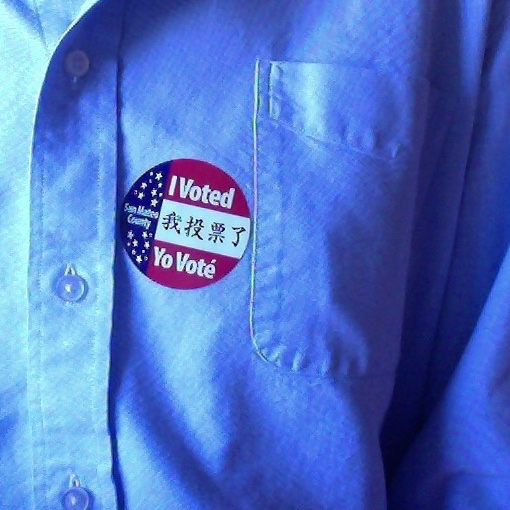
Carol and I just voted. No lines, no waiting. No anxiety — at least, no anxiety in the voting process itself.

Photo of my "I Voted" sticker

Today’s Daily Journal, our local freebie newspaper, reports that the Good Shepherd Episcopal Church in Belmont, Calif., is hosting a “stress-free zone” this evening — a place where you can go and not talk about politics, and not look at media. Rev. Michael Arase-Barhau of the church suggests people bring knitting, a book to read, adult coloring books, whatever.

Carol and I have a different destination in mind: we’ll be going to sing Sacred Harp music at Inder’s house in Oakland. And last night, we went to our congregation for a song circle organized by VJ, in the spirit of election eve song circles (the difference was that ours allowed any gender to participate). I don’t do adult coloring books (maybe I should), but singing works for me as a way to reduce anxiety.

It’s not just the presidential election. Here in Silicon Valley, we have a number of local ballot initiatives for rent stabilization measures. These initiatives are proving to be divisive. In our congregation, we have people on both sides of the rent stabilization issue, and while there isn’t any visible rancor, there are definitely some people who know not to talk local politics with each other.

Maybe this is the biggest problem. Here in the U.S., we lack skills in talking about disagreement. You either agree with someone, or you refuse to talk with them. You don’t like Hillary Clinton? then you won’t talk to a Clinton supporter. You don’t believe in God? then you’ll refuse to talk to Christians. We Americans believe in competition rather than collaboration; in market-based decisions rather than wisdom-based decisions; in individual rights rather than communal good.

No wonder we’re anxious.