“There Is More Love Somewhere”

I don’t want to spoil anything for you, but if you like the hymn “There Is More Love Somewhere,” there’s another version you should know about.

This is not a widely-sung hymn; I can’t find it in in the vast collection of hymnals at the Hymnary.org Web site, and the only hymnal I’ve seen it in is the Unitarian Universalist hymnal, Singing the Living Tradition. The version in Singing the Living Tradition closely follows the melody sung by Bernice Johnson Reagon on her 1986 album “River of Life,” and you can hear Reagon’s version on Youtube. In the booklet that goes with the CD, Reagon says that she learned the song from Bessie Jones. (The only other commercial recording I’ve been able to track down is one by Eileen McGann, a Canadian folk singer, on her 1997 ablum titled “Heritage.”)

Reagon might well have learned the song directly from Bessie Jones, but there’s also an Alan Lomax recording of Jones singing “There Is More Love Somewhere.” Now Bernice Johnson Reagon is a hugely talented singer, but I much prefer Bessie Jones’s rendition of the hymn. Reagon was making a commercial recording, and her performance is highly polished and meticulously crafted. Jones sings the tune in Alan Lomax’s living room, and her performance is by no means a commercially polished recording; yet I feel she gets deeper into the feeling and meaning of the song. Musically, Jones’s version is more direct; Reagon adds carefully articulated sixteenth notes (all of which are carefully reproduced in the Singing the Living Tradition version), where for her part, Jones varies and improvises on the melody, shades pitch and plays with the rhythm, and goes whither the Spirit leads her.

Lest there be any question, the lyrics Jones sings make it clear that this song comes from the African American Christian tradition. Her lyrics begin with “There is more love somewhere,” then go on to “more joy,” “happiness,” “Jesus,” “more peace,” and “heaven,” before reprising “more love” and “more joy.” (If you don’t like heavenly love and joy, you may not want to sing this song.) And as you’d expect from a song out of the African American Christian tradition, there is no pretence that we all have plenty of joy and happiness right here and now; joy, happiness, heaven are all theological ideals, the end towards which we direct our lives, with no guarantee that we will achieve that end now or in the immediate future — we can only hope to find them “somewhere.”

I should also note that Singing the Living Tradition names the tune “Biko,” but as much as I admire Stephen Biko I consider this to be a misleading name that doesn’t relate to the actual origins of the tune. Bessie Jones told Alan Lomax the song came from the Georgia Sea Islands, so “Sea Islands” would be a better name.

In any case — listen to the Bessie Jones version of this tune. Now that I have Jone’s version in my ear, any time I sing it I can’t help but remember that the song comes from the Gullah people of Georgia’s Sea Islands, people who managed to keep their direct cultural connections to Africa; that it’s a song of deepest spiritual longings and hope for the future; and that you don’t need to sing it like a commercially produced recording, you can sing it from the heart.

Local religious data

I love poring over data on U.S. religions, and a motherlode of such data can be found on the Web site of The Association of Religion Data Archives (ARDA).

Tonight, I’ve been looking over religion data for Santa Clara County, the county which includes the UU Church of Palo Alto, as found in the County Membership Report.

ARDA’s Web page shows that 43.6% of the county population are religious adherents, essentially unchanged from 43.3% of the county’s population in 2000. The count includes 1,005,614 people as unaffiliated; 447,369 as Roman Catholic; 148,599 as Evangelical Protestant; 125,165 as Other (this includes Buddhists, Hindus, Jews, UUs, etc.); and 44,623 as Mainline Protestant. 927 people are counted as members of Unitarian Universalist congregations.

These counts are based on self-reporting by 236 religious bodies, and any interpretation should take that into account. Obvious problems: religious bodies may have different reporting procedures; some of us (like me) are regular attendees but are not official members of a congregation, so are not counted; counts may include people who are not really adherents; etc.

The basic data sets come from the Assoc. of Statisticians of American Religious Bodies, whose Web site is also of interest.

My main interest in the ARDA Web page is how it helps show the incredible religious diversity of Santa Clara County. Admittedly, they miss some smaller religious groups, particularly adherents of Orisa Devotion, and several New Religious Movements; but these are groups that may deliberately hide from, or give incorrect information to, researchers. Even with the obvious gaps (Cao Dai, Scientology, Santeria), their list of religious groups shows impressive diversity: a bewildering variety of Christians; Baha’is; Buddhists; Hindus; Jains; Jews; a few New Religious Movements; Sikhs; and Unitarian Universalists.

Definitely a fascinating Web site for exploring data on religion in a given geographical region.

Noted, with minimal comment

Yes indeed. To hell with the homeless, the poor, and the unemployed. It may seem cruel to let them starve to death, but it’s just nature’s way of weeding out the unfit — so sayeth many of our politicians today, in their twisted misunderstanding of biological theory.

Agni

Agni, the ancient Vedic deity of fire, has always appealed to me. But until today, I’d only met Agni through poetry, like this hymn to Agni, the fifth hymn of the third book of the Rig Veda, as translated by Ralph Griffith:

Agni who shines against the Dawns is wakened;
the holy Singer who precedes the sages:
With far-spread luster, kindled by the pious,
the Priest has thrown both gates of darkness open.
Agni has waxed mighty by songs of praise,
to be adored with hymns of those who praise him.
Loving the varied shows of holy Order
at the first flush of dawn, he shines as envoy.
Midst mortal’s homes, Agni has been established,
fulfilling with the Law; Friend, germ of waters.
Loved and adored, the height he has ascended;
the Singer, object of our invocations.

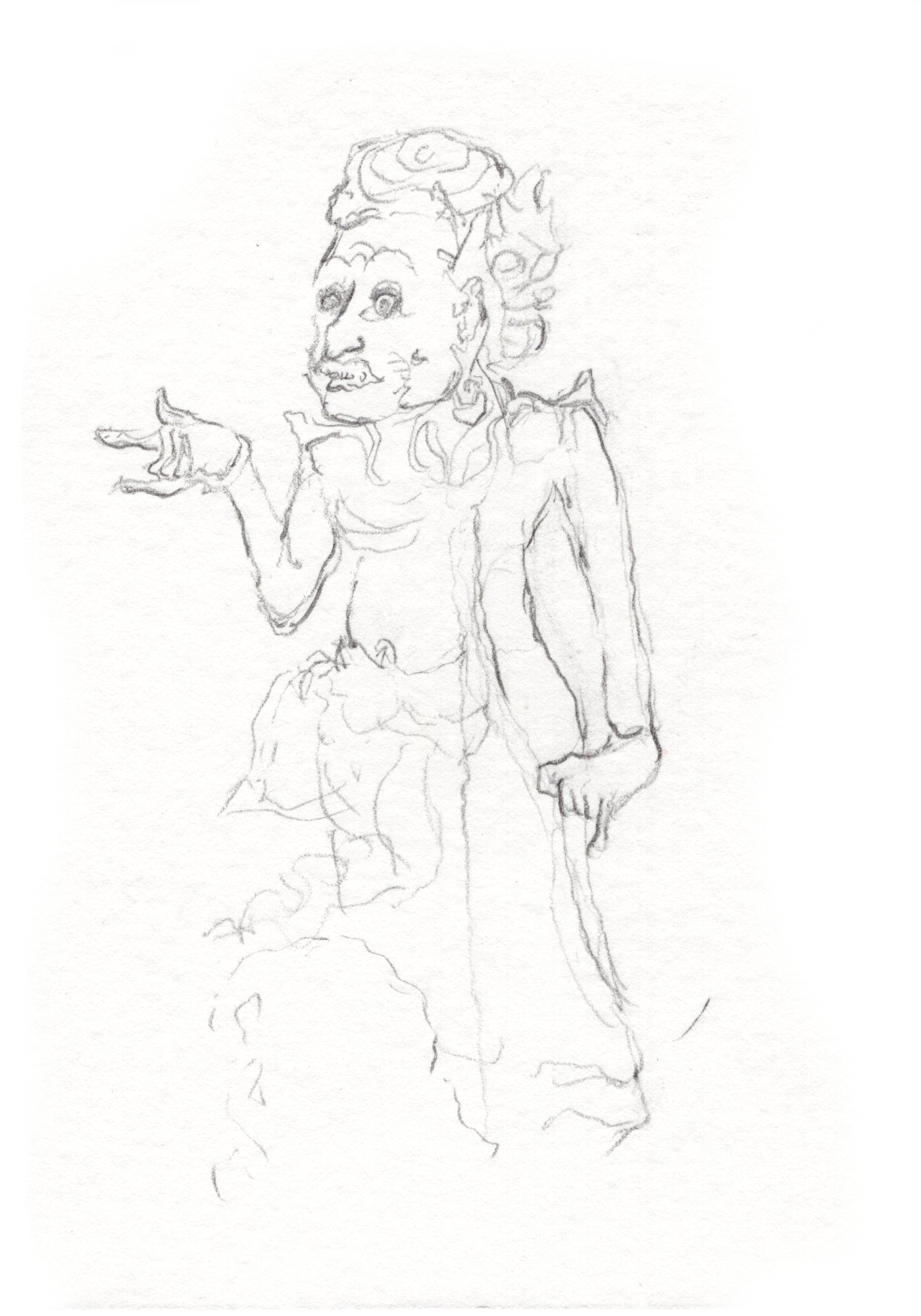
Thus I was pleased to finally see a visual depiction of Agni at the Asian Art Museum this afternoon. He was part of a painting from the Ramayana, protecting Sita during her trial by fire, as imagined by a Balinese artist c. 1850-1900. Since this was a traveling exhibit, photography was not permitted, so I drew a quick sketch of Agni — leaving out Sita, Rama, the army of monkeys, the tongues of fire, and everything else in this detailed painting:

Agni, pencil on paper, 3-1/2x5 in.

Failed rain barrel

Carol and I wanted to put together a rain barrel for the middle school Sunday school class in eco-justice. Of course we waited until the last minute to purchase materials, and so when I saw the “DIY Rain Barrel Diverter & Parts Kit,” it seemed like the perfect solution. The packaging proclaimed, “Works with Plastic Barrels, Wooden Barrels and Garbage Cans.” So on a Saturday evening we purchased one of the kits and a 32-gallon trash barrel, and brought everything to Sunday school the next morning.

DIY Rain Barrel Diverter and Parts Kit

The class had fun drilling holes in the trash barrel for the plumbing fittings. But when we tried to install the fittings — a faucet and a drain hole — into the holes, the class found it very difficult to screw the fittings in. Before people got too frustrated, class ended, and after class I figured I’d try putting the fittings in myself — but they just wouldn’t go. After a lot of fiddling, I finally managed to force them into place. It started raining, so I quickly put the trash barrel, er, rain barrel next to an existing rain barrel that was already full. I directed the overflow from the existing rain barrel into the new rain barrel. It started filling. And then I saw that it was leaking around the drain hole. I wound up having to plug the drain hole with threaded PVC fittings, gasket material, and pipe joint compound. I should have replaced the faucet fitting as well, because by the next day, it, too, had a very slow but noticeable leak where it went into the trash barrel. And now, after three weeks, the sides of the trash barrel are very definitely bulging — it simply isn’t strong enough to bear up under the weight of the water.

Failed rain barrel made of a trash barrel; note bulging sides

Instead of purchasing an expensive pre-packaged “DIY Rain Barrel Kit,” I should have gotten a couple of 3/4 inch bulkhead fittings, two sink faucets, and one of those blue plastic rain barrels. Live and learn.

Progress report

Seven months after my dad’s death, I can tell you (as if you didn’t already know) is that grief takes time. At the rational, conscious level, I often feel as though I’m moving at the same pace that I always do. But then I look around, and see all the housework that isn’t getting done, and all the little things at work that aren’t getting done, and I have to acknowledge that I’m not getting as much done.

I think, though, that when it comes to hands-on work, like housework and growing things and making things, I’ve lost very little efficiency; whereas the less embodied tasks, things like checking email and project management and the like, are taking lots more time. I said I think this is so, but I already know that while I’m grieving my rational self isn’t good at thinking about and judging myself.

I am now bored by grieving. Last week, I was so bored I climbed up on a stepladder and cleaned the cobwebs in the high peaks of the kitchen ceiling, something that I haven’t done for two years. Yesterday, I was so bored I cleaned out all of my tool boxes, made a tool roll for chisels and one for files, and a toolbox for handsaws; in the process I found things I thought I has lost: a chuck key for an old drill, a whet stone, a pop-rivet gun.

But I find I have less tolerance for sitting at a computer. Screens narrow your field of view, and disconnect you from the real world of manipulable things. And, as we are now learning by watching the mental health of teenagers, computers induce and increase anxiety, often to pathological levels; grief is enough; I don’t need to add anxiety.

In short, I’m about where I’d expect to be: grief, so they say, bottoms out in half a year, and I do feel as though I’m on the upward trend.

Obscure Unitarians: Bertha Chapman Cady

An expended version of this short biography may be found here.

A writer, biologist, and sexuality educator, she was born July, 5, 1873, in California. There she knew John Muir, and went hiking with him in the Sierra Nevada mountains. She received her A.B. in English from Stanford University in 1895, and her A.M. in entomology in 1902. After graduating from Stanford, she taught high school from 1900-1907; was assistant in nature study at the Univ. of Chicago, 1907-1909; taught biology at Calif. State Teachers College in Chico in 1918; was a lecturer at Stanford 1921-1923.

She married Vernon Mosher Cady on Dec. 15, 1908, at the Abraham Lincoln Center in Chicago. The Abraham Lincoln Center was a Unitarian church and community center with permanent and transient residents; Bertha and Vernon had both lived in the Center in the summer of 1908. They were probably wed by Rev. Jenkin Lloyd Jones. They had two children: Carol (b. c. 1910) and Jean (b. c. 1913).

She was a graduate student at Stanford 1920-1922, and received her Ph.D. in entomology (at age 50) in 1923. Subsequently, she worked for the Girl Scouts as a naturalist from 1924-1936.

Bertha’s career encompassed biology and education. She and her husband co-wrote The Way Life Begins: An Introduction to Sex Education (New York: American Social Hygiene Assoc., 1917). As the Girl Scout National Naturalist, she wrote for, or wrote in their entirety, many Girl Scout publications.

While she was at Stanford earning her Ph.D., she was active with the Unitarian Church of Palo Alto. She taught the 4th and 5th grade Sunday school class at the Unitarian Church of Palo Alto in 1921-22.

She died Jan. 26, 1956.

Notes: “John Muir,” Guide to Nature, Feb., 1914, Sound Beach, Conn.: Agassiz Assoc., 1909, p. 312; Stanford University Alumni Directory, 1921; Unity, Chicago, Unity Publishing, Abraham Lincoln Center, Jan. 7, 1909, p. 293; Oakland Tribune, Dec. 9, 1908 (gives the name of the officiating clergy as “Lloyd Paul Jones”); Tiffany K. Wayne, American Women of Science Since 1900, vol. 1, Santa Barbara, Calif.: ABC-CLIO, 2011, p. 275; 1920 U.S. Census; Stanford University Alumni Directory, 1931.

Obscure Unitarians: Isabel Dye Butler

A key figure in the history of Unitarianism in Palo Alto, and a Mexican-American (but not an immigrant), Isabel Dye was born July 9, 1840 (other sources say June, 1840), in an old adobe house in Santa Cruz, California, the child of Job Francis Dye and Ecolástica Rodriguez.

Isabel’s mother, Ecolástica Rodriguez, born in 1822, was a Mexican citizen — this was before Mexico ceded California to the U.S. — and reportedly the daughter of the Minister to Mexico from Spain. As a young beauty, Ecolástica owned a Parisian lace dress, allegedly worth $1,000 when new (roughly $24,000 in 2015 dollars).

Isabel’s father, Job Francis Dye, was born in Kentucky in 1807, and traveled over land to southern California, arriving in Jan., 1832. In 1839, he lived in Monterey, where he met and married Ecolastica; ran a distilling business in Santa Cruz in 1840, where Isabel was born. The family returned to Monterey when Isabel was barely a year old; she was carried by her father on a pillow on his saddle.

Not long thereafter, Job received a land grant from the Mexican government of 26,700 acres along the Sacramento River in what is now Tehama County. The family stayed in Monterey, but Job had 1,000 head of cattle and 200 horses on the Central Valley ranch, called “Antelope Rancho.”

When she was about five years old, Isabel’s mother drove her around in old Monterey, bringing baskets of food and clothing to poor people. She continued doing charitable and benevolent work throughout her life.

In 1848, Job went to fight with General Fremont of the U.S., and Isabel Fremont and his troops march into Monterey. She gave a loud “Hurrah!” when she saw them, only to be slapped on the face by Alvarado, an older relative on her mother’s side. She participated in the raising of the new flag in Monterey.

The Gold Rush prompted Job to move to Antelope Ranch in 1849, to take advantage of economic possibilities there. Isabel, however, went to school at Notre Dame Convent in San Jose, a part of the first class of students in that school. Her chief attainments at school were facility in a number of languages, and skill at the piano.

Within a few years of the move, Job and Ecolástica apparently divorced, for Job married a second wife in 1853. Isabel went to live with her father in Tehama County, and at this time broke with her mother’s Catholic religion.

Isabel married John Strange Butler Jan. 15, 1859, in Tehama County, Calif. John was born Nov., 1829, in Indiana; he came to California in 1852, and after mining for three years started the first newspaper in Red Bluff, Tehama County, Calif.

She and John had four children of their own: Thomas (b. c. 1860), Minnie (b. Dec., 1861), Charles E. (b. April 14, 1868, Idaho; d. Dec. 20, 1897, Palo Alto), and Isabel (b. Jul., 1872). She also took care of 28 orphans over the course of her life. The first orphan she took in was in the early years of her married life; after whites massacred local native Americans, there were several babies left alive, and Isabel took one in.

After starting the newspaper, John S. then turned to farming until in Sept., 1862, Job Dye asked him to help sell cattle to miners headed to the silver mines in Idaho. He decided to start a newspaper in Idaho with his brother Thomas, and by Sept., 1863, they began publishing the Boise News. The rest of the family joined him in Idaho, and Isabel and John’s third child, Thomas E., was born in Idaho in 1868.

Thomas and John tried to maintain political neutrality in their newspaper, but it was quickly apparent that they were die-hard Republicans, in a state dominated by Democrats who supported the Confederacy. Even though they were financially successful, they felt pressure to sell out to a Democrat. They went on to start two other newspapers elsewhere in Idaho. In 1870, John finally decided to leave Idaho and return to California. The family settled in Oakland, where John established a job and book printing business.

In Feb., 1877, Isabel came into a large amount of money. The San Francisco Call reported the story this way: “In 1877, Isabel came into a large amount of money: “Fortune has showered its gifts profusely on Mrs. I. Butler, wife of John S. Butler, a printer, of Oakland. Mrs. Maria Isabel Toomes, of Tehama county, came to San Francisco in ill-health some time ago for medical treatment. Six months heretofore she removed to Oakland and recovered rapidly, but two months ago she was seized with typhus fever and sank under it. She was accompanied to the city by her adopted daughter, an invalid, about 20 years of age, and by a housekeeper. Mrs. Butler, living next door to the sick lady, was Samaritan-like in her attentions, and, on her death-bed, Mrs. Toomes summoned her lawyer, and devised all her property, real and personal, to Mrs, Butler, merely stipulating that her adopted invalid daughter, Nellie Toomes, should be provided for and maintained during her life out of the estate.” (quoted from the Call in the Isabella County Enterprise, Mount Pleasant, Mich., Feb. 21, 1877)

The truth was less romantic. Maria Toomes was the wife of Albert G. Toomes, a partner of Isabel’s father, Job Dye, back in the Red Bluff days’ Albert and Job had received adjacent land grants from the Mexican government. Maria Toomes had grown up in Monterey, and probably knew Isabel there. in any case, Isabel inherited $141,000, equivalent to $3.1 million in 2015 dollars.

The Butlers moved to Palo Alto in the early 1890s. Rev. Eliza Tupper Wilkes, then serving part-time as the associate minister at the Unitarian Church in Oakland, and part-time helping start up new congregations throughout northern California, came to preach in Palo Alto several times in 1895. On Feb. 12, 1896, thirty people met in the Butler’s living room to form a “Unity Society,” a lay-led Unitarian fellowship; John became the Treasurer of the Committee on Executive and Finance. One wonders if the Butlers had been members of the Unitarian church in Oakland, and whether they helped bring Wilkes to preach in Palo Alto to help start up the new Unity Society.

The Unity Society did not last more than a year or two. But a core of Uitarians remained in Palo Alto, and finally in 1905, with the help of funding from the American Unitarian Association, a new Unitarian church was formed. Once again, the initial meeting was held in the Butler house.

Both Butlers were active in the new church. John once again became the Treasurer of the new organization. For her part, Isabel was one of the charter members of the Women’s Alliance. They were the largest single contributor to the fund to purchase a lot for the Unitarian Church building in 1905 ($200, about $5250 in 2015 dollars).

Isabel died June 4, 1913, after which John moved back to Oakland; he died there Oct. 30, 1916.

Notes: 1900 U.S. Census; Ewald Flügel, “Isabel Dye Butler: Memorial Address given at the Unitarian Church, Palo Alto,” Pacific Unitarian, July, 1913, pp. 264-266; Federal Writers Project, Works Progress Administration, California: A Guide to the Golden State, New York: Hastings House, 1939; “Job Francis Dye,” An Illustrated History of the State of Idaho, Chicago: Lewis Pub. Co., 1899; Ronnie R. Hayes, Idaho World: A Pioneer Chronicle of the Territory 1863-1918, dissertation, Univ. of Montana, 1982; obituary, Oakland Tribune, June 6, 1913, p. 10; Tehama County Genealogical and Historical Society, “Mexican Land Grants in Tehama County,” tcghsoc.org/MexicanLandGrantsTC.pdf, accessed Nov. 30, 2016; obituary, The Grizzly Bear, Los Angeles: Native Sons of the Golden West, July, 1913, p. 26; Harvard College Class of 1890, 1903-1909, 1909; “Active Veteran Printer Passes,” American Printer and Lithographer, New York: Oswald Publ., Nov. 20, 1916, pp. 54-55; death notice, San Francisco Call, June 6, 1913.

Music for democracy

How do we get rid of the rancor and hatred that was stirred up by the recent presidential election, and rebuild democracy?

How about with music? Here are four examples, in chronological order:

1. Sing with Ocupella Nov. 30: Their announcement reads: “In response to the election results and ongoing turmoil, Ocupella and other singers are creating a public musical gathering for those who want to act in a positive and powerful way in response to the new era in our country. The long and noble tradition of song fueling social movements lives on, and will live on. We hope you will want to be part of it. Our next ‘Singing For Us All’ will be Wednesday evening, November 30, 4:45-6 PM at Ashby BART. ALL VOICES ARE WELCOME! Lyrics provided.”

2. Sing with Michèle Dec. 2: Michèle writes: “I’m hosting a special post-election #MeetupAmerica gathering this Friday, December 2, at St. Alban’s Episcopal Church on Washington at Curtis, in Albany. The idea behind #MeetupAmerica is, ‘No matter how you feel about the election outcome, we can all agree that democracy works best when we don’t just post online but come together face-to-face… Don’t underestimate the power of community.’ Come with a list of your fears, hopes and present joys. We’ll share our lists and sing, at the very least, This Little Light of Mine. Children are absolutely welcome. We’ll start at 7 p.m. and end the structured part of the evening before 8 p.m. The sanctuary is ours until 8:30 p.m…..” Let Michele know if you’re going to attend; there’s contact info on her Web site.

3. Sing for Democracy Dec. 4: This is the group I’m helping to organize, and here’s our announcement:

Join us for a song circle Sunday, December 4, from 2 to 4 p.m. on the 1st Sunday of the month at the Unitarian Universalist Church of Palo Alto. We welcome all singers, as well as guitars, ukuleles, banjos, and any other instrument that goes well with singing.

Why we sing together:
— After the rancorous and divisive 2016 election, some of us felt a need for more music, and more community, in our lives
— We wanted to bring together several musical communities
— You can never have enough singing

What we sing:
We’re kinda making this up as we go along, but here’s what we have so far:
— We’ll have copies of the “Rise Up Singing” songbook
— You can bring your own songs to share — bring a dozen lyrics sheets or lead sheets, or teach simple songs by ear
— We’ll go around the circle, each in turn choosing a song to lead

4. Inauguration Eve concert Jan. 19: Bruce is arranging a concert the night before the presidential inauguration. He’s working on an interfaith gospel choir, a gay men’s chorus, and music from several different faith communities. I brought Bruce’s idea to Multifaith Voices for Peace and Justice tonight (thanks to Kristi), and they’re going to see if they can add their support.

So this raises a question:

How are YOU using the arts to resist hatred and build democracy?