Avoca, Ia., to Joliet, Ill.

Yet another late start. After driving for just two and a half hours, it was time for lunch. I stopped in Colfax, Iowa, and went in to Poppy’s Restaurant. It was lunch hour, and there were half a dozen parties of men, working stiffs, some wearing blaze yellow shirts, some wearing ball caps. Some of the guys talked back and forth from one table to the next. At the table next to mine, two younger men talked seriously about whatever job they were on, then one of them made a call on his cell phone and spoke in the jargon of a trade I wasn’t familiar with.

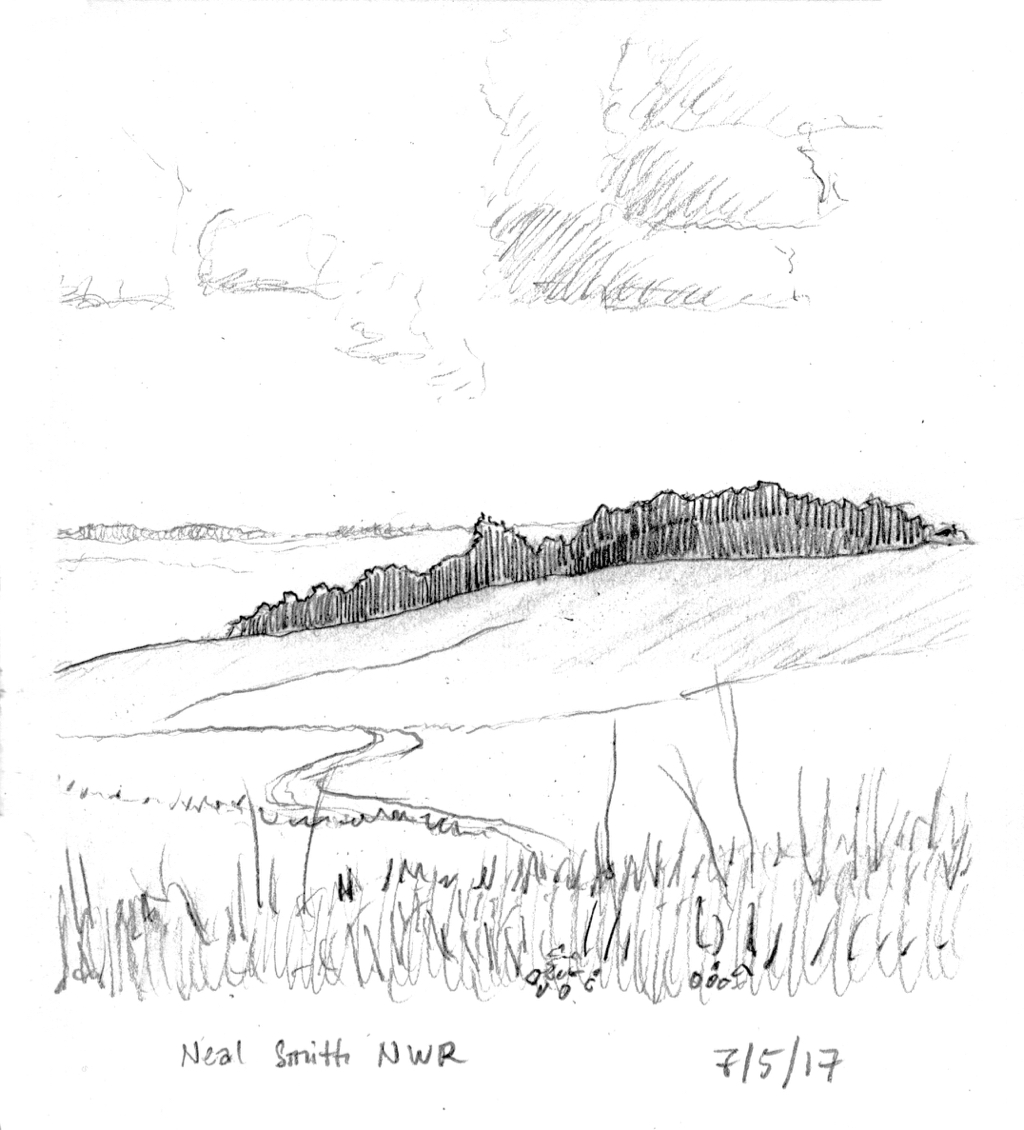
I drove south from Colfax to Neal Smith National Wildlife Refuge, a restored prairie with some oak savanna. Seven hundred acres of the refuge are fenced off and a small bison herd lives there, while scientists study the impact these large mammals had on the prairie ecosystem.

At the visitor center, I spent half an hour talking with a man, probably half my age, who worked for the Department of the Interior. We talked about long distance hiking trails, and I learned from him that the National Park Service now administers the North Country Trail, stretching some 4,600 miles from North Dakota through New York to the Vermont border. He also waxed enthusiastic about the Florida Trail, administered by the U.S. Forest Service, which currently extends for 1,000 miles through Florida. I told him he should take a sabbatical from his job and hike one of those trails, and he said he takes winters off and last winter he went to Nepal.

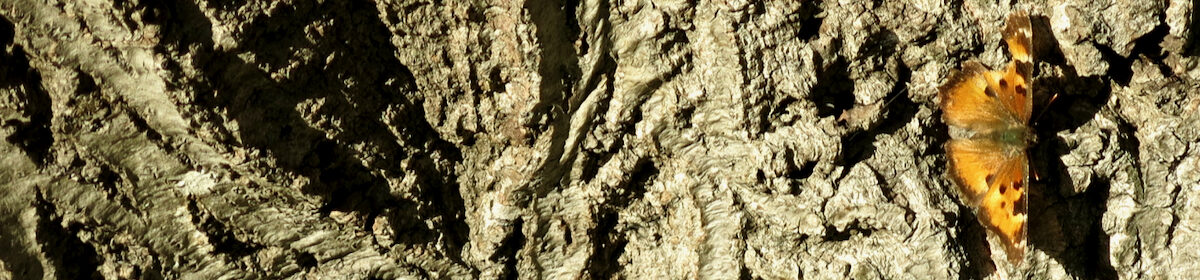
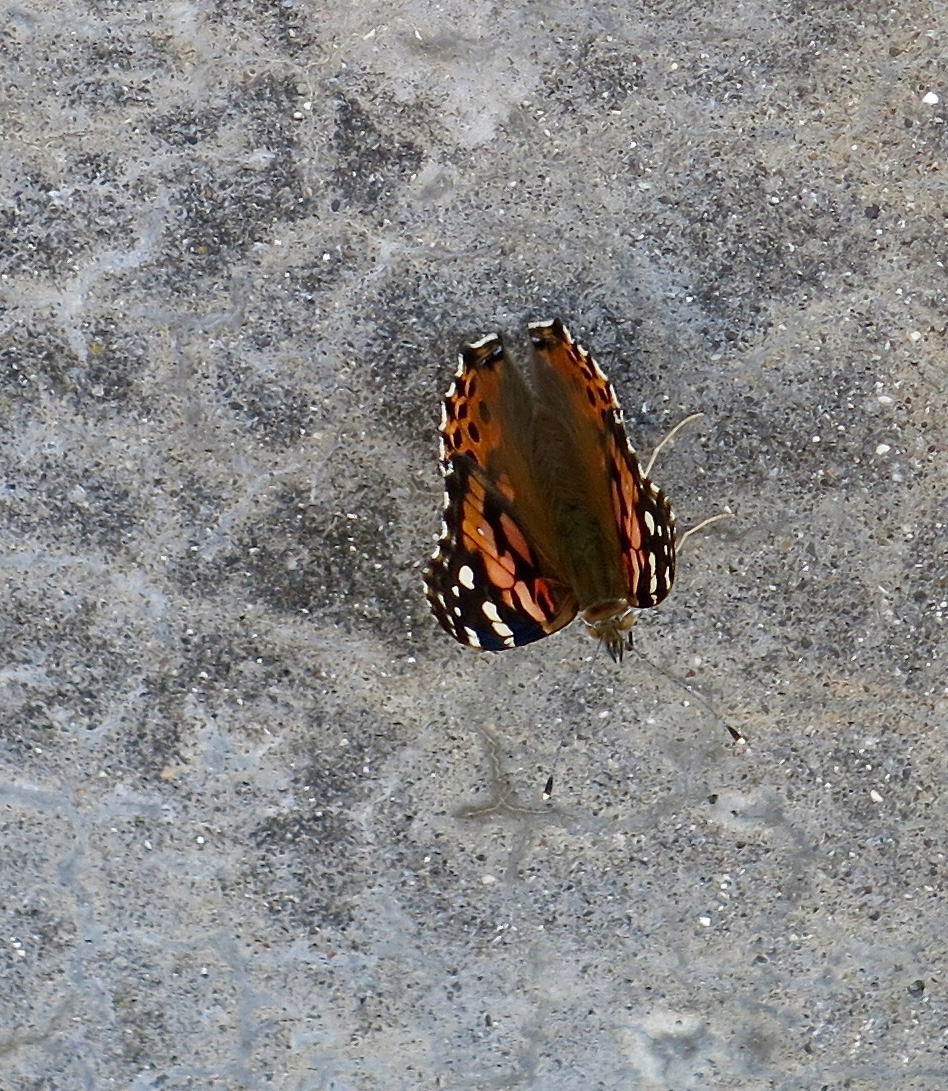
I could have spent more time listening to him talk, but I wanted to get outside. I went out into the hot humid summer day and walked two nature trails, one through oak savanna and one that started high on a prairie hillside then dropped down into a riparian corridor with small willows and a mostly dry stream. Dickcissels were everywhere, Indigo Buntings flew through the lower branches of the oaks, Field Sparrows sang in the grass, and I watched an Orchard Oriole feed its young. A checkerspot butterfly basked in the shade, on the front of a concrete bench.
Before I got back into my car, I stopped to look at the landscape of the restored prairie and oak savanna. The contours of the land were what you’d expect of central Iowa, rolling hills and valleys with small streams. But without the usual dark green covering of soybeans or corn, the landscape took on a different aspect: it was lighter in color, and the air was filled with bird song. I tried to imagine Iowa without any farms, with great herds of bison grazing on the prairie, but it was hard to do so; this is a landscape that we humans have altered almost beyond recognition in the past century and a half.
And tonight I’m staying in Joliet, in the growing sprawl of Chicagoland, where malls and housing developments have replaced corn and soybeans. It’s even harder to imagine this landscape as it must have been before Europeans settled here.
Sidney, Neb., to Avoca, Ia.

Dreams, dreams, dreams. Some of the dreams were unsettling, though I don’t remember specifics, and when I awoke I sat for a moment dazed. It was almost nine o’clock. By the time I started driving it was ten thirty. And in less than a hundred miles I entered the Central Time Zone and lost another hour. I abandoned plans to visit Ash Hollow State Historical Park to see the tracks of the Oregon Trail, because I couldn’t afford the extra hour of driving.

I drove until lunch time, and stopped at a Denny’s. A decade ago, I would have passed Denny’s by, because many of their restaurants refused to serve black people, but supposedly they have mended their ways. My server was a talkative young black man, who lacked the usual carefully defended manner of many servers in interstate truck stops. He was the father of an eight month old — his face lit up when he talked about his son — and he was filling in at Denny’s while getting a paid holiday from his regular job as a lawn tech.

When I stop for meals, I’m re-reading Isaac Asimov’s memoir, I. Asimov. He wrote it in 1990, a couple of years before he died. At the time he wrote it, he was quite ill from the complications of AIDS; he had been infected by a blood transfusion in the early 1980s, though this wasn’t revealed until well after his death. Asimov puts his finger on exactly what his peculiar genius was: he was unbelievably prolific as a writer; but beyond that, he makes no real claims to fame for himself. He loved to write, and he was fortunate that what he liked to write sold well enough to make him a millionaire. The real fascination in his memoir is the degree to which he reveals himself and assesses himself. He cheerfully calls himself vain, arrogant, self-absorbed, and nasty (p. 383), and he was most certainly sharp-tongued. But he also comes across as thoughtful, driven, fearful, and kind. I especially admire his evident kindness, a kindness which had distinct limitations but which was genuine and rooted deeply within him.

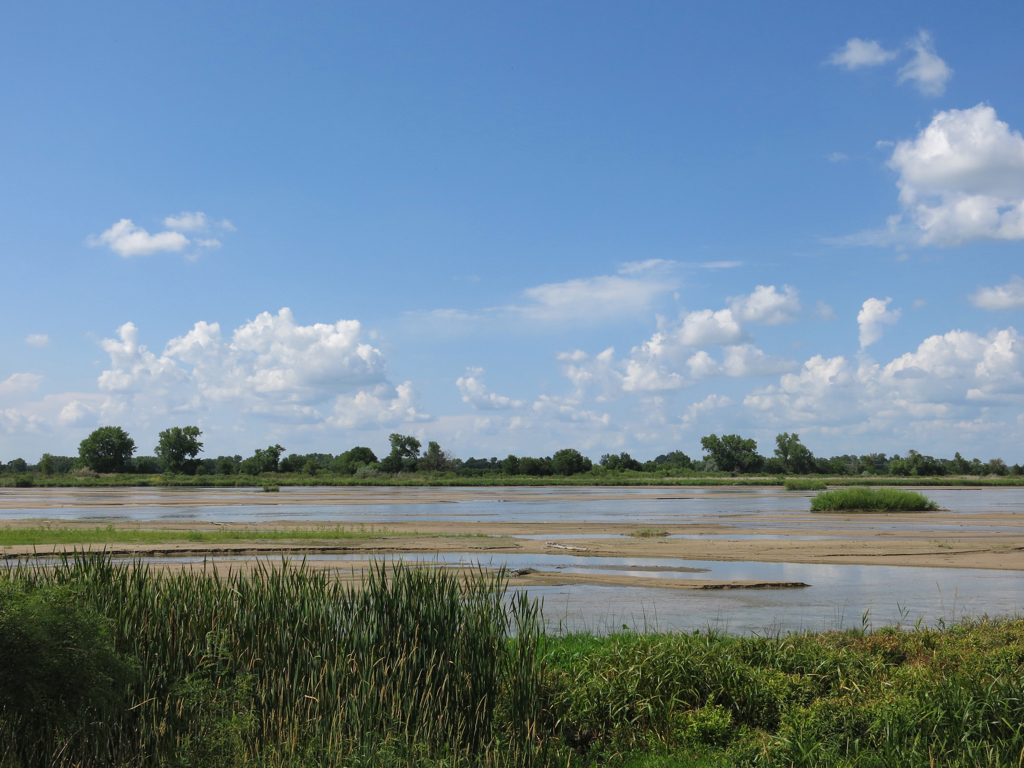
By the middle of the afternoon, it became obvious that I was not going to make it to DeSoto National Wildlife Refuge before dark, since it lay well off the interstate. But I needed a walk, so I stopped where I’ve stopped before, at Rowe Audubon Sanctuary on the Platte River, just five miles from the highway. It was pleasantly hot and a little bit humid. I saw and heard eastern birds that I haven’t seen since the last time I drove west through Nebraska: Blue Jays and Eastern Kingbirds and Northern Bobwhites.

I walked for an hour and a half, and went back to driving. I was listening to an audiobook of The Pickwick Papers, but part of my mind was occupied with thinking about my father’s life. I can hardly escape such thoughts, since a primary reason for this trip back east is to go through what’s left of his papers. And that makes me think about my own life, and I wonder how I will someday describe myself, as Isaac Asimov described himself, assuming I ever get to a stage of life where I have greater perspective on myself. — From such thinking, I suspect, came last night’s dreams.

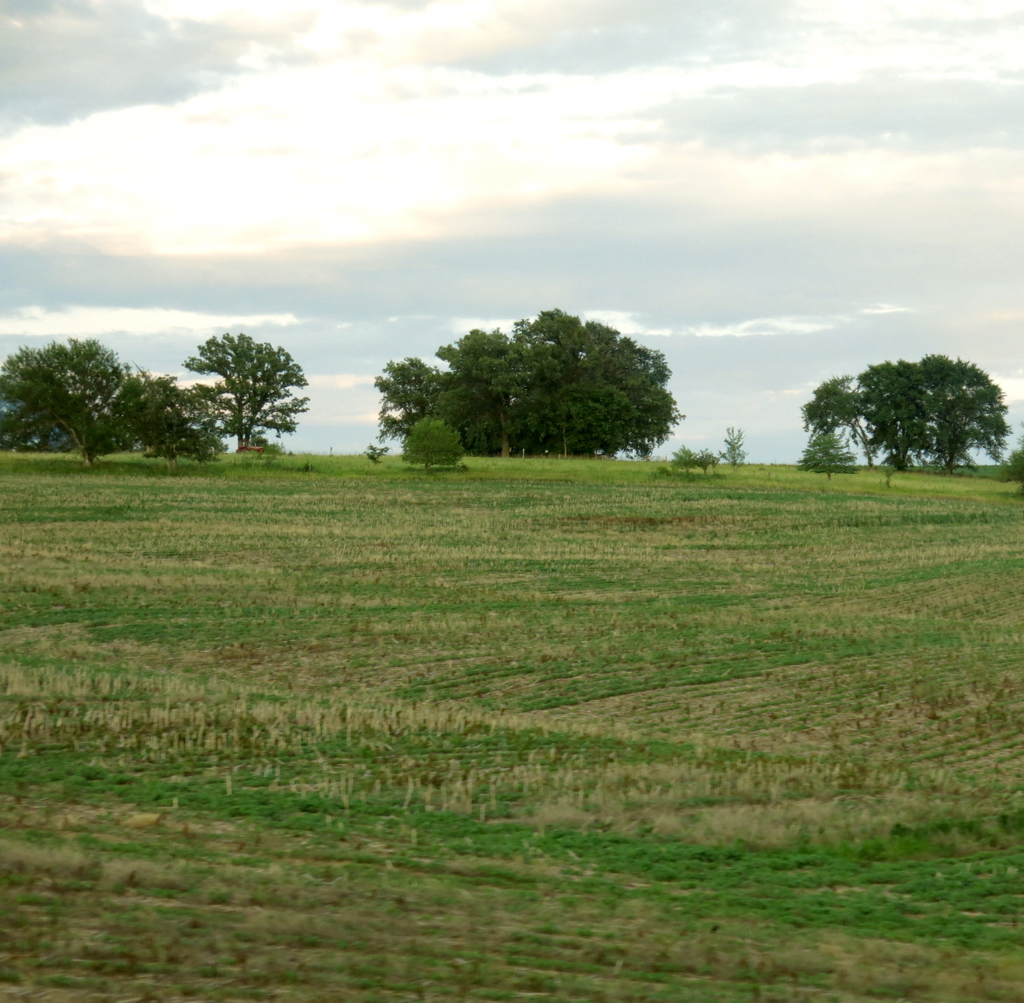
As the sun was setting, I drove up through the Loess Hills of western Iowa, a landscape that is both familiar and unexpected at the same time: fields of Iowa soybeans and corn on steep hillsides whose shift in perspective can mislead one into thinking the hill is steeper, or less steep, than it really is. This could serve as a metaphorical representation of last night’s unsettling dreamscape.

Evanston, Wyo., to Sidney, Neb.

Last night, Will texted me to say he and Linda were driving west on Interstate 80, and where was I? I texted him back saying that I was in Evanston. That’s where we are, replied Will. We arranged to meet for breakfast. Be sure to bring your Sacred Harp book, Will said.

The place that served breakfast in downtown Evanston was closed due to the holiday, so we wound up in the motel where Will and Linda had stayed. I will undoubtedly see Will and Linda at a Sacred Harp singing sometime this year, and when we do see each other we will talk about the same things we talked about at breakfast — how Will’s wife is doing, how Linda feels to have completed her Master’s degree — but how much fun it was to sit and talk as the result of the coincidence of staying in the same town on intersecting cross-country trips!

Linda had to go take care of her cats, but Will and I stayed in the breakfast room of the motel to sing a song or two. Will wanted to sing a traveling song, so we sang “The Promised Land”: “I am bound for the promised land. / Oh, the transporting, rapt’rous scene, / That rises to my sight, / Sweet fields arrayed in living green, / And rivers of delight.” We kept it soft and gentle, so as not to disturb anyone else, and when we had finished talked about how much fun it can be to sing with control and delicacy.

A woman thanked us for singing. We said she was welcome to join us, and she said she would love to; though she wasn’t much of a hymn-singer, even though she was a Christian. We sang “Wondrous Love,” thinking she might know the tune, but she didn’t, so she sight-read the harmony as best she could, improvising in places, in her mellow soprano voice. Then she said she knew “Amazing grace,” so we sang that in three parts. She asked where we had come from, and we told her about our coincidental meeting; she told us that she had lived in Evanston for many years, but now lived in Texas and was back for a visit. And with that, we all had to get going. I drove off feeling the best I’d felt on this trip so far.

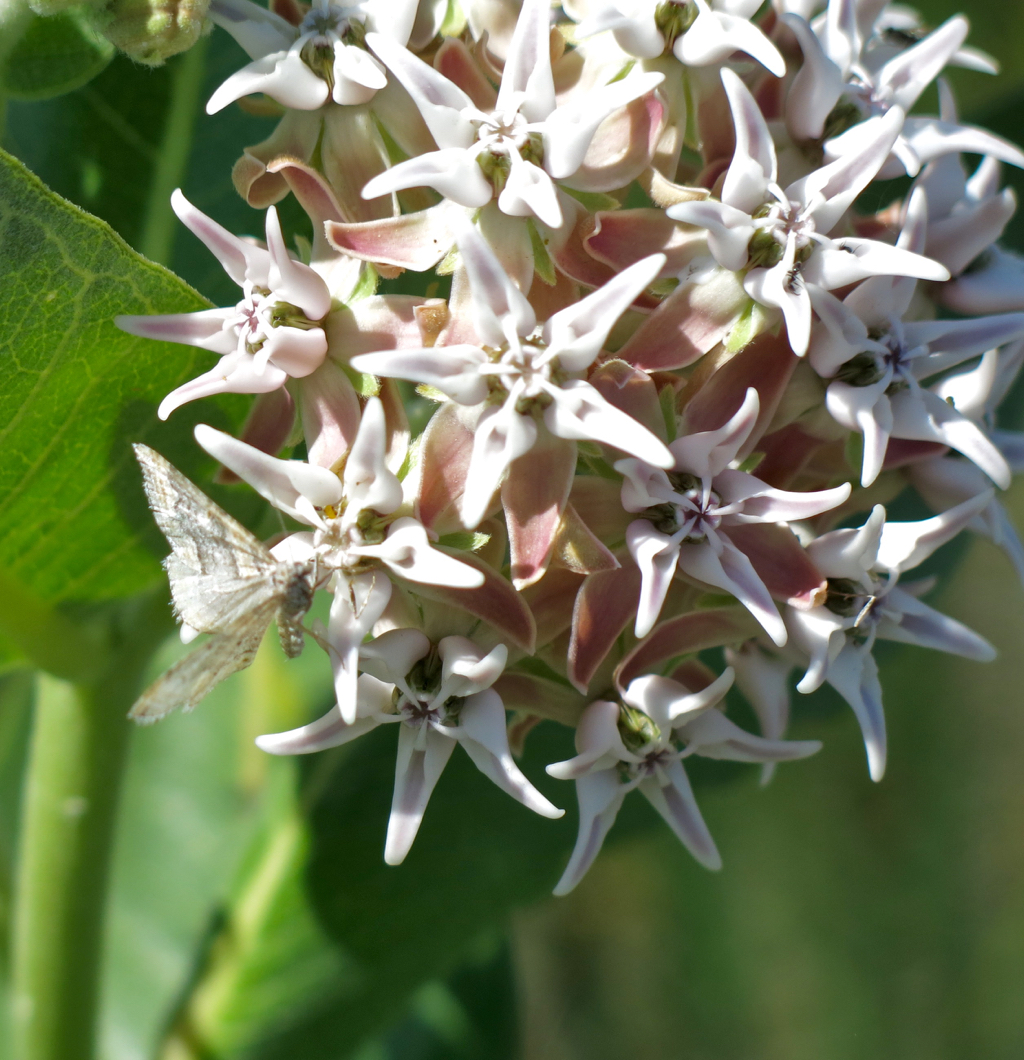
I stopped at Seedskadee National Wildlife Refuge, and went for a walk near Six Mile Bridge. Within a quarter of an hour, I had seen what I had hoped to see: ten or a dozen Greater Sage-Grouse flushed noisily up and flew low over the sagebrush. I stopped to look at some Milkweed that was blooming and counted at least six different pollinators: bees, something that looked like a wasp, and a butterfly. (The photo below shows at least two different pollinators.)

The air was cool, and the sun was hot and bright and cheerful. A slight breeze mostly kept the mosquitoes and deer flies away. A Golden Eagle flew low over the trees on the other side of the Green River, driven to flight by the attacks of smaller birds. In the reeds at the edge of the river, a Moose (Alces alces) browsed the vegetation, chewing big mouthfuls of leaves from the bushes and trees.

Two Mountain Bluebirds flew along an irrigation ditch, looking spectacularly bright. A Pronghorn (Antilocapra americana) skulked through some bushes, trying very hard not to be seen by me. Swallows swooped through the air, moving so fast I could only positively identify Cliff Swallows and Tree Swallows, though I thought I saw Northern Rough-winger Swallows and Violet-Green Swallows, too.

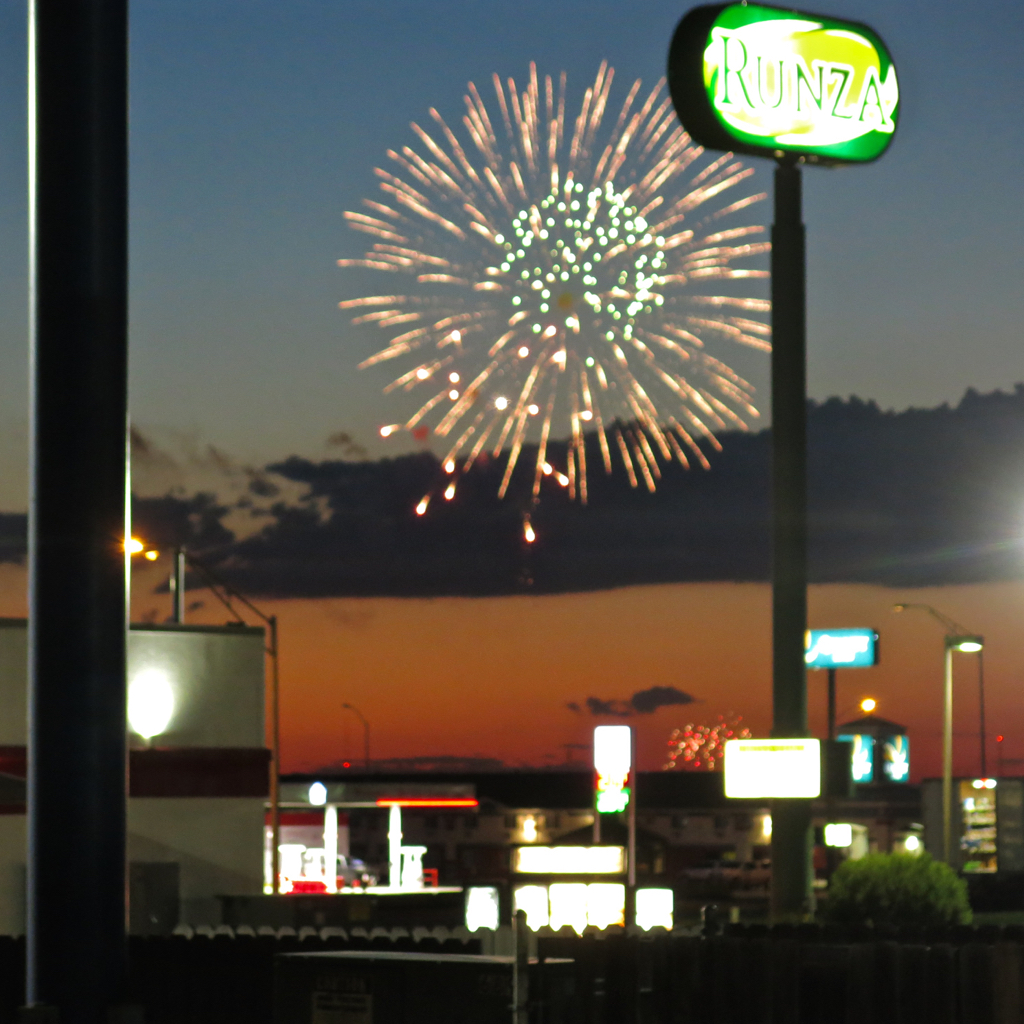
At last it was time to go, and regretfully I got in the car and starting driving east again. Some day I’d like to spend a week at Seedskadee; but not this year, I’m on a tight schedule. I drove the rest of the day, stopping for lunch and dinner, and pulled into Sidney, Nebraska, just in time to see the beginnings of a fireworks display. I watched it from the motel parking lot for ten minutes, then checked in to the motel, drawing the clerk away from the front door where she had been watching the fireworks. She put me in a second floor room that gave an even better view of the fireworks. I called Carol, who loves fireworks, and told her what I was seeing.

And then it was time for bed.

Winnemucca to Evanston, Wyo.

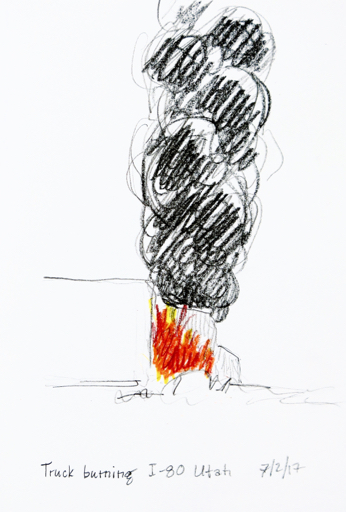
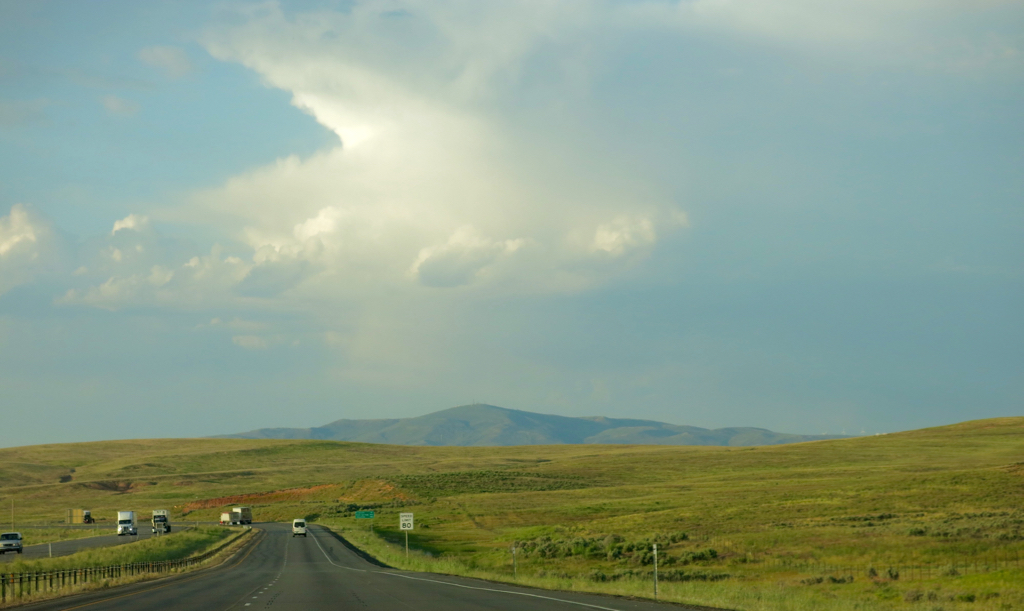
I got on the road at nine, but I wasn’t feeling completley alert, and I kept pulling over to get out and stretch. I tried listening to an audiobook of the Pickwick Papers, but I couldn’t stay focused. I listened to some Renaissance music for a while, then a field recording of old Sacred Harp singing, then Steve Reich, then John Coltrane — but each in turn quickly grew annoying. I tried singing the bass part of a duet I’m learning, but I skipped over a part then couldn’t remember the words. I stopped at one place to take a walk, but it was beastly hot, so I got back in the car and drove. I stopped for lunch at the rest area on the Bonneville Salt Flats. An hour later I stopped for a quick walk at Tempe Spring Wildlife Area, but the Black-Necked Stilts were aggressive and I soon saw why: shy young Stilts were hiding in the reeds, trying to be invisible; so I left. I stopped at a reservoir in Echo Canyon, only to realize that the column of black smoke I saw was a burning tractor trailer rig on the west-bound side of the highway, right over the road I drove under to get to the reservoir. I took a forty-five minute walk, and when I got back to the car the tractor was still burning, surrounded by fire trucks. Finally I drove into Wyoming, into self-proclaimed Big Sky Country — which weakly describes a landscape that makes human affairs feel tiny and insignificant — glad to put an end to this day.

San Mateo to Winnemucca

Today is the first day of a holiday weekend, and of course traffic was horrible. By the time I got to Davis, it was half past noon. So I stopped for lunch at Yolo Bypass Wildlife Area.

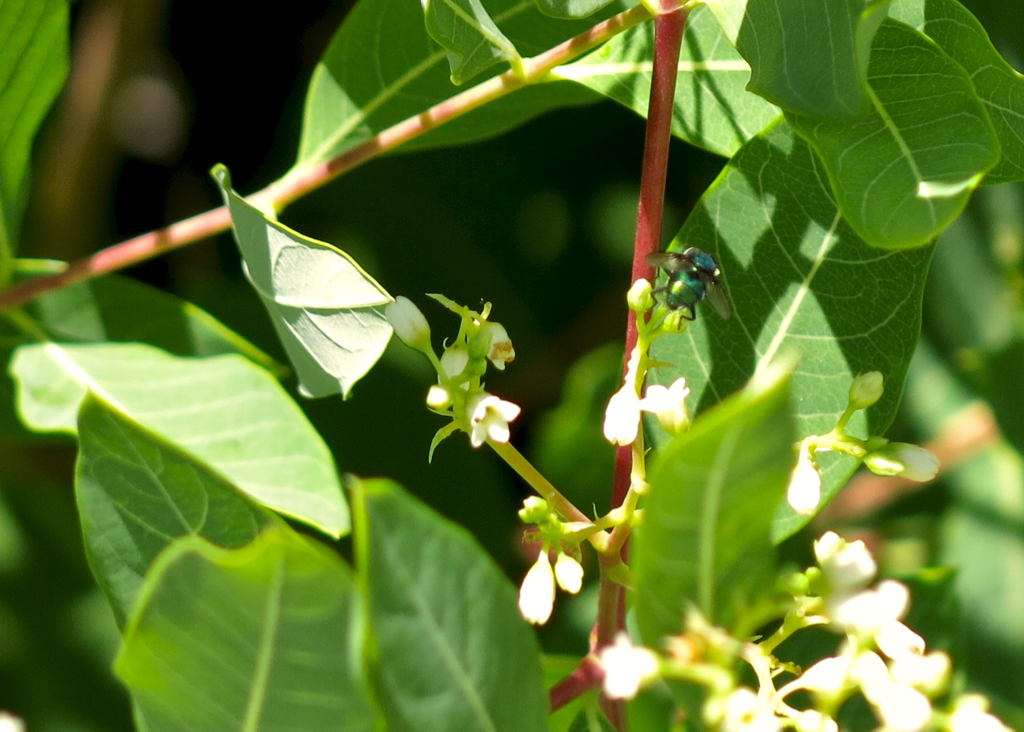
It was so pleasant there — clear, a light breeze, temperature in the low eighties — that I decided to spend an hour walking around. There is very little standing water, except in the rice fields and along the riparian corridors. I walked along one of the riparian corridors, listening to the bullfrogs and enjoying the coolness that emanated from the willows. An American Bittern flew over my head. Some kind of unremarkable-looking plant with white flowers was in bloom between the edge of the road and the willows. An urgent humming sound rose from the flowers: scores, maybe hundreds of tiny metallic green bees flew from tiny blossom to tiny blossom flowers, moving so quickly it was hard to see one, except as a metallic green blur.

I got back on the road, and the traffic was heavy through the Sierras. Some of the peaks still had a little bit of snow on them. Every year when I drive through the Sierras, there are fewer and fewer pines and firs, as the trees succumb to the various effects of global climate change: invasive species that thrive on warmer temperatures, changing weather patterns, and so on. Parts of the Toiyabe National Forest could now be called the Toiyabe National Bare Ground.

After Reno, the traffic grew light. Now way behind schedule, I stopped for dinner in Fernley, and ate at a very mediocre Chinese restaurant. I started driving again just after six, when the sun was getting lower in the sky; this is the best light for the glories of the Humboldt Sink and the mountains along the Humboldt River. I needed a walk, and I stopped at Rye Patch Reservoir near Imlay. At 7:30, it was still hot, over ninety degrees, but the air was dry and filled with the scent of sagebrush.

I walked half a mile down a gentle canyon to the reservoir. Jack rabbits burst from cover and scampered away from me. Cattails and willows grew along the bottom of the canyon. Six or eight Common Ravens talked among themselves on the ridge over my head. A Great Blue Heron flew silently up the canyon away from the water, and a Mule Deer leaped up over a rise and quickly disappeared from my sight.

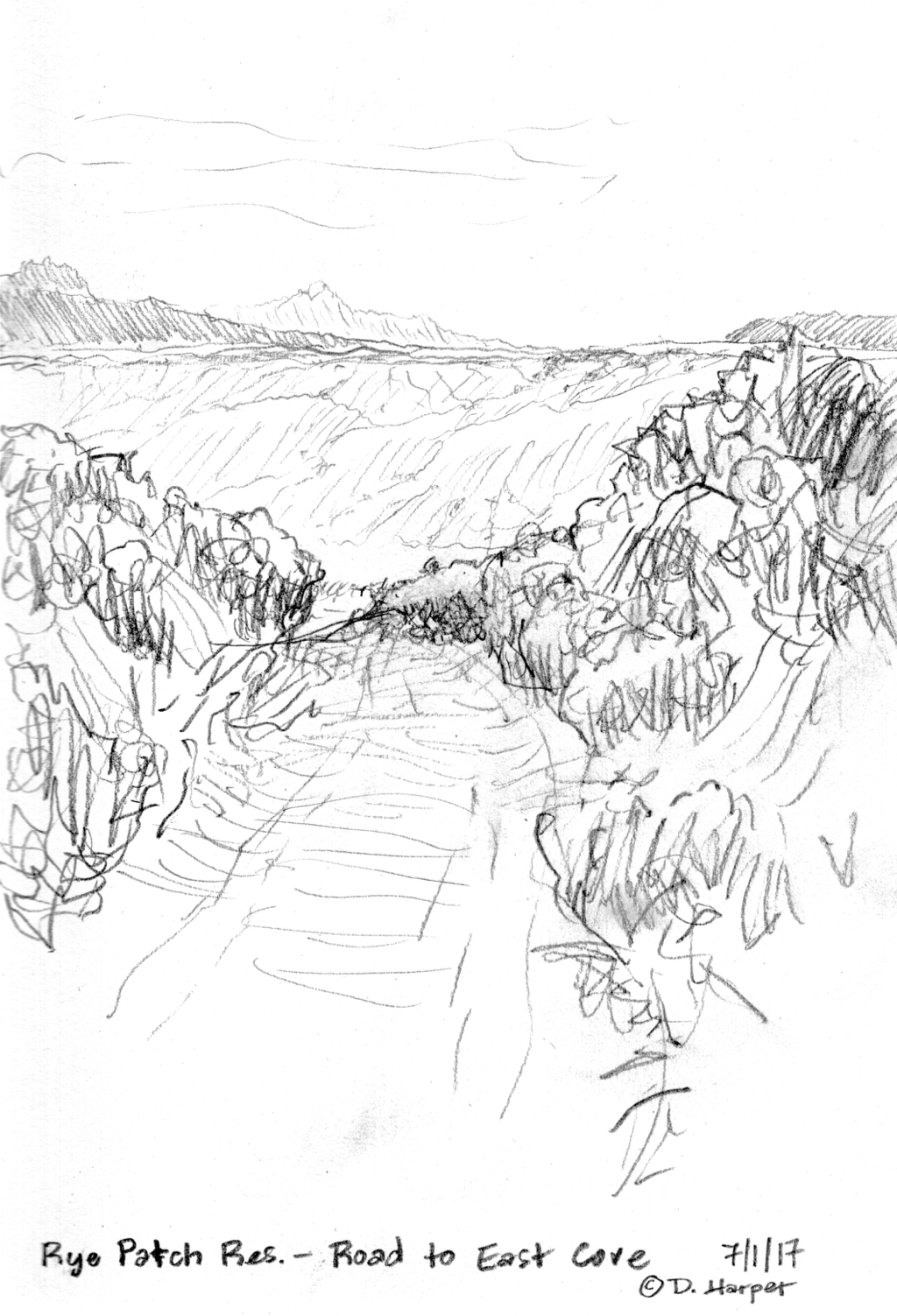
Carol couldn’t come with me on this trip, but she bought me a sketch book to take along. I decided I had better use it, and when I got back to the car I made a sketch of the start of the dirt road down to the reservoir. The sketch smudged easily, and when I got to Winnemucca I stopped at Walmart to get some sprayable fixative. Walmart is a remarkable place, filled with many things that catch and hold your attention, but in contrast to Yolo Bypass or Rye Patch Reservoir, the only organisms I saw at Walmart were human beings.

Pounding flowers

One of the best projects we did in Nature Camp last week was “Pounding Flowers,” a project from the book A Little Bit of Dirt: 55+ Science and Art Activities To Reconnect Children with Nature by Asia Citro (Woodinville, Wash.: Innovation Press, 2015), pp. 72-73. The idea is to collect several different flowers, arrange them on a piece of watercolor paper, cover them with paper towels, and pound the heck out of the flowers so that they release their juices which are then absorbed by the watercolor paper.

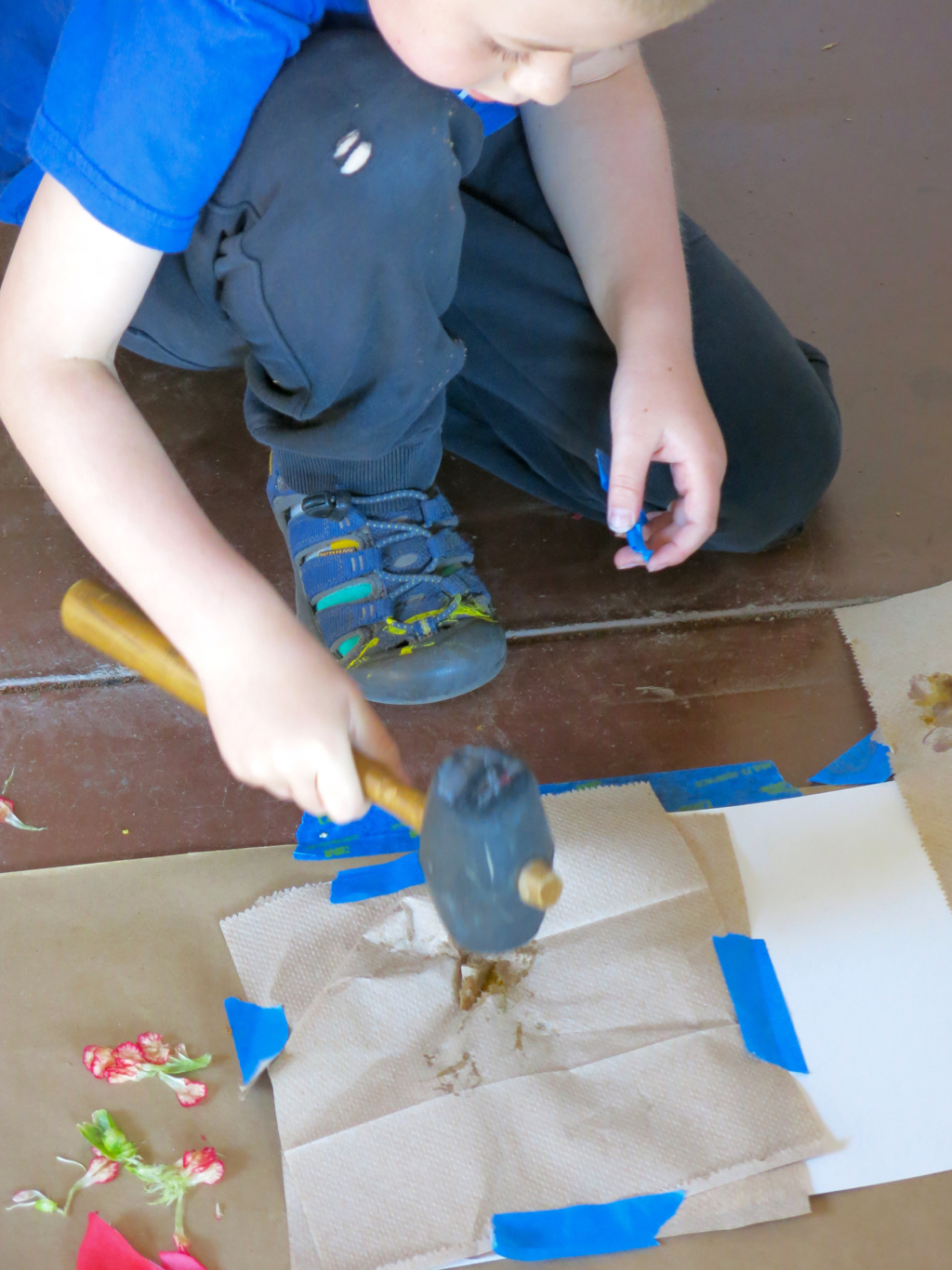
Our campers, who were ages 6-7, particularly enjoyed pounding the flowers with rubber mallets. So did we adults: the feel of the impact of the rubber mallet on a hard concrete floor was satisfying in itself, and the addition of the flowers sandwiched between towels and watercolor paper was even better.

(Photo courtesy of Ecojustice Camp; parents provided a media release for this child.)

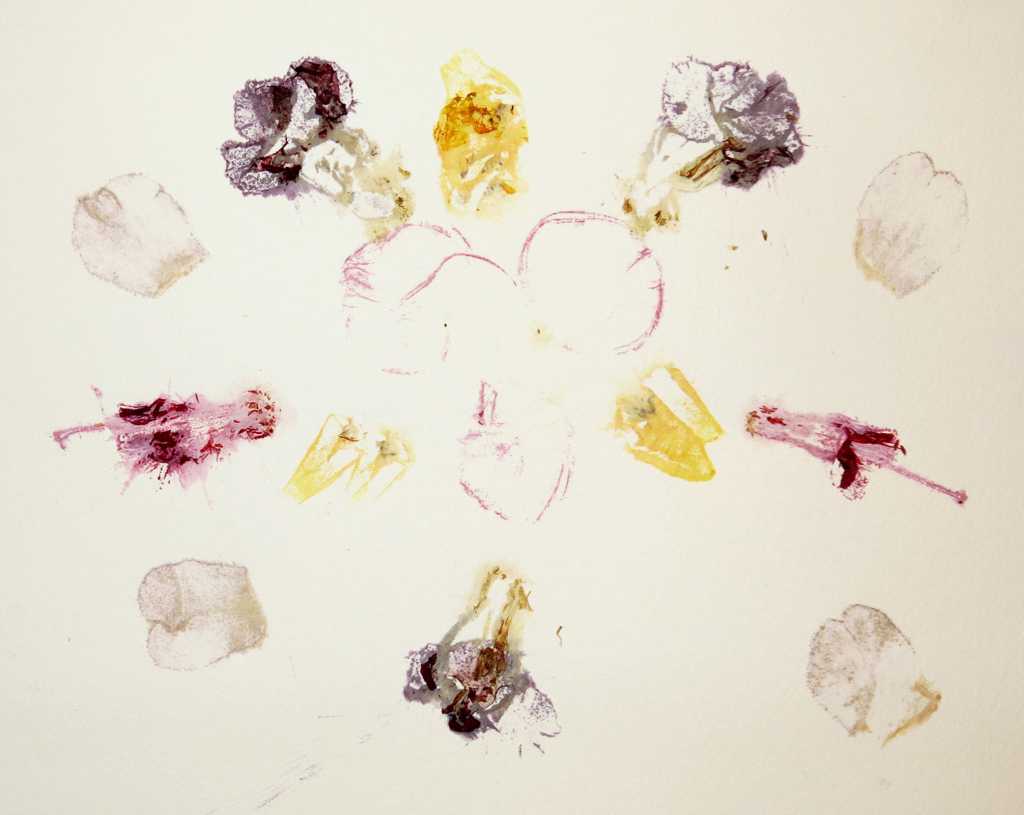
But I was not entirely satisfied with this project myself. The paper towels did not work very well; they tended to shred under heavy pounding, and the flowers tended to shift under them. So tonight I tried something different. I collected some flowers; arranged them on a piece of watercolor paper on a smooth concrete surface; then instead of paper towels I laid another piece of watercolor paper over the arrangement, and pressed gently down.

This worked extremely well. It was even more satisfying to pound on, because the top piece of watercolor paper didn’t shred, and it didn’t shift much. When I was done, I got two pieces of pounding art, mirror images of one another. And, best of all, this process yielded more detail of the flowers: I got distinct outlines of the petals or pistils in some cases.

This was a very fun process art project to begin with, and by sandwiching the flowers between two pieces of watercolor paper it got even better.


Update, July 15, 2025: For a more sophisticated version of this art project, see my post on hammer dyeing.

How to fight therapeutic technological consumerist militarism

The current issue of Geez magazine (“Contemplative Cultural Resistance”) just arrived in my mailbox from Canada, and the issue opens with a quote from Walter Brueggeman’s 2005 essay “Counterscript.” Geez had to abridge the quote, but here’s the original:

———

“The dominant script of both selves and communities in our society, for both liberals and conservatives, is the script of therapeutic, technological, consumerist militarism that permeates every dimension of our common life.

“I use the term therapeutic to refer to the assumption that there is a product or a treatment or a process to counteract every ache and pain and discomfort and trouble, so that life may be lived without inconvenience.

“I use the term technological, following Jacques Ellul, to refer to the assumption that everything can be fixed and made right through human ingenuity; there is no issue so complex or so remote that it cannot be solved.

“I say consumerist, because we live in a culture that believes that the whole world and all its resources are available to us without regard to the neighbor, that assumes more is better and that ‘if you want it, you need it.” Thus there is now an advertisement that says: ‘It is not something you don’t need; it is just that you haven’t thought of it.’

“The militarism that pervades our society exists to protect and maintain the system and to deliver and guarantee all that is needed for therapeutic technological consumerism. This militarism occupies much of the church, much of the national budget and much of the research program of universities.

“It is difficult to imagine life in our society outside the reach of this script; it is everywhere reiterated and legitimated.”

———

Later in the essay, Brueggeman goes on to say that this script has “failed,” for “we are not safe, and we are not happy.” He points to the complicity of the Christian church in “enacting” this script, adding:

“It is the task of the church and its ministry to detach us from that powerful script.”

Unitarian Universalism got kicked out of the Christian church more than a century ago (a fact we’re now kind of proud of), but like many Christian churches we too are enacting the script of therapeutic technological consumerist militarism. We firmly believe that we can find ways to live our lives with no inconvenience. We firmly believe that we can find a fix for every problem.

The next two points may not be as obvious, and will require some explanation.

We may protest that we fight consumerism, but we live our lives as though resources are ours to exploit. We cut down on our oil use, but we firmly believe that the sun and wind are ours to exploit for energy. We say we are anti-racist, but the financial health of many of our congregations can be traced back to seed money accumulated through exploitation of people of color: land appropriated from Native American peoples, labor appropriated from persons of African descent, etc.

We may protest militarism. Many of us may be peaceniks, and some of us have been arrested protesting militarism. But in the end we depend on systems that protect therapeutic technological consumerism, and so we protest that upon which our livelihoods depend.

Brueggeman goes on to say: Continue reading “How to fight therapeutic technological consumerist militarism”

Compact camp cook box

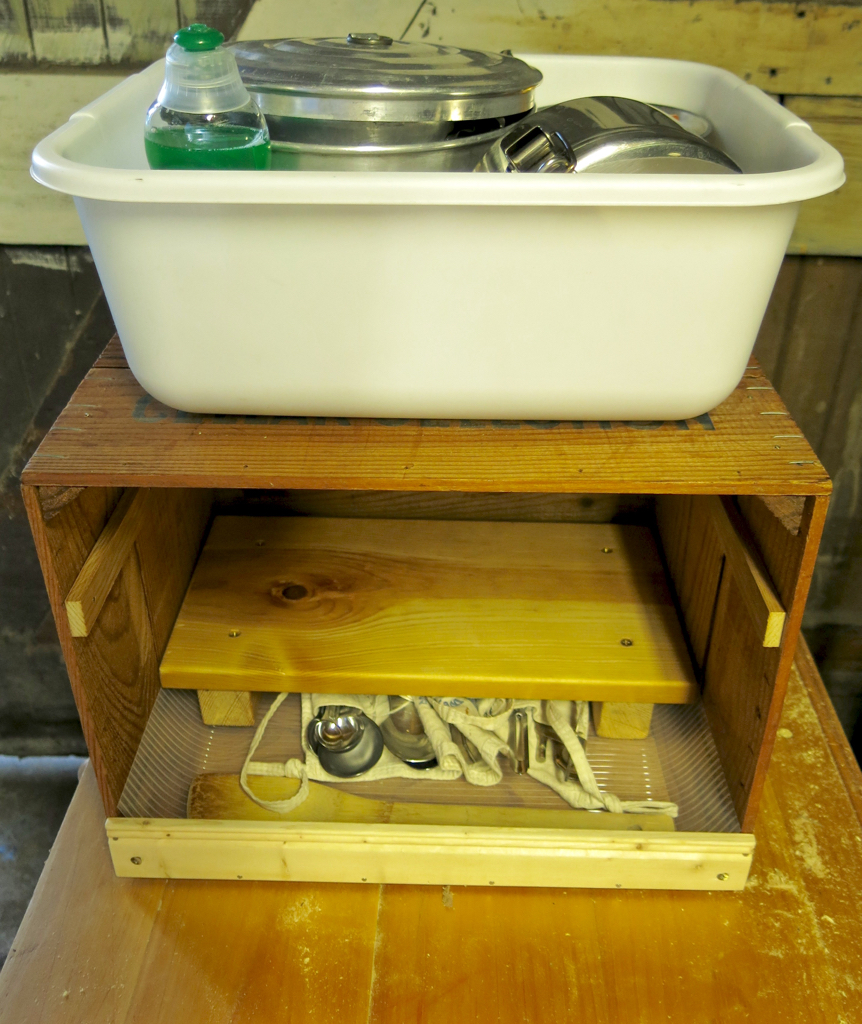
I’ll be driving across the continent by myself during July, camping for about two and a half weeks of that time. The camp cook box we have is big because it’s designed for two or more people. I decided to make a more compact camp cook box for this trip.

I found an old wooden wine create we had in the basement, did extensive repairs, and sealed it with some leftover wood sealer. A standard plastic dishpan fit perfectly inside, and I attached two wood strips for the dishpan to slide on. I made a small cutting board, elevated on wood runners so there’s storage space under it.

The dishpan holds a 2-quart pan with a teapot nested inside, a 1-quart pan, a mug, a small wood box with a sponge and scrubbing pad, dish detergent, and matches in a waterproof case. Under the wood cutting board there’s a cloth tool roll with various kitchen utensils (measuring spoons, stirring spoons, vegetable peeler, can opener, etc.).

I didn’t buy anything except the dishpan; everything else was something we had lying around. I spent too much time hand planing the wood for the cutting board, then hand-rubbing it with chopping block oil. And I used no power tools, which also took more time. But who cares if it took too long? Who cares if the various parts and pieces don’t quite match? I had fun working on it. This kind of project is like process art: the final product is less important than the process of making it.

A day at Nature Camp: insects, process art, stories

The second day of Nature Camp started with opening circle, as always. Our kindergarteners and first graders sat in a circle, and we sang one of the songs we learned yesterday, “The Earth Is Our Mother,” and the children remembered it well enough that they told me when I sang one of the verses wrong. Abby read a short story about Wangari Maathai, one of our Nature Camp elders. Kris also showed us a slug that she had found that morning, and we spent some time watching it before we released it in a shady place.

Then Kris introduced the them for the day: insects. Kris read some excerpts from Simon & Schuster Children’s Guide to Insects and Spiders. We learned what an insect is, and we learned the three parts of an insect (head, thorax, and abdomen). Kris also read to us a little bit about butterflies and moths, or Lepidoptera.

Kris next told us that we were going to make some pitfall traps to catch some insects, by burying a plastic cup in the ground. We learned the ethics of pitfall traps: you have to empty them regularly (at least once a day) to be sure the insects don’t die, and they should not be placed in full sun (the hot sun can kill any insects that fall in them).

The children enjoyed finding shady places to put the traps, and then digging holes in the ground with trowels and placing the plastic cups in the holes. Each child got to put at least one insect trap in the ground. While we were doing this, we stopped at the plum tree and managed to find a few more ripe plums to eat, enough for every child who wanted one to have one.

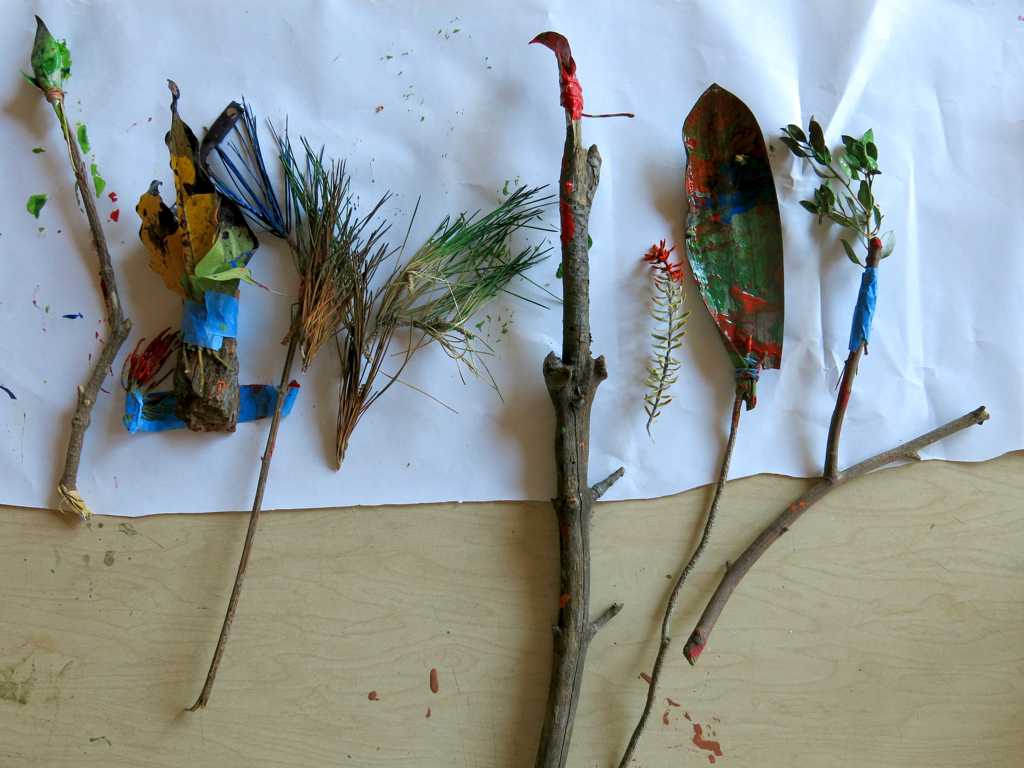
The highlight of the morning for me was Abby’s “natural paintbrush” project. The children got sticks (the handle of the paintbrush) and then attached leaves or pine needles or some other natural object to the stick with masking tape or rubber bands.

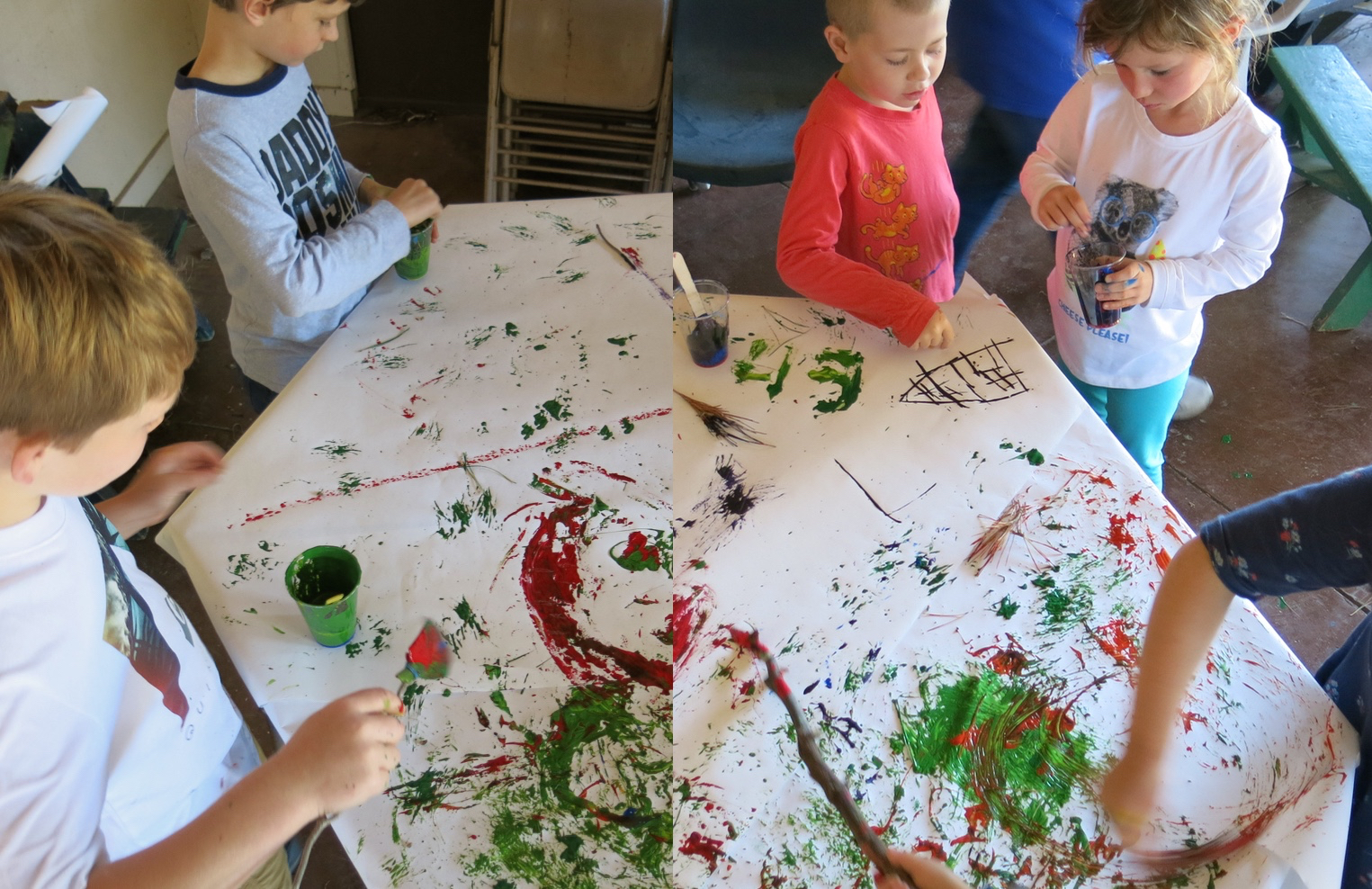
We taped large sheets of paper on two tables, and provided red, yellow, and blue tempera paint. The children enjoyed mixing their own colors, then spreading the colors with the natural paintbrushes.

It was a great example of process art, since there was no “product”; instead the whole emphasis was on exploring the materials and colors.

After we painted for a while, it was time to walk over to Mitchell Park to play on the trees and eat some lunch. The children particularly enjoy climbing a tree that has a long branch that is almost horizontal the the ground, sloping gently upwards. It’s the perfect challenge for this age group. One or two of the children felt comfortable walking along the branch, but most of them moved along slowly, clasping it with legs and hands. Kris told them that they should only climb as far as they felt safe; at the same time she gently urged them to go a little beyond their comfort zones. One child was pleased to find that he could make it further along the branch than he thought he could.

While we were eating lunch, two California Gulls landed not far away and started fighting over some trash. We talked about how gulls like to eat trash, and I described the gull nesting colony near Charleston Slough. I also expressed my opinion that gulls are not particularly pleasant birds: they are loud, and messy, and kind of aggressive. While we were eating lunch, we also saw some butterflies flying by probably (Western Tiger Swallowtails), but it was breezy and the butterflies went by very quickly.

After lunch, Kris had a book that showed us how to draw slugs and butterflies. The children each drew some slugs and butterflies in their nature journals. One child drew a slug very carefully, trying to make it the same color as the one we had seen earlier in the morning. Another child drew a large number of slugs, and then dots all over them which he said was salt that was killing them. We talked a bit about why salt might kill slugs.

At last it was time to go back for closing circle. We sang “The Earth Is Our Mother” again, which the children knew really well by now, as well as “The Adaptation Song” which has a verse about how California Gulls adapt to their environment. To close the day, Kris read part of an Arnold Lobel book about a grasshopper.

All in all, a very satisfying day at Nature Camp. We worked on fine motor skills, gross motor skills, and knowledge about the natural world. Most importantly, we just spent time in nature, looking, touching, playing, being.

Note: We have media releases for all children depicted above. Nature Camp is sponsored by the Unitarian Universalist Church of Palo Alto.

The Useless Tree

Another story in a series for liberal religious kids, this one from the Taoist tradition.

A certain carpenter named Zhih was traveling to the Province of Ch’i. On reaching Shady Circle, he saw a sacred tree in the Temple of the Earth God. It was so large that its shade could cover a herd of several thousand cattle. It was a hundred yards thick at the trunk, and its trunk went up eighty feet in the air before the first branch came out.

The carpenter’s apprentice looked longingly at the tree. What a huge tree! What an enormous amount of timber could be cut out of it! Why, there would be enough timber in that one tree to make a dozen good-sized boats, or three entire houses.

Crowds stood around the tree, gazing at it in awe, but the carpenter didn’t even bother to turn his head, and kept walking. The apprentice, however, stopped to take a good look, and then had to run to catch up with his master.

“Master, ever since I have handled an adze in your service,” said the apprentice, “I have never seen such a splendid piece of timber. How was it that you did not care to stop and look at it?”

“That tree?” said the Master, “It’s not worth talking about. It’s good for nothing. If you cut down that tree and made the wood it into a boat, it would sink. If you took the wood to build a house, the house would break apart and rot. See how crooked its branches are! and see how loose and twisted is its grain! This is wood that has no use at all. Not only that, if you try to taste one of its leaves, it is so bitter that it would have taken the skin off your lips, and the odor of its fruit is enough to make you sick for an hour. It is completely useless, and because it is so useless, the tree has attained a huge size and become very old.”

The carpenter told his apprentice to dismiss the tree from his thoughts, and they continued on their way. They arrived home late at night, and both of them went straight to bed.

———

While the carpenter was asleep, the spirit of the tree came and spoke to him.

“What did you mean when you spoke to your apprentice about me?” said the spirit of the tree. “Of course I am not like the fine-grained wood that you carpenters like best. You carpenters especially like the wood from fruit trees and nut trees — cherry, pear-wood, and walnut.

“But think what happens! As soon as the fruits or nuts of these trees have ripened, you humans treat the trees badly, stripping them of their fruits or nuts. You break their branches, twist and break their twigs. And then you humans cut down the trees in their prime so you can turn them into boards and make them into furniture.

“Those trees destroy themselves by bearing fruits and nuts, and producing beautiful wood,” said the spirit of the tree. “I, on the other hand, do not care if I am beautiful. I only care about being useless.

“Years ago, before I learned how to be useless, I was in constant danger of being cut down. Think! If I had been useful, your great-grandfather, who was also a carpenter, would have cut me down. But because I learned how to be useless, I have grown to a great size and attained a great age.

“Do not criticize me, and I shan’t criticize you,” the spirit of the tree said. “After all, a good-for-nothing fellow like yourself, who will die much sooner than I will — do you have any right to talk about a good-for-nothing tree?”

———

The next morning, the carpenter told his dream to his apprentice.

The apprentice asked, “But if the goal of the tree is to be useless, how did it become sacred tree living in the Temple to the Earth God?”

“Hush!” said the master carpenter. “You don’t know what you’re talking about. And I should never have criticized the tree. The tree is a different kind of being than you and I, and we must judge it by different standards. That’s why it took refuge in the Temple — to escape the abuse of people who didn’t appreciate it.

“A spiritual person should follow the tree’s example, and learn how to be useless.”


Source: from Chuang-tzu 1.16, based on translations by Lin Yutang, Burton Watson, and James Legge.