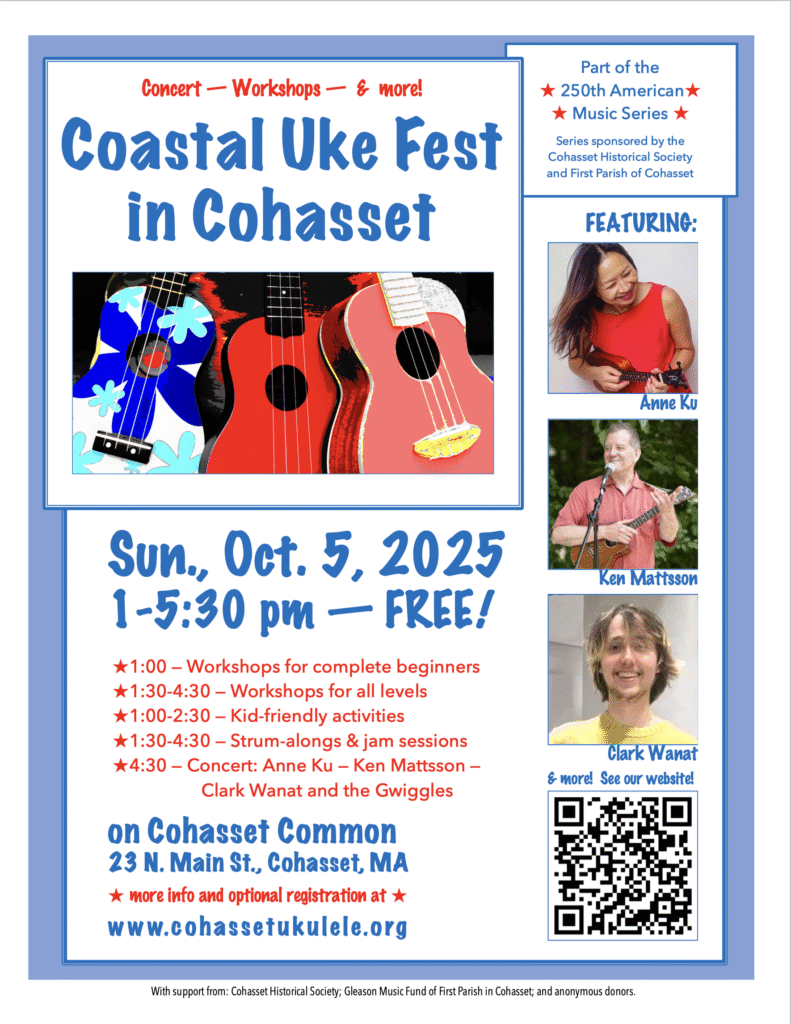
Our twice-monthly ukulele group will be hosting a half-day ukulele festival on Sunday, October 5, 2025. More info here.
This entirely free event is being sponsored by my employer, First Parish in Cohasset, in cooperation with the Cohasset Historical Society. We’re able to make this a completely free event, thanks to a grant from the Gleason Music Fund at First Parish, in-kind support from both First Parish and the Historical Society, as well as a generous anonymous donation. We’re also on a Massachusetts Cultural Council grant application submitted by the Historical Society — if that grant comes through, we’ll be able to increase accessibility with an ASL interpreter for the final concert.
If you’re in the Boston area, hope to see you there. Even if you don’t play ukulele, come join us for the free concert at 4:30.
I started out this series by saying that sometimes the stories of Revolutionary War heroes and heroines have been partially forgotten, or details have been obscured. In this follow-up post, I’ll tell a little about how I researched the stories of Persis and Allen Lincoln, and the story of Briton Nichols. Maybe this will inspire other people to do some research into ordinary Revolutionary War veterans — a worthwhile thing to do as we celebrate the 250th anniversary of the start of the American Revolution.
One place to start researching an individual is by looking through the local history of a given town or city. During the middle part of the 19th century, many municipalities from the 13 original colonies had local histories written. And in most cases, whoever wrote that local history would be sure to record any local traditions about those who served in the Revolution. So, for example, for the town of Cohasset where I live, Victor Bigelow wrote a history of the town in 1898, and he provided lists of those who served and told many stories of the town’s participation in the Revolution.
That being said, local histories may contain local traditions that have gotten muddled over time, and most local histories contain lots of small errors of fact. So the next step is to see if you can find corroborating evidence from other sources. Which can be a huge job. Cohasset is a small town, but there were more than 125 men from the town who did military service during the Revolution. Volunteer local historians like me don’t have time to research all 125+ individuals who served in the Revolution. You have to narrow your focus to research a few individuals in depth.
But how do you narrow your focus? Here are some strategies:
(1) Research a college graduate, who would be far more likely to appear in the written record than non-college graduates. For example, you can find brief biographies of Harvard graduates in the series Sibley’s Harvard Graduates.
(2) Research famous or semi-famous persons, or persons who are part of prominent families. For example, if you were researching persons from Braintree or Quincy, you could start with anyone related to John Adams; there are lots of published genealogies and published histories of the Adamses.
(3) To research ordinary people, start with unusual person names (such as Briton Nichols) and unusual place names (such as Cohasset). Those will be easiest to find information on.
(4) As you’re researching one person, you might run into a lead from someone else altogether (e.g., when researching Briton Nichols, I discovered Ambrose Bates kept a war diary). Keep note of those other leads so you can follow up later.
Next, here are some research strategies:
(A) Use the power of internet search. More and more 18th century documents are being digitized, making information easily available online. This works best with Search using several different search tools — I start with DuckDuckGo, first with the person’s name and place name along, then adding the following to the search string: site:.archive.org (which searches through the many books digitized by the Internet Archive) and site:.loc.gov (which searches the Library of Congress website). Next, I’ll search Google Books. Finally, I’ll try regular Google search (Google seems to turn up a lot of crap these days, which is why I leave it till last).
(B) Search genealogy sites. I use FamilySearch.org, which is free, although it does require you to set up a free account. Paid genealogy sites may give you more information, but FamilySearch.org is a good place to look for Revolutionary War military service records. Additionally, amateur genealogists may have done additional research on some individuals — but be cautious about trusting the work of amateur genealogists. Always click through to look at the sources they cite, and then click through and look at the actual digitized images for those sources (which is how I found out that Persis Lincoln and Allen Lincoln were married by Rev. John Browne of Cohasset).
(C) Don’t forget your local library. Many local libraries have local history sections. If there’s a librarian who has responsibility for the local history section, get to know that person, and ask for help when you need it.
EXCEEDINGLY IMPORTANT: For each little tidbit of information you find, make sure you record where you found it, including full bibliographic information. Footnote everything! You want other people to be able to review your research. You want citations for every single fact. If you don’t have citations for everything, others will assume you’re a sloppy researcher, and discount your work accordingly.
That’s a very brief overview of how you might begin to research individual people to find out their stories. Good luck — and don’t forget to share your research, so others can appreciate it, and correct any errors you might make, and generally help further our knowledge of Revolutionary War veterans.
[PLEASE NOTE: In this post, I draw a connection between Briton Hammon of Marshfield and Briton Nichols of Hingham/Cohasset. I based this conclusion on Robert Desrochers’s essay “‘Surprizing Deliverance’?: Slavery and Freedom, Language, and Identity in the Narrative of Briton Hammon, ‘A Negro Man,’” in Philip Gould and Vincent Carretta, eds., Genius in Bondage: Literature of the Early Black Atlantic (Univ. Press of Kentucky, 2021), p. 168-169. (I did not cite Desrochers in the original post, and I apologize for my inadequate footnotes.) However, in this comment local historian Ellen S. Miller cites documentary evidence that these are two entirely different people. I’m going to leave the post as originally written (I don’t want to hide my mistakes), but I’m injecting subtitles and notes to make it clear that documentary evidence does not support the conclusion that the two are the same person. More on Ellen S Miller.]
The second story of a Revolutionary War veteran is especially interesting because of the way historians have been able to connect separated facts in the historical record, and then tell a fuller story of one person. This is the story of Briton Nichols.
In the historical record, you can find a list dating from July 19, 1780, giving the names of nine men from Cohasset who began six month’s military service on that day.(10) One name on that list, the name of Briton Nichols, stands out for two reasons. First, he had a very unusual name; the written record shows no other man in Massachusetts with the first name of Briton. Second, Briton Nichols is identified as being Black, the only person on that list whose race is given, and (as near as I can tell) the only Black man from Cohasset who served in the American Revolution.
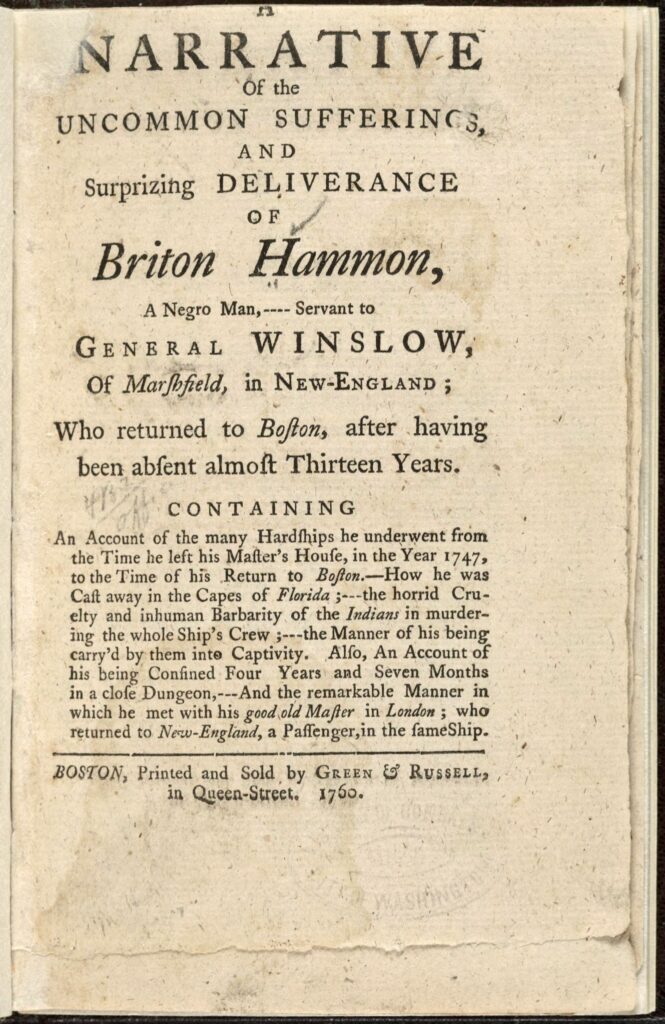
Because Briton Nichols had such an unusual first name, and because his race is given, historians have been able to trace his life in more detail.(11) Historians discovered that in 1760, he published a book in which he told of thirteen years worth of adventures.(12)
[N.B.: as noted above, the two are not the same person; therefore I’m inserting a subtitle here to show that the following is about Briton Hammon.]
Briton Hammon (Who Is Not Briton Nichols)
As a boy, he was enslaved by the Winslow family of Marshfield. At that time, he called himself Briton Hammond. On December 25, 1747, with the permission of his master, Briton left Marshfield to go on a sea voyage; perhaps his master hired him out as a sailor, taking a cut of his salary, a common practice in those days. Briton doesn’t say how old he was when he sailed, but later sources give his birth year as roughly 1740, so he may have been a boy or a young teen. The ship Briton was on sailed for Jamaica, took on a cargo of wood, and sailed north. Having struck a reef off Florida, the ship was attacked by Native Americans who killed everyone except Briton, and then set the ship on fire. After being held captive by the Native Americans for five week, he was able to make his escape on a Spanish schooner, whose captain recognized him, and took him to Havana, Cuba. The Native Americans followed and demanded the Governor of Havana return Briton to them, but the Governor paid ten dollars for him and kept him. A year later, Briton was caught by a press gang, but he refused to serve in the Spanish navy and was thrown in a dungeon.
Title page of the book written by Briton Hammond (later Briton Nichols), from a digitized version on the Library of Congress website.
Briton was finally released from the dungeon four years later, though he was still trapped in Havana. Then a year after his release from the dungeon, he managed to escape from Havana aboard a ship of the British Navy. It appears Briton served in the British Navy for some time thereafter, aboard several different ships, until 1759 when he was wounded in the head by small shot during a fight with a French ship. Briton was put in Greenwich Hospital, where he recovered from his wounds. After additional service on British Navy ships, this time as a cook, he managed to find a berth on a ship bound for New England. By coincidence, his old master, one General Nichols, was on the same ship. Through that chance meeting, Briton was finally able to return to his home in Marshfield after a thirteen year absence.
Soon after his return from Marshfield, Briton’s account of his adventures was published in Boston, perhaps the earliest published memoir written by an African American. Two years later, in 1762, Briton married Hannah, a Black woman who was a member of First Church in Plymouth (today this a Unitarian Universalist congregation). In the late 1770s, Briton left the Winslow family, possibly upon the death of his master, and moved to Cohasset to join the Nichols family; at this time he changed his last name from Hammond to Nichols.
[N.B.: At this point, I made a connection between Briton Hammon, who wrote the Narrative, and Briton Nichols of Hingham/Cohasset. As noted in the introduction, I based this on an essay by Robert Desroches. However, local historian Ellen S. Miller says this: “Nathaniel Nichols Sr. of Cohasset had an enslaved manservant Briton whom he bequeathed to his son Nathaniel in 1757, three years before Briton Hammon’s return. Both of the Nichols men died by the time the estate was settled in 1758. At the same time Nichols bequeathed Phebe, an enslaved servant whom Briton Nichols would later marry, to two of his daughters.” Thus, the documentary evidence from local archives does not support Desroches’s contention that Briton Hammon is the same person as Briton Nichols. However, Briton Nichols’s story is interesting enough by itself to remain here. Just remember that the documentary evidence does not support the conclusion that he’s the same person as Briton Hammon. Therefore, here’s another subtitle to clarify that this is a different person.]
Briton Nichols (Who Is Not Briton Hammon)
In 1777, Briton joined the Continental Army.(13) He must have been around forty years old when he enlisted. We can only speculate as to why he decided to enlist at that age. Most likely, enlisting in the military was a way for him to free himself from slavery. Ambrose Bates, who was one of Briton’s messmates, left a diary that tells a little about their military service.(14) Briton Nichols, Bates, and the rest of their contingent left Cohasset on August 27, 1777, and finally reached Saratoga, New York, in early September. There they joined the conflict between the Continental forces and General Burgoyne’s forces. Much of their military service was filled with boredom. Several days were filled with monotonous marching back and forth from one place to another. On other days, Bates simply records, “Nothing new today.” Those days of boredom were interspersed with days where they had more than enough excitement. To give just one example, on October 7, Bates recorded: “today we had a fight we were alarmed about noon and the fight begun, the sun two hours high at night and we drove them and took field pieces and took sum prisners.” The tide of battle was with the Continental forces, and Burgoyne finally surrendered on October 16. Soon thereafter, Bates and the other Cohasset men marched down to Tarrytown. Their service in Tarrytown was less exciting. Finally, on November 30 their term of military service ended, and they began marching home. They finally arrived back in Cohasset on December 7. So ended Briton Nichol’s first term of military service.
Briton Nichols enlisted again in 1780, giving his age at the time as forty years old.(15) I suspect he lied about his age, presenting himself as younger than he was. I could find no details of his 1780 military service. The next time I found him in the historical record was in the 1790 federal census. At that time, he was living in Hingham as a free Black man, along with his second wife Experience and one other household member, probably their child.
The story of Briton Nichols shows how we can recover some of the lost knowledge of Revolutionary War veterans. Briton Nichols was little more than a name on a list of soldiers, until historians were able to deduce that he was almost certainly the same person as Briton Hammond who had had such amazing adventures from 1747 to 1760.
Of special interest to those of us who are currently part of First Parish, Briton Nichols would have attended Sunday services right in our historica Meetinghouse. We can imagine him sitting upstairs in the balcony, where people of color and White indentured servants had to sit. We can imagine Briton sitting in that gallery on Sunday, August 24, 1777, a few days before he marched off to Saratoga. We can imagine the prayers of the entire congregation centering on the hope that all nine of the Cohasset men marching off as soldiers that week would return home safe and sound.
We today think of all those from this congregation who have served in the military. We think of all those veterans who are now members and friends of First Parish. We also think of those who grew up in this congregation and went off to join the armed services. And we think of those people from First Parish who died in military service. It is good for us to keep alive the memories of all those who served in our armed forces. It is good to keep those memories alive, because it reminds us of the bonds of love which transcend even death.
(10) Victor Bigelow, Narrative History of Cohasset (1898), p. 308.
(11) An introduction to a narrative by Briton Nichols, who earlier in life was called Briton Hammond, gives an overview of what historians conclude about his life: “It is accepted that in 1762 Hammon married Hannah, an African American woman and member of Plymouth’s First Church, with whom he had one child. For many years this was all that was known of Hammon’s life after his return to New England. More recent research, however, has revealed that Hammon probably changed his name to Nichols some time in the late 1770s, after the family with whom he and his master were living when Winslow died in 1774. Briton Nichols is listed as having fought for the Continental Army in the American Revolutionary War, as did many members of the white Nichols family…. In later census records, Briton Nichols is described as a free husband and father.” Derrick R. Spires, editor, Only by Experience: An Anthology of Slave Narratives (Broadview Press, 2023), p. 54.
[***As noted above, I neglected to include a citation here for Robert Desrochers, “‘Surprizing Deliverance’?: Slavery and Freedom, Language, and Identity in the Narrative of Briton Hammon, ‘A Negro Man,’” in Philip Gould and Vincent Carretta, eds., Genius in Bondage: Literature of the Early Black Atlantic (Univ. Press of Kentucky, 2021), p. 168-169. Please note that the documentary evidence cited by Ellen Miller does not support Desrochers’s conclusions. And to be fair, Desrochers presents his conclusions as tentative. Here is the relevant passage in Desrochers’s essay:
[“During the American Revolution a ‘negro’ named Briton Nichols enlisted at the rank of private at least four times between August 1777 and July 1780 for short stints in Massachusetts regiments out of Hingham and neighboring Cohasset. Nichols appears in the print record again in the federal census of 1790, according to which he was a free black, head of a household of three in Hingham, and also the only identifiably non-white man in the entire state with the forename ‘Briton,’ variously spelled. There is reason to believe that Briton Nichols of Hingham, Massachusetts, was in fact the man of shifting identities formerly known as Briton Hammon. When ‘good old Master’ Winslow died in April 1774 he resided at Hingham with his sister Bethia and her husband, Roger Nichols. At this point we can only speculate that sometime after Winslow’s death Hammon became tied to the family of his old master’s brother-in-law, relocated to Hingham, and adopted the Nichols surname to announce the change and perhaps a shift in his patriotic loyalties….
[“Other clues point to the common identity of Briton Nichols and Briton Hammon, and suggest that in some ways black freedom remained no less conditional at the end of the eighteenth century than it had been in the middle. The name of a white soman identified only as ‘Mrs. Hammon’ appeared in the Hingham census return just two lines above the aforementioned record for Briton Nichols. Was this Mrs. Hammon of the same family from which Briton Hammon’s surname derived? Since the pages of data compiled by the census takers on a door-to-door basis would resemble neighborhood grids if plotted on a map, we can presume that Briton Nichols and Mrs. hammon lived close to and knew one another. One wonders on what terms. Did Nichols not live near but actually with Mrs. Hammon, like the one in three ex-slaves in post-revolutionary Massachusetts who resided in a white household? In short, was Briton Hammon’s brief Narrative not the finished account of a black prodigal after all, but a chapter in an unfinished book of a pilgrim’s progress towards freedom? We are left for now with as many questions as answers. Perhaps it is only fitting, however, that Briton Hammon continues to elude us, nearly two-and-a-half centuries after his first and apparently only appearance on the public stage.”]
(12) In this paragraph, the details of the earlier life of Briton Nichols/Hammond are taken from his book, A Narrative of the Uncommon Sufferings, and Surprizing Deliverance of Briton Hammon, A Negro Man (Boston: Green & Russell, 1760); as reprinted on the Pennsylvanian State Univ. website https://psu.pb.unizin.org/opentransatlanticlit/chapter/__unknown__-9/ accessed 22 May 2025.
(13) Victor Bigelow, p. 208.
(14) Victor Bigelow reprints the text of this brief diary, pp. 299-303.
(15) Entry for Briton Nichols, 19 July 1780, “Massachusetts, Revolutionary War, Index Cards to Muster Rolls, 1775-1783,” FamilySearch.org website https://www.familysearch.org/ark:/61903/1:1:QLLS-BBT3 accessed 22 May 2025.
The American Revolution began 250 years ago, as of April 19 this year. This significant anniversary is a good time to reflect on the sacrifices that were made by Revolutionary War-era soldiers and sailors.
And it turns out that we don’t know as much as we think we know about the soldiers and sailors of the American Revolution. We don’t have very good records of exactly which soldiers and sailors died during the Revolutionary War; there simply weren’t full and accurate records of military service,(1) and we don’t even have accurate figures for how many military deaths there were in the Revolution.(2) Yet by digging in to the historical record, historians have been able to recover some remarkable stories that had been forgotten or mis-remembered.
I went looking for stories about people from Cohasset who served in the American Revolution. (My interest was partially selfish — since First Parish, where I serve, was the only church in town during the Revolution, then if I found a Cohasset resident who served in the Revolutionary War, they would have been part of First Parish.) I found two super interesting stories that had been partially forgotten or obscured — but thanks to the efforts of twenty-first century historians, we have now recovered many lost details.
Persis Tower Lincoln, Revolutionary War Heroine
Victor Bigelow, town historian and author of A Narrative History of Cohasset (1898), tells the story of Persis Tower Lincoln. During the occupation of Boston, which lasted from spring of 1775 into 1776, Persis was married to Allen Lincoln, a seaman; Persis was then 16 years old, and Allen was 20; John Browne, minister of First Parish, officiated at their wedding. Allen then left Persis for military service. While he was away, Persis sailed a small boat across Massachusetts Bay to Gloucester to get supplies through the British blockade, so we remember her as a heroine of the American Revolution. Meanwhile — so the traditional story goes — Allen’s ship was captured by the British, and according to local tradition he was taken to Dartmoor prison in England where he died.(3)
Persis’s story appears to be true. Unfortunately, Allen’s story has been remembered incorrectly. Dartmoor Prison wasn’t completed until 1809, so he couldn’t have been imprisoned there during the Revolution. Then too, Allen and Persis had daughter together, and their daughter Sally was born in 1778.(4) Finally, military records show that Allen Lincoln of Cohasset served in the Continental Army after his purported death, in 1776, 1777, and again in 1778.(5)
A more accurate history of Allen Lincoln appears to be something like this: After serving in the military for several months in both 1776 and 1777, Allen re-enlisted in the Continental Navy with the rank of Seaman. Then on March 17, 1778 he was taken prisoner by the British; he was captured about a month after his daughter Sally was born, and was initially imprisoned at Rhode Island.(6) Subsequently, he was apparently taken to Halifax, Nova Scotia, where he died in 1778.(7) It’s not surprising that he died while he was a prisoner of war; the mortality rate was notoriously high among prisoners of war held by the British, and more Revolutionary War soldiers and sailors died in prison camps than died in battle. Allen died at age 22, leaving behind an 18 year old wife and an infant daughter whom he probably only saw for the first few weeks of her life.
Allen Lincoln’s story is worth remembering on its own merits. But it’s also a reminder of how much has been forgotten or mis-remembered about the sailors and soldiers who died during military service in the Revolution. Indeed, historians aren’t even sure how many prisoners of war died while being held captive by the British; it may have been as many 19,000 men.(8) At a local level, it seems that we’re not even sure of how many people from First Parish served in the Revolution. It should be simple to generate such an honor roll of military service — First Parish was the only church in Cohasset, everyone in town belonged to the church, so all we’d need is a list of Cohasset residents who served. However, the only such list I found lists almost certainly includes men from other towns who were recruited by Cohasset to help fill the town’s quota.(9) Given the incomplete records that remain, we may never know exactly how many people from Cohasset served in American Revolution — nor how many of those soldiers and sailors gave their lives in military service.
Yet even though the historical record has gotten a bit muddled over the past two and a half centuries, what’s remarkable is how much we still remember. We still remember Allen Lincoln and Persis Tower, and we still tell their stories when we talk about the history of First Parish. Even if some of the details of the story have been confused or forgotten, we still remember this young couple from First Parish who can be counted among the heroes and heroines of the American Revolution.
(1) Historian mark Edward Lender states that “…most combat was local and took place without major British or Continental forces on the scene”; in other words, many soldiers served in militia units. Lender, Citizen Soldiers or Regulars? The Revolutionary Militia Reconsidered,” in Jim Piecuch, ed., Seven Myths of American Revolution (Hackett Publishing, 2003) p. 59. Militia units did not necessarily keep accurate records, and even where good records were kept they may not have survived or may be hidden in local archives.
(2) According to historian Howard Peckham, who carefully reviewed military records kept by the original thirteen colonies, 5,992 soldiers were killed in military engagements, and 832 sailors were killed in naval engagements, for a total of 6,824 battle casualties. In addition, Peckham estimated that 10,00 soldiers died in camp from diseases such as dysentery, and 8,500 soldier and sailors died in British prisoner-of-war camps. Thus, Peckham estimated the total number of probable deaths in service at over 25,000. Source: Howard Peckham, The Toll of Independence : Engagements & Battle Casualties of the American Revolution (Chicago: Univ. of Chicago Press, 1974), “Summations and Implications.” However, other historians feel that Peckham underestimated the number of deaths among prisoners of war, see e.g., Edwin G. Burrows, Forgotten Patriots: The Untold Story of American Prisoners during the Revolutionary War (Basic Books, 2008), p. 317 n. 12; Burrows places the total number of prisoners of war who died at 19,000, giving a total death toll that is closer to 35,000. (Burrows cites the total number of Americans who took up arms during the war as 200,000.)
(3) Victor Bigelow, Narrative History of Cohasset (1898), p. 290. The marriage record showing that John Browne officiated at the wedding may be found here: Entry for Allen Lincoln and Persis Tower, 23 Nov 1775, “Massachusetts, State Vital Records, 1638-1927,” archived on FamilySearch website https://www.familysearch.org/ark:/61903/1:1:FHQY-G2B accessed 23 May 2025.
(4) According to the Massachusetts State Census of 1855, Sally was born in 1778; so this was not a matter of a christening that was delayed for three years. According to Cohasset Vital Records, she was christened on 18 Oct. 1778.
(5) A search for military records for Allen Lincoln on genealogy website FamilySearch.org turned up two records for military service of Allen or Allyn Lincoln from Cohasset: First, as one of the soldiers who mustered at Hull on June 14, 1776, to serve in the military: Entry for Allyn Lincoln, 14 Jun 1776, “Massachusetts, Revolutionary War, Index Cards to Muster Rolls, 1775-1783″, FamilySearch.org website https://www.familysearch.org/ark:/61903/1:1:Q2RC-LHBT accessed 22 May 2025. Second, as serving in “the Northern Dept.” in 1777: Entry for Allen Lincoln, 24 Aug 1777, “Massachusetts, Revolutionary War, Index Cards to Muster Rolls, 1775-1783,” FamilySearch.org website https://www.familysearch.org/ark:/61903/1:1:Q2RC-9CH6 accessed 22 May 2025.
(6) Entry for Allyn Lyncoln, 17 Mar 1778, “Massachusetts, Revolutionary War, Index Cards to Muster Rolls, 1775-1783,” FamilySearch.org website https://www.familysearch.org/ark:/61903/1:1:Q2RC-2NLM accessed 22 May 2025.
(7) The FamilySearch.org entry for Allen Lincoln lists his date of death as 1778, and place of death as Halifax, Nova Scotia, unfortunately with no documentation. See person entry for “Allen Lincoln” FamilySearch.org website https://www.familysearch.org/en/tree/person/details/LCZP-2JH accessed 22 May 2025.
(8) See e.g. Edwin G. Burrows, Forgotten Patriots: The Untold Story of American Prisoners during the Revolutionary War (Basic Books, 2008), p. 317 n. 12.
Back in 2018, I wrote about some of the challenges the Baby Boomers face — including financial challenges. We hear over and over again how the Boomers are inheriting a ton of money from their parents, so of course all Boomers must be financially secure. Well, not exactly true…
“Adults 50 and older are the fastest-growing age group experiencing homelessness, comprising nearly half of the country’s homeless population, according to the US Department of Health and Human Services. Federal data show a 17 percent jump in the number of Massachusetts adults ages 55 and older counted as homeless from 2023 to 2024, the most recent numbers available. Nationally, that increase was 6 percent.”
This reminds me of a book by Elizabeth White titled 55, Underemployed, and Faking Normal: Your Guide to a Better Retirement Life. White’s book, published a decade ago, showed that many 55 year olds simply didn’t have enough money to retire — and that included people like White herself, a highly educated woman who at age 55 found herself working low-paying jobs because that’s all she could get.
White’s book is still in print — because it’s still relevant. White wrote: “This is why the budget battles on Capitol Hill — which until recently only threatened to cut social security and other social-insurance programs like Medicare and Medicaid — are so ludicrous. What we’re really talking about is dooming millions and millions of women to misery and destitution.” And here we are, ten years later, hearing exactly the same claptrap from political leaders, including from our elderly (78 years old) president. Yes indeedy. I’m so glad we live in a Christian nation where our leaders devoutly follow the teachings of Jesus: “If you want to be perfect, go, sell your possessions and give to the poor, and you will have treasure in heaven. Then come, follow me.” (Matt. 19:21, NIV) I’m just so glad we have good Christian leaders who read their Bibles and decide to cut aid to poor elders so they can doom millions and millions of women to poverty and destitution.
OK, that’s enough sarcasm for now.
My real point is that the current culture wars are actually being fought over whether we help poor people move on up out of poverty, or whether we push more people into poverty. Rev. William Barber and the Poor People’s Campaign make the point that there are 140 million Americans who are functionally living in poverty. Nor do I see either major political party facing up to the magnitude of this issue. Actually, I don’t see Unitarian Universalists at the national level facing up to the magnitude of poverty in this country.
Back to the Boston Globe article for some insight into just how bad the problem is:
“‘I am finding more seniors living in their cars,’ said Sheri Miller-Bedau, a city health inspector in Attleboro. ‘We are in Massachusetts. We have great schools. We are supposed to be leading edge. How is this happening?’ She said local shelters were so full this past winter that even older adults living in their cars were not considered an emergency and were told they had at least a six-month wait.”
And to drive the point home, here’s another quote from the Globe article:
“[Julian] Cyr [D, Provincetown], whose district — Cape Cod, Martha’s Vineyard, and Nantucket — is home to the state’s oldest population, said it’s becoming increasingly common to see seniors living in their cars. ‘It’s a housing crisis on steroids,’ he said. ‘When I stop at a park or restroom [on the Cape], I will often see a car, a sedan packed to the gills, and there is an older person, usually an older woman, who is living in the car.'”
And it just might be that the biggest problem of this political moment is not fascism, or racism, or sexism, or homophobia, or immigration, or global climate change — the biggest problem of this political moment just might be poverty.
It’s a stressful time in the world right now — what with brutal wars in Ukraine, Israel/Gaza, Sudan, Myanmar, and elsewhere — and with economic uncertainty and political instability in the U.S. — and a host of other problems, like looming ecological collapse.
As a result of all these stress-filled events, there are lots of pundits telling us how we can reduce our stress. Recently, I’ve heard a number of pundits tell me that if I want to reduce my stress I should take a walk in the woods. (Before you get all snarky, yes I know this advice makes unwarranted assumptions: that I live in a bioregion where there are woods to walk in; that I live in a human place where enough woodlands remain to walk in; that if there are woods to walk in, they’re safe enough that you can walk in them; that I don’t have physical limitations that preclude walking in the woods. As it happens, I do live in a bioregion which does have woodlands, I’m fortunate enough to live near a 3,000 acre state park which is mostly wooded and mostly safe, and I am physically able to walk in the woods.)
I hate to tell those pundits, but taking a walk in the woods is not going to reduce my stress.
Yesterday, I took a walk in our nearby state park. In many places in that park, American Beech (Fagus grandifolia) are the predominant tree species. But our American Beeches are under attack, and most of the beech trees I saw appeared to be in poor health. To be blunt, beech trees are being killed off by invasive organisms.
First, there’s Beech Bark Disease (BBD):
“BBD is an insect-fungus complex that involves the beech scale insect (Cryptococcus fagisuga Lind.) and the fungi Neonectria faginata and Neonectria coccinea…. It is predicted that BBD will spread across the entire range of American beech in the United States in the next 40–50?years.” (Catalina Salgado-Salazar et al., G3 (Bethesda) [Genes, Genomes, Genetics]. 2021 Mar 9;11(4). https://doi.org/10.1093/g3journal/jkab071 )
The scale insect, which arrived in North America in the early twentieth century, spreads the fungus. The fungus infects the tree causing unsightly canker sores on the bark:
Beech Bark Disease on an American Beech tree in Wompatuck State Park
There is no known cure for Beech Bark Diseases. It often proves fatal.
Second, beech trees are also under attack from Beech Leaf Disease:
“Symptoms of beech leaf disease (BLD), first reported in Ohio in 2012, include interveinal greening, thickening and often chlorosis in leaves, canopy thinning and mortality. Nematodes from diseased leaves of American beech (Fagus grandifolia) sent by the Ohio Department of Agriculture to the USDA, Beltsville, MD in autumn 2017 were identified as the first recorded North American population of Litylenchus crenatae (Nematology, 21, 2019, 5), originally described from Japan.” (Lynn Kay Carta et al., “Beech leaf disease symptoms caused by newly recognized nematode subspecies,” Forest Pathology, 27 Feb. 2020 https://doi.org/10.1111/efp.12580 )
Here’s what the leaves look like after the nematodes have attacked them (I took this photo last May):
Curled leaves of American Beech, showing damage by Beech Leaf Disease
As I understand it, foresters and dendrologists are still learning about Beech Leaf Disease. But it’s very clear that Beech Leaf Disease causes trees to lose most of their leaves, and it’s equally clear that Beech Leaf Disease eventually leads to the death of the tree.
As with Beech Bark Diseases, there is no known cure.
The upshot is that we’re going to lose all, or nearly all, of our American Beech trees in the next decade or so — just as we lost nearly all of our American Chestnut trees in the early twentieth century (due to Chestnut Blight, an invasive fungus), and just as we lost nearly all of our American Elm trees in the mid-twentieth century (due to Dutch Elm Disease, an invasive fungus), and just as we lost nearly all of our ash trees in the early twenty-first century (due to Emerald Ash Borer, an invasive insect).
Invasive organisms are predicted to be one of the major causes of the calamitous decrease in biodiversity that we’re now facing. I suppose you could go for a walk in the woods and willfully ignore these evidences of global environmental disaster. If you’re going to do that, you might as well engage in one of those chic mindfulness practices that helps you forget that anything bad is happening. And what the hell, if you need to be in denial — if that’s what it takes to reduce your stress and keep your sanity — then I say, go for it. But please don’t tell me that I should take a walk in the woods to reduce my stress — what works for you doesn’t necessarily work for me.
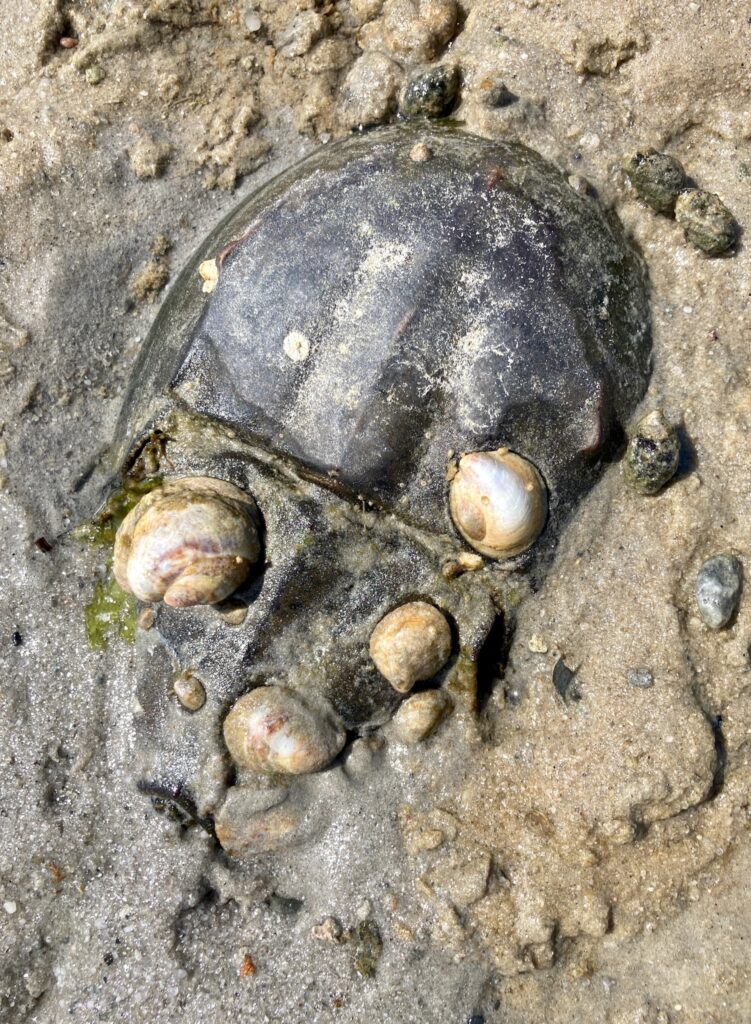
Still haven’t finished the writing I’ve been working on, so you’re stuck with another photograph. This is an Atlantic Horseshoe Crab (Limulus polyphemus) partially buried in the sand of the Long Pasture Audubon sanctuary on Cape Cod. There are Atlantic Slipper Shells (Crepidula fornicata) attached to the top of the shell. This may have been a molted exoskeleton, but it appeared to be a living horseshoe crab that had partially buried itself in the tidal flats at low tide; I decided not to poke at it to see if it was alive.
One hundred days into Donnie Trump’s second reign — er, second term — which religious groups approve of him most?
No surprise — Trump continues to have high approval ratings among White evangelicals. In a recent poll, Pew Research found that 72% of White evangelicals approve of King Donnie — er, President Trump.
Here are the approval ratings for other religious groups in the Pew poll:
72% — White Protestant Christian, evangelical
51% — White Protestant Christian, not evangelical
51% — White Catholic Christian
40% — All US adults
26% — Hispanic Catholic Christian
26% — Religiously unaffiliated
10% — Black Protestant Christian
I was a bit surprised that these approval ratings are very similar to Trump’s first term. In their report, Pew Research says: “Both among the U.S. public as a whole and among major religious groups, Trump’s current approval ratings are on par with what they were around the same time in his first term (April 2017).”
Not surprisingly, White Evangelicals support Trump’s extensive use of executive orders — 53% of them feel that Trump is doing about the right amount by executive order. Only 27% of White evangelicals think Trump is doing too much by executive order, 15% are unsure, and 5% feel he’s doing too little by executive order.
I’d be jumping to conclusions if, based on this one survey, I said that White evangelicals are OK with a president who’s seems to be trying to operate like a king. But I’m keeping that in mind as a possibility.