Moving away from the humanist-theist debate

Tonight Amy Zucker Morgenstern, the senior minister at the Palo Alto church, and I led a class on humanism, theism, and naturalism, part of a series of classes we’re doing on current issues in liberal religion. We each began with a presentation on the topic; the text of my presentation is below. Our presentations were followed by a lively and enjoyable conversation with the 14 people who came, a conversation that ranged from metaphysics to demographics.

When Amy and I started talking about this class, I knew right away what I wanted to talk about: I wanted to talk about religious naturalism. I wanted to talk about religious naturalism because at the moment it is the only theological “ism” that I have any interest in associating with.

The reason I wanted to talk about religious naturalism is because in my experience it is the only theological position within Unitarian Universalism that doesn’t by definition shut out one or more other theological positions. Humanists and theists each want to shut the other group out, even force the other group out. Humanists and christian theists want to keep those doggone pagans out, and pagans, given half a chance, would shut out the humanists and christian theists. The Buddhists sit there smiling smugly at everyone else as if they have the real answers, and they’re willing to tolerate us until such a time that the rest of us get with their program. And so on.

This is all very fine and good. I like a good knock-down, drag-out argument as much as anyone. (Though I will admit I prefer theological bar fights to what academic theologians do — that is, I prefer an out-and-out fight with shouting, throwing of bar stools, and fisticuffs, to the refined intellectual backstabbing that is too often characteristic of the academy.) In fact, I think arguments are a lot of fun, as long as those who are involved are all basically healthy, and all basically want to get involved in the fight. Continue reading “Moving away from the humanist-theist debate”

Regionalization news

The staff of the Unitarian Universalist Association (UUA) are slowly developing what has come to be known as “regionalization.” Although as I understand it regionalization originally came out of initiatives by districts to share and pool scarce resources, now the UUA is being driven towards regionalization by economic necessity. In a recent presentation to district staff, made available on YouTube, Teresa Cooley, Director of Congregational Life, says this:

“We have reduced resources, we have an obligation to steward our resources better, and one of the recognitions we have is: to have administrative structures for nineteen different districts is not necessarily the most cost effective way of doing things.”

I’ll embed the video below. Continue reading “Regionalization news”

Directory errors

D——, another minister, pointed out that my entry in the UUA’s online directory appeared to have errors. I went and looked, and sure enough, the entry was filled with errors.

A moral of the story: If you’re a religious educator or minister, it’s probably worth checking your entry for errors, if you haven’t already done so.

Another moral of the story: This is a fine example of UUA budget cuts at work: funding drops; staff hours are cut; chaos starts creeping into the system.

(Thanks, D——, for pointing this out!)

The last of my general assembly reporting

A few last posts by me on the uuworld.org GA blog:

Scholars of color assess UU history, report on brief talks by Rev. Mark Morrison-Reed, Rev. Monica Cummings, and Rev. Patricia Jimenez.
Music and cultural change in UUism, interviews with UU musicians Nick Page and Jeannie Gagne.
Commission on Appraisal continues study of ministry and authority, covering the Commission on Appraisal’s report to GA, and brief interview with Megan Dowdell of the Commission.
Moderator’s report: All of us working together, covering Gini Courter’s report to GA.

As before, comment here, or comment on the posts themselves.

(Earlier links to my reporting are here, and here.)

More of my General Assembly reporting

Some more of my reporting on General Assembly is up on the uuworld.org blog:

The continuing power of liberal theology today, lecture by Gary Dorrien, with responses by Rebecca Parker and Dan McKanan.
UUA Financial Advisor reports a brighter situation, report from Plenary this morning.
Faith formation in a multi-cultural world, conversation with Mark Hicks, professor of religious education at Meadville/Lomard Theological School.
The cultural challenge of digital media, conversation with Rev. Scott Wells.
Report of the president of the UUA, report from Plenary this afternoon.

As before, comment here, or comment on the posts themselves.

Two images from GA

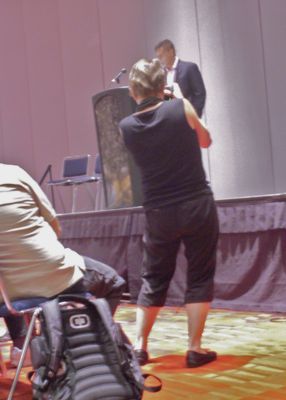
Next time you look at UU World magazine, or uuworld online, really look at the photographs of General Assembly. Nancy Pierce, the photographer for General Assembly, produces some very fine images. It’s also fun to watch her work — she comes into an event, dressed in black, unobtrusively takes her photographs, and slips out before most people have even noticed that she’s there. Today I managed to get a photo of her taking a photo of Gary Dorrien before she slipped out of the room:


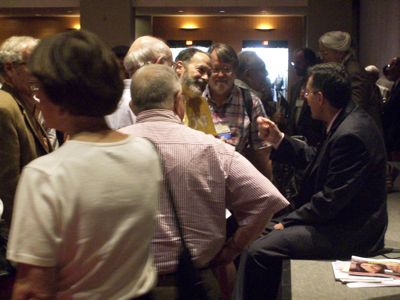
Dorrien held the audience spellbound for an hour, and at the end of his lecture, a crowd gathered gathered around to chat with him. In the photo below, he’s the man sitting on the platform at right. You can tell by his body language that he’s really enjoying talking with all these theology geeks:

Liveblogging the GA Opening Celebration

8:59 p.m. The opening service is over. Now it’s the GA equivalent of social hour — time to look for people whom we haven’t seen for a long time.

8:51 p.m. “We look forward to being a part of a vibrant and vital Unitarian Universalism fifty years from now,” the children say. Listening to, and watching, the children and youth speaking to us it occurs to me that while they might be around for the one hundredth anniversary of the UU, I most certainly won’t be there.

8:48 p.m. Anthem is going on. I’m looking around at people here in the hall. I see a couple of babies, and one boy that looks to be about 8. Now the anthem is over, and a group of children, youth, and young adults are speaking. “As children we are the youngest members of our communities,” say two children. “We are often the reason why our parents seek a Unitarian Universalist congregation in the first place.” And their words are greeted by applause and laughter — for after all, it’s very true. Continue reading “Liveblogging the GA Opening Celebration”

Ministry Daze, er, Days

Charlotte, N.C.

General Assembly hasn’t begun, but ministers and religious educators have already arrived here for professional meetings: “Ministry Days” for ministers and seminarians, and “Professional Day” for religious educators. I won’t say that the streets around the convention center are swarming yet with Unitarian Universalists, but when I went out to get lunch today I ran into Rosie and Marie, old friends from seminary, on the sidewalk, and Nancy, a minister from the Bay Area, while crossing the street, and I saw several other people at a distance whom I felt sure I knew.

Just after four o’clock, I went over to the Hilton Hotel to register for Ministry Days. There were ministers everywhere: ministers in sandals, ministers in seersucker suits, ministers in dresses, ministers in hip black West coast urban garb, ministers in Midwestern pastels, old ministers, young ministers, ministers all over the place. Some of them were people I have never seen before, some of them were people who looked familiar, some of them were people I once knew, a few were people I know quite well. Unfortunately, my brain does not allocate much processing power to my facial recognition software, so when I am in large groups of people I often cannot cannot process faces rapidly enough; as a result, I tend to wander around looking vaguely dazed and slightly bewildered (more so than usual, that is).

Fortunately, I ran into my old friend Ellen, with whom I served at First Parish in Lexington, Massachusetts under Hellen Lutton Cohen. Ellen had not yet eaten, and was looking a little pale, so we went right out and looked for a place to eat. All the cheap restaurants I had looked up on the Web seemed to close at five o’clock. We finally wound up in Halcyon, the restaurant next to the Mint Museum. Ellen told me all about the things they’re doing in her church in Chelmsford, Massachusetts — the successful evening worship service, the way she mobilizes amateur musicians within her congregation, their coming of age program, their youth service trips to Saint Bernard Parish south of New Orleans. Then it turned out that our waitress grew up on Nantucket, so she and I tried to figure out if we had any common acquaintances, but the people I know who live there are all quite a bit older than she. Then Carol joined Ellen and me, and we began talking about families. We walked Ellen back to her hotel, talking all the while.

By the time we got done, today’s program for Ministry Days was over. Yet though I hadn’t attended any official programming, I got more good ideas while eating dinner with Ellen than I get in most half-day professional workshops.