
Shoulder pole carrier for water

Every other year in our Sunday school, we do a recreation of a Judean Village in the year 29 C.E. Children become “apprentices” to artisans, and do activities that evoke village life in 29 C.E.

Carrying water by hand from the village well to wherever it was needed was an integral part of village life. This year, Edie Keating came up with an activity in which children learn how to use a traditional shoulder pole carrier to bring water to irrigate plants. Given the extreme drought that is blanketing most of California, this is also a very relevant activity. Ancient Judea had a very similar climate to ours — what if we had to carry all our water from a well by hand? — how would that change our water consumption habits?

I got to design a shoulder pole carrier using readily available materials. It was fun to design and build, and once it was built it was surprisingly comfortable and easy to use. This is a cool piece of ancient technology that really works well!

———
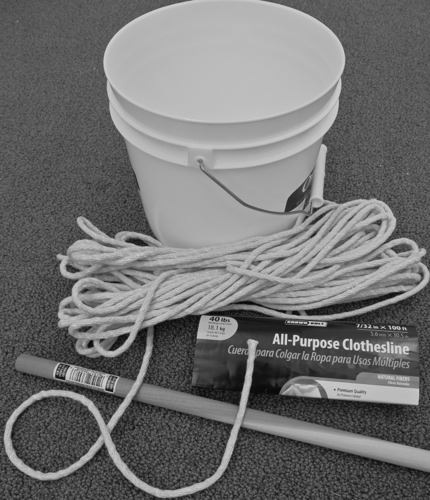
Assembled materials

Materials for 6 pole carriers:
— 100′ of 7/32″ cotton “sash cord” or “all purpose clothesline” (easy to tie, and soft on kids’ hands if they grab it)
— 12 ea. 1-gallon plastic buckets, often sold as painter’s buckets; the ones we like best look like miniature 5-gallon buckets with sturdy reinforcement at the top (see photo above)
— 6 pcs. 5/8″ dia. 4-foot long hardwood dowels
— 9/16″ drill bit and drill (hand drills work well for this project)

———

Measuring for the holes in the buckets

Step one:
Mark out locations for three holes spaced equally around the bucket. Our buckets were 7-3/4″ in diameter, and spacing the holes 6-3/4″ apart (as measured on a straight line, as in the photo above) provided fairly equal spacing.

———

Drilling the holes in the buckets

Step two:
Drill three holes as shown in the photo above.

———
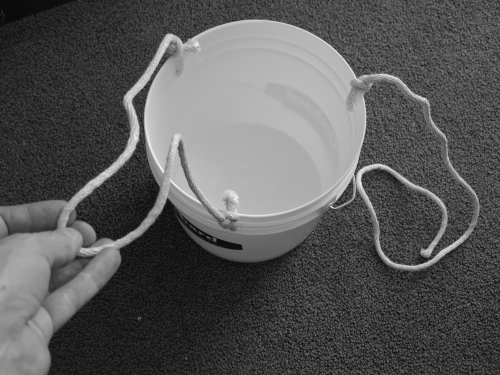
How the cords are tied to the buckets

Step three:
Cut two lengths of sash cord, one 6′ long, and one 4’6″ long. Thread cord through holes and tie with two half hitches as shown — the longer piece of cord is tied at its two ends through two holes, and the shorter piece of cord is tied at one end through one hole. Note that two half hitches function as a slip knot, so snug the knot down to the bucket. (If you don’t know how to tie two half hitches, look at a Scout handbook, or search the Web for instructions.)

Make two of these assemblies, one for each end of the dowel.

———
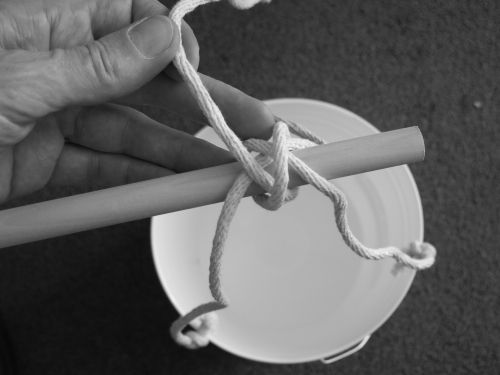
Tying the cords to the pole

Step four:
Loop the longer rope (tied off at both ends) over the dowel. Then tie a clove hitch, using the free end of the shorter cord, so that the clove hitch goes over the longer cord, and secures it to the dowel (see photo above).

Once you get the clove hitch tied, lift up the assembly, and see how the bucket is hanging. It will probably hang unevenly, so adjust all the cords until it hangs more or less evenly — this is much easier if you get someone to hold the dowel for you. When everything looks even, snug up the clove hitch so it’s tight. (You can also tie off the free end of the rope onto one of the other ropes, using two half hitches — this makes for a slightly more secure assembly, although it isn’t really necessary.)

———
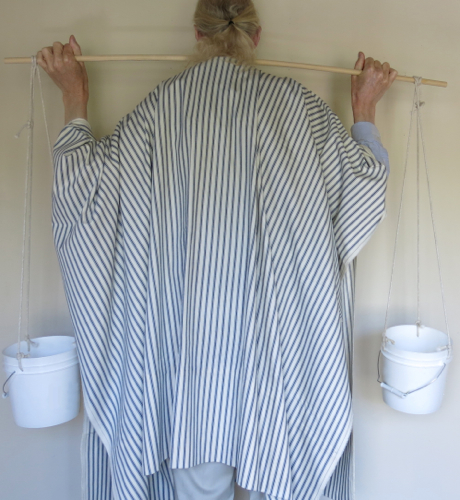
Person in ancient Judean costume with loaded shoulder pole carrier

Above is what the whole thing looks like when it’s completed, with each bucket filled about 1/3 full. Don’t fill the buckets more than half full — if you do, the water will slop all over your feet when you carry it, and there’s a good chance you’ll snap the dowel from the weight.

In fact, for most school-aged children, filling the buckets about a third full will provide the most pleasant experience. With that much water in the buckets, it’s heavy enough so that the water carrier stays in place on the child’s shoulders, but it’s not so heavy that it hurts. Notice that the dowel in this design is relatively thin so that it acts as a spring, providing some cushioning to the shoulders — carrying water with this water carrier is relatively comfortable.

Of course, you can also use this type of carrier with a heavier load in the middle, and with two people carrying, one on each end of the pole. Obviously, a longer, stronger pole would be needed.

If you want to carry bigger loads with a shoulder pole carrier, use a heavier pole. Asian cultures often use bamboo for the pole — it’s a material that’s light, flexible, and strong. Traditional European shoulder pole carriers were typically less flexible, and carved (like ox yokes) to fit around the neck and put more of the load on the shoulders.

Kurt Kuhwald’s thoughts on Starr King

Recently, I talked with Kurt Kuhwald, former professor at Starr King School for the Ministry, about the school’s search process for a new president. Kurt had some interesting things to say about the search, and the conflict that erupted during and after the search.

Before I get to Kurt’s thoughts, you may want to review what happened at Starr King. I have a short post about the situation here. Since I wrote that post, the New York Times covered the story in a balanced and well-written article here, and UU World did a carefully-written article in November which you can read here. Now back to Kurt.

Kurt is someone for whom I have great respect, particularly in his thoughtful and passionate approach to ethical issues, and to issues of prophetic importance. I was lucky enough to have lunch with Kurt a couple of weeks ago, and we talked about several prophetic issues: global climate change; the protests following Ferguson; and the mess at Starr King. We wound up spending most of our time talking about Starr King, not because it is of greater importance than Ferguson or global climate justice, but because it was so fresh in the minds of both of us. Actually, mostly I listened — Kurt has a unique and powerful interpretation of the Starr King situation, and I wanted to hear what he said.

Kurt has been kind enough to send me several documents that he is willing to make public, and with his permission, I am posting them here on my blog. You can click on one of the links below to go to a specific letter, or just scroll down to read these four documents in order:

Kurt’s letter of resignation from Starr King;
An addendum to that letter giving more detail on his reasons for resigning;
A letter to the Ad Hoc Committee set up by Starr King to investigate the situation;
A letter to the members of the UUA Board regarding Starr King.

As I talked with Kurt, it struck me that there was a deep current of theology running through everything Kurt said. He is talking about a theology of power; he is critiquing one way power is wielded in contemporary religious institutions. This is an incredibly important critque. I believe it would behoove anyone with an interest in the mess at Starr King to read or re-read Bernard Loomer’s important 1976 essay “Two Conceptions of Power.” Finally, out of respect for Kurt’s deep theological insights, I’m going to say that if you’d like to comment here you should exhibit some theological thinking. If you’re not sure how to think theologically about this issue, read Loomer’s essay.

As always, I reserve the right to delete or edit comments that I feel are discourteous, rude, or off-topic.

Scroll down to start reading Kurt’s letters….

Update, 14 January 2015: Kurt Kuhwald asked me if I’d be willing to post Dorsey Blake’s letter of resignation from Starr King; until January 9, he was Associate Professor of Spirituality and Prophetic Justice. Since Kurt Kuhwald and Dorsey Blake timed their resignations for the same day, and since they share a prophetic vision for liberal religion, I felt it was appropriate to add that letter to this blog post. Having received Dorsey Blake’s permission, I have added his letter below:
Dorsey Blake’s letter of resignation

Continue reading “Kurt Kuhwald’s thoughts on Starr King”

UNCO 14: pastoral self-care

Derrick convened a very helpful UNCO session on self care for pastors. As the 15 pastors who were present talked about this issue, one thing stood out for me: most congregations may be willing to hear about the health issues of their pastor, except they mostly don’t want to hear about any mental health issues their pastor may have. If a pastor is struggling with, e.g., depression, do they dare to tell their congregation about this health issue? Probably not. Since ministers are at higher risk for the mental health issues of depression and substance abuse, this is a bit of a problem.

On the other hand, I get the feeling that many ministers don’t want to talk about mental health issues until they are actually facing trouble. In my opinion, ministers should have an ongoing relationship with a mental health professional, e.g., I talk every month with someone who is both a congregational consultant and a licensed family therapist. If a minister has such an ongoing relationship, if they do develop mental health problems they have someone they can turn to immediately; they also have someone who can help them identify a growing problem and get treatment before the problem affects work or personal life. Perhaps congregations could take more responsibility for their minister’s mental health by requiring and funding regular consultations with a therapist.

Consumer confidence and contributions

I have long wondered if there is any kind of correlation between consumer confidence, and annual contributions to congregations. I would expect giving to go down during times of lower consumer confidence, and giving to go up in times of higher consumer confidence.

Of course, there are many other variables that affect congregational giving. But I would expect consumer giving to be a major influence. What do you think?

U. Michigan Consumer Confidence index

Above: 10 year chart of the Index of Consumer Sentiment, produced by University of Michigan.

Why you should get your child dedicated

On her blog “All Together Now,” Karen Bellavance-Grace describes the child dedication ceremony that her Unitarian Universalist congregation held for her children:

“I trusted the words that came from our minister, Rev. Barbara McKusick Liscord: ‘For years to come, these children will be a part of our community of mutual caring, concern, responsibility and affection. Wherever they are in the world, they will always be tucked in the heart of this community. Do you, this gathered congregation, dedicate yourselves to nourish their spiritual growth, to welcome and value them, to share with them what you know of life and to learn from them what they have to teach us?’

“I heard the words, thought they were lovely, and trusted the members of the congregation would be kind to my children, smile at them, make small talk at coffee hour, and teach their Religious Education classes. I heard those words, prayed they would hold lasting meaning, and assumed that at the least, this congregation would witness their growing up….”

Well, now her daughters are entering their teen years, and their parents are splitting up, and Bellavance-Grace rightly worries about the girls:

“I knew we had a potential recipe for disaster. There were days when they didn’t want to talk to either of us to process this transition. We asked who the adults were in their life that they would be willing to speak to. One by one, they listed the names of members of their home congregation. Their minister, their OWL teachers, the woman who had taught their RE class when they were in kindergarten, a member of the congregation they thought of us a second grandmother, a Mystery Pal from a few years back. In that moment, I knew they would be okay.”

This is one of the hidden aspects of religious education, an aspect which actually has little to do with education, or with theology. In today’s U.S. society, kids have very few places where they can get to know ordinary adults. Most of us don’t live with extended families any more, and most of us don’t live in true villages or small towns where there is a lot of intergenerational contact. Most of the adults in kids’ lives are authority figures who are focused on specific goals that kids are supposed meet, adults like teachers and sports coaches. One big exception to this societal trend is congregations, where kids can meet and get to know a number of adults, adults who are not going to grade them, or get them to win games.

I like child dedication ceremonies because lying at the theological center of a child dedication ceremony is a promise to support parents and child as that child grows up. The congregation is entering into a set of promises, a covenant, with one particular child, while reminding itself of a wider covenant it has with all children in its purview. When Bellavance-Grace’s children were dedicated, that covenant was explicitly named by the minister, which is a good thing — but even if that covenant isn’t explicitly stated, it is still a core element of a child dedication ceremony.

I also like child dedication ceremonies because they remind congregations of their responsibilities. And because they remind older kids who see the ceremonies that they, too, are part of a covenant. And (maybe most of all) because they keep us focused on one of most important functions congregations have: raising kids.

If you haven’t gotten your child or children dedicated, think about doing it. It’s good for you, good for your kids, and good for everyone.

Academics and practitioners

A few days ago on the “Key Resources” blog, a blog about faith formation from Virginia Theological Seminary blog, Kyle Oliver asked: “What has the academy to do with congregational faith formation (and vice versa)?”

What prompted this question? Kyle had been at the recent annual conference of the Religious Education Association (REA), which is supposed to be an organization of scholars and practitioners. But he had not been convinced that the REA offers much to practitioners: “I wasn’t entirely convinced of the value of the conference for a non-academically-aspiring faith formation minister in a congregation.”

Speaking as a minister of religious education, I agree with Kyle that the academics, not the practitioners, dominate the conference. Two examples of what I mean when I say the academics dominate: (1) At the 2011 conference, I went to an excellent workshop given by Ryan Gardner on teacher reflection for volunteer teachers; it was the only practical workshop in that time slot; yet only two other people showed up, one of whom admitted she was in the wrong workshop (she stayed anyway, bless her heart). (2) At this year’s conference, I went to a good workshop given by Tom Groome on practical approaches to pedagogy for the local congregation; again, it was the only practical workshop in that time slot; yet the conversation got taken over at a couple of points by academics who wanted to argue rather obscure theoretical points. At the same time, all the academics whom I met were sympathetic to practitioners; some of them appeared to be pleased when they found out I actually worked in a congregation with real, live children and youth. I don’t think the academics want to dominate the REA conference.

Some of the problem may lie in the realities that we religious education practitioners face these days. When I started working as a religious educator in the Boston area, back in 1994, it was commonplace for some of the older religious educators to talk about how they studied with Robert Kegan, James Fowler, Tom Groome, and other scholars. Back then it was also commonplace for lay Directors of Religious Education to have a full-time, well-compensated job; there were many more Ministers of Religious Education; congregations expected us to take time to study and keep up with the field. That’s no longer true. As staff costs for congregations outpace inflation, as organized religion declines in an era of civic disengagement, as society changes rapidly around us, as congregations need more from us and are able to offer less to us — as all this goes on, many of us who work in local congregations feel overwhelmed as we try to do more and more with less and less, as we try to keep kids engaged, as we try to hold on to our jobs and our pay.

As a result, when we practitioners go to any kind of conference, we’re usually looking for relentlessly useful ideas that we can use right now. We’re desperate. John Roberto of Faith Formation 2020 gets this; he gives us practitioners what we need in easily digestible bites. At the recent REA conference, I think Beth Katz of Project Interfaith intuited some of this; she showed us excellent and innovative curricula that were both immediately useful and grounded in interesting theoretical perspectives. Mind you, Katz and Roberto are not exactly academics, though they are academically informed. One academic who gets this is Bob Pazmino: I talked with Bob informally at the recent REA conference, and he not only asked me about what was going on in my congregation, and listened carefully and respectfully, but he was able to present me with some interesting possibilities for new directions based on his academic work.

In short, I think Kyle Oliver is correct when he says that he’s not “entirely convinced of the value of the REA conference” for most of us practitioners. I think the academics might want to pay more attention to Kyle’s critique, and think about how they might better unite their theory with our practical realities.

I would also say that we practitioners have to remember that our praxis should be informed with theory. Perhaps it’s time to get a little more assertive, as Kyle is doing, and help the academics pay better attention to what’s going on in our local congregations.

Making changes

Major changes may go smoothly, but they are never easy.

This year, our congregation decided to start Sunday school a month earlier than our usual start date. Since 1950, we had started Sunday school classes in the middle of September. Back in the 1950s, that’s when the local school systems began a new school year, so it made sense for Sunday school to resume at the same time. But this year, in 2013, classes in the Palo Alto Unified School District began on August 15. If we were to follow the pattern of past years, we would have had our first day of regular Sunday school classes on September 22; but it simply didn’t make sense for Sunday school to open more than a month later than the public schools.

So this year, we had our intergenerational ingathering service on August 18. The choir came back from its summer hiatus on August 18; and the Sunday school resumed regular classes on August 25. That also meant that Amy, our senior minister, and I, as the minister of religious education, had had to return from our summer breaks a couple of weeks earlier than usual, on July 22.

Now in theory, moving the start of the congregational year back a month is not all that difficult. We started planning months ago, we paid attention to details, and really everything has gone surprisingly smoothly. Yes, there have been some people who forgot that the congregational year was going to begin a month earlier; yes, there have been some minor annoyances for everyone; but on the whole, we have had almost no real problems.

But that doesn’t mean it has been painless. From my perspective, I realized that for the past eighteen years, I have counted on having the Labor Day holiday as a cushion, in case I needed an extra day to prepare for the opening of the congregational year; I had no such cushion this year, and I could have used it; I’m pretty burned out right now. From the perspective of families, I’ve received a few plaintive email messages from parents saying that they didn’t realize Sunday school was starting so soon; this makes me feel terrible.

And I know from experience that every time you make major changes in a congregational system, you will run afoul of unexpected effects (some of which remain hidden for months) for the next ten to twelve months. Sometimes it’s a cascade effect: one small thing is affected, and that results in two other small changes, which result in even more small changes.

If there is a theological lesson to be drawn from this, it is that everything is connected, often in ways of which we have little or no awareness.

If there is a practical lesson to be drawn from this, it is that even a positive change, one that is widely supported, can be difficult to implement. Which makes me think: No wonder it’s hard to grow a congregation.

What I did with my weekend

I spent this past weekend singing Sacred Harp music: six hours of singing on Saturday, and another hour or so on Sunday. Sacred Harp is a kind of four-part a capella singing which originated in eighteenth century New England, migrated to the South in the nineteenth and early twentieth century, and which is now undergoing a renaissance among postmodern urbanites in the northern and western parts of the U.S. Rolling Stone magazine described it as “a robust, harmonically intricate of country joy and unearthly drone.”

This is sacred music; many of the texts are by Isaac Watts, which means this music would never be sung in most Unitarian Universalist congregations, where people tend to squirm at the mention of God and Jesus. Even though I don’t agree with the theology of most of the songs we sang, nevertheless I got more religion out of singing Sacred Harp than I generally get in a Unitarian Universalist worship service. I’ve been thinking about why that is so, and here are four of my reasons:

(a) Sacred Harp singing is DIY — do-it-yourself — music. There is no paid choir director, no soloists, no experts; there are no performances or performers; everyone participates in order for the music to happen. By contrast, Unitarian Universalist worship services feel like performances in front of an audience; if I don’t show up, it won’t make much difference.

(b) Sacred Harp singing can be, and often is, an ecstatic experience. Ecstatic and transcendental experiences tend to make Unitarian Universalists very uncomfortable.

(c) There’s a broad distribution of ages among Sacred Harp singers, from the late teens to the eighties and nineties. Unitarian Universalist congregations tend to be made up mostly of people who are fifty and older.

(d) The singing is loud, exuberant, and enthusiastic. The tunes are pitched so that ordinary singers can sing them comfortably. By contrast, singing in Unitarian Universalist congregations tends to be restrained, and the tunes are pitched so high that those of us with ordinary voices can’t sing them.

I still love my Unitarian Universalist church; Sacred Harp singing would not be an adequate substitute for what I get out of my religious community. But I can still wish the Unitarian Universalism would embrace the DIY ethos, welcome ecstasy and transcendence, include younger people, and sing better.

Another view of the “nones”

Recently, those who study the contemporary U.S. religious landscape have been focusing on the rise of the “nones,” those who check off “none” when asked their religious affiliation on surveys. Many commentators are predicting a gradual decline in religious affiliation in the U.S. In a recent article on the Alban Institute Web site, Canadian sociologist Reginald Bibby points out that the rise of the “nones” in Canada began long before it did in the United States, and has not resulted in secularization:

“In Canada, the reality of religious polarization is a far cry from what was anticipated by theories of linear secularization. It is literally A New Day for religion, where market demand remains high, precisely at a time when growing numbers are rejecting religion. Changing demographics and varied market performances are contributing to a restructuring of players. But the inclinations to embrace religion and reject religion co-exist, with the balance always in dynamic flux. Such religious polarization, as I’ve been emphasizing, is found everywhere — even now, as the Pew Forum data remind us, in the United States.”

The Alban Institute article, “Welcome to Religio8us Polarization,” is available here. This article is adapted from Bibby’s book-length study, A New Day: The Resilience and Restructuring of Religion in Canada, available as a free download from Project Canada.