Timeline of Christian schisms

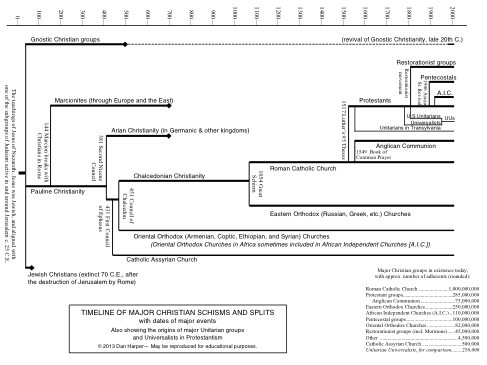
We’ve been running the “Church across the Street” or “Neighboring Faiths” program for our middle schoolers this year in the Palo Alto church. We’ve been going to different Christian churches all fall and into the winter, and I wanted to come up with a resource that would give our kids at least a general sense of how different Christian groups are related to one another. I finally decided that a timeline might do the job best.

However, as I worked on the project, I realized that most of the churches we visited were Protestant churches. And I realized that I would have to do a general timeline for Christianity, and another timeline (on a smaller time scale) for Protestantism. Below is the first part: a general timeline of Christian schisms and splits, showing the origins of the main Christian groups (including a couple of extinct Christian groups). Since I’m using this with Unitarian Universalist kids, I also placed Unitarians and Universalists on this timeline for reference. Click on the thumbnail to see the full-size PDF:

Timeline of Christianity

Update 2/5/13: The handout above has been updated thanks to your comments and email messages.

The season of waiting

At the Starr King Unitarian Universalist Church in Hayward, California, the director of religious education, Darcy Baxter, and the parish minister, Katie Kandarian-Morris, recorded a series of short video messages that give a Unitarian Universalist response to this question.

Here’s what they did: Darcy got the children at Starr King to write down their thoughts on how to be patient during Advent. The children wrote these thoughts inside cards, the outside face of which they then decorated. Darcy hung these cards on a bulletin board so that they look like an Advent calendar.

Now Darcy and Katie are recording a video for each day of Advent. Each video begins with Darcy reading one child’s suggestion of how to be patient. Katie and Darcy talk briefly about the suggestion, and then Katie reads a prayer or mediation for the day. Each video is only about two minutes long, but taken together they form a sort of video Advent calendar.

My favorite suggestion of how to have patience: clean the house. This is in fact what I do when I am trying to be patient. What a great way to utilize social media to extend the reach of a congregation’s ministries!

Advent reflection for December 6:

Continue reading “The season of waiting”

Transcript of a class

Joe and I have been talking about ways to document what goes on inside Sunday school classrooms. Joe is doing his Ph.D. in education right now, and one thing he has been doing lately is videotaping experienced teachers. Eventually he plans to produce video teaching tools to help new teachers learn how to teach.

This past Sunday, Joe hitched up an audio recorder to me while I was teaching our middle school group about Quakerism, in preparation for a field trip to a Quaker meeting that same morning. I decided to transcribe that audio recording to help me reflect on my teaching — what do I do well, where could I improve? The transcript appears below.

In the transcript, I recorded names of specific young people in the class where I could identify their voices (of course I have used pseudonyms), and one thing I noticed is that of the dozen or so kids in the class that day, most of my direct verbal interaction was with the same half dozen kids. I can hear the other kids talking in the background, but they don’t directly respond to my questions. Thus, one thing that I would like to improve is the number of young people with whom I have direct verbal interactions.

The transcript is long, but if you read through it, I’d love to hear your thoughts. Obviously, a transcript like this does not convey tone of voice and body language, which means you’re missing some of the most important stuff that went on (and that’s why Joe is making videos of teachers). Nevertheless: What do you think I did well? Where could I have improved? Leave your answers in the comments.

Continue reading “Transcript of a class”

Alternative Thanksgiving blessings

What words do you use to say grace at Thanksgiving? Do you use a traditional grace, or are you looking for an alternative blessing for you Thanksgiving dinner? As Unitarian Universalists (UUs), we have lots of options when it comes to saying grace at Thanksgiving.

When I was a UU child, we often had Thanksgiving dinner with my mother’s twin and her family. Our cousins were all older than my sisters and I, and we looked up to them. Both our families were UU families, and one year at Thanksgiving our eldest cousin said she was going to say grace before dinner, using a grace she had heard in her UU congregation’s youth group. My mother and father and aunt and uncle all liked the idea, and told her to go ahead. She had us all join hands, and then said, “Rub-a-dub-dub, thanks for the grub, yay God!” I’m not sure the adults at the table were particularly impressed, but my sisters and I were definitely impressed.

Even if you never say grace at any other time of the year, Thanksgiving is a good time to pause before eating, and give thanks for your food. The challenge for us religious liberals is coming up with pleasing ways to give thanks that don’t rely on traditional Christian theology. My UU friend Craig Schwalenberg adapted this grace from his Lutheran childhood:

Cherished family, friends, and guests,
Let this food to us be blessed.
Bless those people who made this food.
May it feed our work for good.

Another friend of mine, Emma Mitchell, grew up as a Unitarian Universalist, and says her family used to say this for grace (and children got to choose whether to refer to God as “her” or “him”):

God is great, God is good,
Let us thank (her) (him) for our food.

I wrote the following grace to remind us of the interdependent web of existence, including farmworkers and the wider ecosystem (there’s a tune that goes with this, and it’s online here):

Praise workers laboring hard in their fields,
May sun and moon increase their yields,
May the soil be blessed by falling silver rains,
As we offer thanks to Mother Earth again.

What’s your favorite alternative Thanksgiving blessing? UUCPA member Kris Geering writes: “For the pagan-friendly folks, I like this grace (there’s a tune you can sing it to, but it’s good as is):”

Give thanks to the Mother Goddess,
Give thanks to the Father Sun.
Give thanks to the plants and the flowers in the garden
Where the Father and the Mother are one.

Rev. Amy Zucker-Morgenstern, our senior minister at UUCPA, sent in the following grace:

Our family grace is to hold hands and say “Thank you for the food,” in as many languages as are known by people at the table. Common variations include thanks to the farmworkers, truckers, people who invented whatever cuisine it is, Mommy or Mama for cooking, etc.

What about you? what’s your favorite non-traditional Thanksgiving grace?

Cross-posted here.

Education reform and technology

Are today’s young people, immersed in social media and similar technology, qualitatively different from the young people of twenty years ago? Many education reformers argue that young people are indeed different, and that we must reform educational practice so that we can engage them effectively.

However, Joe sent me a link to an online peer-reviewed journal article in which Grinnell Smith of San Jose State University “questions the validity of the claim that technology has changed our children in ways relevant to the way we should structure education” (“A critical look at the role of technology as a transformative agent,” THEN [technology, humanities, education and narrative] Journal, issue no. 8, winter, 2011). Smith begins by challenging the notion that children have been fundamentally changed by technology:

A typical approach to supporting the premise that children have been transformed by technology is not to refer to empirical evidence but rather to drag out a few suitably stunning statistics about the pace of technological breakthroughs or to provide a few overwhelming anecdotes illustrating the comfort of adolescents and young adults with regard to technology in the hope that the reader will leap to the “obvious” conclusion that today’s youth is qualitatively different….

Smith then argues that despite the prevalence of such anecdotes, there is little real evidence that young people are learning differently:

In the large view, rather than the creation of something entirely new, what our latest explosion of technological advances has done for us, by and large, is to provide us with new ways to do the same old things we’ve been doing since we drifted out of the Olduvai Gorge across the Serengeti and fanned out into Europe, Asia and the Americas.

Therefore, Smith says we should be skeptical of claims that today’s young people are all that different from the young people of a generation ago — and we should be skeptical of claims that we need extensive educational reform because of social media and/or other technological innovations.

Connected by water

Because someone asked, here’s the story we tell every two or three years as part of our Water Ritual service (a.k.a. “Water Communion”) in early September. I based this story on something Steve Hersey said in the Water Ritual service at the First Parish in Watertown, Massachusetts, circa 1995.

This story requires that you make two simple props. First, click on the images below, and print out the PDF files:

Now take the “602” sheet and tape 7 sheets of “,000” to the right hand edge; carefully fold the “,000” sheets behind the “602” sheet with an accordion fold. Then take the “22” sheet and tape 9 sheets of “,000” to the right hand edge; fold as above. Now you have the two props you will need.

Continue reading “Connected by water”

Games sampler

A bunch of games for you to play, as presented at Pot of Gold Religious Education Conference today.

What are games? Games are FUN. Games have AN OUTCOME. Games are SOCIAL.

Some types of games useful in UU groups:
— Icebreaker and name games: for whenever you have a newcomer
— Classic kid games: for any age, just to have fun
— Fantasy games: unleashing fantasy and creativity
— Active games: get up and get moving
— Simulation or teaching games: learning by doing
— Theatre games: awareness of self, awareness of others
— Energy breaks: very short activities designed to regulate the group’s energy level

Every game-playing group of which I’ve been a part — from Sunday school classes with little kids to adult groups — usually has one or two games that they love best, and the group can play that game over and over again. My goal with every group is to try a bunch of games until I find at least one game we want to play over and over again. Of course I want to play lots of different games, but if there are one or two favorites, then when all other plans fail, we all know that at least we can play our favorite game. The games below marked “Fave Game” been a favorite game of at least one group I’ve led or been a part of.

Please note that rules of games are mutable — you may know one or more of these games with slightly different rules. The rules given here are rules that I know work, but you should change and adapt them as you wish.

Continue reading “Games sampler”

Easy bubble juice

I’m going to be leading a workshop tomorrow at the “Pot of Gold” religious education conference. For the workshop, I’ll be demonstrating bubble juice that makes medium (9-12 in.) soap bubbles. Below is a recipe, and instructions for making a bubble wand.

Easy bubble juice for 9-12″ bubbles

Ingredients:

4 oz. very hot (not boiling) water

3 oz. Dawn brand Ultra Concentrated dishwashing detergent

3 oz. personal lubricating jelly (K-Y Jelly or any generic brand)

water to make up approx. 1 quart, about 22 oz.

Continue reading “Easy bubble juice”

Religious education staffer: administrator, educator, theological resource?

Based on a conversation with a friend, here’s a question about religious education and the role of the religious educator in a congregation:

Should that person spend any Sunday morning time teaching?

This is one of those simple questions that produces a long and interesting answer.

Years ago, religious education theorist Maria Harris suggested that the duties of people doing religious education in a congregation can be divided up into three main categories: theological resource, education, and administration (see her The DRE Book [Paulist Press, 1976], pp. 1-12). Harris further implied that full-time religious education professionals might be able to carry out all three duties, but part-time staff might be able to carry out only one or two of these duties, depending on how many hours they work. I have found this a useful framework in planning out the duties of a religious education professional, both as a religious education professional myself, and as someone who has supervised a DRE when I was a parish minister. Continue reading “Religious education staffer: administrator, educator, theological resource?”

Summer Sunday school: Blob Tag and Jataka tales

From my teaching diary; as usual, children’s names are fictitious.

We’ve been getting 8 to 12 children in grades K-6 in our summer Sunday school class — a nice group size that allows children of different ages to get to know each other. Such a small group size makes it easy to change your plans at the last minute, too. At 9:25, five minutes before heading in to the worship service, Edie, my co-teacher, and I revised our plan. We were supposed to take a walk to the nearby city park, but neither one of us felt like dealing with the hassle of getting permission slips signed.

“Let’s stay here,” said Edie. “We can play giant Jenga.” Last winter, the middle school group had made a game based on Jenga (a trademarked game invented by Leslie Scott), using two-by-fours for the blocks. The middle school kids had played this game on the patio during social hour, and the younger kids were fascinated by it.

“Do you want a story?” I said. I had just gotten an old story book, More Jataka Tales by Ellen C. Babbit (1923), and there was one story I wanted to tell to children. Continue reading “Summer Sunday school: Blob Tag and Jataka tales”