
New upper elementary curriculum

I’ve been working on developing a curriculum for upper elementary children. The basic idea comes from the old Beginnings: Earth, Sky, Life, Death curriculum developed in the mid-twentieth century by Sophia Fahs. However, much of the content is new, the theological framework has been updated, and the curriculum has been designed to be extremely user-friendly. And now almost the entire curriculum is online for you to use — but before I get to that, let me tell you about several key features of this curriculum.

First, much of the content is completely new. I have included some of the stories from the old “em”Beginnings book, but I have always gone back to primary sources and/or scholarly commentary, and written these stories from scratch. I have also included completely new material, such as the story from the Yoruba tradition — a religious tradition that wasn’t even recognized by most Westerners when the old Beginnings book was written.

Second, the theological framework has been updated. Many UU curriculums of the past have been rightly criticized for assuming that all other religions are not as “advanced” as Unitarian Universalism; this curriculum attempts to avoid that trap of neo-colonialism. A companion curriculum is in development that will present Unitarian Universalist myths and stories in exactly the same way that these stories from other religions are presented. This curriculum also assumes that the possibility of significant diversity, of children coming from multi-religious households; i.e., the children in this UU Sunday school class might also have household members or close relatives who participate in another religious tradition such as Hinduism, Yoruba traditions, Judaism, Christianity, Chinese popular religion, etc. Thus I have tried to avoid any implication that another religion is less “true” or less important than our own religion.

This curriculum is also designed to provide some foundation for our version of the old “Church across the Street” curriculum, in which middle schoolers visit other faith communities. Thus, in some of the sessions, reference is made to religious practices that are related to the story for that session, to relate the mythic or narrative dimension of a religion with the ritual dimension (to use two of Ninian Smart’s seven dimensions of religion). Additionally, the illustrations include some photographs of the material dimension of religion.

Finally, and most importantly, the curriculum is designed to for today’s volunteer teachers. Sunday school teachers today need a curriculum that they can pick up ten minutes before class, and teach successfully with little or no prep time. At the same time, some experienced teachers may want the possibility of going more deeply into the lesson. So this curriculum is designed to provide maximum flexibility for teachers. After two years of use in our congregation, teachers seem to like the curriculum pretty well.

By putting this curriculum online, my goal is to make the curriculum even more user-friendly. The Web site uses responsive design, so that the curriculum will display equally well on a smart phone, tablet, laptop, or even a Web-enabled TV. No need for a book or a three-ring binder: all you need is your smart phone (though the illustrations will be easier to show to kids on a bigger screen). Having the curriculum online should also make it much easier for teachers to let parents know what children are doing in Sunday school.

I would love to hear your comments and reactions to this curriculum.To look at the online version of this curriculum, go here.


An illustration from the curriculum:
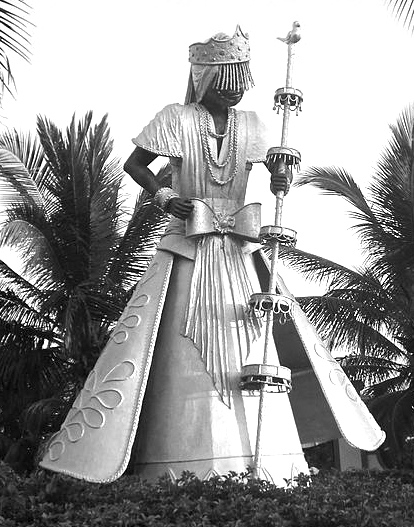
Obatala

A statue of Obatala, an orisha common to many of the Yoruba traditions. This statue was photographed in Costa do Sauipe, Bahia, Brazil. Public domain photo from Wikimedia Commons.

How Doso came to live with Metaneira

Some years ago, I started working on a version of the story of Demeter and Persephone. I put part one of the story on this blog back in 2012; now, finally, here’s part two. No promises when part three will be done.

For part one of the story, click here.

Demeter’s heart was sad at the loss of her daughter, and she was angry at Zeus and Hades. In her sadness and anger, she wandered across the land, until at least she came to the house of wise King Celeus, ruler of the beautiful city of Eleusis.

Demeter sat down to rest on the wayside by the road, in a shady place beneath an olive tree, next to the Maiden Well, from which the women of Eleusis came to get water. She looked like a woman who was too old to bear children, the kind of respectable older woman who might care for the children of a king, or perhaps like one of the housekeepers who clean the echoing halls of a king’s palace.

The four daughters of King Celeus came to Maiden Well with their bronze pitchers, to draw water and carry it to their father’s house. Their names were Callidice, Cleisidice, Demo, and Callithoe who was the eldest of them all. They looked like goddesses in the flower of their girlhood. They saw Demeter sitting there in the shade of the olive tree, but they did not know that she was a goddess — when gods and goddesses roam the earth, it is never easy for mortals to recognize them — and so they spoke to her.

“Old mother,” they said to her, “where do you come from, and what people do you come from? Why have you gone away from the city, and why do you stay away from houses? In many of the shady halls of the houses of our city, there are women of just such age as you, and they would welcome you there.”

Demeter, seeing that the girls were polite, answered them politely. “Hail, dear children,” she said, “whosoever you are. I will tell you my story; for it is right that I should tell you truly what you ask. Here is my story:

“Doso is my name, the name my stately mother gave to me. I have come from the island of Crete, sailing over the wide back of the sea. But I did not come willingly.

“Pirates took me from Crete by force of strength. Continue reading “How Doso came to live with Metaneira”

Progressive religious education in 1912

During an email exchange with a colleague regarding the history of early twentieth century Unitarian religious education, I came across a 1912 report from the Unitarian Sunday School Society.

This brief report gives an interesting look into the beginning of the Progressive era of religious education. Based on the insights of the new science of psychology, the Progressives were implementing closely graded classes, an improvement over older ungraded, or three-grade, classes. The Progressives felt that key outcomes of religious education included providing children with religious knowledge inculcating children with the ideals of social service, and teaching “religion itself.” And, although still focused on the Bible, the Unitarian Progressives were introducing non-Biblical and non-Christian topics to Unitarian children.

For me, the most interesting part of this essay is the penultimate paragraph. With some rewriting, this Progressive statement could serve as a pretty good summary of what we’re still trying to do in our Sunday schools today — something like this:

“We should teach our children about religion — they should know religious history, literature, and theology.

“We should teach our children how to apply religion — they should know that as a tree bears fruit, so religion should produce good works.

“Finally, we should teach our children religion itself. Knowledge about religion points towards religion itself; and religious service grows out of the high ideals of religion itself. But when we teach religion itself — as opposed to knowledge about it, or service based on it — we won’t teach it through classroom instruction. Like all our best knowledge, religion is transmitted by contagion and inspiration, not by instruction; it is caught, not taught. To reach and quicken the child’s religious nature is the highest task of religious education.”

The full text of the essay appears below.

  Continue reading “Progressive religious education in 1912”

One definition

This is from Alfred North Whitehead’s The Aims of Education:

“A religious education is an education which inculcates duty and reverence. Duty arises from our potential control over the course of events. Where attainable knowledge could have changed the issue, ignorance has the guilt of vice. And the foundation of reverence is this perception, that the present holds within itself the complete sum of existence, backwards and forwards, that whole amplitude of time, which is eternity.”

This strikes me as a pretty good definition of at least part of religious education.

We Unitarian Universalists are most likely to speak about duty in connection with our social justice work. However, we are also concerned about duty in terms of personal morality: whenever possible we aim to recognize that other beings are not mere means to our ends, but are ends in and of themselves. This means that we try to get beyond exploitation in our personal relationships; and beyond sexism, racism, and other destructive “isms”; and we try to honor and respect those who can’t stick up for themselves because they’re weaker than we are (e.g., children).

Many of us Unitarian Universalists have a hard time with the word “reverence.” But read over Whitehead’s definition carefully: the present moment holds within in itself eternity, and once we perceive this, we have the foundation of reverence. Notice that Whitehead is not making any claims about divinity, nor is he defining what existence he; he is talking about a kind of knowing. That’s the foundation of reverence: that you can know in the present moment in ways that open up all of time and space to you. Mathematicians and theologians would likely agree.

An open letter to the UUMA Board

Dear friends,

When I received my renewal notice from the Unitarian Universalist Ministers Association (UUMA) this year, I faced a tough choice.

This fiscal year, I had decided to attend both the annual conference of the Religious Education Association (REA), an international, interfaith organization of scholars and practitioners, as well as Religious Education Week at Ferry Beach Unitarian Universalist conference center in Maine. These two conferences each provided me with professional development that specifically addressed my needs as a minister of religious education. The REA conference was especially fruitful for me this year — I had an opportunity to attend workshops and have informal interaction with people like Thomas Groome and Siebren Miedema, scholars with an international reputation in my field, and to spend time with colleagues and former mentors, people who are facing many of the same issues and concerns that I face in religious education. Religious Education Week at Ferry Beach was also very fruitful, as I was able to take a graduate-level class with Mark Hicks of Meadville/Lombard Theological School in an intergenerational setting where we could both learn about religious education for young people, and watch it happening around us.

The basic issue for me is a cost-benefit analysis: as a minister of religious education, the UUMA provides me with very little benefit for the cost. And the cost is very high. My salary is $80K a year. The UUMA sliding scale means I pay $825 (10% of gross salary + housing), minus $100 for my membership in the Liberal Religious Educators Association, yielding a total cost of $725. It’s interesting to compare this to my REA membership: the REA also has a sliding scale, but for the same salary I pay only $105 per year.

You may be thinking that with a salary of $80K a year, I shouldn’t be whining. But I live in Silicon Valley, which has one of the highest costs of living in the United States. According to relocation Web sites that calculate cost of living across the country, $80K in Silicon Valley provides about the same standard of living as $40K in Rochester, New York. So it’s not like I’m getting rich (indeed, according to a recent newspaper article, my salary is below average in Santa Clara County). If I lived and worked in Rochester, New York, and made an equivalent salary providing about the same standard of living, I would pay about $325 for UUMA dues. Continue reading “An open letter to the UUMA Board”

“Full Week Faith” or “Will There Be Faith?”

I’ve just been checking out Karen Bellavance-Grace’s white paper “Full Week Faith: Rethinking Religious Education and Faith Formation Ministries for Twenty-First Century Unitarian Universalists.” If you read it, I think you’ll find that this paper is a pretty good summary of the debates that have been going on within Unitarian Universalism regarding the role of religious education. And that’s both a strength and a weakness. It’s a strength because Bellavance-Grace summarizes the debates nicely, and offers a positive way forward. It’s a weakness because the Unitarian Universalist conversation on religious education has gotten pretty narrow, and has not paid attention to a wider international, interfaith conversation about the role of religious education.

While reading Bellavance-Grace’s paper, I’ve also been reading Thomas Groome’s latest book, Will There Be Faith? and it’s worth making a brief comparison of the two.

Both writers are committed to religious education that is grounded in the experience of learners. But Groome goes further than Bellavance-Grace, and he says that it’s not enough talk about “experience,” because that doesn’t do full justice to the ability of learners to take charge of their own learning. Drawing on Paolo Friere’s work, Groome says he prefers the word “praxis,” by which he means real-world practical action that is more than social service or band-aid charity. As a left-wing Catholic, Groome stands to the left of Bellavance-Grace, particularly in his insistence that children should be active participants in their own learning, and in his insistence that doing education with children can (and should) effect real change in the wider society. So it’s great that Bellavance-Grace continues to be committed to the tradition of experience in education, as set forth by John Dewey a century ago, and it’s great that she updates it for the postmodern era. But Groome is in that same tradition, and he elaborates on Dewey using the insights of Paolo Friere, and then he takes it even further using his own shared praxis model. I find Bellavance-Grace to be a little too conservative for my tastes; Groome’s insistence of the preferential option for the poor, his insistence on the need to seriously challenge the world around us — I find these more in line with what my religious convictions demand of me.

Both writers are committed to educating children into a faith tradition. Groome explicitly acknowledges the insights of John Westerhof, who, at the first rumblings of postmodernism in the 1970s, was one of the first religious educators to point out the new need to explicitly teach children how to be a part of a faith tradition. Bellavance-Grace does not explicitly acknowledge Westerhof, but his influence is clear on her work. Both Bellavance-Grace and Groome come up with similar pedagogical approaches to educating children in faith — Bellavance-Grace calls her approach “experilearn,” and Groome calls his “life to Faith to life.” — and both these approaches emphasize the connection between the life of faith and the rest of the world. But Groome’s pedagogy is much more fully developed, and has a more practical orientation. Also, because his pedagogy is grounded in Friere, there’s a much stronger sense of how reflection and praxis are intertwined; you don’t just learn something then move on, you engage in the world, reflect on your engagement, then engage again, reflect again, and so on for a lifetime. Since I’m a working religious educator, I find Groome’s practical and more fully developed pedagogy to be far more useful.

So Bellavance-Grace and Groome are pretty close in terms of their educational philosophy, and either or both would be useful to Unitarian Universalist parents and religious educators. Unfortunately, many Unitarian Universalists will be turned off by Groome simply because he is a Christian and a Catholic; so many Unitarian Universalists still wear the blinders of anti-Christian and/or anti-Catholic prejudice (and I’ve never quite understood why John Roberto gets a pass from Unitarian Universalists when other Christian religious educators don’t). But while Bellavance-Grace’s paper is quite useful, I think she just doesn’t go far enough; and in the end she advocates a kind of top-down approach driven more by religious professionals than by parents and kids. Groome’s shared praxis approach takes us beyond John Dewey; I think he has a better grasp of the postmodern context; he offers lots more sound practical advice, advice for the grass-roots which will work for religious professionals, parents, and even for kids.

Yes, Bellavance-Grace represents state-of-the-art Unitarian Universalist religious education; she has nicely distilled current cutting-edge Unitarian Universalist religious education practice. The problem is that Unitarian Universalist religious educators are behind the times, and if we want to catch up, we’re going to have to look beyond our narrow borders.

Academics and practitioners

A few days ago on the “Key Resources” blog, a blog about faith formation from Virginia Theological Seminary blog, Kyle Oliver asked: “What has the academy to do with congregational faith formation (and vice versa)?”

What prompted this question? Kyle had been at the recent annual conference of the Religious Education Association (REA), which is supposed to be an organization of scholars and practitioners. But he had not been convinced that the REA offers much to practitioners: “I wasn’t entirely convinced of the value of the conference for a non-academically-aspiring faith formation minister in a congregation.”

Speaking as a minister of religious education, I agree with Kyle that the academics, not the practitioners, dominate the conference. Two examples of what I mean when I say the academics dominate: (1) At the 2011 conference, I went to an excellent workshop given by Ryan Gardner on teacher reflection for volunteer teachers; it was the only practical workshop in that time slot; yet only two other people showed up, one of whom admitted she was in the wrong workshop (she stayed anyway, bless her heart). (2) At this year’s conference, I went to a good workshop given by Tom Groome on practical approaches to pedagogy for the local congregation; again, it was the only practical workshop in that time slot; yet the conversation got taken over at a couple of points by academics who wanted to argue rather obscure theoretical points. At the same time, all the academics whom I met were sympathetic to practitioners; some of them appeared to be pleased when they found out I actually worked in a congregation with real, live children and youth. I don’t think the academics want to dominate the REA conference.

Some of the problem may lie in the realities that we religious education practitioners face these days. When I started working as a religious educator in the Boston area, back in 1994, it was commonplace for some of the older religious educators to talk about how they studied with Robert Kegan, James Fowler, Tom Groome, and other scholars. Back then it was also commonplace for lay Directors of Religious Education to have a full-time, well-compensated job; there were many more Ministers of Religious Education; congregations expected us to take time to study and keep up with the field. That’s no longer true. As staff costs for congregations outpace inflation, as organized religion declines in an era of civic disengagement, as society changes rapidly around us, as congregations need more from us and are able to offer less to us — as all this goes on, many of us who work in local congregations feel overwhelmed as we try to do more and more with less and less, as we try to keep kids engaged, as we try to hold on to our jobs and our pay.

As a result, when we practitioners go to any kind of conference, we’re usually looking for relentlessly useful ideas that we can use right now. We’re desperate. John Roberto of Faith Formation 2020 gets this; he gives us practitioners what we need in easily digestible bites. At the recent REA conference, I think Beth Katz of Project Interfaith intuited some of this; she showed us excellent and innovative curricula that were both immediately useful and grounded in interesting theoretical perspectives. Mind you, Katz and Roberto are not exactly academics, though they are academically informed. One academic who gets this is Bob Pazmino: I talked with Bob informally at the recent REA conference, and he not only asked me about what was going on in my congregation, and listened carefully and respectfully, but he was able to present me with some interesting possibilities for new directions based on his academic work.

In short, I think Kyle Oliver is correct when he says that he’s not “entirely convinced of the value of the REA conference” for most of us practitioners. I think the academics might want to pay more attention to Kyle’s critique, and think about how they might better unite their theory with our practical realities.

I would also say that we practitioners have to remember that our praxis should be informed with theory. Perhaps it’s time to get a little more assertive, as Kyle is doing, and help the academics pay better attention to what’s going on in our local congregations.

REA 2013 conference: teaching religion and good citizenship

“We need to cross borders and join forces for a more humane world,” said Seibren Miedema in his President’s Address during the final plenary session of the 2013 Religious Education Association (REA) annual conference. Miedema is professor emeritus at Vrije Universiteit (Free University), Amersterdam, Netherlands, and president of the REA.

“Learning to work, to live, to play together should be possible,” he said, “and should start in early childhood.”

When Miedema was goring up in the Netherlands in the 1950s, the society was “pillarized”; that is, everyone living in a given Dutch town tended to belong to the same church. I happened to sit next to him during the pre-conference session, and he said then that he didn’t really encounter anyone from a different denomination (let alone a completely different faith tradition) until he was in his teens. In his President’s Address, he said that pillarization began to break down in the 1960s, as society changed rapidly and people of different faiths began engaging in, e.g., social justice work together.

Coming from that Dutch background, Miedema now believes that state-sponsored schools can and should play a crucial role in fostering inter-religious dialogue. He spoke about “the impact of the schools’ contribution, in terms of the selected subject matter and of the arrangement of pedagogical relations and situations by the professionals, on the personal identity formation of students.”

Miedema said he agrees with the position that the “binding role” of religion in society is of “utmost importance” and “should not be neglected.” This position is opposed to the official position in, e.g., France. Miedema reminded us that John Dewey, one of the intellectual founders of the REA, believed that schools should cultivate the religious side of children. Continue reading “REA 2013 conference: teaching religion and good citizenship”

REA 2013 conference: a mentor, practitioners, and list of resources

Some of the best parts of attending a conference like the Religious Education Association (REA) annual conference are the informal conversations.

During one of yesterday’s plenary sessions, I realized I was sitting a couple of rows behind Bob Pazmino, perhaps my most important religious education mentor, especially given his focus on the practice of teaching. I looked for Bob during one of the breaks, and even though I hadn’t been his student since 1999, he still remembered me. We had a good long talk, and I got to hear about his grandchildren, and his research, and so on. And, like a good mentor, he drew me out on some of the challenges I’m facing in my praxis as a religious educator, and helped me to see how when educating for social justice in a predominantly white, predominantly middle class community, one has to be aware of the possible shame that such education can generate among people who are relatively well-off. And awareness of the possibility of shame should, of course, affects one’s pedagogical strategies.

During the annual meeting, someone brought up the point that this conference was heavily tilted towards the interests of scholars, rather than practitioners. (I wrote down his name, but unfortunately lost that slip of paper.) I grabbed him after the meeting, and speaking as a practitioner myself, thanked him for raising that point. Chuck Chesnavage came up and said much the same thing. We floated the idea of some kind of practitioner’s meeting at the next conference.

Finally, in several informal conversations I got lots of recommendations for books and resources and ideas I should follow up on. Here are some of them:
— Book: Practicing Discernment with Youth, by Dan White
— Resource: Association for Practical Theology
— Books: in relation to practical theology, Mary McClintock Fulkerson’s work
— Idea: Elizabeth Caldwell had children retell and illustrate Bible stories, which she then published in book form using online self-publishing tools
— Book: Practical Theology and Qualitative Research by John Swinton and Harriet Mowat

REA 2013 conference: Tom Groome and a pedagogy for teaching religion

For the Sunday morning breakout session at the Religious Education Association conference, I attended Tom Groome’s workshop titled (somewhat mysteriously) “Teaching to ‘Learn From’ Religious Traditions.”

Groome began by asking the question: How do you go about teaching religion in the schools? What is an appropriate pedagogy? He said he wanted a pedagogy that could work in either a public school or a private school, with diverse student populations, a pedagogy in which one could teach any given religious tradition without proselytizing.

More specifically, he wanted to teach religion such that students would become better people within their own tradition (or within their lack of religious tradition). He told a story about a Muslim student named Mohammed who had been in his class on Catholicism at Boston College. Groome told Mohammed that he wanted him to become a better Muslim through learning about Catholicism from his Catholic professor. Some years later Mohammed told Groom that indeed he had become a better Muslim because of that class. This is Groome’s ideal for teaching religion in the schools.

Groome said that they Enlightenment gave us two option: we could learn about religion, or we could learn to become part of a given religion. These two options come, in part, from Katn’s distinction between pure and practical reason. However, Groome takes seriously the feminist eopistemologists who pointed out the objective viewpoint of Kant’s pure reason does not really exist — “there is no view from nowhere.” Thus Groome proposes a third option on which to base an appropriate pedagogy: to learn from religions for your own life.

In other words, Groome called for a pedagogy that would teach religions as “great spiritual wisdoms for life,” rather than presenting them as data or history. “They’re not just a cognitive exercise,” he said, but rather a way for students to learn from other traditions in order to enrich their own traditions.

As an example, he spoke about how one might teach about the Muslim practice of Zakat; this is the practice of giving away 2-1/2% of one’s capital each year to persons in need. This spiritual practice not only promotes charity, it also promotes non-attachment to material goods, and it teaches about the ultimate power of God (i.e., it is God who really owns whatever material possessions one has). Groome said if he were teaching Zakat, he might begin be having the students name what they know about people who are in need, and then teach them Zakat as one religious response to poverty and need. “The learning outcome,” he said, “is that you’re going to encourage their own discernment about poverty.”

The workshop participants engaged in lively discussion with Groome.

There was some discussion about Groome’s theoretical underpinnings for his pedagogy, and one participant (I didn’t get his name) could not agree with Groome’s tendency towards universalism, i.e., that there is a common thread running through all religions. However, after some discussion it seemed clear that even people like me who tend to follow Mark Heim and Stephen Prothero in asserting that religions do not have a universal end or goal could still effectively use Groome’s pedagogical approach.

I asked about assessing learning outcomes, and Groome acknowledged that you can’t test or assess for the student’s own feeling — i.e., you can’t assess whether they have become, or will become, more humane — but you can test them for the data. However, pedagogy need not be driven completely by assessment.

Catherine Owens of Episcopal Divinity School pointed out that so many young adults today are unaffiliated, and having no grounding in any religious tradition, they are “appropriating bits and pieces from religions” (I would be blunt, and say they are often misappopriating) to build their own spiritual life. Therefore, part of what we need to do is to, as it were, expose them to the real thing.

I was sitting next to Kevin Sandberg, and in the time for small group discussion he suggested a “pedagogy of friendship” to supplement Groome’s pedagogy. I liked this formulation, and am thinking about how one might teach using a “pedagogy of friendship.”