Today’s lesson plan on Ferguson

Here’s today’s lesson plan, as taught in the summer Sunday school program at the Unitarian Universalist Church of Palo Alto (UUCPA), Calif. We had about a dozen children in gr. K-8. The lesson plan was written to engage the older children (gr. 5-8), in the expectation that the younger kids would do their best to follow the lead of the older kids; this worked quite well, so even though the conversation was over the heads of the kindergarteners, they followed along as best they could, and at least understood that we were talking about something very important.

One unexpected benefit of this lesson plan: While most of the children knew what “Ferguson” was, they were pretty hazy on the details of the events of August 9, 2014. Going over the story three different times helped reinforce details of that day in their memory.

Lesson plan
Credits
Goals and objectives
Theological background
Notes and resources
Thoughts for teachers
Why isn’t —— in this lesson plan?

Continue reading “Today’s lesson plan on Ferguson”

The Land of the Great

This is my retelling of one section of “Visits to Strange Nations,” which may be found (in translation) in the section on “Anonymous Chinese work of the 17th century,” Gems of Chinese Literature, 2nd ed., trans. Herbert A Giles (Shanghai: Kelly and Walsh, 1923). This story was also retold by Sophia Fahs in From Long Ago and Many Lands, available online through Google Books — click here. My version of the story has a different bias than does Fahs’s version, and perhaps hews closer to the original.


THE LAND OF THE GREAT

In the year 684, the scholar T’ang Ao and his friend Lin Chih-yang grew disgusted with the behavior of Empress Wu, ruler of their home land of China. These two friends thought the empress was both foolish and aggressive, and they also felt that under her reign anything might be bought or sold, including a person’s honor. They decided they would travel the world and see how other nations were ruled, and so they found a guide, a man named Toh Chiu-kung who seemed to know everything and to have traveled everywhere, and then they got on board a ship and sailed over the sea.

After visiting several nations, they came at last to the Land of Great People. In fact, they almost passed by this small nation except that T’ang had heard that in the Land of the Great, no one walked but instead everyone had their own personal cloud which carried them where they wanted to go. Toh warned that they would have to leave the ship and walk a long way inland to really see this country. But T’ang must go see the Land of the Great, so they began to walk inland over some steep hills.

Soon they became lost in a maze of trails, and did not know which way to turn. They were very glad when at last they saw a small temple hidden in among bamboos. Out of the temple came an old man who looked perfectly ordinary except for two things. First, he was riding on a cloud. Second, while in their country anyone who lived in a temple would have to be a priest who shaved their head, did not eat meat, did not drink wine, and was not married — well, this old man had long hair, carried a glass of wine in one hand, a plate of meat in the other hand, and through the door they could see his wife seated at a table.

It is hard to say which shocked the two friends more — a man floating upon a cloud, or a long-haired, meat-eating, wine-drinking, married priest! However, they remained polite. The old man smiled at them, put down his wine and meat, and invited them into the temple. T’ang, speaking for his friends, bowed low and asked what the name of the temple. The old man replied that it was the temple of the goddess of mercy, and that he was the priest of the goddess.

Upon hearing this, Lin asked, “But, respected sir, how can it be that you are a priest but do not shave your head?” Lin decided not to ask about the wine or the meat, or the man’s wife.

“My wife and I have lived here and been the priests ever since we were young,” said the old man. “Every day, we burn incense and candles before the shrine. Here in our country, when we heard that China had accepted the Law of the Buddha, and that priests with shaved heads had become common there, we too decided to accept the Law of the Buddha, but we decided to do away with the usual promises of a priest. Thus we can grow our hair, get married, eat meat, and drink wine.”

When the old man learned that his visitors were from China, he urged them to stay with him. But no, they said they must go on to see the chief city of the Land of the Great.

“But could you please answer one question,” said T’ang. “Could you please explain the reason why the people of your country all have clouds underneath their feet? Is this something that you are born with?”

“Yes, we are born with these clouds,” said the old man. “The clouds come in various colors, and colors change depending on the character of each person. The best clouds have stripes like a rainbow. The second-best clouds are yellow in color. The worst clouds have no color at all, and look dark, as if there is nothingness, or a hole, underneath the person’s feet.”

T’ang asked the old man to show them the way to the city so they could see more of these clouds, and the old man explained which trail to follow.

Soon they were in the great city. There were throngs of people in the city streets, each moving around on a small cloud. They saw clouds of many different colors: red, yellow, orange, green, and so on. At last they saw a homeless man, who obviously hadn’t taken a bath in weeks, whose cloud looked like a brilliant rainbow.

“Why, the priest told us that a rainbow cloud was best of all,” said T’ang, “and here we see a filthy, dirty homeless person with a rainbow cloud!”

“You may remember,” said Lin, “that that priest had a rainbow cloud himself. Yet how could a wine-drinking, meat-eating, long-haired, married priest be considered to be a good person? Just so, how could a homeless person be considered to be a good person? There is something here I do not understand.”

“As you know,” said Toh, their guide, “I have been to this country before. What I learned then was that the color of a person’s cloud comes from the kind of person they are, from the kinds of actions they take, but it does not matter whether they are rich or poor. So the clouds of good and virtuous people show the best colors, and the clouds of wicked people show the worst colors, whether they like it or not. The only way you can change the color of your cloud to a better color is to become a better person, and it does not matter if you are homeless, or if you a priest who eats meat.

“Because of this fact,” continued Toh, “there are poor people who ride on rainbow clouds, as we have just seen, and there are rich and powerful people whose ride on clouds that lack all color at all, and look like holes of darkness. Of course, everyone avoids the people who have a cloud of darkness. On the other hand, the people of this country get the greatest pleasure from seeing acts of kindness. So it is that people are not constantly trying to get the better of each other; no, they are always trying to become better people.”

“Is this why they are called the Land of the Great?” asked T’ang.

“Yes,” said Toh. “The people in the nations next to this one call them the Land of the Great — not because they are bigger and taller than other people, but rather because they are high-minded and good.”

Suddenly they noticed that the people around them were pushing back to the sides of the street, leaving the center of the street to a person of great wealth and power, who looked almost exactly like a wealthy powerful person in their own land, with a red umbrella over his head, with assistants in front and behind carrying official documents and beating gongs, and so on. The difference was that this wealthy person was riding on a cloud that was carefully and completely covered by a red silk cloth.

“Obviously,” said T’ang, “in this country, the wealthy and powerful do not need to ride on horses, for they can move about on these convenient clouds. But one thing I do not understand — why is this man’s cloud mysteriously covered by a red silk cloth?”

“The fact is,” said Toh, lowering his voice so he could not be heard except by the two friends, “this man, like too many other people with lots of money and a high social position, has a cloud of a bad color. His cloud is not exactly one of those horrible clouds of dark nothingness. But his cloud is the color of charcoal and ashes. This means he is not completely bad, but it does mean — as we like to say — that his hands are not so clean as they ought to be.”

“In other words,” said Lin, “he is not exactly a wicked person, but he most certainly is not a good person.”

“That is a good way of putting it,” said Toh. “His cloud takes on the color of his inmost mind. He is not a good man, and so his cloud a bad color. He tries to cover up his bad-colored cloud with red silk, but red silk does not change the color of his cloud. Nothing will change the color of his cloud until his heart becomes good again, until all his actions are once again good. But still, he covers his cloud with red silk, because at least that way no one is quite sure just how bad he really is.”

“How unjust this is!” cried Lin.

“But why do you think this is unjust?” asked T’ang.

“It is unjust that these clouds exist only here, in the Land of the Great,” said Lin. “It would be very useful if we had these clouds in our own nation, for if every wicked person rode about upon a marker of their wickedness, why, that would make good people’s lives easier.”

“My dear friend,” said Toh, “though wicked people in our nation do not ride about on colored clouds, nevertheless you can tell from a person’s looks what the color of their heart is. Someone with a bright, shining look in their eyes surely must have a rainbow-colored heart. And we all know people who have a blankness in their looks that shows an emptiness in their hearts.”

“That may be so,” answered Lin, “but I for one have been fooled by a person’s looks. I would rather we could see the color of the cloud they ride about on.”


Notes:

The story comes from the Chinese novel Ching Jua Yuan, which was written in the 17th century by Li Ju-chen, and is “an allegoric romance in total support of Confucian morality and Taoist wisdom” (C. T. Hsia, “The Scholar-Novelist and Chinese Culture: A Re-appraisal of Ching Hua Yuan,” in Chinese Novel: Critical and Theoretical Essays, ed. Andrew H. Plaks [Princeton University, 2014], p. 266). As such, it is a useful source for portraying to children Confucian ideals of morality. Young T’ang Ao and his friend Lin grow disgusted with the state of morals in their own country; and so they go on visits to other nations, where they find strange peoples who are in some sense more moral than in their own country.

Some scholars have seen this novel as a satire of the position of women in traditional Chinese society (for one such interpretation see Lin Yutang’s Feminist Thought in Ancient China, 1935). I have included a second episode from the novel (see no. 3 below) that gives some taste of that possibility. If, in the episode above, there is little evidence of any feminist inclination, it is important to know that that inclination does exist elsewhere in the novel. Thus, while the novel may support traditional Confucian morality, there existed more than one interpretation of that traditional morality; and this particular interpretation of Confucianism was more progressive in its attitudes towards women than others.

In addition to the Confucian component, there is also a strong Taoist component to the novel. Toh Chiu-kung, for example, becomes a wise elder to the two young men: “He is in one sense almost co-eval with the Yellow Emperor and certainly enjoys the free and easy wandering of Chuang Tzu and Lieh Tzu” (C. T. Hsia, p. 278). Toh, the guide, is a sort of Taoist sage-figure, guiding the two younger men on their visits to strange nations.


How to fail sex ed

One of the wonderful people who teaches comprehensive sexuality education in our church sent along a link to a post on Imgur headed: “Two years ago today, my then 14 year old sister got suspended for submitting these answers for her sex-ed class. I’m so proud of her.” Then there’s a photo of a worksheet titled “Objections to Condoms.” Kids were supposed to come up with possible responses to various excuses for not using condoms.

So, for example, one of the excuses for not using a condom was: “Condoms are gross; they’re messy; I hate them.” To which this creative girl replied: “So are babies.”

Condoms are messy -- So are babies

Mind you, a couple of the replies are just plain unconvincing, e.g. — Excuse: “I’d be embarrassed to use one”; reply: “Look at all the fucks I give.” Yeah, whatever.

But some of the replies, while very snarky, just might actually work in the real world, e.g. — excuse: “I don’t have a condom with me”; reply: “I don’t have my vagina with me.” This is not a good response to put on a worksheet that a public school teacher has to read; but a snarky early adolescent girl who needs to use a little humor to get through to a boy might find that reply useful.

This brings up an interesting point of educational philosophy. A core element of my educational philosophy is to start where the learner is. Some early adolescents learning about sex and sexuality may be most comfortable using snark and f-bombs to talk about sex. Of course we want to move them to a more reasoned form of discourse, a way of speaking that will allow them to talk about sex with potential partners openly, humanely, and with emotional intelligence. But we may have to listen to their f-bombs for a while before we get them there.

The story of Kisa Gotami, and women in early Buddhism

Generations of Unitarian Universalist children have learned the story of Kisa Gotami since it was first included in Sophia Fahs’s classic Sunday school text, From Long Ago and Many Lands. That book was published in 1948, and I included the story in an updated version of From Long Ago that we still use in Sunday school today.

But I’ve become increasingly uncomfortable with this story for its depiction of the state and status of women. Kisa Gotami’s story shows that the Buddha accepted that women were able to follow his path to liberation. At the end of the story, the Buddha ordained Kisa Gotami as a nun, and she “quickly attained arhantship,” and Buddha praised her accomplishments. (1)

But this does not mean that Buddha and the early Buddhists considered women to be the equals of men. Early Buddhism was part of a patriarchal society. Buddha did acknolwedge that women were able to follow the path to liberation (as Kisa Gotami does), but early Buddhist women also were required “to submit to the standards of male control.” (2)

And early Buddhist writings tend promote the following negative stereotypes of women:
“1. A woman is stupid; a beautiful woman has no brains.
2. A girl should be a devoted daughter, and agree to the arrangements made for her by her parents and inlaws.
3. A woman in only concerned with her body, her clothes, and her jewelry.
4. A woman is sensual and seductive, and should therefore be under male control.
5. Children and relatives are a central concern in a woman’s life. Female reproduction i painful and having children binds womend to the world of matter.
6. Women who are old are ugly and useless. A woman’s body is an example of impernance and decay.” (3)

The story of Kisa Gotami plays into these stereotypes, as does the poem attributed to her that is found in the Therigatha, a collection of early Buddhist poems supposedly written by women. Kisa Gotami’s poem in the Therigatha includes the following:

“Being a woman is suffering,
that has been shown by the Buddha,
the tamer of those to be tamed.

“Sharing a husband with another wife is suffering for some,
while for others, having a baby just once is more than enough suffering.

“Some women cut their throats,
others take poison,
some die in pregnancy,
and then both mother and child experience miseries.” (4)

This poem stereotypes women by saying that the suffering a woman feels is due to her reproductive biology and her social status — whereas, for example, her suffering is not due to her intellect. So we can admire the Buddha for going beyond some of the stereotypes about women that held sway in his time and in his land, when he acknowledged that women could follow his path of liberation. Yet we must also recognize that early Buddhism was run by men, and that the early buddhists (including the Buddha himself) were not able to let go of their negative stereotypes of women.

So I think I’m going to have to rewrite that lesson plan on Kisa Gotami to include some more pointed feminist critique of the story….

Notes:

(1) Rita M. Gross, Buddhism after Patriarchy: A Feminist History, Analysis, and Reconstruction of Buddhism (Albany, N.Y.: SUNY Press, 1993), p. 53.

(2) Ria Kloppenberg, “Female Stereotypes in Early Buddhism: The Women of the Therigatha,” in Female Stereotypes in Religious Traditions, ed. Ria Kloppenberg and Wouter J. Hanegraff, (Leiden, Netherlands, and New York: E. J. Brill, 1995), pp. 152.

(3) Kloppenberg, pp. 153-154.

(4) Therigatha: Poems of the First Buddhist Women, trans. Charles Hallisey (Cambridge, Mass.: Harvard University Press, 2015), pp. 111 ff.

Concrete block rocket stove

This past Sunday, the middle school ecojustice Sunday school class cooked on rocket stoves. We based our stoves on design principles developed by Dr. Larry Winiarski, who is affiliated with the Aprovecho Research Center. A rocket stove makes more efficient use of biomass fuels (wood, twigs) through more complete combustion; this also results in fewer harmful emissions. According to the Aprovecho Research Center:

“Improved cooking stoves address at least 5 of the 8 United Nations’ Millennium Development Goals: [1] ending poverty and hunger; [2] gender equity; [3] child health; [4] maternal health; and [5] environmental sustainability.”

So while we don’t really need rocket stoves here in the Bay area (except perhaps in disaster situations), learning about and building them is a great introduction to using appropriate technology to meet ecojustice goals of human well being and environmental sustainability.

If you’re not familiar with rocket stove design principles,Aprovecho Research Center has an excellent introduction on this Web page. Scroll down and click on document no. 8, “Design Principles for Wood Burning Cook Stoves,” June, 2005.

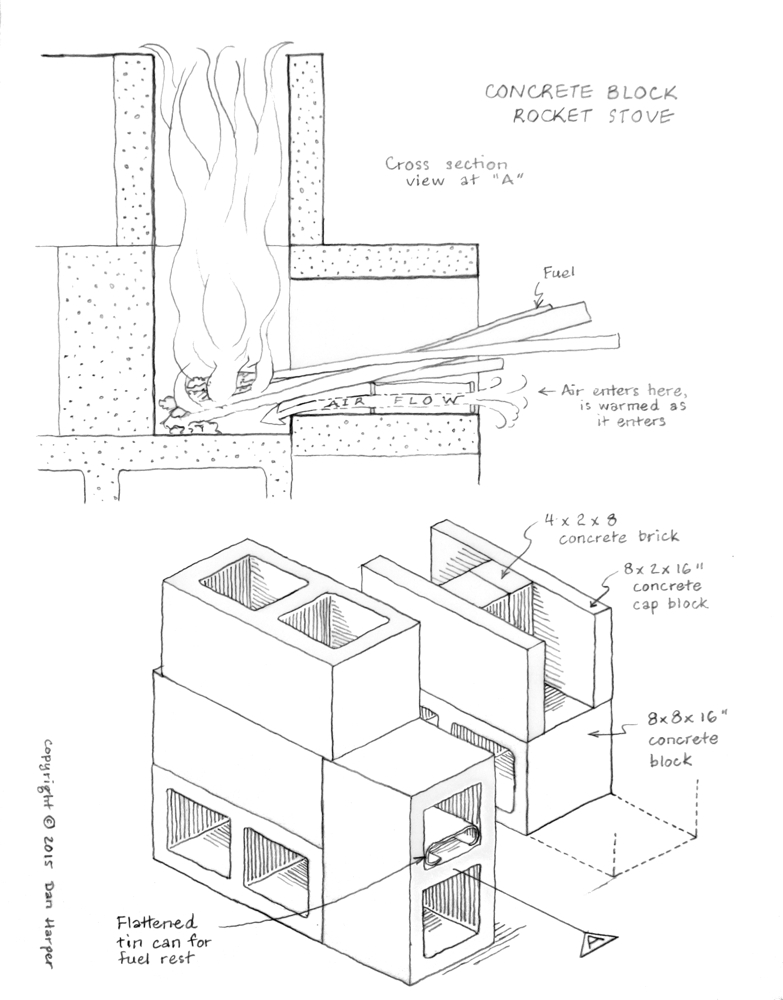
Enough background. Here are instructions for building a concrete block rocket stove, followed by photos of our rocket stove in action:

BlogJan2715a

Click the image above for a drawing of how to build our concrete block rocket stove. You will find other plans for a concrete block rocket stove on the Web, but those plans typically require a concrete h-block, an oddball type of block that we were unable to find. However, most bit home improvement stores carry 8 x 2 x 16 inch concrete cap blocks, and 4 x 2 x 8 inch concrete brick — two cap blocks and two concrete brick can be arranged in an “H” shape to make a stove. In fact, this is a better solution than a concrete H-block, because you can adjust the concrete brick such that you have a constant cross-sectional area throughout the L-shaped combustion chamber (see “Design Principles for Wood Burning Cook Stoves,” principle 7).

BlogJan2715c

Above: The concrete block rocket stove after use. We placed two concrete bricks on the top on which to place cooking implements, etc. The bottom concrete block serves as a convenient place to store fire wood. Notice that our firewood is all salvaged building materials and wood pallets, split to appropriate size for burning.

BlogJan2715b

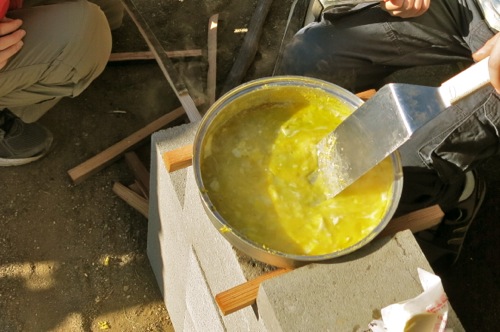
Above: Cooking on the stove. “Design Principles for Wood Burning Cook Stoves” states that a combustion chamber with a 12 x 12 cm cross sectional area is “usually sufficient for a family sized cooking stove.” Our concrete block rocket stove has a cross sectional area of 12.5 x 15 cm. It put out a good amount of heat for cooking scrambled eggs for half a dozen people. Note that one person is feeding the fuel into the stove, while the other cooks — we found it was challenging to cook and tend the fire at the same time.

We did not try to boil water on our concrete block rocket stove, to see how long that would take. Maybe that’s a task for a future class.

Update, one year on: This has proved to be a good, but not excellent, rocket stove design. The chief problem with this design is that the concrete block acts as a fairly large thermal mass, and it takes a while to heat the block. Once the block is warm, the stove functions pretty efficiently; while the block is still cook, it’s not as good. Another problem is that the stove is finicky, and requires constant attention to feeding fuel in order to maintain a fairly constant temperature. Nevertheless, given the low cost of materials, and the ease of construction, this remains a practical design.

REA: Last day of the 2014 conference

BlogNov1214a

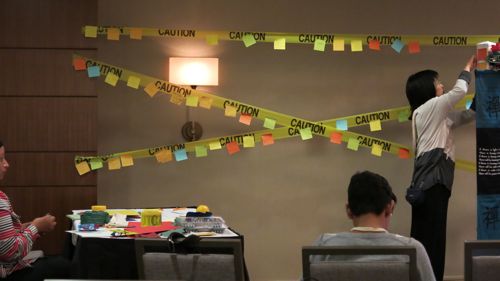
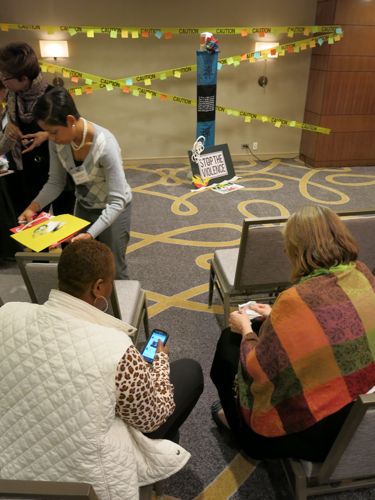
(em>Above: Yes, there were arts and crafts at the Religious Education Association 2014 conference. In keeping with the more interactive approach at the 2014 conference, there were several opportunities for conferees to participate in interactive projects around the topic of unmaking violence. Here, conferees decorate a “peace pole.”

BlogNo1214d

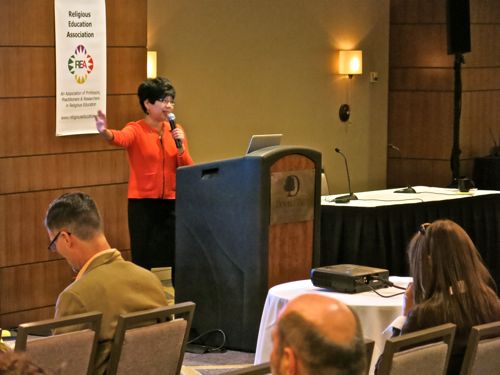
Above: REA president-elect Mai-an Tranh, professor at Eden Theological Seminary, speaking at the final plenary session: wrapping up this year’s conference, and tying this year’s conference topic to next year’s topic. Tranh used Henry A Giroux’s “disimagination machine” as a central theme in her talk.

BlogNov1214c

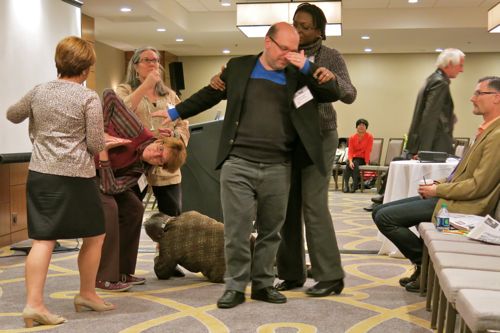
Above: In the final plenary, Evelyn L. Parker of Perkins School of Theology led conferees in an interactive theatre exercise. She invited ten conferees to imagine with their bodies what the “disimagination machine” might look and feel like. Then she invited the rest of us “spec-actors” to disassemble the machine. In the photo above, a conferee is gently removing a piece of the machine.

BlogNov1214b

Above: The close of the conference, just before the business meeting.

REA: Interrupting violence on the ground

The second plenary sessions at the Religious Education Association 2014 conference was devoted to field trips to various locations in Chicago that are working for nonviolence. One field trip was to the a href=”http://www.swopchicago.org/home.aspx”>Southwest Organizing Project (SWOP); a second trip went to the John Marshall Law School Restorative Justice Project. I chose to go to Precious Blood Ministry of Reconciliation (PBMR) in the Back of the Yards neighborhood of Chicago.

At PRMR, we met with Father David Kelly, a Catholic priest affiliated with the Precious Blood missionaries, and three young men who participated in PBMR programs. Father Kelly said that he had been involved with various prison and inner city ministries before helping to organize PBMR. In his experience, he had found that the criminal justice system is primarily adversarial in nature, and that it does not provide any real support to either perpetrators nor victims. And at times he found himself in situations where he had a relationship with both the victim and the perpetrator of a crime — how could he minister effectively to both?

Continue reading “REA: Interrupting violence on the ground”

REA: Teaching about Islam using a worldview framework approach

In the final breakout session at the Religious Education Association 2014 conference, I attended a presentation by Mualla Selçuk of Ankara University and John Valk of the University of New Brunswick titled “Journeying into Peaceful Islam: A Worldview Framework Approach.”

Valk and Selcuk reported on a pedagogical model they used to engage Muslims and non-Muslims in learning about “a comprehensive Islam.” The problem they are addressing with their pedagogical model is pervasive stereotyping regarding Islam. In particular, Islam is stereotyped as violent; as authoritarian, patriarchal, and rigid; as a religion that persecutes other religions; etc.

Sometimes the stereotyping of Islam is subtle, particularly in media coverage of Islam in the west. Media coverage of Islam “often confuses correlation with causation” — if an individual Muslim engages in, say, an act of violence, the act of violence will be attributed to the individual’s religion. Sometimes the stereotyping is not as subtle, as when anti-religious and anti-Islamic discourse cherry-picks elements of Islam (or religion more generally) to “prove” that religion/Islam is bad.

Religious education can be complicit in stereotyping, if it uses a passive passive pedagogical model. It’s not enough to give students information about religion, e.g., disconnected facts (e.g., Muslims pray using certain prescribed body motions), or prescribed answers (e.g., Islam as a whole believes X).

Valk asserted that an appropriate pedagogical model must include an experiential component. He mentioned site visits, meetings with spiritual leaders, human interaction, etc. He added that “personal engagement” is also necessary, i.e., engaging the questions and challenges of Islam: religious, spiritual, science, religion, etc. Valk said that they challenge the learners to think. “So instead of saying, ‘Islam believes in God’,” he said, “We ask, ‘What does it mean to believe in God?’ … Let the students explore the possibilities.”

Valk then outlined their worldview framework for an appropriate pedagogy. This worldview framework has five sub-frameworks, including: personal/group identity;
cultural dimensions;
existentialist questions; etc.
The pedagogy uses a “Socratic” approach of open-ended questions.

Mualla Selçuk, a Muslim, pointed out that Valk is a Christian. Thus the collaboration between them reflects their pedagogical approach. She referred her listeners to their recent article in the REA journal for more information about their work. “This worldview approach to Islam, or I would argue to any religious or secular worldview,” she concluded, “is a valuable resource for religious educators and teachers.”

One questioner asked, “Both your presentations had components of unlearning. Do you have a pedagogical model for this?” While unlearning was not explicitly mentioned in their model, this was something they had thought about.

REA: Ecology and RE

In a Sunday morning colloquium at the Religious Education Association 2014 conference, Miriam Martin of Saint Paul University in Ottawa spoke on the subject “Ecology, Christian Discipleship and the Role of RE.”

When considering environmental problems such as global climate change, Martin said, “We have to recognize that a situation of violence exists.” To unmake violence, she added, first we have to acknowledge “the situation of violence.”

“Violence against against nature is basically predicated on the fact that we have such a deep separation from it and a false sense of disconnect,” Martin said. Just as we justify human violence against other humans by demonizing the “other,” so too human violence against other beings is justified by thinking of other organisms as the “other.”

Therefore, Martin said, we humans must look at ourselves and ask: Who do we say we are? Citing such thinkers as Sallie McFague (A New Climate for Theology, 2008), Elizabeth Johnson (Ask the Beasts, 2014), and Francois Euve (“Humanity Reveals the World,” in Ilia Delio, ed., From Teilhard to Omega, 2014), Martin called for a new theological anthropology.

In thinking about a theological anthropology, Martin reflected on the uniqueness of humankind. The unique ability of human beings to reflect on the whole emergence of the universe story comes with a great responsibility. “Humans are the uniquely responsible animals,” she said.

She came at the issue of responsibility from another angle, turning to recent work by religious Gabriel Moran, who asks: Are humans superior? Moran asserts that we cannot understand differences at higher or lower levels. Moran says there is one place where humans are superior, and that is “we are uniquely responsible.”

In terms of specifically Christian religious education, Martin referred to Sallie McFague, who says we cannot continue to “live in a way that consumes the world’s resources and undermines its most basic systems.” Thus, said Martin, there is not a separation between the damage being done to the poor, and the damage being done to the environment.

So what do we need to do? Martin said that Elizabeth Johnsons’ recent work offers a solution: “[Theology] needs to reclaim the natural world as an essential element both theologically and in practice.” Then, Martin said, we must bring these rigorous theological conversations into wider interdisciplinary dialogue. Finally, as theology reclaims the natural world, this can be brought out through ritual and through the arts. As a partial demonstration of this, Martin closed her presentation by singing one of her songs on the relationship between humankind and the natural world.

REA: Religious literacy, bullying, and RE teaching

In the second breakout session of the Religious Education Association 2014 conference, I attended a combined colloquium. Wing Yu Alice Chan, a doctoral student at McGill University, presented work in progress under the title of “Can Religious Literacy Deter Religious Bullying?” Andrea Haith of Canterbury Christ Church University presented her work in progress under the title of “An Exploration of Religious Education Teachers’ Understandings of Religiously Inspired Violence and the Worldviews of Children in the Classroom.”

Chan presented a definition of religious literacy based on a definition by Diane Moore (2007), the ability to discuss and analyze the intersections o religion with society.

She next defined religious bullying as bullying on the basis of religious difference, including physical and psychological bullying, online bullying, etc. In a review of literature on religious bullying, she found research that indicates that religious bullying gets transmitted across generations. Furthermore, she found research that the aftereffects of religious bullying can lead to religious extremism.

At the moment, her research is focusing on two North American religious literacy programs in public schools: Quebec’s “Ethics and Religious Culture” program, and the “World Geography and World Religions” programs in modesto, California. These are the only two mandatory courses in religious literacy that she found in North America. In her research so far what is most prominent is the role of dialogue.

Her research methodology is outlined in her online prospectus here.

Andrea Haith is a teacher of religious education in the United Kingdom (U.K.). She began by saying that teaching religious education is extremely challenging, as the young people taking the courses “don’t see the point.” It is also challenging because “any discussion of Islam does evoke stereotypes.”

Haith said that the U.K. has complex legislation that implements religious education in the public schools. The challenge then is how to discuss religiously inspired violence within this framework. Her research focuses on the teaching of religiously inspired violence as it relates to religious education teaching more generally.

Her hypothesis is that religious education has become “sanitized,” in part because examination-focused learning outcomes may serve to distort the subject matter of religious education. Her research questions include:

— What is the nature of RE teacher’s understandings of religiously inspired violence?
— How are these understandings translated into teaching practice in the classrooms?
— Is there a relationship between teachers concepts of religiously inspired violence and their pedagogy?

Haith’s research project is outlined online here.

At the end of the two presentations, a questioner pointed out that a key issue is how we train teachers. Haith and Chan both agreed.

Another questioner pointed out that it is problematic to consider religious literacy out of any other context, and that religious literacy must be placed in a values-based context. Haith and Chan seemed less interested in this idea.

I asked a somewhat inarticulate question about the importance of students recognizing their own religious identity. Interestingly, in a later colloquium, I learned about the “worldview framework approach” in Mualla Selçuk and John Valk’s presentation “Journeying into Islam” (more on their research here); Selçuk and Valk’s worldview framework explicitly names religious identity as important.

I would say that I found both Haith and Chan’s research to be of great interest and importance. Chan’s research into the relationship between religious literacy and religious bullying could be especially valuable.