From a story by Fiona Murphy titled “How ‘RaptureTok’ amplified an extreme corner of faith” (Religion New Service, 26 Sept. 2025). The story documents how minority religious views are often mocked and belittled on TikTok….
“Heidi Campbell, director of the Network for New Media, Religion and Digital Culture Studies at Texas A&M University in College Station, said that since 2016, online discourse has shifted toward what she calls a ‘performance of meanness.’
“‘The screen has allowed us to broadcast so much more diversity, which can be a positive thing,’ Campbell said. ‘But instead of bringing us closer together, which a lot of internet prophets and cyber philosophers kind of said in the 1990s, it’s actually brought more division.’”
In the June 14 issue, The Economist reports that the decline of organized religion has seen a mild reversal since COVID. In 2023-2024, according to this report, three different surveys show a decline of “Nones,” those who report no religious affiliation, by four percentage points.
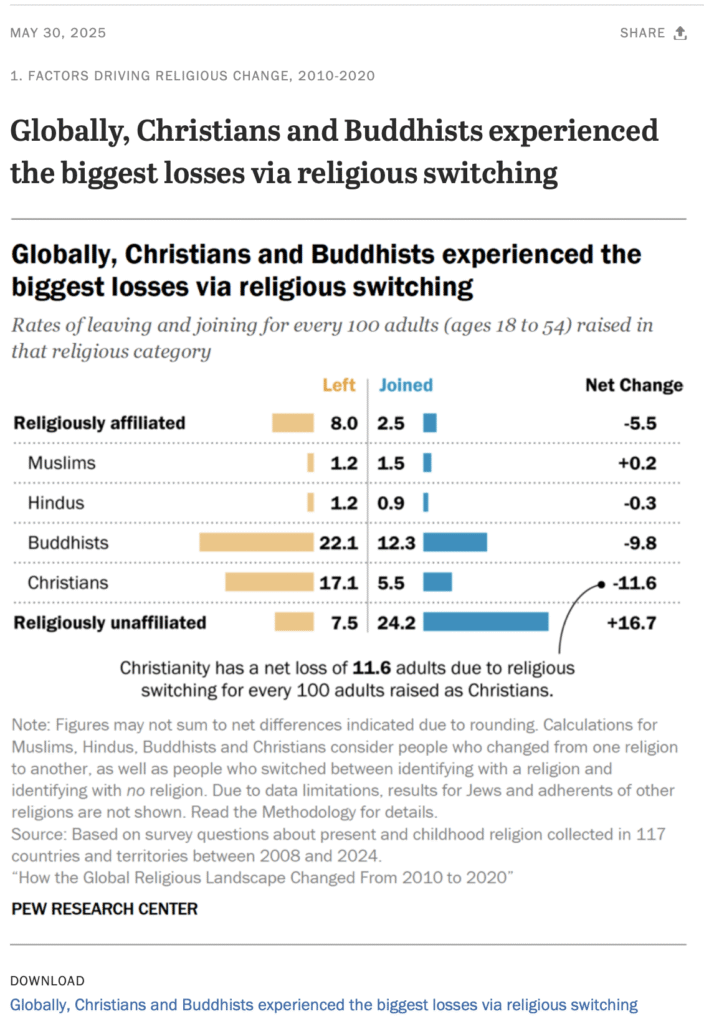
Screenshot of web page with the infographic by Pew Research showing global percentage losses over five major religions, plus gains by the religiously unaffiliated. Click on the image above to go to the original.
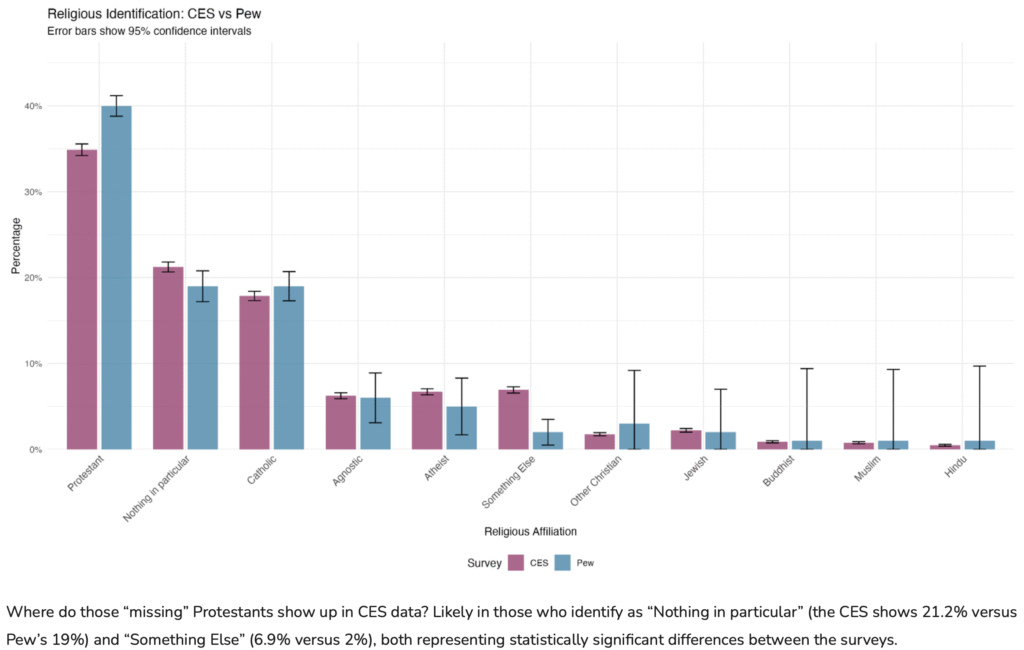
The Cooperative Election Survey (CES), housed at Harvard University, also asks questions about religion, and serves as another good source for data on religious affiliation. The CES tracks the Pew Research surveys within a few percentage points. But there are some curious differences. CES finds 5.1% fewer Protestants than Pew does. There’s also a significant gap in those reporting as “Something else” — which is probably what many Unitarian Universalists would report themselves as.
Screenshot of web page with infographic showing differences between CES and Pew. Click on the image above to go to the original.
Also of note — in my view, both CES and Pew define “religion” in such a way that Christianity serves as the paradigm, which may not capture the religion of, say, Unitarian Universalists who strongly identify with their religion yet don’t believe in God, don’t pray, and don’t feel the need to attend regular worship services. If you don’t assume that religion centers around Christian-style belief in God and attendance at church, then social atomization and disaffiliation (as reported, e.g., by Robert Putnam in his book Bowling Alone) might be the stronger factors driving so-called secularization.
The Economist does report one possible explanation for the slight increase in religious affiliation from 2022 to 2023:
“The most plausible explanation for the changing trend is the covid-19 pandemic. Lockdowns, social isolation and economic shocks affected almost all countries and age cohorts at about the time the data on religious belief hit an inflection point…. Research by Jeanet Sinding Bentzen, an economist at the University of Copenhagen, shows internet searches for prayer and other religious practices shot up in alsmot every country in 2020. Pippa Norris of Harvard and the late Ronald Inglehart argued that in times of existential insecurity, people tend to turn to religion for comfort…. Ms. Bentzen’s previous research on devotion following earthquakes — a different sort of shock — shows that religiosity tends to remain elevated for up to 12 years after a catastrophic event.”
Time will tell if we’re actually seeing a slight decline in “Nones,” or if this is just a temporary blip. As a Unitarian Universalist, I’m also less worried about secularization — after all, by many definitions we’re already secular — and far more worried about social atomization and disaffiliation. We don’t have to convince people to believe in God. We only have to convince people that being part of a values-based community is a good thing.
One hundred days into Donnie Trump’s second reign — er, second term — which religious groups approve of him most?
No surprise — Trump continues to have high approval ratings among White evangelicals. In a recent poll, Pew Research found that 72% of White evangelicals approve of King Donnie — er, President Trump.
Here are the approval ratings for other religious groups in the Pew poll:
72% — White Protestant Christian, evangelical
51% — White Protestant Christian, not evangelical
51% — White Catholic Christian
40% — All US adults
26% — Hispanic Catholic Christian
26% — Religiously unaffiliated
10% — Black Protestant Christian
I was a bit surprised that these approval ratings are very similar to Trump’s first term. In their report, Pew Research says: “Both among the U.S. public as a whole and among major religious groups, Trump’s current approval ratings are on par with what they were around the same time in his first term (April 2017).”
Not surprisingly, White Evangelicals support Trump’s extensive use of executive orders — 53% of them feel that Trump is doing about the right amount by executive order. Only 27% of White evangelicals think Trump is doing too much by executive order, 15% are unsure, and 5% feel he’s doing too little by executive order.
I’d be jumping to conclusions if, based on this one survey, I said that White evangelicals are OK with a president who’s seems to be trying to operate like a king. But I’m keeping that in mind as a possibility.
“‘On February 29, 2024, counsel for the SBC Executive Committee was informed that the US Attorney’s Office for the Southern District of New York has concluded its investigation into the EC with no further action to be taken,’ Jonathan Howe, Executive Committee interim president and CEO, told Religion News Service in a text….”
“‘The lead investigator from the DOJ concerning this investigation was as surprised as we were by these reports. She answered both Megan [lively, another abuse survivor] and I immediately when we called (separately) and said the investigation is very much open and active,’ Thigpen told Religion News Service in a text….”
The DOJ is unable to comment publicly about ongoing investigations, so they refused to comment to Religion News Service. The fact that they can’t comment is in itself revealing. And on March 7, Baptist Press reported that SBC legal counsel has confirmed that the investigation is ongoing.
Obviously, this is a bone-headed move on the part of SBC leadership. But the rest of us can learn from this. The main takeaway — learn from Yogi Berra that it isn’t over till it’s over. So don’t do any victory laps until it’s actually, really and truly, finally over.
According to a Religion News Service article, the Episcopal Church has beefed up its procedures for reporting clergy misconduct:
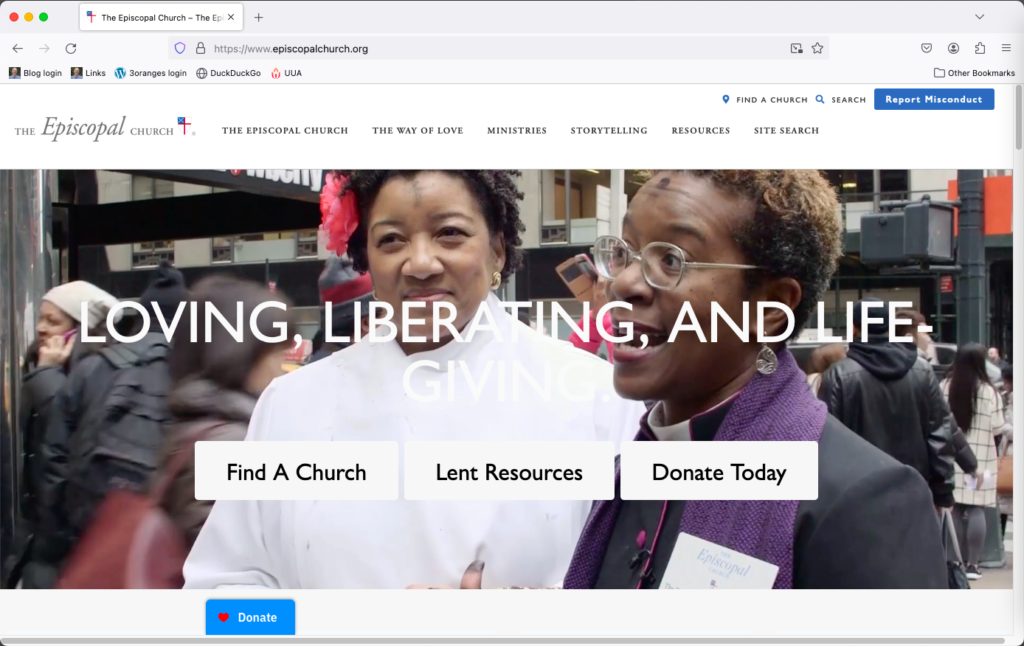
“A blue ‘Report Misconduct’ button now appears in the top right corner of the Episcopal Church’s homepage. The button leads to an informational page on Title IV with a step-by-step breakdown of Title IV processes involving bishops and a link to report bishops.”
Good for the Episcopal Church for making it easier to report misconduct. Here’s a screenshot showing the blue misconduct button:
Mind you, it’s not perfect. When you view the website on your phone (and half of all web use is now from phones), the blue misconduct button disappears into a menu.
But it’s a heck of a lot better than the UUA website, where it’s quite difficult to figure out how to report misconduct.
Like the Southern Baptists, we Unitarian Universalists (UUs) have a history of sex abuse. (Nor are we alone: nearly every American institution, from schools to sports to health care to entertainment, has its own history of abuse.) I’ve mostly heard allegations about male UU ministers and lay leaders targeting women over the age of 18. But I’ve also heard allegations about powerful men targeting legal minors.
And like the Southern Baptists, we have a decentralized structure. Each local congregation is theoretically autonomous. If a local congregation wants to hire a minister who’s known to have a history of abuse, there’s no way to stop them.
From today’s news story, it appears that the Southern Baptists have used their decentralized structure to avoid taking responsibility for dealing with their sex abuse crisis:
“…Southern Baptist leaders boast of their power to spread the gospel but take little responsibility when things go wrong. And local congregations have little power to fix things that are broken on a national level. ‘The beauty of SBC is that we’re local and autonomous,’ said Adam Wyatt, a Mississippi pastor and member of the SBC Executive Committee, recently. ‘The challenge is, we’re local and autonomous.”
A lawsuit against Paul Pressler, one of the most powerful Southern Baptist leaders over the past fifty years, alleges that Southern Baptist leaders might talk about local autonomy, but they have also been evading responsibility.
This is what we Unitarian Universalists can learn from the Southern Baptists. We, too, like to talk about the autonomy of local congregations. To what extent do we (and I mean all of us) use local autonomy as an excuse to evade our responsibility to protect against sex abuse?
I think we Unitarian Universalists have made more progress at dealing with sex abuse than have the Southern Baptists. But we have lots more work to do before we really address the problem. At least we can learn from the Southern Baptist debacle that local autonomy is no excuse.
An article in today’s Boston Globe by Dana Goldstein, “New school laws have unintended consequences in Fla.: bureaucracy,” reports on unintended consequences of Florida’s “Parental Rights in Education Act.” The Globe picked up this article from the New York Times, which ran it on Wed., Jan. 10 — here’s a free version of the article.
Under Florida’s new law, many school districts are now requiring permission slips for what used to be routine matters. For example, some school districts are now require permission forms for putting a band-aid on a child, because the new law requires that parents be able to opt out of health care services for their children.
The result, according to Goldstein, is increased paperwork: “Educators across the state say recent laws and regulations around parental consent have created an entirely new bureaucracy, filled with forms and nagging phone calls to parents.” Goldstein goes on to report: “While no state has gone as far as Florida with parental consent requirements, dozens of states are considering bills inspired by Florida’s laws.”
I don’t expect many new laws requiring parental consent for religious education programs. Nevertheless, one result of law like this is that parents are coming to expect to be allowed to exercise more granular control over their children’s experiences. Congregations are going to have to be increasingly sensitive to parent expectations — and congregations are going to face an increasing paperwork burden as they track parent consent on a widening range of matters.
One key finding in this report is that in the aftermath of the panedmic, the number of congregational clergy who are both considering leaving their current position and who are thinking about changing careers keeps increasing. We’ve been seeing some of this in Unitarian Universalism — I personally know of several UU ministers who have not only left their congregations, but who are now transitioning to a new career.
I participated in this study — I have no idea how they found my email address, but they sent me the survey forms and I filled it out. Now that I see the results of the report, it turns out that I’m in the minority of clergy who still love their jobs and who have no intention of leaving ministry.
But the fact remains that many other clergy are leaving the profession. It remains to be seen what effect this has on organized religion. Will it have a positive effect, in that new clergy come along whose expectations for the profession are more aligned with the new realities of congregational life? Will it have a negative effect, by reducing the pool of qualified ministers such that too many congregations can’t find qualified leadership? Or something else entirely?
Let’s start with how others perceived us this past year. Unitarian Universalists are a tiny, tiny group, but we made the news with four stories this year. I’ll start with the lesser stories, and save the big one for the end.
1. Religion News Service (RNS) covered the annual General Assembly of the Unitarian Universalist Association (UUA) back in June, and wrote about two main stories. One story, with the headline “Unitarian Universalism revisits identity, values at 2023 gathering,” talked about the proposed revision to ARticle II of the UUA bylaws. It was the kind of article where you felt the reporter was working pretty hard to make it sound newsworthy. Revising bylaws isn’t going to be of much interest to non-Unitarian Universalists.
2. RNS was much more interested in the fact that the “Unitarian Universalists elect first woman of color, openly queer president,” especially considering the fact that this new president was taking over from the first woman who served as president. They wrote (by my count) four separate articles on this basic story.
It’s been an eventful year, both for U.S. organized religion generally, and for Unitarian Universalism in particular. In this post, I’ll start by reviewing some of the key developments in organized religion in the U.S. In a second post, I’ll review some of the explosive developments within Unitarian Universalism.
1. Culture wars and religion
Religion is right at the center of the ongoing escalation of the culture wars in the United States. And the role of religion in the culture wars has gotten more complex than ever. To try to make sense out of it all, I’ll consider some of the culture wars battlegrounds separately.