Ecojustice Camp, year four

Friday was the last day of Ecojustice Camp. This is the fourth year our congregation has sponsored this camp, and each year has been more fun than the last (from the adult leader point of view).

On the plus side, the overnight camping trip went far more smoothly this year; we firmed up the curriculum and added some new camp songs that both campers and adults loved; and we were better about integrating age groups. For the finances, I’m still waiting for all expenses to be submitted but I’m projecting that we’ll run a modest surplus again this year (the surplus provides start-up funds for the following year).

On the negative side, camp took it out of me this year: camp typically means a ten-hour day for me, and my regular duties as a minister get piled on top of that; that’s usually not a problem for just one week, but this year I haven’t fully recovered from some health issues, so I’m pretty well tuckered out. Having said all that, I felt it was completely worth it — it wasn’t just the campers who had a great camp experience, we adults did too.

Above all, it feels like this kind of camp is critically important in today’s world. It’s important to teach kids to enjoy the outdoors, while not shying away from the intertwined issues of environmental justice, racism, sexism, consumerism, etc. I don’t think there’s much hope for the world unless we teach First World kids how to love Nature, and how to save it from ruin.

Above: 6 a.m hike on the Ecojustice Camp overnight. Not many of the campers got up to go on this hike, but those who did had a blast.

Arjuna’s Choice

A story from a series for liberal religious kids; this story comes from the Bhagavad Gita.

Once upon a time, two armies assembled at the Kuru Field. On one side was the army of Yudhishthira [Yut-ish-tir-ah], who was the nephew of Dhritarashtra [Dri-tah-rahsh-trah], the great blind King of the Kurus. On the other side was the army of Duryodhana [Dur-yo-tahn-ah], the eldest of Dhri-tarashtra’s hundred sons. Twenty years before, Dhritarashtra had decided to give his kingdom to his nephew Yudhishthira, instead of to his son Duryodhana; for he knew that Duryodhana was wicked and selfish.

———

As the battle was about to begin, great heroes, their bows and arrows at the ready, stood in their chariots behind their charioteers, who were busy controlling the horses pulling each chariot. Other great heroes also stood at the ready, armed with many different kinds of weapons, each of them skilled in war. (In those days, in that place, only men fought wars, so everyone there was a man.)

Ajuna was one of the heroes who stood in in chariots. His was a large and fine chariot, pulled by magnificent white horses who were driven by a skilled charioteer.

Suddenly, somewhere a warrior blew on a conch shell, making a loud and terrifying sound, to signal that the battle was to begin.

Other warriors took out their conch shells and blew them. Still other people beat on drums and cymbals, and blew loud horns. All this made an incredible noise which sounded over all the earth, up into the sky, making everyone’s heart beat faster.

Someone let loose an arrow, and other warriors responded by shooting their own arrows.

At exactly this moment Arjuna said to his charioteer, “Drive the chariot in between the two armies. I want to look at all these warriors standing eager for battle, those people I’m about to fight.”

His charioteer drove the chariot out in between the two armies. The sound of the conch shells, the sounds of the drums and horns, was just dying away. The two armies are about to join in battle.

Arjuna stood in his chariot, alone in the middle of the field, all prepared to fight. As he looked across the field, he recognizes many of the people in the other army—uncles, teachers, cousins, and friends of his. He saw fathers who had sons in his army, and brothers who were about to fight brothers in his army.

Arjuna thought to himself: “Here are friends and relatives on either side of Kuru Field, about to try and kill each other. This does not make sense.”

Arjuna turned to his charioteer and said, “My mouth is dry and my mind is whirling. I feel that we are about to do a bad thing. What good can come of it if brothers kill brothers, if fathers kill their sons? I feel it would be better if did not fight at all, and simply let the other side kill me.”

Arjuna could not decide what to do next. Should he throw down his weapons and let the other side kill him? Should he go forward and kill his friends and relatives? He did not like either choice, yet he must do something.

And his charioteer turned around, and gave him an unexpected answer….

To Be Continued….

Source: Chapter 1, the Bhagavad Gita

Story book

Over the years on this blog, and on its predecessor, I’ve published a number of stories for liberal religious kids.

You can now locate these stories using the tag “story book”:
link to “story book” tag on this blog
link to “story book” tag on the old blog

Additional stories for liberal religious kids appear in thre curriculums I’ve written; some of these stories are revised versions of the stories found on my blog:
Greek Myths
From Long Ago
Beginnings

Denominational leaders shooting themselves in the foot

It was just over a year ago that my denomination was engulfed in conflict due to a denominational leader’s insensitive remarks. Looking back, I still feel embarrassed by that moment — not that anyone else in the world cares what my tiny denomination does, but still, no one likes having denominational stupidity on view for all the world to see.

With that in mind, and in a spirit of utter humility remembering all the other stupid things my denomination has done, it’s kind of a relief to read about another, much larger, denomination having its own moment of embarrassment. An article in Christianity Today (which I learned about from John Fea’s blog post) tells the story of Paige Patterson, one-time president of the Southern Baptist Convention (SBC) and current president of an SBC seminary, and Paul Pressler, an SBC layperson. Back in the 1980s, Patterson and Pressler were the architects of the “Conservative Resurgence” within the SBC. Now Pressler faces allegations of sexual assault, and Patterson allegedly assisted in a cover up.

It’s an ugly story, almost as ugly as our own Unitarian Universalist Forrest Church episode. And before you say that this sort of thing implies that we should do away with organized religion, may I remind you of the sexual misconduct of Jerry Sandusky and Bill Cosby, so if we’re going to do away with organized religion we also need to do away with organized sports and the entertainment industry. And sadly this kind of argument does lead many religious progressives to claim that we should do away with all organized institutions, because (so goes the reasoning) human institutions are the locus of the problem. As if we can separate individual human begins from society. As if human society without any organized institutions would put an end to sexual assault. So let’s just stop those silly arguments, shall we?

Instead, this story about Paige Patterson and the SBC offers a chance to reflect on the fact that we human beings screw up regularly. Instead of being shocked when human beings screw up, it is wiser to accept regular screw-ups as a fact of life, to acknowledge that any one of us can (and probably will) screw up, and to make sure we build into our human institutions processes for dealing with screw-ups. I suppose it seems more glamorous to get all indignant when other people screw up, and flood social media with that indignation — but while maintaining and strengthening institutional processes is far less glamorous, I promise you it’s more likely to bend the moral arc of the universe towards justice.

Bioregional quiz

In the Winter, 1981, issue, the editors of the magazine Coevolution Quarterly published “Where You At? A Bioregional Quiz,” developed by Leonard Charles, Jim Dodge, Lynn Milliman, and Vitoria Stockley (you can find this quiz online here). The quiz was later republished in the book Home: A Bioregional Reader (New Society, 1990). Since then, others have modified the quiz; most notably, in 2006 Kevin Kelly posted a revised version of this quiz titled “The Big Here” on his blog.

As much as I like the original version of the quiz, some of the questions are specific only to certain bioregions, such as “What spring wildflower is consistently among the first to bloom where you live?” — if you live in a region where flowers bloom year-round, there is no good answer to that question. And some of the questions are maybe too difficult, such as “Name five grasses in your area” — I’ve been trying to learn how to identify grasses down to the species level, and it’s very challenging. A couple more things bother me about the quiz. First, the quiz focuses too much on book knowledge; you are merely asked to “Name five resident and five migratory birds,” you are not asked to identify them in the field. Second, the quiz ignores whole clades of organisms that would have been familiar to indigenous peoples, such as invertebrates and non-vascular plants.

So I’ve been thinking about how to revise the quiz. I wanted to create a quiz that would prompt me to learn more about my watershed, and to encourage me to get outdoors and explore that watershed. The first draft of my quiz appears below. How many answers did you get? What did I leave off that I should have included?

Continue reading “Bioregional quiz”

Mindfulness and the elite

From my files: Three years ago, the New York Times Magazine published an article by Virginia Heffernan on the craze for mindfulness (“Mind the Gap,” 19 April 2015, pp. 13-15). Citing a Time magazine cover story that called the craze a “revolution,” Heffernan comments:

“If it’s a revolution, it’s not a grass-roots one. Although mindfulness teachers regularly offer the practice in disenfranchised communities in the United States and abroad, the powerful have really made mindfulness their own, exacting from the delicate idea concrete promises of longer lives and greater productivity. In January [2015], during the World Economic Forum in Davos, Switzerland, [mindfulness popularizer Jon] Kabat-Zinn led executives and 1 percenters in a mindfulness meditation meant to promote general well-being.” But, notes Heffernan, “what commercial mindfulness may have lost from the most rigorous Buddhist tenets it replaced: the implication that suffering cannot be escaped but must be faced.”

Three years on, mindfulness is even more firmly entrenched among the elites. I recognize that there are serious Buddhist practitioners out there who teach authentic Buddhist mindfulness practices, and I also recognize that there are those who use mindfulness-stripped-of-Buddhism for benign ends. But when I think about how the 1 percenters have adopted mindfulness, I am curious about how it became so widespread among the “cultured despisers of religion.” Is the ongoing craze for mindfulness an example of how consumer capitalism can strip all the authentic weirdness out of religion, turning authentic religious practices into “opiates for the masses”? Or is mindfulness similar to the Christian “Prosperity Gospel,” that is, authentic religious teachings co-opted to promote consumer capitalism? except where the Prosperity Gospel is used to control lower middle class suckers, Prosperity Mindfulness is to control professional class suckers.

I am also curious whether authentic Buddhist mindfulness will survive being co-opted by the 1 percenters and consumer capitalism. What Heffernan calls “commercial mindfulness” really is nothing but an opiate: a pill that numbs us to the stress and horror and absurdity of an increasingly unjust economic system, but doesn’t actually cure the underlying illness of injustice.

To paraphrase Morpheus in the movie The Matrix: “If you swallow the blue pill of mindfulness, you wake up in your bed and believe whatever you want to believe; but if you take the red pill of skepticism, you can see the wool that has been pulled over your eyes to blind you from the truth….”

Amar Chitra Katha

Someone in our congregation lent me a copy of a comic book biography of the life of Guru Nanak, the founder of Sikhism. Aimed at middle readers, I think it would work for older kids (and adults) too — a concise, easy-to-understand summary of Guru Nanak’s life and principles.

That comic book is published by Amar Chitra Katha, a publisher with over 400 comic books on hand, with titles like “Guru Nanak,” “Buddha,” “Buddhist Tales” and “More Buddhist Tales,” “Kalidasa,” and “Rabindranath Tagore” (the Nobel prize winning poet much beloved of mid-twentieth century Unitarians).

The one I really want to get is the forthcoming title “Valiki’s Ramayana,” a 960 page graphic novel treatment of the Ramayana. Most of us in the West know far too little about this major Indian religious work — and most of us aren’t going to read the full Ramayana, so I’d love to structure an adult education course around this graphic novel.

Amar Chitra Katha has lots of comics that would work great for children and youth, too. They have a U.S. branch, so the prices are pretty reasonable.

Game development

In our congregation, we decided we need to pay more attention to resources that can support the curriculums. We want resources that are fun for kids, don’t feel like weekday school, don’t require any teacher preparation, and support the learning that takes place in the regular curriculums.

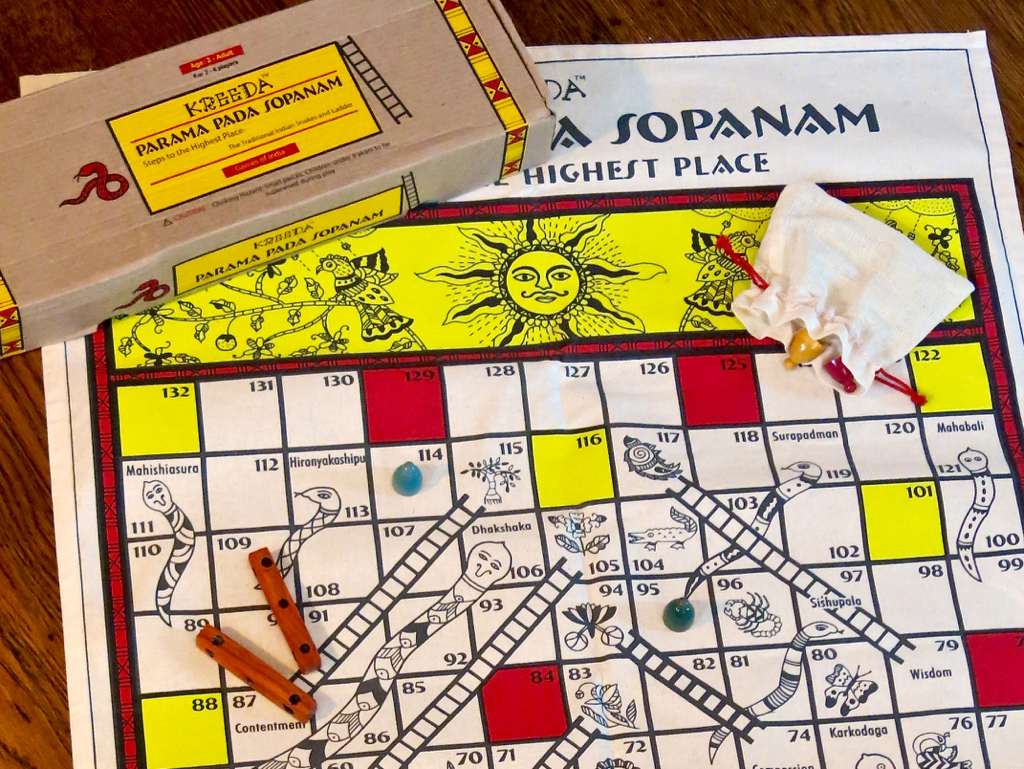
Like, for example, board games and card games. We already use a couple of board games in our Sunday school: (1) Wildcraft, a cooperative board game that teaches about herbs, supports some of our ecology courses; and (2) Moksha Patam, a board game that simulates karma, rebirth, etc., supports one of our world religions curriculums.

Ideally, we’d like to have one relevant board game per quarter per age group that we can give to teachers. And while we were talking this over in the curriculum review committee, I started dreaming up a card game about Moses leading the Israelites to freedom across the wilderness. Then I had a day of study leave today, so I could prototype this game, provisionally called: “Exodus, The Card Game.”

The game borrows its basic structure from the classic card game Mille Bornes (if you don’t know Milles Bornes, it will be easier to understand this blog post if you first read the Wikipedia article).

Although I’m borrowing the basic structure of the game from Mille Bornes, there are significant differences. Mostly, Exodus is a faster-paced game, more suited to the short time allotted to Sunday school classes. And I had to make other changes to fit the narrative of the book of Exodus — I wanted to make sure that as you play you get some sense of the narrative of Exodus…such as the fact that G-d released fiery serpents that attacked the Israelites, but then G-d told Moses to make a brass serpent that would heal serpents bites (Num. 21:6-8). Before researching this game, I didn’t even remember about the fiery serpents. It’s a pretty strange thing to include in the narrative, and one of my learning goals (and part of my theological interpretation) for Exodus, The Card Game is to help kids understand that the story of Exodus is pretty weird. It’s not trying to be an accurate historical account, nor is it some kind of scientific explanation — rather, it is a narrative filled with fantastical elements that reveal G-d’s character.

My other big learning goal and theological component for the game is, not surprisingly, to give some understanding of G-d’s character. First and foremost, G-d is not all kittens-and-rainbows, as for example when G-d sends the fiery serpents to bite the Israelites. Second, G-d does not follow human logic and is ultimately unknowable by humans; this is symbolized for the Israelites in part by spelling G-d’s name without vowels: “YHWH” (this idiosyncratic spelling is retained in the game in the English name for G-d). Third, while G-d is not omnibenevolent, G-d does want justice for humans and for the land; this theological interpretation of G-d’s character is communicated by the social justice flavor of the G-d Given Right Cards. A lesser fourth point is that G-d’s power do have some limits to them; G-d is not wholly omnipotent. So it is the game tries to help the players get a small sense of G-d’s character.

If I ever put the game into production, I’ll let you know how you can get a copy….

Update 4/14/18: Major revisions to game rules and narrative now complete. I won’t revise this post any more; any future rules revisions will be incorporated into the production game (if it’s ever put into production).

Update 9/7/18: The game is now available as a professionally-produced card game, so I’m removing the outdated rules and card designs. To see the final game, click here.

Define “human”

What does it mean to be human? It is the fashion in liberal theology today to state that humans are embodied beings; we are not just some disembodied soul temporarily trapped in flesh; rather, you can’t separate our being from our flesh. If you want to leave any transcendent reality out of this definition, you might wind up defining humans as the entirely biological product of evolution; extreme versions of this would say that humans are nothing more than DNA that wants to replicate itself.

Now consider the fact that less than half of the cells in your body carry your human DNA. In article posted today, the BBC reports on the latest research about the human microbiome; latest estimates hold that only 43% of the cells in your body carry your DNA; the rest are “bacteria, viruses, fungi and archaea.”

This would imply that to be an embodied human means, not that you are a solitary organism, but rather you are an ecosystem. In fact, the boundaries of your ecosystem may be less well defined than you have thought. Indeed, the latest thinking in medical science is that we might want to begin monitoring the information stored in the DNA of all those organisms. The BBC quotes Rob Knight, professor at the University of California San Diego:

“It’s incredible to think each teaspoon of your stool contains more data in the DNA of those microbes than it would take literally a ton of DVDs to store. At the moment every time you’re taking one of those data dumps, as it were, you’re just flushing that information away.”

“Data dumps”? Ah yes, the Brits do seem to find ways to include poop jokes where you least expect it. But seriously, this seems to bring us back to that older definition of what it means to be an embodied human, but with a twist: to be an embodied human is still to be a collection of information encoded on DNA; but now there’s a lot more information, not just from humans but also from archaea, bacteria, viruses, etc.

What’s killing Sunday school

A follow up to this post.

If Sunday school is going to die, what’s going to kill it? Let’s look at four social and economic factors that are leading to declines in U.S. Unitarian Universalist Sunday schools — and when I talk about decline, I’m talking about decline in enrollment, decline in attendance (which differs from enrollment), decline in interest among children and teens, and decline in interest among adults.

(1) The biggest single demographic factor affecting Sunday school enrollment has to be increasing diversity in the U.S. population. The majority of Unitarian Universalist congregations remain racially and ethnically segregated. That segregation may result from one or more of several causes: (a) Many Unitarian Universalist congregations are located in racially homogenous municipalities, typically upper middle class white towns that have the political power to keep people of color out. (b) Power structures in many Unitarian Universalist congregations are dominated by older white people who remain uncomfortable with the increasing racial diversity of the world around them, and enforce the whiteness of their congregations through a variety of means, including so-called microaggressions, blindness towards their congregation’s biases, talk about how “those people” wouldn’t want to be Unitarian Universalists because they’re all Catholics, or all Buddhists, or what have you; and still other means beyond these. (c) The way Unitarian Universalist congregations tend to imagine diversity primarily in terms of a white congregation adding a few black members, thus ignoring the stunning racial, linguistic, and ethnic diversity of much of the country, including the incredible diversity of people who are lumped together as “Hispanic” and “Asian,” and also including the way that some racial or ethnic groups get obscured by overly broad categorizations (such as Lusophones who are lumped in with Hispanics, or the treatment of “blacks” as a monolithic ethnic group).

For many people, our workplaces, schools, and community groups all have some racial and ethnic diversity. Thus, a parent who walks into a Unitarian Universalist congregation that is overwhelmingly white — and this includes a white parent — is going to feel that this is a strange place, and maybe a place they don’t want their children to be part of.

How can we address this demographic factor? Continue reading “What’s killing Sunday school”