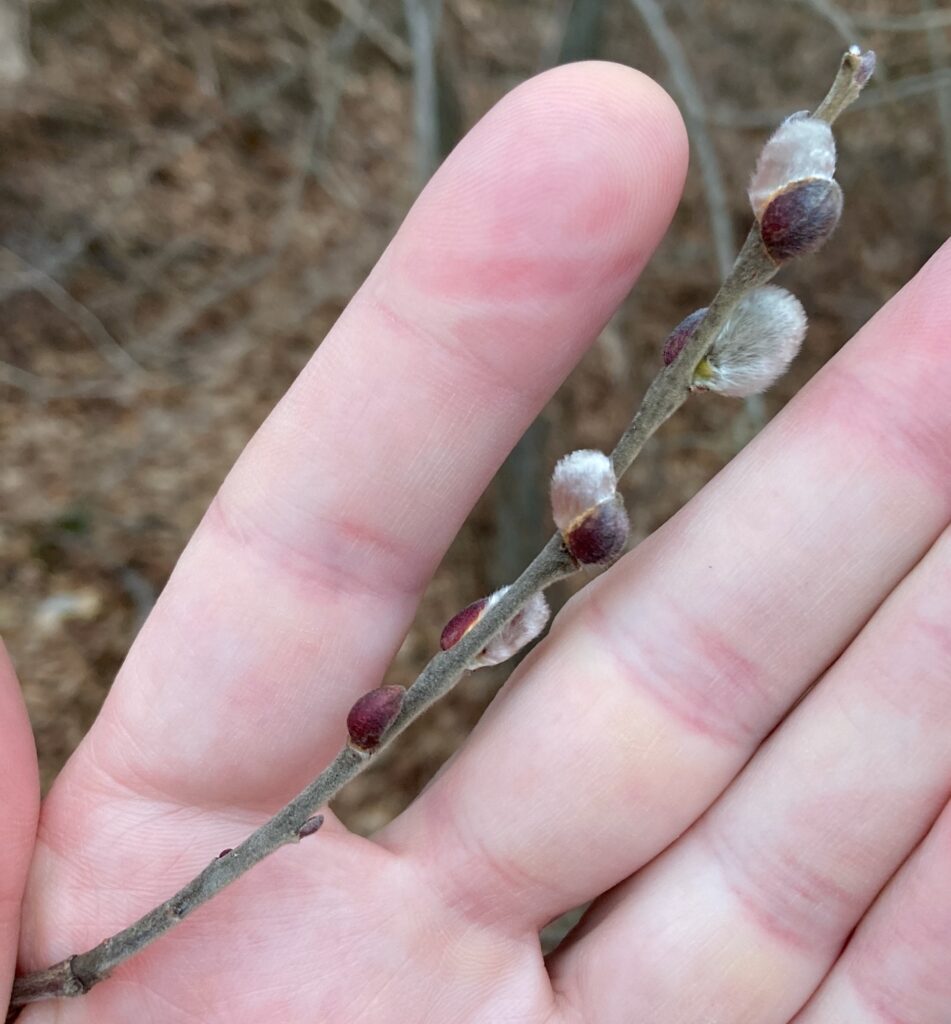
On my Sunday afternoon walk, I came across a small tree covered with little gray catkins just coming out on some of the twigs. We always called these Pussy Willows, presumably because the trees look like willow trees (Salix sp.), and the small emerging flower clusters, true to their name, look like small furry cats. This is the second native plant I’ve seen in bloom this spring.
As to what type of willow tree this is, I have no idea. Flora Novae Angliae states, “Salix is a difficult genus that displays tremendous phenotypic plasticity.” Meaning it’s hard to identify. Not counting hybrids, there are something like 19 species of willow that grow in Massachusetts, one of which is known by the common name Pussy Willow (S. discolor). But when I tried to follow the “Key for carpellate reproductive material” in Flora Novae Angliae, I got stuck at terms like “Decorticated wood” and “Ovaries glabrous.” If I spent enough time, I could look up all these terms and follow the key. But I think I’ll just call this Salix sp. until I learn more of the technical terms in botany.
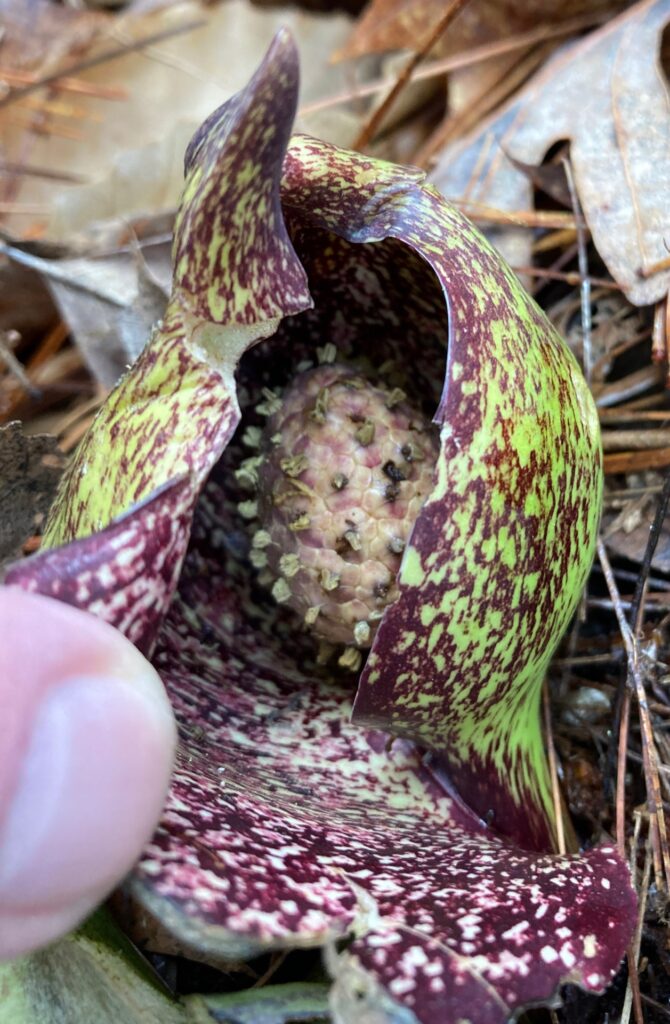
I went for a walk at the Norris Reservation in Norwell, Mass., today. Walking around Gordon’s Pond, I saw Skunk Cabbage (Symplocarpus foetidus) beginning to sprout. Perhaps two dozen tightly curled green and purple spathes dotted the ground on either side of the boardwalk. One of the spathes had opened, revealing the spadix inside, with tiny little flowers blooming on it. This is the first native flower I’ve seen since the Witch Hazel bloomed in December.
Yesterday’s post on the different ways white people, and people of color, respond to charismatic megafauna and mesafauna got me thinking about a recent post by Desireé Melonas at the Blog of the APA. She went to Africatown, in Mobile, Alabama, as part of a group that received a grant to develop environmental justice curriculum materials for students living and going to school in Africatown. Why environmental justice curriculum? Because Africatown is another example of how communities of color and working class communities find themselves dominated by polluting industries.
In this blog post, Desireé Melonas reflects on her first impressions upon visitng Africatown: “…both Vince and Roald [other members of her group] commented on Africatown’s distinct soundscape. In a sort of astonished tone, Vince told of how the community is blanketed by what felt like an eerie absence of sound; no birds could be heard, a sound many of us are perhaps so inured to hearing that we take for granted what about our communities their being there signifies. This sonic experience Vince described paradoxically as ‘suffocating,’ a fitting term given the connection here between the existential experience and the literal source of the sonic absence.”
The lack of birds and other wildlife is a direct result of the toxication of Africatown by the industrial plants sited there, operated by such major manufacturers as the Scott Paper Co., International Paper, etc. So not only are the residents of Africatown experiencing higher levels of cancer from the toxication, they also have to deal with a “suffocating” soundscape.
This reminds me of another aspect of toxication.
Lichens are sensitive to air pollution, and are actually an effective way to monitor air pollution. I experienced some of this when we lived in San Mateo. When we lived downtown next to the train station, in a white minority neighborhood, there were no lichens growing anywhere in our little yard; this should have been no surprise, since we lived two blocks from the train line, right next to a major bus route, a few block from Highway 101, and not far from the usual landing route for jets into SFO; while the air pollution wasn’t terrible (not as bad as in Africatown), it was omnipresent. Then we moved just two miles away, up the hill into the old caretaker’s cottage owned by a nonprofit cemetery (who rented to us at below market rates). The surrounding neighborhood was quite well-to-do, and quite white. Quite a few lichens grew in the cemetery, because the air was a lot cleaner; and, no surprise, I stopped getting bronchitis as often as before. Now we live in Cohasset (which is very white), where there are lots of lichens growing everywhere, and not only have I not gotten bronchitis this winter, but my allergies aren’t as bad as they were a couple of years ago.
So an area that lacks lichens will have enough air pollution to cause noticeable negative health effects. An area that lacks birds is seriously polluted, with major negative health effects. While we don’t need to be sentimental about charismatic megafauna and mesafauna, a lack of such animals in a residential area might be telling us something about the level of toxication there.
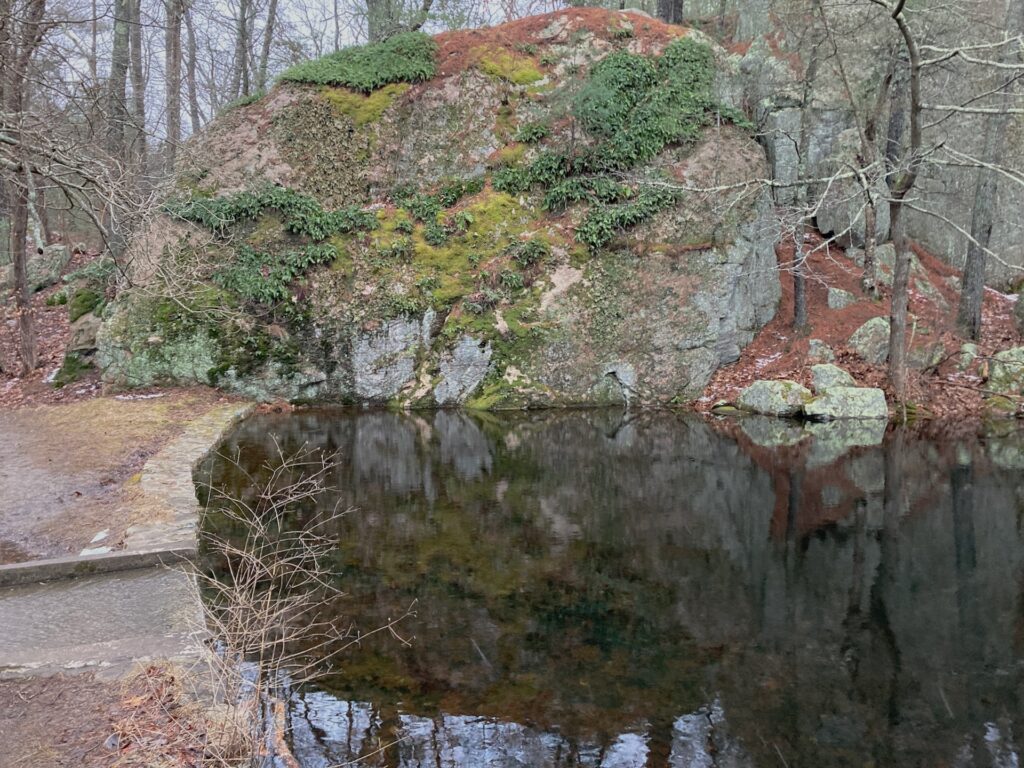
Today’s walk took me a little further than intended, and dusk was settling in before I started heading home. Though I was hurrying a little, I stopped to admire a large rock outcropping that rose about twenty feet above a small artificial pond. Although the face of the rock was only about ten degrees away from vertical, it was mostly covered with plants and lichens. The lichens ranged from crustose microlichens, to Rock Tripe (Umbilicaria mammulata) the size of your hand growing in large colonies, the thallus of each lichen dangling from its umbilicus and showing bits of the dark lower surface. In addition to mosses growing in several large patches, there were a number of vascular plants, of which the most numerous were ferns, Rock Polypodys (Polypodium virginianum). But there were also two or three small trees that had rooted in the rock face, including a small Eastern White Pine (Pinus strobus) near the peak.
The different organisms growing on the rock created a patchwork of colors: greenish brown where the Rock Tripe grew, dark green for the Rock Polypody, and various shades of gree for the other kinds of lichen and the mosses. Here and there, the gray rock showed through the life growing on it.
It’s a trivial sight, something you see every day. I don’t know why it caught my eye today. I admired it for a minute or so, then hurried on my way.
Yelp.com used to be my go-to online source for finding religious communities in a given area. In the San Francisco Bay area, I could type in my location, plus the search term “Religious organizations,” and I’d get a fairly complete list of religious communities, including communities that had no other web presence.
But here in southeastern Massachusetts, Yelp has been failing me. A Yelp search for “Religious organizations” seems to miss a good many religious communities, and has incorrect or outdated information for quite a few others. I won’t say it’s useless, but it’s almost not worth looking at. YP.com, the “real Yellow Pages,” turns out to be somewhat better than Yelp, though you have to use search terms for specific religious groups.
Not sure what the significance of this is. It may simply be that Yelp’s user community in this area simply doesn’t pay much attention to religion. But I also think Yelp pays little attention to religious organizations these days. I claimed the Yelp page for First Parish in Cohasset, and have tried a number of times to get Yelp to change the name of our congregation from “Unitarian Church” to “First Parish in Cohasset,” but they just ignore me. I’m guessing Yelp gets no revenue from hosting religious organizations, so they just ignore us.
I knew I shouldn’t go to the Registry of Motor Vehicles right after lunch. I knew there would be a long line. I knew I’d have to wait forever. I was there 3 hours. A 30 minute drive each way made it 4 hours total.
And before you ask, no I couldn’t use a runner. No I couldn’t make an appointment. No I couldn’t go to the local AAA office. If you’re transferring an out-of-state registration, you go in person and wait in line.
Having said all this, the RMV staff were all polite, knowledgeable, and efficient. The long wait is mostly the fault of Massachusetts voters who don’t want to fund adequate staffing for the RMV.
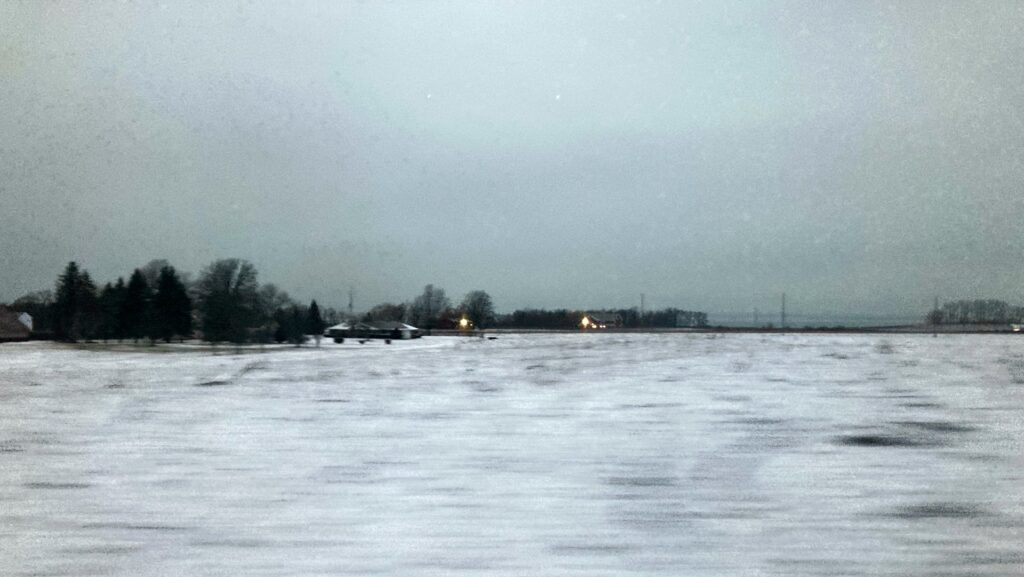
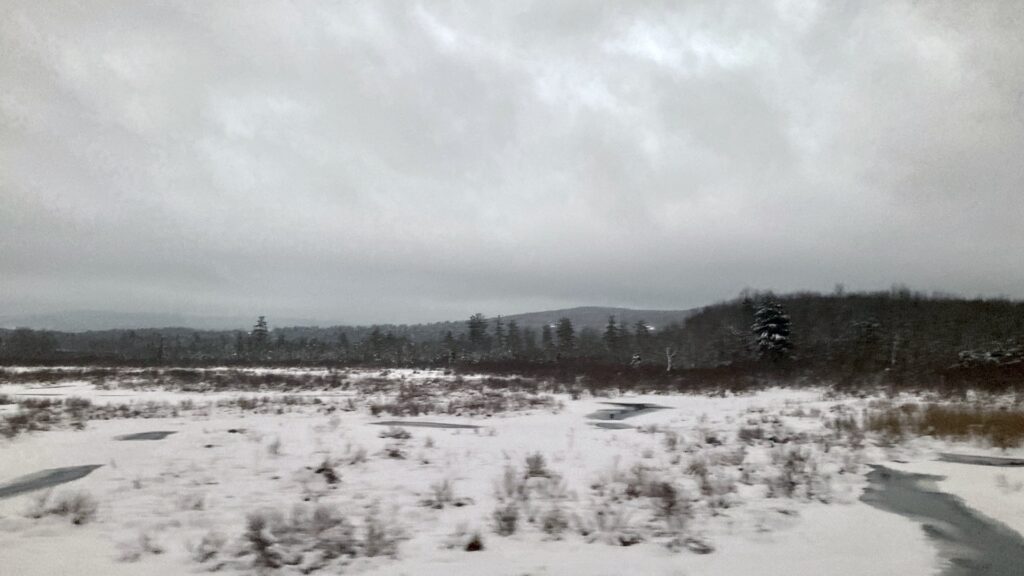
I woke up around seven o’clock. We were still in Pennsylvania. The sky was a dull gray. My roomette was on the north side of the train, and I kept hoping for a sight of Lake Erie. I finally thought I saw the lake in the distance.
Near Freeport, Pennsylvania
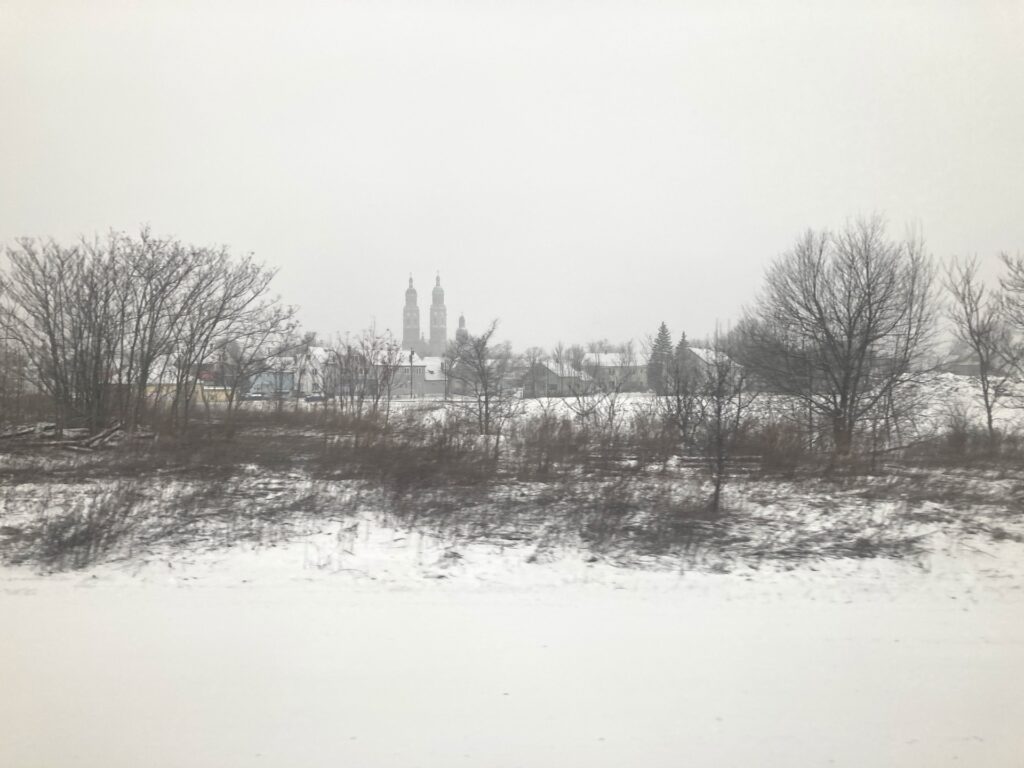
It started snowing. The blowing snow made verything I saw out the window look faded. It was hard to tell the difference between the sky and the ground — both looked white.
Snow near Buffalo, New York
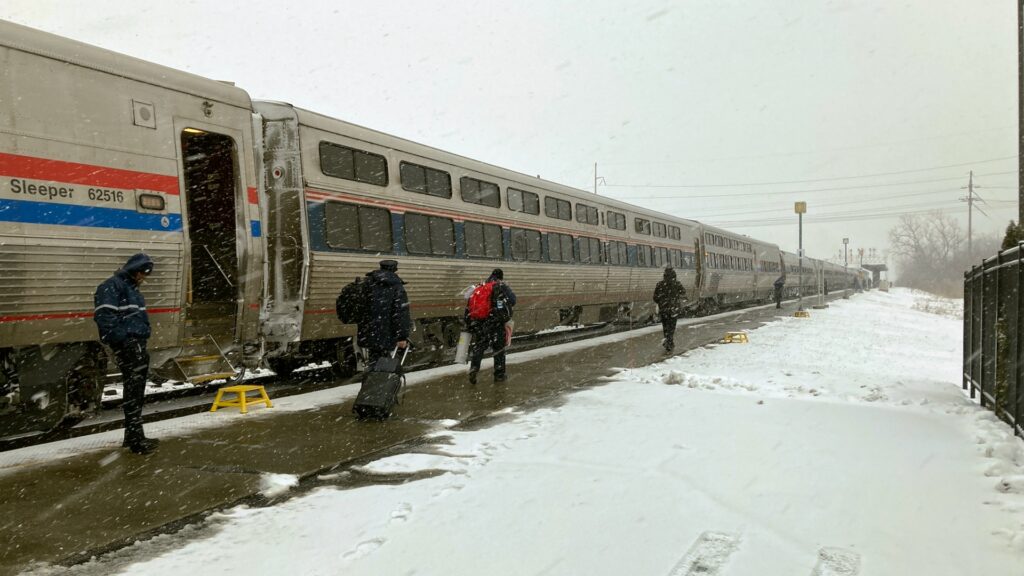
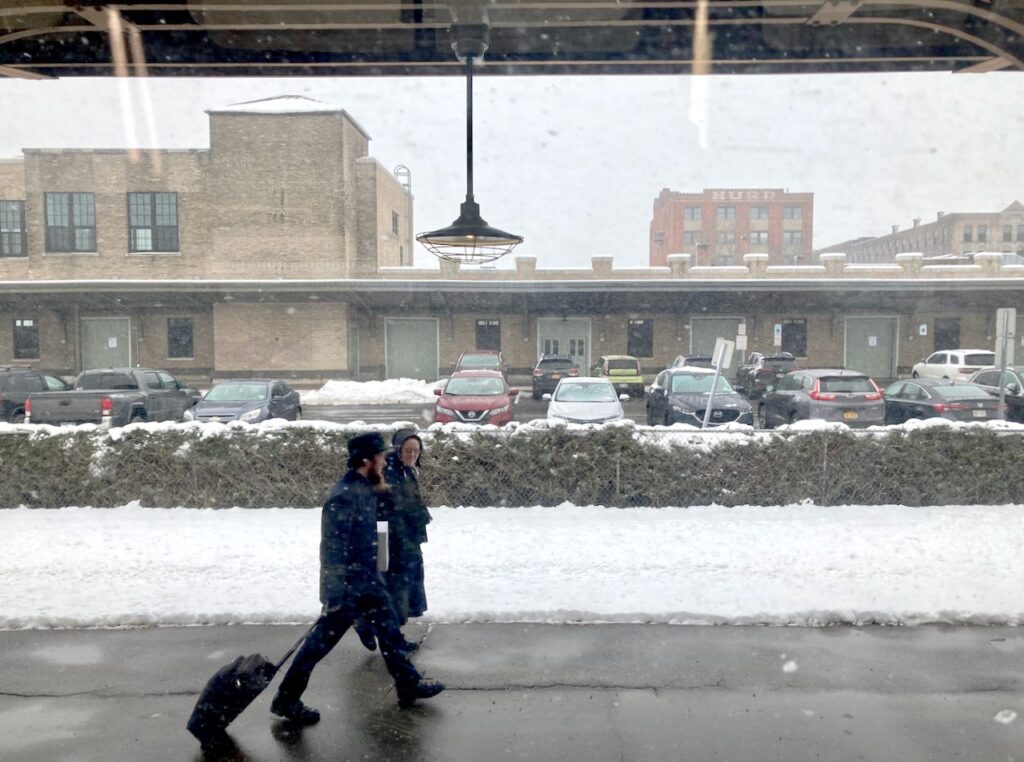
We had a quarter of an hour layover at the Buffalo-Depew station, so I got out to stretch my legs. A few smokers got out and miserably puffed their cigarettes while the snow swirled around. The people getting on the train bent their heads down to keep snow out of their eyes.
Buffalo-Depew Station
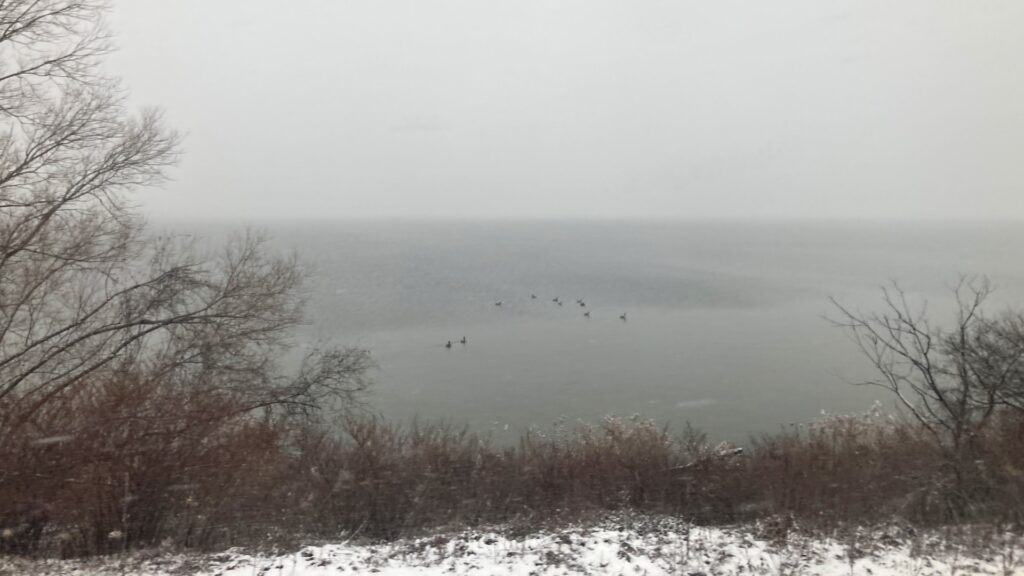
The train passes quite near the lower end of Onondaga Lake. Through the falling snow, I saw a Bald Eagle sitting in tree near the water, and half a dozen Canada Geese swimming out in the lake.
Onondaga Lake, New York
The Lake Shore Limited seems to carry quite a few people in plain dress. Maybe they were Amish, but the Amish aren’t the only group that wears plain dress; there are Mennonite groups who wear plain dress, Hutterites, and still others. I asked one of the train crew about them. He said lots of Amish (as he called them) took the train, and sometimes they took over a whole car. I said I had heard at least one couple speking what sounded like Pennsylvania Dutch of Low German to me, but that wasn’t something he had noticed.
Couple wearing plain dress, Utica station (faces blurred to protect privacy)
When we got to Albany, I had to move to a different car. There’s a one hour layover in Albany. After I stowed my luggage in my new roomette, I stood outside the train, just to be outdoors. A young man was taking photographs with what looked like a film camera, and I asked him about it. He was shooting outdated Kodak Gold color film, which he processes and prints himself to get certain specific artistic effects. I was suitably impressed. He wandered off to take more photographs. I talked for a bit with the sleeping car attendant, who grew up in Dedham.
Then I fell into conversation with a man from Australia. He and his wife had taken the train from San Francisco, with a stop in Denver, and a two day layover in Chicago. He loved both cities, and was looking forward to seeing Boston, and then New York. It turned out that he was a retired air traffic controller, and so I asked him about the recent FAA shutdown of air traffic in the United States. He said that of course once you have a glitch like the FAA had, you have to shut down all air traffic. But he also said that problems like that do arise when you outsource certain functions.
We got back on the train a minute before it started up again. By now, it was starting to get dark. But the light lasted long enough for me to see the Berkshires off in the distance.
Near the Housatonic River, south of Hinsdale, Massachusetts, with mountains in the distance
The train arrived on time in Framingham. I got my car out of long-term parking just as it started pouring rain. I was thankful that it wasn’t cold enough to turn the rain to snow.
Now I’m home, and I still feel like there’s a train moving under me….
I wound up with a 7 hour layover in Chicago. The nice thing about train travel is that when you have a layover, you can leave the terminal. And when you have a layover in Chicago, you’re downtown, right in the Loop.
The Art Institute is closed on Tuesdays, so I went to Exile in Bookville, a bookstore on the second floor of the Fine Arts Building on Michigan Ave. The Fine Arts Building still retains much of its 1898 decor, and it even still has elevators that need to be operated by human beings. Exile in Bookville turned out to be an excellent small bookstore. I passed over William Cronon’s environmental history of Chicago and the midwest (too bulky to carry on the train) and instead bought The Future Is Disabled by Leah Lakshmi Piepzna-Samarasinha. I also stopped at the DePaul University bookstore, which is run by Barnes and Noble.
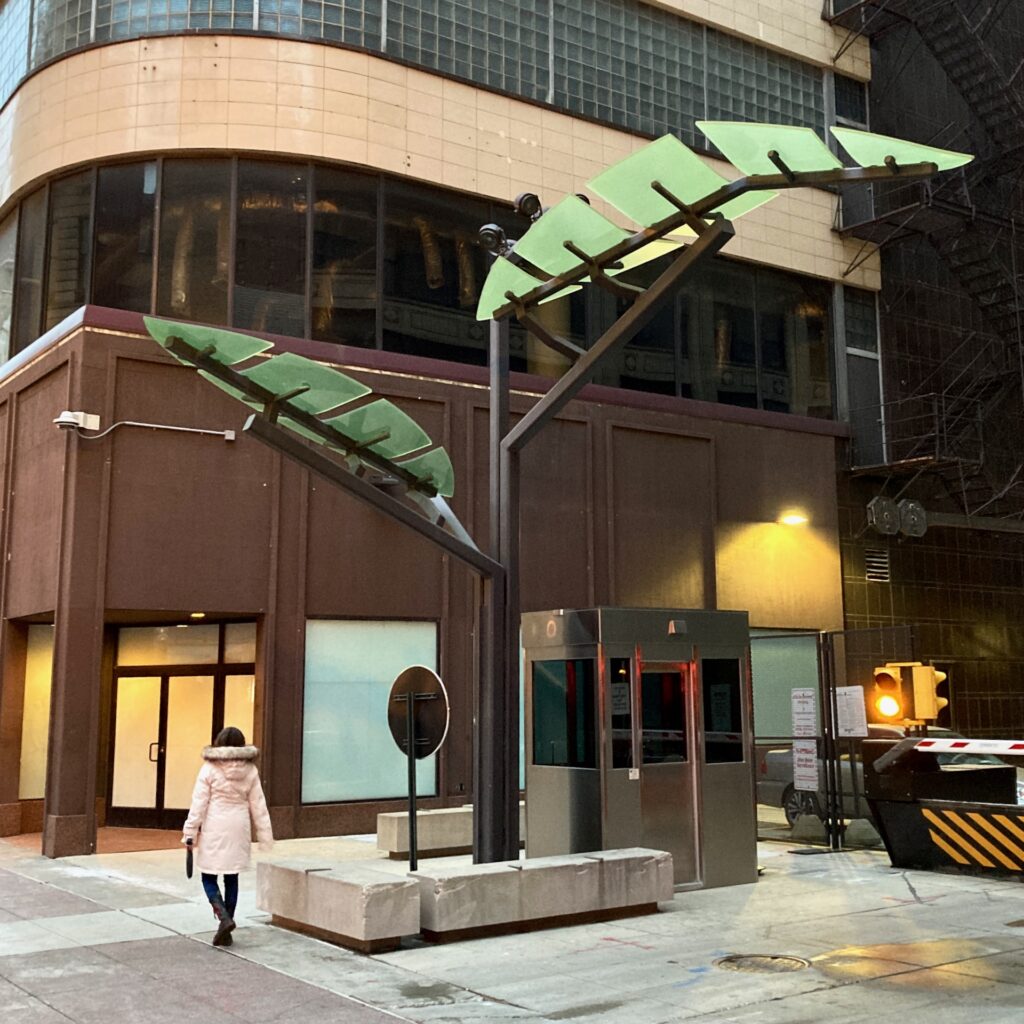
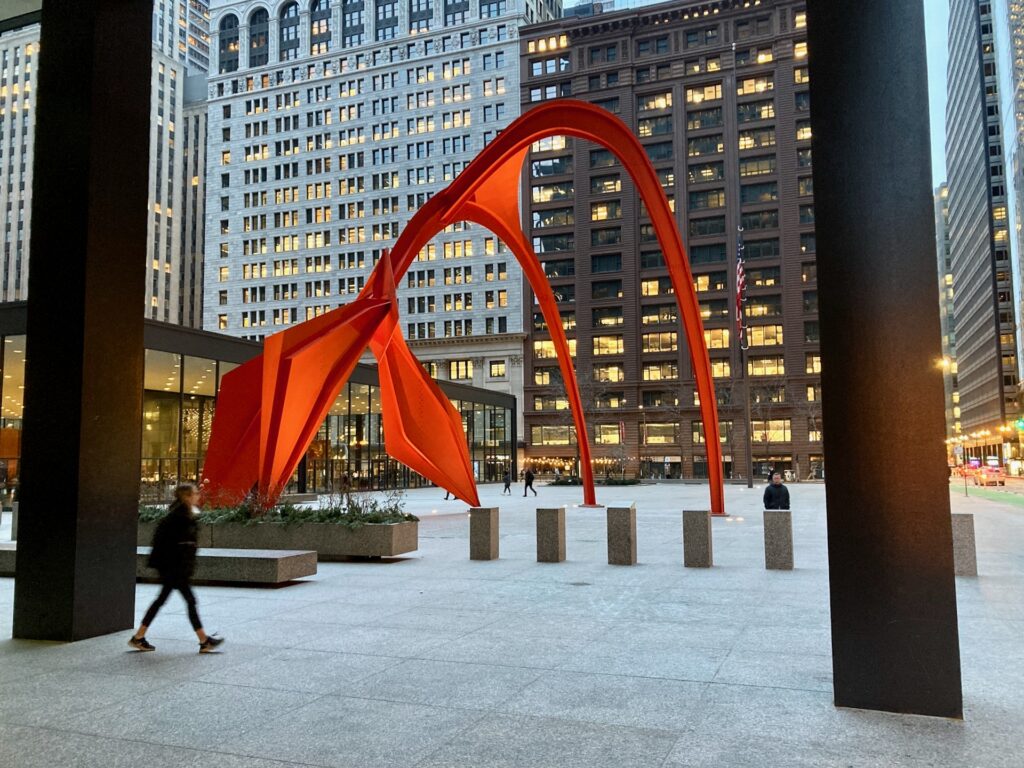
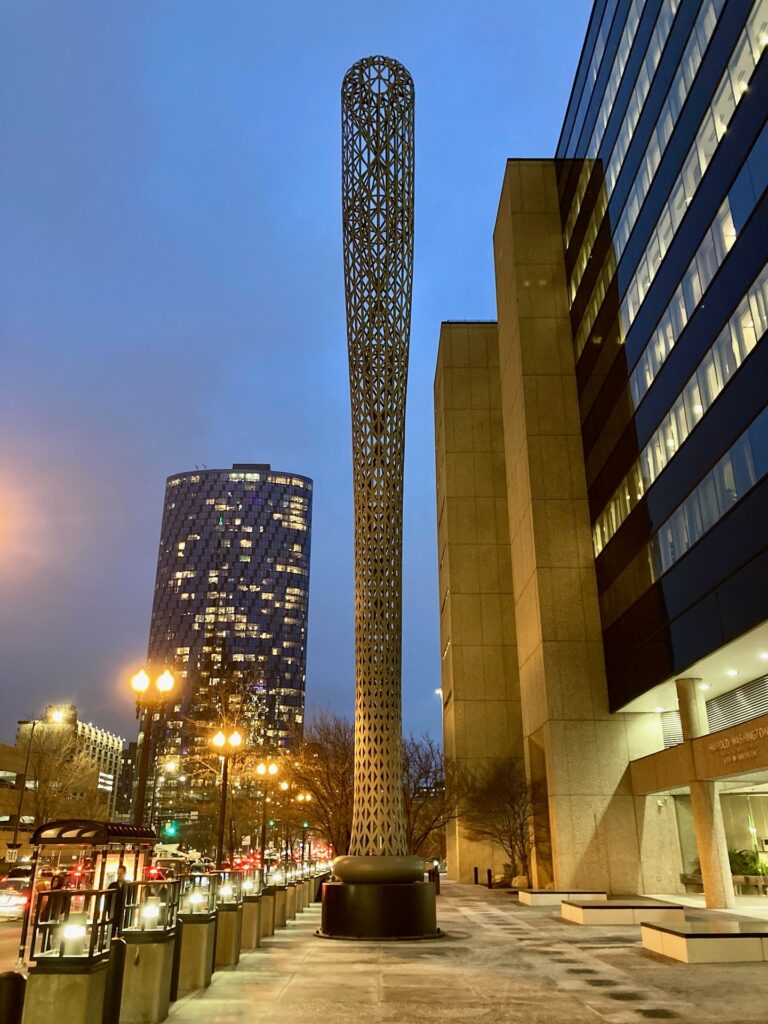
By then it was half past four. Time to start walking slowly back to Union Station. I stopped to take a photo of part of a public art work on Quincy St. at South State St.
Public art, Quincy Street at South State Street, Chicago
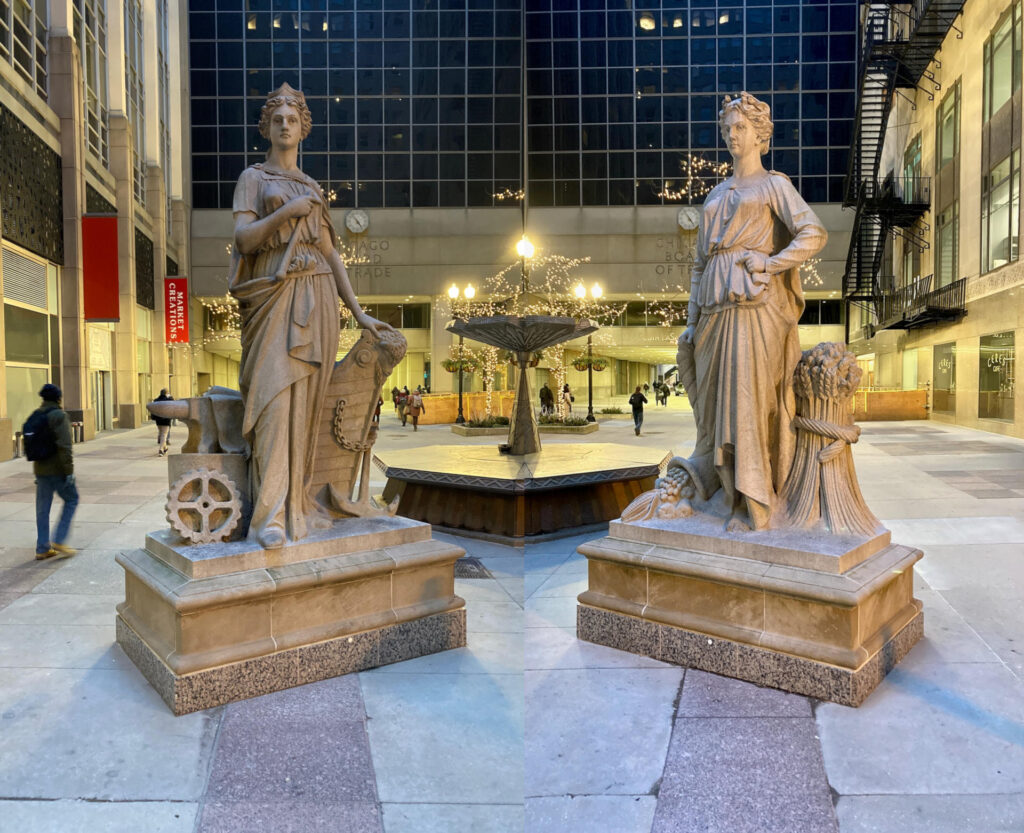
As I continued walking, I looked for more public art….
Photomontage, Chicago Board of Trade statues symbolizing agriculture and industry, c. 1885Alexander Calder, Flamingo, Klucynzski Federal Building, Chicago, 1973Claes Oldenberg, Batcolumn, Social Security Administration Building, Chicago, 1977
It turned out to be a very pleasant layover in Chicago.
We went out for a walk along the river that runs through Oshkosh, Wisconsin, today. A Bald Eagle soared overhead, landed in a tree, and soared off again when we got too close. Then a couple of minutes later, there was another Bald Eagle ahead of us, sitting in a tree.
It was breathtaking to see Bald Eagles that close. But we shouldn’t be seeing any eagles over the river in Oshkosh in January. Instead, the river and the lakes should be fully frozen over, driving the eagles to Lake Michigan to find open water for hunting. It has been such a warm winter, the river is almost completely ice-free. So while I love seeing the eagles, we’re seeing them because of global climate change, which is not a cheerful thought.
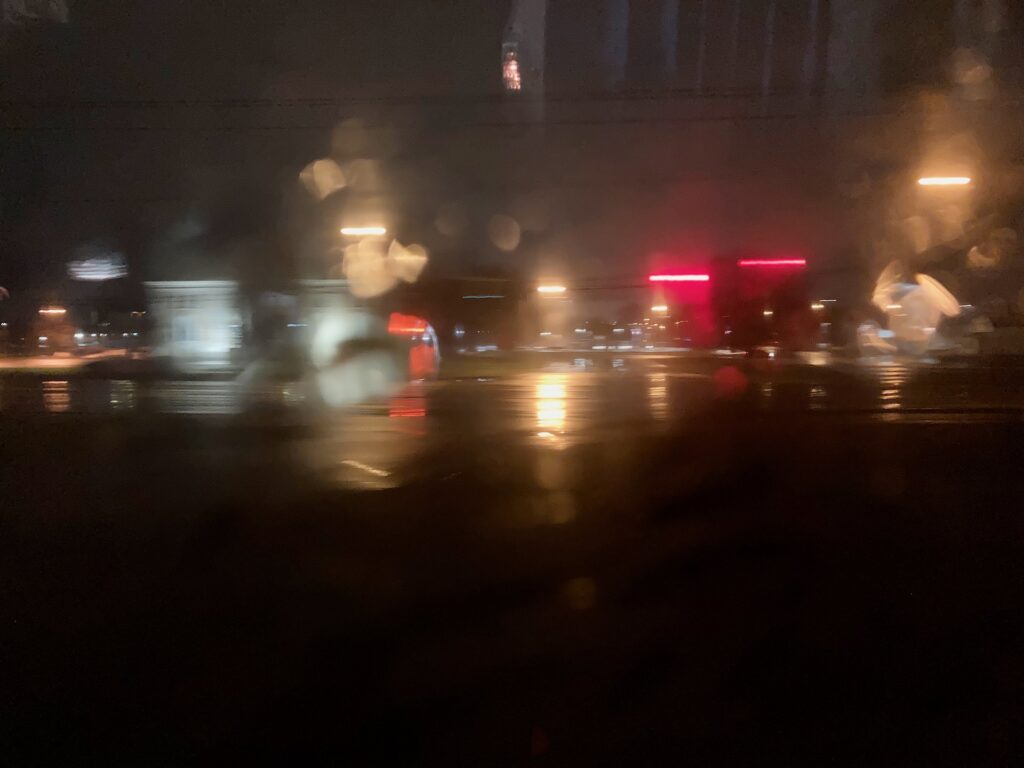
I awakened in the middle of the night and looked out the window of the upper berth. Rain blurred the view. The GPS on my phone said we were in Buffalo, but I saw nothing distinctive.
Buffalo, N.Y., at 12:45 a.m., from the train window.
I had gone to bed before nine o’clock, so it was no surprise when I awakened at half past six. I tried to doze, but I was awake. I washed my face and shaved, got dressed, and tried to read for a while. At last it started to grow light outside. I opened the curtains of the roomette to watch the world go by. We passed a brightly-painted, brightly-lit water tower in Bryan, Ohio.
Bryan, Ohio
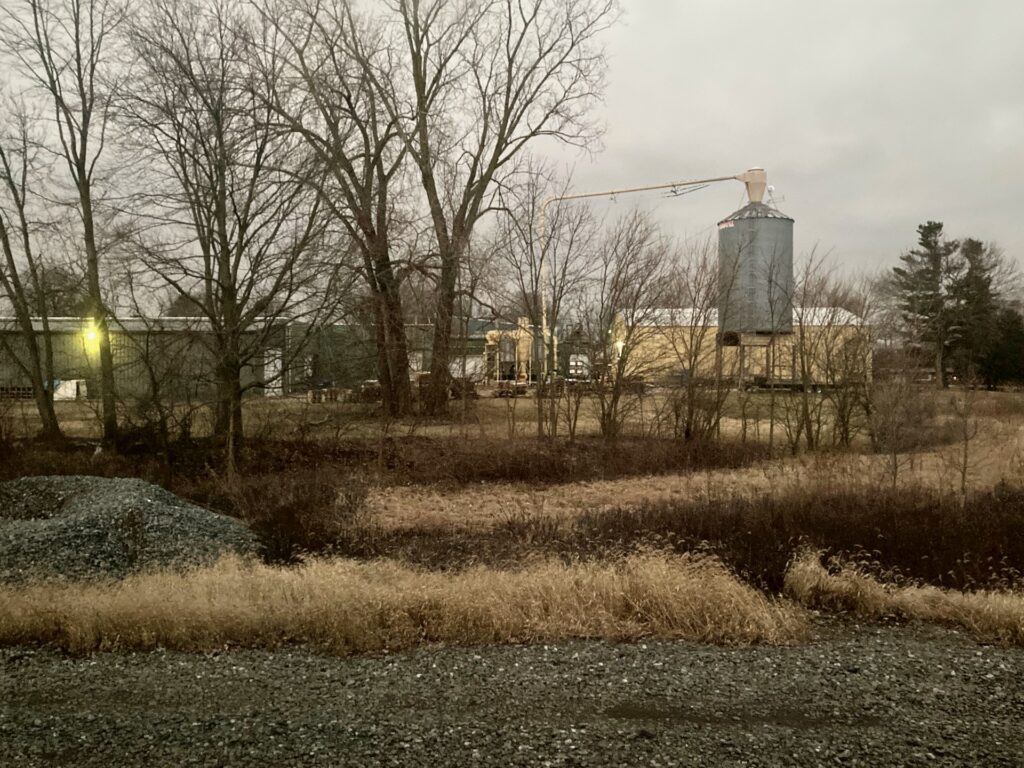
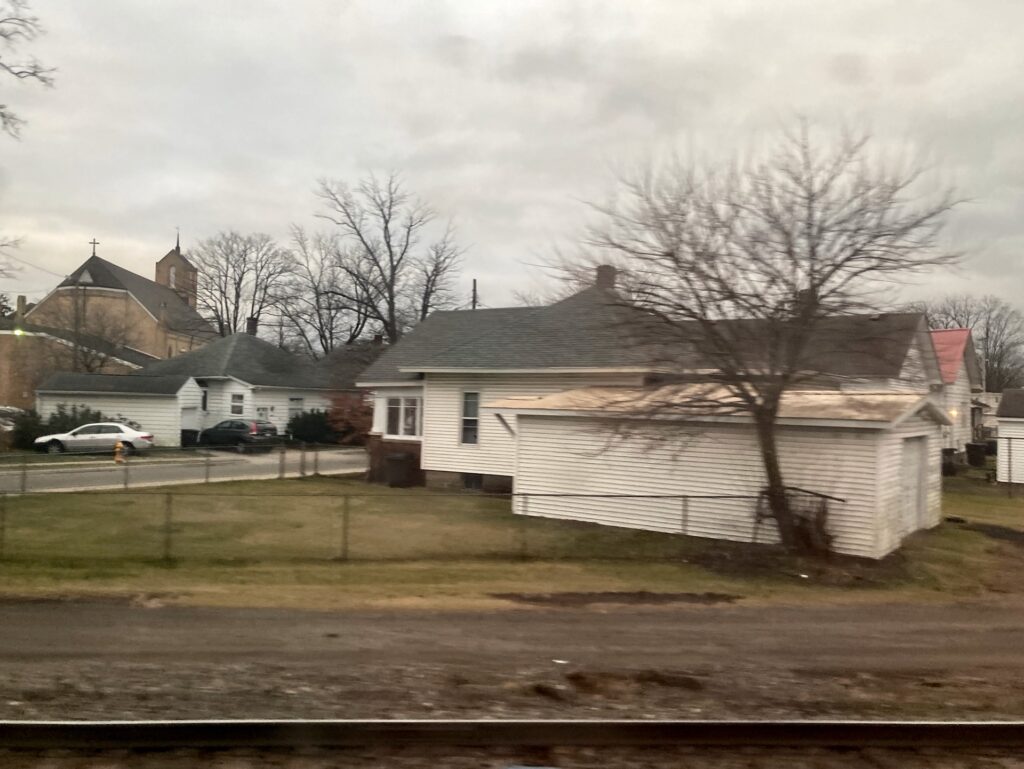
We mostly pass through farm fields, with a few patches of woodland, a few small towns, and a few areas of light industry.
Waterloo, Indiana
I saw no snow anywhere. I’ve taken the Lake Shore Limited several times before in January, and there is always snow on the ground at this time of year. But not this year. Global climate change is taking hold.
Elkhart, Indiana
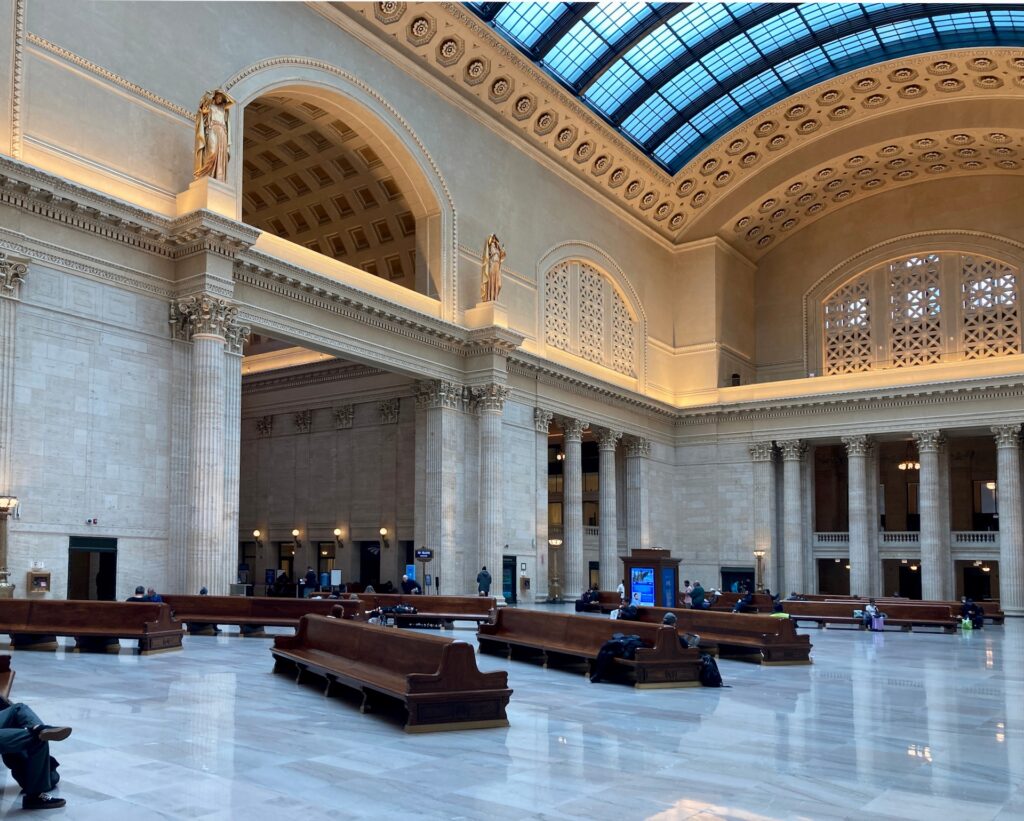
Before I knew it, we were in Chicago, arriving at Union Station just before ten o’clock, ahead of schedule. I went up to the Great Hall, to see if it was as spectacular as I remembered it being. It was, and is. The sight was spoiled somewhat by the fact that Amtrak plays bad Muzak which sounds echo-y and terrible in that high space. I did my best to ignore the bad Muzak, and just enjoyed the light and space. It was a very peaceful place to spend a couple of hours while waiting for the connecting train to Milwaukee.
The Great Hall, Union Station, Chicago
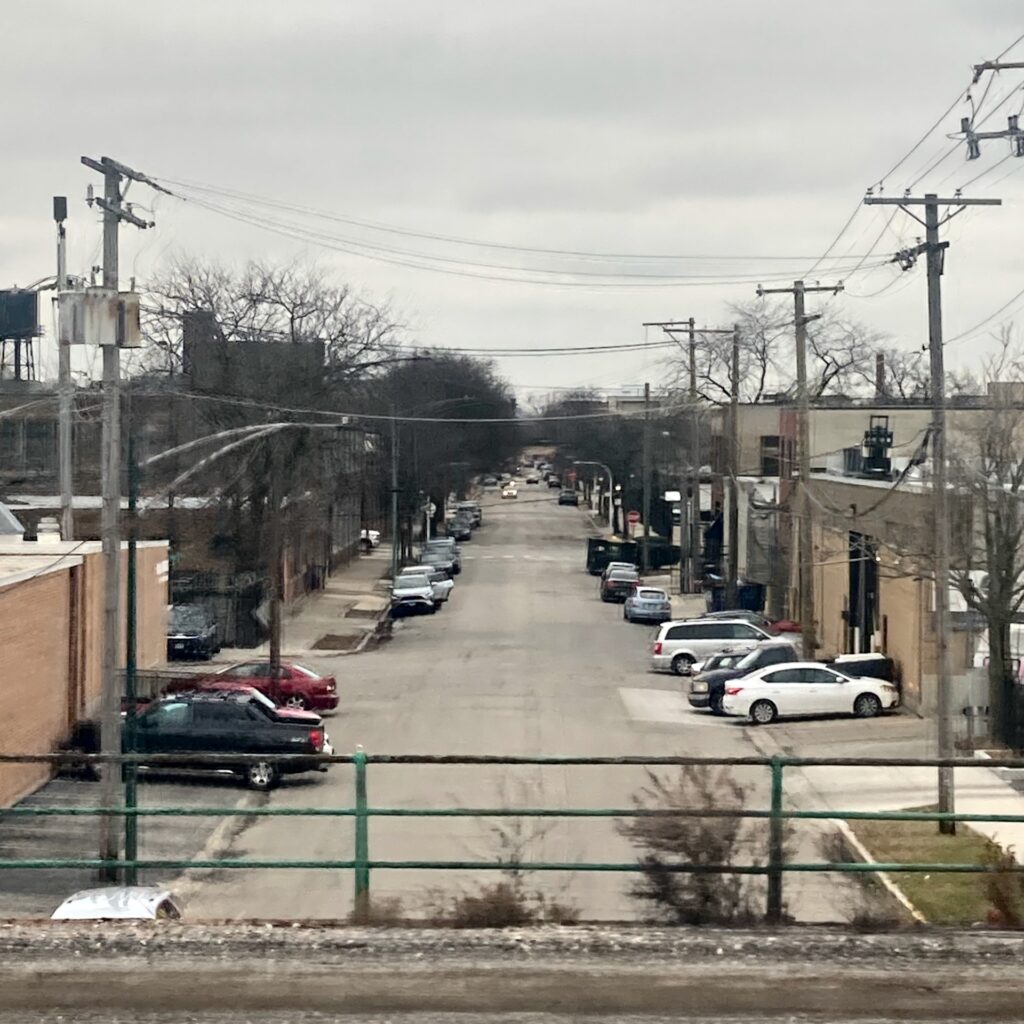
Hiawatha Service, the service to Milwaukee, was delayed half and hour due to a computer glitch. At last we were on our way. I enjoyed looking down the streets of Chicago and trying to imagine who lived there.
Leavitt St., Near West Side, Chicago
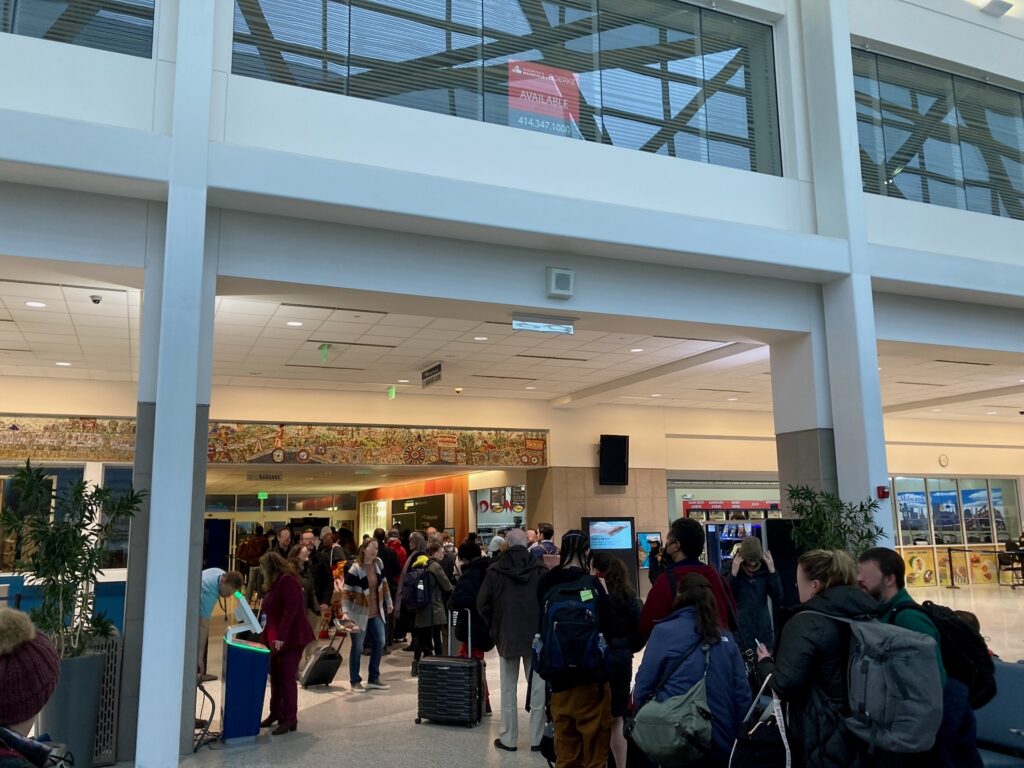
I dozed off, and awakened again when we were in Wisconsin. It was a short ride, just under 90 minutes. The downtown Milwaukee train station was nothing special — it looked like a bus terminal, and actually it was a bus terminal as well as a train station.
Downtown Milwaukee intermodal station, passngers waiting to board the southbound Hiawatha Service (faces blurred to protect privacy).
Carol and her dad were waiting to pick me up outside the station. Supposedly there’s a move to extend train service all the way up the coast of Lake Michigan to Green Bay. That would have saved Carol an hour and a half drive down to pick me up.
While my trip took much longer than the two hour flight from Boston to Milwaukee, my carbon footprint was much, much smaller. And I enjoyed it more, because instead of being treated like animated cargo (that’s how TSA and the airlines treat you), I was treated like an actual human being.