Outdoors

The errands and chores took up most of the day, and everything took more time than usual due to the traffic which got increasingly worse as the day went on, as the winter storm warnings for Wednesday grew more dire. Get your Thanksgiving shopping done today! shouted the news media. Begin your Thanksgiving travels now! But in spite of all the traffic, and in spite of the errands and chores I had to do, I did manage to get outdoors.

I got up early and drove to White Pond. I walked to the pond over the bluff on the southeastern shore, and as the pond came into view, the white sand banks stood out through the November gloom, and I was struck by how appropriate its name is. The rainbow trout were rising well within casting distance of the shore, little dimples of water appearing her and there as a fish sucked a fly underwater. But the trout didn’t like anything I cast; there was a hatch of flies going on, and I suspect they were completely absorbed by that; had I been fly fishing, perhaps I could have presented something they would have struck at.

A woman came walking down the shore, and we started chatting. “I haven’t fished here in a dozen years,” I said, “and the houses seem to keep getting bigger.” The houses on the pond started out as modest summer cottages, but now many have them have transmogrified into McMansions. “Oh, it’s terrible,” she said, “they keep expanding them. Some of them are huge now. Three, four floors.” I didn’t say it out loud, but I thought: this is what growing wealth inequality is doing to Concord, Massachusetts: changing it into an enclave of the elite. That thought dampened my mood, so I started fishing again.

After three quarters of an hour, the rainbows stopped rising, and I went off to start my errands. Sadly, I had to spend most of the rest of the day either in the car, or indoors.

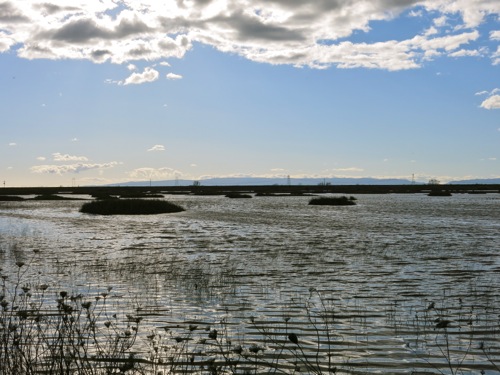
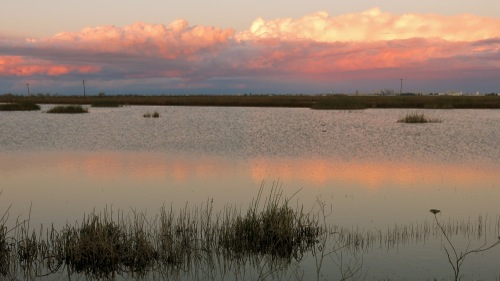
But as the day turned towards dusk, I found I had just enough time to go to Great Meadows National Wildlife Refuge and see what birds were there. I arrived too late to see the immature Bald Eagle that has been there for the last couple of days, but I arrived just in time for one of the most spectacular sunsets I have seen in months.

BlogNov2514

Above: Two Mallards swimming in the upper pool at Great Meadows, Concord, Mass.

Tail race from Damon Mill

Dad’s condo is across the street from Damon Mill in West Concord, a mid-nineteenth century brick mill building now converted to offices. The old outflow stream from the mill, technically a “tail race,” flows right behind Dad’s condo and thence into the Assabet River.

BlogNov2114

Above: The tail race from Damon Mill; the main current of the Assabet River is visible through the trees.

A cold front went through last night, and this morning when we got up, there was a skin of ice on the tail race; leaves and twigs that had been floating on the surface of the water got frozen into the skin of ice. It was cold enough today that the ice never melted. I took the above photo at 3 p.m., and there’s the skin of ice, still holding on to the leaves and twigs.

A week ago, Dad and I walked around the edge of the field below his condo. But today it was too cold to walk that far. We made it to Dad’s garden, which is close by his condo, before he decided he wanted to turn around. We did see, however, that there is still one last pea plant struggling to survive the cold snap. It’s supposed to get up to sixty degrees on Monday, so perhaps the pea plant will revive then.

Assabet River

BlogNov1614

Above: The Assabet River, just below the Pine Street bridge in Concord, Mass., on 15 Nov. 2014

Tonight, my father’s brother Lee, and my cousins Lynn and Steve came up to visit Dad. Uncle Lee spent his career as a chemist, but I would be more likely to call him a practical icthyologist; he knows as much about the biology of fish as anyone else I know; he raises something on the order of a hundred different species of fish in his basement, and he’s an avid fisherman of wide experience. For her part, my cousin Lynn works for MassWildlife as a habitat protection specialist, and has a wide knowledge of many different Massachusetts ecosystems, including rivers, streams, and ponds.

As we were eating our dinner (we had fish, of course), Uncle Lee and Lynn got to talking about fish. Between them, they covered the possible effects of global climate change on lake trout in Canadian lakes; invasive Asian carp in the Midwest; the reintroduction of sturgeon into the Chesapeake River; which species of fish were native in Eastern Massachusetts rivers; etc. Since the Assabet River is visible from Dad’s living room window, of course we talked about the SuAsCo (Sudbury/Assabet/Concord) river system. I tried to participate in the conversation, but it was far more interesting to listen to the two of them. At one point, I looked at Steve and said, “Isn’t it interesting to listen to two fish experts talk?” He agreed. It’s always interesting to hear people talk about something they know well.

Wetlands, Concord, Mass.

BlogNov1414

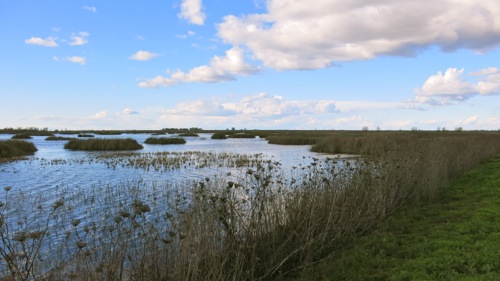
Above: Cattails in a wetlands along the abandoned Old Colony Railroad (later New York, New Haven and Hartford Railroad) grade that parallels Old Marlboro Road, Concord, Mass.

This wetlands area has a substantial expanse of open water, due to beaver dams; in the photo there is open water on the far side of the cattails, and you can see the grey trunks of dead trees, trees which could not survive the flooding from the beaver activity. Beyond that, you can see hills covered mostly in white pine (Pinus strobus), with some red oak (Quercus rubra) mixed in; this mix of pine and oak is typical on upland glacial till soils in eastern Massachusetts.

These are characteristic colors of mid-November wetlands in Concord: the dull brown and white of dead cattails and their seeds and the grey of dead or leafless deciduous trees; a sky covered with dull gray clouds above; and in the background, the dark green of white pines with a few spots of dull red provided by the red oaks which still retain their leaves.

Weed, Calif.

BlogOct2514

Light rain began blowing against the windshield as I drove south on Interstate 5 towards Weed, California. The sun was still shining, but Mount Shasta was obscured by clouds. I stopped at a rest area to stretch my legs, and looked north, the way I had come: there was a rainbow behind me. As I watched, a faint second rainbow was forming. I took a photo, got back in the car, my hair blown every which way, my glasses speckled with rain drops, and drove south into the rain.

UNCO 14: last thoughts

The last session I attended at UNCO 14 West was the session on the spiritual and mental health of pastors on Wednesday morning.

The purpose of the Wednesday morning breakout sessions is to figure out what “has legs,” that is, which of the ideas that emerged during UNCO are worth following up on. One of the key ideas that came up during UNCO 14 West was the idea that innovative ministries need to find new funding sources. This is an important step in the evolution of Unco, as Carol Howard Merritt tweeted: “#unco14 discussions at year 5: We have gone from complaining to dreaming to planting. Now we’re looking at funding. It’s really beautiful.”

And I think the idea that we need to support the mental and spiritual health of pastors engaged in innovative ministries is just as important the idea that we need to support the financial health of innovative ministries. Ministry is, in many ways, an essentially conservative profession: we are supposed to conserve the tradition of which we are a part. My own denomination is theologically liberal, but methodologically conservative and risk-averse: a few innovative ideas have been given the imprimatur of the denominational bureaucracy, but most other innovation is ignored. I’d guess my denomination is typical of all mainline denominations.

And what happens if a minister or lay leader tries innovation goes beyond the innovative allowed by the bureaucracy? What happens when a minister or lay leader tries something risky? Well, because of the conservative nature of ministry, and because of the conservative nature of denominations, anyone who goes beyond the allowed limits of innovation had better be well-connected. If you are well-connected, if you have friends in powerful positions, your innovation may be allowed, and if it is allowed, it will likely be funded. But if you are not well-connected, you may well feel like the goat in Leviticus 16 who gets sent into the wilderness: “The goat shall bear on itself all their iniquities to a barren region; and the goat shall be set free in the wilderness.” [Lev. 16.22, NRSV]

Innovative and/or risky ministries are stressful enough in and of themselves. If you are engaged in innovative ministries but are not well-connected within your denomination, you are likely to feel more stress, and have less support. You are also less likely to be held accountable in appropriate ways, and your ministries may well be judged by the wrong standards. This is a recipe for burn-out. I suspect that pastors engaged in innovative ministries are at higher risk for mental illness, something that is already an occupational hazard of professional ministry.

This would suggest that those who are engaged in innovative ministries need additional support. In our breakout session on Wednesday morning, we brainstormed a few ideas: setting up some kind of online chaplaincy for UNCO participants; mutual support and accountability groups meeting via Google Hangouts or Skype; continuing to offer face-to-face support at UNCO; etc. We’ll see which of these ideas “has legs” and will turn into a reality.

But there is a need: innovative ministers need appropriate accountability and sympathetic support.

Talent, Oregon

BlogOct2314

The old railroad depot at Talent, Oregon. The sign reads: “To Portland 336 mi. / TALENT / To San Francisco 436 mi. / Elevation 1,635”

My cousin Sue tells me that up until a few years ago, two trains a day passed through Talent, carrying lumber south to Redding, California. With the collapse of the timber industry in this part of Oregon, there are no more regularly scheduled trains — this, along with the mills closing down, and good working class jobs disappearing, represents the changing economy of southwestern Oregon. The railroad depot has been converted into shops, perhaps a symbol of the growing importance of service industry jobs.

Winter melon

What would you do with a half a winter melon? I’ve gotten friendly with a farmstand that specializes in Asian vegetables at the San Mateo Farmer’s Market. The woman who runs the farmstand knows I love bitter melon, and has told me about its health benefits. She probably figured this white guy needed to expand his Asian melon repertoire, so today she gave me half a winter melon, and said, “Try it in soup.”

There are lots of winter melon soup recipes online, and I’m leaning towards a simple one with dried black mushrooms, chicken broth, a little bit of chopped meat, and some slices of ginger.* But — what would you do if someone gave you half a winter melon?

BlogOct1114b

*Two weeks later: And here’s the recipe I have been using for winter melon soup:

Half of a five pound winter melon, cut into 2 inch pieces (about 2 pounds of melon)
1 quart of chicken broth
1 knockwurst, cut into 1/2 inch circles
8-10 dried black Chinese mushrooms, soaked in hot water for 20 minutes
half a dozen slices of ginger root, peeled, and slivered
salt to taste

Bring the winter melon to a boil in water to cover, then simmer covered for 20 minutes.
Drain the water off.
Add chicken broth, mushrooms, ginger, and knockwurst to the cooked winter melon. Simmer for 20 minutes.

Autumn watch

Even though the temperature got up to nearly eighty degrees today, it feels like fall. The sun is noticeably lower in the sky, and daylight is noticeably shorter than nighttime. I went for a walk up in the hills overlooking Half Moon Bay, and once you get out from under the redwoods into the chaparral, the plants look tired and dry and worn out, ready for the winter rains. Even the fall asters look faded now, with blossoms that are almost white instead of pale violet.

BlogOct1114

Above: Honeybee pollinating asters at Purissima Creek Redwoods Open Space Preserve; the asters are probably the Common California Aster (Symphyotrichum chilense)

During the long climb back up to the trail head, I kept stopping to admire the way the afternoon sun shone gently on the steep hills and canyons that descended to the ocean; admiring the view was also a good excuse to stop and catch my breath when the trail was steepest. After one particularly steep stretch, I turned and saw a Golden Eagle below me. This was a perfect excuse to stop for a moment. I watched the eagle ride the breeze down the canyon until it disappeared from my view behind a forested ridge.