Sidney, Neb., to Evanston, Wyo.

In the motel parking lot this morning, two women were re-packing the car next to mine, while a toddler sat quietly in the back seat, sucking at a bottle of milk. One of the two women was a couple of years older than I, and she was moving from South Carolina to Portland, Oregon, to be near her daughter — the other woman in the car — and her grandson — the toddler. So the car was full of her belongings. I told her that I had been in Massachusetts helping my sister dispose of the last of my father’s belongings, so my car was full of stuff, too. We got into a long talk about moving, and people dying, and other such mournful topics that are so satisfying when you get into your fifties, while the young woman pretty much ignored us, and worked on repacking the car. We said something to her about how she probably found this kind of talk boring, and she politely refrained from rolling her eyes and said something noncommittal. Her mother said, “She’s in her twenties, she’s still young.” I said to the young woman, “I’ll bet you don’t feel young.” “No,” she said, “I don’t.”

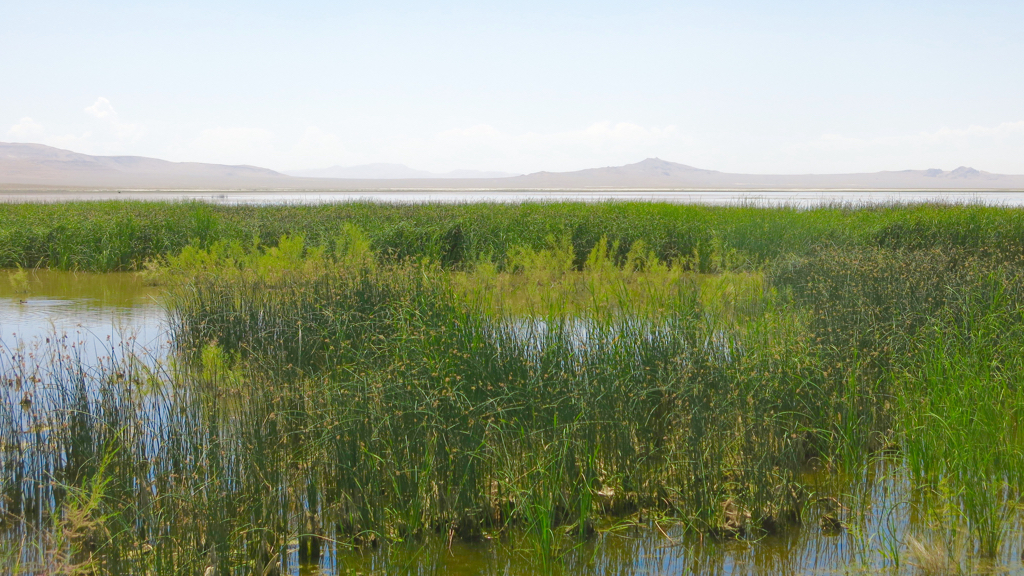
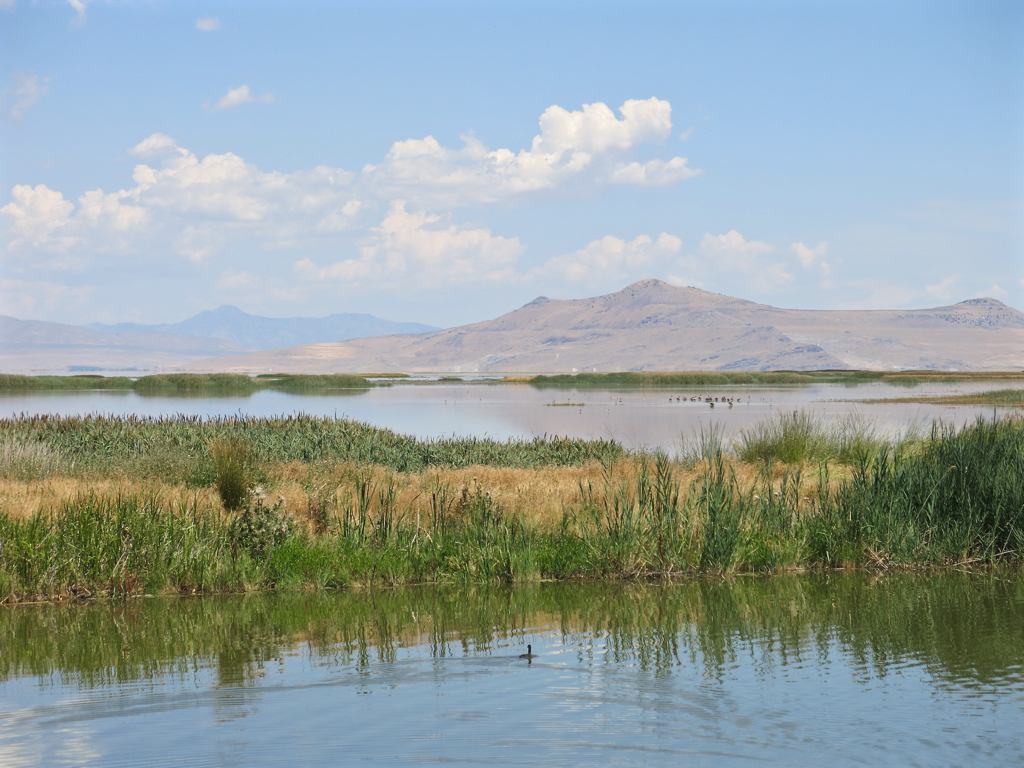
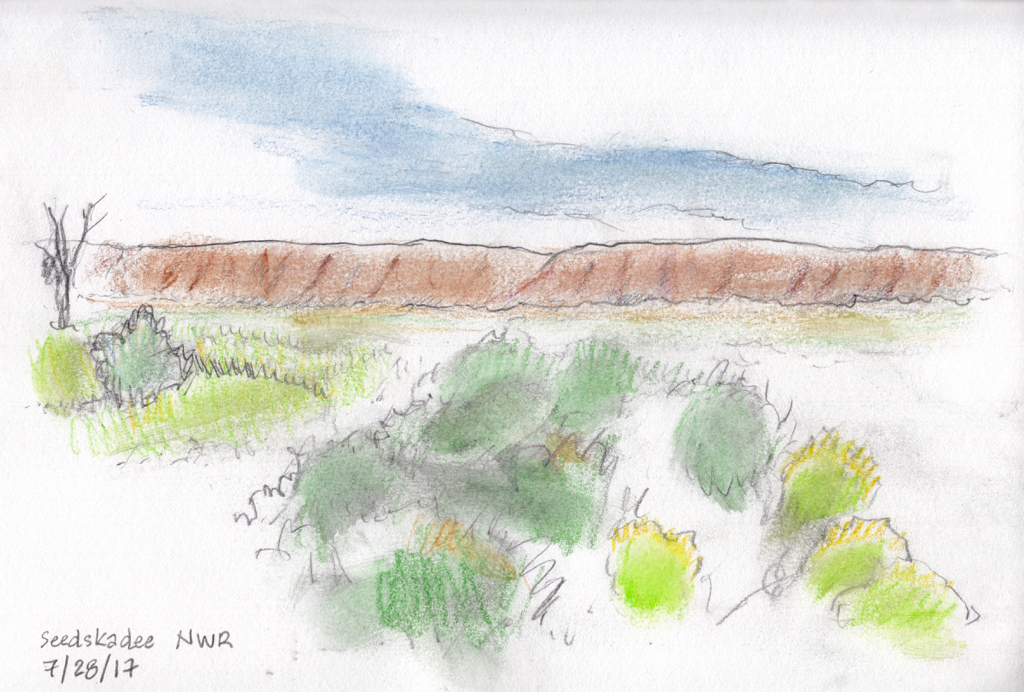
I drove all day, and at about six o’clock pulled into one of the several entrance roads to Seedskadee National Wildlife Refuge. I had thought about going to someplace new and different, but after being so disappointed with yesterday’s visit to a new and different place I decided I’d go to a place I knew I liked. I walked a mile and a half down a dirt road alongside the Green River, looking out at the marshes and trees along the edges of the river. And then I walked back, this time looking in the opposite direction, out over the sage brush and up at the heavily eroded bluffs a mile or so back from the river. Some Sage Sparrows flew over my head, singing their funny little tsee-tsit-sit song as they went over.

It’s certainly not a wilderness experience. The county highway is a mile away but you can see it clearly over the flat sage plain; and the huge white above-ground infrastructure for Ciner Wyoming, a company that mines soda ash, is clearly visible ten miles to the south. But there is something very satisfying about the swift Green River, and its verdant marshes and trees, flowing in the middle of the arid sage brush plains, with steep bluffs well back from each side of the river, and in the far distance glimpses of snow-covered mountains. There is something about the elevation, something like seven thousand feet above sea level, and the dryness of the air, and the clarity of vision that comes with both these things. And there’s something about the sage brush, and the big ant hills among the sage, and the rocky alluvial soil under the sage.

The sun began to move lower in the sky, and I knew I had to leave. Some day, I promised myself, some day I’ll come back and spend a week or two here — but I don’t feel any need to keep that promise; it was enough to just think about it.

Avoca, Ia., to Sidney, Neb.

I drove into DeSoto National Wildlife Refuge at about ten o’clock. The refuge comprises an oxbow bend of the Missouri River that had been cut off by the Army Corps of Engineers in order to shorten the main navigation channel. I had high hopes for DeSoto National Wildlife Refuge, but it had been over-developed, with carefully graded and graveled paths, and easy-to-drive roads, and large buildings, and distant refuge staffers who obviously saw too many tourists each day to want to spend more than the minimum time talking. The oxbow bend had been channelized by the Army Corps of Engineers before it had been cut off, and it too looked carefully arranged. I spent an hour and a half walking the short, easy-to-walk trail and looking for birds, and then I drove through the rest of the refuge, and as I drove back to the interstate I was just as happy to leave the refuge behind.

That unsatisfactory visit left me with no time to do anything during the rest of the day but drive, and listen to Great Expectations. As Great Expectations progresses, the impossible coincidences pile up, but the characters feel real, and the moral force of the book feels real, and so the coincidences of the plot quickly fade out of consciousness.

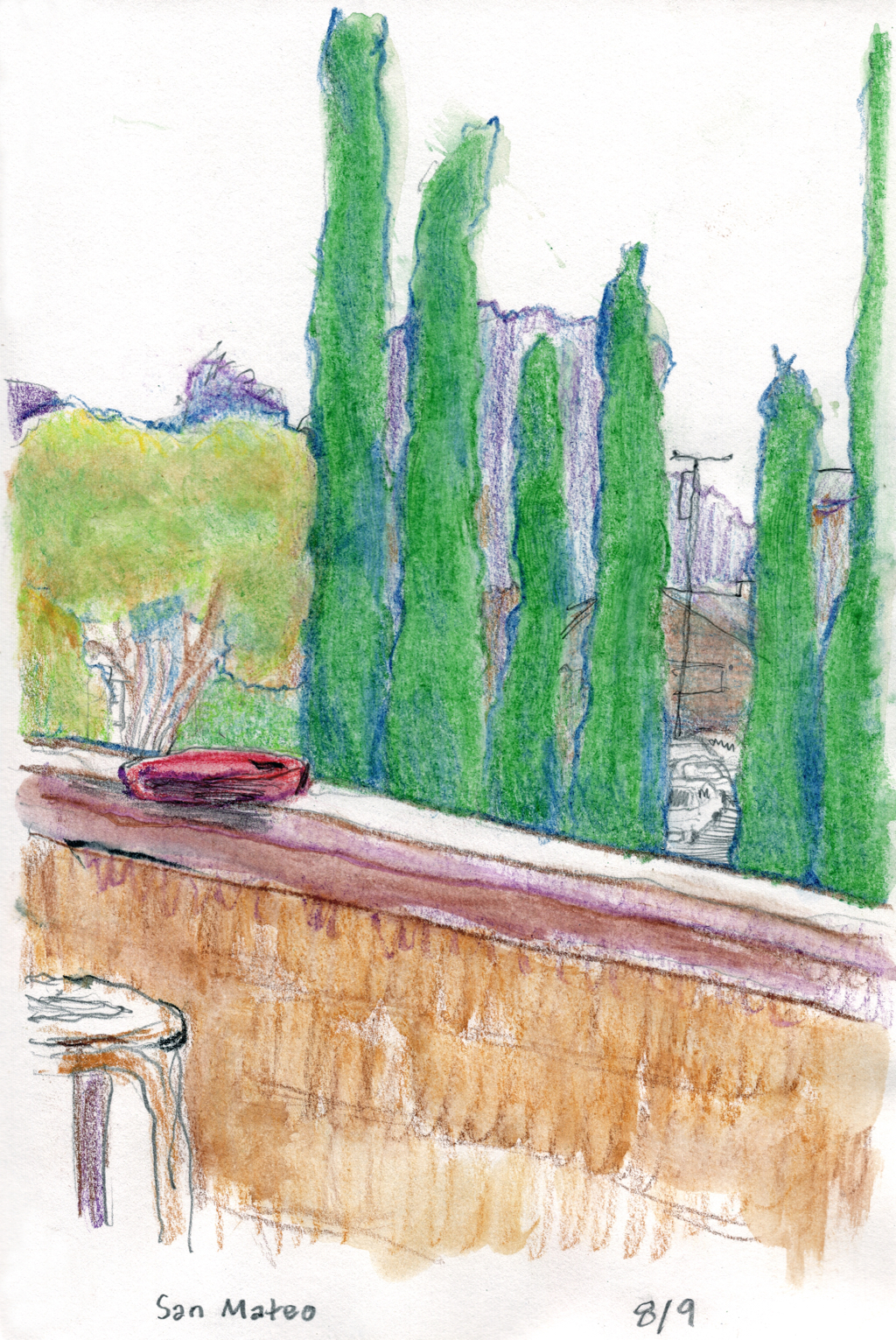
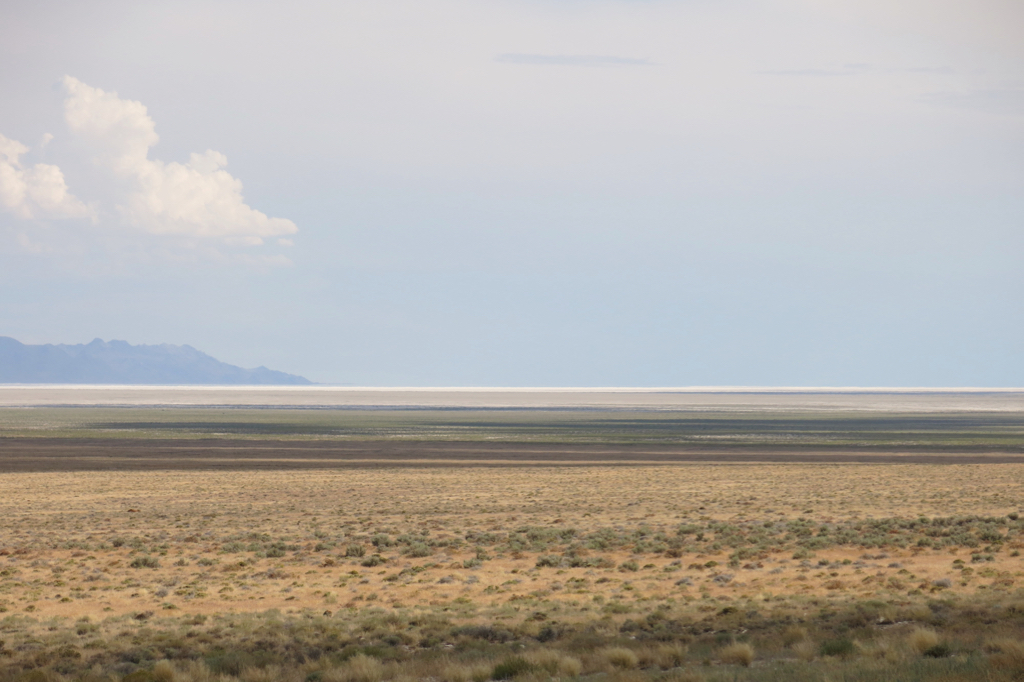
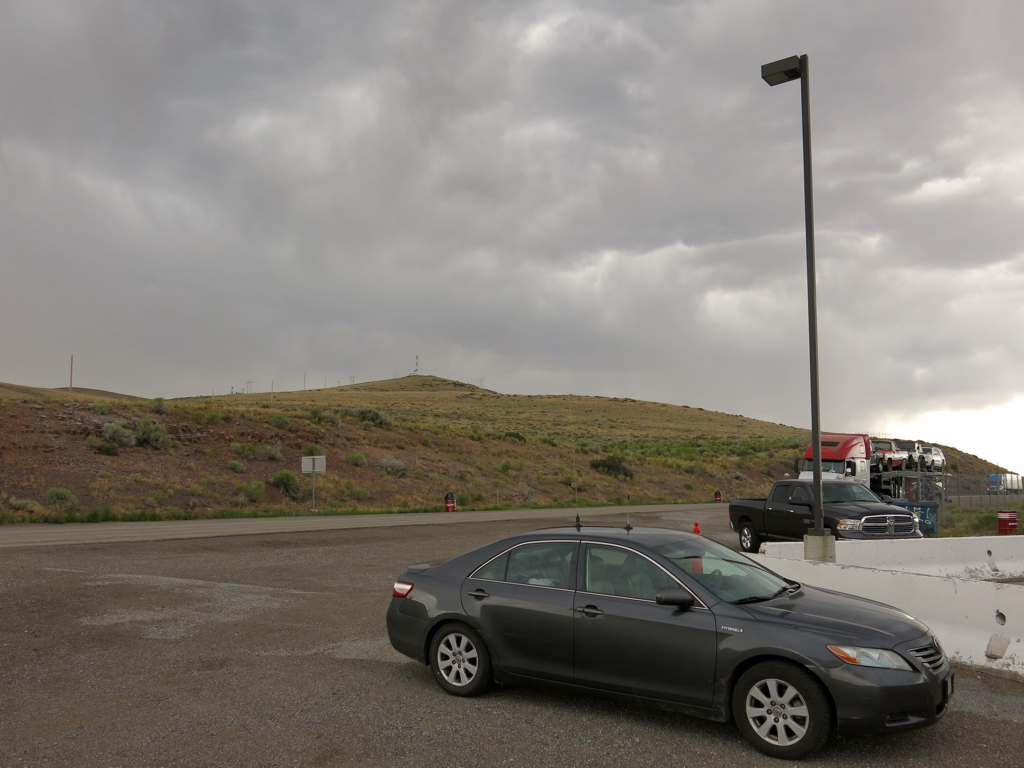
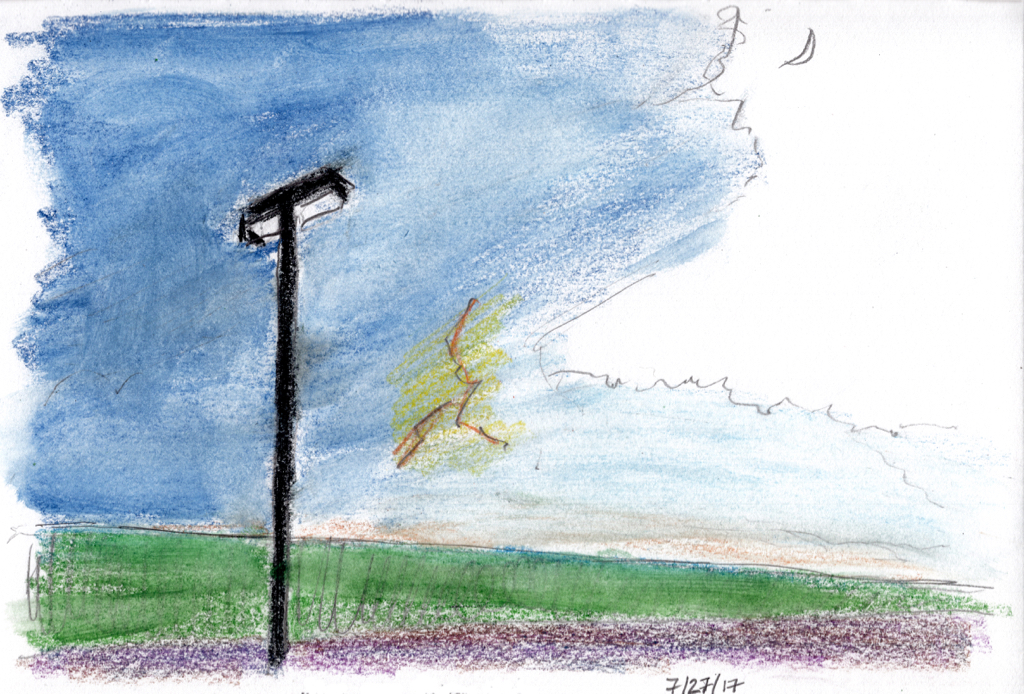
As I drove across Nebraska, the Midwestern Prairie gave way to the Great Plains, and the sky loomed larger and larger, and made me feel less and less consequential. Just before I got to Sidney, I pulled over at a rest area to check the directions to the motel. A large thunderhead towered to the south, to my left, and the sky to the north was covered in thick black roiling clouds lit from within every once in a while with a weird sickly orangey-yellow light. I got out to make a sketch of the thundercloud to my left, with the tiny new moon visible to the west in a patch of sky that was yet clear. I had done only a quick sketch when a gust of wind hit the trees behind me, and then a gust of wind hit me, carrying spattered rain drops, and I ran and got back in the car. The car rocked with the wind as I drove towards Sidney. Another spattering of light rain hit me as I got out of the car to check into the motel — but that was all; the main force of the storm passed to the north, and I was able to carry my luggage inside without getting wet.

Joliet, Ill., to Avoca, Ia.

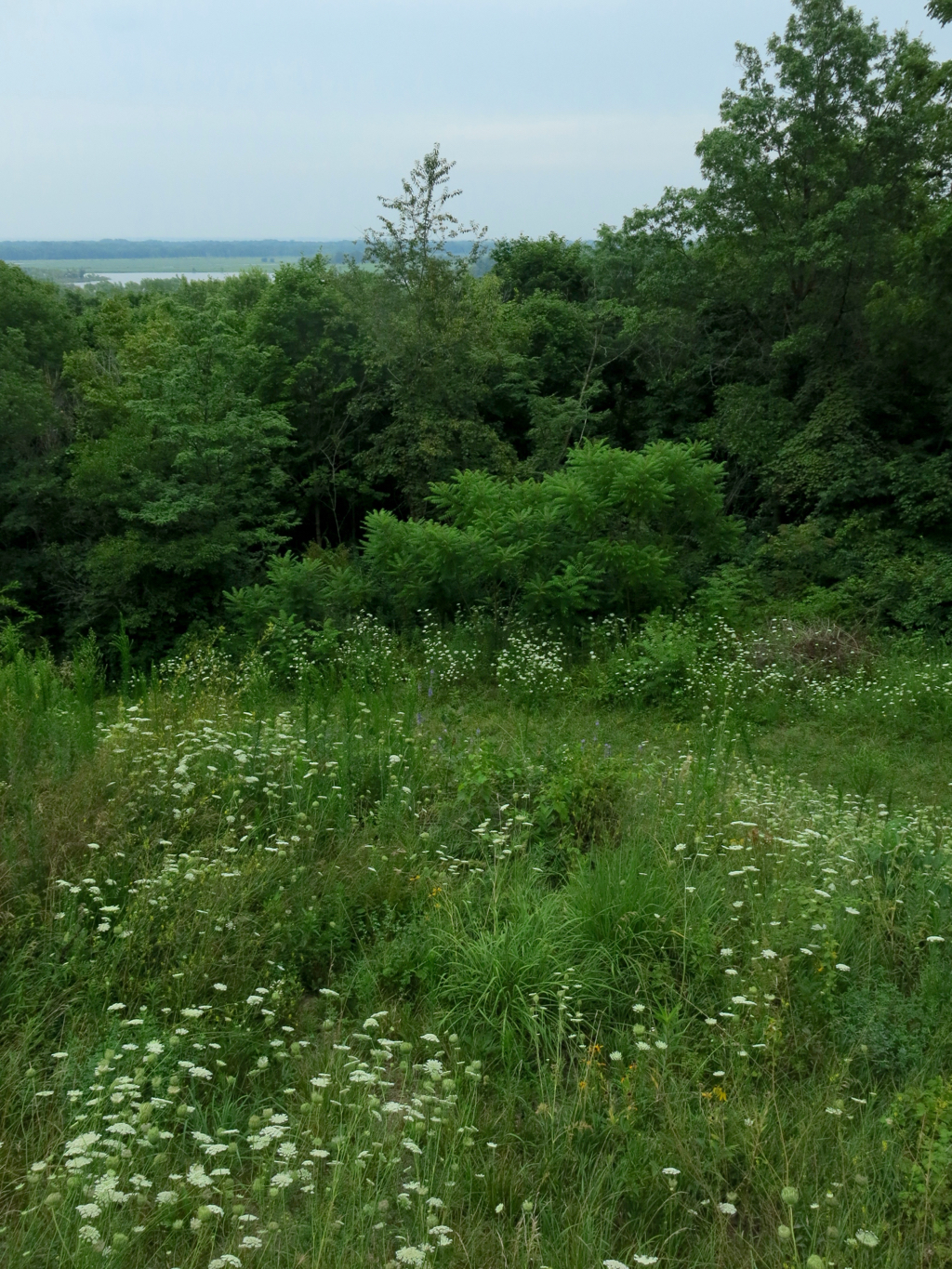
I made a detour to Port Louisa National Wildlife Refuge, along the Mississippi River about six miles north of Wapello, Iowa. It was 86 degrees when I arrived, and the dew point was probably in the low seventies: the air was warm and moist and smelled of fields and river bottomlands. I walked down the bluff to the bottomland. There was standing water not far from the trail, which the map told me was Little Goose Pond, a back water of the Mississippi River. Four Double-crested Cormorants sat in the topmost branches of a dead tree on the opposite shore of the back water, their mouths gaping open for no apparent reason. But I didn’t see many birds; mostly I heard birds, and often I couldn’t be sure what they were; I’ve left behind the eastern woodlands and moved into the prairies and plains of the middle of the continent, an ecological stage with a somewhat different cast of characters.

I stopped to talk to a member of the refuge staff who was cutting brush, aided by two summer interns. “Have you seen many birds?” he asked, looking at the binoculars hanging around my neck. “I haven’t seen many different taxa,” I said, “but I have seen quite a few individuals. Like there were about twenty Wood Ducks back there.” At this, one of the interns perked up. “Twenty?” he asked, somewhat skeptical. “I didn’t see them all, but I heard them,” I told him. We talked about Wood Ducks a bit, then the intern turned and pointed in the woods. “A deer.” I almost didn’t see it, skulking through the woods a good hundred yards away.

Back at the top of the bluffs, I was dripping with sweat. A few drops of light rain falling didn’t cool me off. I turned to look over the broad wooded bottomlands along the Mississippi, wishing I had an entire day to spend there.

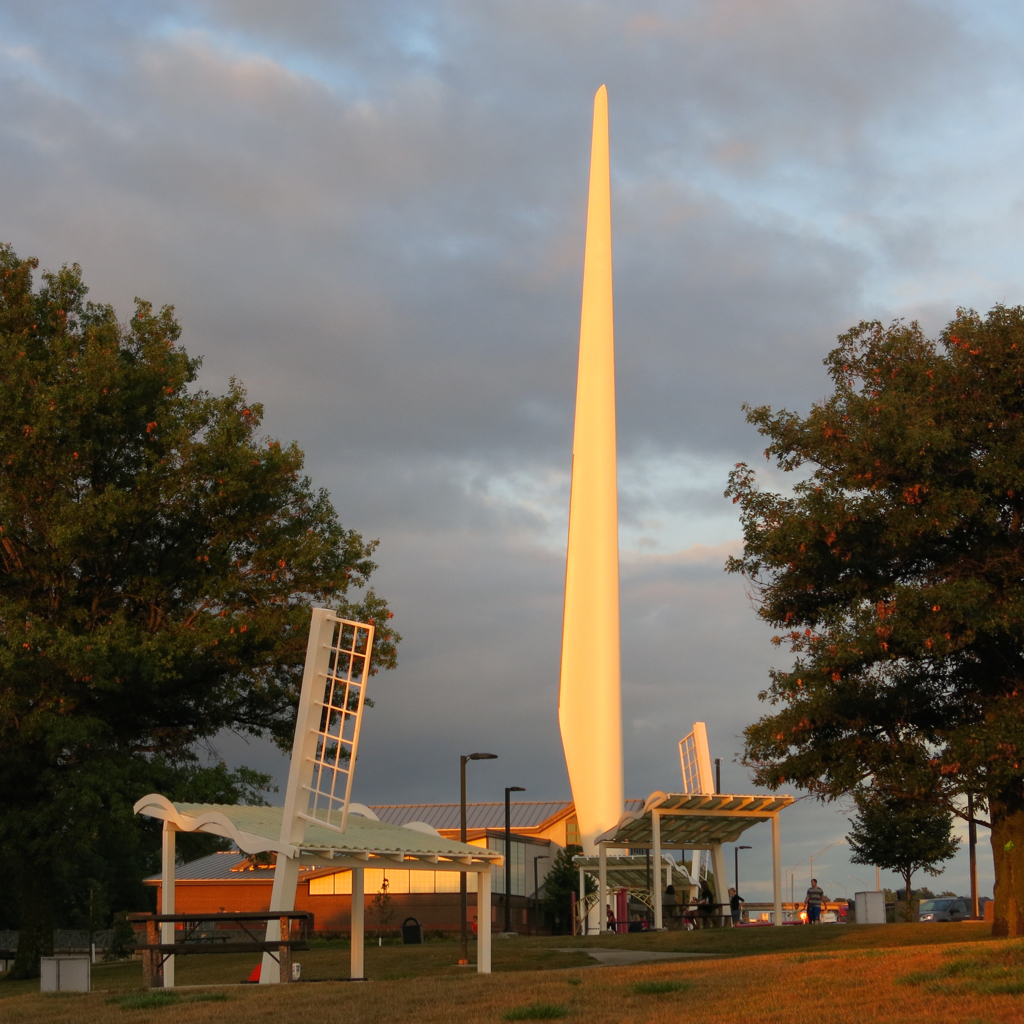
At a rest area west of Des Moines, I stopped because a blade from a wind turbine had been erected there. A plaque said it was 148 feet tall. The children playing on the playground below it, and the picnickers sitting at tables near it, made it look much bigger than the same-sized blades slowly turning on wind turbines on the ridge above.

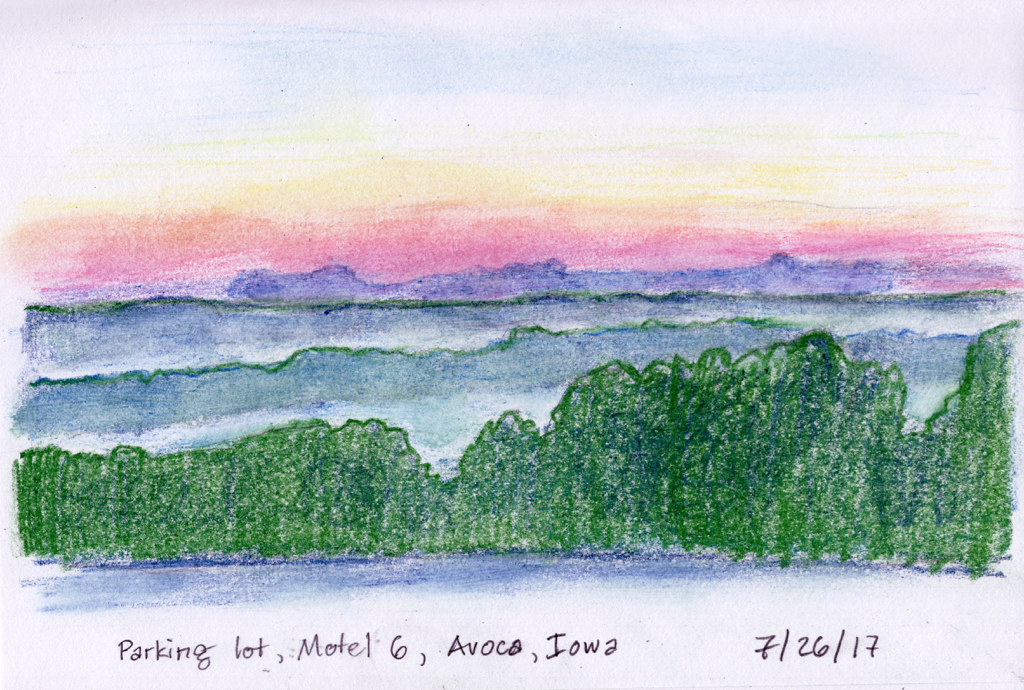
I pulled into Avoca at nine o’clock, and took a moment to watch the light fade over the steeply rolling hills to the west. The air temperature was just about at the dew point; mist began to gather where the land was lowest; the windows on the car were quickly covered with dew; and in the western distance it became hard to tell where the land stopped and the clouds started.

Macedonia, O., to Joliet, Ill.

After two days of getting lots of sleep and still needing two naps a day and some minor aches and pains, I concluded I must have a little infection. My prescription for myself is: drink plenty of water, get plenty of sleep, take acetaminophen when needed, and take it slow.

On the trip out I saw a sign that read “Indian Mounds,” and on this return trip I decided to see them. I followed the sign until I wasn’t sure which way to go, and stopped to ask at a small roadside store. While I picked out something to drink, I listened to three women having a conversation. One woman was telling about her ugly drivers license photo. “When I get rid of this baby fat,” she said, hitching a small baby up higher on her hip, “I’m going to lose my drivers license so I can get a new one.” “You don’t have to do that,” said the woman behind the counter. “You’d know what I mean if you ever saw my drivers license photo,” said the woman with the baby grimly, and went out to her car.

I went to the counter to buy my drink, told the two remaining women that I was a tourist and wanted to see the Indian mounds. “Right up that street,” said the woman behind the counter, “You’ll see the sign. And you should know that this lake here,” pointing out behind the store to where there was a small lake, “is the largest natural lake in Ohio.” I promised to look at the lake, and said that it seemed like it was a nice place to live around there. Both women agreed. “It’s a little slow, though,” said the woman behind the counter, “We like to watch paint dry.” I said that sounded good to me.

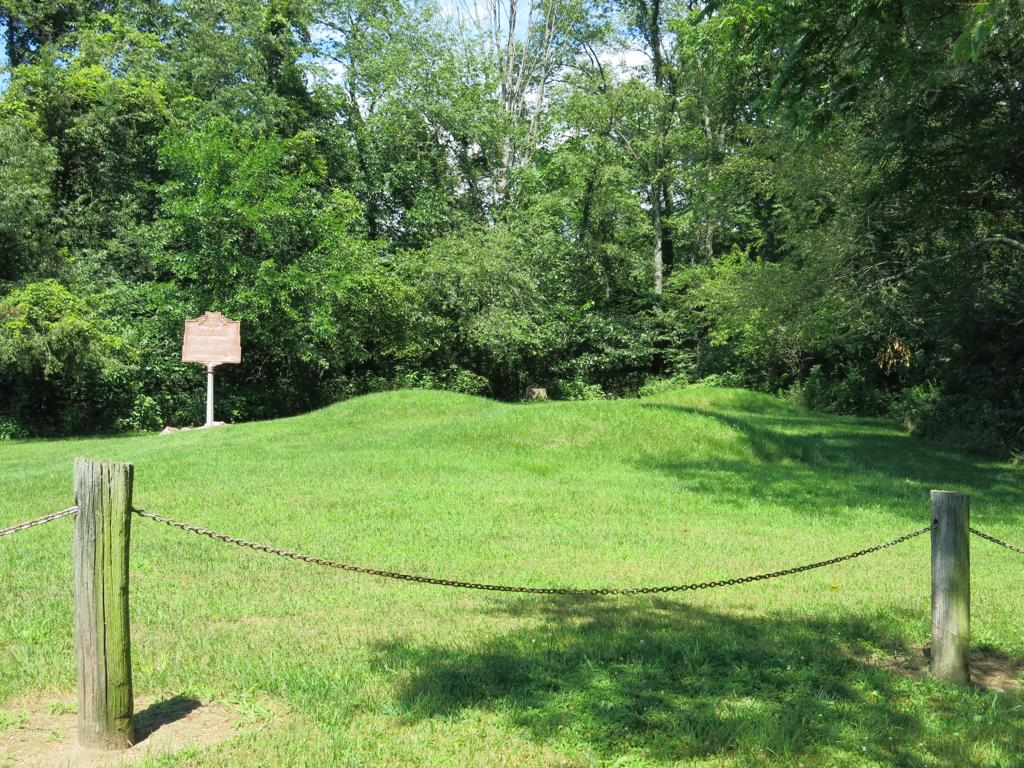
The Indian mounds were small: about two or three feet high, and maybe fifteen feet in diameter. A sign said they were burial mounds probably left by the Hopewell people — the qualifier “probably” was necessary because pot hunters and grave robbers had plundered the mounds and had not adequately documented their finds. Even though the mounds were small, I felt that romance attached to them: they were visible signs of a people who had lived two thousand years ago, and I wondered what the land was like then, what they saw and thought about and felt.

I stopped to look at Nettle Lake on my way back to the interstate highway. From where I stood I couldn’t see the whole lake, but estimated what I saw to cover about 50 acres (I looked it up, and found I could only see about half the lake; the total area is 115 acres). It was a pretty lake, filling a hollow left by the ancient glacier, with small houses and mowed lawns all around the edge.

The toll road through Indiana was as dreary as always. But on this trip, I’m listening to Great Expectations by Charles Dickens, and it’s such an engaging book that the miles passed by quickly.

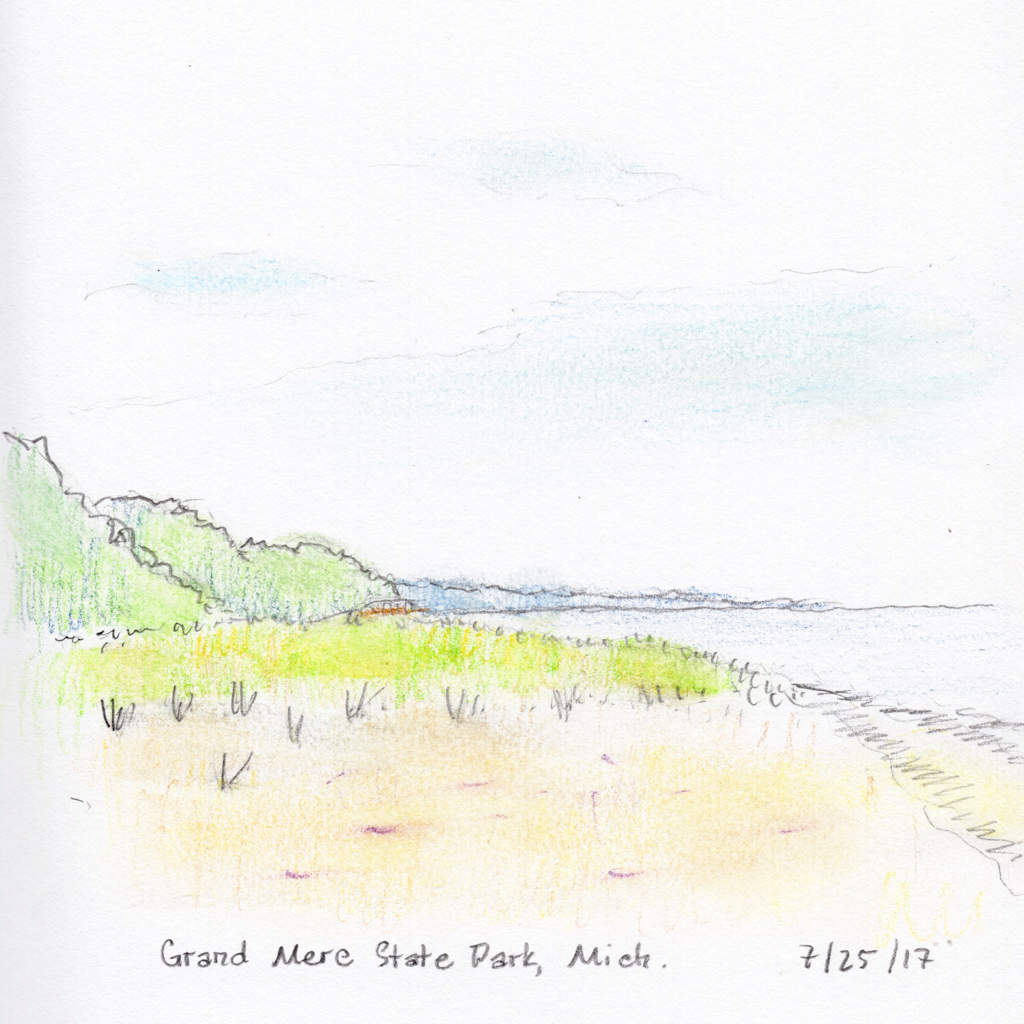
I knew I was going to hit Chicago at rush hour, so I detoured up to Grand Mere State Park in Michigan. The park includes a couple of miles of shoreline on Lake Michigan, as well as three inland lakes formed in depressions left by the glacier. But the one inland lake I saw, South Lake, has mostly filled in so that there is almost no open water in it. I know this, because I climbed up one of the sand dunes that lie between Lake Michigan and the inland lakes. This sand dune was at least a couple of hundred feet high, covered with trees and dune grass. Parts of the trail were steep enough that I could reach out and touch the sand in front of me while hiking; and the hiking was so difficult in the loose, sliding sand of the trail up that I dug my hands in and used them to help my slow upward progress. I had to stop several times to catch my breath, but when I got to the top the view was worth it: the mostly overgrown inland lake to the east, and wide shining grey Lake Michigan to the west.

Then I slid down the other side, and and sat and admired the dramatic lake shore: huge wooded sand dunes on my right, a wide beach covered with dune grass in front of me, the wide lake spreading out to my left.

I walked north along the lake, and climbed back over the wooded dunes, this time on an easier trail. My legs were sore by the time I got to my car.

And then I drove on, dodging the insane Chicago drivers, to arrive in Joliet at nine o’clock.

Rochester, N.Y., to Hudson, Ohio

The bookstore for the Rochester Institute of Technology was a five minutes drive from last night’s motel, so I stopped there on my way to the interstate. In five minutes of browsing, I found Bumble Bees of North America by Paul Williams, et al. I’m fascinated with Hymenoptera (bees and wasps) to begin with, and as the first sentence of the book says, “Everybody likes bumblebees.” At every rest stop during today’s drive I read about bumblebees, genus Bombus, and every bit of it was fascinating reading; though I was discouraged to learn that distinguishing some Bombus species requires looking at details like the structure of male genatalia and learning terms like “midleg basitarsus distal posterior corner.”

The book about bumblebees was the only interesting part of today’s drive; I had no time to stop anywhere along the way, because I planned to meet my uncle in the mid-afternoon. But the visit with my uncle was well worth the boring drive. We had a long talk, mostly about the younger members of the extended family, we ate dinner together, and then before I went back to the motel we called my cousin E. to ask her about the recent death of cousin C. He had had an unpleasant illness, and his death came more quickly than expected. This call was a somber end to what was otherwise an upbeat visit; but this is simply part of the experience of upper middle age; people that you’ve known for decades start to die off; and of course the number of such deaths will only increase, and their pace accelerate, and the thing to do (I can see from watching people like my uncle) is to acknowledge the deaths but not let them take over your sense of being; to keep the focus of one’s attention on growth and life rather than on death and decay.

Now I really have to get to bed early, so I can get on the road at a decent hour tomorrow morning. But first I want to read some more about bumblebees.

Eastern Mass. to Rochester, N.Y.

I left my sister’s house this morning, and started driving west. By late morning I was in the Berkshires in western Massachusetts, and I couldn’t stand sitting in the car any more, so I got off the highway to go for an hour and a half walk on the Appalachian Trail. I parked in Beckett, Mass., and started walking, following the famous white blazes south.

There’s a footbridge for the Appalachian Trail over the interstate, and I’ve driven under it many times; now at last I was walking across it, watching the cars speed by under my feet. The trail climbed up into the woods, and a Wood Thrush sang in the trees. The traffic noise grew fainter and fainter, until at last it faded completely away. Black-throated Green Warblers and Red-eyed Vireos sang their monotonous songs in the trees above me. All too soon, it was time for me to turn back, and reluctantly I headed back downhill to the car.

The rest of the day was boring: driving, stopping at rest areas, a couple of naps in the car because I was still tired from dealing with Dad’s estate. I went to the wrong place in Rochester, and when I finally got to the correct hotel and checked my voice mail I got a message from one of my cousins that another of our cousins had died after a long illness.

Eastern Massachusetts

I spent the week at my younger sister’s house going through Dad’s papers, figuring out what needs to be saved. Each morning before we started working, I drove to Great Meadows National Wildlife Refuge in Concord, Mass., to spend a couple of hours birding.

On the first day I went there, another birder pointed out where a Ruby-throated Hummingbird was nesting. The mother would come once or twice an hour to feed the young. When they saw or heard she was near, they pointed their bills straight up, and opened their mouths. She perched on the edge of the nest, and put her long bill down into the mouth of one baby, far enough down that I could not see the end of her bill. Presumably she regurgitated nectar that she had gathered. She alternated between nestlings, putting her bill into each nestling’s mouth three or four times during a feeding.

Over the course of the week, pin feathers gradually replaced downy feathers on the nestlings; on Friday, the last day I made it to Great Meadows, the nestlings were spreading their wings. By now they may well have fledged, and left the nest. Also on Friday, I saw a Least Sandpiper, which must be one of the early shorebirds to return from the far north where it nested, gradually making its way south for the winter, stopping here and there to feed heavily. With the hummingbird nestlings about to fledge, and the shorebirds heading south, it felt like the season was turning: summer was past its peak and heading towards autumn.

My sister and I finished going through Dad’s paperwork, and closed out the checking account for the estate. There is very little left to do, except shred his financial and medical records. And tomorrow I start driving back to California.

Section through Ferry Beach, Maine

If you’re at Ferry Beach and you start at the ocean, then walk inland, first you pass up over a sand dune covered with dune grass. Once past the primary dune, you pass over secondary dunes, with low-growing pines and various grasses and forbs growing in sandy soil. From the secondary dune, you pass down into lower ground, generally swampy and poorly drained and sometimes with open water, generally wooded with mixed hardwoods and conifers. If you keep walking inland, the ground gradually gets higher and drier, but the slope is gradual enough that where there are low places you’ll often find swampy areas.

Below is the sketch I made to show the kids in the ecology class how this all looks. And then we walked from the ocean inland, so that we could see it in real life.

Utica, N.Y., to Saco, Me.

I had to get to Saco, Maine by one o’clock, which meant I had to start driving by about six in the morning. I managed to get up and get on the road by ten after six. By the time I got to central Massachusetts, traffic started getting heavy, and it was stop-and-go in several places. But I made it to Saco in time for the one o’clock meeting for children’s staff for Religious Education Week at Ferry Beach Camp and Conference Center, somewhat frazzled, but ready to spend the week doing nature and ecology activities with children.

Mentor, Ohio, to Utica, N.Y.

Of course I got a late start again today, and I had to get the oil changed in the car as well. So I planned to get the oil changed, then get on the road as quickly as possible, with no delays and not stopping.

But the James Garfield National Historic Site was a quarter of a mile from the place where I got the car’s oil changed. As I was driving to the interstate, I couldn’t resist stopping in. A tour was just starting, and they let me join it.

Garfield, if you remember (I hadn’t remembered until the tour started) only served as president of the United States for four months before he was shot. He received inadequate medical care for the wound, lingered for nearly three months, then died.

We toured the Garfield house, which they called “Lawnfield,” and from the front porch of which Garfield gave numerous campaign speeches. After his death, his widow Lucretia more than doubled the floor area, creating a James Garfield memorial presidential library to hold all his books and some of his papers. While our excellent tour guide told us about the room and its contents, I looked at the books, and spotted both Channing’s memoirs, and his complete works.

Garfield was baptized into the Disciples of Christ, so he didn’t own these books because Channing was a Unitarian; any well-read progressive Republican politician of the mid-nineteenth century might have had Channing’s works.

My favorite room was called, if I heard the name right, the “Snuggery.” It has a comfortable reading chair, a desk, a couple of other chairs for visitors, and a fireplace over which is the motto “In Memoriam,” the poem by Tennyson, one of Garfield’s favorite poems.

It was worth the time to stop and see Lawnfield, and I liked it so much I’d like to return some day. But of course that stop meant I arrived at my hotel later than I had hoped, and I have to get up at five tomorrow morning so I can be in Maine by one in the afternoon….