Housing

We’re looking for a new place to live — our landlord is finally selling the duplex where we live, so he can use the money to enjoy his retirement. We’ve been looking for most of a month now, and it has not been easy. The average rent for an apartment around here is ridiculously high; the Bay Area has some of the highest housing costs in the U.S. In some cities in the Bay Area, you can make over $80,000 a year and still qualify for affordable housing options.

We refuse to spend more than a third of our combined gross income on rent, and we would prefer to spend only a quarter of our gross income. The apartments we can afford are either tiny, or shabby, or sometimes both tiny and shabby. To make matters worse, competition for these relatively affordable, tiny or shabby apartments is intense. All this combines to make our search for housing into an unpleasant task.

The ridiculously high cost of housing, and the shortage of affordable housing, are problems that will not be solved any time soon. Build more affordable housing? Recent news stories carried by Bay Area media outlets make it clear that demand will outpace supply of new affordable housing for the foreseeable future. Impose rent control? Most local rent control initiatives have failed, under intense pressure from the real estate lobby. Leave the Bay Area? That’s the answer for many people; several cities in Silicon Valley have lost population in the past few years. Live on the streets? The homeless population in the Bay Area continues to grow.

I don’t have any answers. But I do know that we here in Silicon Valley have a front row seat for watching the growth in income inequality.

Smoke

We were awakened Sunday night by the smell of smoke. We got up in the dark and tried to figure out where the smell was coming from. Maybe the neighbors left a fire burning in their fireplace overnight, and the slight breeze was blowing it into our house? When we got up on Monday morning, we read that thousands of acres were burning about 70 miles north of us; we had smelled the smoke from those fires.

The wind shifted yesterday and the air cleared, but today the smoke returned. It appeared to be an overcast day, but it was smoke, not clouds, blocking the sun. Over in the East Bay, Ms. M.’s spouse saw ash falling out of the sky in Oakland. I stayed indoors with the windows closed.

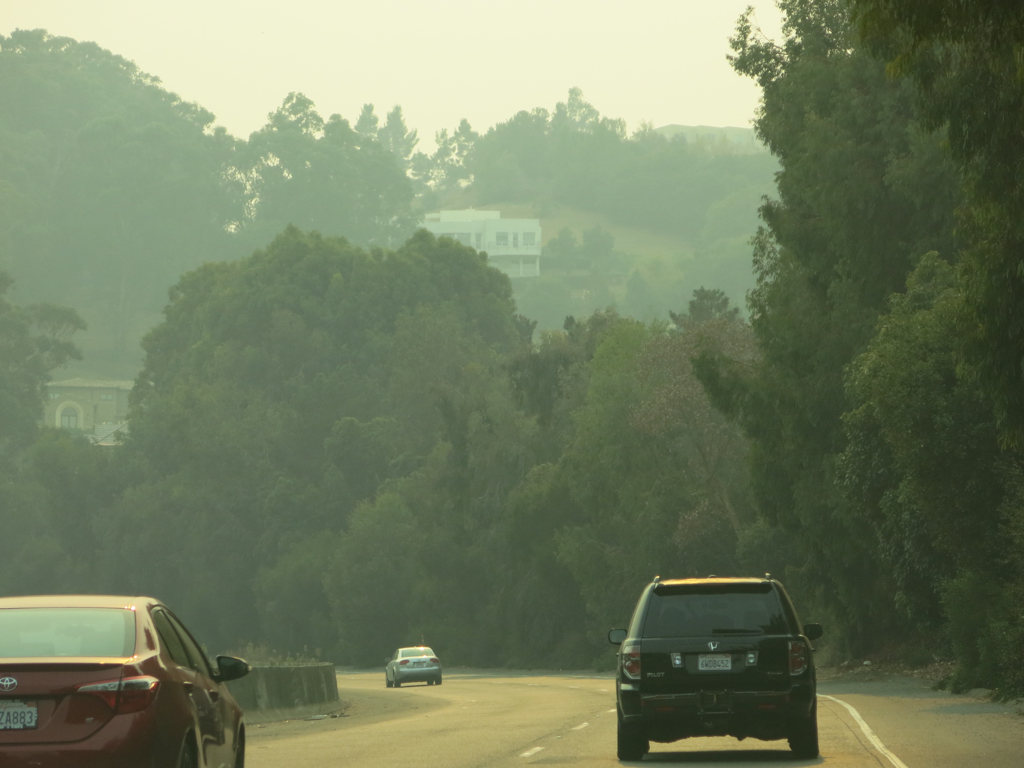
In the afternoon, Carol found an apartment for us to look at over in Half Moon Bay. We drove up Highway 92 into the hills west of San Mateo. The smoke reduced visibility so that from the flats where we started out, the tops of the hills looked blue and misty.

<

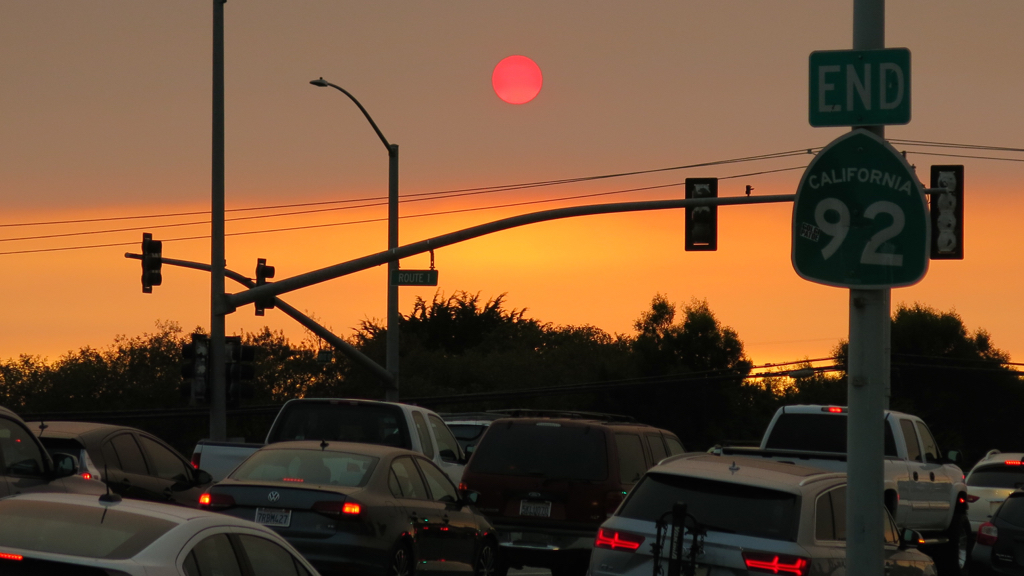
In Half Moon Bay the air smelled clean; the line of hills to the east, and an onshore breeze, kept the smoke away. But we could see the smoke above us, a wide plume about a thousand feet up. As the sun got low in the sky, the plume of smoke turned it into a lurid red glowing ball, like a huge red traffic light in the sky.

Argh

Our landlord is selling the place we live in. Finding a new apartment in the tight Bay Area rental market has become our all-consuming task (we had a lead on one place, but that fell through). If you don’t live in the Bay Area, you won’t believe how tight the rental market is here. If you do live in the Bay Area, and you know of a one-bedroom apartment that’s reasonably priced within an hour’s drive of Palo Alto, let me know!

Heat and smoke

The temperature reached 104 degrees at San Francisco airport this afternoon, which is about 6 miles from our house.

We drove to Berkeley to see my cousin, and when we got to the Bay Bridge, you could barely across San Francisco Bay because of the smoke that has drifted down from the wildfires burning to the north.

More heat and smoke forecast for tomorrow.

Now I know perfectly well that climate change cannot be traced in short-term weather patterns: climate change is traced through analysis of wider trends, which is what makes it so difficult for human beings to understand. And I know perfectly well that just because we have extreme heat today, and Europe had extreme heat a couple of weeks ago, and there are forest fires raging across the Pacific Northwest because of hot and dry conditions up there, and a devastating hurricane swept through Houston — I know perfectly well that these things, by themselves, do not indicate that climate change is getting worse.

But I can say, with some accuracy: Guess we’d better get used to heat and smoke (and hurricanes, and…), because we’re just going to have more of them.

Busy

We started Sunday school on August 20, a week earlier than usual, to correspond with the start of public school.

I leave for sabbatical on October 1, and have to have everything ship-shape and ready for the Sabbatical Religious Educator.

My other chorus started up, and the director is giving us some challenging music.

Our landlord decided to sell the house we’re living in (and thanks, Nancy, for finding a place for us to move to).

No wonder I feel busy.

Three views of the eclipse

1. HF wavelengths

“Although the ionospheric effects of solar eclipses have been studied for over 50 years, many unanswered questions remain,” according to HamSci.com, organizers of citizen science experiments designed to test the propagation of radio signals during the eclipse. I was not set up to actually participate in the citizen science experiments organized by HamSci.com, but I turned on one of my amateur radio transceivers to monitor high frequency transmissions during the eclipse; specifically, I monitored PSK-31 transmissions centered on 14.070 MHz, where I knew there would be a lot of activity.

Propagation was good before the eclipse started; at about 9 a.m. there was a fair amount of activity on 14.070 MHz, and I was receiving stations as far away as Colorado. As the eclipse progressed, I received fewer and fewer transmissions, and by about 10:20 (when the eclipse was at its maximum here in San Mateo), there were almost no readable transmissions. By now, the band is more active, although the stations I’m hearing are all on the West Coast.

My observations were completely unscientific, and it will be interesting to see what comes out of the data that the folks at HamSci.com are gathering during this eclipse.

2. Visible wavelengths

My plan was to project an image of the sun through binoculars mounted on a tripod. The sky was covered by stratus clouds (high fog) at 9 a.m., but by 9:45 the clouds began to break up and Carol and I got a few views of the moon’s shadow slowly moving over the sun’s disk. It became mostly clear by 10:20, in time for the maximum. Then it stayed clear, and I was able to watch the moon’s shadow slowly slide away from the sun.

One of the benefits of projecting the eclipse is that I could see the rotation of the earth as the projected image slowly moved as the sun changed its relative position in the sky. This was a good reminder that an eclipse involves relative movement of three astronomical bodies: sun, moon, and earth. And if I had had access to better optics, I could have projected a larger image and watched the movement of sunspots as well.

3. The emotional response

At about 10:20, when the eclipse was at its greatest extent, it was noticeably dimmer than it should have been. The light was about as bright as it would be around sunset — the difference being that the sun was high in the sky, so the shadows were short. It definitely felt a little eerie.

But mostly what I felt was a sense of wonder. This was the most astronomical fun I’ve had since watching the transit of Venus a few years ago.

San Mateo, Calif.

This year, I set aside a day of vacation to unpack the car, do laundry, and ready to go back to work. Those tasks left me a few hours to begin dealing with the papers and photos I had brought back with me; I had sorted through most of Dad’s papers and photos while in Massachusetts, but I still had a couple of boxes to sort through, scanning those that were worth saving.

I started with the easiest task. While in Massachusetts, I had divided Dad’s photos up among his three children; if a photo featured one of us prominently, I gave it to that child; and the other photos I divided randomly and evenly among us. The easiest task was this: take my share of the photos, sort them in chronological order, and put them into a photo album. That took me a couple of hours, and I showed Carol the photo album, and then I looked through it again on my own. When I had done all this, I was pretty sad — the worst part was looking at the photos of my mother the year before she died; I had forgotten how bad she looked — but I was nevertheless glad I had done it. I realized, too, that most of these photos just sat in boxes for years and years, for decades even, and we never looked at them. Now even if I don’t want to look through that photo album ever again, at least I have the option to do so, and that feels like a minor accomplishment.

And that, I guess, is the real end to this summer’s road trip.

Winnemucca, Nev., to San Mateo, Calif.

Winnemucca lies at about 4,200 feet above sea level, has a desert climate with about eight inches of precipitation a year, is the only incorporated city in Humboldt County, and has itself a population of only about 7,400 people; as a result, the air is clean and fresh. I felt groggy when I awoke — too many days of driving this week, and too many hours of dealing with Dad’s papers last week have taken their toll — but I got up to go get a cup of coffee, and as soon as I had taken a few breaths of that cool, clean desert air, before I had even had any caffeine, I felt alive and awake and ready to go.

I headed west on Interstate 80, then south on U.S. 95. Just after I had made the turn onto U.S. 95, a two-lane highway with a 70 mile an hour speed limit, I saw a little sign that read “California Trail / Auto Tour Route / Truckee Route,” and I could see a rough track running west through the desert. I found a place to turn around, and walked out along the track into the desert.

Maybe this track followed the route of the original California Trail turn-off to Truckee, the route the Donner Party followed to its cannibalistic end in the Sierra Nevada Mountains, but the tracks that were visible were those of twenty-first century off-road vehicles. The temperature was now up to about ninety degrees, but the air was still fresh and dry, and I walked briskly along for for a mile or so until my car was a speck in the distance. It must have rained yesterday, for the whitish soil was still damp, and my feet crunched pleasantly on a dry crust that had formed on top of the moist soil. Black, red, and buff-colored igneous rocks were scattered on the surface of the soil, many of them with air bubbles in the rock.

As I drove away from where I had parked, I saw that just south of where I had got out and walked, the highway crossed over a small ditch with open water in it. Perhaps this was why Truckee Route followed this particular path across the desert, following that dry wash that sometimes had water in it.

I stopped at Stillwater National Wildlife Refuge east of Fallon, Nevada, and it was just as I remembered it: a stunning oasis of open water and green wetlands. The difference this time was that Stillwater Reservoir had water in it; when I was here a couple of years ago, the reservoir had been dry. The open water, the green tule rushes and cattails, and the loud calls of a myriad of birds — squawking White-faced Ibis, grunting and hooting American Coots, booming American Bittern, quacking Blue-winged Teal and Cinnamon Teal, screaming Red-winged Blackbirds — contrasted bizarrely with the quiet of the reddish desert mountains in the distance and the serene blue sky overhead.

On my way through Fallon, I stopped at the bookstore in town, Third Space Books, and had a long talk with one of the owners, who turned out to be an early childhood educator who was worked with troubled adolescents during the summer. She was pursuing her doctorate of education online, and I asked about her online program and how she liked it. Aside from the obvious point that it obviously made more sense for her to get her degree online than driving an hour each way to study at the University of Nevada in Reno while holding down a full-time job in education, she also preferred online learning.

From Fallon, I drove up over the Sierra Nevadas towards home. As usual, I stopped at the Donner Pass rest area, and took the trail from the rest area towards the Pacific Crest Trail, where I ran into a long-haul trucker who was taking a break from driving. He said that while he had stopped at that rest area many times, it had always been at night, and this was the first time he had seen it during the daylight. “Where does that trail go?” he asked, and I said, “Pretty soon it meets another trail, and if you turn left you can walk to Canada, and if you turn right you can walk to Mexico.” His eyes widened, and he clearly thought I was putting him on, so I added, “I’m not making this up,” and explained to him about the Pacific Crest Trail. He said he’d like to return sometime with his thirteen year old son, who sometimes came with him on these trips. On the other hand, he also said that he didn’t like driving through Nevada because there were casinos and slot machines everywhere, and he had lost too much money gambling earlier in the day, and he was thinking of asking his boss to only send him along the southern route, via Interstate 40.

We said goodbye, and he walked abck to his truck while I walked out into the alpine forest that is slowly. What struck me most were the many tall white skeletons of dead pine trees which stand out among the remaining green trees. The Sierras have been ravaged by bark beetles, a native species that can kill trees that are stressed by drought. According to a March 28, 2015, article in the San Francisco Chronicle, “The beetle population is normally kept in check by the winter cold, but three years of above-average temperatures and lack of snowfall have given the growing bug hordes free rein to search and destroy.” This is yet another effect of global climate change. This past winter was cold and snowy, providing a respite for the trees this summer; but the trend of global climate change means that the bark beetle problem will soon return. I stood there and made a sketch: a few bleached trees standing out from trees and undergrowth that are bright green for now.

I briefly fantasized about continuing to walk along the Pacific Crest Trail, heading for Canada. But instead, I turned around and headed back to my car.

Note: Written on 8/2 from my notes.

Evanston, Wyo., to Winnemucca, Nev.

When I got up, the air felt cool, clean, thin, and bracing. The temperature this morning was in the low sixties; Evanston lies far from any major city or industry or source of heavy air pollution; the city is some 6,750 feet above sea level, so the air is much thinner than the sea level air I’m used to; and the combined effect made me feel cheerful, alert, and a little light-headed. I decided to take a walk in Evanston before I started the day’s long drive; Bear River State Park was just minutes from my motel, and soon I was walking along the Bear River. I left my binoculars in the car, because I needed to walk, not stand and look at birds; and of course there were many birds in the marshes and willows and green grassy fields around the river, and I soon wished I had brought the binoculars, but I managed to walk briskly for an hour without them.

As I drove down the highway towards Salt Lake City, I couldn’t decide which route to take. About an hour from Evanston, I stopped at a rest area that had Utah tourist information. There was a brochure for Bear River Migratory Bird Refuge — a different Bear River from the one I walked beside in Evanston, this was a Bear River in Utah that empties into Great Salt Lake. So instead of going through Salt Lake City and then driving west across the salt flats, I went north towards Idaho, got off the highway at Brigham City, Utah, and headed west to the auto tour route of the Bear River Refuge.

I generally dislike auto tour routes; I don’t like sitting in my car to look for birds, I prefer to get out and walk around. But this auto tour route proved to be exceptionally beautiful: driving on dikes through the Bear River delta, the flatness of Great Salt Lake to the south, the dry flat plain gradually rising up from the Lake to the north and east, towering mountains appearing at a distance in all directions, bright sun coming down through the dry, incredibly clear desert air; and all around the dike on which I drove was the incongruous sight of water in the middle of the desert.

I spent two hours driving along the auto tour route, getting out frequently to to look at birds, or admire the landscape, or for no real reason at all. Had I had all day to spend, I would have liked to have walked all twelve miles of the auto tour route. But as it was, my average speed was just six miles an hour: plenty of time to see adult Western Grebes swimming with their fuzzy babies, and Cliff Swallow nests, and half a dozen American White Pelicans soaring in formation over the open water of the marsh.

From the refuge, I drove north on Utah Highway 82, past the turnoff for Promontory Point, past Orbital ATK with its exhibit of a huge NASA rocket, drove on the interstate for a few miles, then headed west on Utah Highway 30. A sign informed me that there were no services for the next 100 miles. There was very little to see but vast plains, sudden steep hills, mountains in the distance, and the slowly gathering clouds in the sky overhead. I drove through the village of Park Valley, where the Overland Trail Motel had once sold gas but was now closed, and saw two children riding horses up and down a large mound of dirt. More plains and cattle and carefully irrigated hayfields, then the hamlet of Rosette with a tiny post office. The road turned south towards the north edge of the great salt flats, and I stopped to stretch my legs — it had been a long time since I had left Bear River Refuge — and looked out over the salt flats in the distance. The plain I stood on tilted downhill, but when it met the perfectly level salt flats I had the impression that the salt flats were tilting up and away from me. Then the salt flats are so vast that you become aware of the curvature of the earth’s surface. I guessed I could see for a hundred miles or more. I am not used to seeing that far on land, and I found it disconcerting.

I kept driving across the open landscape, resentful if I saw another car — which was not often — feeling very much at peace. I realized that I had not wanted to drive through Salt Lake City, so even though this route was longer and slower, I was very glad I had come this way. At last I rejoined the interstate highway in Oasis, Nevada, and though there weren’t many vehicles on it, it felt busy and crowded. I am not looking forward to plunging back into the bustle of city life when I return home tomorrow.

At Pequop Summit, I pulled over to stretch my legs again. It started raining. It wasn’t a heavy rain, or a hard rain, but it was a steady light rain. The sage brush smelled strongly in the rain. I had to try to photograph rain in the middle of the Nevada desert, though you can’t see any evidence of rain in the photo — the air was so dry the pavement didn’t get wet — all you can see is dark clouds. There was a roll of thunder, and I got back in my car and continued driving west.

Notes:

If I ever return to the area north of the salt flats, I’d like to go see Nancy Holt’s huge environmental artwork “Sun Tunnels,” about ten miles south of Utah highway 30.

I ate dinner at a Chinese restaurant in Elko, Nev., and the fortune inside the fortune cookie read: “You desire to discover new frontiers. It’s time to travel.” — an ironic fortune to receive when I’m about to end my travels and return to work.