Housing

We’re looking for a new place to live — our landlord is finally selling the duplex where we live, so he can use the money to enjoy his retirement. We’ve been looking for most of a month now, and it has not been easy. The average rent for an apartment around here is ridiculously high; the Bay Area has some of the highest housing costs in the U.S. In some cities in the Bay Area, you can make over $80,000 a year and still qualify for affordable housing options.

We refuse to spend more than a third of our combined gross income on rent, and we would prefer to spend only a quarter of our gross income. The apartments we can afford are either tiny, or shabby, or sometimes both tiny and shabby. To make matters worse, competition for these relatively affordable, tiny or shabby apartments is intense. All this combines to make our search for housing into an unpleasant task.

The ridiculously high cost of housing, and the shortage of affordable housing, are problems that will not be solved any time soon. Build more affordable housing? Recent news stories carried by Bay Area media outlets make it clear that demand will outpace supply of new affordable housing for the foreseeable future. Impose rent control? Most local rent control initiatives have failed, under intense pressure from the real estate lobby. Leave the Bay Area? That’s the answer for many people; several cities in Silicon Valley have lost population in the past few years. Live on the streets? The homeless population in the Bay Area continues to grow.

I don’t have any answers. But I do know that we here in Silicon Valley have a front row seat for watching the growth in income inequality.

Smoke

We were awakened Sunday night by the smell of smoke. We got up in the dark and tried to figure out where the smell was coming from. Maybe the neighbors left a fire burning in their fireplace overnight, and the slight breeze was blowing it into our house? When we got up on Monday morning, we read that thousands of acres were burning about 70 miles north of us; we had smelled the smoke from those fires.

The wind shifted yesterday and the air cleared, but today the smoke returned. It appeared to be an overcast day, but it was smoke, not clouds, blocking the sun. Over in the East Bay, Ms. M.’s spouse saw ash falling out of the sky in Oakland. I stayed indoors with the windows closed.

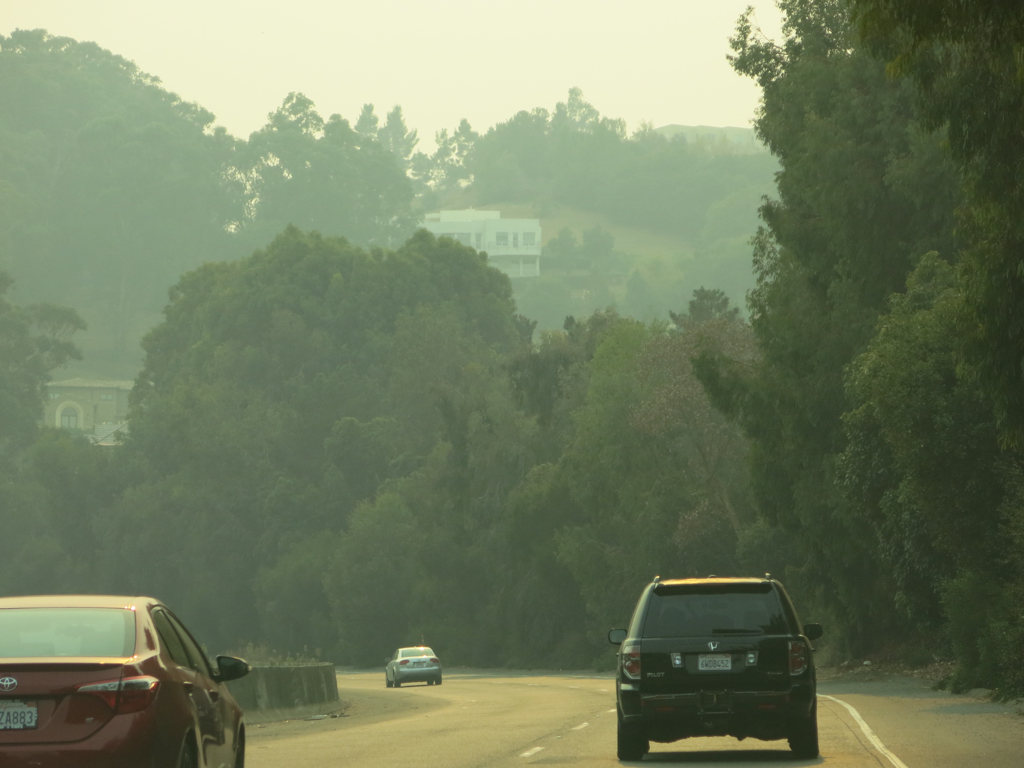
In the afternoon, Carol found an apartment for us to look at over in Half Moon Bay. We drove up Highway 92 into the hills west of San Mateo. The smoke reduced visibility so that from the flats where we started out, the tops of the hills looked blue and misty.

<

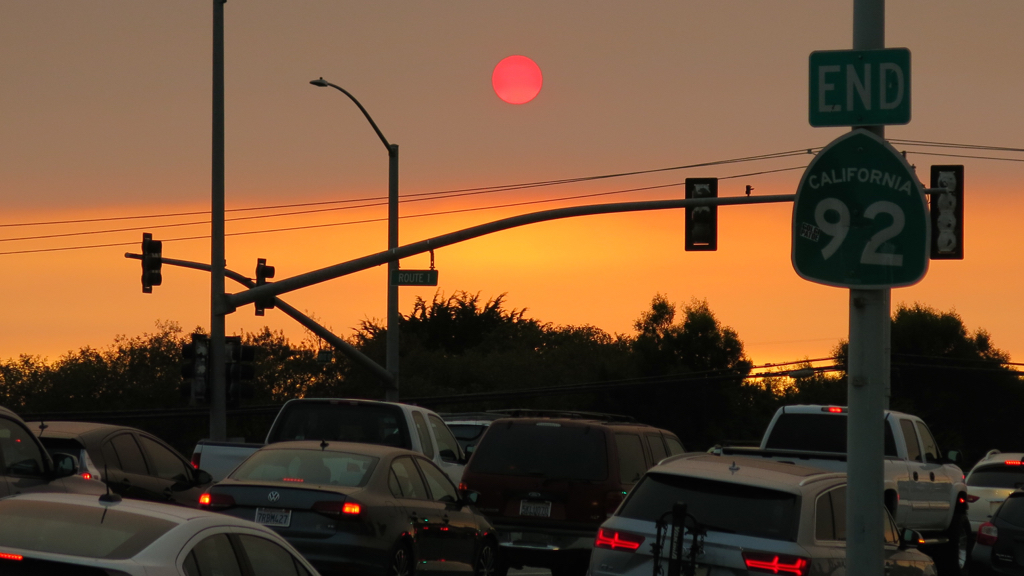
In Half Moon Bay the air smelled clean; the line of hills to the east, and an onshore breeze, kept the smoke away. But we could see the smoke above us, a wide plume about a thousand feet up. As the sun got low in the sky, the plume of smoke turned it into a lurid red glowing ball, like a huge red traffic light in the sky.

Argh

Our landlord is selling the place we live in. Finding a new apartment in the tight Bay Area rental market has become our all-consuming task (we had a lead on one place, but that fell through). If you don’t live in the Bay Area, you won’t believe how tight the rental market is here. If you do live in the Bay Area, and you know of a one-bedroom apartment that’s reasonably priced within an hour’s drive of Palo Alto, let me know!

Heat and smoke

The temperature reached 104 degrees at San Francisco airport this afternoon, which is about 6 miles from our house.

We drove to Berkeley to see my cousin, and when we got to the Bay Bridge, you could barely across San Francisco Bay because of the smoke that has drifted down from the wildfires burning to the north.

More heat and smoke forecast for tomorrow.

Now I know perfectly well that climate change cannot be traced in short-term weather patterns: climate change is traced through analysis of wider trends, which is what makes it so difficult for human beings to understand. And I know perfectly well that just because we have extreme heat today, and Europe had extreme heat a couple of weeks ago, and there are forest fires raging across the Pacific Northwest because of hot and dry conditions up there, and a devastating hurricane swept through Houston — I know perfectly well that these things, by themselves, do not indicate that climate change is getting worse.

But I can say, with some accuracy: Guess we’d better get used to heat and smoke (and hurricanes, and…), because we’re just going to have more of them.

Busy

We started Sunday school on August 20, a week earlier than usual, to correspond with the start of public school.

I leave for sabbatical on October 1, and have to have everything ship-shape and ready for the Sabbatical Religious Educator.

My other chorus started up, and the director is giving us some challenging music.

Our landlord decided to sell the house we’re living in (and thanks, Nancy, for finding a place for us to move to).

No wonder I feel busy.

Three views of the eclipse

1. HF wavelengths

“Although the ionospheric effects of solar eclipses have been studied for over 50 years, many unanswered questions remain,” according to HamSci.com, organizers of citizen science experiments designed to test the propagation of radio signals during the eclipse. I was not set up to actually participate in the citizen science experiments organized by HamSci.com, but I turned on one of my amateur radio transceivers to monitor high frequency transmissions during the eclipse; specifically, I monitored PSK-31 transmissions centered on 14.070 MHz, where I knew there would be a lot of activity.

Propagation was good before the eclipse started; at about 9 a.m. there was a fair amount of activity on 14.070 MHz, and I was receiving stations as far away as Colorado. As the eclipse progressed, I received fewer and fewer transmissions, and by about 10:20 (when the eclipse was at its maximum here in San Mateo), there were almost no readable transmissions. By now, the band is more active, although the stations I’m hearing are all on the West Coast.

My observations were completely unscientific, and it will be interesting to see what comes out of the data that the folks at HamSci.com are gathering during this eclipse.

2. Visible wavelengths

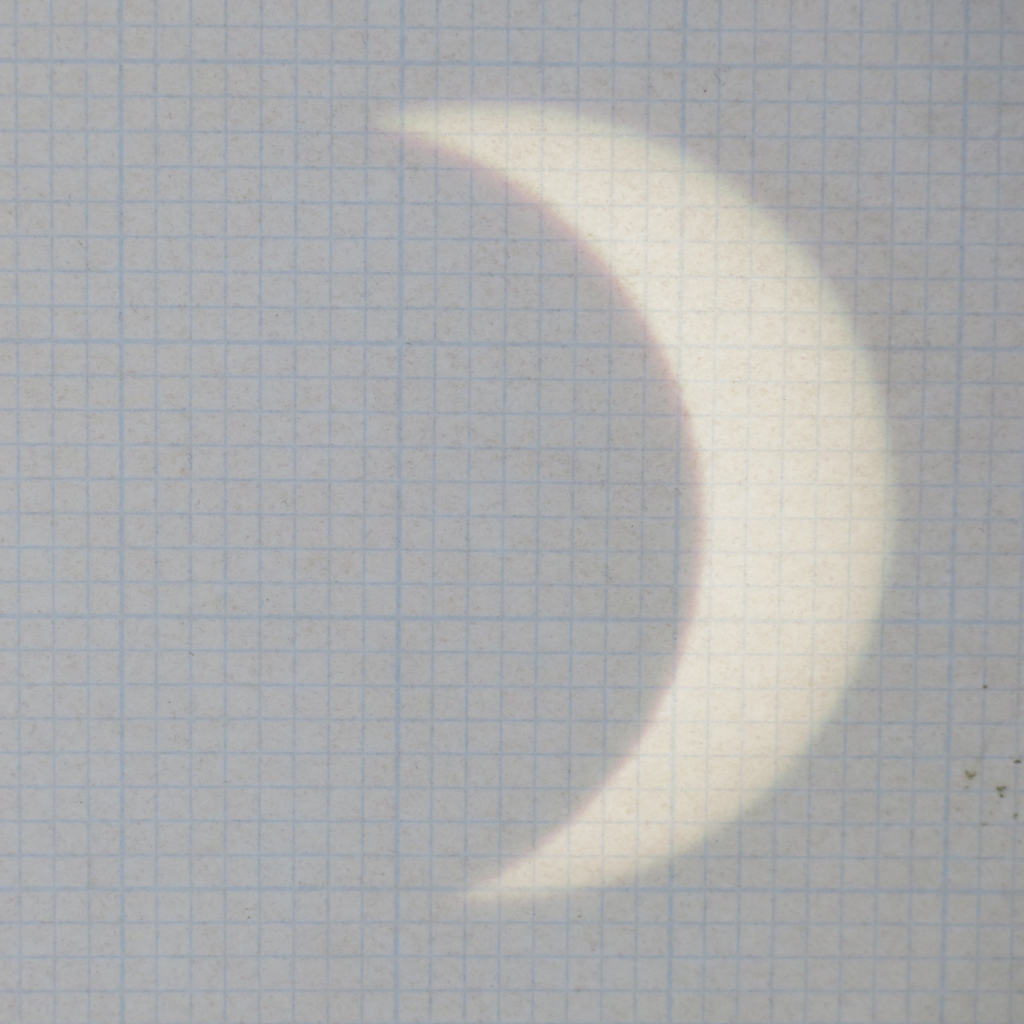
My plan was to project an image of the sun through binoculars mounted on a tripod. The sky was covered by stratus clouds (high fog) at 9 a.m., but by 9:45 the clouds began to break up and Carol and I got a few views of the moon’s shadow slowly moving over the sun’s disk. It became mostly clear by 10:20, in time for the maximum. Then it stayed clear, and I was able to watch the moon’s shadow slowly slide away from the sun.

One of the benefits of projecting the eclipse is that I could see the rotation of the earth as the projected image slowly moved as the sun changed its relative position in the sky. This was a good reminder that an eclipse involves relative movement of three astronomical bodies: sun, moon, and earth. And if I had had access to better optics, I could have projected a larger image and watched the movement of sunspots as well.

3. The emotional response

At about 10:20, when the eclipse was at its greatest extent, it was noticeably dimmer than it should have been. The light was about as bright as it would be around sunset — the difference being that the sun was high in the sky, so the shadows were short. It definitely felt a little eerie.

But mostly what I felt was a sense of wonder. This was the most astronomical fun I’ve had since watching the transit of Venus a few years ago.

Bath time

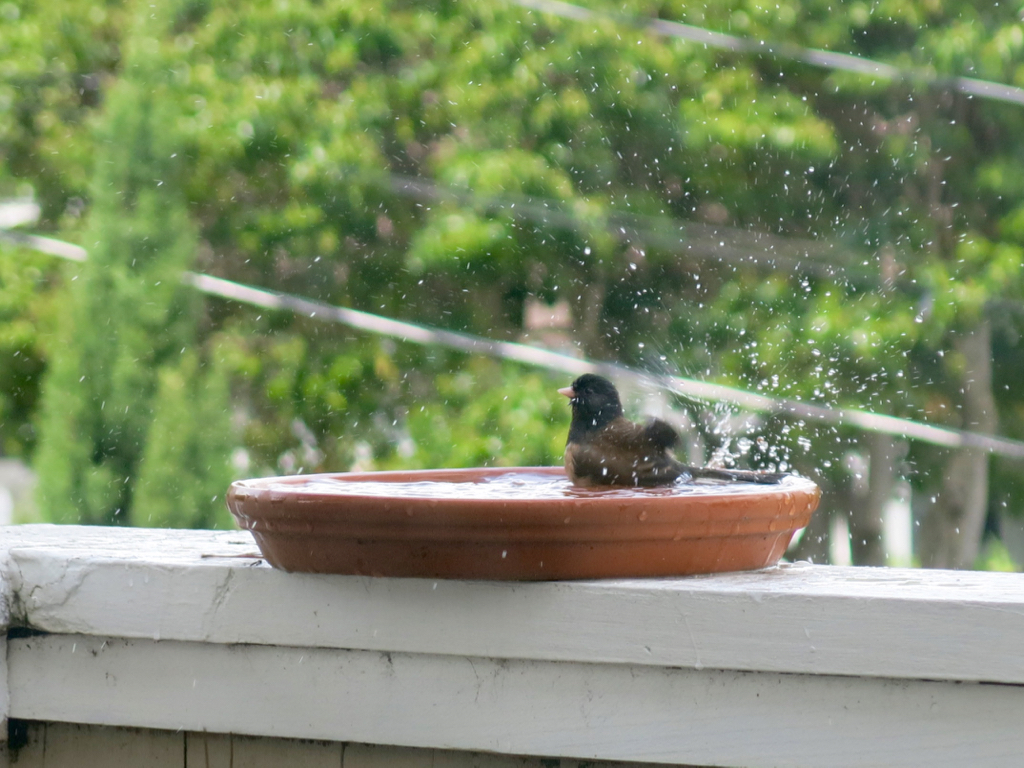
We left a large clay saucer (the thing you put under a potted plant to hold excess water) out on the railing of our balcony, and filled it with water to make a bird bath. Many of the neighborhood birds have come to drink or bathe, including California Scrub Jays (Aphelocoma californica), American Crows (Corvus brachyrhynchos), Cedar Waxwings (Bombycilla cedrorum), House Finches (Carpodacus mexicanus), and Dark-eyed Juncos (Junco hyemalis). The crows and scrub-jays are too big to bathe, and all they do is drink the water — pretty boring. I most enjoy watching the juncos bathing — sometimes, one bird will be splashing around in the water while another waits impatiently for its turn to bathe. Yet even watching crows drink is better than staying glued to online “news” sources for more stories about a U.S. president who denies human-caused climate change while taking great glee in dropping the biggest bombs he can.

mOOn Over tOwns mOOn
whisper
less creature huge grO
pingness
— E. E. Cummings

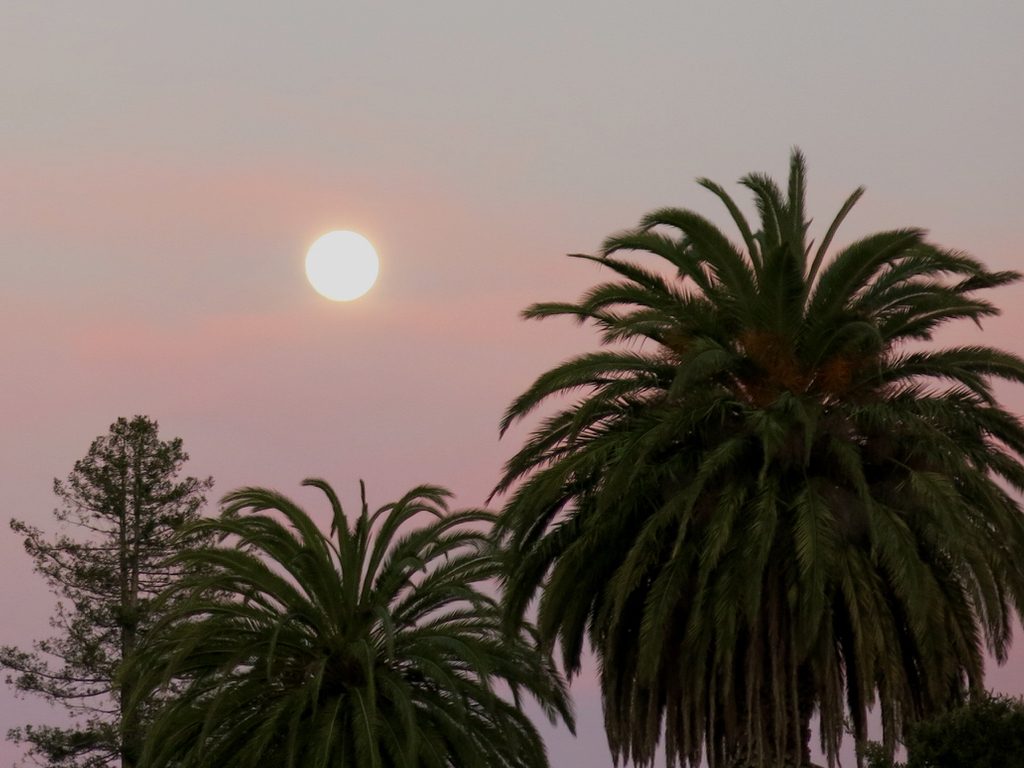
The rising of the full moon pulls us away from the mundane world of traffic and pollution and politics, drawing us up into a different place: the world of Chang-O and the Rabbit in the Moon; the world of the Apollo moon landings; no, different than both these things. Something primal, something that draws our eyes up at the time of the full moon, even though any mention of the moon is trite, as trite as poems that rhyme June and Moon. I still can’t believe that I live in the northern California subrubs, where I can see the full moon rising up over both palm trees and redwood trees at the same time. I want to pretend to be bored, but I am never bored by the rising moon. It is always new, always a wonder.

Election research in California

We have 17 statewide ballot initiatives/referenda to vote on this year, some of which are confusing as hell.

Fortunately, the UU Justice Ministry of California (formerly the UU legislative Ministry, a less-politically-correct but more accurate name) has come up with an excellent one-page summary of 2016 ballot recommendations.

blognov0616

The best thing about this is that it summarizes the ballot recommendations of 15 different advocacy groups, including the League of Women Voters, the Sierra Club, Jewish and Christian faith-based legislative groups, and other groups. I found this very helpful as I try to make my way through the confusion of ballot initiatives.