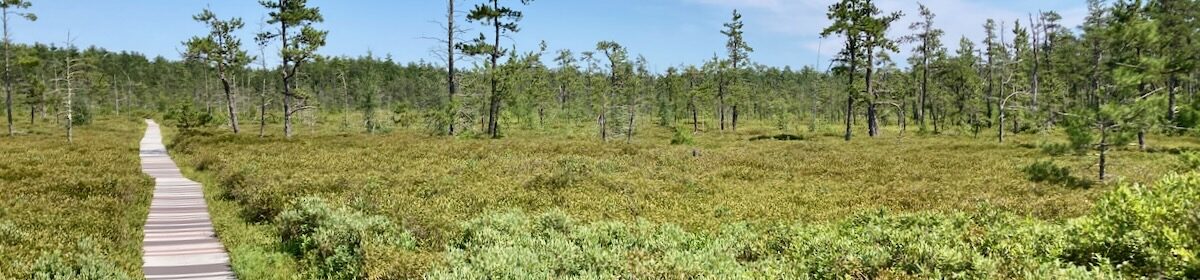
Killer

Beech leaf disease (BLD) has arrived in Cohasset. I’m seeing leaves on American Beeches withering and dropping off both in Wheelwright Park and in the Whitney Thayer Woods. In some places, stands of beeches have lost so many leaves that it no longer feels like you’re walking in the forest.
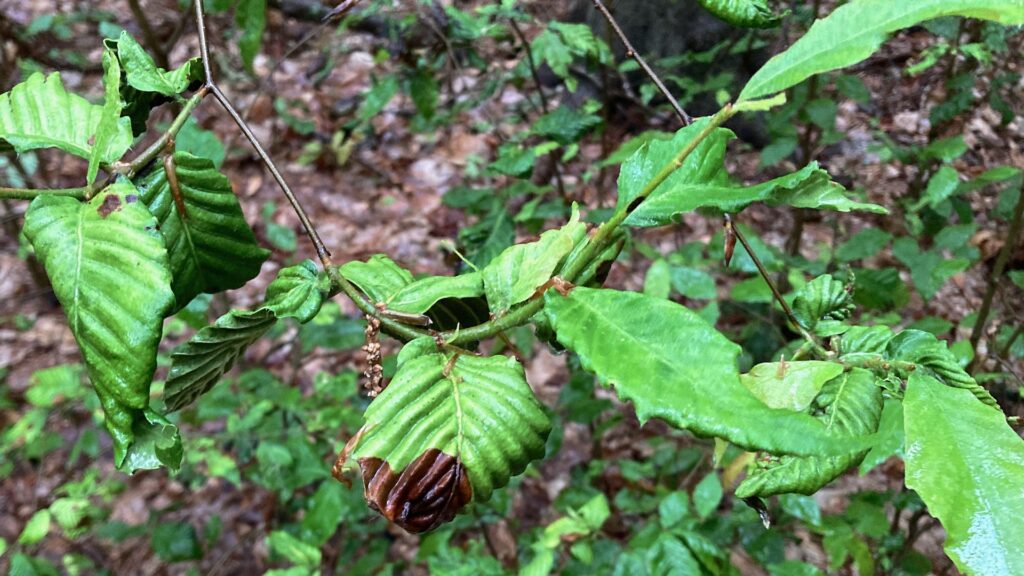
Withered leaves on an American Beech sapling.
American Beech sapling in Whitney Thayer woods with BLD

A scientific article from two and a half years ago — Sharon E. Reed, et al., “The distribution of beech leaf disease…,” Forest Ecology and Management, vol. 503, January, 2022 — found that BLD is a worse threat to American Beech stands than two previous invasive pathologies, beech scale (Cryptococcus fagisuga), and beech bark disease (C. fagisuga and Neonectria spp. complex).

Withered leaves on an American Beech sapling
American Beech sapling in Whitney Thayer Woods with BLD

An invasive nematode from east Asia, Litylenchus crenatae, is always present when BLD is present. But a scientific article from Sept., 2021 — Carrie J. Ewing et al., The Foliar Microbiome Suggests that Fungal and Bacterial Agents May be Involved in the Beech Leaf Disease Pathosystem, Phytobiomes Journal, pub. online 29 Sep 2021 — also found that organisms from four bacterial genera — Wolbachia, Erwinia, Paenibacillus, and Pseudomonas — and one fungal genus, Paraphaeosphaeria — are always present with the nematode when BLD is present.
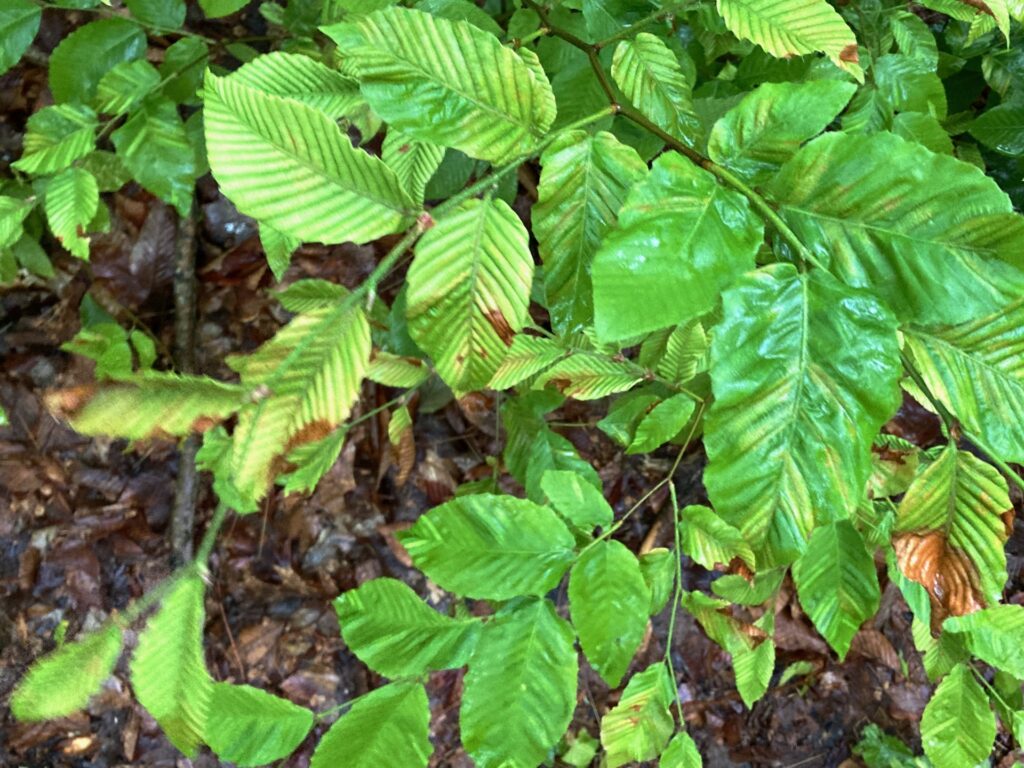
A few withred leaves among healthy leaves in an American Beech sapling
American Beech sapling in Whitney Thayer Woods with BLD

From what I can gather, our understanding of BLD is still incomplete. However, a few things are quite clear. The University of Rhode Island suggests a couple of strategies to try to save trees from BLD: heavy applications of phosphite fetilizer twice a year, and/or application of pesticide to kill the nematodes. If trees with BLD are left untreated, they will die within 6 to 10 years. Since we cannot treat most trees in our forests, we can expect most infected American Beeches to die within a decade.

Yet another reason for eco-grief.

And this is another reminder that as dire as the situation might be with climate change, invasive species are also devastating our New England forest ecosystems. A hundred years ago, we lost our American Chestnuts to invasive Chestnut Blight. Fifty years ago, we lost most of our American Elms to invasive Dutch Elm Disease. We’re in the process of losing all our Eastern Hemlocks to an invasive insect, the Woolly Adelgid, and all our ash trees to another invasive insect, the Emerald Ash Borer. Now we’re losing all our American Beech trees to yet another invasive organism.

Yes we need to stop climate change, but that’s only a part of the threat to Earth’s life-supporting systems. There’s a lot of work for us to do….
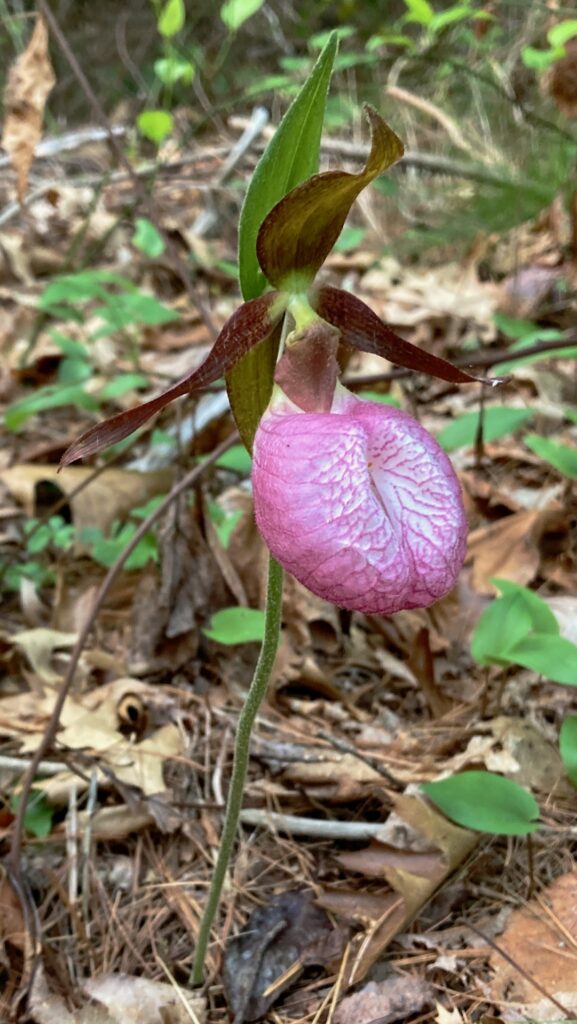
Orcas having fun

Orcas off the Iberian Peninsula have been ramming sailboats, and have even managed to sink three boats, according to Live Science. Humans who claim to be experts on orcas think they know the reason why:

“Experts suspect that a female orca they call White Gladis suffered a ‘critical moment of agony’ — a collision with a boat or entrapment during illegal fishing — that flipped a behavioral switch. ‘That traumatized orca is the one that started this behavior of physical contact with the boat,’ López Fernandez said.”

I’m mildly skeptical of this explanation only because trauma has recently become a popular human explanation for everything. I don’t mean to minimize the effect of traumatic events on humans (or other organisms). But I’m reminded of the mid-twentieth century when, under the influence of Freudianism, sex was the popular explanation for everything. In that time period, trauma was not regularly invoked to explain mammal behavior, so I can imagine mid-twentieth century cetologists explaining orcas sinking boats as somehow being motivated by sex.

NPR reported on the same story, with some additional details, including the fact that orcas seem to like biting sailboat rudders:

“Jared Towers, the director of Bay Cetology, a research organization in British Columbia, says ‘there’s something about moving parts … that seem to stimulate them…. Perhaps that’s why they’re focused on the rudders….'”

Ultimately, we humans don’t know why orcas are ramming sailboats and biting rudders. (Actually, we really know why humans do many of the things we do.) I suspect this has become a news story mostly because humans who are part of Western cultures get worried when other animals threaten us or make us feel that we might not be the apex predator. This attitude is in part due to the influence of Western religions — both Judaism and Christianity have a sacred text that claims that a deity gave to human beings the right to have dominion over all other living beings. But orcas have not read the Bible, and they didn’t get the memo that humans are in charge.

Intestine seaweed

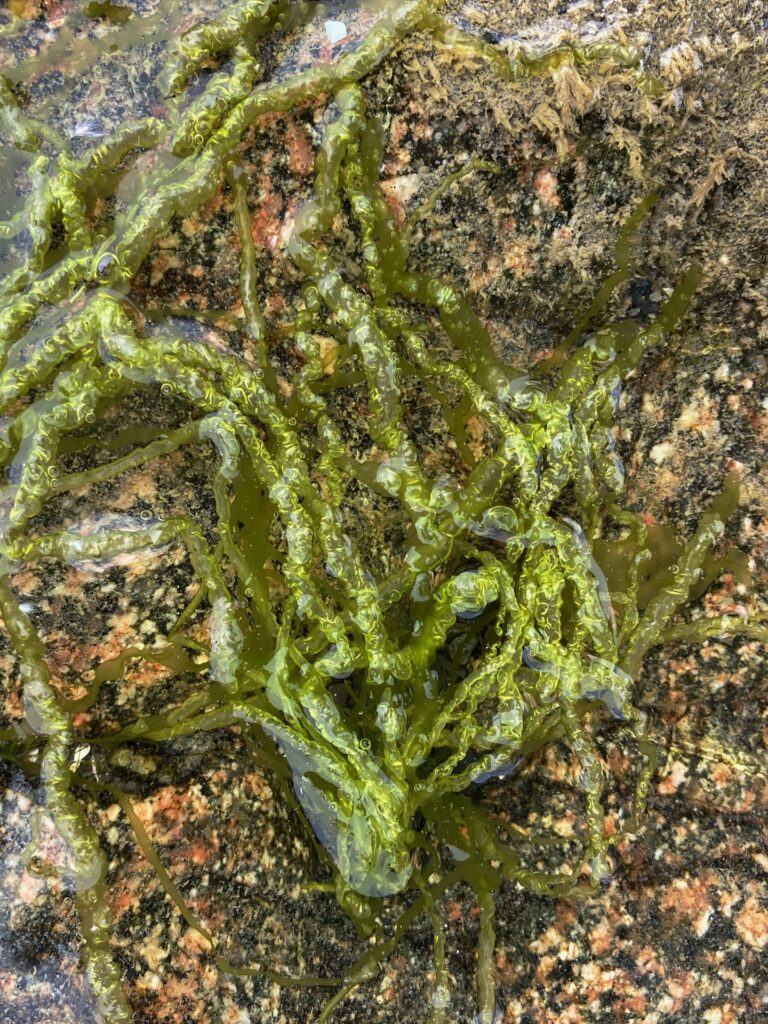
There’s a species of seaweed that grows along the coast here in Cohasset with the scientific name Ulva intestinalis; so named because it looks like intestines. A common English name for it is Gutweed, though I’d rather call it Intestine seaweed.

Anyway, it’s one of my favorite seaweeds. How could I not like something that looks like little green intestines?

Strands of green tubular seaweed lying on a rock.

Jack-in-the-pulpit

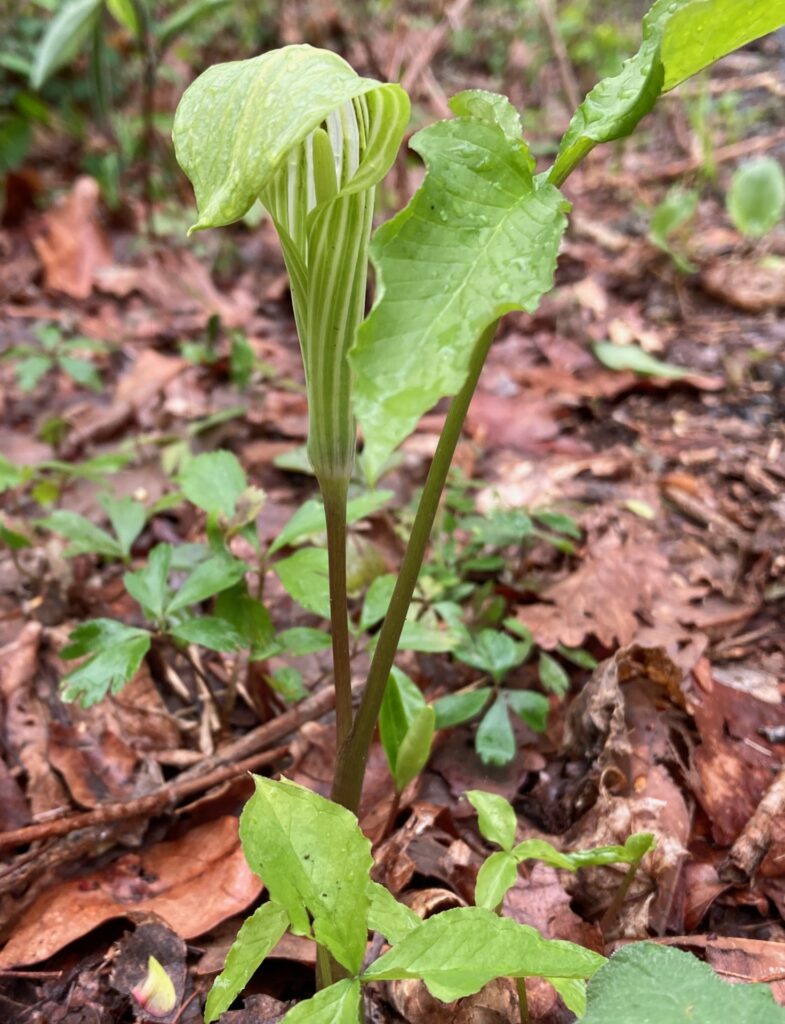
Today while walking in the Attleboro Springs Audubon Sanctuary, I saw Jacks-in-the-pulpit (Arisaema triphyllum) in bloom. The dramatic striped spathe shelters a spadix on which the flowers are born. This is one of my favorite native flowers — we used to grow them when we lived in the rental share in Concord center — and seeing their blooms today prompted me to learn a little more about them.

According the Extension service of North Carolina State State University, individual Arisaema triphyllum plants can change between male and female from year to year: “This unique plant, which is pollinated by flies and gnats, has the ability to change gender.  A plant that starts out as male can spontaneously change to female the next year and vice versa. …”

Or, according to another source, first year plants only produce male flowers; then the plant becomes hermaphroditic, producing both male and female flowers. In any case, as is so often true, our stereotypical human norms around gender and biological sex being determined from birth do not apply to all organisms (the stereotypes don’t even always apply to human organisms).

A fascinating plant. Makes me want to start growing Arisaema triphyllum again.

Jack-in-the-pulpit (Arisaema triphyllum). Note the two trifoliate leaves, the striped spathe, and the pale green spadix inside the spathe.

Urban gulls…human shouting…

In the Mass Audubon class I’m taking, tonight’s lecture was on birds. We learned about a scientific paper titled, “Urban gulls show similar thermographic and behavioral response to human shouting and conspecific alarm cries” (Frontiers in Ecology and Evolution, 20 Sept. 2022). Equipment used in this research included a plush Cornish pasty and a child’s baby carriage with an infrared camera hidden inside it. No, I am not making this up. Apparently some ornithologists manage to have a sense of humor while doing serious science.

Young owl

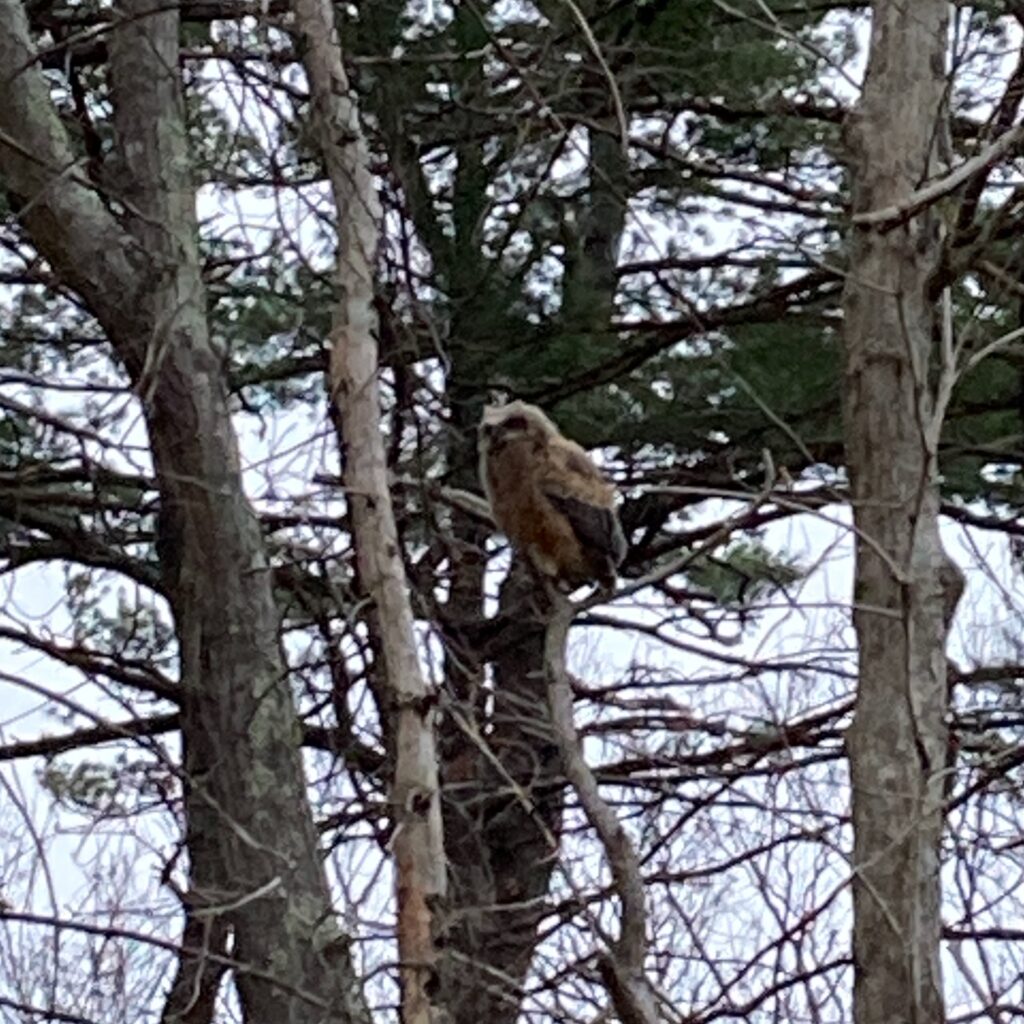
I was out for a walk at dusk in nearby Wheelwright Park, and heard a strange sound coming from a nearby tree — a sort of whiny “cheep” kind of sound. I looked up, and there was a juvenile Great Horned Owl about 10 meters up.

The fading light made it hard to see much, but the bird appeared to have well-developed flight feathers. The prominent ear tufts which are characteristic of adult Great Horned Owls were just starting to form. And the plumage was a lighter color than adult plumage. So my guess is that this was a young owl out for one of its first forays from the nest.

As I stood watching it — and trying to take photos with my smartphone — I thought I heard another owl cheeping from a tree farther away. It seems like there were two young owls out trying out their new wings.

An owl sitting on a branch partway up a tree, at some distance from the camera. The light is dim, and the photo is pixelated and of poor quality.

Spring chorus

On Friday when I went for a walk in Whitney Woods here in Cohasset, the marshes were silent. On Saturday, I heard a chorus of frogs calling from a couple of marshes and one vernal pool. When I returned on Sunday, the temperature had dropped 20 degrees, from about 54 degrees to the mid-30s. There were a lot fewer frogs calling on Sunday, but some were still singing away. They sounded like a bunch of ducks gabbling together.

Whenever I tried to get close enough to see them, all I ever saw was a circular ripple where a frog slipped underwater. Nevertheless, identification was relatively easy. Here’s the description of the voice of the Wood Frog (Rana sylvatica) in the Peterson Field Guide to Reptiles and Amphibians: “A hoarse clacking sound suggesting the quack of a duck.” Another source says: “from a distance, a chorus [of Wood Frogs] sounds like a gathering of miniature ducks quacking.”

I’ll let you decide if they sound like ducks or not. Here’s my lo-fi audio recording:

Sign of spring

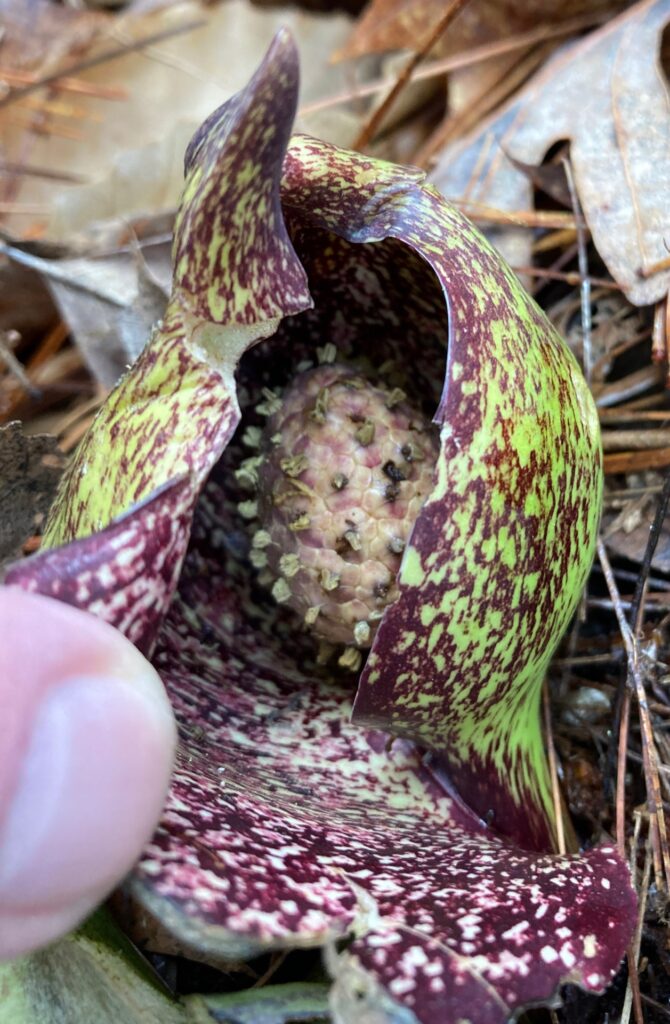
I went for a walk at the Norris Reservation in Norwell, Mass., today. Walking around Gordon’s Pond, I saw Skunk Cabbage (Symplocarpus foetidus) beginning to sprout. Perhaps two dozen tightly curled green and purple spathes dotted the ground on either side of the boardwalk. One of the spathes had opened, revealing the spadix inside, with tiny little flowers blooming on it. This is the first native flower I’ve seen since the Witch Hazel bloomed in December.

A close-up of a Skink Cabbage inflorescence inside its purple-and-green spathe.