
Recent web browsing

Some links from my recent web browsing:

Are We Allies?

Foluke Ifejola Adebisi has an excellent blog post on “the concept of allyship against injustice.” In other words, what does it mean to be a “white ally,” or any other kind of ally? Adebisi makes an intersting disctintion between allyship as being, and allyship as doing:

“I think what is important is that we move away from thinking of allyship as something we are, but instead think of it as something we do, each time we do something. Each time we want to contribute to a particular struggle for justice, we must decide what must be done in the moment, irrespective of what we have done before or what type of person we think we are.”

I came away from this blog post thinking that if I hear someone saying they are an ally, this may not mean much. I’m going to watch what they do instead of listen to what they say they are.

Jew or Judean?

Marginalia hosts a scholarly debate on how to translate ioudaioi in texts from the last centuries BCE and the first few centuries CE. Does it mean Jew or Judean? While this may seem like a big argument over a trivial detail, the scholars involved claim the stakes are higher than you’d think.

For example, if you translate ioudaioi in the Gospel of John as “Jew,” then that could reinforce one of the foundations of Christian anti-Semitism. The ioudaioi, the Jews, killed Jesus. Whereas if you translate ioudaioi as “Judean,” someone from the land of Judea, maybe you can undermine that foundation of anti-Semitism.

But other scholars argue that in some texts, ioudaioi is better translated into modern English as “Jew,” sometimes as “Judean.” It all depends on the context. And we don’t want to inject anachronisms into translations.

Another point comes up: Is it anachronistic to talk about Judaism as a religion in this era? Was Judaism more of an ethnic identity than a religion? (In a related story, Haaretz reports on archaelogist Yonatan Adler’s new book that advances the claim that the archaelogical record does not show evidence for Jusdaism as a religion before the 2nd century BCE.)

Dare You Fight?

Editor Neal caren is creating an online collection of W. E. B. DuBois’s articles for The Crisis. These articles were written between 1914 and 1934, and many have not been collected previously.

DuBois’s essays are fascinating to read. His articles for The Crisis sounds radical even by today’s standards.

Invasion

Australian librarian Hugh Rundle writes about the exodus of people from Twitter to Mastodon. He titles his blog post “Home invasion: Mastodon’s Eternal September begins.” As a Mastodon user of fairly long standing, he describes how he has experienced the influx of Twitterers:

“It’s not entirely the Twitter people’s fault. They’ve been taught to behave in certain ways. To chase likes and retweets/boosts. To promote themselves. To perform. All of that sort of thing is anathema to most of the people who were on Mastodon a week ago…. To the Mastodon locals it feels like a busload of Kontiki tourists just arrived, blundering around yelling at each other and complaining that they don’t know how to order room service.”

Although I’m most emphatically not a Twitter user (I left Twitter in 2014, not in 2022), I am a new Mastodon user. I hope the Mastodon users don’t see me as behaving badly….
Halloween costume

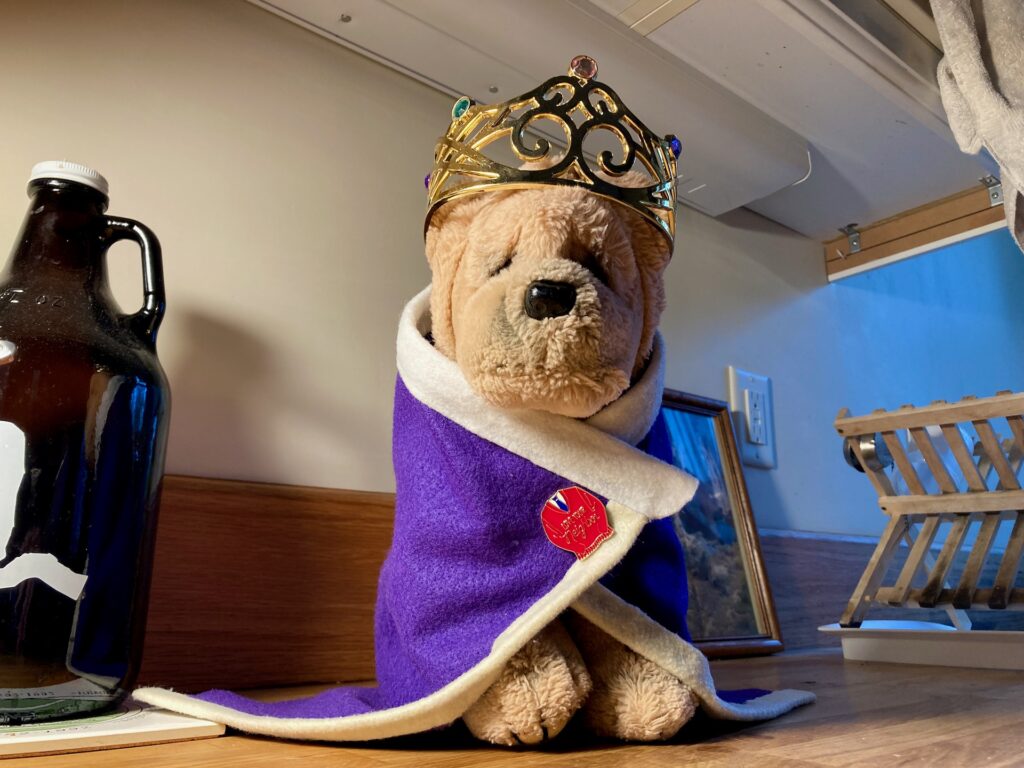
Our cross-country move isn’t over yet. We’re still unpacking — and if this move is anything like past moves, we’ll still be unpacking cardboard boxes for a year to come. Today the box I happened to unpack turned out to have a costume for a stuffed animal in it.

During the pandemic, I did a series of weekly videos, many of which focused on stuffed animal characters. Sometimes the stuffed animals wore costumes. But when we moved, I packed away all the stuffies and got rid of all the costumes — or so I thought. For here was one of the costumes.

I had no intention of doing anything for Halloween this year. But if it’s Hallowe’en and you find a costume on Halloween, you might as well use it.

This was the extent of my Halloween celebration — five minutes of dressing a stuffie in costume, and taking a photo.

Then I went back to work unpacking boxes.

Fifth shot

I got my fifth COVID shot today, the so-called bivalent booster.

Getting a COVID shot is boring now. But it didn’t used to be.

We got our first shots the day after our age group was eligible. We had to drive an hour to find an appointment. There was an elaborate check-in process. After getting the Pfizer shot, we had to sit down for fifteen minutes until they were certain we weren’t going to pass out or go into anaphylactic shock. Four weeks later, we got the second dose at the same drugstore, going through the same elaborate process. I was ill for two days after the second shot. Then it became a big topic of conversation for the next month: Did you get vaccinated yet? Which vaccine did you get? How long were you sick for afterwards?

We felt invincible for about four months, until the Delta variant hit. Then at last we were eligible for our first booster. This time, we got an appointment at a mass vaccination clinic, held at the San Mateo Event Center, formerly called the county fairgrounds. We waited in a long line of cars while volunteers in fluorescent yellow vests directed us into a big barn. Did we want Pfizer or Moderna? We had heard that you should get the one you didn’t get the first time. So we got Moderna. Then we had to drive into a big parking area while they monitored us to make sure we didn’t pass out. Once again, it was all very dramatic. And I was ill for a day after I got the booster.

For the second booster, I went to the Redwood City medical center where my primary care physician had her office. It was just like getting my annual flu shot. A nurse told me I shouldn’t worry about sitting in the waiting area after getting the shot. I got the shot, left the building, and drove home. My arm hurt for the rest of the day, but I didn’t feel ill.

Today I drove to Braintree to get both my annual flu shot and my third COVID booster. My appointment was at an older, somewhat dingy pharmacy. This time I remembered to wear a short-sleeved shirt. After I got my shot, the pharmacist told me to sit and wait fifteen minutes. I heard the man talking to the pharmacist as he got his shot. “Another shot, I can’t believe it! We’re going to be doing this forever,” he said, in his high querulous tenor voice. She murmured something soothing. “I guess it’s like getting your flu shot every year, isn’t it. And these people who don’t get shots. Can you believe them?!” Another soothing murmur. By this time I had waited five minutes. I decided I wasn’t going to pass out and walked out of the store. There was nothing exciting about any of it.

I still worry a little when I hear about people I know getting COVID. But getting your COVID shot is no longer exciting. It’s just part of the annual routine.

What Franklin Graham says

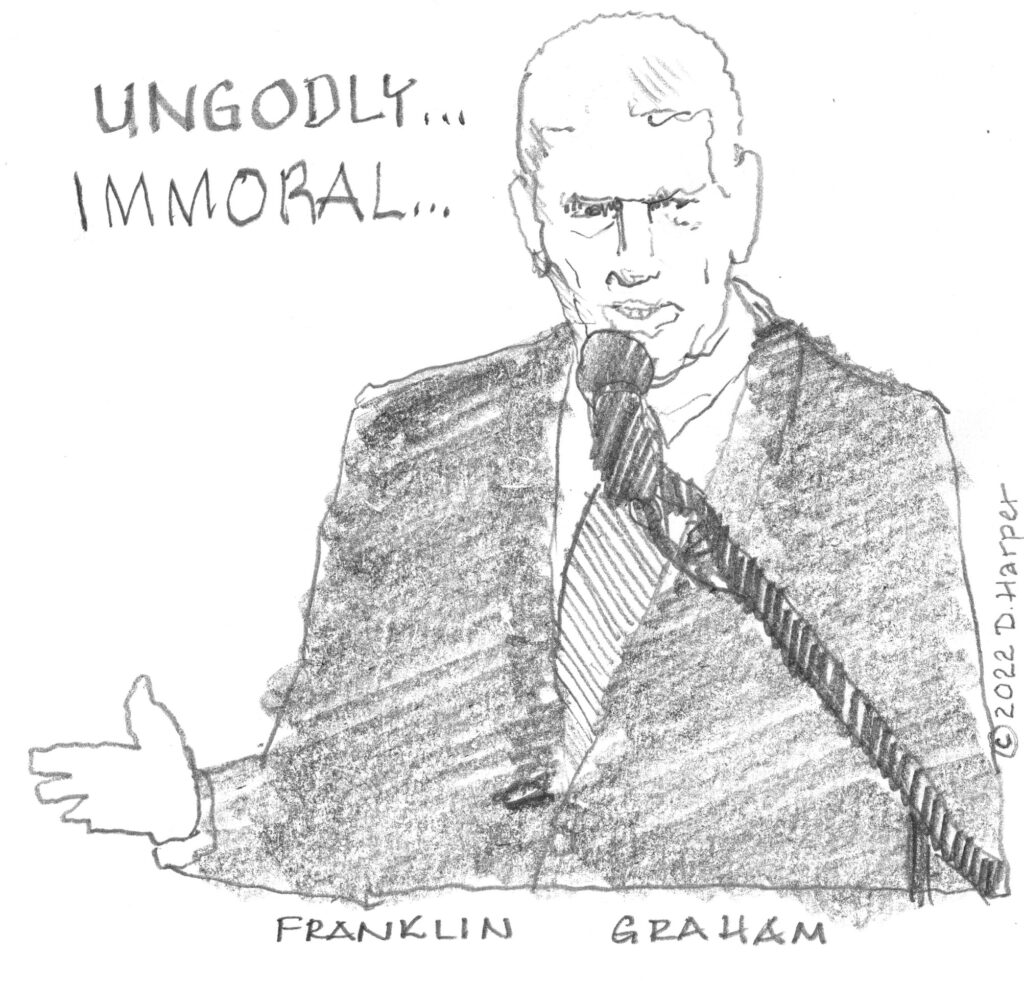
We have a post box for our mail, so sometimes we receive mail sent to previous holders of that box number. Today we received the October issue of “Decision” magazine, published by the Billy Graham Evangelical Association.

The editor-in-chief, Franklin Graham, wrote the lead article in this issue, titled “We Can Still Turn Back.” Franklin Graham says, in part:

“On Nov. 8, tens of millions of voters will head to polls across America in the most crucial midterm elections in recent history. To say that much is at stake is a gross understatement. It isn’t just control of Congress; it may be our last chance to stop the immoral and ungodly policies that have brought our national to the moral brink of disaster.”

What are the “immoral and ungodly policies” to which he refers? About what you’d expect: same sex marriage, abortion rights, and “transgenderism.”

In his article, Franklin Graham concludes, “That’s why it is so critical that you go to the polls on Nov. 8 and vote from the candidates who best align with godly, Biblical principles.”

But which Biblical principles? Franklin Graham’s net worth is estimated to be on the order of $10 million, and he has an annual income on the order of $600,000. Yet in Matthew 19:16-21, we hear this story:

“Then someone came to [Jesus] and said, ‘Teacher, what good deed must I do to have eternal life?’ And he said to him, ‘Why do you ask me about what is good? There is only one who is good. If you wish to enter into life, keep the commandments.’ He said to him, ‘Which ones?’ And Jesus said, ‘You shall not murder; You shall not commit adultery; You shall not steal; You shall not bear false witness; Honor your father and mother; also, You shall love your neighbor as yourself.’ The young man said to him, ‘I have kept all these; what do I still lack?’ Jesus said to him, ‘If you wish to be perfect, go, sell your possessions, and give the money to the poor, and you will have treasure in heaven; then come, follow me.’…” [NRSV; emphasis added]

Franklin Graham contributes to good in the world through the global charity he heads, Samaritan’s Purse. But I do not see Franklin Graham actually following this teaching of Jesus in Matthew 19:16-21, to go and sell all his possessions and give the money to the poor. Sadly, this makes it look like he picks Bible passages that confirm his biases while passing over Bible passages that cause him discomfort.

Which makes him appear hypocritical.

No wonder young people are leaving organized religion in droves.

Anxiety screening

The U.S. Preventive Services Task Force (USPSTF) issued a draft recommendation statement on Tuesday, suggesting that everyone under age 65 might benefit from screening for anxiety disorder.

Before you jump to conclusions, you need to know a few things.

First, this is still a draft statement. The USPSTF has released this draft for public comment. After the public comment period ends on October 17, the USPSTF will prepare the final statement.

Second, despite its impressive title, the USPSTF is not a government agency. It is “an independent, volunteer panel of national experts in disease prevention and evidence-based medicine.”

Third, this report appears to rely on data published before the COVID-19 pandemic. In other words, this is not a response to the widely-reported rise in anxiety disorder during and following the pandemic.

But even after reading this draft statement carefully, and even if we don’t jump to conclusions about the effects of the pandemic, I think this is still important. As the draft recommendation points out: “According to U.S. data collected from 2001 to 2002, the lifetime prevalence of anxiety disorders in adults was 26.4% for men and 40.4% for women.” In other words, anxiety disorders were widespread before the present alleged post-pandemic rise in anxiety disorders. This is a serious public health issue.

Anxiety is also obviously a serious issue for women. With over 40% of women developing anxiety disorder, this is indeed a serious public health issue. And in fact the USPSTF reports that “the Women’s Preventive Services Initiative [already] recommends that screening for anxiety should include all female patients age 13 years or older not currently diagnosed with an anxiety disorder, including pregnant and postpartum women.”

The USPSTF draft recommendation also points out how anxiety correlates with age and stage of life: “The natural history of anxiety disorders typically begins in childhood and early adulthood, and symptoms appear to decline with age. Some community-based epidemiology studies indicate that rates of anxiety disorders are lowest in adults ages 65 to 79 years, but these data are outdated.” So this becomes an important concern for parents, educators, and anyone in the helping professions who works with young people.

Also of interest: the USPSTF notes that screening tools to help medical professionals identify persons who may have anxiety disorder are widely available. Mind you, these are screening tools, not diagnostic tools. But as screening tools, they can cue medical professionals to schedule a follow-up diagnostic assessment. I found one of these screening tools online on the University of Washington website, and it takes only a few minutes to complete. So you can see how this screening tool could be added to routine examinations by primary care physicians.

Now that we’re not going to jump to conclusions, we can go on to speculation.

If there really has been a rise in anxiety disorder during and following the pandemic — and I suspect there has — then it may prove to be even more important to screen for anxiety.

And there are implications for those of us who are ministers. We’re not mental health professionals, but tend to be on the front lines of mental health care because of the people we see during formal and informal pastoral care and counseling. We often suggest that people seek out mental health care. This report suggests that we may want to become more aware of anxiety disorders.

The mood in England

JB, a friend from high school, has been living in London for a number of years. His essay titled “The Mood in London” helps explain to us Yanks what it’s like to be in England right now. More interesting to me was his account of what it was like to stand in line to view the Queen lying in state. Like this ritual that he witnessed:

“Rather than a walk-past (when visiting the Crown Jewels you’re actually standing on a moving conveyor belt), each person was allowed a moment or so to contemplate or bow, as many people did. It was just as I was paying my respects that I was asked to move on, to make way for the changing of the guard. This was an extraordinary spectacle with a new team of sentinels marching to the catafalque (the platform that held the coffin), and positioning themselves directly behind the waxworks. Then, by clockwork, the petrified figures displayed their sentience, seeming to lurch alive and step forward, as their replacements took their positions and powered down to a fugue state. The rescued team then marched, like wind-up soldiers, to a stone staircase, which they ascended in military precision and before disappearing through a door. This ceremony was repeated every 20 minutes, and whatever its origins, it was a remarkable sight.”

More on electric cars

Rabbi Yonatan Neril, founder of the Interfaith Center for Sustainable Development and co-author of the Eco-Bible, adds another reason why electric cars won’t solve the ecological crisis:

“The ecological crisis is a spiritual crisis. It’s not just about nature and bees and the birds and the trees and the toads. It’s also about human beings and how we live as spiritual beings in a physical reality. And so, you know, with all due respect to Elon Musk and everyone buying a Tesla, we’re not going to curb climate change with Teslas alone — when the operating system of billions of people is consumer-driven.”

As Rabbi Neril points out, we’re not going to stop climate change by buying something new. In fact, buying an electric car is really just part of consumerism, the ideological myth that buying something new can solve our problems. Consumerism is the problem, not the solution. Rabbi Neril continues:

“The only force in the world that changes this operating system of consumerism is religion and spirituality. The root issues we’re talking about are greed, short-term thinking, egoism, seeking pleasure in the physical. The spiritual solutions to those are humility, long-term thinking, caring for other people and creatures. The only institutions in the world that can deliver that are religious institutions.”

Electric cars are not the solution to the world’s problems

Science fiction author and Scottish nationalist Charles Stross opines:

“I’m going to suggest that American automobile culture is fundamentally toxic and aggressively hegemonizing and evangelical towards other cultures, and needs to be heavily regulated and rolled back.”

Not to belabor the point, but while electric cars may help us address climate change, they still emit toxic substances (tires spewing microplastics into the environment, for example), and they also enable habitat destruction. Even when it comes to climate change, their carbon footprint is not zero.

(Why mention that Stross is a Scottish nationalist? Because that means he apparently hasn’t bought into the American mythos.)

Mandatory pronouns

Joshua Pederson, professor at Boston University, makes a good point in today’s Boston Globe. Several years ago, Pederson began all his classes by having students introduce themselves by saying their names and pronouns. But, Pederson says, at the end of that first class:

“As my students began filing out of the classroom, one lagged behind, visibly distraught. They asked if they could talk to me about the way I ran introductions. They identified as non-binary and used they’them pronouns, but they felt exposed and vulnerable when I told them to share that. I din’t make them feel included; I made them feel unsafe.”

Now, Pederson gives his own pronouns, and invites but does not require students to share their pronouns. I think he’s on to something. In part, he’s addressing the power imbalance between teacher and student. And also, as he notes, “mandating that students share pronouns can force those who are unsure of their gender identity to pick one, even if they don’t feel ready.”

Those of us who spend time in religious organizations might think about following Perderson’s lead. In congregations, ministers, Sunday school teachers, committee chairs, youth leaders, etc. can share their own pronouns, but there’s no need to make it mandatory for everyone to share their pronouns. In other gatherings, denominational staff, volunteer denominational leaders, workshop leaders, etc. can do the same thing — share their own pronouns, but not make it mandatory for everyone to share pronouns.

In the past, I’ve asked various Unitarian Universalist groups to share pronouns. I won’t be doing that any more. I might share my own pronouns, but I’m not going to ask anyone else to share theirs. Invite, maybe; ask, nope.

Coaches

I thought I overheard someone say, “The Supreme Court backed coaches preying on the field.” Preying? You mean, preying on children and teens…?

It took me a moment to realize that the Supreme Court was not supporting child-molesting coaches, but was instead allowing coaches to offer supplication to their deity before and after sports games.

Sadly, given the ongoing sexual abuse crises in some conservative Christian denominations, my momentary confusion is somewhat understandable. Even I — and I should know better — subconsciously associate organized religion with unsavory unethical actions of male leaders.