Wait, what?!

A new study from Public Religion Research Institute (PRRI) looks into religious affiliations of QAnon devotees. QAnon devotees believe that governments, media outlets, and world finances are in the control of pedophiles who worship Satan. They also believe that there’s some kind of big convulsion coming that will get rid of all the powerful elites, allowing the world’s true leaders (like Donald Trump) to return to their rightful positions of power. And QAnon devotees believe that real American patriots are gonna have to get their guns and use violence to save America.

41 million Americans believe in QAnon — roughly 16% of the population. We usually think of QAnon devotees as white Protestant evangelicals. But you can find QAnon devotees in many different religious groups. For example, 17% of all QAnon believers are “Nones,” religiously unaffiliated Americans.

PRRI also looked at specific religious groups to determine what percentage of each religious group were QAnon devotees. So while 17% of QAnon devotees are Nones, only 11% of Nones are QAnon devotees. Hispanic Protestants had the highest percentage of QAnon devotees, at 27%. Interestingly, 17% of all Buddhists are QAnon devotees, whereas only 14% of white mainline (non-evangelical) Protestant Christians were QAnon devotees. And 7% of Unitarian Universalists are QAnon devotees.

Wait, what?!

7% of us are QAnon devotees. So if there are roughly 200,000 Unitarian Universalists, that means there are 14,000 Unitarian Universalists who are QAnon devotees. Well, I guess we can take comfort that there’s only one group — Jews — with a smaller percentage of QAnon devotees (5%).

But still….

Teaching and critical race theory

Classroom teacher and public intellectual Jose Vilson has a post on his blog on “the work we must do” in public education. After pointing out that our guiding principle should be “educating for an informed democracy,” he provides good advice on how to respond to the misguided critics of critical race theory:

“We can say ‘critical race theory has two tenets: 1) we have systems that depend on racial hierarchy and 2) we can do something about it.’ We’ve been doing this work towards a better democracy for decades and can’t shy away from it by going on the defensive. We teach the truth without apology. We’re unafraid because we know our communities trust in us to do this work and we know history will look kindly on those who put justice, compassion, and the truth in front of young people who need it the most.”

I know that I’ve been responding to the silly attacks on critical race theory by pointing out how those attacking it don’t seem to know what critical race theory actually is. Critical race theory is not, for example, the same thing as the Frankfurt School of Marxism, despite what some pundits would have us believe.

But I think Vilson is right. There’s no reason to go on the defensive. Instead, we can meet these attacks head on. Maybe some people don’t like “critical race theory,” but racial hierarchy is real. Since a fundamental purpose of education should be to strengthen democracy, then we of course we should talk with children about the places where democracy has fallen short. Of course we will address all topics in a developmentally appropriate way, but there is no reason to lie to children.

Coloniality and gender

I seem to have very little time these days, as the Omicron surge winds down, and as our congregation opens up again (or maybe re-opens up? — or is it re-re-opens up?). Nevertheless, I’m slowly making my way through some essays by Maria Lugones, and I’m currently reading “The Coloniality of Gender.” In this essay, she critiques Anibal Quijano’s theoretical work on global capitalism for his “complicity with the gender system.” In other words, many males who write about colonialism ignore how women are dominated.

But Lugones is also laying out another way to analyze gender, a model which she calls “the modern colonial/gender system”:

“In Quijano’s model of global capitalist Eurocentered power, ‘capitalism’ refers to the ‘structural articulation of all historically known forms of control of labor or exploitation, slavery, servitude, small independent mercantile production, wage labor, and reciprocity under the hegemony of the capital-wage labor relation.’ (‘Colonialidad del Poder y Clasificacion Social,’ Festschrift for Immanuel Wallerstein, part I, Journal of World Systems Research, V. xi, #2, summer/fall 2000). In this sense, the structuring of the disputes over control of labor are discontinuous: not all labor relations under global, Eurocentered capitalism fall under the capital/wage relation model, though this is the hegemonic model. It is important in beginning to see the reach of the coloniality of power that wage labor has been reserved almost exclusively for white Europeans. The division of labor is thoroughly ‘racialized’ as well as geographically differentiated. Here we see the coloniality of labor as a thorough meshing of labor and ‘race.’”

Lugones connects colonialism, capitalism, gender, and race. This has some interesting implications for the way we Unitarian Universalists think about anti-oppression work.

Noted without comment

“…[there are] levels in what counts as political. As you dare to witness police arresting people, or dare to ask a woman who is saying ‘no’ to a man’s hold whether she’s all right, whether she wants to leave, you notice that it is quite different to do that than to organize a demonstration against Anglo takeover of land and water in the U.S. Southwest. It is all beyond the pale, but the latter is more easily understood as political — it is afforded a kind of sociality — that the others may lack. So, there are levels of disruption, levels of resistant, in terms of the political sense that the act makes. Foundations that fund political projects often look for political activity that makes a particular kind of ‘within-bounds’ sense. It is important to take stock of the ease of acceptance, since there is a need to try to roam more deeply into the social to understand who’s paying for one’s acceptability.”

— Maria Lugones, Pilgrimages/Peregrinajes: Theorizing Coalition Against Multiple Oppressions (Rowman & Littlefield, 2003), p. 2.

Step by Step

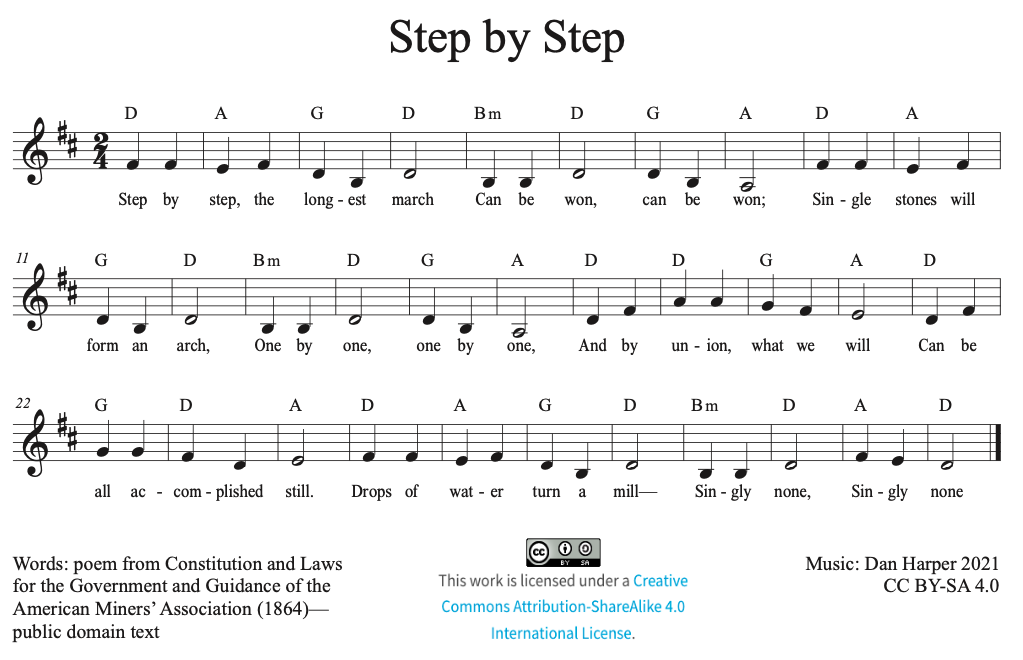
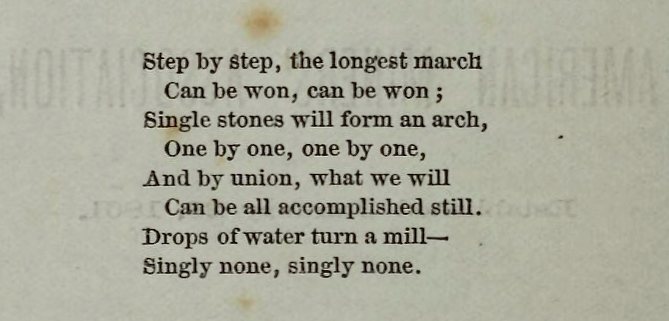
I got curious about the song “Step by Step,” a song that Waldemar Hille and Pete Seeger put together — it’s hymn number 157 in the Unitarian Universalist hymnal. Hille found a poem in the “Constitution and Laws for the Government and Guidance of the American Miners’ Association” (1864), and he and Seeger made a song out of it. But Seeger said they changed some of the words, so I got curious about the original wording. I found a digitized copy of the poem online, and it reads like this:

Step by step, the longest march
Can be won, can be won,
Single stones will form an arch
One by one, one by one,
And by union, what we will
Can be all accomplished still.
Drops of water turn a mill—
Singly none, singly none.

I decided I liked the original words better than Hille and Seeger’s rewrite — the original second stanza feels more positive to me. Then I realized I’ve always disliked Hille and Seeger’s tune; it sounds like a dirge, better suited to a funeral than to a union marching song.

Worst of all, Hille and Seeger slapped a copyright on their song. Maybe while they were alive they would have given permission to use it freely, but they’re both dead now. Besides, who wants to have to write for permission to sing the song?

So here’s my version of this grand old union song. It has the original public domain words, paired with a tune licensed under the Creative Commons Attribution-ShareAlike 4.0 International License:

Click on the image above for a PDF.

Solving the Silicon Valley housing crisis four people at a time

The title of a recent San Francisco Chronicle article says it all:

He wanted to let homeless neighbors sleep in cars outside his church. It launched a two-year battle.

The “he” in the title is my new UU hero, Chris Kan. Chris grew up in San Francisco, and after a stint teaching at UC Santa Cruz, moved to Silicon Valley to do cancer research. He also joined the Unitarian Universalist Church of Palo Alto (UUCPA), where he got involved in an effort to allow car dwellers to park safely in the church parking lot. I’m proud to say that UUCPA is my congregation, too, and I’m proud that many of us supported Chris in this two year battle — showing up at City Council meetings, working behind the scenes with community stakeholders, coordinating with Move Mountain View, a local nonprofit, to provide support services, arranging to have a Porta-Potty on site, making sure we could provide free wifi to car dwellers, and on and on — but Chris was the one who provided clear and steady leadership through this agonizing two-year process.

Sadly, we all knew that UUCPA’s permit application would take forever to get through the city of Palo Alto. The city is notorious for its torturous permitting process. And during the application process we suspected we’d hear comments like, “We don’t want those people living near us.” Those are the things you have to expect when you propose any solution to Silicon Valley’s housing crisis: the city government will take forever to approve the project, and some city residents will talk about “those people.”

Admittedly, we were a little surprised when Stevenson House, the subsidized elderly housing project next door to our church, filed a last minute appeal to block our permit this summer. But it all turned out all right in the end. You can read about the appeal in this news article — the reporter quotes Grace Mah, president of the Stevenson House Board, as saying the Board wanted background checks. True, some safe parking programs do require background checks, but our local county opposes background checks because they raise another barrier to housing. Fortunately, the Stevenson House Board quickly changed its mind, and the next time they met they voted to drop the appeal. (That installment of the story is reported here.) I’m a big supporter of Stevenson House’s mission, and I appreciate the fact that their board, after doing their due diligence, ultimately supported our safe parking program. We’re grateful to have a good neighbor like Stevenson House, a group that’s also committed to solving the Silicon Valley housing crisis.

The big problem is how badly local city governments are handling any proposed solution to the Silicon Valley housing crisis. As Chris Kan told the Chronicle reporter: “They basically treated [the safe parking program] the same way you would if I was building a condo building…. [but] it’s literally a parking lot with a trash can.” I suppose you could do some incisive social analysis of why local city governments throw up barriers to any solution to the Silicon Valley housing crisis. However, I’ve given up on incisive social analysis, preferring to pour my energy into supporting people like Chris Kan, who are actually out there solving the problem. As I said, Chris is my new UU hero.

Update: NBC Bay Area covers this story here. Here’s an excerpt from their story — I particularly like Amber Stine’s comment at the end:

“A board member at the senior living facility next door [i.e., Grace Mah of Stevenson House] asked for a review…. She eventually dropped the request after Kan and other church members explained the program…. ‘The pushback is fine. Some of it is necessary. It creates conversation. I think it’s the outcome that matters more than anything,’ said Amber Stime, executive director of Move Mountain View.”

Many conservative Christians are appalled by anti-vaxxers

Steve Hassen, a conservative Christian, has written a blog post that explains why conservative Christians should get vaccinated. The blog post is based on a podcast interview with Professor Warren Throckmorton, a psychologist. Here’s an excerpt from the blog post:

“I asked Throckmorton for his view on the COVID-19 pandemic and what he thinks about vaccination? He and his family are vaccinated. When I asked him about Christianity and science, he told me Biblical sources provide believers guidance. He pointed out that Timothy, a disciple of St. Paul, had a stomach ailment. He was not advised to pray or just have faith but to take a little wine (that is, treat the ailment). Luke, who wrote one of the Gospels, was himself a physician. God gave us incredible gifts: our minds, intelligence, and curiosity. Certainly, we are meant to use our minds and think and not allow irrational fears to cause harm and death.”

Hassen covers a lot of ground in his blog post. He takes on Trump: “How can anyone [who’s] religious think God is using Donald Trump?” He explains how science and conservative Christian faith are compatible. He critiques Christian nationalism and dominionism, two of the biggest threats to U.S. democracy today. And he touches on the problem of narcissism in the pastors of mega-churches (some of what he says there reminds me of one or two people who used to be ministers of some of our largest UU congregations).

Hassen reminds me of the conservative Christians I used to know back in the day: people whose intelligence, morals, and ethics I held in great respect, even while disagreeing with them on some theological points. Unitarian Universalists who like to demonize white evangelical conservative Christians might want to read this post, and expand their horizons a little bit. If we’re going to stop the threat to democracy represented by QAnon and Trumpism, we need all the allies we can get.

The big divide in U.S. religion today

U.S. Catholic bishops have voted 155 to 55 (with 6 abstentions) to deny holy communion to U.S. politicians who support abortion rights. Elected officials who openly support the death penalty will still be allowed to receive communion, even though the church’s catechism states, “the death penalty is inadmissible because it is an attack on the inviolability and dignity of the person.” Elected officials who deny climate change will still be able to receive communion, even though Pope Francis has said, “We need to act decisively to put an end to all emissions of greenhouse gases by mid-century at the very latest, and to do even more than that.” This is typical of U.S. religion today.

I have come to believe that the big divide in U.S. religion these days is actually politics, not theology. Do you support the Republican party line, or the Democratic party line? — that’s how the U.S. religious divide is defined. The U.S. Catholic bishops voting to deny communion to politicians who support abortion rights, yet taking no action on politicians who support the death penalty, may not seem logically consistent. Nevertheless, their stance is entirely consistent with Republican politics.

I’m pretty sure that Unitarian Universalists suffer from the same problem, on the other side of the political divide. Unitarian Universalism is doing its best to stand up against racism, sexism, transphobia, ableism (to some extent), and other forms of systemic injustice. Classism, however, is mostly dismissed or ignored within Unitarian Universalism. Nor does Unitarian Universalism engage in systematic critique of capitalism. Our stance may not be logically consistent, but it is entirely consistent Democratic politics.

Therefore, fellow Unitarian Universalists, before you speak scornfully of the Catholic bishops, first reflect on how Unitarian Universalism hews so closely to the Democratic party line. Instead of speaking of another religion with scorn, we might instead reflect on the words of a wise ancient Jewish teacher who said, “How can you say to your brother, ‘Let me take the speck out of your eye,’ when all the time there is a plank in your own eye?” In other words, I do hope we Unitarian Universalists don’t become merely a special interest group of the Democratic party.

Why some white people need to worry about U.S. policing

I recently finished reading Howard Zinn’s memoir You Can’t Be Neutral on a Moving Train. In the chapter “Growing Up Class Conscious,” Zinn talks about going to his first political demonstration in Times Square, New York City, when he was in his late teens:

“In the midst of the crowd, banners were unfurled, and people, perhaps a thousand or more, formed into lines carrying banners and signs and chanting slogans about peace and justice and a dozen other causes of the day. I was exciting. And non-threatening….”

Except that expressing such political ideas was not exactly non-threatening to the powers-that-be:

“We heard the sound of sirens and I thought there must be a fire somewhere, and accident of some kind. But then I heard screams and saw hundreds of policemen, mounted on horses and on foot, charging into the lines of marchers, smashing people with their clubs. I was astonished, bewildered. This was America, a country where, whatever its faults, people could speak, write, assemble, demonstrate without fear.”

Zinn quickly learned that the freedom to assemble and demonstrate without fear is not actually a right for working class whites:

“As I absorbed all this, as my thoughts raced, all in a few seconds, I was spun around by a very large man, who seized my shoulder and hit me very hard. I only saw him as a blur. I didn’t know if it was a club or a fist or a blackjack, but I was knocked unconscious.”

This was a key moment in Zinn’s political awakening:

“Those young Communist on the block [where Zinn lived] were right! The state and its police were not neutral referees in a society of contending interests. They were on the side of the rich and powerful.”

U.S. Communists were wrong about a number of things, including the Soviet Union, but they were absolutely right about the police and the state. No wonder Communism was made functionally illegal in the U.S. during the 1950s, just a few years after Zinn’s political awakening.

We’re seeing this play out in Congress right now. The people who stormed the Capitol on January 6 did so at the behest of the rich and powerful. The Democrats in the House of Representatives have proposed a bipartisan inquiry into the storming of the Capitol, but the majority of Republicans in the House voted against it. (Not that I trust the Democrats to institute an objective inquiry — they too are the rich and powerful, and their goal is mostly to score political points off their equally rich and powerful rivals.) My liberal and progressive friends like to say: if the people who stormed the Capitol had been black, they would have been stopped pretty quickly. But it’s equally true that if the people who stormed the Capitol had been working class whites, or homeless people, or Communists, they would have been stopped just as quickly.

If you’re an upper middle class white person — these days, that means a white person with a college degree — you probably don’t have worry about police. But three quarters of white people in the U.S. are not upper middle class. True, they don’t have to worry about policing in the same way as non-white people — but as Howard Zinn discovered in the late 1940s, the police are most definitely not on their side.

One final, obvious, point: the problem does not lie with individual police officers. The police officers I’ve know, and know, are courageous, kind, and dedicated public servants. The rich and powerful would love for us to believe that the problem can be solved by disciplining individual police officers. But the problem can only be solved when the state no longer protects the rich and powerful at the expense of non-white and working class people.

A divided nation

The United States is divided so badly that it’s hard to believe. My liberal and progressive friends blame it all on the Republicans. Not surprisingly, the conservatives blame it all on the liberals. No one seems to listen to anyone but the people they agree with any more.

I’ve been blaming this unhealthy division on social media. But in his new book How Rights Went Wrong, Jamal Greene, professor of law at Columbia Law School, argues that the U.S. Supreme Court, and lower courts, are also to blame:

“…The job of the courts in a pluralistic democracy isn’t to please their base. It’s to work to resolve conflicts, to ratchet them down rather than up. Courts should be reminding us of what we have in common. They should be granting just enough constitutional leverage on each side that we have no choice but to sit down across from each other at the table, to look each other in the eye, and to speak to each other….” How Rights Went Wrong: : Why Our Obsession with Rights Is Tearing America Apart (Houghton Mifflin Harcourt, 2021), p. 163

Instead, Supreme Court decisions have become a zero-sum game, with clear winners and clear losers. Rather than trying to work people we disagree with, to find some common ground, we just want to eliminate them. As a result, progressives now hope that some of the conservative justices on the Supreme Court will die so Joe Biden can appoint some more progressive justices. Conversely, conservatives hope that the conservative justices can live another four years.

Unitarian Universalist congregations are supposed to support the democratic process in our congregations, and in society at large. But these days, most Unitarian Universalists have unthinkingly bought into the anti-democratic notion that Supreme Court decisions are a zero-sum game. Maybe it’s time for us Unitarian Universalists to reflect seriously on Jamal Greene’s thoughts — maybe we need to stop hoping that conservative Supreme Court justices will die, and start thinking about how to strengthen democracy.